Bringing diversity to Utah classrooms through the Teacher Recruitment Scholarship Program

Story and photo by LORIEN HARKER

According to a 2010 survey by the National Congress for Black Women, less than 9 percent of educators in the United States are African-American.

The Teacher Recruitment Scholarship Program is looking to raise the percentage of diverse educators in Utah.

The TRS is a scholarship for those of an ethnic background who are majoring in early education. The scholarship is available through the University of Utah, Salt Lake Community College, and the Granite, Jordan, Salt Lake, and Davis school districts. According to the Salt Lake Community College Financial Aid website, the scholarship “is designed to increase the number of culturally and ethnically diverse students accessing higher education and completing teaching preparation programs.”

Fennel and I in Park City.

Fennel and reporter Lorien Harker enjoying the fresh air in Park City, Utah.

The scholarship offers compensation for tuition costs for a full two years and $500 a semester for books. Kailie Fennel, a prospective 2014 University of Utah student currently majoring in early elementary education at SLCC, is a recipient of the TRS.

She says in a phone interview that having a diverse field of educators would help students broaden their thinking process, as well as become more exposed to people of different ethnic backgrounds. Fennel says through students becoming more acclimated to different races, they can avoid awkward situations like she had in a middle school history class.

“In middle school, a teacher asked me if it was OK to talk about slavery. They made it a big deal,” Kailie says.

She also says she has yet to have an African-American educator.

“I’ve never had a black teacher,” she says. “I was looking up statistics on something and found there were only 8 percent black people in Salt Lake.”

According to the Utah census in 2010, the African-American population in Salt Lake was 2.7 percent.

Kailie says if there were more ethnic teachers, it would prevent awkward situations for students from happening, and students need to be exposed to culturally diverse teachers for this to happen.

Mary Burbank, the director for the Urban Institute for Teacher Education, says the goal of the TRS is to “broaden the traditional audience of teachers.”

The population of diverse students is increasing, and Burbank says the teachers need to reflect that diversity. In addition, diverse teachers would offer a “broad spectrum of contributions.”

She also says students would benefit from diverse teachers because of language differences, life histories and perspectives of the educators. Burbank says oftentimes, a single student of a particular race is often singled out in class and seen as the “token representative” to their class of that race. A field of diverse educators would “open up perspective” for students in the classroom, Burbank says.

“Any group of kids would be strengthened,” she says.

Cheryl Fennel, Kailie’s mother, said in a phone interview that she has felt the impact of the lack of diversity on her children in the community of South Jordan. Cheryl has three African-American children, one Korean child, and three white children.

“I think there can be some struggle socially,” Cheryl says. “They can’t be raised in an area like South Jordan without it affecting them.”

Cheryl says her children are “in a weird spot” because they are African-American, but raised in the predominantly white and Mormon culture of Utah. She also says she is concerned about her youngest daughter, Tara, going to school out of state. She has talked to other adoptive parents who have sent their children to college elsewhere, and they say that their children were shunned by the African-American students as well as by the white students.

However, Cheryl says compared to other children of adoptive parents in other areas surrounding South Jordan, her children have it relatively easy. Though she admits sometimes her children — her youngest son Josh in particular — relish the attention, she says education should focus more on the academics rather than diversity.

“It shouldn’t be about color,” Cheryl says. “I wish the issue would just go away and Kailie could just be a person.”

As far as Kailie’s awkward situation, her mother says to “handle it with a giggle,” because you can’t force complete acceptance of diversity into a class that is inexperienced with diverse students.

Kailie says she wants to be an educator her students can talk to about their personal lives and academic concerns.

“I hope to teach not only core curriculum but to give students a way to be themselves and be proud of it,” Kailie says. “I feel like there’s something to learn from everyone, whether it’s from a student, a peer, or a co-worker.”

Kailie says she knew she wanted to be a teacher when she helped her older sister grade papers for her elementary school class.

“I got to sit with this girl who had dwarfism. She was a first grader and she was probably shorter than my nephew, who is 2,” she says. “I had the opportunity to read with her during their recess as she couldn’t go outside because of medical problems. I would help her sound out each word and help with the ones that she didn’t know. Anyway, it’s satisfying to see that your service helps out someone else. It was a growing love for teaching that started with helping out my sister but was solidified when I got to teach a group of primary children.”

Kailie’s sister, Shaunna Page, was a teacher in Payson for the Nebo School District. Besides her sister, Kailie has an aunt who teaches children with disabilities. A grandmother and cousin are also educators.

“Seeing children learn is such a reward to me,” Kailie says, “probably more than anyone else.”

‘I am who I am’: A profile of one man’s journey toward self-acceptance

Story and slideshow by DAYLAN JONES

Feeling from an early age that you are attracted to the same sex can be scary and confusing.

“I thought it was normal to feel this way. It wasn’t till 5th grade when I realized there were homosexuals and it wasn’t considered ‘normal’ to everyone else,” said R. Gamelson.

“Moving to the States, exploring my wants, coming out to my family and being on my own,” all those things were difficult and scary, said Gamelson, who asked that his first name not be used.

He feared being judged but said, “Even though I feel I am an exception, I am who I am. I am the same person; I will not treat you differently, so why would you treat me differently… If we quit assuming things and educate ourselves, the world will be a lot more accepting.”

Gamelson was born in the Philippines and lived there until he was 12. He said it’s a completely different culture there. “It isn’t bad to be gay over there. In some cases it is even celebrated,” he said.

When his parents decided to come to America Gamelson was excited to start a new school and make new friends. “I feel like I was an exception, I wasn’t shy, I didn’t act ‘prissy’ and I was good at sports,” he said.

Still silently questioning his sexuality in the back of his mind, he pushed it to the side and kept busy. He was involved in sports, newspaper, yearbook and theater. Gamelson made many friends quickly and felt accepted.

Although he said he enjoyed being involved in many extracurricular activities, he had one love: dance.

Gamelson started dancing at age 4 and credits his sanity today to over 15 years of dance, he said jokingly.

“It is my art, my expression and my outlet,” he said. Eventually he hopes to own his own studio and make that his life’s work.

“I only stopped for one year in junior high because of the fear of being judged or not being accepted,” he said. “After I got over that, nothing was going to stop me from achieving my dreams.” He said dancing is his escape from everyone he is afraid will judge him or treat him differently. “Art forms and outlets do not judge, only people do.”

His high school dance teacher, Karen Jones, said, “Ron is a beautiful dancer. Being a boy in high school, it is not common for a boy to stand out and stand proud as a dancer, he did both… He wasn’t concerned what others thought because he was proud of his ability and that was his to have; no one could take that away.”

Though he felt accepted socially, his self-acceptance was still a constant battle. He said the questioning became more intense and harder to push aside.

When Gamelson entered his senior year he couldn’t fight it anymore. That’s when he made the decision to accept being gay; accept it within himself. He knew what felt wrong and what felt right. Yet, he wasn’t quite ready for the world to know. His upcoming job offer was the perfect way to explore that.

“I met [him] at the gym I was going to. He heard I was a dancer and he offered me a job,” Gamelson said about his boss who introduced him to the gay community. That’s when Gamelson landed the job that started the double life no one knew about during his senior year.

“I would go to school like everyone else and go-go dance at night in Salt Lake City,” he said.

Seeing the new job as an opportunity to get to know a different side of himself and get to know this new community, Gamelson danced most Friday nights. “I would arrive at 9 that night, walk in through the back door and get myself ready. There was an immense amount of body oil and glitter,” he said.

Although he was a little overwhelmed his first night at the club, the night’s pay eased his concerns. Yet, fearing judgment and questioning of his sexuality Gamelson told no one; not his friends or family.

“About a year into it I told very few people, but I continued to dance another year before I was done,” he said.

“I came to the knowledge that you cannot have a relationship; you are there to flirt and entertain, to make money in tips. That is just too detrimental for a healthy relationship,” Gamelson said.

Meanwhile, Gamelson attended Weber State University where he completed his associate’s degree in spring 2012. “It made me realize I don’t necessarily need school to live my dream,” he said. “I believe a general knowledge is important, but I don’t need more than that to own my studio.”

Joking that the associate’s degree was easier than having the courage to tell the people who were closest to him, Gamelson said his mom “just knew… if you got in trouble and had to tell your mom, you know not to look her in the eyes because she already knew, she knows you better than anyone.”

But he was nervous to tell his dad. “My dad was a bit different; he had a hard time at first knowing his boy who was athletic and who played football was ‘playing for the other team,’ but he came around and we are pretty close again.”

Gamelson said most of his friends were supportive when he came out. “Some stuck around, a lot stuck around. They accepted [that]I am who I am.”

He enjoys giving back to his community. He volunteers at the Utah Pride Center, where he acts as an ambassador. “I saw an ad on Facebook, I called, went through some meetings, got the opportunity to speak with youth who were and weren’t struggling with their sexuality. I wanted to help; it is a support group, it is safe.”

Gamelson said he has learned a lot about himself and others during his coming out process. “There is a lot of assuming; people assuming I was one way and I wasn’t, me assuming I would be judged and not accepted but I was by many,” he said. “If we quit assuming things and educate ourselves, the world will be a lot more accepting.”

Berlin Schlegel has learned to take the good with the bad

Story and slideshow by Valeria Moncada

Get to know Berlin Schlegel and his friends.

Coming from an LDS family, Berlin Schlegel, 20, has had to face many difficult situations throughout his lifetime. Yet, in hand with these difficulties he has also had positive life lessons that he has learned from.

Schlegel was born in North Dakota. A month later he was adopted and then taken to Montana by his adoptive family.

“I grew up there until the age of 12,” Schlegel said. He then moved to Utah with his family and has lived here ever since.

He came out to his family and friends during his senior year of high school in October 2009. The process took about a month due to Schlegel’s fear of not being accepted.

“When coming out to my friends I didn’t feel as much fear as I did when coming out to my family. My friends made me feel comfortable and accepted,” he said. “My family, on the other hand, made me nervous and I felt like I could not tell them. It was a very big step for me.”

Schlegel added, “My friends took it incredibly well, I certainly could not have done it without them.”

He vividly remembers the night he came out to his mom.

“It was Halloween night when I built up the courage to tell my mother,” he said. “She was very upset and I ended up staying the night at a friend’s place.”

Schlegel’s father and sister took his coming out surprisingly well, by accepting him and his decisions. Things then gradually became easier with his family, until Christmas Eve.

“My mother and I got into another argument about my orientation,” Schlegel said. “It ended up with me being told to leave. That was definitely the worst of everything. As time passed things gradually began getting better.”

Schlegel has had to face many difficult situations in life, yet he has no regrets.

“I don’t really like to think of myself as having any regrets,” he said. “I think that there is something to be gained from every experience, regardless of how positive or negative it may seem.”

The most meaningful object to Schlegel is some old paperwork, such as his birth certificate and other hospital documents, that he has from his birth family.

“It’s all that I really know about them and I would like to find them someday,” Schlegel said. “I suppose that it would be one of the only tangible things that hold a lot of meaning for me.”

Another thing that Schlegel hopes to do one day is to see a Broadway show.

“It seems like it would be fun and I have always wanted to attend one,” he said.

Human rights are a subject that Schlegel is very interested in. His biggest interest is ongoing historical examples of discrimination that exist.

“It seems as if regardless of the culture or time period, there seems to be some form of authorization that emerges,” he added.

Schlegel’s biggest accomplishment would be when he was arrested about a year ago for an act of civil disobedience.

“Me and 26 other individuals were arrested outside of the courthouse of Tim DeChristopher’s sentencing,” he said.

DeChristopher, a climate activist, is co-founder of an environmental group called Peaceful Uprising. On Dec. 19, 2008, DeChristopher placed bids to obtain 14 parcels of land for $1.8 million in protest of an oil and gas lease auction. He was removed from the auction by federal agents, taken into custody and questioned. He was sentenced to two years of prison on July 26, 2011.

“We had gone into it with the idea of getting arrested,” Schlegel said. “It was a fun experience; it made me feel like I was a part of something bigger than I was so that was nice.” Although Schlegel did not have to spend the night in jail, he and other protestors were still arrested and had to be bailed out.

Schlegel has attended the Utah Pride Festival every year since he came out. He served as an intern for the Utah Pride Center and was largely responsible for the event planning of Queer Prom 2010. The prom, sponsored by the Utah Pride Center, is for LGBT couples between the ages of 14 and 20 who are not allowed to go to their prom. This event is held at the Salt Lake City library annually in April. In 2013, Queer Prom will be held on April 21.

Schlegel wants to finish his bachelor’s degree in musical theater at Weber State University and then he hopes to move to Chicago to pursue his career.

“I am also open to the idea of graduate school or applying to the Peace Corps later down the road. I suppose it all depends on how things play out,” he said.

Even though Schlegel has had to face difficult situations he has a positive mindset on life and tries to make the best of all of these challenges.

Schlegel added, “I’m just a person that is full of clichés so I tend to stay positive in life and I just think life is what you make of it so people should make the best of it.”

Coming out was the hardest thing that Schlegel has had to overcome in life, but it taught him a great deal.

“I can’t imagine my life any other way and in my regard I am grateful for the trials that I face,” Schlegel said. “It made me much more aware of the discrimination that exists throughout society and encouraged me to do something about it.”

How Mormonism shaped Salt Lake City gay activist Troy Williams

Story and slideshow by CONNOR WALLACE

See Troy Williams in action.

It is difficult to mention Troy Williams without bringing up his experiences with the Mormon Church and his activism in the gay community. But Williams, production and public affairs director at KRCL 90.9 FM, is better known for his role in the Salt Lake City Kiss-Ins.

Williams grew up in Eugene, Ore., where he was raised in the LDS church. Like others, he decided to go on a mission and was sent to England. Looking back, he says there were signs that he was gay.

“I pushed down my sexual desires in such a way that I channeled it into zealotry,” Williams said. “But it would creep out in interesting ways. I was on my mission from ’89 to ‘91, and I still broke the rules so that I could get the new Madonna CD that came out or the new Erasure CD, all this gay stuff, gay music. I remember teaching … and this family let us in to teach the first discussion. So here I am talking about Joseph Smith … and I see for the very first time on the television set the Madonna ‘Vogue’ video and all of the sudden I’m transfixed…. All I could do was watch.”

After returning home from his mission he was an intern with Utah’s chapter of the Eagle Forum. In Utah, The Eagle Forum is a religiously conservative anti-gay organization that focuses on affecting policy. Williams tried to deny his identity while there, but it kept bubbling to the surface. Since then he has maintained a cordial relationship with Gayle Ruzicka, the chapter’s president.

“I love Gayle Ruzicka and Gayle Ruzicka loves me, and she’ll tell anybody. Gayle always says ‘I have gay friends’ and ‘I’m not a homophobe’ … Well she’s talking about me and other people that she knows,” Williams said.

Although Williams cares for her, he acknowledges the negative impact she and former Utah State Senator Chris Buttars have had on equal rights. Both have succeeded in striking down legislation that would give the gay community more rights.

“Make no mistake, I don’t trivialize the damage that she’s done to LGBT families because it’s been horrific,” Williams said. “But on the flip side of that I think that Gayle and Chris Buttars and all these homophobic adversaries in Utah have really helped the LGBT community congeal to become stronger, to become more weathered. We’ve organized so much and a lot of it is due to the fierce opposition that we’ve had.”

Williams also points out that not only does this opposition help to make the community stronger, but it also helps each individual to feel more wanted.

“Salt Lake City is one of the easiest places to be a gay person,” Williams said. “It’s so easy to plug in to the community here. We just kind of take you in.”

After his time at the Eagle Forum, Williams reevaluated his life and became more entrenched in the gay community. He eventually landed at the local nonprofit indie-music radio station, KRCL, which debuted in 1979. It was one of the first to put gay people on air when it introduced “Concerning Gays and Lesbians” in the 1980s.

Williams has used KRCL as a type of conduit to help not only the gay community, but also the Salt Lake City public as well. “RadioActive” is a set of community features that explore the different issues concerning the Salt Lake Valley. “RadioActive” has moved from being a one-hour show on Sundays to a segment that is played each hour.

Vicki Mann is the general manager of KRCL, located at 1971 W. North Temple. She said Williams is vital to the station because he oversees the community connection features, fills in as a DJ when needed and is a hard worker.

“He really does whatever he needs to do,” Mann said. “He’s a roll-up-your-sleeves kind of guy.”

In 2009, Williams took the activism out of the radio booth and onto the doorstep of the Mormon Church. Two gay men were arrested for kissing on Temple Square. In response, Williams helped lead three Kiss-ins there. Although the events were in protest, one of the Kiss-ins ended up bringing him together with his current boyfriend.

“I had to lead the Kiss-ins but I didn’t have anybody to kiss until I scanned the crowd, and there was this adorable guy there. I actually just went down and grabbed him and pulled him up with me, and then the pictures were shot and then it ended up in the [Salt Lake] Tribune and then three and a half years later he’s been my boyfriend. When I go in and meet with [the Church of Jesus Christ of Latter-day Saints], I’m always like ‘I want to thank you guys for helping me to hook up with my boyfriend because if it wasn’t for you arresting those two boys on the plaza I never would have met Josh,’” Williams said. “It’s fun to tease them about that a bit.”

Williams was in the spotlight again soon after his role in the Kiss-ins. He received a part on the “Colbert Report,” a satirical news show. He was also in “Tabloid,” a documentary about a woman who tried to seduce a Mormon away from his religion, and even met another famous Utahn.

“That was like the craziest week for me because I went and and shot the Colbert piece, and then I went to L.A. and did the … film the next day, and the third day I met with Roseanne Barr in a coffee shop and developed this deep friendship that I still have to this day,” he said.

Brandie Balken, director of Equality Utah, was a former co-host of “RadioActive” with Williams. Equality Utah is a civil rights organization that focuses on improving LGBTQ people’s lives through political action and educating the public about issues facing this community. Balken points out that there are more similarities than differences between Mormons and LGBTQ people.

“We share families, we share workplaces, we share neighborhoods, our kids go to the same schools,” Balken said. “There’s a lot of interface between these supposedly separate communities.”

Williams agrees and points to the group, Mormons Building Bridges. Members of the organization marched in June 2012 with Williams and Dustin Lance Black, the Academy Award-winning writer of the movie “Milk,” in the Utah Pride Festival Parade.

“We marched at the front of the Pride Parade with 300 active Mormons who, in their Sunday clothes, were marching to show their support for the LGBT community. That’s unprecedented, and it sparked Mormons marching in 10 different Pride parades across the summer, across the country,” Williams said. “This is such an exciting time. You can actually see the nation shifting on an issue and it’s happening so rapidly.”

Troy Williams continues his advocacy on behalf of the LGBTQ community and his work to improve relations with the LDS Church.

“I think without folks like Troy,” Balken said, “we are more likely to leave people behind.”

Salt Lake City band RaeRe combines soul with folk music

Story and slideshow by MADELINE SMITH

Meet the band at RaeRe’s rehearsal

Tanner Crawford gently plucks the strings on his cello. Cameron Jorgensen joins in on his bass drum mirroring Crawford’s rhythm while lightly tapping on the rim of his snare. Scotty Phillips’ soulful vocals fill in the rest of the sound as Fleetwood Mac’s “Landslide” rings through Crawford’s living room.

These three musicians make up RaeRe (pronounced “Ray-Ray”), a local Salt Lake City soulful folk band. Their unusual arrangement of instruments gives insight to the band’s personality.

The members of RaeRe attended Emery County High School, and all throughout, Phillips and Crawford played music together. Their first original song, “I’m a Vegan,” was written during their junior year.

They started writing songs first on the piano, and Crawford would then translate the notes onto the cello.

Crawford also plays an Appalachian dulcimer, a four-stringed instrument that is plucked or strummed, usually heard in bluegrass music. “Hope and Coffee” is currently RaeRe’s only song with the dulcimer.

Phillips struggled at singing with the cello at first, but he learned to sing on key, driven by his emotional connection to the instrument.

“The hardest thing about singing with a cello is that it’s not a typical instrument to sing with by itself,” Phillips said. “It’s usually an instrument that accompanies something else, like a piano.”

In the summer of 2011, Crawford and Phillips were ready to move on from a single accompanying instrument to a fuller sound, and asked Jorgensen to be their drummer.

Crawford and Jorgensen listen to similar genres of music so they thought he would be a good fit. As they practiced, they could feel the music click.

Jorgensen focuses on understanding the structure of the song, and sometimes practices on a full drum kit with cymbals. Occasionally, he’ll bring a hi-hat or crash cymbal onstage, but it doesn’t get more complex than that, he said.

“Adding more drums can easily lead me to overcomplicating my part, which is a huge disservice to the band and audience,” Jorgensen said. “People come to shows to listen, not watch.”

He uses mallets, rods, brushes and sticks to create a variety of tones that suit the mood of any song, he said.

Jorgensen doesn’t just play drums, however. He picked up the guitar in RaeRe’s songs “The Witch” and sometimes plays on “Yellow Daisy.”

“Playing with other bands, your guitarist will leave their guitar at your place and you can’t help but play it,” Jorgensen said.

The band members thought of finding a permanent guitarist, but adding another person with a sporadic schedule to work around seemed like too much of an obligation, Jorgensen said. Also, it would only add so much to a sound they’re already content with.

He said a benefit of having just one string instrument is that Crawford doesn’t have to match another person, and can follow his own formula to suit the atmosphere of Phillips’ lyrics.

Phillips sings about life experiences other people can connect to, such as lucid dreams or a favorite coffee shop.

“I like to write things that I know other people could possibly relate to because music is very special to me as a tool to help other people,” Phillips said.

His lyrics don’t only stem from happiness, however. He said he’s also motivated by hard times he’s been through and tries to create something special from the heart, hoping people will enjoy it.

“Inspiration doesn’t always mean it’s uplifting,” he said.

The mood of Phillips’ words dictates which instrument Crawford plays. Because the dulcimer has a limited range of notes, he uses the cello or piano on more dynamic songs, he said. Also, the cello is better suited for songs with a sad or angry tone.

Jorgensen bases his percussion part off Crawford’s arrangement to fit the overall feeling of the song they’re working on.

RaeRe rehearsed its only love song, “Like Blake,” in Crawford’s living room on Nov. 25, 2012, and even though Phillips isn’t in the same state of mind as when he wrote it, he still gets choked up, he said.

He sings about a past breakup and questions why the relationship didn’t last, after all he and Blake went through and how perfect they were for each other. In the chorus, Phillips references a novel written by Richard Bach about a seagull that is bored of its day-to-day life, titled “Jonathan Livingston Seagull.” It flies higher than the other seagulls and was, as Blake described Phillips, distinctly different.

As they performed this song in Crawford’s Salt Lake City apartment, each member’s eyes closed, and they subconsciously responded to each other’s playing.

“When three talented people care about what they do, a natural chemistry develops,” Phillips said.

Every time Phillips sings, he becomes the music, allowing the words to take control. This makes it easier to convey the emotion he felt when the lyrics were written, he said.

Crawford called it a performance blackout, where he loses himself in the music and doesn’t remember what happened while playing his instrument.

“It can only be achieved safely when you know your music,” he said.

RaeRe’s Audience

Not every member in the band is gay, but it identifies as queer.

Jorgensen said, “If people thought I was gay, I’d be OK with it.”

Phillips said, “There’s nothing specifically homosexual in our songs, but it’s who I am so it reflects in them.”

Even though he doesn’t sing about relationships often, Phillips said he’s not going to incorporate the word “female” as opposed to “male” to please people.

Crawford said despite how the band identifies, straight people hear their music and say, “’Whoa, I feel the same way,’” because they talk about emotions that are human, not specific to just one group of people.

RaeRe carries this theme of openness through its performances, and wants to break the invisible barrier between the musicians and audience.

Crawford said, “Just because we’re on the stage doesn’t mean we can’t interact with the crowd.”

Phillips likes to create a metaphorical sense of comfort while performing. He often sets up end tables and displays items from his house on top of them.

RaeRe’s stage presence is very casual, Jorgensen said. Most bands that have a cellist play in a formal sitting position, but Crawford tries not to look rigid. Jorgensen said they just get into the music.

RaeRe had its debut on July 31, 2012, opening for Jay Brannan at Kilby Court, 741 S. Kilby Court. Phillips, a fan of Brannan, said it was a dream come true.

The band’s second show was at Paper Moon, 3737 S. State St., with The Brian Bingham Band.

On Nov. 6, 2012, they opened again for The Brian Bingham Band, along with Chanda Charmayne at Urban Lounge, located at 241 S. 500 East.

Jorgensen said RaeRe’s audience is often pleasantly surprised about how full of a sound it delivers, despite not having a guitarist.

Phillips said, “Compliments never get old and they never go to my head.”

He recalled receiving a letter from a woman his mom works with, who had connected to RaeRe’s music. She specifically praised each musician, and said “Marilyn’s Song” helped her through a hard time.

Phillips saw her at a Smith’s grocery store and he said she was crying as she hugged him. He was astonished that his band’s music could impact a listener enough that they would be excited to see him.

“To be able to give someone help is the best thing you can do,” Phillips said.

After their performances, the members of the band watch videos recorded during their set. Phillips said it’s surreal to hear people singing along.

RaeRe is focusing on getting its music to new audiences using social media such as Facebook and YouTube.

“You just have to not be afraid to tell people what you’re doing,” Phillips said.

The guys are planning to play more shows in 2013, possibly with an onstage couch to accompany Phillips’ end tables and complete a full living room vibe, Crawford said. Until then, Phillips, Jorgensen and Crawford have a lot to prepare.

The band is getting ready to record its first EP, although it has enough material to record a full album. There are 25 to 30 original songs written, and RaeRe is always in the process of writing more.

“I woke up yesterday and wrote two songs,” Phillips said with a laugh.

LGBT Resource Center connects through Pride Week

Story and photos by CARSON HUISKAMP

This cute dog represented the U as it hit the event stage.

The dogs wagged their tails, they barked and they ran around the Union patio at the University of Utah, strutting their stuff in order to win the Pride Pet Pageant and garner a few toys such as doggy bones and chew toys. As folks gathered around to watch the owners and their dogs give a show, in the background stood a small kiosk that was the sole reason for  the event.

This kiosk stood all by itself, much like a lone wolf in the middle of the patio. Many asked why it was there as they walked by.

That dialogue enabled staff with the university’s LGBT Resource Center to share information about Pride Week.

“We wanted to do a Pride Week and come up with a theme that spoke to the fact that there are issues in this population that are more than just marriage equality,” said Kai Medina-Martínez, the center’s director.

An important aspect of Pride Week is fundraising, which helps keep the center running. Financial support through donations helps build programs that promote its message to the LGBT community at the U.

This center might not be the most well known around campus, but its goal is as big as any.

When the LGBT Resource Center first opened its doors in 2002, it didn’t have the resources to help much of the community.

“It was a small closet. In that closet all they could put in it were a desk and a small red couch,” Medina-Martínez said.

A grant from the David Bohnett Foundation enabled the LGBT Resource Center to provide computers for students.

Now the facility has grown to more than 1,000 square feet and is located on the fourth floor of the Union Building. The Resource Center offers students access to safe workstations and printing hubs. All this was made possible through the David Bohnett Foundation, which donated $15,000 to create the LGBT CyberCenter. Because of this donation, the Resource Center was able to include four Internet-ready IBM computers, as well as a laser jet printer for students to use on a daily basis Monday-Friday, from 8 a.m. to 5 p.m.

One of the biggest contributions the Resource Center provides is the variety of programs and events it runs or is involved in that help ensure the safety of LGBT students around campus.

The LGBT Resource Center provides one of the friendliest atmospheres around campus.

One unique program the LGBT Resource Center provides is called Queers Peers, which allows students to anonymously ask questions about being LGBT or other issues through the use of email.

“What is most beneficial about the program is that anyone can submit any question without the fear of having to ask someone in person or being judged,” said Mariana Ramiro, head of the Queers Peers email service.

However, Ramiro said the program isn’t very well known around campus and has not gotten much of a boost in acceptance or usage over the years.

“We only get about one email a month. Most of the emails tend to just be spam,” she said.

However, where the email service is most helpful to U students is with the distribution of LGBT information and social events.

“We do get emails asking about resources for coming out, as well as where and how to find out about possible social events,” Ramiro said. “It has existed for a couple of years now, and I just wish most people knew about Queers Peers so it could be used more.”

And that is why the LGBT Resource Center was found all throughout campus during Pride Week in hopes to spread the word about resources like Queers Peers, and the center itself.

Salt Lake City group of drag queens is changing the scene

Story and photos by MADELINE SMITH

Klaus von Austerlitz isn’t your stereotypical drag queen with fake breasts, high heels and glamourous makeup. Instead, he takes the stage with a chalk white complexion and black designs drawn on with eyeliner, a red wig topped off with his trademarked black mouse ears and moon boots.

“I take the stereotype and flip it on its head,” he said. “We make the idea of what women should be gross.”

Von Austerlitz is Tanner Crawford’s stage name. Crawford is a junior at the University of Utah working on a bachelor’s degree in performing-arts design. He specializes in lighting, makeup and wigs and aspires to be a wig master for a professional theater.

Growing up, Crawford felt foreign living in Ferron, Utah, and developed von Austerlitz’s character during high school. It wasn’t until 2011 when Crawford began doing drag that von Austerlitz, a German man, came to life. The foreign roots stem from Crawford’s feelings of being different in his hometown, he said.

“[Klaus] is my idea of what a boy can be,” he said.

He uses his performing-arts design experience in von Austerlitz’s costumes. He said even if the look isn’t 100 percent great, he still has a solid idea and a full design.

During the U’s Pride Week drag show on Oct. 4, 2012, von Austerlitz performed to a remixed version of Carly Rae Jepsen’s “Call Me Maybe.” He mixed the song to transition from the original to a version with ghoulish vocals and a darker sound, and he performed accordingly.

Von Austerlitz pointed to his hand and the numbers 666 every time Carly Rae Jepsen sang, “Here’s my number…,” in her song “Call Me Maybe.”

Crawford said the Pride Week drag show attracted an audience he typically doesn’t see elsewhere. He was unsure how people would react to his performance.

“I was out of my element,” he said. “I just wanted to show what I’ve got.”

Crawford said his strange style stems from his concern about the drag scene being too homogenized. He doesn’t like the idea of drag entailing only dressing up like a woman and lip-synching.

“[It’s] sexist. It’s men putting on what women should be,” he said.

Doing drag is a form of catharsis, a more intimate means of art. He said he uses it to express dark messages that people don’t want to think about. For example, he utilizes revered symbols such as painting an upside-down cross on his forehead and dousing his clothes in blood to inspire people to question societal norms.

Crawford strives to make people more open to being uncomfortable. He also puts himself in unusual situations, including watching disturbing documentaries that force him to learn how to react.

“I try to be comfortable being uncomfortable,” Crawford said. “It makes me more open of a person.”

He said a lot of his costumes are inspired by Japanese horror films such as “Ju-on” and “Ringu.”

Crawford tries to incorporate multiple cultures, such as Japanese and Native American, into his costumes by utilizing dominant symbols like a cross, feathers or culturally-influenced makeup.

Despite using important symbols, he takes precautions not to stigmatize any one group of people.

“I try not to be racist or demeaning,” Crawford said.

He also gets inspiration from the movie “Party Monster,” a story about the original club kids in New York City in the late 1980s who wore flamboyant and bizarre costumes.

The Bad Kids

The movie also inspires Crawford’s friends, a group of five queens who met at Miss City Weekly on June 2, 2011. They discovered a shared interest in challenging the standard image of a drag queen and formed The Bad Kids, named after the famous Lady Gaga song.

Cartel Fenicé, as Scotty Phillips is known on stage, is Klaus von Austerlitz’s drag sister.

“We try to be a collective, all-inclusive group,” Phillips said in a phone interview.

They encourage people to join them, be themselves and express who they are. The Bad Kids don’t follow the rules like traditional drag queens, Phillips said. They don’t portray themselves as women on stage and they’re trying to change the idea of what gender is.

“It’s disrespectful to women,” Phillips said. “It’s like we assume all women have big breasts.”

Instead of wearing fake breasts, The Bad Kids bear messages scribbled on their bare chests with eyeliner, or Kentucky Fried Chicken buckets on their heads with their bodies covered in blood and feathers.

However, The Bad Kids aren’t all about gore. They use the stage to make statements that they feel strongly about, such as abortion and greed.

Phillips dressed as a gypsy for a performance at Metro Bar during the themed show “Politics are a Drag.” He danced to a mash-up of Shania Twain’s “Cha Ching,” “Money” by the Flying Lizards, and “Money, Success, Fame, Glamour” from the movie “Party Monster.”

“[I was] the mystic woman trying to tell the world that what everyone is doing in America is filthy,” Phillips said.

He ended his performance by ripping off his dress to reveal dollar sign pasties covering his nipples and throwing Monopoly money at the audience.

Despite the sometimes-political meaning behind their performances, The Bad Kids never take themselves too seriously, Crawford said.

“We’re like clowns,” he said. “We make people have a fun time.”

The Bad Kids perform on the last Thursday of each month at Metro Bar, located at 540 W. 200 South. Crawford encourages other queens to join the group to ensure fresh, creative performances at the club, and can be reached by email at klausxoxo@hellokitty.com.

Even when they’re not doing drag shows, The Bad Kids dress up and go out for a night on the town, regardless of the public’s reaction. Phillips said this is how they perpetrate their vision and make their presence in the community known.

Philips said some individuals they encounter wonder why the queens don’t wear fake breasts. Others think it’s a bold thing to do in Salt Lake City.

“Some see it as unique, some people expect us to embody what women look like,” he said.

Phillips said being out in the community also creates awareness of the group. Individuals who are interested in doing drag are invited to  connect to The Bad Kids through each of the queen’s Facebook pages.

Crawford said the group tries to be friends with everyone, in part because the drag community in Salt Lake City is so small. Since 1976, the local drag scene has been dominated by The Royal Court of the Golden Spike Empire, a nonprofit organization that is made up of high-fashion drag queens who perform to raise money for Utah charities.

The Bad Kids want to create a spectrum of queens to break away from the standard, Crawford said.

Klaus von Austerlitz waves to the crowd after the crown was given for the best drag queen at the U’s Pride Week drag show, held at Sugar Space on Oct. 4, 2012.

Phillips said The Bad Kids want to do bigger shows in larger venues with a variety of performances.

And Crawford said the group hopes to film videos and post them on YouTube.

“I’m being myself!” he said. “Come do it with me!”

Gender Blender at University of Utah Pride Week

Story and photos by ADRIENNE PURDY

How would you feel if your job was in jeopardy based on your sexual orientation? How about if you were asked not to associate with your extended family because of perceived negative influences from your lifestyle? These issues and more were addressed at Gender Blender, an event put on by the Social Justice Advocates in correlation with the University of Utah Pride Week during the first week of October 2012.

This year’s Gender Blender showed a short movie from YouTube, titled “Transgender Basics – Gender Identity Project,” and concluded with a panel of four students self-identifying as members of the LGBT community who took questions from the audience. Lauryn Hansen of the Social Justice Advocates was in charge of the event held in the Petersen Heritage Center. The campus organization strives to create and promote a safe environment for everyone on campus. The Gender Blender event is a way to bring up conversations that otherwise would not happen.

Decorations at the Gender Blender discussion at the University of Utah Pride Week.

The video highlighted three individuals with different identities: A transgender man or a woman living as a man, a transgender woman or a man living as a woman and a gender-queer individual or an individual who identifies as both a man and a woman.

The video showed some of the problems encountered by transgender individuals, such as gender expectations and the feeling of being forced to select a particular box, indicating that one must choose male or female and there is no other option.

A handout was given at the Gender Blender with a picture of a “Genderbread Person” showing gender identity, gender expression, biological sex and sexual orientation and making the differences between them easier to understand.

The Genderbread Person illustrates that gender identity is how you think about yourself in your head. It is the chemistry aspect and how you interpret what it means. This can range from woman to genderqueer to man.

Gender expression is how you demonstrate your gender based on how you act, dress and behave and can be expressed as feminine, androgynous and masculine.

Biological sex refers to the organs, hormones and chromosomes that you were born with that determine whether you are male or female. One can be born male or female, but one can also be born intersex, which is a biological combination of both the male and female sexes. When a child is born intersex — and depending on the type of intersex condition — surgery may be performed for social reasons rather than medical necessity.

Sexual orientation is who you are physically attracted to, which can range from heterosexual, bisexual and homosexual. Knowing the wide range of possibilities of identity, expression and orientation helps us understand why the problem of “boxing in” is so prevalent.

The four-person panel who fielded questions from the audience after the movie was comprised of Adrian Harrison, Kiko Cloward, Kai Medina-Martínez and Eduardo Galindo, who are students or faculty at the U. All panelists self-identified as members of the LGBT community. Different sexual orientations were represented on the panel, which enabled different points of view to be expressed and heard.

One question from the audience regarding how to ask about someone’s identity sparked different answers from the panel.

“The best way to learn is just to ask,” Cloward said.

Medina-Martínez countered: “I think the intention of needing to know is important. If it’s to honor someone or meet them there that’s great, otherwise does it really matter?”

Galindo said: “Ask respectfully instead of asking a loaded question.”

When asked about what it is like on campus for a member of the LGBT community, Galindo and Medina-Martínez told the audience about the initiative for an inclusive bathroom policy on campus.

The LGBT Resource Center in the Union Building at the University of Utah.

Medina-Martínez, who is the director of the LGBT Resource Center on campus, said that where to go to the bathroom is something most people don’t even think about. But for a transgender individual it can be a big problem. Wanting to go to a restroom where one feels comfortable usually means going out of the way to find a single-stall bathroom. The LGBT Resource Center has compiled a list of these bathrooms.

The stigma that surrounds transgender individuals in society was a hot topic and attendees asked whether the same stigma exists in the LGBT community.

“There can be trans phobia in the LGBTQ community as well as the non LGBTQ community,” Galindo said. Transgender can still be a taboo subject even in communities who are very accepting.

A recurring theme among the panelists was the term cisgender, which means conforming to gender-based expectations. Medina-Martínez, who now identifies as gender fluid and uses the pronoun they, said they became very good at expressing hyper femininity at a younger age.

“People want to put me in boxes. I like the fluidity,” Medina-Martínez said.

Cloward, who now identifies as genderqueer, went through periods of expressing femininity and masculinity.

“I love some feminine activities no matter how I look and I love some masculine activities no matter how I look,” Cloward said.

As Lauryn Hansen of the Social Justice Advocates said, “We live in a world with seven billion people, each with our own uniqueness.”

Note: A new version of the “Genderbread Person” with a flowchart is now available.

The Salt Lake City LGBT community wants equal rights

Story and photo by VALERIA MONCADA

Many lesbian, gay, bisexual and transgender Utahns want equal rights. This does not only include equal marital status but also includes issues such as adoption, benefits, the protection of their children and the right to make choices for their partner.

Monica Martin, 22, and Hali Taylor, 23, have been dating for a year and living together in Logan for 10 months.

“Neither of us has been disowned or had our parents disappointed in us,” Martin said. “But my father was remarried this summer and he made it clear he didn’t want us introduced as a couple at his wedding because he didn’t want people focusing on us and our relationship rather than his marriage. In reality he was afraid that he would be judged as a father.”

Martin and Taylor have also encountered difficult situations where landlords did not want to rent them an apartment due to their sexual orientation.

“Renting an apartment was hard in a religious community,” Martin said. “Even though people are not supposed to discriminate, they do. We have had to be careful not to disclose our relationship to possible prospective landlords.”

When it comes to acceptance, some people are not as lucky as Martin and Taylor.

Berlin Schlegel, 20, who lives in Murray, did not have his family’s support during his coming-out process.

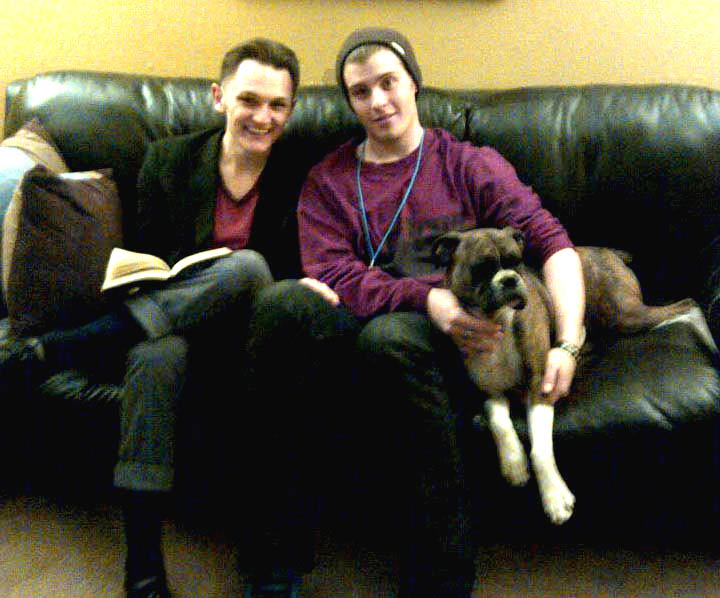
Berlin Schlegel, on the left, and Tadd Mecham are like any other couple: they enjoy reading together, hanging out and spending time with their dog.

“The biggest struggle I have had to overcome was the disapproval from my family,” Schlegel said. “My mom did not take my coming out well and it has since then created an ongoing conflict.”

Schlegel not only had to face family issues, but he also began to get cyberbullied.

“I would receive anonymous emails that said things like faggot, queer, homo, etc.,” he said. “There were not any instances that were very assertive, just a few offensive slurs here and there.”

In the lives of a gay or lesbian person there are more difficulties than just marriage. Equal rights, renting a place, buying a car and family situations all can be challenging.

Martin and Taylor have thought about these difficulties.

“Honestly marriage is the least of our worries,” Martin said. “I am more concerned about hospital rights, partnership rights, insurance, all the details that straight couples often take for granted. It scares me that one day I could end up in the hospital or Hali could and we would not be able to see one another without permission of an immediate family member.”

Others do worry more about equal marriage rights, such as Tadd Mecham, a student at the University of Utah.

“I am concerned that equal marriage rights will take longer than they should to become legally recognized nationwide it is already long overdue,” he said.

Mecham added, “If I want to get married it should not be a process of moving to another state. I should be able to get married and adopt if I want to. Also, it would be nice to be able to legally visit my partner if they were in a serious accident. Things like that should not fall under anyone else’s responsibilities.”

Martin worries about end-of-life issues. “If I die my wishes would be determined by my family who honestly has no clue what I want if such a thing were to happen,” she said.

“I would love to one day call Hali my wife, but if it cannot happen tomorrow or even five years from now that is OK, it doesn’t change how much I love her,” Martin said. “All we ask for is the ability to gain civil union rights.”

Sometimes there may not be any family members to decide what happens. Brandie Balken, the executive director of Equality Utah, recently related a story about friends of hers.

“Nikki and Ann had been together for 24 years, they had all of their paperwork put together,” she said. “Unfortunately Ann died of a heart attack. Nikki called the morgue and then went to pick up the body. She had every contract except Disposition of Remains.

“Ann’s parents were dead and she did not have any siblings, there was no one to give the body to because Nikki did not have that contract, Ann’s body goes to the state and Nikki does not have a say in what happens,” Balken added.

Despite all of the challenges the LGBT community faces, Martin stressed how ordinary their lives are.

“We are definitely normal,” Martin said. “We are best friends; we build forts like kids, have sushi dates and spend nights watching our favorite shows and doing homework together. And we could not be happier.”

You’re born naked and everything else is drag

By FRANCES MOODY

Drag queens are fabulous, but what makes them fabulous? Is it the sequined clothes, the big hair or the bright makeup? Maybe it’s the person behind the layers of foundation and eye shadow, the man behind the woman.

Püre at Club Sound on Friday night lights up with a main and weekly attraction, the drag queen show. Local celebrities, like the one and only Nova Starr, lip sync to pop music and spout choreographed dance moves.

Coming from the “House of Starr,” Nova pushed her way through the ranks of “salty gossip” (otherwise, known as the gay Salt Lake City gossip) and accomplished Salt Lake stardom. Adorned in bright makeup, a curly blond wig, and tight fitting clothes designed to hug the curves on Nova’s voluptuous figure, Nova adores busting out on stage with performances full of surprises However, her quest to change the minds of Salt Lake City citizens and to make an art form out of dressing in drag proved a tedious and frustrating task.

Nova moved to Salt Lake to chase the dream of becoming a costume designer at the Utah Opera Company. Perfecting her skills in costume design, Nova carried her talent her drag persona. A personality filled with expensive styling practices.

Now without the money to make costumes, style hair and live the performer lifestyle, Nova has decided to follow her dreams on tour. A path that was introduced after Nova was named in two books: 100 of the Most Influential Gay Entertainers and the Official Drag Handbook.

However, not wanting to disappoint her fans, Nova does her best to perform in Salt Lake City once a month. “Honey! As a drag performer, you spend hundreds of dollars on clothes and style. Yet, at Püre, I would only get paid $50 a night to perform once a week. That just doesn’t cut it.” Nova said.

Despite such societal stipulations, Nova, with her drag presence, created a niche for yearning drag queens, a niche that offered self-expression and a place to call home.

Like Nova, many other aspiring drag queens have experienced turmoil within the Salt Lake community whether it is the Salt Lake community in nightlife, gay-life or churchlife.

This home, this “House of Starr,” gave community fame to on-the-spur performers, like Paris Starr. It also inspired art admirers, like Vienna Starr.  Vienna Starr, real name, Justin Carter, is known in the real world simply as Justy. He is on hiatus from drag queen life. He gave several reasons.

Stomping into his friend’s bungalow in Salt Lake City’s Sugar House neighborhood, Justy walked through the living room and straight into the kitchen. Pulling out a bottle of Danish vodka, he was ready to pour out his heart and the alcohol.

Like many others who perform in drag, Justy was attracted to the idea of acting as someone else. “It was very easy as to introduce myself as Vienna, get to know these people and then, hang out with them as a boy later… To do drag made social life a lot easier,” said Justy, after sipping from his signature drink, “a touch of class,” a concoction made from vodka, orange juice and tonic water.

It is easy to imagine Vienna’s popularity at Püre. Standing at six feet and dressed top to bottom in stylish couture clothes, Vienna pulled in attention from all corners of the club. Living drag made Justy’s life better in many ways, he said. Coming from Utah County, a predominantly LDS and politically conservative area, Justy hid himself and his homosexuality from the world.

Not coming “out of the closet” until he was 19, Justy thrust himself into the gay world and a new mode of self-expression. This representation of self and sexuality was delayed. Especially, when glancing upon Justy’s peers.

Now 22-years-old, Justy feels that he lived and still is living through, what he calls high school the sequel. To him, high school the sequel arouses gays to experience common adolescent issues. Experiences that his school friends thrust through in their teenage years. For instance, Justy, for the first time, went on his first “real” date, faced peer pressure involving drugs and made attempts to rebel against his family and the LDS lifestyle. Justy’s acceptance of his homosexuality, prompted him to jump over life’s hurdles at an older age and for him to find a place of acceptance.

This form of discovery can be seen in many young gay adults in Salt Lake City. Hoping to belong to a place where they are fully accepted, several of them have found solace at Püre. To some, Püre is a place to call home. It was and sometimes still is the House of Starr.

The documentary, Paris is Burning, produced more than 20 years ago, displayed the meaning of a “House” and it’s importance to the gay world. Nova made the point to prove the film’s presence. “A house is a group of gay people that comes together as a family… in Utah’s community, many people need a house or a family,” she said.

People like Justy found a new home. They also found a place to showcase their spectacular talents. Nova and others from the Starr family agree that drag is much more than dressing as a woman. It’s about expressing yourself as a person capable of achieving a dreamlike existence. “To be honest, drag is an extension on what I do best,” Nova said.

Though he found a family and attention, Justy experienced negativity in the world of “dragdom.” Skipping experiences as the “true” Justy when in his former years, Justy lived his newfound personality in younger and exuberant ways. These young ways presented many problems for him in the drag culture, problems existing in almost every high school setting.

Like Nova, Justy experienced a lack of appreciation both in and out of the drag queen circle. Justy lived in just one of the many subcultures within the gay community. Such subcultures hold places in a caste system structure. “It’s just like the movie ‘Mean Girls,’ girls, but it’s mean boys,” Justy said.

Speaking in young adult terms, drag queens are the most unpopular group within the gay circles. “Drag queens are at the bottom of the food chain, being at the bottom of the chain means you can’t get dates,” Justy said while browsing through the messages stored in his phone’s inbox.

Perhaps, people classify drag queens as social scum because they play the role of an alter ego. To a lot of the gay population, drag queens are characters that hide behind a mask, or in drag queen terms, layers of makeup. in spite of the existent profiling, Nova argues that dressing drag is an expansion of John Carter, her given name.

To Nova, most everyone adopts a role to play, whether it is on or off stage. “Drag Queens say, you’re born naked and everything else is drag. For instance, every gay man dresses drag, whether it’s a gym bunny with his shirt off or a twink wearing tight jeans (both are groups found in the gay community),” Nova said. Nova attempts to advertise her definition of drag, hoping that all people will find a connection to her personal lifestyle.

To Justy and Nova, many Utahns hold no respect for what drag queens do.  Nova wants people to know that dressing drag has been around for centuries and has surfaced in several cultures around the world. When talking about drag, Nova always mentions its history.

The word “drag” was used during the Elizabethan period to describe acclaimed actors who performed the roles of women in plays. “It makes you think about the bedroom scene in Romeo and Juliet a little bit differently,” Nova quipped.

Dressing drag is still a shock to much of the world. By choosing the drag queen lifestyle, Nova and Justy lived with many forms of discrimination. With Nova on tour and selling jewelry that has received attention from famous drag queen reality TV star RuPaul and Justy pursuing other areas of interest, one question remains: What will happen to the drag queen culture in Salt Lake City?

Said Nova: “Drag in Utah will evolve, though it may take longer to catch up with more liberal areas.”