Great Salt Lake Clothing Co. entrepreneurs talk fear, failure and success

Story and photos by NATHAN ASTILL

Young, fresh and active, entrepreneurs are the embodiment of Utah’s new spirit. That same spirit is also everything that Great Salt Lake Clothing Co. stands for.

“There is a voice in everyones’ head and as soon as you come up with a new idea, as soon as you say something to yourself, it tells you that it’s stupid,” David Marquardt says. He pauses briefly, thinking about his phrasing before continuing. “Ignore that voice at all times, it is never an entrepreneur’s friend.”

Marquardt, left, stands side-by-side with Martin.

Marquardt, 28, and co-owner Michael Martin, 37, sit at their desks, working from behind their computers while they casually talk about the business they started in November 2014, Great Salt Lake Clothing Co.

For the time being they are working out of an old church, which is currently being renovated, located on the northwest corner of 400 S. and 300 East in downtown Salt Lake City.

And downtown Salt Lake is exactly where they want to be. They are bulding their company around the heart of the city.

“We wanted to model ourselves after the Cleveland Clothing Co,” Martin says. The Ohio-based company was also started by two friends and is locally owned. According to their website, their mission is simple, “Spreading Cleveland pride, one T-shirt at a time.”

Jumping back to Marquardt and Martin, it’s easy to see the parallels. “From skiing to hiking to Utah Jazz shirts, we wanted to represent everything that makes Salt Lake City awesome,” Martin says.

But to those on the outside looking in, starting and running a business is not as easy as it may seem.

“To succeed at any small business you have to wear a lot of hats,” Marquardt says.

Both men are wearing multiple hats — one is in the form of the other jobs they work. Martin comes into the office early so he can do his part-time job, writing computer software for a company on the East Coast, while Marquardt is busy running his other business, Beehive Sport and Social Club, on the side. This sport and social club offers a casual, no pressure environment for people looking to hang out with friends and/or make new ones.

Test

Some of the more popular Great Salt Lake Clothing Co. shirts, with the “mistake” Utah Jazz basketball shirt (at bottom right of photo).

A casual and fun yet alluring environment is also what Martin and Marquardt are creating with Great Salt Lake Clothing Co. But make no mistake, a casual atmosphere and hard work can, and should, go hand-in-hand.

The two men have worked extremely hard to create options. Customers may buy directly from them at their office or at their website. Now they may also find Great Salt Lake Clothing Co. retailing in stores like Sports Den, Uintah Standard and the gift shop at the Great Salt Lake State Marina.

Not only that, but Martin and Marquardt are also funding everything out of their own pockets. “The first six months [are] tough, you only have a certain amount of money,” Marquardt says. “It can be very stressful, if people don’t buy shirts, if you go a week and sell just one or two there is the thought, are we going to have to stop?”

But runaway trains don’t stop. Neither of the men have a background in clothing or design, yet they still design, and more importantly sell, all of their own shirts. Neither of the men have managed Fortune 500 companies, yet they still send out feelers to connect with other businesses while continuing to fill online orders. And lastly, neither of the men started out as social media gurus, and yet they still manage to successfully promote themselves online through their social media, such as their visually striking Instagram account.

“Instagram has been our best resource by far,” Martin says. “I have a lot of fun connecting with people through social media. But it’s hard not to get burned out trying to come up with new ideas every day.”

But persistence is important, said Ann Marie Thompson, program director of the Salt Lake Chamber Women’s Business Center. “You can do it. Continue to be studious, look for opportunities. Not only would I be looking for opportunities, I would be willing to do the work and homework.”

Test

The Sundance Film Festival LOVE shirt, which was designed to be included in the 2015 swag bag.

And their work has paid off in unique ways. They landed the contract for designing “LOVE” T-shirts for the 2015 Sundance Film Festival Swag bags, which are given to directors and producers, thanks to a Twitter follower who recommended them to the Utah Film Commission.

Not only are they putting in the work, but they also are constantly learning.

“I mean we kinda had to learn everything from scratch,” Martin says. “I had to Google a lot of stuff to learn how to do things.”

But Google isn’t the only way the two men learn. They also learn from each other. Take for example Marquardt, who pauses in between sentences, asking Martin for help with updating the web design on their site.

Like most people, both men also realize that hindsight is 20/20. “Looking back on things, in the beginning, maybe it would’ve been smart to research the whole T-shirt printing method and the cost,” Martin says.

Marquardt agrees, but says making mistakes and learning is all part of the process. “You just need to start, break it down into small steps and keep it going,” he says. “If you stop learning you start failing.”

Marquardt laughs as he thinks back over some of their recent mistakes. “Our basketball shirt was a pretty decent failure, at the time. I mean, the timing for the T-shirt was wrong. It was winter and the Jazz were doing bad,” Marquardt says pausing. “But if you’re not failing you’re not pushing the envelope far enough.”

He mulled it over for another moment. “But if it was easy, everyone would do it,” he says.

Nevertheless, the rewards have the potential to far outweigh the risks. Martin and Marquardt both enjoy the freedom that allows them to create their own products.

Church

Downtown Salt Lake is exactly where Marquardt and Martin want to be. For now they are working out of the Central Christian Church building, which is being renovated to accommodate more small businesses.

“It’s more rewarding than the average 9-to-5 job,” Martin says, “because it allows you to see the end result of what you’ve worked on.” Martin leans back in his chair, continuing, “It’s really cool to see people using something that you’ve created. I remember this time when I was riding the lift up at Snowbird. I was chatting to this kid about Great Salt Lake Clothing Co. and the shirts we made. Then this kid goes, ‘Oh like this?’ and raises his jacket up and he was wearing our ‘church is in session’ shirt. It was a really awesome moment.”

So even though they may not be selling shirts every day right now, and even though every new day may present more challenges and questions than answers, both men are assured that they are doing the right thing.

Besides, Marquardt knows exactly how to handle the hard times. “At every dead end you encounter,” he says, “you’ve either got to find another door to open or you need to bash your head through the wall.”

Guitar maker Ryan Thorell builds custom, hand-crafted instruments

Story and photos by WILLIAM PHIFER III

Behind the scenes of Ryan Thorell’s guitar making process.

test

Ryan Thorell, who recently shaved his beard, chisels away at the bracing on the back of a guitar’s sound board.

Nestled in the heart of downtown Logan, Utah, is a warehouse with a fire-engine red door on the southern side. But this is no ordinary warehouse. Inside, the scent of wood dust fills the nostrils and a man named Ryan Thorell can be seen huddled over a workbench. With thick red hair and a bright bushy beard to match, Thorell’s passion and profession is evident as he carefully chisels away unwanted shavings from a piece of cedar wood.

Thorell, 35, uses many old-fashioned methods to efficiently hand-craft innovative, fine acoustic guitars.

“A lot of what I do is custom,” Thorell said. “My designs are constantly changing. I try to really reinvent the guitar and push it with each design.”

As a guitar maker, Thorell said, “I think you’re constantly prototyping instruments with everything you build, and trying to improve upon it. You’re constantly trying to build a better [sound] box and trying to make it perform and look as good as you can.”

Unlike other instruments, such as the violin, Thorell said the guitar is continually being redesigned and improved. This creates a desire among musicians for custom and personalized guitars with different sound profiles.

One of those musicians is Frank Vignola, 49. A world-renowned guitarist, Vignola teaches various workshops online and at music universities such as the Juilliard School. As a prominent jazz musician who owns three guitars made by Thorell, Vignola really likes the durability and tone of each one.

“I travel and play about 150 shows a year all over the world,” Vignola wrote in an email interview. “I am always amazed that the guitar barely goes out of tune.” He added, “Always knowing I can rely on the guitar to sound great and travel well is a must for any professional touring musician.”

Vignola, who performed in Salt Lake City on Jan. 3, 2015, wrote in the email, “There are many great builders out there. What stands out about Ryan’s guitars are their uniqueness in look, design and sound.” Thorell’s guitars were on display at the Capitol Theatre.

Thorell prides himself on creating guitars that are pleasing to his customers. He said one of the things he enjoys the most is “working with clients and getting excited about a concept, and turning that into a super high-quality, fine machine for making music.”

However, the process of designing, crafting and finishing guitars is time-intensive. Thorell currently has a year-long waiting list for prospective clients.

Perhaps one of the reasons Thorell enjoys making guitars and working with musicians is because he has also played the guitar for many years.

“I think it has been very informative to me to have a good playing background so that I can fine tune what’s important to me in a guitar,” Thorell said.

Growing up in Utah, Thorell always had a passion for music and guitars. He said listening to the band, Metallica, influenced him to learn how to play the guitar. He started lessons at the age of 14 and was introduced to a guitar maker by the name of Tim Gonzalez.

Gonzalez, who died in 2009, was a board member of the Intermountain Acoustic Music Association and owner of a shop in Salt Lake City called Gonzo Guitars.

test

The first guitar Thorell made with the help of Tim Gonzalez.

Intrigued by Gonzalez’s work, Thorell decided to try his hand at making his very first guitar. With the help and guidance of Gonzalez, Thorell learned how to build and repair guitars and completed his own guitar when he was 16.

Thorell became involved with playing the guitar in high school and after graduation, he chose to enroll in music and guitar performance at the University of Utah. Family issues later caused him to move to Logan, where his grandfather had a wood-working shop.

“I got messing around with stuff in his shop and decided to go back into guitar making,” Thorell said.

Thorell completed apprenticeships with many people who influenced his guitar making. One of those people was Chris Gochnour, an experienced furniture maker in Salt Lake City who uses traditional hand-crafting tools. Gochnour taught Thorell, who was 23 at the time, a great deal about woodworking and how to work efficiently when creating different designs.

“He was building the largest range of styles of furniture,” Thorell said. “He would just gear up for each piece and it would be drastically different than the piece before it. It was such an experience in how little you need to be efficient … on the fly like that.”

With a firm grasp of woodworking, Thorell decided he wanted to focus on building archtop guitars. Similar in style to violins, archtop guitars have a convexly curved back and the f-holes on the soundboard, or front of the guitar, often look very similar to that of a violin.

Thorell, then 25, went to study with Tom Ribbecke.

Based out of Healdsburg, Calif., Ribbecke, 62, is an expert guitar maker who teaches and specializes in building archtop guitars.

“Tom is the guitar world’s version of James Krenov, the redwood-style furniture maker,” Thorell said in a phone interview. “He has approached archtop building from a perspective that is very much in line with that school of woodworking.”

During his time in California, Thorell studied the fluid arm motions Ribbecke used to carve his guitars. “He is able to get these finely graduated curves on his archtops that are very unique in the instrument design world,” Thorell said.

Thorell is proud to call Ribbecke his mentor, while Ribbecke admires Thorell and considers him one of his best students. “He’s gifted, he’s brilliant and he’s fun,” Ribbecke said in a phone interview. “I’m very lucky to have met an individual like him. … To have been able to have a positive influence on him, it’s a great gift and it’s a great blessing for me.”

Over the years, the two have continued to seek each other’s opinions and share insights on their work. Having taught an estimated 150 guitar makers, Ribbecke said, “Ryan is a pretty unique and insightful guy [and] I would say [he] is the best of those makers and the most gifted.” But, he added, “I haven’t told him this, lest it would cause his large red head to get any larger.”

Every day Ryan Thorell continues to develop his craft, art and business. “In the guitar market you have so much leeway to be creative,” he said. “Instrument-wise there is almost nothing that can look as weird and different as a guitar can from the next guitar. There is nothing else like it.”

Jorge Fierro accomplishes the American Dream with restaurant, Rico brand

Story and photos by CALLI PETERSON

“The fact that as an outsider coming to this country not speaking any English and not knowing anybody,” said Jorge Fierro, owner of Rico brand and Frida Bistro, “I have been able, with a lot of hard work and a lot of help from my employees and friends, to accomplish the American Dream.”

jorge

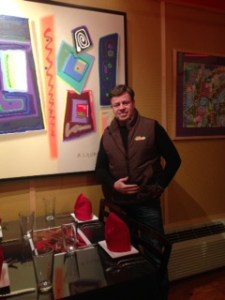
Fierro stands next to one of the paintings in Frida Bistro.

Fierro proved that dreams can truly become reality with deep passion and a lot of hard work. After growing up in Mexico, Fierro decided to leave his home and head to the U.S. hoping to learn English and make a name for himself.

“When I came to Utah in 1985, I didn’t know anybody,” Fierro said.

He said he did not have a place to live, so he ended up staying at a shelter for about a month.

Though his choice of living proved limited, he did not let that stop him from pushing to learn English and searching for a place to work.

“I went to a Catholic church, and they needed a volunteer to wash dishes,” Fierro said. “So, I said ‘Me! Me! I’m a dishwasher!'”

Fierro’s time at the men’s shelter gave him opportunities to see life in a new light. As he became more and more successful, Fierro searched for ways to give back to those around him.

“I was never hungry, so I promised to pay it forward,” he said, raising his sleeve and showing the words, “Pay It Forward,” tattooed on his arm.

And “Pay It Foward,” Fierro does.

In the early 1980s, he gained the friendship of a local couple, Larry and Gail Gerlach. Gail, who was teaching at Shriners Hospitals for Children, hoped to bring some authentic Mexican food to children from Mexico who were undergoing surgeries.

She called Fierro, knowing he would help her accomplish this dream.

“He came up one day and brought food for these kids, and they just exploded with joy,” Larry said in a phone interview. “Gail wrote him a check, and he said, ‘No. No, no, no. Señora, it’s on me, for my people.'”

By this action, Fierro supplied the children with something to look forward to and gained a permanent part in the hearts of the Gerlachs.

“He’s a special friend,” Larry said. “What he did for my wife at that hospital, I think, as much as anything, speaks of his character.”

Fierro actively works with the community by holding fundraisers for nonprofit organizations and initiating the Burrito Project.

The Burrito Project helps to feed the homeless with burritos and bottles of water in Salt Lake City. A large percentage of the homeless, Fierro found, are veterans. This discovery became a significant reason why he works so hard to feed them.

Fierro assembles a group of volunteers who come together to make bean and rice burritos. After the burritos are made, the volunteers hop on bicycles and ride around the city giving burritos to those in need.

This humanitarian effort attracted many volunteers, including University of Utah football players.

“Being able to feed the homeless is one thing, but actually seeing the ins and outs and seeing how these people in the shelter live, it’s very eye-opening,” said Matt Martinez, a former U football player and Burrito Project volunteer. “It’s very humbling to have them say ‘thank you.'”

In a phone interview, Martinez said he has become friends with Fierro and hopes to bring more publicity to this project.

Fierro’s philanthropy has been possible, in part, because one day he had an epiphany about the poor quality of Mexican food in America.

“One day I went to a supermarket, and I bought some flour tortillas and kinds of refined beans and some cheese,” Fierro said. “When I opened them, I was really disgusted with the beans. I thought, ‘What is this?’”

Fierro never dreamed of running his own food business, but after recognizing the lack of quality ingredients in Utah, he realized he needed to do something.

“I was thinking ‘What can I do?'” Fierro said.

He grew up with his mother running a small business. Fierro’s mother would make cooked beans, package them and sell them to markets in Mexico. Having watched her, Fierro had the thought that maybe he could do that too.

Not thinking once more about it, Fierro asked his mother for her cooked bean and creamy salsa recipes and started selling beans downtown at the farmer’s market.

Frida

Frida Bistro is designed with many bright colors and dim lighting. Even the waiting area is decorated to match the design.

Sales started to increase little by little and soon Fierro was approached by someone who represented a small line of farmer’s markets. They asked him if he would be interested in putting a label on his products and selling them.

Fierro jumped at this opportunity and thus was born the Rico brand.

Sales took off, so Fierro started searching for a larger place to prepare and distribute his products. As he was searching, he came across a large warehouse located on 545 W. 700 South.

He turned the warehouse into a place where he and his employees could make the food for the Rico brand.

Then, another opportunity presented itself.

“The front of [the warehouse] used to be my employees’ break room and my office,” Fierro said. “People would drive by and see my employees eating. They would come in and open the door and go ‘Oh, I’m so sorry. I thought it was a restaurant.’ So, OK, let’s start a restaurant.”

And so, Fierro converted the warehouse into a restaurant.

He chose the name Frida Bistro to honor the celebrated artist, Frida Kahlo. “Like Frida Kahlo’s passion for art, Frida Bistro represents Jorge’s passion for food,” according to ricobrand.com.

Bistro

Pictured is one of Fierro’s favorite spots in his restaurant.

Frida Kahlo became the overall theme of the restaurant as paintings of her embellish the walls. Bright colors and dim lighting also contribute to the decorative design of the restaurant which Fierro designed himself.

To add to the authentic feel of the restaurant, Fierro changes the menu every four months or so.

“I took the time to go to Mexico and learn about our gastronomy,” Fierro said. “We created our menu around that.”

In 2011, Frida Bistro was recognized as the best Mexican restaurant in Salt Lake City, according to the Salt Lake Magazine Dining Awards 2011.

Now, Fierro is the proud owner of Rico brand and Frida Bistro and also serves on the board of directors for Local First Utah. He actively works with the community by holding fundraisers for nonprofit organizations and initiating the Burrito Project, which helps to feed the homeless.

He adamantly believes in searching for a passion and is glad he found his calling.

“The most important thing: I love what I do for a living,” Fierro said. “I love what I do for a living.”

Roy pharmacy prescribes customer care

Lloyd Thomas stands at his pharmacy in Roy Winegars.

Lloyd Thomas stands at his pharmacy in the Roy Winegars.

Story and photos by BRITTNI STRICKLAND

Lloyd Thomas, a University of Utah alumnus who owns the pharmacy inside Roy Winegars, recently reminisced about his 46 years as a pharmacist during a phone interview with Voices of Utah.

Thomas first realized he wanted to be in the pharmacy industry at a career day as a sophomore in high school. Thomas grew up in South Ogden, Utah, and recalled going into the local pharmacy thinking it had “really neat smells.” Thomas also watched his uncle own a pharmacy and said he knew it was an opportunity for him to help people. So, he had to take it.

“There aren’t a lot of people who know what they want to do so young, I was lucky,” Thomas said, chuckling.

He opened the Winegars pharmacy in 1995 at 3444 W. 4800 South, in Roy. Winegars is one of the oldest family-owned supermarkets in the state of Utah and values the name of a “Home Town Grocer,” according to the website. Winegars is a convenient grocery store near the center of the city.

Thomas is specifically known in the Roy community for his unique customer care.

Sheri Tanner said her mother has been coming to the Roy Winegars pharmacy for 20 years, since it opened. Tanner still comes to the same pharmacy to pick up her mother’s prescriptions simply because of the quality care. “When I come get her medicine they always say ‘how’s your mom doing?’ and it’s very personal,” Tanner said.

Julie Arthur, a resident of Roy, has shopped at the local pharmacy for 15 years because of the personal service. “Every time I go in I feel like they genuinely care about your health, they’re not just doing their job,” Arthur said. She said she trusts the Roy pharmacy because she feels that the pharmacy staff is very knowledgeable and willing to answer her questions regarding prescriptions.

Thomas said he believes treating customers well is key. “People don’t care how much you know, it’s how much you care,” he said.

Being the owner of his own pharmacy, Thomas said he’s in control of the prices, where products are bought and whom he hires and fires. His pharmacy is independent, so he can focus more on customer care rather than being told to focus on money. He also said it’s more fun that way: “When you’re not intent on making money, it just comes.” Thomas said he prefers to shop where people love what they do, so he makes sure that that is clear in his pharmacy.

Customers head to the west side of the store, where the pharmacy is located. Even from a distance it is easy to sense the passion and camaraderie. Taped to the counter of the pharmacy are quotes, comics and obituaries of loyal customers. Behind the gray counter, two or three employees stand with smiles on their faces and a hello to give.

Nick Lucas has worked as an employee for Thomas for 20 years. Lucas quickly brought up Thomas’ heart for the customers. “He looks at it as extended family for some of these people,” Lucas said. “It’s a tough standard to live up to, he’s a great man.” Lucas learned the art of caring for customers simply by spending time around Thomas and watching him work with people. “He’s a great boss, but a better person,” Lucas said.

Roy Winegars is the home of Lloyd Thomas' pharmacy

Roy Winegars is the home of Lloyd Thomas’ pharmacy.

Location and loyal customers are what keeps the pharmacy up and running to this day. “It’s the only reason we have a job is because of them,” Thomas said. Having the pharmacy inside Winegars has been an ideal location because it is one of the more popular grocery stores in town where people can shop and pick up their prescription in a timely manner.

Thomas joked about how interesting it is that it is now a popular occurrence to have a pharmacy in a grocery store, compared to when he first began as a pharmacist. There wasn’t a single grocery store in the area that had a pharmacy. He said pharmacies are now more popular because people are living a lot longer and there is a lot of new medicine available.

Now that people are living longer, Thomas said convenience has become an issue in our society. “Everyone’s time is valuable,” Thomas said.

Customers such as Julie Arthur appreciate that consideration. “At other pharmacies I’ve noticed a longer wait time, and when you’re sick you don’t want to just stand around,” she said. The Roy Winegars pharmacy promises to have prescriptions out as quickly as possible, usually with a wait time no longer than five minutes.

Timely service is one thing Thomas has learned during his two decades as a pharmacist. With his years of experience also come numerous memories. “There are so many great memories, that I couldn’t come up with one,” he said. However, Thomas remembered winning the “Bowl of Hygeia” award in 2013. According to the website, the prestigious honor “recognized pharmacists who possess outstanding records of civic leadership in their community.” He said it truly was an honor to win that award.

Thomas made clear that the customers are why he stays in the pharmacy industry by saying, “I love people, I love to help people.”

How dreams fuel small businesses’ futures

Story and photos by ALEX HARRINGTON

How does something as gut-wrenchingly difficult as starting a new business ever get off the drawing board?

Simple.

The people who make it happen have a dream.

Oftentimes everything is riding on this dream, which can be as different between business owners as the stars are from the sun. But the common thread is the hope that they can succeed in the unforgiving world of business.

If there’s one person who knows that success in the business world can come from just a dream and a liberal amount of elbow grease, it’s Ann Marie Thompson, the program director for the Women’s Business Center.

It’s Thompson’s job in the WBC to turn prospective entrepreneurs’ lofty, seemingly unreachable dreams into reality. The Women’s Business Center builds dreams in every way it can, from its “Jumpstart” business essentials training to the expert advice it gives on the direction a budding business should take. Thompson described her organization’s mission of making hopeful small business owners “start small and think big.”

However, even with the help that the Women’s Business Center provides, dreams can seem unreachable when so much is at stake. Though Thompson said she frequently advises her clients against quitting their jobs or taking out a big loan, the enormous dreams that her clients hold often demand a lot from their dreamers.

She pointed to “Utah’s cultural aversion to risk” as one of the many reasons that many women and men never pursue their dreams. Thompson said a dream or idea for a small business has to have the potential to make money and to fill a need.

However, not every dream has these qualities. She has witnessed a score of disappointments amid the successes, and seen dreams that weren’t able to come to fruition.

Game Changerz provides incredible customer service and products to all who check them out.

But why does this have to be? Dreams like starting a small business often need more than wishing stars and fairy dust to succeed. While almost anything can be turned into an opportunity to make a quick buck, this need that Thompson describes is much trickier for some small businesses to meet.

Though starting a business from these tiny dreams can be a terrifying and difficult prospect, it is not impossible. For

For Michael Morrissey, branch manager for a video game retail store called Game Changerz, his small business does its best to fill a need that sets it apart from other larger retail stores.

During a phone interview, Morrissey said, “[Our store] is free to do whatever we want for our customers.” He recalled many instances where his store worked with customers, adjusting prices and even throwing in free games, in order to make their experience more positive.

Fulfilling these needs can create something new in the business world. “We offer the best customer service in town,” Morrissey said. From anyone else it might sound like an empty boast, but his willingness to work with customers on a personal level gives it much more weight.

The branch manager of Game Changerz, Michael Morrissey, poses by some of his incredible videogame items.

The branch manager of Game Changerz, Michael Morrissey, poses by some of his incredible video game items.

For people like Morrissey, the dreams they have are about making a new and wonderful experience that the customer has never seen before. He is filling a need that many people didn’t even know they had.

But what does fulfilling this need mean for small businesses? Kristen Lavelett, executive director of Local First Utah, said “[Small businesses] keep the American Dream alive.”

The meaning of the American Dream that Lavelett talked about has been debated for hundreds of years throughout U.S. history. But this dream is almost always thought of as the ability of a single person to find a way to start with nothing and to rise to be as great a business figure as they can be.

But for many small businesses, this big, majestic concept is simply a way of life that they strive to achieve every day. Morrissey described other larger retail stores, like GameStop, as being “very corporate.” In a world cluttered with mega stores that often limit their interests to the contents of their customers’ wallets, small businesses like Game Changerz create a bit of personality and individuality that sets them apart.

Morrissey described in a subsequent interview what he believed makes his small business important to his customers. Game Changerz carries many games that bigger retail stores don’t have, like games for older systems like the Super Nintendo or Sega Genesis. Morrissey said “people want to relive their childhood.”

Our world would be diminished without the individuality that the dreamers provide. The dreams are a big part of what makes small businesses so special.

Body Buddies, a Salt Lake City fitness company, changes lives

Story and photos by DAVID FISHER

Working at a desk in an investment firm office was the last thing Kristy Jo Hunt wanted to do for the rest of her life. She decided to take one of the biggest risks she has ever been faced with. Hunt, 28, created her own independently-run nutrition and fitness business known as Body Buddies, without any prior experience in the field of business.

In addition, Hunt was not always a fitness guru.

Three years ago, Hunt was overweight and a victim of binge eating. She also suffers from severe scoliosis. Orthopedic doctors had told her that by age 40 she could be in a wheel chair if she did not change her eating habits and stay active because of her deformed back.

Kristy Jo Hunt poses in the gym after working with a client.

Kristy Jo Hunt poses in the gym after working with a client.

However, she conquered her struggles, gained a newfound interest in the field of health and wellness and worked toward her goals of becoming a professional dancer and fitness instructor.

This new interest eventually motivated Hunt to become a certified personal trainer and fitness nutrition specialist through the National Academy of Sports Medicine. She made drastic changes to her lifestyle, and wanted to help others make lifestyle changes as well. Thus, Body Buddies was launched in January 2014.

Hunt put together a business plan through watching multiple business startup podcasts, attending start-up business conferences and seeking advice from friends and family. She had to make some personal sacrifices along the way, including quitting her full-time job and learning to live off of $20,000 a year.

Those sacrifices underscored her commitment to seeing the success of her clients and independent business.

“Body Buddies is first a people thing, then secondly a business,” Hunt says.

Education is an important aspect of her business model.

Hunt provides weekly coaching calls and meal plans for clients in Utah. The coaching includes a fat loss and muscle gaining workout regime that clients follow on a six-days-a-week basis for 12 weeks. Each workout plan is individualized based on a survey clients fill out at the beginning of this lifestyle change. Questions include food preferences, any kind of physical ailments and a daily schedule.

Clients who pay a base fee of $50 also have access to 250 power food recipes that are full of protein, replace unwanted fats and increase energy levels. Every recipe is taken from her own published cookbook, The Power Foods Lifestyle.

An example of a power foods recipe is Hunt’s chicken ranch slaw burritos. These are a healthy alternative to any kind of processed burrito that is often found in the grocery store. Many of her recipes are healthy replacements to microwaveable freezer meals.

Chicken ranch slaw burritos are one of the many available recipes Hunt provides in her cookbook

Chicken ranch slaw burritos are one of the many available recipes Hunt provides in her cookbook.

“You are the master of yourself,” Hunt explains. “I provide the base, and you create the results.”

Body Buddies originally started with only 50 clients. It now has more than 1,000 clients. Hunt manages multiple client binders, calendars and daily scheduled emails and lists. She even has clients from around the globe in places such as Africa and Europe.

Hunt provides daily coaching calls to her clients. This is where they truly open up about themselves and achieve the results they want to see. She speaks to the individual over the phone and finds out what is and isn’t keeping them motivated. If clients have any questions about their diet, workouts, or life in general. Hunt is available to provide answers.

Some of the best results Hunt has ever seen came from her client, Amy Bellamy, in Salt Lake City. Bellamy has been a client of Hunt’s for almost a year, and has stuck with the Power foods lifestyle the entire time. Hunt explains that Bellamy was constantly motivated to achieve her goals of having a bikini body.

Amy's amazing body transformation from following Hunt's coaching

Amy Bellamy was able to transform her body by following Hunt’s coaching. Photo courtesy of BodBuds Instagram.

Hunt filmed and produced 100 instructional workout videos for her Body Buddies YouTube channel. It was through this channel that many of her clients discovered her business. These videos create an easy and accessible way for clients to understand how to successfully utilize all of their muscles while working out in the gym. For example, clients learn how to successfully perform a seated row weight lift to activate muscles both in their back and in their arms.

Through Facebook, Instagram and Pinterest, Hunt has created a successful way to market to a wide audience of clients.  Hunt has more than 7,000 followers on social media.

Instagram is her main method of gaining followers. She posts workout videos, before-and-after result photos of her clients and motivational quotes every day. It is a quick way to instantly communicate to her followers. However, these posts are only previews of what can come from the full Body Buddies experience.

"The Power Foods Lifestyle" is available for purchase on Hunt's website.

“The Power Foods Lifestyle” is available for purchase on Hunt’s website. Image courtesy of Hunt.

By using hashtags such as #FitFan, #CleanEats and #WeightLossJourney, Hunt has gained public attention of her Instagram posts. These are hashtags that people wanting to start their own fitness journey investigate. Clients see her social media posts and then reach out to her to receive her coaching to start their own fitness journeys. She wants to be the person to help change clients’ lifestyles and make them love their bodies.

Instagram user Tyler Griffin, 23, a student at the University of Utah who uses the handle TGriff08, is a client and one of Hunt’s many followers. “Although I finished my 12-week program with Kristy back in September of 2014 as part of a reshaping of my body during the summer, I still follow her to seek constant new ways to work out, discover new recipes and see the success of many other of her clients who went through the same process that I did,” he says.
Griffin had lost more than 15 pounds during the 12-week process and gained a tremendous amount of muscle to his body. When grocery shopping, he is more aware of the foods that are beneficial to his lifestyle so he can maintain that muscle build that he worked for. 
“There were times when I felt like I wasn’t going to stick to this intense 12- week program,” Griffin says. “But Kristy provided a constant motivational push to keep working for my final goal — and I reached that goal, and I felt like a completely new person when I started my final fall semester.”
Griffin has referred multiple family members and friends to Body Buddies so they could achieve the same lifestyle changes that he accomplished with Hunt’s help.
One such friend was Brooke Legeman, 19, of Salt Lake City who started working with Hunt two weeks ago in hopes of removing the freshman 15 that she gained this past year.
“Being a part of the Body Buddies program is something that I want to commit myself towards to start a completely new health lifestyle,” Legeman said in a phone interview. “Kristy is helping me balance school, work and my fitness goals so that I can achieve the success that I want to achieve. I feel like I am in control of my body and making it back into the shape that I once had … or maybe in even better shape.”
Legeman finds herself going to the gym almost every day now, and avoiding all of the fast food that she was guilty of eating during her freshman year.

Hunt has started her own motivational seminars that she calls “Girls Night Out.” These empowering presentations are held at Salt Lake City gyms. Hunt wants to change the way clients think about themselves, and have their bodies reflect the changes that they can see.

“I’m not a feminist, I’m an empowerist,” Hunt says. “Integrity is the name of the game for people in life. Know where your integrity is at, and never let it crumble.”

Ski ‘N See not bothered by lack of snow

Story and photo by BRANDON RISLEY

People normally think of hot summers and national parks in southern Utah and cold winters with lots of skiing in the northern part of the state. But that has not been the case during the winter of 2014-2015.

The famous Utah slopes have been bare for the most part due to the outrageously high temperatures the state has experienced this winter. In February alone, according to accuweather.com, Utah has exceeded 60 degrees on numerous occasions and has been nearly 16 degrees warmer than the average February weather. February in Salt Lake City normally averages around 43 degrees with about 1.37 inches of precipitation. With March’s first weekend coming to an end, Utah has gotten record high temperatures as well as an astonishing accumulation of 0.17 inches of precipitation.

Utah's lack of snow showing on its mountains.

Utah’s lack of snow showing on its mountains.

One of the main parts of Utah that might have struggled due to this weather was the ski shops. The state has a wide variety that are known for getting very good business.

In an interview with Mark Johnson, the manager of the Ski ‘N See shop in downtown Salt Lake City, he talked about how the weather hasn’t been affecting his shop much because there will always be sales.

“You know it hasn’t been as bad as you’d think,” Johnson said. “Yes we’ve had fewer sales with out-of-towners but at the same time people still want to ski and it’s not like it won’t get cold at the mountain. I think our Park City shops have struggled a little more but we’re definitely making due.”

He said the Park City shops haven’t done as well because Park City is a huge tourist city. And, he said, out-of-town people aren’t traveling there as much this winter because of the lack of snow.

“Most of the people that live in Park City already have equipment because they ski more frequently than people that may live in other parts of the state,” Johnson said. “Without the tourists flocking to ski [in Park City] our sales drop around 10 to 15 percent.”

With multiple locations across the state set up near most of the major resorts, Ski ‘N See is one of the premiere shops for purchasing ski and snow board equipment. From inexpensive beginner gear to pricier items for more experienced riders, Ski ‘N See has it all.

Derek Evans, a Salt Lake City resident and loyal customer of the downtown Salt Lake City store, said his experience with Ski ‘N See over the years has been great.

“The numerous times I’ve been there have been awesome and I would definitely recommend it for anyone,” Evans said. “One of the things I love about this place is the fact that you can rent equipment for cheaper than the actual mountains will charge you. My first experience I rented because I didn’t quite know what I wanted to buy yet and the staff were very helpful and showed me exactly what I needed.”

In 2003 Ski ‘N See struck up a partnership with ARCS Ski and Board. ARCS Ski and Board is now owned by Ski ‘N See and they have expanded from one store in Park City to four others in Deer Valley, Cottonwood Heights and Sandy.

In a 2012 press release, Ski ‘N See owner Roy Ostendorf said that expanding his business was more about optimizing website searches than anything. “Ski ‘N See was created in 1987, well before the internet or the need for your company name to be so descriptive of what is offered inside your doors,” said Ostendorf in the release. “Ski ‘N See is near the bottom of the alphabet, but we don’t want to abandon the name completely. The new shops gave us the chance to grow while taking the internet into account.”

Johnson, manager of the Salt Lake City location, said that another bonus of the partnership was to expand Ski ‘N See’s reach in Utah as well as give people more leeway in returning their equipment.

“One of the great things about the partnership is that people could rent their equipment in one place and then return it to any of the Ski ‘N See or ARCS locations,” Johnson said. “This has made our customers very happy.”

With 12 Ski ‘N See and ARCS locations, both Ostendorf and Johnson haven’t feared the lack of snow very much. “We’re not really worried about it to be honest,” Ostendorf said. “We survived the critical months of December through February and it really didn’t drop off that much. We have been able to open [12] stores because people have been coming to us for nearly 30 years. People still want to ski in this beautiful state and they will still flock to buy and rent gear when necessary.”

Johnson reiterated those exact thoughts saying, “We made it through the winter with minimal casualties. The diehards still came in to get their gear fixed up and the people new to skiing still needed equipment. We’re going to be fine.”

With reasonable prices and highly rated gear, Ski ‘N See hasn’t been affected much by the snow drought in Utah. The tourists haven’t been coming in at usual rates, but the diehard skiers and snow boarders of Utah have not let them down.

The Women’s Business Center: A support in the entrepreneurial journey

Story and photos by LIZ G. ROJAS

One of Utah’s best-kept secrets for aspiring entrepreneurs is the Women’s Business Center, located in downtown Salt Lake City within the Chamber offices.

The WBC is a nonprofit organization that is partially funded by the federal government through the Salt Lake City Chamber. Because the center is a 501(c)(3), it is expected to match the funding it receives through fundraising or sponsors.

The Women’s Business Center’s goal and purpose is to help increase the number of women-owned businesses in the state of Utah through consulting, training and networking opportunities.

The center has been operational for 17 years and has a consultant who provides a variety of different services. Services are free to the public and range from helping with business plans and cash flow projections to government consulting.

Former day-care owner Lorena Sierra missed the opportunity to work with the Women’s Business Center.

Lorena Sierra

Lorena Sierra

“I know a lot of times I needed help with grants and I wasn’t able to apply because I had no idea how,” Sierra said. “I wish I would have known of an organization like that [WBC].”

Sierra owned a day-care center in Utah County alongside her business partner for 17 years. In 2012, after her partner sold her half, Sierra ran out of funding options and chose to sell her business.

According to American Express, her center was 1 of 73,000 businesses in Utah that are women-owned, compared to the 9.1 million nationally that are owned by women.

The Small Business Administration defines a woman-owned business as one that is owned at least 51 percent by a woman. In addition, the woman can make independent decisions regarding the business without being undermined by anyone and is responsible for planning the short- and long-term activities.

Ann Marie Thompson- Program Director for the Women's Business Center

Ann Marie Thompson

Ann Marie Thompson, program director for the Women’s Business Center, says there is demand for a woman-oriented organization because there are different stresses for women than there are for men.

Most women are trying to start a business from home or as an addition to full-time responsibilities. They’re driven by flexibility because their first obligation is to their family. The majority of clients who meet with the WBC have these similar backgrounds and priorities.

Evette Alldredge, a local business owner, was guided by the Women’s Business Center and benefited from its services.

In a phone interview, Alldredge said that she arrived at the center with a partial business plan and high hopes. She met once a week for approximately five months with the center to create a business plan and explore all aspects of the planning.

Alldredge was able to present in front of Utah’s Microenterprise Loan Fund and received funding from the nonprofit for her business.

In April 2014, Evette Alldredge’s business, Super Gym Gymnastics, opened its doors.

However, even though the business center does direct its organization toward women, its services are for everyone. Thompson said that 20 percent of the WBC’s clientele are, in fact, men. She said, “We consult with anyone who wants to come.”

The Women’s Business Center has a broad range of connections and partnerships. Some of the partners are the National Association of Women Business Owners, the Utah Microenterprise Loan Fund and the Utah Governor’s Office of Economic Development.

The center also works with the Salt Lake City World Trade Center and Salt Lake Magazine. The WBC refers clients to the World Trade Center if they need help learning how to import and export.

Salt Lake Magazine features the Women in Business section in the September/October issue. The WBC is highlighted in that issue.

Although the center is associated with the Salt Lake City Chamber it is not confined to the Wasatch Front. Thompson said Google Hangout and Skype are frequently used to communicate with clients throughout the state.

According to the Small Business Administration, twice as many women-owned businesses are opened every day, compared to three years ago. However, there are still barriers that haven’t been overcome by women business owners.

One of the barriers is the compensation gap. Even if a woman is the owner of a business, her salary is lower compared to others in her same position.

“Women choose to pay themselves less, not knowing what others are paying themselves,” Thompson said. “Women are also choosing jobs that pay less. ”

American Express reported in 2014 that the goal shouldn’t be to motivate more women to open businesses, but instead to financially support those who are already established and help them expand.

Regardless, the need for the Women’s Business Center in Utah is crucial. As Lorena Sierra said, “We do need a lot of support. We have the desire to have our own businesses but we don’t have a guide.”

The WBC is one of Utah’s best-kept secret support systems for aspiring business owners.

“If it weren’t for the Women’s Business Center I would not be where I am today,” said Evette Alldredge, owner of Super Gym Gymnastics, who continues to work with the center for a business expansion loan. “I am the most happy, successful entrepreneur.”

Local singer-songwriter Emily Bea uncovers hidden talent after soccer injury

Story and photos by McCALL GRAY

Music can be defined as an art of sound that turns ideas and emotions into words. The elements of melody, cadence, harmony and voice are strung together with a conscious effort to create it. Music can inspire both the artist and the listener to something beyond the lyrics.

Local singer-songwriter Emily Bea, from Sandy, has demonstrated exactly this — and she’s only 20.

Bea comes from a musical family. Her parents and three siblings all played instruments and shared a love for playing soccer. Bea has been devoted to the sport since she was 3. Simultaneously she began to enjoy music, too. She began piano lessons, then taught herself the violin, ukulele and mandolin. By 8th grade, she had moved on to teach herself the guitar and experiment with song writing.

Bea cherishes her Martin guitar because she earned enough money from her performances to help pay for it.

“The first song I remember her writing and singing to me was about her twin sister who passed away when she was a baby,” said Brian, Bea’s father.

When she wrote it, Bea said she was experiencing a sorrowful moment of loss, missing her sister. She was looking for a way to gain comfort and peace and found that avenue through her guitar.

“I started singing words and they just kind of came out,” Bea said.

The song was called, “Wow, I Really Love You.”

“It completely floored me. … From that experience, I knew she had potential to do something great with her music,” Brian said.

Bea began to discover her way with music and her indie pop style of songwriting. But, it always came second to playing soccer. That is until on two separate occasions she sustained a serious injury. Her ACL tore twice, preventing her from playing on her Brighton High School soccer team. Bea pushed through therapy and worked hard to get back on the field. Meanwhile, the recovery period allowed her more time to focus on her music.

“Soccer was the thing I ultimately wanted to do, but when it [the ACL tear] happened again it made me question if soccer was what I was really supposed to be doing,” Bea said. To her surprise, it wasn’t. After she fully recovered the second time around, she met with a vocal coach.

“[The coach] heard her sing and told her, ‘I don’t care how good of a soccer player you are. God gave you a gift, and you need to sing,’” Brian said. “With that, she gave up soccer and focused on music.”

Bea’s music career progressed from there. She promoted her music independently, gaining a steady viewership on her YouTube channel, Facebook page, Twitter and Instagram accounts.

“I think her music is truly original, and that nobody can fully replicate her sound nor style. I appreciate other musicians who take ownership of their art like she does,” said Scott Hebertson, a fellow music artist and friend of the family.

Music turned out to be a natural talent even though Bea hand’t intended to strongly pursue it in the beginning. “Music was always my fallback,” she said. “It was really hard at first, but it’s really been a blessing. … I really enjoy it.”

Bea played her song "Bench For Two." It was the song that sparked her theme for her second album.

Bea played her song “Bench For Two.” That song sparked her theme for her second album.

When it came to performing in public, she started out at open mics and restaurants such as Winger’s in West Valley and Pat’s Barbecue in Salt Lake City. She did her first show in 2012, opening for the musical group, “A Great Big World” and Greg Holden, who wrote the song “Home,” made famous by “American Idol” winner Phillip Phillips.

“It is inspiring to see someone start from nowhere, begin to chase their dream, and then start seeing results,” Hebertson said.

Bea’s creation process for writing a new song stems from many sources. “Inspiration comes from everywhere,” Bea said. She discovers ideas for new songs by what people say as they pass her by, what she reads, sees in movies and from personal experiences.

Bea self-produced a quality list of original content where she sang and played an instrument in each song. In 2012 her first EP album, “Love A Fair,” launched. With its success came another and in 2014 she released her first full-length album, “Bench For Two.”

“When I got my first album I cried, a lot, just because it was really exciting,” Bea said. “It was tangible and had my name and picture on it.”

Bea’s producer, Trevor Price, assisted her in recording “Love A Fair” in his basement studio. Two years later, “Bench for Two” was recorded at Price’s new Salt Lake City location, Stone Angel Music Studios.

Once the recording process was complete, she manufactured her CDs through an independent CD and DVD manufacturer called Disc Makers. This allowed her the opportunity to sell them worldwide on CDBaby.com and have them available on Spotify, Amazon and iTunes. Bea also received 1,000 hard copies to sell on her own, which she does through email, emilybeamusic@gmail.com.

“I initially helped out financially to get her on her feet. But she has been able, through album sales and shows, to pay me back and make some money,” Brian said. “She books her own shows and spends a lot of time marketing her music. It is fun to see her learn and grow, both in music and business.”

Bea finds her favorite place to compose new songs is outside.

Bea finds being outside is her favorite place to compose new songs.

Since her latest album release in 2014, Bea aims to perform two to three shows per month. She has performed at the Utah State Fair, Kilby Court in Salt Lake City and many times at Velour Live Music Gallery in Provo.

She announced the news via social media that her newest single, “Angel Fly,” had been chosen for the “Songs For Life 2015” album. “Angel Fly” was written in memory of her high school classmate, Tyler Robinson, who lost his battle to cancer. The album was released March 6, 2015, two years and two days since his passing. All proceeds from the album and individual songs are donated to cancer research.

Whether it’s the interactions with fans after performances or the accomplishment of finishing the lyrics to a new song at 2 a.m., rewarding experiences surround Bea and make her journey worthwhile.

“I definitely didn’t expect myself to be this far, especially being independent and doing everything by myself,” Bea said.

She has managed her music career while attending Salt Lake Community College full time and working another job. Bea will graduate May 2015 with her general associate degree. She expects to release more albums in the future and continue her pursuit of a full-time career in the industry.

“I think it’s just a gift that I have that I want to share with people,” Bea said. “And I feel like if I just didn’t do it then I would just be wasting what my Heavenly Father gave me. Ultimately it is to bless other people and their lives as well as help me in mine.”

Spice Kitchen Incubator helps refugees start food businesses

Story and photos by RYAN CARRILLO

Spice Kitchen Incubator gives certain Utah residents a unique opportunity: a chance to plan and develop a food-based business.

The kitchen incubator primarily assists international refugees who have relocated to Salt Lake City, but also provides services to immigrants and lower-income individuals. The program is part of the International Rescue Committee in Salt Lake City, or IRC SLC, which helps in international crises and relocates refugees in 22 different cities throughout the U.S.

Spice Kitchen Incubator provides everything from ovens to large prep space for the chefs

Spice Kitchen Incubator provides everything from ovens to large prep space for the chefs.

Refugees are individuals forced to leave their native country due to political unrest, war or safety concerns. When they are relocated to the United States, they have to adapt to a completely new culture and way of living.

Spice Kitchen Incubator helps them adjust to some of these changes.

Entrepreneurs, or participants, in Spice Kitchen Incubator aspire to start their own business. These individuals will mostly likely run their own catering business, food truck or farmers market booth by the end of the program.

The program is designed to help each entrepreneur achieve these goals and be successful in the American business market.

“Every entrepreneur’s goals are different but our overall goal is to build self-sufficient businesses,” said Genevieve Healey, the program coordinator for Spice Kitchen Incubator. “Those are the things we are helping them with, [things] like accounting, marketing and connecting them to resources. At a certain point they are comfortable doing that all on their own and they know how to use those resources.”

Spice Kitchen Incubator is divided into two different levels: pre-incubation and incubation. Pre-incubation is designed to help entrepreneurs develop a business plan and teach them how to run a successful business. Incubation is focused on real experience and exposure, putting each participant in control of their business.

Entrepreneurs begin in pre-incubation. They participate in this level for six months before advancing to incubation, depending on their individual needs and progress. During this phase of the program, they are building the foundation for running a business.

Each Saturday, the kitchen incubator hosts workshops for those individuals, covering everything from profit-and-loss and advertising to marketing positioning and food costing. Additionally, each entrepreneur will participate in a focus group. The focus group plays an essential role in the development of the aspiring business owner’s business plan.

“Volunteers from the food industry and the community come and try the entrepreneur’s food and those are entrepreneurs in pre-incubation so they are just developing their menu and what they are going to sell,” Healey said.

Feedback from volunteers is essential. It helps the chefs make adjustments to the business plan. It also can help them develop a mentorship with people in the community.

Kamal is one of 10 entrepreneurs in the pre-incubation stage. As a Bhutanese refugee, he was resettled in the U.S. almost five years ago. He has participated in the Spice Kitchen Incubator for almost a year.

Kamal’s focus group met on March 11, 2015. The chef spent several hours preparing food to present to the group. He said he has enjoyed participating in the program and was excited to share his culture and food with the volunteers and staff. He said he is very appreciative for the help of his wife and daughter, as well as a local volunteer, while preparing for his focus group.

Kamal prepares for his focus group with the help of his wife, daughter and a community volunteer.

Kamal prepares for his focus group with the help of his wife, daughter and a community volunteer.

After pre-incubation, entrepreneurs advance to incubation. This portion of the program typically lasts for 4 to 4 1/2 years. In all, entrepreneurs are able to be in the program for five years. There are currently three entrepreneurs enrolled in the incubation portion of the program. Since the Spice Kitchen Incubator was only opened in 2013, no one has graduated from the program yet.

During incubation, the aspiring business owners begin running an operational business. They start by applying for their business license. Once received, the entrepreneurs begin catering events and participating in local farmers markets.

During the winter, the chefs sell pre-packaged food at the market that they prepare at the Spice Kitchen Incubator’s facilities. The winter market is held every other Saturday at the Rio Grande Depot (300 S. 300 West) from 10 a.m. until 2 p.m. It runs through April 2015.

During the summer farmers market, entrepreneurs rotate between packaged and prepared foods. Prepared foods are cooked on-site rather than at the Spice Kitchen Incubator facilities. Healey said the kitchen hopes to expand its services at this year’s summer market to include one booth dedicated solely to packaged foods and another just for prepared foods. This would give the entrepreneurs more exposure and increase their ability to build a client base. The summer market runs from June 13 to Oct. 24, 2015, and is held each week at Pioneer Park on 300 W. 400 South.

Healey said the farmers market demonstrated how beneficial the incubator’s programs can be for both the business owners as well as the community as a whole.

“The farmers market was a really awesome experience, especially the summer farmers market because it is where we can do prepared foods,” she said. “We’ve said that there is a need for this in the community but it was really cool to have that hands-on [experience], like ‘oh yeah, people really want this.’”

Community members can get involved with the incubator through several different ways. The Spice Kitchen Incubator is always looking for individuals to serve on focus group panels, which requires a commitment of a couple hours each session, as well as help with any other topics related to running a business. Donations can also be made on the incubator’s website.

Maria Gigourtaki, who works as the volunteer and communications coordinator for the kitchen, said volunteers can have some amazing experiences with the program. “[The entrepreneurs] are all so passionate,” she said. “I mean, food is something that gets people together and it’s awesome. You can get to see and meet people, new cultures, new flavors, history, languages, everything. It’s amazing!”