Utah nonprofits fighting to stay afloat in a rough economy

Story and photos by BROOKE MANGUM

With the downturn in the economy many businesses are losing their shirts, but what is seldom thought about is how nonprofits are impacted during these times.

According to the National Center for Charitable Statistics (NCCS) the U.S. is home to more than 1.5 million nonprofit organizations. There are nearly 10,000 registered nonprofits in Utah alone.

Although nonprofits may not be the first type of corporation that comes to mind when thinking about big business, it is still a moneymaking entity that relies on a healthy economy. Many Utah nonprofits are struggling to survive and are looking for strategies and ways to stay in business.

“Obliviously in this economy everybody suffers,” said Nancy Basinger, Ph.D., the Lowell Bennion Community Service Center assistant director. “Nonprofits maybe suffer more because there is more demand and there are fewer dollars coming in the door.”

Nonprofits have been an area of research for Basinger for about eight years. She received her master’s degree in nonprofit organizations and her doctorate studying the interactions between government and nonprofits. Basinger has also worked in the nonprofit sector as a bookkeeper and financial director.

Basinger said the main problem facing Utah nonprofits is that community needs are up but the revenues are down. Organizations are being forced to lay off staff members and downsize services even though the demand is still rising. This makes fulfilling the needs of the community extremely difficult, if not impossible.

The Community Foundation of Utah  reported that in 2010, 77 percent of reporting nonprofits in Utah saw an increase in demands for their services. Subsequently, organizations are looking for funding any way they can, since much of their savings have been depleted.

“Organizations that used to keep six months’ worth of expenses in the bank for a rainy day have now spent it all. This is the rainy day and now we have to figure out what to do,” Basinger said.

Nonprofits are tightening their belts and are working to become as cost efficient as possible. This means organizations are finding new ways to deliver their services as well as making changes in funding sources.
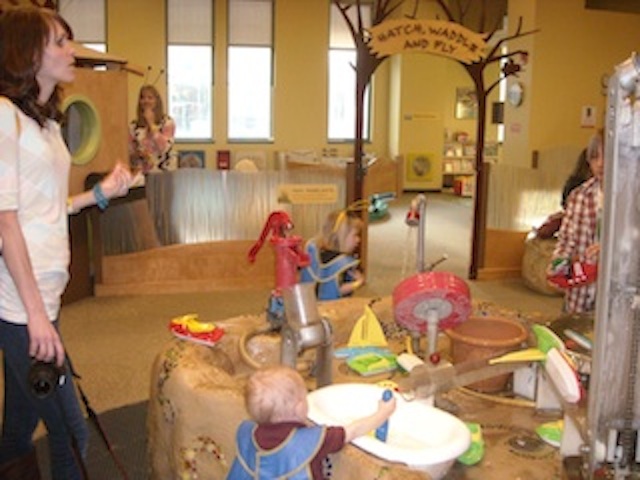
Discovery Gateway has fun interactive exhibits suitable for children of all ages

One organization that is doing this is the west-side nonprofit Discovery Gateway. Discovery Gateway specializes in children’s education through interactive exhibits, and like many nonprofits has experienced a drop in funds to the organization.

Steven Suite, chairman of the board of directors of Discovery Gateway, says the museum has been hit hardest by the decrease in donations given by foundations. Many foundations base their donation amount upon the interest they make on their investments. If the foundation’s investments do poorly, the donations to nonprofits suffer.

“Our strategy has been to put more focus on corporate sponsorship, more importantly, finding new donors to help fill the pot,” Suite said.

All donations to Discovery Gateway are tax-deductible

Discovery Gateway children’s museum is a 501 (c)(3) public charity. This type of nonprofit is tax exempt, benefits the community and derives at least one-third of its revenue support from the public.

“Discovery Gateway gets its funding from two places, the ZAP tax, which comes from the government and private donations and fundraising events,” Suite said. “Donations and fundraisers account for more than half of the museum’s yearly income. Without it the museum would cease to exist.”

According to the Community Foundation of Utah, 35 percent of Utah nonprofits have experienced a significant decrease in end-of-year giving. Twenty-eight percent reported a decrease in overall contributions and foundation, and corporate giving is down by nearly 50 percent. Overall, 64 percent of Utah nonprofits have seen donations decrease since the beginning of 2010.

Historically, Utah residents have given a great deal of support and funding to charitable organizations such as nonprofits. In fact, according to a report by the Community Foundation of Utah, the average charitable contribution per tax return in Utah is 4.9 percent while the national average is only half of that at 2.2 percent.

“Luckily, we have not had to go as far as raising our admission prices, or cutting down our hours but we did reorganize,” said Lindsie Smith, Discovery Gateway development and marketing director in a phone interview. “We have made changes in our staff and board of directors, and consolidated. To keep overhead costs down we have not rehired or filled any open positions.”

Utahns Against Hunger encourages Food Stamps program to those who qualify

Food Pantries only feed a small percentage of Utah's Hungry

Story and photo by CECELIA FENNELL

Efforts to end hunger in Utah continue beyond September, the state’s hunger action month, because food donations and distributions from food pantries only feed a small percent of the hungry.

That’s why Utahns Against Hunger, a nonprofit organization based on the west side of Salt Lake City, works to develop more effective community outreach programs for the larger percentage of Utah’s hungry. It does this by providing programs for low-income communities instead of providing direct services.

“Food pantries only feed a small percentage of the hungry so we provide other options and programs to meet all hunger needs in Utah,” said Mike Evans, associate director of Utahns Against Hunger. One option is the Supplemental Nutrition Assistance Program, also known as SNAP, a food stamps program.

According to UAH’s website, the organization was originally a project run out of Crossroads Urban Center in the late 1970s. As the community realized the need to improve federal nutrition programs statewide, it was established in 1981 as its own nonprofit organization. Since its beginning, UAH has worked to expand the reach of nutrition programs to “an estimated 1 in 6 households in Utah” who struggle to afford enough food by presenting and passing bills through Utah’s legislature. UAH is not an emergency food provider; instead its mission is to work with policymakers and community leaders to shape public policy by making nutrition programs work for the people who need them.

UAH serves all of Utah, but specifically those in need. Evans said the individuals who are most in need happen to live on the west side, which is why most food pantries are located in that area. UAH commonly advertises its events and programs to homes on the west side. In the past, the nonprofit distributed door hangers with information written in English on one side, and Spanish on the other.

According to its website, “UAH offers 17 food assistance programs, projects and initiatives. One program, Food Stamps, also known as the Supplemental Nutrition Assistance Program, or SNAP nationally, provides food assistance to low-income individuals and households through an electronic benefits transfer EBT card called the horizon card.”

Nathan Cram, director of Americorps VISTA, a partner of UAH, has been using food stamps himself over the past two years. Cram qualifies for food stamps because his net income is below the poverty level. He said the horizon card works a lot like a debit card and prevents many cases of fraud because of the rules associated with using it. It can only be used for food items and in stores that sell a majority of food products, he said.

“In order for an individual to qualify for the food stamps program, federal law requires that the individual’s net income be under poverty level,” Cram said. “Essentially they have to live on less than $900 each month,” he said. People can apply for food stamps through the Department of Workforce Services.

“Ninety-seven percent of food given to low-income communities comes from food stamps, only 6.6 percent comes from food pantries,” Cram said in a phone interview.

However, Evans said only 55 percent of those eligible of food stamps participate. “Some don’t know they’re eligible, some would rather seek other options and for others it’s an issue of humility – they want to be able to help themselves,” he said.

As an individual who has participated in SNAP, Cram encourages individuals who qualify for food stamps to participate because the quality of food is better.

“People surprisingly have more obesity in the low-income community because they can only afford foods high in fats and carbohydrates. Food stamps allow higher-quality food,” Cram said.

He also recommends using the food stamp calculator on UAH’s website to get an estimate on eligibility.

Since Utahns Against Hunger is an advocacy organization, it doesn’t need volunteers like food pantries and other nonprofits typically do. Directors of UAH encourage people to speak with local legislative leaders about existing hunger issues as a means to get involved.

“One of the best ways for people to get involved is by talking with their political leaders, volunteering and standing up and having a voice,” Evans said.

Utah nonprofits, Sorenson Unity Center roll with recession

Story and photo by DEREK SIDDOWAY

In the midst of numerous stock market plummets, layoffs and home foreclosures, many people have come to rely on soup kitchens, housing services, welfare entities and charities such as the Salvation Army and Deseret Industries for basic necessities.

According to the Bureau of Labor Statistics, Salt Lake City’s unemployment rate was at 7.4 percent in August 2011. Online real-estate marketing company RealtyTrac reported 560 housing foreclosures in the city throughout September 2011.

With no economic relief in sight, nonprofit organizations in Utah are working tirelessly to meet an increased demand for their service. A 2011 report prepared by the Community Foundation of Utah and Wells Fargo paints a vivid picture.

According to the report, “The New Normal, Changes to Utah’s Nonprofit Economy in the Great Recession”: “Utah nonprofits are, like the families they serve, stretched to the limit,” In addition, “As many as 14 percent have no cash on hand, and are living paycheck to paycheck, much like many of the people who come to them for assistance.”

The report, presented to the Utah State Legislature in February 2011, indicates demand is continuing to increase. In 2009 and 2010, nearly 80 percent of Utah nonprofits saw an increased need for service. These findings hint that up to one-third of Utah nonprofits could be out of business if there is no relief in the immediate future. When the report was published, 70 percent relied on deficit spending or were operating on less than three months of reserve funding.

“There is basically no reserve fund left in the state of Utah for nonprofits,” said Nancy Basinger, assistant director and service-learning manager of the Lowell Bennion Community Service Center. She studied nonprofit interactions with the government for her doctorate research at the University of Georgia in 2003 and is a member of the advisory board at the Nonprofit Academy for Excellence in Professional Education at the University of Utah.

Basinger, who has published various reports and research projects concerning the nonprofit sector in Utah, said nonprofits suffer more in a down economy when demand rises and funding bottoms out. She is concerned over how nonprofits will continue to meet their obligations and serve the community if they are unable to make payroll.

“This is the rainy day and now we’ve got to really figure out what to do,” Basinger said. “The pot is smaller and the (number of) people donating is smaller.”

The pot may be shrinking while demand has done anything but. In addition to providing for the physical needs of their patrons, nonprofits have experienced an increased need for social and mental programs as well.

“Behaviors supported by social services are more in need because of job loss, at-home abuse, substance abuse and no health insurance,” Basinger said.

The Sorenson Unity Center houses a variety of nonprofit organizations selected through its Programming Partnership.

Some nonprofits have responded to these diverse needs by joining forces. For example, the Sorenson Unity Center has found that this strategy benefits patrons in addition to decreasing operational costs. The operation came about in 2008 when the Sorenson Multicultural Center and Salt Lake County approached the city government with a plan to run the center for a reduced cost. Located at 900 W. 1383 South, the Sorenson Unity Center provides services for the Glendale and Poplar Grove neighborhoods.

“Sorenson Unity Center is a way to bring organizations under one roof so that it’s not so difficult to have a million nonprofit organizations competing for the same dollars,” Basinger said. “(Salt Lake City) has decided that it is in its interest as a supporter of society to support the work of those nonprofit organizations. They are working together and accomplishing twice and much with the same dollars.”

Angela Romero, Sorenson Unity Center’s program director, is responsible for the selection of nonprofit organizations through its Programming Partnership. She describes her job supervising the partnership as a way to provide opportunities for the community that would be otherwise unavailable. Nonprofits seeking to use the Sorenson Unity Center’s resources must show Romero the services they will provide to the community before they are approved.

“We want to be a resource through the programs we provide,” Romero said. “We hope individuals can take away something that will help them in dealing with the current economic environment.”

According to its annual report, the Sorenson Unity Center had a total of 8,334 participants in programming activities for the 2010-2011 fiscal year. Overall, the center and its affiliates served more than 18,000 patrons during the past fiscal year. These affiliates — Unity Computer Center, Computer Clubhouse, Donated Dental, Fitness Center, Child Care and general events and meetings — saw a total of 74,283 visitors during the same period.

However, the Sorenson Center and its affiliates receive financing through city funding. This steady source of revenue allows the center to maintain its facilities for the community’s use without wondering where the next check is coming from.

“I think what the recession has done is (create) a greater need for us to provide quality services for individuals that are in our community,” Romero said. “Hopefully more people are able to access the programs we have here.”

Switch to Under Armour brings budget increase, controversy to women’s basketball team

Story by JANITA BADON

Nike has been around the University of Utah women’s basketball team for more than 25 years. Nike guaranteed the team comfortable travel gear, shoes that fit perfectly and thin jerseys to make the players run faster. All  of that sounds good, but would you rather have quality or quantity?

The women’s basketball team is trading to Under Armour, along with the rest of the school. When talking about quality over quantity, the women’s basketball team budget grew from the $50,000 that Nike gave yearly to the $140,000 that Under Armour is putting on the table.

Nike gave the team home and away jerseys, practice uniforms, two pairs of basketball shoes, travel shoes and a pair of running shoes. Under Armour not only doubled that, but they’re also giving the womens basketball team pink jerseys for the national “Pink Game” that supports breast cancer.

Last year, the Lady Utes played Texas Christian University in a nationally televised game. The game just so happened to be the “Pink Game,” on the Utes home floor. The Utes took the court in pink shoe laces – all Nike game them. But the Lady Frogs wore pink shoes, pink jerseys and pink laces. Nike couldn’t give the Lady Utes pink jerseys because the football team is Under Armour and it would have cost $25,000, just for those jerseys.

With Nike not giving the Lady Utes what their opponents were getting, the coaches thought it was simply time for a change.

Although the coaches think it’s a great idea to switch from Nike to Under Armour, not all the players share their excitement. Rita Sitvi a sophomore guard for the women’s basketball team isn’t too fond of this decision and is actually considering switching schools.

“I love Nike, simple as that,” Sitvi said, “I had offers from other schools that were sponsored by Adidas but I turned them down for that reason.”

Most wouldn’t think switching sponsors would create this many problems, but it is the talk of the locker room around campus. But since the coaches call the shots, they don’t think it’s necessary to discuss with players. Anthony Levrets, coach of the women’s basketball team, thinks this was a great decision.

“I think switching to Under Armour was a huge decision, which I made with a smile on my face,” Levrets said. “I think our girls deserve way more than what Nike was supplying us, and Under Armour isn’t not only enough, but they’re spoiling our girls this year. I say spoiling because what they get from Under Armour compared to Nike is double, almost triple the amount”

Comparing and contrasting the numbers and the quality of the product, he only worries about the shoes. With Nike being around for as long as they have been, they have a good resume for the basketball shoes they produce. Under Armour just began to make basketball shoes in 2010.

“My one and only worry about Under Armour is how comfortable the shoes are going to be for the players,” Levrets said. “With them being so new to basketball shoes, that thought, makes me want quality over quantity.”

The players on the team have mixed emotions and are really just worried about how comfortable they’ll be on the floor. But it’s not all frowns on every player on the women’s basketball team; some are really happy about the change. Michelle Plouffe a freshmen small forward for the Utes, is excited.

“I have never been the one that’s into what I wear on the basketball court; I more concentrated on how I play,” Plouffee said. “Most people are caught up in the swoosh symbol, when that’s not what’s putting the ball in the basket.”

Salt Lake City homeless population has country-wide roots

Watch a video about Salt Lake City’s homeless population.

Story and multimedia by PARKER LEE

You do not have to look for very long to find people living on the streets or begging for money in downtown Salt Lake City. Whether it be in front of Wal-Mart, Temple Square or elsewhere, homeless people will be present.

Some of them have a few things in common. Most obviously, they do not have homes. They can’t find work. In many cases, they have family.

There are also characteristics of each homeless person that make them unique, such as age and gender. The methods they use to survive without a job or shelter vary from person to person.

But where these people are from might be the most intriguing aspect of their lives. Many homeless people in Salt Lake are not native to Salt Lake City, or even Utah. Yet they are all “living” here for one reason or another.

Cathy is a homeless, middle-aged, woman who lives and begs in Salt Lake, specifically near the Wal-Mart on 1300 South and 500 West. She does not call Utah home. Cathy is an Arizona native.

“I came here from Arizona with my boyfriend,” Cathy said. “My grandkids, I have two of them, they are still in the southern part of Arizona.”

Cathy misses the warm weather of Arizona. “It is tough here when it rains or snows,” she said. “It never snows in Arizona where I’m from, and it hardly ever rains.”

Fellow Arizonian panhandler Samantha also finds the Utah climate to be a bit harsh at times. “It is hard to be comfortable living outside when the ground is wet,” Samantha said.

Samantha has a difficult time panhandling, so she goes to Temple Square where there is a high volume of foot traffic. But she has a particularly challenging time acquiring food- because she is diabetic. That makes asking for food almost too hard, so she simply asks for money.

Samantha’s situation is complicated even more by the fact that she has two kids.

Another easy-to-spot local homeless person living downtown is a woman who refers to herself only as Ms. Burnet. With her brightly colored beanie with ear flaps and coat to match, it is hard to miss her walking up and down State Street. She is also not originally from Utah.

“I came here from Ohio several years ago,” Ms. Burnet said. “I don’t remember exactly when I got here.”

“Tall Tom” is another homeless individual in the Salt Lake area. He can be seen at or around Spring Mobile Ballpark. He has a long, shaggy, brown beard dusted by streaks of gray. Tom wears a baseball hat and stands well over six feet tall, earning him his nickname.

Tom is in Utah from the great state of Colorado. He is here by himself and has less contact with his family than the other three. He said it is quite possible that they don’t even know he is in Utah.

“They are spread all over,” Tom said. “But we haven’t talked for years. I would be shocked if they knew I wasn’t in Colorado.”

Tom has been here for two or three years and has not had a home the whole time he has been here. He says it is hard to find work here, which makes finding shelter hard.

All four of these homeless people are from out-of-state. But the reasons for coming here are different for each.

For Cathy, the lack of employment in Arizona was the driving force. “Me and my boyfriend couldn’t find any jobs down there,” she said. “We thought it might be better up here.”

Samantha and her kids are not necessarily here by choice. “We were up here just temporarily,” she said. “But then we couldn’t get enough money to go back to Arizona.” So her family is stuck here in the Beehive State, at least that is what caused them to stay in the first place.

Ms. Burnet, who is here by way of Ohio, did not give a reason as to why she decided to come to Utah specifically.

“No reason, I just wanted to leave Ohio,” Ms. Burnet said. “I felt like I needed to leave my hometown and get away. This is just where I ended up.”

As for our friend Tall Tom, he has bounced around quite a bit. He calls claims Colorado as being where he is from, but that is because he stayed there longer than any other place. Utah is where he landed this time.

There does not appear to be any correlation from the four transients as to why they came here. As it turns out, they did not come to Utah because of any one reason. But perhaps their staying in Utah has a common thread.

Tall Tom has found the people to be fairly understanding of his situation.

“Well, people do sometimes give me work,” Tom said. “And I do not make a ton of money begging, but I get at least enough to scratch by most of the time.”

For Ms. Burnet, her interaction with the people of downtown Salt Lake has played a role in keeping her here.

“I do have to beg for money, but I don’t mind it,” Ms. Burnet said. “I get to meet a lot of interesting people. And nobody is too mean.”

Samantha did not come to live here by choice, but she has stayed here by choice. She is able to obtain at least some necessities for her and her children.

“It is not easy and I wish there was another way,” she said. “But it isn’t the worst place to do this I guess. Some of the people who walk by give me change and money.”

Cathy and her boyfriend have remained in Utah, away from her grandkids. They had hoped things in Utah would be better than in Arizona. And they have been, though maybe not by much.

“He (her boyfriend) is able to find day jobs sometimes,” Cathy said. “And when I’ve been out here with my sign, people have been really generous.”

Cathy also said they occasionally get some help for shelter.

“The motel over here is letting us stay for a couple nights,” she said. “We can’t stay for very long, but it’s nice we get a few nights inside.”

There are undoubtedly many factors at play that keep the homeless in Utah. But our homeless foursome has identified the generosity they’ve been given by passersby as the main culprit. An environment has been created where the residents here can have compassion on their fellow men.

This attitude towards the homeless has given Cathy hope and positivity.

“We will get the help we need,” she said. “We just have to stay positive and keep trying and we’ll be fine.”

University of Utah students brace for tuition hikes

Watch a multimedia slideshow about increasing tuition costs as the University of Utah.

Story and multimedia by SCOTT WISEMAN

The price of a college education is at a record high, causing troubles for students across the nation. While financial aid, scholarships and student loans are available to create some relief, many students are scraping together their last pennies to meet the required costs to attend college.

University of Utah students met financial struggles last year as the cost of attending school was at an all-time high. The same students will face yet another challenge as tuition will rise 7.8 percent starting in the summer semester of 2011, university officials announced earlier this month.

The increase determines that the average in-state undergraduate student taking 15 credit hours will expect to see an increase of $247 per semester. A 15 credit load for an out-of-state undergraduate will increase by $783 per semester.

“I really do not know how I’m going to come up with the extra money,” said Gunnar Lamb, an undecided freshman. “Being an out-of-state student is really starting to catch up with me financially.”

The tuition increase for next year is less than last year’s increase, which hit students for 9.5 percent.

“Of course, we do understand that in a tough economy, this is hard for students,” said David Pershing, senior vice president of academic affairs. “This is why we tried really hard to find a balance between maintaining the quality of the university and the tuition increase.”

Tuition at the U is divided into two different tiers. Tier one is the budget decided upon by the Board of Regents, while tier two is decided on by the University of Utah. The overall 7.8 percent increase is comprised of a 5 percent increase in tier one, and a 2.8 percent increase in tier two. The Board of Regents in St. George approved the final adjustments to the increases on March 27.

The Board of Regents originally approved a 7 percent reduction in state funding, but lowered that amount to 2.5 percent early last month, according to higheredutah.org. The tuition increase would have raised an additional 5 percent if the original reduction had been approved. The students have been asked to pay the amount out of pocket that the federal government decides to cut each year.

“State support for our colleges and universities has been steadily declining over recent years,” said Board of Regents chair David Jordan in an interview with higheredutah.org. “We need to reverse that trend so that all of our institutions remain affordable, particularly at the community college level. We can’t continue to cover increasing costs with tuition hikes.”

Students are turning to additional sources of funding such as grants, scholarships and loans to help make up the difference in prices.

“Although my tuition has been paid through scholarships, for friends who do have to pay out of pocket, that is a pretty high increase which would make a significance difference,” said Carla Gonzalez, a senior in behavioral science.

Currently, the U is funding is comprised of 47 percent tuition and 53 percent state funding, Pershing said. An increase in tuition will help bring a higher percentage of private funding to the U.

Tier two funding, the additional budget determined by the University of Utah, has been broken down by use. A majority— 56 percent— of tier two funding will be used to restore funding to academic departments, 18 percent given to student services, 13 percent for academic support and 13 percent given to other support areas such as utilities.

The overall increase in tuition has 32 percent of budget going to faculty retention, 29 percent for academic departments and 19 percent to staff health insurance. Only 5 percent of the overall increase will go to benefit academic support.

“Students clearly don’t look forward to the increases in tuition and fees, but most students seem to understand that we try to keep increases as small as we could,” Pershing said. “The U is a very cost effective place to attend school based on its quality.”

In the 2010 school year, the university’s resident undergraduate tuition and fees totaled $6,274. This is significantly lower when compared to the national average of $7,605. When compared to other public universities of similar rapport, the University of Utah fared well. Select schools such as Pennsylvania State University and the University of Illinois cost almost three times as much as Utah.

Chase Jardine, president of the Associated Students of the University of Utah and a senior in economics and chemistry, said that while he believes that the increases may bring hardships to college students, they were necessary to prevent department closures and faculty layoffs.

“Of course the increase is unfortunate, but I was very impressed with the administration’s dedication to see it as low as possible,” Jardine said. “The 7.8 percent is as low as we possibly could increase given the economic severities we have.”

Pershing highlighted the fact that the University of Utah only can offer approximately $17,000 worth of core funding per student. Other top schools, such as the University of North Carolina provide almost $30,000 of core funding per each student. He stressed that in order for Utah to compete with the top schools in the nation, more core funding is needed.

Dominic Ford, a junior in geography said he doesn’t like tuition increases, but sometimes they are necessary. Increased funding for academic departments will be an improvement, Ford said.

“It’s better than last year’s increase,” Ford said. “I don’t know if I’m okay with it, but with budget cuts everywhere, there’s not much that we can do about it.”

Student fees are also increasing at 7.8 percent. Some of the increases will be represented by a $17 increase in a building fund and a $5 increase in the fine arts budget for an in-state undergraduate taking 15 credit hours. The only area with a cut budget is the utility fee, which is dropping $3 per semester.

“If the fees are going to impact the student in a better way, then I guess it is okay, but the part I don’t agree with is the increased health insurance for the faculty,” Gonzalez said. “If they want better insurance, they should pay for it out of pocket, not out of mine.“

These increases in budgets have already had impact on the university’s campus, as the Associated Students of the University of Utah announced this week that it will be able to increase its amount of funding for the next school year.

“I do not attend any on campus events hosted by ASUU, and I would like to see those budgets cut before I pay more tuition,” Lamb said. “The academic integrity of this school is the most important value, and tuition increases are only justifiable to improve academics.”

Cheston Newhall, a junior in business said while tuition increasing will be negative to many students on campus, he believes that increased funding will help to improve the quality of the university.

“They’ve got to do what they’ve got to do,” Newhall said. “Although it is unfortunate that we will all be paying more money as students, but at least we’re going to get something back out of it.”

Along with the increase in funding to help maintain key staff and faculty members, Newhall said that an increased budget to help with on campus events is important.

“Going out to events sponsored by ASUU on campus is a great way to get connected to the university,” Newhall said. “I feel as if the U would not be as strong of a community if the events budgets were cut.”

According to Pershing, in 2008, a high school graduate had mean earnings of $40,000 per year, while those who had their bachelor’s degree earned a mean of $70,000 per year. Even though the price of obtaining a bachelors degree is rising dramatically, students say those mean salaries show it is worth the initial sacrifice.

“All in all, the tuition increase is unfortunate, but ultimately necessary,” Gonzalez said. “I will continue to stick it out and get my degree as planned.”

Hair today isn’t necessarily gone tomorrow for Utah women

Watch a multimedia slideshow about women’s beauty habits in a down economy.

Story and multimedia by WHITNEY BUTTERS

Split ends, drab color and shapelessness. Bangs that once framed the face now long enough to obstruct vision. Hair so unruly that even a helmet of hairspray could not keep the temperamental tresses in place.

This is more than just a bad hair day — it’s a sign that it’s time to visit the salon again.

“When your hair isn’t going right, nothing seems to be going right,” said Lila Latu, a customer at the Mane Station Salon in North Salt Lake.

This perceived need for hair maintenance keeps the multi-billion dollar beauty industry going as women continue to spend money on their appearance at varying degrees despite the downturn in the economy.

“Getting hair done is still a necessity,” said Memorie Morrision, assistant salon director and grand salon stylist at Landis Lifestyle Salon in the Marmalade district of Salt Lake City. “It’s not something people go without. It is a reflection of how you see yourself.”

Undying dedication to keeping up appearances allows the beauty industry to flourish while other sectors of the business world flounder.

The Bureau of Labor Statistics states barbers, cosmetologists and other personal appearance workers held approximately 821,900 jobs in the United States in 2008. That number is expected to grow by 20 percent before 2018 due to a growing population and increasing demand for hair service, which is faster than the average growth rate over all occupations.

Landis Lifestyle Salon added to the increasing job opportunities when it opened its doors in Sugar House in 2005. It recently expanded into its second location in Marmalade in September 2010. Morrison said the salon has already surpassed the owner’s expectations and continues to grow “slowly but surely.”

The industry continues to grow despite the fact that many customers are trying different tactics for saving money on hair care. Some try their hands at cosmetology by cutting their own hair at home but often end up turning to the help of professionals in the end.

“I fixed more haircuts in January of 2009 than I ever have,” said Misty Jones, manager of the Winegars Marketplace Great Clips in Bountiful. “I remember once when I fixed five in one day.”

Many cut back by simplifying their hair treatments instead of trying the do-it-yourself approach. Latu decided to keep her hair her natural color so she didn’t have to worry about the cost of upkeep. “I’m just getting a trim today,” she said. “I can’t afford to get it colored.”

Others try to spread the cost over several months by waiting longer in between haircuts. Misty Jones said women who used to get their hair cut every 3-4 months now wait 5-6 months.

Tara Jefferson, a customer at the Marmalade Landis Lifestyle Salon used to make an appointment every six weeks to get her hair cut. She says she now examines her finances each month, often resorting to putting it off until the funds are available. “Even if it’s looking bad, I guess I’ll just have to be extra creative (that) month,” she said. “It does depend on my budget and how badly I need my hair cut.”

While getting hair cut may be seen as an essential, Misty Jones and Morrison both said hair products are one of the first things someone will cut when trying to save money.

“Before the downturn in the economy, it was easy to sell $50 in products to one person,” Misty Jones said. “Now we give someone a recommendation and they automatically ask if they could get it cheaper somewhere else.”

Even specialty stores are experiencing some of the same drop in hair product sales.

“My boss says that it used to be quite a bit busier a couple of years ago, and it’s just slowly declined,” Madison LeMelle, an employee at Classy Chassis beauty supply store in Bountiful, said. “We still get people in, but it’s definitely not as much as we used to.”

Although sales may be down compared to years past, women still seek quality when it comes to hair products. “We use professional brands in here, and it really does make a difference,” LeMelle said. “With the economy, even though it’s bad, people still want to use the best stuff they can.”

Stylists are sensitive to their clients’ financial situations and try to help them prioritize on the essential products. Many consult with their clients and explain the purpose of each product recommendation to achieving the overall desired look. “It’s our job to really hone in on what a person needs,” Morrison said. “They don’t want to pay for a style and not have the same results from home, so products are still important.”

Jefferson’s stylist recommended she purchase enhancer and conditioner from Landis’s Aveda products collection, but she had to further narrow down the options because of tight funds.

“I just got the conditioner, just because I am so strapped financially,” she said. “Next time when I’m rich and famous I’ll get both.”

There are still women who cling to their hair routine sacrifice in other aspects of life in order to maintain it.

Helen Jones used to take her mother to the beauty parlor once a week to get her hair done. “If she missed a week, I knew she must have been sick because she never missed her trip to the salon,” she said.

She has picked up her mother’s tradition and visits her cosmetologist at the Mane Station weekly to get her hair styled. “I would not give up my weekly hair appointment for anything,” she said.

When many women are cutting back on color treatments, Helen Jones holds fast to her habits. “It can get expensive to color it, but it’s worth it no matter what the sacrifice is,” she said.

Regardless of whether a woman chooses to save on hair costs, every cut, color, trim, style and shampoo seems to carry inherent value.

“It’s part of a women’s nature to let people rely on us,” Misty Jones said. “Beauty is a service industry, and it’s our job to make people feel good. It’s an opportunity for women to let someone else do something for them.”

This opportunity to do something for themselves is what Morrison believes drives many women to fill the salon chairs at Landis Lifestyle Salon.

“We try to put value into what we do, and women who come here are willing to pay for the certainty that they will get what they want,” she said. “Our customers know they will get a stylist that will give them time and focus on them.”

More than “me” time, a trip to the salon brings a new sense of self. Morrison said she sees the “mirror face” on a daily basis as she watches a woman’s countenance change when she sees her new hair and a revised version of herself.

Possibly the biggest drive for women to continue to sacrifice money on beauty is the perception it portrays and the transformation of attitude.

“I feel good, and it affects the way people treat you, and that’s why I’m willing to spend what I can spend,” Jefferson said. “Because when you look good, you feel good about yourself. Beauty starts on the inside, but you have to extend that to the outside.”

Economy creates unique challenge for undocumented immigrant’s

Watch a multimedia video about undocumented immigrant’s struggles with the economy.

Story and multimedia by FLOR OLIVIO

The immigration debate often gets heated. In an effort to humanize the politics of immigration we see storytelling that some have classified as melodrama.

“I think it’s a very important part of the story, but I don’t think the opposition cares about that part, and why bother talking about something that is not going to get results,” says history teacher, Jodi Lopez.

We regularly find the faces of the people who this debate is really about buried in piles of statistics and dramatic stories. The turmoil between state and federal action is very clear even at a personal level.

The figures and facts both nationally and locally show a picture of an undocumented immigrant who among struggles, perseveres through American values.

Undocumented immigrants in the U.S. not only exist but they are here in the thousands.

Their contributions come in the billions. Regardless of immigration policy these people have the same basic necessities.

“A third of the children of unauthorized immigrants and a fifth of adult unauthorized immigrants lives in poverty,” according to the Pew Hispanic Center, “this is nearly double the poverty rate for children of U.S.-born parents (18%) or for U.S.-born adults (10%).”

Taking into account that undocumented children and families do not qualify for basic needs assistance like food stamps (SNAP), or traditional medical care (Medicaid), according to the Utah Department of Workforce Services, community resources and family help become essential for undocumented families.

The Pew Hispanic Center found that “most unauthorized immigrant adults reside with immediate family members- spouses or children.” “Almost half (47 percent) of undocumented immigrant homes are composed of couples with children,” a considerably different picture from households of US-born residents (21 percent) or legal immigrants (35 percent).

The stories that remain untold are of families helping each other and their sacrifices through unceasing work that gets these new American families through the days, weeks and months.

“I sell everything that I can.” said Milvia, an undocumented immigrant woman who migrated to the US from Colombia. “I sell nutrition products. I clean offices at night, I earn about seven hundred a month doing that, and even with all this we could not afford to pay rent, and everything else the kids need. My husband had to travel out of the state to find work and has been working there since October of last year, with no hope to return.” Milviaʼs full name is excluded because of her current immigration status.

The facts that undocumented workers pay property, state, food and federal taxes as well as Medicare and Social Security pay-ins that they can never apply for or benefit from are also frequently left out.

A study published in April 2011 by the Institute on Taxation and Economic Policy, a nonprofit, non-partisan research organization that works on federal, state, and local tax policy issues, found that in 2010, “unauthorized immigrants paid $11.2 billion in state and local taxes. Which included $1.2 billion in personal income taxes, $1.6 billion in property, and $8.4 billion in sales taxes.” The states receiving the most tax revenue were California, Texas, Florida, New York and Illinois. Utah received, 105 million in total revenue from undocumented immigrant taxes.

Regardless of their hard work, immigrant familiesʼ income is notably less than nonimmigrant families, and so immigrant children live in families with lower levels of income.

In a report by the Urban Institute, a nonpartisan economic and social policy research organization, nationally “the median hourly wages for all wage and salary earners in immigrant families were lower than the median wages for native families,” $14 versus $18.

“The current Utah economy affects these undocumented children directly,” says Elisa Bridge, a coordinator and family support worker for the Salt Lake School District, “jobs are not in abundance, and if you are undocumented itʼs harder to get a job.”

She explained the on-going situation with two parents working outside the home, two or three jobs at a time to be able to support families and provide their children with very basic necessities.

Students suffer when their basic necessities are not met, “This can affect their learning,” said Bridge,” when Iʼm talking about basic needs Iʼm talking about food, clothing or families struggling with bed bugs,” which is a big problem for undocumented families we come in contact with right now. It comes down to “a lot of people just living in horrible situations.”

These are very negative effects but hope seems to be abundant for the undocumented.

“There are students that see their parents struggling, so that might motivate them to fight harder to become something in life and obtain and education,” says Bridge.

Even with this motivation, these same students currently have no hope to actually go on to receive a higher education or to be able to work legally.

Legislation like the “DREAM Act” is geared to close some of these gaps for undocumented children who want to pursue a higher education or serve in the military and successfully navigate through American society.

Some programs that currently help undocumented youth are kept under the shadows in the same places these children reside. Northwest Middle School has an after school program where children receive homework help. The school also provides a dinner option for any student that decides to participate and because school districts do not inquire about immigration status these programs are sometimes the only way some of these students can get a good dinner.

In reality it is hard to document a group of people who live in constant fear of having their livelihood destroyed. It becomes just one more daily struggle.

Regardless unauthorized immigrants continue making it through the values that most Americans identify with hard work, honesty, family and the pursuit of happiness, these undocumented people continue living, surviving and in most cases creating a community of perseverance and hope.

Musicians in Utah are finding alternative ways to have their music heard

Watch a multimedia video about a local record label.

Story and multimedia by HELEN COX

For musicians wanting to be heard, it’s all about who they know and how creative and resourceful they can get. Despite the current recession, bands are finding alternative ways to record and release their music.

Getting a good record deal has never been easy, and these days it’s even harder. While several record labels and distributors do exist, a legitimate contract that will pay for recording and pressing is more difficult to attain than some may realize. The money is simply not there. But several locals have been looking for and finding new ways to get their music out to the public on a low budget.

Gavin Hoffman, drummer of INVDRS and IX Zealot – and an employee of Raunch Records and SLUG Magazine – has been playing music in Salt Lake City for 18 years. He has noticed bands are more likely to find a label to pay for the release of their albums if they know someone or if they tour.

Neither of Hoffman’s bands tour. In order to get their music out, they must do it themselves by networking within the music world and paying out of pocket. It’s a sacrifice, but even in a recession he explains there is a positive aspect. People still want to hear new music.

“If we shell out the dough and the time to record, press, and send our stuff to people, someone will eventually hear it,” Hoffman said.

Even with good networking and reasonable prices, this is not inexpensive. Hoffman’s sludge punk band, INVDRS, spent about $1,300 to record, mix and master their full-length album. The record was co-released by Relapse Records. His blackened hardcore doom band, IX Zealot, spent close to $700 to record, mix, master and press their three-song demo.

“We don’t ever expect to make that money back. It’s a total investment, simply to record and get our music out to people,” Hoffman said. “Neither of my bands – in fact, no band I’ve ever been in – has ever done anything to make money. We play and record simply because that’s what we like to do.”

Local black doom metal band, Gravecode Nebula, has decided to save some money and record on their own. They brought a PC with recording software into their practice space and have spent the last several months experimenting with rehearsal recordings. They are also saving foam padding from a shipping room at a band member’s workplace in order to make sound-proofing material – padding that would otherwise be sitting in a landfill.

“With the advent of new technology and the modern PC, we see that getting a professional sound with a home recording is now easier than ever,” guitarist Eric Elde said. “Other than saving a lot of money, I think the main benefit of this is that you can take your time to perfect and enrich your music to the vision you have for whatever you want to do.”

With a label that will fund the pressing and release of Gravecode Nebula’s debut album, the band is confident that recording their guitar, bass, keyboard and vocal tracks in their own studio is ideal. Due to drums being more troublesome to record – it is difficult without proper equipment – they plan to pitch in a few hundred dollars for their drummer to be recorded in a professional studio.

While many bands have found reasonable ways to record, distribution is an even greater issue musicians face. Without decent promotion and distribution, the music may never be heard.

“After recording and pressing, we have to get the album out to the masses,” said Hoffman. “Local support is good. Sell the album at shows and get it into local shops like the Heavy Metal Shop and Raunch Records. You have to get it out into the universe. The best way I’ve found is to send as many copies as possible to local, national, and international magazines for review. Even a negative review will generate some amount of interest.”

While some bands like to stick with more traditional approaches to promotion, social media has also become a very popular and accessible outlet. With an increasing number of websites that allow musicians to upload and share their music for free, it is easier for bands to be heard. Some labels are taking these ideas to a new level.

This year Backscatter Media and its sub-label, Dungeon Recordings, launched a new website with a unique idea. Two digital compilation albums are available on the site, with the option to stream or download the music for free. Many local favorites are included on these compilations, and the labels feel this is a great way to help Salt Lake City bands get exposure.

“We were already affiliated with a bunch of different artists who we were helping out, just kind of selling their stuff on our website,” Kevin Cazier of Dungeon Recordings said. “None of these bands really had any distribution, they didn’t really have any websites built for themselves.”

Cazier believes traditional methods of promotion and distribution are still very effective, but the Internet has something to offer that is difficult to provide otherwise – free music for the public and free exposure for musicians.

“In the past we had done compilation CDs, and it kind of gave us the idea to do this,” said Cazier. “We took that idea one step further. We thought a free download would be excellent – one compilation to represent Backscatter and another to represent Dungeon. Generally when people are listening to music they don’t have as much of an open mind if they have to pay for it. It helps the bands and it helps our label.”

Skyler Sheen, a self-described artistic terrorist who runs Wee Gee Wee Gee Records, a sub-label of Touch of Horror, believes all sound should be free and utilizes his home studio and social media more than most.

“If you have a painting, you can’t really charge somebody to look at it,” Sheen said. “Music and audio – sound – should be 100 percent free. I think most people believe this or they wouldn’t be stealing, or whatever, music all the time.”

Sheen believes money should only be made from the more artistic aspects of music, and social media should be taken advantage of as free distribution. He sees live performances and creating fun, personal and interesting ways to release and promote physical albums and merchandise as the only acceptable ways of making money in the music biz.

“I don’t know why somebody would want to be signed to a record label anyway,” Sheen said. “Create your own label or create your own thing. That’s why the corporate music industry is in trouble, is because a lot of people are going and doing that.”

It is apparent that the recession has given local artists a reason to appreciate their independence, get away from outdated norms and come up with new ideas. These are qualities that could be beneficial in the long run, even though they are likely to give the music industry a run for their money.

“I think, if anything, the recession has taught musicians to value what they have, to look toward the future and find new and exciting ways to capture their music,” said Elde. “Any way to save a buck in this economic climate is beneficial.”

U’s Sill Center pushes sustainable building efforts

Watch a multimedia video about the University of Utah’s Sill Center and their sustainability efforts.

Story and multimedia by JENNA LEVETAN

Construction all over campus causes students to pay a $17 fee in their tuition every semester. But one older building is adding new and innovative methods to save money and also energy.

The Sterling Sill Center is where the office of undergraduate studies is located and is a leader in housing sustainable projects on campus. It has solar panels on top of the building, organic gardens in front and the most recent project is in their backyard and is called an ice ball.

The ice ball is an experiment that could be a breakthrough in air conditioning.  The experiment is happening 40 feet underground behind the building. Professor Kent Udell spearheaded the idea of the ice ball with students from the department of mechanical engineering. An ice ball is a method of taking the cold winter air and saving it underground.

There are 19 pipes sticking out of the ground behind the building called thermosyphines. The pipes are what bring the cold air down underground.

“The basic concept is that we are trying to TIVO the seasons.  We are trying to store the winter cold that we are experiencing right now, take advantage of it in summer and get free air conditioning,” Udell said.

A special coolant fluid similar to Freon is put into the pipes that have both the liquid and vapor phase. The liquid is in the bottom of the pipes and the vapor is on top.

“What happens in the winter is that when the temperature outside drops below the temperature underground, that liquid in the bottom starts to boil.  As it boils the vapors come up, go to the condenser, condense, and the liquid runs back down. Then comes summer and we reverse it,” Udell said.

When the cold liquid comes back into the ground, it freezes the soil around the pipes, forming what people are calling an ice ball. The cold liquid will be pumped into the air conditioner and will be used to cool the building as the ice ball melts. The ice ball will grow to be about 35 feet in diameter.

Sill Center employees are hoping to use the energy gained by their solar panels to pump the liquid into the air conditioner making the ice ball truly environmentally friendly by using no electricity at all. St. Andrew personally asked Udell to use the backyard of the Sill Center for the ice ball.

“If this works it has immense potential for saving lots and lots of money and preventing a lot of pollution. And if it works hopefully we can expand the idea and not only change the way this building gets its air conditioning, but the world,” said St. Andrew.

Building the ice ball has cost just over $20,000, but Udell believes that the cost of installing the ice ball will be paid back in three years with all the money the school will save in air conditioning bills and it should last for decades.

The installation is now complete and Udell hopes it to be operational by summer 2011. If the ice ball turns out to be successful, Udell will work on a similar but separate project to keep the warm summer air stored to help them heat the building during the winter.

Another green project the Sill Center houses are the solar panels that were installed in December 2009. There are 30 plates of solar panels on the roof with three rows of 10. It only cost the university about $17,000 out of pocket to buy and install them after they got a grant from Rocky Mountain Power.

“We got a grant through Rocky Mountain Power for $30,000,” said Mark St. Andrew, assistant dean of undergraduate studies. “It is going to take us nearly 50 years to pay off these panels in the amount of energy that they are going to produce.”

Though the goal of solar panels are to save energy, the ones at the Sill Center produce much less then some may think.

According to the data from the Rocky Mountain energy manager, last year the panels only produced three percent of what the building uses in a year. The university will be in debt to the panels for so long because of the large out of pocket expense for the panels and the small dent of energy they actually produce.

The panels are only guaranteed to last for 30 years, meaning the university may be paying for them for nearly 20 years after they are gone. The employees at the Sill Center are aware that there are some conservative fiscal people who think they were a waste of money, but they stand by their decision of getting them because even without a return on investment the panels get people talking about alternative sources of energy.

The organic garden is a project funded by the Sustainable Campus Initiative Fund. When Alex Parvas, founder of gardens, asked the Sill Center if she could grow the gardens in front of the building there they were more then pleased to say yes.

“The gardens are perfect at the Sill Center,” said Parvas. “Once they get fully in bloom it is going to be really pretty and hopefully a conversation starter since the building is so central on campus.”

The Sill Center and garden coordinators have also set up a patio area along side the building so students and faculty can have a spot on campus to picnic around the gardens.

The Sill Center will continue to look for innovative ways to improve sustainability on campus and remains optimistic about the future.

“There is no overall plan or master plan that we have hatched,” St. Andrew said. “It is just stuff that makes sense to do.”