A Utahn’s search for culture, history and education

by RITA TOTTEN

“If you don’t have a command of history you are vulnerable,” said Forrest Cuch, who has been the executive director of the Utah Division of Indian Affairs since 1997. As director he works to enhance intergovernmental relationships throughout Utah. His experiences at the Division, coupled with his history as an educator, have made him successful. As a graduate of Westminster College he went on to teach social studies and become the education director of the Ute Tribe.

Growing up, Cuch was faced with trauma of an intellectual nature. While at home his parents told him about his culture and his people but at school he was taught that Native Americans didn’t contribute to civilization. Unsure of whom to believe, he had mixed feelings about school.

The contradictory information he received as a child is what drove him to challenge what kids are learning. Cuch believes that there is a need for reform and change and teachers should be taught to change social norms. “Cultural diversity makes the wonderful life we have today,” he said.

“The best way to teach is out of the heart,” he said. He believes that to provide great education to children, parents need to entrust their education with the right people. Cuch said it is important to find people who love children. Employing individuals who will nourish and foster children is essential. In addition, he believes paying teachers a decent salary is vital and suggests looking for new and alternative ways to teach and hook kids.

The biggest accomplishment and what he is most proud of is the empowerment training he helped develop. He trained more than 90 individuals from tribes and urban areas. The training focused on four main sections. The first was reteaching history. Cuch emphasized the importance of not believing everything one is taught; reteaching and relearning is key. Secondly, community develop was highlighted.

Physical and mental health were the last two components of the training. Before white settlers came to the Americas, Native Americans had never been exposed to alcohol and sugar, Cuch said. These elements were treated like toxins to their bodies and contributed to the setbacks that many Native Americans have faced.

The University of Utah is currently reviewing the program and Cuch hopes to receive more funding to continue his work. So far, the training has been held three different times: in 2002, 2003 and again in 2005. The main message he hopes people will take from the training is that education really is the key for success in business, personal and health aspects.

Bly Miller, a Park City resident and former teacher, is a member of the Iroquois tribe. Miller remembers the lessons her mother and grandmother taught her about the importance of knowing her culture and history. “They were always telling me about the struggles of our people and how no matter what they kept going. Knowing your history is vital because we are our history, our ancestors,” she said.

Miller has worked closely with the Iroquois tribe, educating its young on everything from tradition to basic life skills. She feels that her purpose in life is to teach and pass on what she has learned from her family. “If I can offer my knowledge to these children than I have done my part as a citizen of the world,” Miller said.

Cuch’s passion for education comes from the hardships he faced in school. While in high school he was exposed to the pain that came with the “white” version of history. Once he was in college he began to explore and learn the truth about his people and started his work with Native Americans. The result of this educational journey is the humanity he spreads through his work as a Ute and citizen. “History is not in the past,” he said, “it is now.”

Tribal leader training in SLC provides growth, opportunity

by KATHRYN JONES

One man has high hopes for the education of Native American people, and 90 tribal leaders from across the U.S. have supported his life changing efforts.

His name is Forrest Cuch.

The program? Empowerment training.

And no, Cuch didn’t always see life the way he sees it now. As an enrolled member of the Ute Indian Tribe and executive director of the Utah Division of Indian Affairs since 1997, he had to wade through years of his own fears and insecurities before he could help others tackle their own.

“We had a way of life that was good, but when I started hearing about Pilgrims the information was painful to me,” he says. “‘Oh, what about the Indians?'” he asked. “I didn’t feel good about school.”

Cuch admits he didn’t trust what he’d been taught by his parents and says he was confused about his heritage.

“Had the American Indians made no progress to society”? Did his people really kill those in wagon trains “without any provocation”? Were there historical inaccuracies that he should know about?

“I had to learn about my “own humanity,” he says, “my good side as well as my bad. My people enslaved [others]. I learned from that.”

Cuch also learned from a man named Mack Gift Ph.D., a non-Native American professor who taught him at Westminster College where he graduated in 1973 with a bachelor’s degree in behavioral science.

Twenty-nine years later, after Cuch had gained experience in Native American directing, planning and administration involving various endeavors, as well as becoming a department head and teacher in the social studies department at Wasatch Academy in Mt. Pleasant, Utah, Cuch and Gift came together once again.

The rest may even be history.

About 30 tribal leaders from across the country were invited to attend that first empowerment training in 2002 at the Embassy Suites Hotel in downtown Salt Lake City. Among other things, the experiential and lecture oriented training instructed Native American tribal leaders in history, community development, spirituality, government, business and physical and mental health.

The curriculum borrows from the Minnesota Model of “training and empowering disabled people under the National Governor’s Council for the Disabled program,” Cuch says. Passive/aggressive behavior as well as eye contact is a part of the agenda that helps to educate tribal leaders to improve their lives.

And the medium has proved a success.

Thirty tribal leaders were invited and spent one weekend a month for 10 months at the same location the following year. In 2005, 30 additional tribal leaders from various Native American tribes were selected, making a total of approximately 90 tribal leaders who would finish the program.

“There was no preaching,” Cuch says. The leaders were shown how to make a better life by contrast and by choice. Though education was given, it was up to the tribal leader to take it in and live it, he says.

“It was a respite for people, a respite for excellent learning,” Gift adds in a phone interview. “Each of the tribes learned to go beyond tribal identity. They found a commonality.”

Not surprisingly, with the training of tribal leaders came growth for others.

“Tribal leaders have shared it with other people,” Gift says.” It is a great program, but we are trying to get funding to go through it again.”

Currently, the Institute for Social Research at the University of Utah is evaluating Cuch’s program, which he said costs an average of $100,000 per training or about $3,300 per participant.

The research group was “pretty impressed with the program” Gift says. He has high hopes that, in time, the training will expand. Once it’s been established annually for Native American tribal leaders, Gift would like to involve as many Native Americans as possible.

“When we hear, ‘we’re ready to live now, we see clearly now,’ that makes us feel good,” Cuch says, speaking of the empowerment program his division provides. “We must use every medium possible, and it’s a very challenging thing to do. [But] the future hinges on the quality of education for all people.”

Bhutanese celebrate holiday, new life in SLC

Story and photos by MATT BERGSTROM

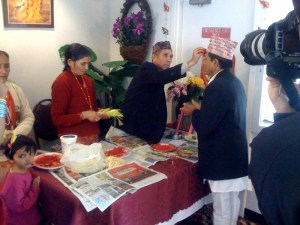
Thursday, Oct. 9, was an important day for Hindus around the world. It was the celebration of Dashera, the victory of the goddess Durga over the demons who stood in the gods’ way during creation.

For a group of Bhutanese refugees in Salt Lake City, it was also a celebration of a different victory.

Thursday was the first time the small Bhutanese community in Salt Lake City has officially gathered since refugees began arriving in the city in April 2008. The gathering was held at the Taj India restaurant at 4515 S. 900 East.

Bhutanese celebration

Bhutanese celebration

For nearly 20 years, these families had been living in refugee camps in Nepal. Most of that time the Bhutanese coexisted peacefully with their Nepali hosts. For the past few years, tense relations between China and Tibet have driven more refugees into Nepal. This flood of new arrivals pushed the Nepali government to its breaking point, prompting officials to make an appeal to the United Nations for help. The U.N. decided to resettle the Bhutanese who had long been without a home of their own.

Nearly 250 Bhutanese have resettled in Salt Lake since April. Among them are many members of the Dulal family.

Biren Dulal, 26, was only 8 years old when his life was uprooted and he moved with his family from his home in Bhutan to a camp in southeast Nepal. Today he barely remembers why he had to leave his home. He thinks it had something to do with the Buddhist government wanting Hindus to convert in the interest of national identity.

The actual reason seems to still be in dispute. According to the Web site for Human Rights Watch, the exodus was based on ethnic reasons rather than religious ones. The government of Bhutan in the late 1990s was interested in establishing a firmer national identity. The dispute is whether ethnic Nepalese in Bhutan chose to leave or were forced out by the government.

Regardless of the reason for leaving, Biren said life in the camp was difficult, but not unbearable.

Refugees were seldom allowed to leave. They had their own schools and shops and most of their basic needs were met. However, under certain circumstances, refugees could get permission to live outside the camp.

Biren left the camp for the first time at 18 years old to attend Kalimpong College in eastern India. After earning his bachelor’s degree he went to Katmandu to teach middle school science. A short time later he decided to return to the camp where most of his family still lived to continue his teaching there.

Soon after, members of Biren’s family began being resettled in the U.S. He decided it would be best if he joined them.

Biren Dulal arrived in San Diego on June 21, 2008. He had been sent to live with a brother and sister who had already been resettled there. Biren did not care for San Diego, but is too polite to say why.

Biren Dulal at the celebration.

Biren Dulal at the celebration.

He was then allowed to join the rest of his other brothers and sisters in Salt Lake City. The former teacher now divides his time between his job as an interpreter for the International Rescue Committee in Salt Lake, the nonprofit group that helped resettle him, and his volunteer work teaching English to other Bhutanese in town.

Ultimately he would like to get back to teaching science.

Travis Zirker, an IRC caseworker for many members of the Dulal family, said getting back to work is a common desire. A few of Biren’s brothers also were teachers in Nepal before coming to America.

One of those brothers is Ghana Dulal, who Zirker said has become a sort of unofficial community leader.

In the small Indian restaurant packed on an unseasonably warm autumn afternoon with almost 200 Bhutanese refugees, guests from various resettlement organizations and members of the press, Ghana Dulal offered a speech of gratitude and, in a small way, victory.

He talked of their hardships while encamped in Nepal and of the warnings they received from friends before leaving. They were told they would not be allowed to be Hindus in America.

In the end, Ghana Dulal summed up what all the Bhutanese were feeling, and what those who have not been there could not understand, when he said, “We are no longer refugees. We are free people.”

A big change is coming for the IRC in SLC

by MATT BERGSTROM

Imagine you have just contracted a life-altering disease. You find a specialist who knows how to treat it and the two of you work together to improve your quality of life. Now imagine that after six months you are told you have to go to a new specialist. The new doctor is just as qualified, but knows very little about your specific needs. You now have to go back and find a system that works for you both.

This is what life is like for newly arrived refugees in Salt Lake City. They are given six months to grow accustomed to one aid organization, and then their case is handed over to another, Patrick Poulin said. Poulin is the resettlement director for the International Rescue Committee in Salt Lake.

The IRC is an international nonprofit organization that specializes in resettling refugees from around the world in the United States.

The IRC is also the first doctor in the scenario given above.

When the U.S. State Department decides who will be given a new home here, they approach groups like the IRC and ask them how many refugees their organization can take on. The IRC then gives them a number. When the two agree which cases will be handled, the IRC is given all the information on each person being resettled.

The next job is deciding which of the IRC’s 17 U.S. regional offices will handle each case.

Once the local office has the information and has arranged for the refugee to enter the country, the staff have six months to do everything they can to help people get resettled and become self-sufficient.

According to the IRC’s Web site, staff and volunteers work together to help refugees obtain “the tools of self-reliance: housing, job placement and employment skills, clothing, medical attention, education, English-language classes and community orientation.”

This is where the second specialist gets involved.

After six months of assistance from the IRC the refugees and their cases are transferred to the Asian Association of Utah.

The AAU, which is also a nonprofit organization, works with refugees to improve their situation by upgrading housing, finding permanent employment so they can become completely self-sufficient. The goal of the AAU is to have refugees settled into a job, a community and a way of life that will best facilitate their individual needs.

Both organizations have similar goals, but Poulin says it’s a difficult transition for someone coming from a completely different world to have to adjust to a new aid organization so quickly. That is why he and the IRC have been trying to extend their involvement with refugees from six months to as many as 24 months. Poulin feels this is ample time for refugees to get settled into their new surroundings and firmly anchor their new life in America.

Lina Smith, program director for resettlement for the Asian Association of Utah, agrees with Poulin. “I think whatever works for the refugee, I’m for it,” Smith said.

The AAU currently handles all refugee cases in the state including those managed by other nonprofits.

Smith said the IRC will begin working with refugees for up to two years beginning in January. She feels this will help ease the workload of the AAU’s four full-time caseworkers who currently oversee more than 80 cases each. Her organization will still be there to help refugees who need assistance after the first two years.

Smith and Poulin agree that a more equal share of the responsibility between the two organizations is beneficial for the refugees and the nonprofits. But they still worry about money.

Both organizations receive funding from the State Department, but Smith and Poulin feel that it is not enough. Currently, refugees receive $425 a month on which to live.

Poulin said Gov. Jon Huntsman Jr. has set aside an additional $200,000 from the Utah state budget for refugee services in 2009. Poulin also says The George S. and Dolores Dore Eccles Foundation has promised the IRC a $50,000 grant.

Poulin is convinced the additional funding will help greatly with the overall success of their program. He said, “If we are able to provide more quality services to refugees … then we are successful.”

Gerald Brown: Fighting for those who cannot fight back

by REED NELSON

The man is happier than any man should rightfully be for a 7:30 a.m. meeting, but in his line of work, this is the least stressful part of his day. Donned in a bow tie, thick-rimmed glasses with Coke-bottle lenses, and topsiders, and for a man in his position, he looks the part.

He deals with grants (or lack thereof), crime (both with clients and against), family issues (his and his clients), resettlements, and the acclimation of oppressed people in a foreign land.

His name is Gerald Brown, 57, and for the better part of three decades, he has been working with refugees in locations such as New York City and Houston before arriving in Salt Lake City in 2002.

Now, as the Director of Refugee Services, in the Utah Department of Workforce Services, Brown is under constant pressure from the weight of two separate worlds. He must keep his budget in line, because he is a government employee. And he must also keep the refugees he helps happy, healthy and in tune, because he knows they are the ones who can get lost in the shuffle.

“We provide eight months of Medical service and cash assistance for those who qualify,” Brown said with a hint of empathy, ” the problem with Utah is a lot of time there is no one to look after them after that.”

Brown began his work with refugees in Houston for four years, then continued his work in the melting pot that is New York City. He understands that it was a good place, if not the most mundane, to earn his stripes. He was thrown into the middle of the daily struggle that is resettlement with a group of Cambodian refugees.

“Once I began to learn to communicate with them I could plant a seed,” Brown said, “and once the seed is planted, it can be enforced to the nth degree.”

He ran a resettlement house for 10 years in New York, and that led him to a job as a political asylum officer in Kansas in 1998. (Political asylum differs from refugee status, only because asylum deals exclusively with political conflict and oppression. A refugee is oppressed from any and all angles.)

After Kansas, Brown moved to Salt Lake to bolster the resettlement program, before ending up with the Utah Department of Workforce Services

“When I came here, we had one guy in a cubicle, now we have six,” Brown said with a grin. And his grin is genuine, because when he works with such a limited, but demanding, clientele, he needs all the sure handed help he can get.

Now he has a volunteer training program in place, and help, at least with a face, has arrived. His caseworkers are now fully trained, and now they can manage each responsibly and compassionately. The training program is essential, Brown said, especially when handling home visits with refugees.

“Volunteers untrained can cause more trouble they help most of the time,” Brown said. Which is why his case workers are equipped not only to handle face to face interaction with their clients, but the behind the scenes business as well.

Those volunteers have now taken on a heavy load of individual cases. The case management process requires the caseworkers to be fully versed in the refugees’ rights; otherwise a lot of necessary services are not readily available. It is Brown’s job to make sure his workers can access those services.

Brown understands that he is fighting an uphill battle, but the battle far from over. He has reached members of the Salt Lake community indirectly, which is a testament to his influence. Some do not even know who to see when they first arrive.

“My family never knew where to go, and I am still the only English speaking member of my family,” said Sean Keranovic, a Salt Lake Community College student originally from Prijedor, Bosnia. “Our neighbors got in touch with a case worker back in 2002, and their transition has been made much easier. No late bills, no missed school, and very little confusion.”

So while Brown deals with his 11-year-old son (“He wants to be a journalist,” Brown said with a chuckle) and his family life, he is always making sure that no case is left untouched.

Society has the propensity to complicate things, and complication can often bury the unprepared. Gerald Brown deals with people who have had few choices in life, and makes sure they don’t slip all the way through the cracks. And despite the long hours, he still manages to keep a broad smile on his face.

“Man, I’ve had the privilege to know the world,” Brown said, with the same smile adorning his face, directed more to himself than anyone in particular. “To learn [about people from other countries] is like another college degree free of charge. Cool.”

Erik Daenitz

MY STORIES:erik-daenitz


MY BLOG: Patricia Quijano Dark

After the winter break and not thinking about journalism for a while, I was a bit nervous when Patricia Quijano Dark came to our class for an interview. However, after a few minutes I felt more comfortable and her friendliness and openness certainly helped. It was interesting to hear all of her experiences from working at Marie Claire in England, to editing for Clarín and living in Argentina. After the interview I felt like I wanted to do more than just write the usual profile story. Along with that Utah House Bill 241 was an issue that was in the forefront of my mind, and it specifically related to the Latino community. I interviewed professor Armando Solorzano to hear his experiences and get his ideas and opinions. I also interviewed my friend Carlos Paz. Both offered unique stories about their own lives and in my opinion they shared some very powerful thoughts with me. The greatest difficulty I had was trying to figure out how to combine all the great information I felt I had and turn it into a story that made sense. From my rough draft to my final draft I ended up taking out two pages in my effort to make it more concise.

Sandra Plazas
For my profile story on Sandra Plazas I felt that I wanted to give an overview the challenge she faced in coming to the United States and creating her own newspaper and business. She was especially helpful in answering my follow up questions after the interview in class. The story also brought up the ideas of education in the community, while also discussing the importance of service, things that Plazas emphasizes in her own life.

Su Banco
In class every student was assigned a story to write on out of class. My assignment was to cover the program Su Banco, at the University of Utah’s English Language Institute. I spoke with the program director Rick Van De Graaf and Theresa Martinez, the woman who helped create it. They were both very helpful in providing me information about the program and they shared interesting ideas. I encountered many challenges in my efforts to contact Su Banco students. However, I was eventually able to attend a class and speak with the students in person. They shared their desire to learn the English language with me. The common goals for the students were self-improvement, better education and better job opportunities. From my view the Su Banco program is aiding in all of these goals.

Niños on Skis
Another assignment we had in class was to create or enterprise our own story. We brought in ideas to class and my fellow students gave their opinions on which story might be best. I decided to go with my idea to write about the Niños on Skis program at St. Mary’s Catholic Church in Park City, Utah. The program director, Ernest Oriente was very helpful in sharing his ideas, experiences and thoughts about the program. He also arranged for me to ski with the group so I could interview participants. Father Bob Bussen, who had the idea for the program several years ago, spoke with me about its beginnings and about the generous contributors who make the program possible. Skiing with the boys and girls while interviewing and taking photographs was an interesting and fun experience. I interviewed on the chairlifts and during short breaks. Then while the participants skied down runs I took pictures with my camera. The constant snowfall complicated things somewhat while I tried to maintain clean equipment, but it was a challenging, fun and unique experience.


ABOUT ME:

My name is Erik Daenitz and I am a 20-year-old student in mass communication at the University of Utah. In 1995, I moved with my family from La Cañada, Calif., to Park City, Utah. I graduated in 2005 from Park City High School and decided to stay in the state for college in order to enjoy the many outdoor activities that Utah offers. While my active life initially led me to pursue a degree in athletic training, I ended up switching majors.

My interest in journalism actually came about because of another interest of mine in photography. However, I felt that I wanted to have as many skills as possible in order to open up different job opportunities. I chose the news editorial track in mass communication because I felt it would help me improve my writing skills. Besides improving my writing it has also shown me the importance of connecting with people. My journalism classes of the past two semesters have forced me to leave my own box, or my own world. I have learned about things I never knew existed, and I have met people that are doing many things to improve the lives of others.

TEA of Utah

by JENNIFER MORGAN

Teinamarie Nelson and Rebecca Wilder were having lunch one day and discussing an issue they heard about from the media regarding transgender people that they thought was unfair. The two women wanted to do something to help transgender people and those who interact with them so they didn’t make the news the same way. They decided to form a nonprofit organization but, it wasn’t until Christopher Scuderi came on board that things started moving.

Transgender Education Advocates, or TEA (pronounced “T”), was established in 2003 as a volunteer organization. It is an affiliate program of the Utah Pride Center and its mission is “to educate the public on transgender issues for better understanding and awareness of discrimination towards the transgender population.”

TEA offers a Gender 101 class, which aims to make people aware of individuals who don’t fit the binary gender system. Scuderi said 50 percent of the classes they teach are requested while the other half are through TEA’s outreach efforts. Because TEA doesn’t have an office of its own, classes are offered in the Utah Pride Center or at the organization receiving the training.

One group that received the Gender 101 training recently was the Public Safety Liaison Committee. PSLC is a group of individuals in service-related professions, including firefighters, police officers and EMTs that aim to educate those in their field about LGBT issues. Rachel Hanson of the Utah Pride Center and Scuderi conducted the training for PSLC, which lasted about an hour and half. Hanson felt it was a success because people openly talked a lot about biases and other subjects that came up during the presentation. Another good gauge for determining whether the training went well, is if participants feel free to ask questions. “I can often tell when people feel comfortable because they ask questions without worrying about sounding dumb,” she said. “A lot of people don’t understand transgender people.”

Gary Horenkamp, PSLC’s co-chair, said the training was “a well-organized, well-presented learning activity” with useful information that he hadn’t heard anywhere before. Horenkamp also is the project leader for OUTreach Ogden, which supports the “personal growth, acceptance and equality” of LGBTQ people and serves Box Elder, Morgan, Weber and Davis Counties. Gender 101 classes are available throughout the year, but TEA also hosts special events.

During November, TEA hosted a number of events in recognition of Transgender Awareness Month. For 2007 it brought in two speakers to provide workshops for medical and legal students and professionals. TEA also observes the Day of Remembrance annually on Nov. 20 with a candlelight vigil. The memorial commemorates transgender people who have lost their lives due to hate-crime violence.

Although it wasn’t a hate crime, Scuderi tells of an individual who was involved in a car accident that died because of a lack of understanding. When paramedics arrived they had to cut away clothing and when they discovered the genitalia of the victim didn’t match the rest of their appearance they were shocked. Apparently they laughed and poked fun but never helped, which resulted in the victim’s death. Some people have a hard time seeking medical help because they don’t know how they will be treated.

In the Salt Lake City medical community there are four family doctors who advertise that they treat transgender patients, but only one, Dr. Nicola Riley, is still accepting new patients. The others had to stop because their practices were too large. Riley received TEA’s 2006 award for Individual of the Year, while Equality Utah was given the Organization of the Year award for its work. Riley received this award partly because of her willingness to continue accepting transgender patients.

If a transgender person decides to have gender reassignment surgery, or GRS, they may have a difficult time finding a surgeon as well. Scuderi estimates there are a dozen throughout the United States, but none are in Utah. The closest surgeons are in Colorado, California or Arizona. Outside of the country, Thailand has the most GRS surgeons because of its progressive views regarding gender.

TEA’s 2007 keynote speaker, Dr. Marci Bowers, has a waiting list of 150 people. Her practice is located in Trinidad, Colo., which is the “transgender capital of the world” according to the city welcome sign. Born Mark Bowers, she transitioned later in life after marrying and having children although she had thoughts about becoming a woman by the age of 5. Bowers has helped more than 500 patients through this process and is considered a world-renowned surgeon. She has been a guest on “Oprah” and “Larry King Live.”

Locating a surgeon is just one challenge facing individuals. Securing funding also can be problematic. Many people can only afford changes from the waist up and can feel incomplete because of it. A few insurance companies cover GRS, but it has to be written into the plan. For male-to-female surgery, Scuderi estimates the cost ranges from $8,000 to $22,000. Female-to-male surgery costs considerably more: $30,000 to $150,000.

Because the costs are out of reach for many, TEA established the Cans For Change program. Aluminum cans are collected for recycling and the money goes toward a scholarship. The scholarship fund was developed to help with a portion of general reassignment surgery costs for an individual on a need basis. You can e-mail TEA to arrange a pick up of clean cans any time. While it has yet to raise enough to consider applicants, TEA hopes to have $1,000 soon for this purpose.

Due to confidentiality and stigma, few statistics are available on the transgender population. But Scuderi and Rachel Hanson believe the transgender youth population is growing. They think this is partly due to the media. Films such as “Boys Don’t Cry” and Barbara Walter’s segment on “20/20” bring exposure to the transgender community. Also, the Internet provides a forum for youth to discuss their lives and issues in a safe environment.

Hanson is the youth director at the Utah Pride Center and facilitates the transgender youth group that meets weekly. She said many transgender people are not receiving support from family or friends so they are at a higher risk for suicide and other self-destructive behavior than gay and lesbian youth.

Utah law doesn’t allow the promotion of homosexuality in schools. Hanson says that when they have approached schools to educate them they often shy away from the training because they’re afraid it’ll fall under the “promotion” of alternative lifestyles.

Scuderi says TEA has had conversations with two school boards. “We’ve contacted most of them, but they’ve either declined or haven’t returned emails or phone calls.”

On campus and elsewhere, the most obvious place transgender people encounter problems is the bathrooms. If a female has male genitalia and goes into the boy’s bathroom she’s more likely to have a problem than using a girl’s restroom.

Another place that is high risk for transgender people is correctional facilities. Currently when someone is picked up they are placed in holding cells based on their genitalia. Because their outward appearance is generally different than those their holed up with, they become easy targets for harassment or worse. Horenkamp said there was a senior officer from SLCPD at the Gender 101 training and he felt it was well received.

Staff intern dedicates three years to LGBT Resource Center

by YEVGENIYA KOPELEVA

As the co-president of the Lesbian Gay Student Union in Spring 2005, Bonnie Owens, a senior in gender studies with a minor in human rights at the University of Utah, wanted to make a difference and pass on the legacy.

“We changed the name from LGSU to Queer Student Union in 2006 because we had amazing support from the administration, people were always talking about it and we were supported throughout the community,” said Owens, 21. The addition of the word “queer” unites with academics and professors using the word in their curriculum, and gives the title more prestige and makes it more inclusive. “The word ‘queer’ is more of a freedom term — powerful, cultural, generational and changes with time,” she said. Altering the name took two votes and a series of discussions.

“For the past three years, we have been the community center for the entire QSU population and now we have incorporated other areas like Uswerve and Queer Students of Color,” she said.

Owens began her journey with the LGBT Resource Center as a volunteer in 2004. Now, she gets paid to be a staff intern. The center included 12 dedicated students and grew to 25 devoted members with meetings ranging from 20 to 50 people this year.

Over the past three years, Owens has taken on more and more responsibilities for an annual event sponsored by the center. Initially, she sat on the Pride Week committee as a member, then as a student chair, and this year as the chair. She said it was the leadership changes, like hiring Cathy Martinez for the director position, and the reorganization of the office that allowed her to take the lead. This year’s variety of events came from conversations and discussions with fellow queer students, faculty, staff and the community.

“The dog show was the most fun to plan and coordinate, and although it rained, we had four pooches,” Owens said. She enjoyed listening to Lisa Diamond, assistant professor of psychology and gender studies, who emphasized the importance of the queer community. She also liked watching the nine contestants who participated in the spelling bee. “We Googled gay words and made up others,” Owens said. “After it was over, the contestants would explain to me how they thought the word they missed was Greek, not Latin.”

Owens said the goal of this year’s Pride Week was “Pride on a budget” — offering a wide variety of events and activities with support from numerous sponsors and the community. If she could go back in time and change anything, it would be scheduling the week-long event before inclement weather sets in and using more posters to advertise the events.

Owens’ next project is a “staff, student and faculty mixer” for students to be able to meet and mingle with fellow queer faculty and staff. “My peers are my role models and LGBTQ students need adults to look up to,” she said. Owens met her role model when she was 16 years old. While writing a report on Judaism in high school, she interviewed a lesbian rabbi whom she found to be very intelligent and compassionate.

Her mother, a previous role model, died while Owens was still in high school. Since there weren’t many photographs left, Owens had a difficult time recalling memories of her mother. It is then that she decided to express her artistic vision through photography. “I like remembering people and I like to remember things,” she said.

Owens said she had a “crappy” camera in high school, so she decided to upgrade to a digital camera when she went to Europe in 2005. She then took a digital photography class at the U in spring 2006 and fell in love with photography once again. This time, she was inspired by a professional photographer, Heather Franck, who became her girlfriend.

She is currently taking a basic photography class through the Department of Communication in which her genre, “violence against queer bodies,” reflects her passion for nontraditional portraiture — taking pictures of people in different situations. “I chose this genre because I first thought about portraying what it meant to be queer, but then I saw violence as a big part of our culture and society,” Owens said. She finds inspiration through people around her and believes everyone is photogenic. “I saw a woman and positioned her in a way to make her strong and vulnerable while empowering her at the same time,” Owens said. “I get satisfaction from looking at a photograph over and over again and knowing that it’s mine.”

For Owens, empowering others and giving rights to individuals means being equal and fair. She believes passage of the employment non-discrimination bill is critical; without it, she said, employers can justify decisions not to hire LGBT employees since they have no legal choices. She thinks people take many things for granted, like not being afraid to be yourself in the workplace.

“The problem is how we take identity and lose the individuality,” Owens said. She respects anyone on the capitol who is out and proudly fighting for equal rights.

“When a bill passes, when a member of the LGBT population dies, when someone looks at me with disapproval, when someone says something — every little thing wears me down. It is a difficult feeling to live with knowing that I don’t deserve it,” she said. Sometimes, she feels overwhelmed, but conversations and dialogue keep her going.

“The important thing to realize is that it will be different in 30 years,” Owens said. She believes people don’t stay oppressed forever and that revolution is coming, as community organizations take the lead and the LGBT population fights back. She hopes people will finally understand that oppression in any form ultimately hurts everyone, thus empowering individuals to work toward social justice.

Owens’ goal is to have her own nonprofit organization that keeps oppressed youth off the streets and helps them pursue higher education. She believes individuals with a college degree have a better understanding of the world around them and go on to vote, become involved in effecting change and instill ideas to their future generations. “Since I am in higher education, my mindset is here and there are so many things I want to do that I told myself to choose one, and this is it,” Owens said.

Hispanic health care difficult for patients, doctors

by JEFF DUNN

It’s a typical Monday afternoon at Dr. John H. Newton’s downtown orthodontist office. Patients are flipping through entertainment magazines, checking their voice mail or engaging in light conversation. In an adjoining room, Newton is tightening wires and applying fresh rubber bands. Of the nine people waiting in the cushioned chairs, four are Hispanic. And they all have different stories to tell.

Cassandra Avila, 16, attends night school at Horizonte High School to make room for her busy work schedule. The teenager works as a Subway sandwich artist five days a week. She’s required to work to help her single mother cover expenses, particularly health care. (Her parents are still married; however her father resides in Pachuca, Mexico, after giving his immigration papers to his brother 20 years ago.)

“I have a job so I’m helping,” she said, speaking of health care costs. “I hardly have time for myself. I have to make time to come to the dentist.”

Though she knew about the cost of orthodontia when she began the treatment program, Avila said she wanted braces to help correct her severely crooked teeth.

“My teeth were really messed up. I had a tooth up here,” she said, pointing to her upper gums near her left nostril.

Avila’s teeth are nearly straight now, and she happily reports her braces will be off in a few months. She should be happy. She’s worked harder than most 16-year-olds for her movie star smile.

Anna Cataxinos, 41, has also sacrificed for her health coverage. She actually worked for a time in medical records at a local hospital. While working there, the daughter of Chilean immigrants said she often got requests from different departments to translate for Spanish-speaking patients.

“A lot of people needed help understanding simple things like changing rooms,” she said. “Learning a new medical system is difficult and complicated for them.”

Despite being fluent in Spanish, Cataxinos said she struggled with different dialects and confusing medical terminology.

“It’s the terms that are hard,” she said. “It took me awhile. I didn’t trust myself to remember.”

Cataxinos said she knew the patients needed as much medical information as possible, so she made a list of all the terms she needed to know so she could make sure she got everything correct.

Avila agreed that translating complicated procedures for family members or friends can be extremely taxing. Her aunt, for example, doesn’t speak English and therefore doesn’t feel comfortable going to the doctor’s office alone.

“Every time she goes, she gets me or my cousin to go with her,” Avila said. “There are some big words they use, like doctor language that I don’t get. I speak both languages fluently, but it’s hard for me to understand.”

More importantly, it’s hard for her aunt to understand. Avila said it often requires repeated, simplified translations before her father’s sister-in-law can grasp what’s going on.

“I let her know until she gets it, and then she’ll go, ‘Oh, okay,'” Avila said.

Explaining the financial side of health care is even more challenging, according to Cataxinos. She said many Latin Americans she has worked with are used to different payment plans and protocols.

“The system is so different in South America,” she said. “Here things work so differently. They have to learn a whole new system.”

Dr. Newton, who has worked as an orthodontist for three decades, estimated he sees Spanish-speaking patients once or twice a month. He said many times the Hispanics people are required to have their children translate for them, which makes things difficult.

“There’s a lot lost in translation,” he said. “[The kids] frequently don’t understand the financial aspects, and 12-year-olds have a hard time explaining.”

Though working with child translators is strenuous and time consuming, he said he’s happy to do it. However, he said he knows several orthodontists who aren’t as willing.

“There’s that attitude that, ‘Hey, this is America. You have to learn English, because we’re not going to learn Spanish,'” he said.

Erik Storheim, 35, can relate. Storheim is a local dentist fluent in Spanish, thanks to a two-year mission to Santiago, Chile, for The Church of Jesus Christ of Latter-day Saints. He said explaining dental terminology in a foreign language is a constant struggle.

“Even though I speak Spanish, there’s definitely a communication barrier,” he said. “It’s hard to go in-depth and explain procedures. I didn’t learn dental terms on my mission.”

Storheim used periodontal disease prevention as an example of a difficult concept to describe to his Latino patients.

“It’s hard enough to explain to someone who is a native English speaker,” he said. “When I try to explain it with my limited Spanish ability, it’s even harder to convey the importance.”

But the complications don’t stop at the dentist chair. Because no one else on Storheim’s staff speaks Spanish, he is required to handle all the scheduling and financial arrangments for his Hispanic patients. Managing the receptionist’s duties often causes delayed appointments for other patients, he said.

Still, Storheim said it’s not the delays and complications that bother him the most, it’s the lack of care created by the language barrier.

“I get frustrated communicating sometimes,” he said. “I feel like I can’t communicate adequately and educate my patients like I want to. I feel like they don’t get the care they need sometimes.”

Storheim said he genuinely cares about his patients’ well-being and didn’t go through the rigors of dental school just to punch a time card.

“I’m not a dentist just to fill cavities and pull teeth,” he said. “I want my patients to come away more educated about their dental health. I don’t feel that I can provide that service all the time.”

Newton said he has been working with Hispanic clients since he attended orthodontist school at the University of Illinois in the early 1970s. During his last two years, Newton accepted a summer job in Alamosa, Colo., helping undocumented Hispanic workers get adequate health care.

“A lot of people think Colorado’s main source of income is skiing, tourism and John Denver,” he said. “I learned that that’s not true. The main source of revenue for Colorado is agriculture. And of course, they need field hands to work the crop and prepare the fields.”

Newton was one of around 20 upper-class medical students who worked to provide medical attention to needy migrant workers. He described his experience as eye-opening and disheartening.

“It was very hard,” he said. “Many were seriously ill, but they didn’t have any money or medical insurance.”

He also added the experience gave him a better understanding of some workers’ conception of health care.

“It was fascinating to see their folk remedies that didn’t exactly [jibe] with western, traditional medicine,” he said.

Although the team of students and doctors did all they could to help the workers, Newton said they simply didn’t have the resources to take care of everyone.

“It was like trying to hold back the ocean with a broom sometimes,” he said.

The orthodontist said he doesn’t think the situation has improved in the last 30 years.

“They’re outside the system,” he said. “No one’s interested in helping them, because there are no political benefits.”

No one except for dentists like Erik Storheim. Though he has his own financial issues stemming from buying his own practice in January, he said he still tries to help out when he can.

“Sometimes I give people a good deal,” he said. “I’ll say, ‘Listen, this is just for you.’ I don’t want word to get out that I do free dentistry.”

Storheim said assisting others is his way of showing gratitude for all he’s been blessed with.

“Everyone deserves a break once in a while,” he said. “You can always give back.”

An hour has passed, and the waiting room crowd is starting to thin out. The magazines are read, the voice mail checked and the light conversation complete. Dr. Newton appears, motioning in another patient. His tired eyes require no translation.

Neither do theirs.

A diverse education in Salt Lake City

by ERIK DAENITZ

Patricia Quijano Dark wants her daughters to appreciate diversity. But she didn’t find that in the public schools near their home in Sandy, Utah, so she and four other women helped create the Dual Immersion Academy, which opened in September 2007.

“At the Dual Immersion Academy we are achieving more diversity, multiple colors and multiple languages,” she said.

The first fully bilingual school in Utah, DIA teaches all subjects in both Spanish and English to children in kindergarten through sixth grade.

The children quickly develop the ability to read, write and speak in both languages, Dark said. This ability allows students to better communicate with each other, breaking down barriers and increasing the diversity of stories, ideas and experiences.

Armando Solorzano, a researcher and associate professor in the department of Family and Consumer Studies at the University of Utah, agrees with Dark.

“The DIA is very positive,” Solorzano said. “It integrates children at a very early age so children grow up with an understanding of each other’s differences. It breaks the cycle of racism and discrimination.”

DIA helps break down cultural barriers but has other benefits, too. Dark said that students who attend a bilingual school such as the Dual Immersion Academy are 70 percent more likely to attend college than those who do not.

However, in the state of Utah, rising tuition costs are affecting one’s chances of attending college.

In 2002 the Utah Legislature passed House Bill 144, which allowed undocumented students to receive in-state tuition at public universities if they met certain requirements. Now with House Bill 241, the benefit of in-state tuition costs may be repealed.

The bill counteracts much of Dark’s efforts by raising the costs of a college education. At the DIA more than half of the 350 students live below federal poverty standards.

Solorzano said the educational system does not provide the same opportunities to everybody. In fact, halting the potential of Latino students harms not only them, but also the community as a whole.

“Why are we not letting these students come?” he said. “It is limiting opportunities and affecting the economy of Utah. These individuals will not be able to compete in a global society.”

Dark said the buying power of Utah’s Latinos today exceeds $5 billion and by the year 2010 it is expected to exceed $6.5 billion. She said that purchasing power could be diminished substantially if people are unable to attend college and obtain jobs that pay well.

These figures mesh with data released in an article by Mark Alvarez, administrator of minority affairs with the U’s Center for Public Policy and Administration, in an article titled, “Latino Participation.” He expects Latino purchasing power to reach $6.2 billion by 2010.

While there exists a connection between education and business in Utah, the same connection exists in Dark’s own life.

Her goal of educating children dovetails with her efforts to do the same for adults through the Utah Hispanic Chamber of Commerce.

Dark, 41, accepted the position as executive director of the chamber after a career as a reporter in England and Argentina. One of her goals is to provide a resource for immigrants who are unfamiliar with life in Utah.

She recently instituted new workshops that anyone can attend. The program allows people to meet, share experiences, develop new business contacts and enjoy food and refreshments together.

Dark pointed out that many immigrants from other countries are highly educated but still have trouble integrating into a new culture due to unfamiliarity with businesses here and the education system.

Carlos Paz, 27, a U student identifies with this.

Paz holds a bachelor’s degree in business administration from the University of Buenos Aires, an associate degree in health science from Brigham Young University, and he will soon graduate from the U with a bachelor’s degree in exercise physiology and a minor in psychology. He plans to attend medical school after graduation.

Despite his academic success, Paz still encountered some of the challenges that Dark spoke of.

“When I first came to the United States I had to explain the way I was thinking,” Paz said. “For example, when I did math the solution was right but the work I did was different. I would get marked off and have to explain my thinking.”

Paz traveled to the United States for a brief stint in high school before going to college. He said that people expected a lower quality of work from him. They made fun of the way he spoke, and his treatment by classmates was upsetting.

Dark pointed out how preconceived notions about people can lead to incorrect judgments.

“There is a misconception that all Hispanics are the same, and we encounter that in the press,” she said. “Don’t ever underestimate who you are talking to.”

Solorzano has experienced incorrect judgments too. He offered suggestions for how people can avoid stereotypical thinking.

“People need to be educated to start with,” Solorzano said. “They need to start with actual information instead of perception. They need to be open-minded and deal with problems from a more holistic view. They need to break the suspicion that Latinos are here to damage the country. We are not here to damage it. We are here to build it.”

Education is a common theme among these three individuals. They view it as an essential means of self-improvement.

Patricia Dark helps lead two organizations that aim to educate and break down barriers and has met many challenges along the way.

“Opening a school is like building an airplane in the air,” she said. “But, when you dedicate yourself to something you just do it. You don’t walk away from something you start.”

While Dark’s daughters Katie, 5, and Elizabeth, 7, have the unique status of triple citizenship in England, Argentina and the United States, not all immigrants enjoy this benefit.

Undocumented students face adversity in their goals of personal betterment. Yet these students may still have hope for an affordable education.

“One of our biggest supporters is Gov. Jon Huntsman Jr.,” Dark said. “He understands the importance of diversity and languages.”

The outcome for House Bill 241 has not been decided. However, Patricia Quijano Dark and others who value education will continue to advocate for the benefits that it brings.


Una educación diversa en Salt Lake City

por ERIC DAENITZ; traducido por MIGUEL PALMA NIETO

Patricia Quijano Dark quiere que sus hijas aprecien la diversidad en su comunidad. Pero las escuelas publicas cercas de su casa en sandy no ofrecen esto. Así que con la ayuda de cuatro mujeres Dark creo la escuela con el nombre Dual Immersion Academy, cual Abrió sus puertas en Septiembre 2007.

En esta Academia hemos alcanzado mas diversidad, mas color y lenguajes, Dark dijo.

La primera escuela completamente bilingüe en Utah, DIA les enseña a los estudiantes todo tipo de materia en ambos ingles y español, desde kinder hasta el sexto año.

Los niños desarrollan rápidamente la habilidad de poder leer y escribir en ambos idiomas. Esto les ayuda a los estudiantes a comunicarse uno con el otro quebrando la barreras e incrementar los diferentes tipos de historias, ideas y experiencias que tiene cada estudiante.

Armando Solórzano, profesor en el departamento de Estudios de Familia y consumo en la Universidad de Utah, esta de acuerdo con Dark.

“La DIA es algo muy positivo,” dijo Solórzano. “Los niños están en la escuela juntos desde muy pequeños, así crecen juntos entendiendo las diferencias de cada uno. Esto rompe el ciclo de racismo y discriminación.

A parte de romper esas barreras culturales DIA tiene mas que ofrecer, Dark dice que los estudiantes que vienen a escuelas como Dual Immersion Academy tienen un 70 por ciento mas en probabilidad en ir a una universidad.

Sin embargo, en el estado de Utah, el alto costo universitario afecta la oportunidad para que estos niños puedan asistir a una Universidad.

En el 2002 el Estado de Utah paso proposito 144 a ser ley, cual permite a estudiantes indocumentados asistir a una universidad publica, pagar el costo como estudiante local que seria mas barato que pagar como estudiante extranjero. Los jóvenes tienen que tener ciertos requisitos para pagar como estudiante local. Pero con el propósito 241 llega a pasar el beneficio de costo estatal puede ser revocado y los estudiantes tendrán que pagar mas.

Propósito 241 contra ataca los esfuerzos que Dark, subiendo el costo de colegiatura. En DIA mas de la mitad de los 350 estudiantes viven en pobresa.

Solórzano dice que el sistema educativo no ofrece las mismas oportunidades a todos. De hecho detener la educación para latinos daña no solo a ellos, pero también a la comunidad.

“Por que no dejamos que estos estudiantes vengan a estudiar?” dijo Solórzano. “Les estamos limitando oportunidades y afecta a la economía de Utah. Y estos jóvenes no podrán competir con una sociedad globalizada.”

Dark dice que el poder de consumo del los Latinos sobrepasa los $5 billones y para el año 2010 se espera que sobrepase los $6.5 billones. Este poder de consumo disminuirá si estos jóvenes no podrán asistir a una Universidad y obtener trabajos con buen sueldo.

Estos números coinciden con u articulo publicado por Mark Álvarez con el “center for public policy and administation” en la Universidad de Utah. El articulo titulado “Participación del Latino.” El espera que el poder de consumo del latino en Estado Unidos alcance los $6.2 billones para 2010.

Mientras en Utah existe una conexión entre la educación y el negocio. También ay una conexión con la vida de la Sra. Dark.

Su meta de educar a niños va mano en mano a sus esfuerzos a educar a adultos por medio de The Utah Hispanic Chamber of Commerce.

Dark de 41 años de edad acepto la posición de directora ejecutiva en el chamber después de trabajar como reportera en Argentina e Inglaterra. Una de sus metas es proveer un lugar de recursos para imigrantes que no están familiarizados como es la vida en Utah.

Recientemente Dark a organizado pequeños talleres donde la gente se juntan disfrutan de comida y refrescos. Mientras se conocen, comparten experiencias, y crean contactos para expandir o empezar sus propios negocios.

Dark dio a reconocer que muchos imigrantes de otros países están educados, pero tienen problemas integrándose a una nueva cultura debido a no estar familiarizado como el negocio y la educación trabaja en este país.

Estudiante Carlos Paz de 27 años de edad se identifica muy bien con este tipo de casos.

Paz se recibió en administración de negocios en la Universidad De Buenos Aires, y un asociados en Ciencias de salud en Brigham Young University, y pronto se recibirá en fisiología en la Universidad de Utah y una carrera chica en psicología. Una vez de graduarse el planea en ir a escuela medica.

A pesar de sus éxito académico, Paz nos menciona de los desafios con los cuales se a encontrado.

“Cuando llegue a los Estado Unidos tenia que explicar la forma en que estaba pensando,” explico Paz. “Por ejemplo, cuando hacia matemáticas el resultado estaba bien pero el trabajo que hacia era diferente. Así que me marcaban el problema mal, y tenia que explicar mi forma de procesar el problema.”

Paz viajo un poco a los Estado Unidos mientras iba al colegio. Paz menciona, cuando se trataba de trabajos academicos la gente tenia bajas expectativas. Se burlaban de la forma en que hablaba y le molestaba la forma en que los otros estudiantes lo trataban.

Dark menciona como ciertos conceptos que algunos tienen acerca de gente lleva a alguien ser juzgado incorrectamente.

“Ay un concepto erróneo de que todos los Latinos somos iguales, y vemos esto en los medios. No hay que subestimar con aquel quien estas hablando.”

Solórzano también a tenido malas experiencias en la forma que a sido juzgado. El ofrece sugerencias en que forma de evadir el esteriotipo que la gente puede tener acerca de Latinos.

“Primero la gente tiene la necesidad de educarse. Necesitan empezar con información actual en ves de percepciones. Necesitan mantener una mente abierta y enfrentar los problemas en una forma mas pacifica. Necesitan deshacerse de la idea que Latinos están aquí para dañar el país. No estamos aquí para hacerle daño, estamos aquí para construirlo.”

La educación es algo muy común en este tercio. Ellos ven la educación como una forma de mejorarse.

Patricia Dark se a enfrenado con varios retos ya que es parte de dos organizaciones donde la meta es educar y romper barreras.

“Abrir una escuela es como construír un avión en el aire,” expreso Dark. “Pero cuando te dedicas a algo nada mas tienes que hacerlo. No puedes dejar algo que acabas de empezar.”

Las hijas de Patricia Dark, Katie de 5 años y Elizabeth de 7, tienen la rara comodidad de tener tres ciudadanías en Inglaterra, Argentina, y los Estados Unidos. No todos los inmigrantes disfrutan de este beneficio.

Estudiantes indocumentados se enfrentan contra varios obstáculos en tratar de alcanzar sus metas, pero de cualquier manera estos estudiantes tienen esperanza en tener una educación accesible.

“Tenemos el gran apoyo del Gobernador Jon Huntsman Jr.,” menciona Dark. “El entiende la importancia de diversidad y lenguajes.”

Todavía no se a dado el resultado sobre el propósito 241. Pero de todas formas Patricia Quijano Dark y otros quienes valoran la educación seguirán apoyando los beneficios que de a la comunidad.