Refugees can be overwhelmed when first arriving to Salt Lake City

Story and photos by HAYDEN S. MITCHELL

Utah became home to 1,200 refugees in 2016. All of them were people fleeing their home countries because of persecution, violence or war. They left behind families, friends and a place they had spent the majority of their lives. Somewhere they considered home, according to a PBS story.

“These people are not leaving because they want to,” said Aden Batar, a refugee who fled Somalia in 1994 with his family and resettled in Utah. “They are facing tough conditions as they flee because they would rather go than face the danger in their country.”

Any refugee coming to the United States, specifically Utah, is stepping into a completely new environment. They are starting their lives over again. The process of creating a new home can be a challenge for lots of New Americans. Batar said that some of the biggest challenges are the differences in language, the change in weather and finding affordable housing and a job.

Gerald Brown, assistant director of the Refugee Services Office, said, “It’s tough to rely on a safety net in Utah … refugees need to become self-sufficient in order to succeed.”

Becoming familiar with the new surroundings and getting comfortable with a different language is a priority when first arriving, Brown said.

They are initially greeted by a caseworker who has been assigned to them. The caseworker then takes them to a house, which has been furnished and readied for arrival. After the refugees see where they will be living, the caseworker assigned to assist the family will continue to help them as much as possible. It is important that the refugees feel like they have help and support through their transition. The goal for a caseworker is to get New Americans to self-sufficiency, which is when the refugee gets to the point of being able to provide for themselves or their family without assistance.

“We are the first face they see,” said Danielle Stamos, public relations and marketing director at Catholic Community Services of Utah in Salt Lake City, located at 745 E. 300 South. “It is important that we make them feel welcomed and relaxed. They have a lot going on and we want to make sure that they are not on their own.”

The refugee process can be difficult, but with the help of organizations like the Refuge Services Office and CCS it can become less of a burden. Help comes in a variety of forms for New Americans not only through organizations. Family, friends, faith, community and volunteers all help the process of integrating into a new home.

“Volunteers are amazing. They understand how much their time and effort helps these people,” Batar said. “The refugees appreciate all the help they get and the volunteers enjoy helping someone create a new home.”
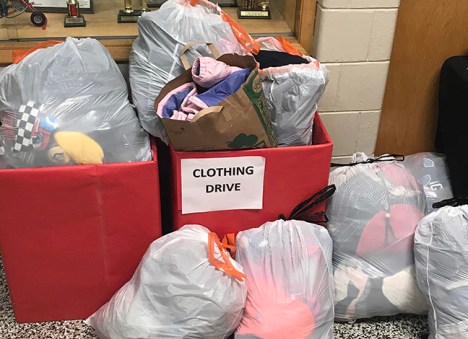
Here are some results from the St. Vincent de Paul donation drive held in early November 2017.

Children at the school and members of the parish donated canned goods and other goodies for Thanksgiving.

There are many ways to get involved and help with the refugee process. If you want to be a positive impact on these people’s lives, here are a few ways that you can help out,  according to rescue.org and ccsutah.org.

  • The Refugee Family Mentor Program pairs volunteers with refugee families who are now living in Salt Lake City. Volunteers will guide these families through areas such as education, health care and accessing local resources. The most important aspect of this program is that volunteers become friends with these New Americans.
  • Joining the Know Your Neighbor Volunteer Program will allow you to mentor New Americans and help them become a part of the community. This program is run through the Salt Lake City Office of Diversity and Human Rights. Jennifer Seelig, the director of community relations, oversees the program.
  • Donating supplies, food and money can often be the simplest yet most effective way to give back. The International Rescue Committee is an organization looking for donations to help it provide newly arrived refugees with the basics they will need to start over. Some supplies that are most needed are baby products, toiletries and hygiene products.
  • KUTV lists some drop off locations:
    • Lincoln Elementary School, 3700 S. 450 East, Salt Lake City.
    • International Rescue Committee, 221 S. 400 West, Salt Lake City. Donations can be made between 9 a.m. and 5 p.m. with advance notice. To set up a time contact Jesse Sheets, IRC development coordinator, at donateSLC@rescue.org.
    • Catholic Community Services accepts donations Monday through Thursday at the CCS Sharehouse, 440 S. 400 West in Salt Lake City. If you don’t want to travel, monetary donations may be made online.

Helping someone in need can be one of the most rewarding experiences in life, Danielle Stamos said. Organizations and volunteers help can make all the difference in the world. Helping refugees is not only appreciated but it can also be rewarding for the volunteers. It can provide a new life experience for donating their time to help and give them a new perspective on the world.

“Volunteers help us reach our full potential as an organization,” Stamos said. “They allow us to provide more help to those in need.”

Social media fundraising for refugees: A dream nightmare come true

Story and slideshow by JACE BARRACLOUGH

The creation of social media has connected people worldwide. For some, it’s a tool used to help refugees of war-torn countries. Through various organizations, a person can simply click a link that redirects them to a donation site where they can send money to provide relief to refugees struggling to survive financially, medically and educationally. But, knowing where the money is going is crucial.

Humanwire is a website geared toward assisting refugee families. It claims 100 percent of donations go to the cause. It was founded by Andrew Baron in Boulder, Colorado, in November 2015. It has marketed itself by encouraging its followers to share personal stories of their supported refugee families and donation campaigns via social media. Just like most businesses, Humanwire understands that word of mouth from those you trust bridges the gap between hesitation and execution when it comes to buying a product — or in this case, donating money.

“I was made aware of it because of another friend who posted about it on social media,” says Molly Jackson of Park City, Utah, in a phone interview. “When I saw her experience and how easy it was … [I said] I’m going to do that.”

Humanwire allows donors to choose a refugee family to support by way of social media-like profiles on its website. The amount that is donated, whether all at once or collectively, allows donors greater or lesser degrees of interaction with the family. Individuals providing smaller donations are awarded limited information about the family they have sponsored, whereas larger donations allow you to interact with them via live-stream on Skype.

Jackson says she hasn’t donated or posted about it for months. However, she receives email notifications that friends and strangers alike continue to donate to her chosen family as a result of her old social media posts. She’s received single donations to her Humanwire account totaling $1,000 to support her refugee family. Some are from people she doesn’t even know.

“It’s as easy as posting an Instagram post,” she says. “You just say, ‘Look at these people. They are in need. I’m the host. Here’s the link. Donate your money.’”

Trusting that their friends and loved ones are vetting the organization, it has left little thought for many to follow through with the research portion of the company before handing over their hard-earned dollars.

In the summer of 2017 it was claimed in a YouTube video, posted by Humanwire’s co-founder Andrew Baron, that the director of its “Tent to Home” program, Anna Segur, had stolen $10,000 via ATM withdrawals.

“The theft was followed by intense slander, criminal activity and harassment,” Baron says in the description portion of his video. “She caused many people to join her cause, misleading volunteers to believe that she owns and controls Tent to Home, and causing many of our staff members to quit out of pure fear for her slander.”

The other co-founder of Humanwire, Mona Ayoub, was living in Lebanon, taking care of the company’s donations, schools, students, teachers, employees, and registering refugees. In August 2017 after the funds stopped, Ayoub said via Facebook Messenger, she flew to the United States to get to the bottom of the issue. Unfortunately, she discovered Baron had mismanaged the funds and misrepresented the way they were being used. She said Baron claimed the money had gone toward operating costs even though Humanwire had promised all donated funds would go to the refugees.

In September 2017, Baron later admitted to the Denver Post to have taken as much as $80,000 over the last two years. However, after a police investigation, it was discovered that Baron had taken over $100,000 from Humanwire and was arrested on felony charges of charity fraud and theft.

Ayoub submitted her letter of resignation on November 1, 2017.

“Had I known the extent of mismanagement and misrepresentation prior to traveling to the United States, I would have resigned immediately,” Ayoub said.

Yet more problems have surfaced since the claims against Humanwire. The organization has started to lose its partnerships with other organizations dedicated to helping refugees.

“Standing With Alana” is a group whose mission is bringing awareness and aid to the Yezidi people from Syria who are facing a genocide at the hands of ISIS.

On October 8, 2017, Standing With Alana announced via Facebook, “Standing With Alana is no longer working through Humanwire due to financial problems within the organization. We are now communicating directly through Yezidi Emergency Support (YES).”

Yezidi Emergency Support team leader Anne Norona was one of Humanwire’s contacts overseas. As Baron tried to extinguish the flames of ridicule on Humanwire’s Facebook page, Norona added more fuel by expressing her frustrations in a reply to Baron’s YouTube video, which he later shared on Humanwire’s Faceboook page.

“I asked you in JUNE to send the money when I last went to Iraq,” she says. “There are FOUR Yezidi families you owe a LOT of money to.”

With allegations publicized, both internally and from its partners, it has left donors wondering what happened with the money intended to help their refugee families.

“I did photo shoots and donated all the money I made to them,” says Terra Cooper of Syracuse, Utah. “It was a sacrifice for my family since usually that’s how I pay for our Christmas.”

Through Humanwire, donors like Cooper have their own financial account to hold money for their refugee family. Whenever the family needs certain items they can use that money to purchase them on Humanwire’s site and have it delivered by local representatives. At least, that’s how it’s supposed to work?

“I’ve released money for surgeries and medical bills and they’ll send me a picture of them holding the check,” Cooper said in a phone interview. “They’ve been good at sending that kind of stuff.”

However, she says she’s noticed over the last few months things haven’t quite been the same. Cooper has had approximately $1,000 left of the $3,000 she raised in her family’s account, but she has been unable to use it.

“I’ve been trying to release that $1,000 for their rent for three or four months and it still hasn’t been released,” she says. “I have been emailing them and I haven’t heard back.”

Cooper even went as far as commenting on Humanwire’s Facebook page asking for answers, but says her post was deleted by the company. When trying to get in touch with her point of contact, she was made aware that person had left the organization.

“I’m sick about it,” she says. “I don’t care about me, though. That money was supposed to be rent money for my refugee family.”

Cooper’s love for her refugee family, with whom she has kept in contact, is what has fueled her to investigate the dealings of her funds. After all, at the end of the day it’s the refugees, not the donors, who suffer the biggest loss.

“The organization did do a lot of good in the beginning,” says Laurel Sandberg-Armstrong, a donor of Humanwire. “My guess is they expanded too fast and lost control,” She said in a phone interview.

The Federal Trade Commission encourages anyone who is thinking about donating to a charity to do research beforehand. Well-known organizations such as the United Nations High Commissioner of Refugees (UNHCR) and the International Rescue Committee (IRC) are generally good options for those wanting to donate.

Humanwire was contacted for comment. An employee replied via Facebook Messenger saying the accusations were misunderstood and they still encourage people to support their organization.

“Humanwire is awesome,” a representative from Humanwire said in a Facebook message. “Please give it a try and see for yourself.”


This slideshow requires JavaScript.

Tom Huynh brings experience as Vietnamese refugee to West Valley City Council

Story and photo by EMILY ANDERSON

When he first arrived at Philippine First Asylum Center (PFAC) in the island province Palawan from Vietnam, Tom Huynh was shocked by the “horrible” conditions of the camp.

“It was a sad place, very depressing,” Huynh said. “But people had no choice.”

He was immediately placed in a 12-by-12 room with seven other people. His unit was given a card identifying everyone in the flat, which allowed them to obtain two cups of rice, one piece of broccoli and two pieces of fish to be divided among the occupants each day.

As Huynh was standing in line to collect the food during his first few days in the camp, he met a man in his 60s. The man told Huynh that he had a lot to learn in the coming years — the refugee camp was a whole new world.

The pair arrived at the front of the line. The fish given to the man was rotten, although there was a heap of fresh fish behind the refugee who had been assigned to pass out the rations. Huynh said he protested the unjust treatment, but the man stopped him. He told Huynh the pile of newly-caught fish was being saved for the distributor’s family and friends.

After thanking Huynh for standing up for him, the man said, “Tom, promise me that if you’re ever in a position of power, you will treat people fairly.”

Huynh said he has always remembered the man’s plea and it has influenced the way he lives his life.

Vietnamese refugee Tom Huynh has served on the West Valley City Council for six years.

Since coming to the U.S., Huynh has pursued a career in politics while working as a real estate agent. He was elected to the West Valley City Council in 2011, and is in his second term in the District 1 seat.

Huynh’s journey to government leadership began with his father’s efforts to defend his own government.

Journey to Safety

In the aftermath of the Cambodian-Vietnamese war, in which the Socialist Republic of Vietnam invaded Democratic Kampuchea to remove the Khmer Rouge from power, the Vietnamese military continued to fight against armed Cambodian groups who opposed the new regime until 1989.

The government continued to tap all men above age 18 for military service. Many of Huynh’s friends had been drafted to patrol the Cambodian borders. Many were killed. Some returned home with missing limbs, he said.

Huynh’s father, a South Vietnamese soldier, was killed in the Vietnam War when Huynh was 5 years old. This left his mother to care for her children alone, which included bribing military officials to keep Huynh out of the military.

When the financial pressure on his mother became too great, Huynh said he fled the country on a boat with his 15-year-old sister Tiet in 1986 to avoid being conscripted.

Between 1975 and 1995, others were leaving the country to escape economic despair brought on by U.S. sanctions and destruction left in the wake of the Vietnam War.

Huynh and 99 other refugees packed into a boat that was approximately 10 feet by 30 feet. The group was so densely crowded that Huynh was confined to a singular spot the entire trip.

At one point on the journey, the boat became lost. The party ran out of food and water, then people began dying.

“Everyone was scared to the point that they were like, ‘I see you and you see me, but we’re not human beings anymore,’” Huynh said. “They knew they were going to die.”

It was a miracle that Huynh made it to the refugee camp, he said.

“At that moment, I was not a religious guy,” Huynh said. “But I looked into the sky and I said, ‘I really don’t want to die. I’m only 19. So please help me out.’”

When he arrived, Philippine First Asylum Camp hosted about 3,000 people on approximately 1 square mile of land. The refugees were desperate and crime rates were high.

“There was everything there,” Huynh said. “I witnessed a fight where someone stabbed someone else about 2 or 3 feet from me, for no reason really — it was over the water.”

Huynh was trying to avoid being lured into crime like the other men his age in the camp, he said, so he volunteered to pass out mail to other refugees.

“I didn’t want to waste my time,” Huynh said. “I like to work, and the employees at the camp center could see that.”

After three months, he was promoted to deputy of the planning commission. His job was to keep records of how many people were staying in each housing unit, then assign rooms to new arrivals.

“It kept me very busy, all day every day,” Huynh said. “I was lucky, because then I stayed out of trouble.”

Despite the success he found in the camp, Huynh wanted out. The refugees were plagued with rampant alcoholism, drug addiction and violence, while many young women were forced into sex work as a means to make money.

Six months after Huynh arrived at the camp, representatives from the U.N. came to interview refugees to be considered for admission into the U.S. They prioritized people like Huynh, who were children of South Vietnamese soldiers. However, there was one stipulation — refugees had to provide multiple documents to prove their parents’ position.

“My dad sacrificed his life, so I had the privilege to go to the city center to speak with the delegation,” Huynh said.

Huynh slid his father’s military ID — one of the few things he brought on the boat — across the table at his meeting with a U.N. official. This was the only document he had, because his mother, like many other South Vietnamese, burned documents connecting their family to the American forces to avoid persecution from the new government.

The official, whose name Huynh recalled as Pam, told him that although she wanted to sponsor him, she couldn’t. The ID wasn’t enough documentation to prove that he was the son of a South Vietnamese soldier.

Huynh said he began to worry that he would never be able to leave the camp.

Then, as part of what Huynh called another miracle, there were a series of coup attempts on the Filipino government — one of which resulted in a fierce battle on the streets of Palawan.

The U.S. government became concerned about the welfare of refugees on the island, so it gave a number of those living in PFAC another opportunity to be interviewed for acceptance into the country. Huynh was given a second chance to get out.

Although Huynh was unable to obtain additional documentation, the official he met with told him he had been cleared to leave the camp, and would be transported to the Philippine Refugee Processing Center (PRPC) in Bataan. His next and final stop would be the U.S.

He left PFAC in 1987. Soon after, the U.N. stopped accepting refugees into the camp and began reducing its size. Some people volunteered to return to Vietnam, while others fought the guards and committed suicide.

Huynh was elated to be relieved of the uncertainty associated with being a refugee.

“You don’t know where you’re going to go, where you’re going to end up or how your life is going to be,” he said. “Are they going to send you back to Vietnam? Are they going to send you to Canada, Australia or somewhere else? You just don’t know. Your destination, your life, depends on someone else. It leaves you feeling powerless and useless.”

While at PRPC, Huynh met missionaries from the Church of Jesus Christ of Latter-day Saints who were teaching English.

He said he was curious about the religion, because he had been on a quest to find the right religion for him since his plea to God earlier on the boat. Huynh’s family was Buddhist, and he previously attended Catholic and Baptist churches.

“I just wanted something that felt comfortable,” he said. “At the Mormon church, I had a sense that they were nice people.”

When Huynh was processed and relocated to the U.S., he was baptized into the church and served a mission in Washington, D.C., from 1990 to 1992. Huynh credited the changes the religion forced him to make and the lessons he learned on his mission for many of his life’s successes.

“I wanted a different path in my life, and my decision brought me to where I am today,” he said.

Ongoing Political Journey

Huynh later graduated from Brigham Young University with a degree in Asian studies. Upon graduation, he was appointed president of the Vietnamese Community of Utah. He hopes to eventually go to law school, but for now he wants to continue his political career.

“Politics are very complex,” Huynh said. “In China, Vietnam or any communist country, they don’t trust government. They don’t trust police. Then when [people from those countries] come here, they stay away from government and police — but I want to be different. I want to do something to help people around me.”

His determination to forge a path for marginalized communities in politics not only increases the diversity of voices at the table, but also encourages other minorities to be involved in the community.

“It is inspiring to see someone so close to home break down socio-cultural barriers and proving that we are capable of taking on larger roles like politics,” said the Vietnamese-American Student Association at the University of Utah in a prepared statement. “The younger Vietnamese-American can often feel detached from the government due to lack of [Vietnamese] representation, often discouraging them from participating in civic engagement. Tom Huynh’s position as the West Valley City Councilman empowers the younger generation and encourages them to strive toward active political awareness.”

Caren Frost, the director of the Center for Research on Migration and Refugee Integration at the University of Utah, said in a telephone interview that civic engagement is the last step of integration for a refugee. She feels that as Huynh continues to succeed, his political involvement will extend beyond Vietnamese-Americans to inspire all refugees in Utah.

“If a refugee is visible in the community participating in government, then all refugees will feel more comfortable taking the next step and getting involved,” Frost said.

As a city councilman, Huynh focuses on mending the problems of not just refugees, but other groups who are also frequently forgotten. He reaches out to senior citizens in the community to listen to their perspective. Since 2013, Huynh has gone on twice-monthly ride-alongs with police in an effort to solve the city’s crime problem.

“In government, you can change things,” Huynh said. “And that’s what I’m doing.”

Working with refugees in the Salt Lake Valley

Story and photo by ZACH CARLSON

Chandra Sapkota lives with his wife and children in Salt Lake City. Sapkota currently works three different jobs. He works as a translator, he helps refugee families with children under the age of 3  at a local organization called Discover, Develop, and Impact (DDI) and he assists students part time at Cottonwood High School through the Granite School District.

Sapkota began educating people and helping parents while he was living in a refugee camp in Nepal. Sapkota lived in this camp for 18 years before the United States accepted him as a Bhutanese refugee in 2009 — one year after America began taking these refugees in.

Once Sapkota came here to Utah he met a friend who was working for DDI who helped him get a part-time job as a translator. Sapkota began to work his way up the corporate ladder and began to get more hours. He quickly became a full-time employee going into homes and doing what Sapkota referred to as “parenting.” This means that he helps the parent give their kid a better childhood, hopefully leading to a better adulthood and life.

“The DDI focuses on education and parenting,” Sapkota said. He goes into homes that have children up to 3 years old and helps the parent raise the children while honoring their culture. How Sapkota helps the family honor their culture varies from background to background, but with most cultures it involves making sure that they eat the proper foods to get enough nutrition without compromising their values on what foods are acceptable.

DDI works with families of all incomes and ethnic backgrounds in the Salt Lake Valley. Sapkota specializes in refugee families that typically fall beneath the poverty line. “I visit and work with 11 different families and spend 90 minutes with each of them,” Sapkota said.

One of the biggest unseen challenges that refugees face is not only getting enough food, but also getting healthy food. According to the Centers for Disease Control and Prevention, undernutrition has been reported in many cases with refugees. The CDC also stated that “although undernutrition is often associated with refugee status, concerns are increasing about overweight/obesity among refugees resettling to developed countries. Overweight and obesity are frequently assumed to be associated with assimilation to a U.S. lifestyle (increased availability of high-calorie foods, reduced physical activity), compounded by lack of nutritional education.”

This is where Laureen Carlson comes in.

Carlson is a frequent collaborator of Sapkota’s, working together to help Nepalese families. Carlson is an employee of the Expanded Food Nutrition Education Program (EFNEP), whose goal is teaching people and families, particularly those who are lower income, how to eat healthy on a budget.

EFNEP is available in every state and most territories, according to Carlson. EFNEP is funded in Utah by Utah State University in Logan, through its agriculture department.

She met Sapkota while teaching a Nepalese family with whom he was working as a translator. Sapkota contacts EFNEP and asks for Carlson to come and help these families with nutrition. He requests her because she is good with the families and everyone else working for EFNEP in the Salt Lake area has quit, citing low pay for their leaving within the last five years, according to Carlson.

Carlson said she has taught roughly 20 different refugee families about nutrition, most of them from Nepal. She said it has been quite a culture shock for her as well as the families she teaches. She said, “One of the things that surprised me the most was how many people live in these small living spaces. You’ll oftentimes have three or four generations of a family living in a two- or three-bedroom apartment.”

Another aspect of living that astounded her was the sleeping arrangements. “A lot of these families do not have enough mattresses for everyone. In some cases, everyone sleeps on the floor with blankets. One family had couches along the edge of their living room where they slept in shifts,” Carlson said. “Family members who worked the night shift would be sleeping on the couches during the day, then the rest would take the available couches when the others went off to work.”

Laureen Carlson with the cute puppy of a family she was teaching in Kearns, Utah. She is an avid dog lover.

Carlson said that one of the hardest parts of working with refugees is helping them eat healthy while also honoring their traditions and customs. When working with Nepalese families she said that most of them want to eat goat, lamb, or yak, which happen to be some of the more expensive types of meats. “Our goal isn’t for them to eat like us. Our goal is for them to eat healthy and affordably,” Carlson said.

What can be especially hard for some refugee families, Carlson said, is making food for everyone in the family. Carlson said that in every refugee family she has taught nutrition to, the children receive free breakfast and lunch from their schools, due to the family’s low-income status. Carlson said the kids really like the food here and ask her to teach their parents how to make it, which can cause problems at home.

“The kids like some western food like tuna casserole, and the parents are willing to make it for them. The problem comes in with the grandparents and great-grandparents. They only want to eat their home food, which is understandable, but sometimes the kids don’t. A lot of these families don’t have the money to make two separate dinners, so it can lead to a sort of rock and a hard place,” Carlson said.

Sapkota has been an active member of the refugee community in Utah since he arrived here, but Carlson is a much newer addition to the community. As Carlson works with the refugee families she becomes closer and closer with them, with her even being invited to some family parties and functions. Sapkota and Carlson both work hard with refugees trying to help them provide for and take care of their family.

The Boys and Girls Clubs of America step up to help refugees

Story and photos by KATIE UNDESSER

The Boys and Girls Clubs of America are making a positive impact on the refugee community by providing open activities for them to enjoy. Refugees come into a new country and more often than not do not know anyone. According to statistics from UNHCR an extraordinary 65.6 million people have been forcibly displaced from their homes. Among them are nearly 22.5 million refugees, over half of whom are under the age of 18.

The Boys and Girls Club of Sugarhouse located at 968 Sugarmont Drive offers several after-school programs.

During the day while the parents are at work the kids are either in school or at an after-school activity.

Ghufran, a refugee from Iraq, said, “While my parents are at work I have nothing to do but to sit by myself so I try to find things to keep myself busy. On Wednesdays, I am able to go bowling with some friends. I am a manager at Burger King and go to the Boys and Girls Club.”

Ghufran, who is 17, arrived in the United States in January 2017. She was fortunate enough to be educated in English years before arriving, which made her resettlement a little easier.

According to Brian Grace, who worked for Catholic Community Services (CCS) for a year as part of the AmeriCorps VISTA program, “Every story is different. You get some people like Ghufran who spoke English before they came here and succeed in school and have a plan for college. Then you have others that never spoke a word of English before they got here and are a senior in high school and they aren’t going to graduate.”

Amira, a refugee from a city in western Syria called Homs, said, “I first came to the States not knowing anyone. It was hard making friends. My mentor set me and my brothers up with the Boys and Girls Club to help us socialize more. I hadn’t heard of this place before and we had nothing like it back in Homs.”

The Boys and Girls Clubs of America (BGCA) mission statement says, “To enable all young people, especially those who need us the most, to reach their full potential as productive, caring, and responsible citizens.”

Refugees such as Ghufran and Amira opened up to the possibilities that the BGCA could offer them and their siblings. There are eight locations throughout the Greater Salt Lake area.

BGCA takes part in the McKinney-Vento Homeless Assistance Act in coordination with any school district and city council not only in Utah, but all across America to help families who are considered low income. This act essentially helps refugees and those with low incomes come to the Boys and Girls Club for free to use their amenities.

The BGCA has several grant-funded programs including Power Hour: Making Minutes Count, Career Launch, CyberSafety and Healthy Habits.

According to BGCA, Power Hour: Making Minutes Count provides Club professionals with the strategies, activities, resources and information to create an engaging homework help and tutoring program that encourages Club members of every age to become self-directed learners.

The playground at the Boys and Girls Club of Sugarhouse creates a space for children to get some recreation.

Along with the programs listed, the BGCA offers leadership programs, community service programs, resume help and skill building for job seeking.

Since Ghufran’s arrival in Salt Lake City, she has learned to be a successful manager at Burger King and has a plan for after high school. Ghufran is currently a senior at Murray High School and plans to pursue her college education at Salt Lake Community College after she travels for a couple of months.

“The Boys and Girls Club helped me build my resume for college and receive scholarships so it could even be possible for me to go to college. I am planning on traveling after high school, but I am sad it has to be in the States. I do not have [a] green card yet to travel. Then I plan on going to SLCC (Salt Lake Community College) for two years and then the U (The University of Utah),” Ghufran said.

Amira, who is 17, is currently a junior in high school. She arrived in Salt Lake City in March 2016 with little-to-no English skills. Amira is continuing to go to BGCA to receive the benefits from attending. Her English has gotten better over the year but she wants to improve it more.

Gerald Brown, the dedicated man behind Salt Lake City’s refugee community

Story and photos by KAYA DANAE

Gerald Brown, the assistant director of refugee services and state refugee coordinator at the Utah Department of Workforce Services, has lived a life dedicated to refugees.

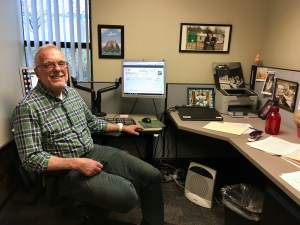
Gerald Brown at his office in the Utah Refugee Education & Training Center at 250 W. 3900 South, Bldg. B.

Born and raised in North Carolina, Brown’s passion for humanitarian work began after college, when he spent two years working in Cairo, Egypt, developing programs for the YMCA. He then went on to teach English in Taiwan for a little over a year. When he returned to the U.S. he inquired about jobs that meshed with the work that he had been doing overseas. He learned about a refugee resettlement program in the U.S. that had started while he was out of the country. He got a job at its Houston location, where he says his real education began.

The first family Brown helped resettle was Cambodian. They arrived the same day Brown started his job. “There were four people in the family. A father, mother, baby and a little boy– the little boy was very malnourished,” Brown said.

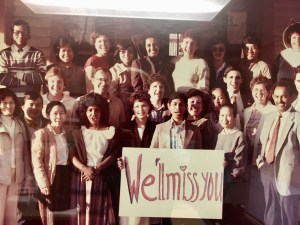
A photo given to Brown when he left his job in Houston. The man holding the sign is the Cambodian refugee whom Brown hired. Photo courtesy of Gerald Brown.

“They had been at the Khmer Rouge forced labor camps. The father told me their story and I couldn’t believe it. They were almost starved to death, it was very, very brutal,”  he said.

Throughout the ’70s tens of thousands of Cambodians fled to the Thai border because of the ongoing civil war and U.S.- led bombings. Khmer Rouge was a rebel-political group that established makeshift camps along the Thai border where Cambodian refugees were living under awful conditions. About one-fourth of the 8 million Cambodian people were murdered or starved during this time.

Brown spent four years working as a refugee resettlement job developer in Houston, and established a relationship with the father. Brown ended up hiring him to work the night shift at the refugee welcome center. The family has gone on to own a home and live a happy, healthy life, Brown said.

“He taught me that people are very resilient. It’s possible to overcome horrible experiences and go on. This job has shown me what people are capable of,” he said.

Brown was later hired as the director of refugee resettlement in New York City, where he met his wife and lived for 13 years. He began working for Asylum Corp. in 1995 and led a project where he brought social workers into Haiti with a military operation. After four years he felt restricted by the position and left.

He and his wife moved to Kanab, Utah, where he worked remotely giving technical assistance to a resettlement organization in Washington, D.C. Through this position he traveled to Saudi Arabia, where he worked with a U.S.- vetting organization. He also traveled to Macedonia, where he worked to prepare refugees for asylum, and Croatia, where he conducted the UN’s initial interview for Bosnian refugees.

Rachel Appel, the volunteer coordinator for the Know Your Neighbor Volunteer Program, has worked closely with Brown and emphasized his breadth of knowledge on refugees. “If I ever have any kind of question, he has the answer. He knows the policy, the cultural aspect of working with refugees, the history of refugees in the U.S. — really just all-encompassing,” Appel said. “He’s got really strong relationships with refugees here in Salt Lake City. One of the refugees, Joe Nahas, once said to me, ‘That man’s got heart,’ which just perfectly describes Gerald.”

Brown said with a smile, “I think working with refugees has enriched my personal life. It’s hard to imagine the two (work and personal life) being separate.” 

Utah Refugee Education & Training Center, where Brown, Appel, and Dulal work.

Gyanu Dulal, the refugee center program coordinator at the Utah Department of Workforce services, was a refugee from Bhutan. He recalls Brown’s dedication to his work. “I was introduced to Gerald in 2008 by one of our community members. Since then I have a very good relationship with him. I have never seen anybody so dedicated, motivated and committed to help the refugees.”

Dulal continues, “In these nine years that I have been working with him, I have never seen him say this cannot be done. Every refugee here has access to his personal cell phone. He is willing to talk to anyone at any time to find help the best way he can.”

Speaking about the most challenging aspect of his job, Brown said, “The way they (refugees) have been treated is infuriating. It’s very depressing and it just keeps getting worse and worse it seems. And that’s hard. I’ve had a hard time working within bureaucracy. There’s always red tape when you just want to cut to it and get stuff done. But, you know, you do what you can do.”

Brown quickly turned to the most rewarding aspect of his job. “Knowing refugees,” he said. “I know several people that have come out of camp with nothing. They are totally shell shocked, and there is PTSD and you just wonder how in the world are they ever going to make it, and they do. It’s perseverance, you know? It shows you what people can be capable of.”

While working with refugees has benefitted Brown in his personal life, Dulal emphasized how Brown has benefitted the refugee community.

“His tireless and dedicated effort to the Refugee Resettlement Center has been so helpful for all refugee communities to get the support that they need. We have employment, treatment, education, everything here. And this is a hub for people to come and learn about refugees as well, so it is an integrating space. Gerald reaches out to individuals to come forward, learn about refugees, make friends with refugees, that way they understand each other and help.”

Pamphlets advertising resources available to refugees.

Becoming emotional, Dulal said, “Gerald is the man I have known, he’s the best person I have ever found in my life. If anybody has a heart for the refugees, and knows more about refugees than anyone, it’s Mr. Gerald Brown. I have never found anybody so willing and so open to help refugees.”

Brown stressed the importance of education – learning about the global refugee crisis and understanding the situations facing people who are forced to flee their homes due to war and persecution.“Refugee resettlement is incredibly important. These people are refugees by no fault of their own. If anyone deserves support, it’s refugees and asylees,” Brown said. The Utah Refugee Education & Training Center offers many volunteer opportunities.

Refugees given tools to adjust to a new culture

Story by SCOTT FUNK

What makes a home? Is it the people you live with, or is it the pictures and decorations within the house? Is it the home-cooked meals, or the fun and games with family and friends? No matter what it is, a home can be defined in many ways. However, leaving the place you call home often is only described in one way: difficult.

Gerald Brown, the Utah state refugee coordinator and assistant director of the Refugee Services Office, has dedicated his life to helping refugees.

Throughout his lifelong career, he has constantly been “trying to make the world a little more fair.” He has found his motivation to do his work based off what he has seen and experienced. “Leaving their country is difficult and traumatic,” Brown said. “And the resettlement process is just as difficult and often traumatic.”

On a daily basis, Brown works side-by-side with the International Rescue Committee (IRC) developing programs designed to make the resettlement process less traumatic. One of these programs that the IRC has established is called Adjustment Support Groups.

Jennica Henderson, the mental health program coordinator for the IRC in Utah, said in a phone interview that the curriculum of these groups consists of three parts: adjusting to the U.S. and a new culture; mental health; stress management and community wellness and development.

Henderson said the curriculum was designed by a company in Seattle called Pathways to Wellness. She said the curriculum and groups are designed to “provide education and skill development around mental health and well-being. It is also designed to develop community support for one another so that our participants can rely on one another.”

Following the curriculum, refugees participate in an eight-week course featuring a new topic weekly that falls under one of the three key concepts of the curriculum. These topics in order are: introduction to the group and establishing guidelines and rules; culture shock and moving from one country to another; refugee experience; mental health and tools to overcome stress; mind and body connection; goals and dreams.

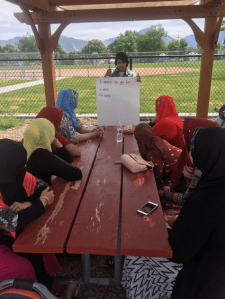
Adjustment Group at the Central Park Community Garden. Photo courtesy of New Roots SLC.

In Utah, these groups are just getting underway, as they have only been in use since fall 2016. They are funded by grants and currently run in the spring, summer and fall and are only offered to women. However, the program is expanding to start its first male group in spring 2018.

For now, the program meets at the Central Park Community Garden, located at 2825 S. 200 East in Salt Lake City.

The signup process for the group is simple: there is none. When a refugee is resettled, their location is saved within a database. Henderson said one of the goals of the program is to make the ability to attend as easy as possible. Therefore, once a location for the group is chosen, based on their geographical location, refugees are then called and invited to attend.

When invited, refugees are asked what day and time would work best for their schedules. Based on the results, a day and time is chosen that is best suited for the majority. Refugees are also informed in that call that the IRC provides transportation to and from the meetings, food and childcare for who attend.

In Utah, up to three separate support groups are offered at once. These groups are led by three instructors — Jennica Henderson, Alex Haas and Sara Franke — all of whom are employees of the IRC and have completed hands-on training to know the curriculum and know how to best help the refugees in their process of settling in a new culture.

One of the instructors, Alex Haas, said in a phone interview that he believes these groups are helping refugees become self-sufficient and that they are creating a “community of wellness.”

As refugees come and participate in the program, they meet new people and develop new relationships. Although the programs may never replace everything that a refugee lost, they are succeeding in what they were meant to do: helping resettle in a new home.

Granite School District forms charter school to serve refugees and immigrants

Story and photos by KATIE UNDESSER

Take a tour of Utah International Charter School.

Non-English-speaking children now have the opportunity to go to school with a curriculum catered to them in Granite School District.

The Utah International Charter School (Utah International), located in South Salt Lake, Utah, held its first class in August 2013. When opened, it launched with a total of 94 students and six teachers, two of whom were part-time.

UTAH International11

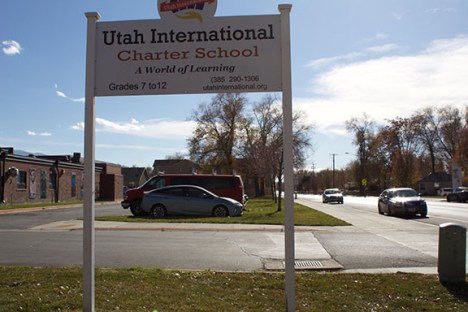
Utah International Charter School, located at 350 E. Baird Circle in Salt Lake City, provides a curriculum catered to refugees and immigrants.

By Oct. 1, 2013, this seventh- through 12th-grade charter school had 104 students attending its classes.

There was another school before Utah International was established that educated refugees and non-English-speaking students. However, it was shut down due to segregation issues.

“District politicians decided they couldn’t have a school that segregates because it’s a Civil Rights violation,” said Angela Rowland, principal of Utah International.

According to Uncommon Schools, a charter school is an independently run public school that is granted greater flexibility in its operations, in return for greater accountability for performance. It is a publicly funded school established by teachers, parents or community groups under the terms of a charter with a local or national authority.

The Board of Trustees, including Steven Winitzky, Wanda Gayle and others, were concerned about the high drop-out rate of refugees. Some were falling behind because their English was not at grade level or they hadn’t learned any yet.

Now, Utah International has nearly tripled in enrollment with 245 students and 18 full-time teachers along with six staff members. Approximately 90 percent of the school’s enrollment consists of students whose first language is not English; 80 percent of whom are refugees.

“It’s like a little U.N. (United Nations) where you can walk down the halls and hear eight different languages,” said Heather Amir, one of Utah International’s para professionals who helps with the special education students.

“They (the kids) are mainstreamed into regular classes and so if they don’t need assistance, I can go help other students. Mainly the English-learners are the ones I help with when they need help with the understanding of words, spelling, definitions – that kind of stuff,” Amir said.

“I aid the special-education students by helping them get focused, receive the materials they need and assist them in following directions,’ she said.

The success of Utah International is based on the model of Sheltered English Instruction from the International Network for Public Schools, Rowland said. This model is designed to make every subject accessible to students no matter their proficiency in English.

Students are put into a classroom where they are assigned to groups. Within these groups, they all face each other. This set up makes it so the students are required to talk to each other to get their work done versus having a teacher talk at them.

ClassroomUtahInternational11

One of the classrooms at Utah International, where students work in groups.

“I feel almost like the aunt who’s not like a huge part of their lives, but they always know I’m there and if they ever need anything they can come to me,” Amir said. “Sometimes, I have to say ‘I can’t help you, but let me find somebody who can,’ and I think that really is an empowering tool for them to see.”

This model gives the opportunity for those students who speak different languages to find the one common ground in English.

“How do I make it so even my students with a low level of English can think about it to interact with that material?” Rowland wonders. “That’s called scaffolding.”

According to The Glossary of Education Reform, “scaffolding refers to a variety of instructional techniques used to move students progressively toward stronger understanding and, ultimately, greater independence in the learning process. The term itself offers the relevant descriptive metaphor: teachers provide successive levels of temporary support that help students reach higher levels of comprehension and skill acquisition that they would not be able to achieve without assistance.”

The majority of the funding for Utah International comes from the state of Utah

“We are chartered by Granite, but we pay full market rate, we don’t get any deal from them,” Rowland said.

Granite School District does not advertise Utah International on its website.

“The reason behind this,” Rowland said, “is because if a student goes down to a public school and they realize that student speaks zero English they will say ‘Oh, you speak no English, we’re going to send you to Utah International,’ when in fact that is when it becomes a segregating issue.”

uICS

Utah International as you walk in the front door.

By law, Utah International is required to accept anyone who would like to attend as long as it has room for them.

Utah International is not just a school that teaches geography, science, math and more. It is a school that provides teenagers with vision and self-worthiness.

In 2016, Eagle Vision, a private nonprofit, volunteered to come to Utah International to give free eye examinations. Rowland said 90 students needed glasses.

That same nonprofit chartered two buses to take the 90 students to get their follow-up exam. A couple of days later, Eagle Vision came back to the school to fit those 90 students with cost-free glasses.

Utah International provides free breakfast, lunch and even dinner to most of its students. Between the time of school dismissal until dinner, the school is open to them all where it offers various after-school programs or activities. These activities include homework help, dance, soccer, basketball and cooking.

MuralUtahinternational

Murals of the graduating class of 2016 created by the summer art program.

Adrienne Buhler, the after-school programmer, was hired by the City of South Salt Lake. She partners with Utah International through the program Promise South Salt Lake.

Buhler said, “Our mayor (Cherie Wood) made three promises to the city: every student will graduate from high school and go onto a post-secondary degree, every neighborhood will be clean and safe and every family will have the ability to be healthy and prosper.”

Rowland said, “The library is opened so students can do homework and use the computers. Unlike a lot of schools, we allow them to use YouTube. At home, they don’t have Wi-Fi. They all have phones, but they’re almost always broken and never have phone service.”

During the summertime, Utah International hosts several different programs that its students can attend.

“These kids want to go to school. They don’t have cars, their parents work all day and there’s nothing for them to do,” Rowland said.

She added, “Some of the programs allow the students to show their creative side in art. Others inform them on topics such as sex, relationships or drugs.”

Amir, the para professional, said, “Most of the faculty want to be here. They are investing their time and energy for these kids.”

Utah International had its first graduating class of eight in 2016. Each year, Utah International is growing as the demand for English learning classes increases.


Uniting for a cause: partnership provides promise of education for refugees in Salt Lake City

Story by ANNA STUMP

The University of Utah, in partnership with Salt Lake Community College and Jesuit Worldwide Learning, is working hard to make it feasible for refugees to earn a bachelor’s degree in social work.

Jesuit Worldwide Learning Higher Education at the Margins (JWL) is a collaborative global partnership that provides an education to those who are marginalized, including refugees, internally displaced people, economically poor, and socially neglected and underserved.

JWL, whose global headquarters is in Geneva, constructs online and in-person learning centers around the world. It offers three levels of educational opportunities, including the Academic or Diploma Program. The online infrastructure allows those in remote villages or in refugee camps, without locally operated schools, to gain an education.

Once a refugee finishes with the programs provided by JWL, the student can begin taking online classes from Salt Lake Community College. Students who complete their last 15 credit hours with SLCC can earn an associate degree. The college has agreed to charge refugees in-state tuition.

Once an associate degree is earned, the University of Utah hopes to take over from there.

Laying the groundwork

Patrick Panos, a professor of social work and director of Global Education and Outreach at the U, is the driving force behind the effort to provide refugees with a chance to earn a bachelor’s degree and become leaders in their respective communities.

“Without an education, all you have is your physical labor to sell. And if all you have is your physical labor, that is a time-limited commodity,” he says.

JWL laid most of the groundwork for SLCC and the U by setting up a structure for education in distant war-torn areas that the colleges wouldn’t dare enter. Panos says he is grateful for the organization’s work.

“They’re going to places where we could not physically go. The University of Utah is not going to go open up a school in Afghanistan. But [the U] can have students in Afghanistan through this process,” he says.

STORY 2 asset

Refugees take pride in their education from the University of Utah. Photo courtesy of Karen Cordova.

Francis P. Xavier, vice president for academics and research for JWL, said in an email interview that the organization currently has learning centers in the Middle East, Asia and Africa. He hopes JWL will become more global in the future.

A trial run proved the functionality of the distance-learning program and the feasibility of providing online classes with little cost to the student. The classes at the U will be offered to student refugees who qualify. That group will become known as a closed cohort, and pay nominal tuition to the College of Social Work rather than to the university as a whole. This is significant because the college will cover the cost of classes so the refugee students don’t have to. “I can charge them a dollar a class, and that‘s OK. And the university is OK with that,” Panos says.

story 2 Case management 2

Graduates of the University of Utah’s Case Management Certificate Program in 2015. Photo courtesy of Karen Cordova.

Technology as a learning tool

Distance learning challenges historical notions of how a university operates. Traditionally, students come to campus, where they have access to amenities such as tutoring centers and the library. But an online delivery of course content makes it possible for refugees and others in marginalized communities to pursue educational opportunities.

The classes at the U will operate through Canvas, an online learning platform that connects professors and students in real time. A library database can be accessed with a student ID, so refugee students are able to access scholarly articles at their fingertips.

Kyle Jensen, director of Canvas user interface, said in an email interview that Canvas is special in terms of communication.

“Canvas, at its core, is a communication tool. As such, we aim to encourage high quality, meaningful interaction opportunities between educators and students. We also spend a lot of time and resources ensuring that Canvas works for everyone.”

Collaboration leads to reciprocal learning

Students within the Canvas classroom have much to gain from this collaboration and cultural exchange, both of which are crucial to the nature of social work. This relationship is valuable, as it allows traditional students to gain other perspectives before entering their profession.

Regarding the distance learners, Panos said, “If you want to have your students have a high impact upon graduation, these are them. They are changing the world. Educate a refugee — change the world.”

Panos pointed out that refugees who are trained in social work are then able to use this knowledge to work within their respective communities to improve the lives of the people living in the camps.

“Social workers learn how to advocate, how to do community development, how to do all of the things about how to reconstitute a community — and bring mental health in, child welfare in, and all those different pieces,” Panos says.

Refugee students speak in the native dialect of fellow asylum seekers, and have intimate knowledge of what is needed in the places where they work. Because of this insight, graduates of the College of Social Work can later seek employment with International relief efforts such as Doctors Without Borders and the United Nations.

Panos has high hopes for the future of the program. He’d like to see it expand beyond the College of Social Work, so students can earn other degrees in fields such as nursing, architecture and education. Panos also said his wish is for more refugees to have access to higher education, made possible by a collaboration of efforts from universities and programs in the U.S.

Xavier, the JWL executive, said his organization currently offers a diploma and some associate degrees. It wants to offer bachelors and master’s degrees and eventually doctoral degrees.

“I look forward [to] JWL becoming a virtual university which offers degrees of high quality for the refugees and the marginalized at affordable cost,” Xavier says.


Flying into mountains: A refugee’s point of view

Flying into mountains: A refugee’s point of view

Story and photo by JACE BARRACLOUGH

“Say what you will about America, there’s definitely a lot more opportunities here.”

Dario Jokic is a student at the University of Utah. He’s also an aspiring film director and a Fox 13 studio technician. He has spent most of his life in Utah and has no problem integrating himself into different social circles. With no accent or visible cultural differences, people are shocked to find out he’s a Bosnian refugee.

IMG_4453 copy

Dario Jokic edits news at Fox 13 Utah.

Jokic came to Salt Lake City when he was in the first grade. His family’s case worker told them Utah was a mountainous desert with people who practice polygamy.

“We thought we were literally going to fly into mountains … and the first thing that was going to welcome us there was one man with six women,” Jokic says.

The Jokic family was grateful for the welcoming they received from their new friend. They were also a bit relieved.

“She was a really sweet and energetic lady who spoke our language,” Jokic says.

He says the hardest part about his resettlement and integration was learning English.

“I hated English,” he says. “I remember my first time in ESL (English as a Second Language) class, they put me with the wrong teacher who was teaching English in Spanish.”


Gerald Brown, Utah’s state coordinator for refugee resettlement, says ESL is the state’s most costly of all the services offered to refugees who resettle to Utah. However, he says it’s still not enough.

“That funding is very, very limited. You cannot do a decent job with that funding alone,” he says.

Though Brown says there is some help from the private sector, the majority of the funding comes from the federally funded U.S. Office of Refugee Resettlement.

Brown also doesn’t see it getting any better due to recent decisions made by the government. According to the 2016 Refugee Services Office’s Report to the Governor, the State of Utah spent $171,000 on the program. However, Brown predicts that number will drop, which is bad news for non-English speaking refugees like Jokic was.

“The current [presidential] administration has different priorities,” Brown says. “It’s becoming less every year and this year we’re really worried what the budget is going to look like.”

Utah’s Gov. Gary Herbert said in a January 2017 press conference that Utah is still a pro immigration and refugee state, but made it clear those types of issues are strictly handled at the federal level. He also said Utah tried to intervene in the past but was issued a lawsuit as a result.

Gerald Brown speaks highly of the Church of Jesus Christ of Latter-day Saints’ (LDS Church) influence on the state regarding refugee resettlement. Unlike Jokic’s experience with publicly funded ESL classes, the LDS Church funds its own classes to help struggling refugees be successful.

“One of the reasons Salt Lake City and this area is a good place is because of the LDS Church,” Brown says. “They’ve put a tremendous amount of resources into helping refugees.”

While resettlers are learning English in hopes of finding better jobs, they can utilize programs like the refugee table at the Jenibee Market hosted by Jeni Gochnour.

“We provide the table and give 100 percent of their sales back to them,” Gochnour says. “They sold around $300 [at the fall event]!”

Ann Howden, of the group Serve Refugees, donates her time by teaching refugees how to sew. They make bags, pillows, blankets and other items to sell at the refugee table in order to help their families financially.

The Jokic family, themselves, know all too well the sting of trying to make ends meet without proficiency in the English language. Jokic’s father, formerly an economics professor in Sarajevo, had to take a job at a glass factory soon after arriving in Utah. Since he didn’t speak English, and his degree was from another country, it made it impossible to continue his teaching career in the U.S.

Jokic’s mother, however, did speak English and was able to find a job as a counselor for the Department of Workforce Services. She also acquired jobs as a translator for various medical facilities.

Even though there were difficulties, Jokic expresses his gratitude for the change.

“I’m very privileged to be here,” he says. “I know there’s a lot of negative things being spread about the United States, but my life would be totally different if I wasn’t living here.”

He continues, “If I was [in Bosnia] I wouldn’t be going to college. … Say what you will about America, there’s definitely a lot more opportunities here.”

Jokic gives advice to refugees dealing with the trials that come with resettlement.

He says, “Don’t be afraid to ask for help [and] look for people that will care about you.”

IMG_3667

Big Budah, Dario Jokic and Jace Barraclough preparing for Fox 13’s “The Place.” Photo courtesy of Big Budah.