Our professor slowly paced the front of the classroom and proclaimed “this business isn’t for pansies” (family-friendly version) as we prepared to embark on journeys to find additional sources. A phrase that I will probably never forget as I aspire to make my career as a journalist.
This statement not only added to what I’ve learned in this classroom, but rather, defined it. No other time in my life would I approach an Eastern European restaurant owner and ask him if I could interview him, only to be rejected three times. I would never find myself talking to complete strangers at a rally at the Capitol Building, trying to find a poignant that I could add to my story. Hell, I even found myself talking to a few complete strangers while picking up food for work.
Who was I becoming? My dad? The man who has been calculated to speak to 90 percent of strangers on an airplane, while myself and older brother have a rate of 20 percent. Maybe. I’d like to think I was just simply becoming a journalist.
I’ve come a long way from the kid who could hardly stomach telling a waiter that my order was wrong. Or that calling to set up an appointment for a haircut was almost too intimidating. I never liked talking to strangers before I became a journalism student. And no other class has taught me to put myself out there quite like Holly’s.
Again, I couldn’t believe I was emailing legislators, even talking to them on the phone. As I worked for the Daily Utah Chronicle I wrote columns and sat idly in Real Salt Lake press conferences. Sure, sometimes I would man up, like when I marched onto the swim deck for a last-minute, deadline-saving, interview with the swim coach. But I always felt uncomfortable.
As I prepare myself for graduation in the first week of May, I can honestly say this lesson may be the one I carry out of this university. Whether it’s finding a job or finding a source, I think the phrase “this business isn’t for pansies” can be used in almost any situation.
It has helped me realize that if you don’t put yourself out there to succeed, you won’t.
ABOUT ME:
Hailing from ever-cultured Utah County, I’ve transitioned myself to Salt Lake City and am slowly attempting to become a journalist while at the University of Utah. Sports is an undying passion of mine and the reasoning behind my endeavor to work with sports in any way possible. Whether it’s writing or producing, working with sports is not just something I want to do, but have to do. While it may seem that I’m one-dimensional when it comes to my interests: music, food and social concerns are some other aspects of life that take up my time. And yes, I’m being sarcastic about a cultured Utah County.
The United States has the highest obesity rate in the world. Obesity is an issue that reaches far beyond the way someone looks. Medical experts have linked excess weight to everything from heart disease and diabetes to chronic back, hip and knee pain.
According to the U.S. Surgeon General, 74.6 percent of Americans are overweight or obese. For the past decade the rates have risen steadily for Americans of all ages and population groups. The difference between being overweight and obese is determined by a person’s body mass index (BMI). Adults with a BMI between 25 and 29.9 are considered overweight. Adults with a BMI of 30 or higher are considered to be obese. Try calculating your own BMI
Studies performed by the Centers for Disease Control and Prevention show that one in every 50 Americans is obese. This number is significantly higher than it was even five years ago. As the number rises, so do the costs. Chronic obesity costs the individual, but the problem has its impact on others fiscally, as well. “Obesity not only costs the patient a whole lot of extra money, but it costs us as doctors. We spend more time with patients who are overweight. The health issue creates many other issues in which rises the rate of diseases and disorders, which in turn impacts us,” said Dr. Cassandra Quigley.
As the obesity rate increases, so do the rates of obesity-related medical problems. Medical problems such as cardiovascular disease, diabetes, and hypertension affect the cost and availability of insurance benefits, which increase the cost for the average person. The rates also cause government programs to pay enormous amounts for those benefiting from the programs.
The Surgeon General estimates the annual medical costs of obesity are as high as $147 billion. On average, obese people have medical costs that are $1,429 more than medical costs of people of healthy weight. More information regarding the dollar amounts of these medical costs can be found at http://www.cdc.gov/obesity/causes/economics.html
“The increasing amount of obese patients I see, is really getting terrifying,” Quigley said.
“I am learning more details of the personal causes behind this disorder, said Laura Welch, a certified nutritionist and health fitness coach. She graduated from BYU with a degree in nutrition, and has been studying it ever since.
“Most of my clients admit that their issue comes from within. They slowly start feeling bad about themselves and overeating and not exercising is their way of coping. The other major problem underlying obesity is accessibility and convenience to fast food and treats that help pack on the extra pounds.”
We can get online, make an order and wait 15 minutes for our meal to show up at our door. We can drive through the local McDonald’s and have our food within seconds. We have instant macaroni and cheese, instant brownies, instant everything. It has become about convenience and price. Fast foods are always the least healthy, but the least expensive option.
The number of overweight college students has also significantly increased in the past decade. In order to understand the increase, I decided to observe and research the habits of students. College lifestyles have a major influence on obesity. We’ve all heard about the “freshman 15,”, a familiar reference to the standard weight gain new college students typically pack on. Studies have shown that three-quarters of students gain weight their freshman year of college. These students can easily form a habit of overeating and overlooking regular exercise. These habits continue to impact their weight for years to come. Research by science daily.
Some University of Utah students say that “convenience” is the main reason for their unhealthy eating habits. It is hard for students to find the right balance while attending college. In a study performed by researchers at the Mayo Clinic in 2009, researchers found that lack of sleep and skipping breakfast are prominent promoters of obesity among students. A jam-packed school schedule, late nights, early morning lectures and exam cramming leave little room for healthy eating habits. Students often reach for the quickest and cheapest options—fast foods low in nutrients but high in calories, fat, and sugar.
“ I go for whatever is cheapest and fastest during my school breaks. I have all the intentions of eating healthier, but when the time comes I don’t want to spend the extra money, or take the time out of my crazy studying and work schedule to make a healthy option.” Mary Earl, a U freshman said.
Sleep is another factor that affects obesity in college students. When the proper amount of sleep gets cut in half, along with a scattered diet, a body has a hard time sufficiently metabolizing. Students are at the most vulnerable state, and the habits are not a top priority. More sleep and obesity related studies can be found here.
“When healthy food becomes more convenient to pick up and cheaper, that’s when I will start eating healthier during this time in my life. It sounds lazy, but it’s true. Convenience and cost are just the factors that play into these habits for me,” Earl said.
In 2011, the Utah Legislature passed a controversial bill pertaining to illegal immigration throughout the state. In subsequent months, outcry from the Latino community and leaders around Salt Lake City, led to a court challenge against House Bill 497.
HB 497, would allow police officers to check the immigration status of most individuals they encounter, making it necessary for those of Latino background to carry their documents with them wherever they go.
And in May 2011, just after Utah Gov. Gary Herbert signed HB 497, the American Civil Liberties Union (ACLU) sued the state of Utah. That action suspended the bill, and Judge Clark Waddoups of U.S. District Court for the District of Utah, recently postponed the case, citing that he will wait until the U.S. Supreme Court decides on a similar bill from Arizona.
While the courts will ultimately decide the fate of HB 497, Salt Lake City Police Chief Chris Burbank and other opponents have urged the courts to consider the problems a bill of this nature could create for officers.
“I should not take into account who [citizens] they are, what language they speak, the color of their skin, where they might be from, and all those other things.” Burbank said. “We all have these biases built into us. But does that hold true? Absolutely not. And if officers start using that [biases] as a basis to make enforcement decisions, that is wrong.”
Burbank also let his thoughts be known in a Feb. 16th op-ed column in The Salt Lake Tribune, the day before Waddoups moved to suspend the bill. Headlined “ ‘Papers-please’ law would harm all Utahns,” Burbank pleaded for the judicial system to block HB 497.
As Burbank—2011 recipient of the Tribune’s “Person on the Year” honor, spoke the same day his column was printed, he reiterated the overriding sentiments toward the issue. And more specifically, he addressed the influence HB 497 would have on the growing Latino community in the state of Utah.
“In Salt Lake City, last year’s census had 22.5 percent of the population being documented as being Hispanic or Latino,” Burbank said. “The school census, when you look at the enrolled children in school, that number is about 31 percent of the population. And to alienate one-third of the population is ridiculous.”
Passing by 59-15 in the Utah House and 22-5 in the Utah Senate it was clear that lawmakers overwhelmingly supported HB 497. However– like Burbank–not all Utah leaders were on board with the controversial bill. Rep. David Litvack D-Salt Lake City, agrees that HB 497 would only create unnecessary issues for police officers and citizens alike.
“I think it does a disservice to the entire community,” Litvack said. “You can’t resolve immigration issues through enforcement only, it’s misleading. And as far as law enforcement, as well as the immigrant community, it puts them in a very compromising position. Law enforcement relies on a good relationship with the entire community, including the undocumented community.”
Being one of the 15 House opponents to the bill last legislative session, Litvack adamantly defended his decision to vote against a bill that many supported.
“My big concern for witnesses of crime, is how willing they will be cooperate, to speak with law enforcement if their big fear is that they’re going to be arrested or deported,” Litvack said.
And while HB 497 has clearly been met with resistance from some, in the end, the law must really be about guaranteeing the safety and rights for all those who live in the state of Utah, Burbank wrote in his guest column.
“In order to perform our job effectively, all people – including those who lack authorization to be in this country – should feel confident approaching police officers and coming forward as victims of or witnesses to crime without fear this interaction may lead to an investigation of their immigration status.”
On a recent Saturday night 21,000 fans slowly stream out of Rio Tinto Stadium after a Real Salt Lake match against Chivas USA. Before a sold- out crowd, it’s apparent Real Salt Lake has come a long way since it’s inaugural season in 2004.
Just eight years ago Real Salt Lake found themselves without a stadium and little support. That is, until the new and picturesque $110 million Rio Tinto Stadium opened in 2008. The stadium was funded half by private donations and half by public funds. The city of Sandy took the brunt of the responsibility for financing Rio Tinto and its investment seems to be paying off for the local economy. Restaurants, bars and hotels all benefit from the 25-plus home games each year and off-season concerts at the 23-acre complex.
“I think the only reason Jim’s Diner is even still there is because of Real Salt Lake games,” said Brandon Craft, Real Salt Lake Fan Relations Coordinator. “The amount of fans that come to games really do impact the surrounding businesses.”
The stadium has drastically changed the atmosphere of Real Salt Lake games, something that didn’t exist when the team played in the much larger Rice-Eccles Stadium at the University of Utah for its first four seasons.
“I’ve been going to games since they were played at the U and I can’t express how much better the atmosphere is here at Rio Tinto,” said fan Cristiano Pesci, as he cheered on RSL from the upper deck. “It’s a beautiful stadium. It rivals going to Jazz, BYU, Utah games in my opinion. It honestly might be the best sporting event you can attend in the state of Utah.”
Building an atmosphere is something that all sporting events need and that atmosphere can now be seen at every Real Salt Lake match. La Barra, RCB, and Salt City United are the main supporter groups for RSL. They wave flags, throw streamer and beat drums for an entire match.
It’s the personality of each group that builds on those generic characteristics seen at most soccer matches around the world. Whether it’s the shirtless drummers of La Barra or the tattooed, vulgar chanting RCB and Salt City United, the atmosphere thrives in the uniqueness of RSL fans.
Fan support is the lifeblood of professional sports teams and the RSL fan base has steadily increased recently, Craft said.
“The last three seasons we’ve seen our season tickets increase each year. We have 1,200 more season tickets this season than last. Last year was the first time that we’ve [RSL] broken even in any season. I think three years ago our revenue was $6 million, the next was around $6.8 million, and this year were on pace to be about half a million dollars above that. So yeah, it’s certainly a growing sport and organization here in Utah.”
Television viewership is another important aspect of professional sports, an aspect that Real Salt Lake has recently improved. In the first few years of the team’s existence finding a game on television was a daunting task. But after signing a long term, high-definition contract with the KTVX, the local ABC television affiliate, Real Salt Lake games can now be routinely seen on basic cable television. And Craft points out that the number of viewers has already jumped dramatically.
“We got a report that ratings have nearly doubled from last season. We used to just have casual fans but people are slowly becoming just as invested in RSL as any other sport.”
That fan investment has morphed into a full-blown culture.
Branden Steineckert, former drummer for the punk band The Used, and current Rancid drummer, is one of Real Salt Lake’s biggest supporters. Steineckert’s YouTube anthem “Believe RSL” became popular with fans just before the season and became the theme song for the team and fans. Sung before each home game in 2012, it’s also shouted in a march to the stadium by dedicated supporters.
If you believe then stand up on your feet and shout it loud Real. Here at the RioT the battle hymns begun, we’re here for RSL, the anthem rings throughout the stadium.
While Real Salt Lake has been hailed a “minor” league team by organizations such as the Utah Jazz, and continually thought to be the little brother to BYU and Utah games, much has changed in the eight years of the organization’s life.
RSL is no longer borrowing a university stadium meant for football and threats of leaving the state no longer exist. It’s now a fan-base that prides themselves on being loyal and above all else, believing.
So if you believe just stand up on your feet and shout it loud Real, the anthem echoes on a suddenly brisk and clear Saturday night in Utah.
Over the past three months I have sat in an intermediate reporting class, listening, observing and accepting plenty of tools that may help me become a much better writer. Some of the things that have been offered from classmates as well as some of the things I had on my mind were made clear by our instructor, Holly Mullen, as we expressed our difficulties we stumble upon when we are writing. Despite all of the sharing and learning that has gone on in this semester, it has seemed to fly by in a blink of an eye. A lot of joking and laughter has been expressed throughout the four walls surrounding us in this enclosed box in the LNCO building here at the University of Utah.
As our class first began, we set out on an expedition to write about Law & Justice. But the process of writing kicked in, our theme being edited and stripped down to its final details to make readers become attached to the stories we wrote is the journey this class went on. Straying away from Law & Justice later in the semester, we were able to seek out things we were interested in, stories we felt attached to as well as something we at least knew a little about. The road wasn’t easy but it sure was a great learning experience along the way. With only a dozen student/classmates the class seemed as if it had begun to mold into an authentic friendship. There has been a great change from the first month of class to now, as we approach our final destination to the semester’s end. We all feel comfortable asking the person to our left for help with a critique on our stories, because as we learned from guest speakers, that intimidation of peer editing is something every writer needs to overcome, because every good writer needs a great editor.
The process of writing can sometimes intimidate me, due to the fact of having to go seek out strangers, sit them down and talk face to face asking personal questions at times. But like any fear, we cant let them stop us from doing what it is we want to do as well as become great at it. When you take these kinds of risks you find you learn a lot not only about yourself but others around you. This might be someone you would never have chosen to speak to. You begin to build a relationship with someone in such a short period of time, and it seems real.
An experience I encountered while doing our enterprise stories was something that stands out in my mind till this very day. I went to the Rescue Mission of Salt Lake to visit and chat with some of the homeless people there. I saw a lot of intimidating human beings, (or was it because they didn’t have the same privileges as myself) but I caught my eye on one guy in particular, a 72-year old man by the name of Herbert Smith. A recovering drug addict who has lived in so many places in those years, he doesn’t feel comfortable enough to call anyplace home. As he shared his story with me I felt some sort of connection in an entirely different way. My mind had been made up before I ever walked into the Rescue Mission about what I would find there. This has been the experience I have gained this whole semester, going into things with an open mind. Walking into something blind can be a bit scary, but with the right game plan, everything can turn out the way you wanted it to.
The way we ended this class has been sweet, literally, sweet. We gathered one last time for cups of lemonade and cookies, our sweet tooth’s were calling for something to make us all jump out of our seats. Although everyone was hesitant for a bit, we all made our way up to the front of the class to partake in some last minute refreshments.
ABOUT ME:
My name is Lewis Walker, 22. I am a student at the University of Utah studying journalism as well as a part of the athletics program. Born in a small town in California named Lancaster, then moving to Utah in high school, where I have seen a whole different side of culture. The reasons as to why I aspire to become a journalist are simple: I love to write and share things with others, writing can change many views of people when they see a different angle on a subject, and writing is a medicine to the mind. It allows you to clear your head and just let things out.
If, one day, all my dreams were to come true outside of sports, I would love to travel the world and take photographs that force people to look deeper into the images sitting in front of them, allowing the mind to become creative and free.
Before, the cliché, less is more, had no real meaning to me. To me, more dessert was better than less dessert, more coffee was was better than less coffee, and, at times, more alcohol was better than less alcohol. But my goal to become a news writer proved the common cliché to be accurate in every way.
When I eat too much dessert, I get too full. When I drink copious amounts of coffee, I can’t fall asleep. When I consume bottles of alcohol, I get very intoxicated. Lastly, when I add too much description into a story, I make the readers and myself confused.
When reflecting on my writing style in the past and present, I have noticed a great change in syntax, organization, and choice of words. All changes are due to the motto, “less is more!”
The example of less being more can be found in my last story, “You’re Born Naked and Everything Else Is Drag.” While researching for this story, I discovered the rich history of drag queen life. Before, I would have become overwhelmed and would have felt the urge to include all my research. But with the idea of less is more in mind, I took a straight angle and included the story of two drag queens’ journeys.
On my quest to become a news writer and journalist, I discovered that clichés, though overused, have the power to teach useful lessons.
ABOUT ME:Bonjour mes amis! I would very much love to introduce myself and offer the credentials I will carry into the world of journalism. My name is Frances Moody and I am a student at the University of Utah studying International Studies and Mass Communication. I love anything and everything French. With that being said, I am also minoring in French. Parlez-vous français? At only 22 years of age, I have the whole world ahead of me. Coming from the small town of Mt. Pleasant, Utah, I am ready to experience more than the local Dairy Queen and drive-in theater. In summary, I want to travel the world and get the most out of my young life. Hopefully, my passion for new experiences and yearning to live among different cultures will allow me to become a phenomenal writer and journalist.
Coming into intermediate reporting at first, I honestly thought it was going to be a repetition of what I have already learned out in the “real world,” through the several internships that I have done.
I have done a vast amount of work with the Utah Jazz and the University of Utah Athletics program, focusing largely on football. Throughout working with these different sports teams, I have and continue to receive multiple opportunities to interview others.
Throughout the course of the semester, I have come to realize how much my experiences in this class have strengthened my writing towards my undergraduate education. It has proven how grateful I am for the opportunity to take this class with Holly Mullen.
Holly has been the utmost help and a very beneficial teacher when it comes to improving my writing and becoming successful in my future career path, wherever it may take me.
This class has provided me the opportunity to strengthen my work, provides amazing clips to add to my portfolio and established a more crisp and clearer path for my life after graduation.
Intermediate reporting has been one of the many classes that have been truly beneficial and provided challenges and accomplishment towards my success as a student and future professional. Without classes like intermediate reporting, I wouldn’t be the step ahead of other students fighting for similar career positions.
Through this class, I have been able to learn more about what is going on in the Salt Lake area, the state of Utah and even pertaining to the nation. It has allowed me to become more updated and aware of what is going on in such a fast-paced world.
I’m excited to implement all I have learned in this class to my work, whether it is through interviewing, writing and going about my different projects I am assigned to. I am anxious to see where my life will lead and know that this class will help get me to where my dreams, since a young girl, will take me.
ABOUT ME:
Growing up in a house full of boys with a dad as a football and basketball coach in Southern Nevada, it’s been my goal since a young girl to pursue a career in sports media. Currently a junior at the University of Utah, I study in mass communication and continue to reach my goal of becoming a sideline reporter. Whether it is through covering Utah Ute athletics to the Utah Jazz, my experiences working here in the Salt Lake media industry have helped my passion for sports and journalism grow tremendously.
Derk’s Field photo courtesy of the Utah State Historical Society
For everyday people the world can often seem dull. We wander through our lives, habitually proceeding from task to task. Rarely do we stop to appreciate the
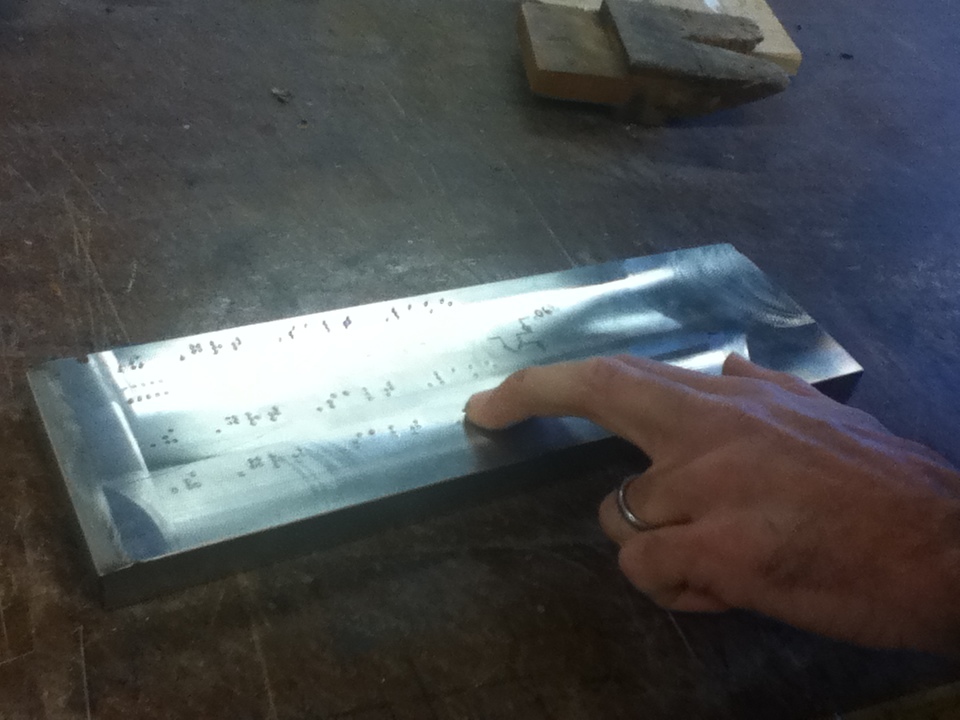
Shawn Porter, 43, with a sample of the Braille text that will be displayed on his artwork.
world around us, much less take inspiration from it.
Shawn Porter, however, is not an everyday person. The facilities supervisor for the arts and sculpture buildings at the University of Utah, Porter sees inspiration in places few would think to look. From that inspiration are born pieces of art that are as reflective of their environments as they are creatively breathtaking.
Porter, who has had work featured in both public places as well as more traditional gallery settings, didn’t begin his career as an artist. In fact, his artistic inspiration stems from more practical creations.
Having grown up in Lehi, Utah, Porter, 43, spent more than 13 years working as a professional woodworker, designing and creating functional pieces of furniture. It was that time spent honing his skills with wood that actually allowed him to branch into art, Porter said.
“The technical end of woodworking or being a craftsman has given me a platform to spring off of as far as making artwork is concerned,” Porter said. “People often say, half-jokingly, if you can build a chair you can build anything.”
Since coming to the U, Porter has expanded his use of materials beyond wood. His time working in the Department of Art and Art History has allowed him to gain a better knowledge of the “artist’s dialogue and process.”
In 2010 Porter began working on a project for the Utah Transit Authority’s (UTA) “art in transit” program. The agency, in collaboration with the Salt Lake City Arts Council, commissions local artists to create pieces for the various TRAX stations and routes that run throughout the Salt Lake Valley.
Porter believes public art, such as his work for “art in transit,” should be reflective of the cultural and historical values of the area in which it’s being placed.
“In a way I think public art is in place to represent the community,” Porter said.
He wants his work to be as much a representation of the public area surrounding it as it is a creative piece of art.
“That’s what public art is really supposed to do. That’s what it’s intended for, in my mind. That is, it isn’t just pretty decoration in a location. It definitely references local environment, culture, history, and it all depends on the history and culture of that area.”
Justin Diggle, an assistant professor of the Department of Art and Art History, at the U, agrees with Porter. Having worked on the committees for both the Salt Lake Art and Design Board in 2003, as well as the University committees, Diggle aided in the selection process for past “art in transit” pieces.
“With any public art I think you have to be sensitive to the area,” Diggle said. “You have to be sensitive to the people who live around there, people who are going to use it.”
Porter’s work will be installed at the 1950 W. North Temple TRAX stop, and will be modeled after the wetlands and waterways that exist between the Salt Lake City Airport and the stop. It’s expected to be installed around September of this year.
Porter said he wants his work to draw attention to the fact that the Great Salt Lake is actually a thriving wetland full of life.
“It [the Great Salt Lake] is not just a wasteland. It’s not just this smelly thing that people think it is,” Porter said. “It really is a thriving ecosystem.”
Porter’s minimalistic design for his “art in transit” project will be made primarily of stainless steel, a bit of a departure from the wood materials he’s used for most of his life. The change has been a good one, he said.
“That’s the challenge I really enjoy. The thinking through an idea and then bringing that to life through the use of different materials and the complexity of those materials.”
Porter’s work will include two large steel plates, elevated two feet above the ground to simulate a river’s surface. It will also include segmented pipes that evoke the idea of river reeds resting among a riverbed of smoothed metal stones. Porter is fabricating three minimalist representations of birds associated with the Utah wetlands that will also be placed throughout the piece.
“I think it’s really critical also to draw visitors into that conversation of—what is this place? What is it like? What might I experience in visiting Salt Lake City?” Porter said.
He wanted to ensure his work reflected more than just the natural surroundings leading up to his stop, but also the areas of public access nearby. For the 1950 W. North Temple stop, that includes the Utah State Library for the Blind and Disabled.
As a way of incorporating the library into his piece, Porter included an artist’s statement about the piece as well as some poetry about the Great Salt Lake and the birds that migrate there. The poetry will be written in Braille, directly on the piece.
A sample of the Braille text that will be featured on Porter's artwork.
Roni Thomas, the public art program manager for the Salt Lake City Arts Council, said that Porter’s inclusion of Braille on the piece was yet another inspiration from the well of his creativity.
“Shawn recognized that there was an opportunity to reach out to an audience that ordinarily couldn’t participate because of their visual impairment,” Thomas said.
Whether it be through addition of Braille, or simply, the inspired reflection of Utah’s beauty, one thing is certain—Porter’s creativity is sure to shine through his new piece.
“A lot of people just look at public art as decoration,” Porter said. “But I think it’s important for people to take something from the work that is there. Whether they recognize that it is a representation of something in their community or not, I think at the base level people can at least take [something] from the aesthetic.”
Food trucks have come a long way in recent years. The mobile restaurateurs of today are shedding the “roach coach” moniker and moving toward haute cuisine.
Since 2010, SuAn Chow has been at the forefront of this movement in Salt Lake City with her blazing yellow Chow Truck, where she serves up her unique brand of fusion cuisine. The Chow Truck’s menu includes tacos, sliders and salads infused with flavors from Asia.
“Everyone understands tacos or sliders or salads,” Chow said. “The twist is the actual base, the marinade, the sauces.”
Panko-crusted tofu, coconut lemongrass chicken and pineapple ginger pork are some of the mainstays of the menu, and Chow offers them in the above-mentioned familiar forms.
Xiaoyuay Lou, a visitor from New York who was in town for the National Association of Corrosion Engineers (NACE) Conference, stopped by the Chow Truck while parked at its weekly spot at the Gallivan Center in downtown Salt Lake.
“The sliders are really good – they’re delicious,” Lou said.
Chow’s flare for blurring the lines between different regional cuisines must have come from her upbringing.
She is a second-generation Chinese-American, born and raised in Salt Lake City. Growing up, her parents owned a restaurant that featured Polynesian themed décor and a menu with both Chinese and American dishes – similar to the campy Trader Vic’s, a legendary California-based franchise popular in ‘50s and ‘60s.
“On his menu, my father had great American comfort food,” Chow said. “He used to make the best breaded veal cutlets and chicken fried steak and roast turkey.”
These are some of the foods she grew up enjoying because her family spent a lot of time at that restaurant, Chow said.
“I always vowed never to get in the business,” she said. “I saw how hard my parents worked and thought there had to be a better way to make a living.”
But in 1985, she started her own restaurant, Charlie Chow’s, in downtown Salt Lake. It was her way of providing a venue for her father to cook traditional Chinese dishes, which is what he made for the family at home.
“I wanted to rescue my father from his restaurant, which was a dying concept,” Chow said.
She noticed the general public was becoming savvier about food and travel and saw a market for authentic Chinese food in Salt Lake.
“We did black bean mussels and clams. I was the first to offer dim sum as appetizers on the regular menu,” Chow said.
Her father died of colon cancer about a year after the opening of Charlie Chow’s, but she held on to the restaurant until 1993.
After she sold the restaurant, Chow moved to New York to explore new career paths. She was the director of creative services at Joseph Abboud and later sold real estate in Manhattan.
Even during her hiatus from the restaurant business, Chow kept an eye on evolving trends in the food world. In the late 2000s, she was reading about the food truck scene in Los Angeles and decided to head west to see what the hype was about.
“I went to L.A. and spent some time on some trucks and I felt it was something that could be great for Salt Lake,” Chow said. “No one else was doing it and I felt that this was something I could do and do well.”
The Chow Truck has been in business for just over two years and already has garnered awards from City Weekly and Salt Lake Magazine for its distinctive offerings. But all the accolades haven’t come easily.
Operating a food truck can be harder than running a brick-and-mortar restaurant, Chow said. With the mobile model, she has to battle the elements and stay on the move to comply with city ordinances that won’t allow mobile food services to stay in one location for more than two hours.
Technical difficulties aside, Chow’s truck has allowed her to connect with her customers and community in a way that’s not possible with a traditional restaurant.
Because of how the food truck is set up, with its large bay windows, Chow and her kitchen staff are able to gauge diners’ responses immediately.
“I always tell my kitchen staff that I’m offering them a kitchen with a view,” Chow said.
There is no full-time chef on board the Chow Truck. Instead, Chow relies on a steady rotation of local chefs to craft special items. Past collaborators include Ryan Lowder of The Copper Onion, who contributed a pork belly taco, and Takashi Gibo of Takashi, who gave the Chow Truck the tako taco – tako is the Japanese word for octopus.
In March, the Chow Truck is featuring a Utah elk slider with himichurri sauce by Ethan Lappe of Cafe Niche.
A first-time customer who was lured in by the intoxicating aromas permeating the Gallivan Center seemed impressed by the Chow Truck.
“I chose the Chow Truck because I could smell it from way over there,” Lindsey Goodman said. “I had the elk slider and it was amazing.”
That kind of reaction keeps Chow motivated.
“Being able to hear people respond to the food is very gratifying,” she said.
Paper, snail mail and telephones are a thing of the past. With the Internet and on-line activity at its peak, criminals have had to evolve with the times. According to the Federal Trade Commission identity theft and fraud cost Americans $1.52 billion last year alone.
And Internet crimes are not just a problem nationally. Salt Lake’s Police Chief, Chris Burbank acknowledges that identity theft is one of the biggest issues as far as crimes go that needs to be solved in Salt Lake.
“Everyone gets upset if someone is shot and killed, but fraud costs more and because no one is dying it doesn’t get the attention of the public. That’s the challenge of the future. It is a failure of a single person if we allow someone to be victimized,” Burbank said in Holly Mullen’s Communications 3660 class, at the University of Utah, February 16th.
These thieves have come up with a plethora of ways to go about stealing money and identities. However, the most common ways of identity fraud involve, surfing the social network, dumpster diving, phis-hing for information, your family and friends and skimming for dollars.
Social networking is a great way to connect with love ones, but it’s also a way that Internet criminals get personal information like age, birthday, and place of employment. A lot of people don’t tear up things like credit card offers and bills from the bank. Crooks will take the information found on those items and use it. Phis-hing is the oldest practice of the five. Phis-hers are the ones who send things to personal emails. These emails will be under the guise of winning something or look like an already familiar website. Both will often direct you to sites that ask for personal information. Often times the scam will look like a refuge in another country asking for help or even a family member asking for help. In fact, family and friends account for half of all fraud cases. Skimming for dollars is where thieves will steal bank and credit information when a debit or credit card used during a gas purchase or ATM withdrawal. It’s called skimming because often times the perpetrator will take small often unnoticeable amounts over a period of time.
Rebecca Jarrett was a victim of both phis-hing and family and friends methods. Jarrett’s grandparents received an email one day indicating that she was in the hospital and needed help to pay some of the medical bills. Her grandparents upon seeing that the email address was in fact hers immediately sent money to the bank account and routing number provided. A few months later Jarrett tried to contact her grandparents and got no response. Jarrett finally found out from another relative what happened. “They said they were upset that they had sent money that they needed back. They were even more upset that they hadn’t heard from me after they’d sent it,” Jarrett said. Jarrett later reconnected with her relatives after they found out that they had been the victims of an Internet crime. However, the damage had been done.
Jared White (this person’s name has been changed at his request) was a victim of social networking. It was during the chaos of the holidays. White and his wife were out of town visiting one of their children. There had been a charge to his primary credit card for an international plane ticket. The airline had called their home phone to verify the charge, but they weren’t home and because the crook had all the necessary information they approved the purchase. White didn’t realize what happened until a few weeks later when he went to check his account and saw that it was way over their limit.
Fortunately after a talk with his credit card company they removed the charges to his account contingent on him completing a fraud report. Unfortunately the villain was never caught. As long as they got their money that neither the credit card company or the airline cared about catching the criminal.
“The whole incident emphasized to me why credit card fraud is at epidemic proportions: the ease by which it is accomplished; the difficulty in catching and prosecuting the perpetrators; and most of all, the apathy of the companies involved. It made it clear to me a lot of fraud is written off with the final cost being borne by the consumer in terms of tighter credit, higher interest rates and fees,” White said.
It’s as Burbank stated. If no one has died the importance of crimes like this go unnoticed and often unpunished, which is why identity theft and fraud is rapidly rising to become the most committed and expensive crimes.
White reflects that he would have done things differently. He would have checked his accounts more frequently so that the individual could have been caught when he tried to fly. White also suggests to, “Check your credit card accounts, even your inactive ones every week or so. Try to limit your online purchases using your major cards, use other sources, like Paypal, which offers good fraud protection. If you have fraudulent charges on one of your cards, report it immediately, first by phone (record the important information about the call), then follow immediately in writing. As I understand the law, consumers have the right to dispute any charge if they report it in writing within 30 days of the charge.”













 voices-of-utah.com