Local Utah artist’s work reflects on community, beauty of Utah’s wetlands

Story, video and pictures by JAVAN RIVERA

Slideshow courtesy of Shawn Porter

Derk’s Field photo courtesy of the Utah State Historical Society

For everyday people the world can often seem dull. We wander through our lives, habitually proceeding from task to task. Rarely do we stop to appreciate the

Shawn Porter, 43, with a sample of the Braille text that will be displayed on his artwork.

world around us, much less take inspiration from it.

Shawn Porter, however, is not an everyday person. The facilities supervisor for the arts and sculpture buildings at the University of Utah, Porter sees inspiration in places few would think to look. From that inspiration are born pieces of art that are as reflective of their environments as they are creatively breathtaking.

Porter, who has had work featured in both public places as well as more traditional gallery settings, didn’t begin his career as an artist. In fact, his artistic inspiration stems from more practical creations.

Having grown up in Lehi, Utah, Porter, 43, spent more than 13 years working as a professional woodworker, designing and creating functional pieces of furniture. It was that time spent honing his skills with wood that actually allowed him to branch into art, Porter said.

“The technical end of woodworking or being a craftsman has given me a platform to spring off of as far as making artwork is concerned,” Porter said. “People often say, half-jokingly, if you can build a chair you can build anything.”

Since coming to the U, Porter has expanded his use of materials beyond wood. His time working in the Department of Art and Art History has allowed him to gain a better knowledge of the “artist’s dialogue and process.”

In 2010 Porter began working on a project for the Utah Transit Authority’s (UTA) “art in transit” program. The agency, in collaboration with the Salt Lake City Arts Council, commissions local artists to create pieces for the various TRAX stations and routes that run throughout the Salt Lake Valley.

Porter believes public art, such as his work for “art in transit,” should be reflective of the cultural and historical values of the area in which it’s being placed.

“In a way I think public art is in place to represent the community,” Porter said.

He wants his work to be as much a representation of the public area surrounding it as it is a creative piece of art.

“That’s what public art is really supposed to do. That’s what it’s intended for, in my mind. That is, it isn’t just pretty decoration in a location. It definitely references local environment, culture, history, and it all depends on the history and culture of that area.”

Justin Diggle, an assistant professor of the Department of Art and Art History, at the U, agrees with Porter. Having worked on the committees for both the Salt Lake Art and Design Board in 2003, as well as the University committees, Diggle aided in the selection process for past “art in transit” pieces.

“With any public art I think you have to be sensitive to the area,” Diggle said. “You have to be sensitive to the people who live around there, people who are going to use it.”

Porter’s work will be installed at the 1950 W. North Temple TRAX stop, and will be modeled after the wetlands and waterways that exist between the Salt Lake City Airport and the stop. It’s expected to be installed around September of this year.

Porter said he wants his work to draw attention to the fact that the Great Salt Lake is actually a thriving wetland full of life.

“It [the Great Salt Lake] is not just a wasteland. It’s not just this smelly thing that people think it is,” Porter said. “It really is a thriving ecosystem.”

Porter’s minimalistic design for his “art in transit” project will be made primarily of stainless steel, a bit of a departure from the wood materials he’s used for most of his life. The change has been a good one, he said.

“That’s the challenge I really enjoy. The thinking through an idea and then bringing that to life through the use of different materials and the complexity of those materials.”

Porter’s work will include two large steel plates, elevated two feet above the ground to simulate a river’s surface. It will also include segmented pipes that evoke the idea of river reeds resting among a riverbed of smoothed metal stones. Porter is fabricating three minimalist representations of birds associated with the Utah wetlands that will also be placed throughout the piece.

“I think it’s really critical also to draw visitors into that conversation of—what is this place? What is it like? What might I experience in visiting Salt Lake City?” Porter said.

He wanted to ensure his work reflected more than just the natural surroundings leading up to his stop, but also the areas of public access nearby. For the 1950 W. North Temple stop, that includes the Utah State Library for the Blind and Disabled.

As a way of incorporating the library into his piece, Porter included an artist’s statement about the piece as well as some poetry about the Great Salt Lake and the birds that migrate there. The poetry will be written in Braille, directly on the piece.
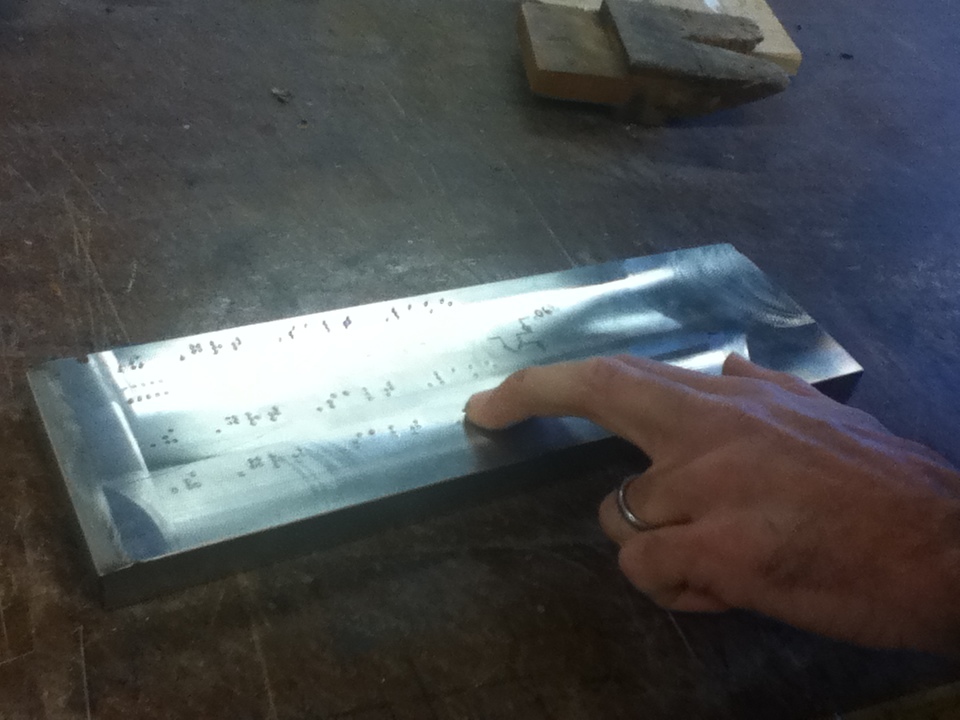
A sample of the Braille text that will be featured on Porter's artwork.

Roni Thomas, the public art program manager for the Salt Lake City Arts Council, said that Porter’s inclusion of Braille on the piece was yet another inspiration from the well of his creativity.

“Shawn recognized that there was an opportunity to reach out to an audience that ordinarily couldn’t participate because of their visual impairment,” Thomas said.

Whether it be through addition of Braille, or simply, the inspired reflection of Utah’s beauty, one thing is certain—Porter’s creativity is sure to shine through his new piece.

“A lot of people just look at public art as decoration,” Porter said. “But I think it’s important for people to take something from the work that is there. Whether they recognize that it is a representation of something in their community or not, I think at the base level people can at least take [something] from the aesthetic.”

This slideshow requires JavaScript.

Field of dreams: Sometimes a triple is a great shot

by LEWIS WALKER

What if you got paid to do what you love and have grown up doing your whole life? This is the life of Keenyn Walker, who by the age of 20 was drafted twice before signing a contract to play professionally in major league baseball.

“I thought he was crazy not to leave once he was selected out of high school. Not many people are that blessed,” said Jeff Myaer, head baseball coach at Judge Memorial High School in Salt Lake City.

Of all the odds and breaks in life, Walker has been blessed with his share.

Walker who is currently a part of the Chicago White Sox farm league in the Single-A organization is stationed in Kannapolis, N.C. playing for the Intimidators. His journey before making it there may have been a whirlwind to most folks.

As a senior at Judge Memorial, Walker was drafted by the Chicago Cubs, but he turned down that deal and moved on, choosing instead to attend Central Arizona College( CAC) in Coolidge, Ariz., one of the powerhouses for college baseball. After his freshman year at CAC, Walker was drafted again, this time by the Phillies. “It was crazy when I was in high school and got drafted, but then again just a year later is humbling,” Walker said.

Denying the offers from the big league left Walker, a center fielder, wondering if he would get another chance. “After my freshman year of college was over and I turned down another chance to play baseball, my dreams kind of became a blur,” he said. “I didn’t think anyone else would draft me again because I had turned down two teams already.”

Some doubted Walker might get another chance at his dream. “I was drafted when I was in college. I know how hard it is to have that opportunity come your way, but three times is out of this world,” Myaer said.

With many people watching from the outside, few stood strong in his corner, Walker said. Except for one. “My mom has been a huge part in this whole journey,” he said. “When I doubted myself she had the right words to put me back on track to complete what I had set out to do a long time ago.”

“Keenyn is someone who just loves to play baseball,” said his mother, Lori Walker, of Salt Lake City. “In baseball you have ups and downs that come easily and it can transfer over to life as well.”

June 6, 2011 is a day Walker will always remember. “That day I was just at home with my family watching the draft,” he said. “Teams just kept calling me and saying they may take me at this pick,” he said. Nervously walking around waiting for his name to be announced, Walker continuously ate snacks to calm his nerves, as well as talking and joking with the few family members who were present.

“It was a family thing,” Walker said.

After all the hoping and waiting, Walker’s blurry dreams have finally become a reality. Now 21, he was selected as the first overall pick in the 2011 MLB draft for the Chicago White Sox.

“I wake up and I feel like it’s a dream,” Walker said over the phone while training in Phoenix. Being a professional athlete comes with a lot of responsibility, as well as temptations.  “I have more money than my mother does now,” said Walker, laughing. But his mother thinks he’s doing just fine.

“I am proud of the decisions he made. Even though they were hard to make, he made the correct ones,” said Lori Walker. “It is crazy seeing my son become something he has wanted to become his whole life.”

“My schedule has been hectic, kind of,” Walker said. He wakes at 8 a.m., goes for a run and then heads to batting practice. He does interviews between ball games. There seems to be an endless number of items to autograph, such as rookie cards, helmets and photos. “Each day I sign about 500 items for people I don’t even know,” Walker said.

“I am so fortunate and blessed to be where I am right now,” Walker said. “This is so crazy. It still hasn’t hit me yet, even though I have already played six minor league games, moved my way up to the single A organization, and now in spring training.”

Although the process to the big leagues is a long bumpy road, things seem to be falling in place for Walker. “I guess the third time is a luck charm,” he said.

Photo credits: Clockwise from top left, Megan Wallo: Keenyn Walker: Central Arizona College, Athletics: Jim Shipman.

Jason Nowa

Ute Basketball a Story of Struggle

By Jason Nowa

The University of Utah Utes’ 2011-2012 men’s basketball (Voices of Utah) team has completed the most atrocious season in their history. This season marked the Utes first 20-loss season as they tumbled to an uninspiring record of 6-25. They finished 11th overall in their first season as a member of the Pac-12 Conference.

“This season was rough, no way around it, but from where we started we saw improvement throughout the rest of the season.” said junior forward Dijon Farr.

The Utes packaged numerous transfers together to make a team, as eight players left the team last year following Coach Jim Boylen’s exit.

Coach Larry Krystkowiak (Voices of Utah) spun the best team available to him, and though it was a struggle from the start, many team members felt they competed hard in the second half of the season after a distraction in the locker room was resolved.

The team’s best player, senior Josh “Jiggy” Watkins was dismissed from the team January18, due to violation of team rules and constant struggles in the classroom. Watkins was the team’s leading scorer and with assists, with 15.6 points per game and 4.8 assists in only 16 games. The loss of Watkins occurred mid-season, and set the Utes back even more.

A season of few ups but mostly downs hit phenomenal proportions when the Utes suffered a 40- point setback at the University of Colorado on New Year’s Eve. Then the worst loss in the program’s 104 years occurred in the regular season finale, when the Utes lost by 46 points at the University of Oregon.

The Utes’ best victory of the season was at home, against Stanford, which finished in the middle of the pack in the Pac 12. The first conference victory was a January 5 home win against Washington State, 62-60 in overtime. The Utes finished 3-15 in their inaugural season in the Pac 12.

Jason Washburn was the team’s pleasant surprise player of the year as he broke out with 11.4 points per game. The junior center led the team after the dismissal of Watkins, with 6.2 rebounds per game. Washburn was a big fill-in player after starting center David Foster’s injury sidelined him for the season.

Some close to the team say it’s hard to put a team together on the fly and expect to win as the Utes did, especially after so many players left the squad. Krystkowiak has to get a few years of his own recruits to determine the tenor of his success or failure.

The Utes finished their season with a loss in the Pac 12 Tournament to conference champion Colorado, which upset UNLV in the second round of the NCAA Tournament.

The Utes heading into next season will look to schedule more home games at the beginning of the year. This past season the Utes had only six non-conference home games far less than most Pac 12 teams. With a young team, home games scheduled for early in the season can be a great confidence boost. Team managers expect to overhaul the roster as numerous new players come in and some older player will likely transfer out.

“This year was a bad year for our team but coming back next year we hope to get our team situated and turn this thing around,” said junior guard Cedric Martin.

Expect Martin, and Farr to return next year. Kareem Storey, and Chris Hines are among four players who have been granted their release of scholarship to transfer. Center David Foster, nursing his broken foot, is recovering and should be ready for next season team managers mentioned.

Foster was the 2009 Mountain West Conference Defensive Player of the Year as he led to a school record in blocked shots. Coping wit his injury, he said, took its toll. “It was tough to see and watch the guys all year long, but I’m on the road to recovery and look to really help our team become better next season.”

Hines, who at times during the season was the most explosive player on the team, mentioned that the Utes might surprise every team in the conference next season despite the fact that he is transferring.

There might be two new suspected starters in the lineup next year with redshirt transfer guards Aaron Dotson from LSU and Glen Dean from Eastern Washington University. Both started at their previous schools and are expected to be significant upgrades from this year’s starters.

Contrary to what pessimists believe, Utes basketball (Voices of Utah) could be on the upswing. With fall just around the corner, the roster will be set soon and practice will begin. With a healthy Foster and some transfer players coming in, the team could kick into gear. Returning players will bring experience and wisdom and Krystkowiak has every reason to feel upbeat.

“We are looking forward to next season and get everybody together to prove how good this team really can be,” said redshirt transfer guard Aaron Dotson.

Occupy Salt Lake movement continues after a peaceful eviction

by Tricia Oliphant

Isaac Hoppe, who first became homeless about eight years ago, was on her last limb. She felt she had done everything possible to find work but did not see any results. She was ready to quit.

Last October, Hoppe saw a flier on a light post that gave her new hope. This flier advertised participation in the local Occupy Salt Lake movement that would commence the following day.

“I was pretty close to the end. On October 5, had I not read the declaration on a light pole, I think I would have given up on life completely,” Hoppe said.

Hoppe is one of several protesters who joined the Occupy Salt Lake movement in harmony with the Occupy Wall Street movement on Oct. 6, 2011. Salt Lake City has become one of hundreds of cities worldwide where demonstrators have congregated and camped in an effort to make their voices heard. Among other motives, the demonstrators feel 99 percent of the population is not fairly represented by the government; instead, only the voice of the wealthy 1 percent of the population is heard. This cause compelled people like Hoppe to join the Occupy movement.

“It’s not about blame; it’s understanding that we have all had a hand in getting the world where it is,” Hoppe said.

For more than a month, Salt Lake City protesters gathered in Pioneer Park downtown, living out of tents and sharing donated food.

The protest was challenged on Nov. 11, 2011 when participant Michael Manhard died in his tent.  Consequently, Salt Lake police officers evicted all Occupy protesters from Pioneer Park the next day.

Memories of Manhard’s death, the subsequent eviction, and how police handled both continue to upset Occupy participants.

Soon after the discovery of Manhard’s body, Salt Lake City Police Chief Chris Burbank held a press conference where he announced that all demonstrators must evacuate the park within 36 hours due to Manhard’s death and sanitation issues.

“We felt it would have been better to have a private meeting [with Chief Burbank],” Hoppe said. “I think it was a breach of trust that he made a public event of the death of one of our participants.”

Burbank gave the protesters too little time to evacuate and remove their belongings and, as a result, many lost their belongings, said protester and cook Raphael Cordray.

Cordray said that two dump trucks and a front loader were used to remove all unclaimed belongings on the night of the evacuation. “It was pretty awful,” she said. “Some people weren’t prepared to leave.”

Although several participants were upset by the short eviction notice, they still offered Burbank and the Salt Lake City police some praise for the otherwise peaceful eviction.

“Burbank does a lot better than some folk,” Cordray said.

Upon evicting the group, the police did not dress in riot gear and did not use pepper spray or other harmful force, as was the case in Oakland, Calif. Instead, they spoke with protesters and stated their options: leave peacefully, receive a citation, or stay and be arrested.

“Pepper spray is a use of force. There are other ways to deal with it,” Burbank said. “When you have a relationship, it works a lot better.”

Nineteen protesters were arrested, Cordray said.

Since the eviction from Pioneer Park in November, some of the participants relocated to where they currently camp at the Gallivan Center in downtown Salt Lake City.

At present, only a dozen protesters camp full-time at the Gallivan Center.  This reduction of campers is due to smaller space, as well as a requirement to follow strict regulations.

The no drugs/violence/alcohol policy is now enforced more thoroughly than it was at Pioneer Park, Hoppe said. She has remained among the last camping protesters.

Tougher regulations at Gallivan mean participants can no longer cook food at their campsites or give food away.  These regulations are a result of the poor sanitation concerns at Pioneer Park.

Consequently, participants are in partnership with One World Café, where they eat their meals as well as volunteer their time.

Occupy Salt Lake will be allowed to stay at the Gallivan Center until May, Hoppe said. At that point, the city’s summer activities at the site will start, forcing another relocation for the demonstrators.

Several protesters who are not actively camping at the Gallivan Center meet with other protesters at the Salt Lake City Public Library at bi-weekly meetings to discuss current issues and to make plans.

“We want to work with the city,” Hoppe said.

Salt Lake County District Attorney Sim Gill, mental health court, address criminal recidivism in Utah

by JAVAN RIVERA

Taking action to solve Utah’s homeless problem could save Salt Lake City taxpayers thousands of dollars.

Homeless men and women wander the streets of downtown Salt Lake City every day. Many avoid the homeless, brush off their panhandling and go about their daily business. They never stop to think about how these people ended up in their current situation, much less how the growing problem of the mentally ill homeless population might cost far more in taxes than a handful of quarters to a panhandler ever will.

Since 2001, the Salt Lake County mental health court has been helping to reduce the rate of criminal recidivism among Salt Lake City’s mentally ill. Through a system of what Salt Lake County District Attorney Sim Gill likes to call “restorative justice,” the mental health court has reduced repeat offenses through weekly court dates and proper medication. This therapeutic take on justice is what Gill believes will not only help with Salt Lake City’s homeless criminal offense problem, but also save taxpayers a lot of money.

“We are bankrupting ourselves into oblivion,” Gill said of the current system of “zero tolerance” enacted by most of U.S. law and justice systems. “We need to seek out alternatives to incarceration; we need to focus on therapeutic justice, and we need to focus on locking up those we are afraid of, not those who we don’t like.”

Salt Lake County’s mental health court works on what Gill calls a “system approach,” something he thinks of as simple problem-solving. He believes that all too often, the legal system relies on “crisis management” rather than proactively preventing repeat offenses by taking active measures right away. This is the core of mental health court.

“The neat thing about the people we serve in mental health court is that simple medication is often enough to reduce recidivism,” said Jeannie Edens, supervisor of the Day Reporting Center of Criminal Justice Services (DRC).

Edens’ work at DRC allows her to see the benefits of mental health court both for the participants who are sent to the program as well as the taxpayers whose money is being put to more efficient use. She feels that the work being done at DRC is important to a fair judicial system.

DRC provides an alternative to jail time by allowing criminals to participate in intensive case management that includes treatment, educational and employment opportunities to prevent criminal recidivism. DRC  works regularly with Salt Lake County’s mental health court.

“In a regular court setting a judge may not know that a person has mental health problems,” Edens said. “They think it’s just another substance abuse problem and could sentence them to longer and harsher punishments.”

It’s those longer sentences that usually end up costing Utah taxpayers. According to Gill, conservatively, the average cost of detaining, treating and processing a mentally ill criminal offender is often in the range of thousands of dollars. That includes the cost of police dispatch, ambulance, medical treatment, court processing, and jail time—all of which, Gill said, is coming out of the taxpayer’s wallet.

“So it’s not just a good progressive idea that I’m talking about,” Gill said. “It’s become a fiscal reality as well.”

For Gill, however, mental health court provides more than just an opportunity to reduce repeat offenses and increase fiscal efficiency in Salt Lake County’s criminal justice system. It also allows the criminal justice system to treat these mentally ill offenders in a manner that denotes respect and dignity, despite their current situation.

“The worst thing you can do to a person is make them insignificant,  to disrespect them,” Gill said. “This program [mental health court] respects them.”

It’s that respect that Gill believes has helped to bring about the success of mental health court in Salt Lake County. Through the program, officials have seen a decrease of recidivism from 68 percent to between 17 to 19 percent among participants, Gill said. Additionally, the number of “event failures,” the amount of time between significant lapses of criminal behavior, have increased from an average of 230 days to more than 1,300 days.

“Is this a perfect model? Absolutely not,” Gill said. “Is it a better one? Damn straight.”

Homeless outreach brings Volunteers of America’s resources to the streets

Story and audio slideshow by LAURA SCHMITZ

Go on a ride-along with the Homeless Outreach Team.

When Buddy Tymczyszyn and Kimberly Bell go to work each day, they don’t need to put on fancy clothes or stare at a computer screen. They don’t need to worry about office politics. But, during the winter, they definitely can’t leave home without their gloves.

Just west of the hubbub of downtown Salt Lake City rests their quaint work center, housing a program that actively pursues a population with which few are familiar.

Utah’s arm of Volunteers of America facilitates a Homeless Outreach Program that is constantly ready for action, equipped with a van-full of necessities, including food, water, beanies and blankets.

A national, nonprofit organization, VOA has a presence in 44 states and employs a range of paid staff, who work to tackle issues such as homelessness and drug addiction.

Tymczyszyn, 22, and Bell, 24, join forces to make up the outreach team. Together, the two pack up a van with supplies each morning to scan the streets of the west side for homeless people in need.

“We do a lot of driving,” Tymczyszyn said of his 40-hours-per-week job in the field.

“Part of [the program] is to get people socks, jackets and blankets — stuff to keep them warm and safe on the streets,” he said. “But the heart of it underneath is to help them with any kind of deeper, underlying issues that may be keeping them out there.”

Both began their posts with a “heart” for the homeless population.

“None of us really deserve to be where we’re at,” Bell said. “Those of us that have enough money or family support to be able to stay in a warm place and have good food, it’s not because we did anything to deserve it.”

The team documents every shoe, scarf and bag of chips they give out in order to ensure that VOA receives adequate donations and its clients — the homeless people they serve — are given proper financial support.

VOA’s donations come largely from the Utah Food Bank and individual donors. Clients will receive state funding based in part on the amount of services they receive from the organization.

As Tymczyszyn and Bell traverse alleys and fields, searching for potential clients, they will often discover vacant tents, blankets or sleeping bags — evidence of a shelter.

“Some are remarkably easy to find,” Tymczyszyn said. “They follow the same, routine pattern every day.”

If the team reaches a “home” of someone who is not there, they will “water bomb” or “sock bomb” the residence, leaving a water bottle or pair of socks with VOA’s business card attached.

“It helps give us a good name to them, so the next time we see them, they can recognize us or they can just give us a call from that number,” Bell said.

During outreach missions, Bell and Tymczyszyn said clients’ reaction to them depends on their approach.

“A lot of times it takes meeting someone five or 10 times before they trust you enough to talk to you. The next step is learning their name, then the step after that is having them take a pair of socks or a bottle of water from you,” Tymczyszyn said. “Every little step of the way is a success.”

Cliff Thurber, 54, has made the streets of Salt Lake City his home for several years. A regular client of VOA, he is an example of the established trust its staff strive to build, as he candidly spoke with Tymczyszyn and Bell like old friends.

“They’ve given me food and good [conversation] and comforting thoughts, so that’s been helpful,” Thurber said of the two.

Thurber moved from Provo to Salt Lake City, seeking a steadier income. He now sells the Salt Lake Street News, a newspaper put out by the Salt Lake City Mission. The nonprofit publication is specifically geared to help people experiencing poverty and homelessness.

“I earn 50 cents a paper,” Thurber said. “Once I sell them, I can turn more money back in and get more papers to sell. I buy them for 50 cents and sell them for a dollar — sometimes people donate more. It’s really coming along.”

Thurber said he does his best to remain law-abiding in his lifestyle.

“Police have never really hassled me,” Thurber said. “I’ve tried to stay above the law and tried to not do anything [illegal] — not be drunk in public places or anything like that. That’s not good,” he said with a laugh.

Though several clients are experiencing homelessness because of job loss or negative life circumstances, some come to VOA with needs arising from addictions.

One frequent client, Kevin Hansen, openly said he was on the streets because of a history of alcoholism.

“I just love alcohol,” Hansen said, describing what he believes to be the ultimate reason for his homelessness.

His past “hurts sometimes, but sometimes it doesn’t.”

Bell and Tymcyzcyzn both agreed their job can be emotionally taxing as they build relationships with their clients and struggle with them through their situations.

“Sometimes, I want to make people’s decisions for them,” Bell said. “Some of our clients are really intoxicated all the time. They drink a lot constantly, and it’s a way for them to drown their pain, but they’re slowly killing themselves — I just want to make them stop [for their own good].”

One goal of the homeless outreach team is an initiative they call harm-reduction. Tymczyszyn said the goal of harm-reduction is to try to get clients into a better situation immediately, working toward the deeper-rooted problems later.

The team provides needle-cleaning kits and safer methods of using cocaine in order to minimize the adverse consequences of the drugs while coming out of addiction.

“If they’re going to use needle drugs, how can they clean their needle to do it safely? If they’re going to sleep outside on the street that night no matter what, how can we try to help them stay warm in the process?” Tymczyszyn said.

Bell said that though she sometimes feels “helpless” because of the negative habitual cycles some clients fall into, she recognizes that any change is “ultimately their choice.”

Despite challenges that come with the territory, Bell said her job is rewarding.

“I wouldn’t have it any other way, because I don’t want to live too far removed from the tragedy that exists,” she said. “I don’t just want to live in ignorance, because ignorance is bliss, but our world isn’t a blissful place.”

This year marks VOA Utah’s 25th anniversary. According to its website, it boasts about 140 paid, professional staff who serve more than 10,000 people throughout the state each year.

“Substance abuse and homelessness are the main areas of focus in Utah,” said Zach Bale, director of external relations for VOA Utah. “We go where we’re the most needed, and do what needs to be done.”

The homeless outreach team is in the field 8 a.m. to 5 p.m. Monday – Friday.

“It’s the most incredible job in the world — I can’t believe I get paid for it,” Bell said.

University Neighborhood Partners aims to widen access to education for west side residents

University Neighborhood Partners, located on the west side of Salt Lake City, partners with 25 organizations across the Salt Lake Valley to provide access to education and services for residents of that community.

Story and photo by LAURA SCHMITZ

When Sarah Munro began her dissertation at the University of Michigan, she saw a need to bring access to education to minority communities.

After conducting research in Italy and receiving her Ph.D. in anthropology in 2002, she now works as the associate director of University Neighborhood Partners to make that need a reality.

As part of the president’s office at the University of Utah, UNP is “a bridge between the U and nonprofits on the west side,” Munro said.

UNP was launched in 2002 and acts as that bridge by creating partnerships under three main “umbrellas” — youth and education, community leadership and capacity building.

Serving two ZIP codes and seven neighborhoods on the west side of Salt Lake City, UNP currently boasts about 34 partnerships with 25 organizations. Munro admitted that monitoring the success of UNP is difficult, given that much of its work is seen only by the success of its partners.

“We’re always the convener,” Munro said. “We don’t actually do the work — we bring in community organizers to do the work.”

Munro collaborates with UNP staff in choosing organizations with which to partner. She said she and the seven to 10 staff members then maintain partnerships through ample communication and a positive attitude.

“We’re in constant communication,” Munro said of UNP and its partners. “We sit in both worlds and anticipate needs and goals.”

UNP works by building relationships with organizations that work with underrepresented populations, including refugees and undocumented immigrants. Munro said language, transportation and childcare are major hurdles west-side residents face in accessing basic freedoms, including education and healthcare.

“Our policy is we help anyone who comes to the table,” Munro said. “We don’t choose who we help, the organizations do. We simply create the table.”

According to 2010 census data, about 13 percent of Salt Lake City residents are Hispanic — a 78 percent increase from 2000 census data. As demographics continue to change in the United States, Utah and the Salt Lake Valley, Munro said institutions of higher education must adapt to prepare future students for college by widening access.

“A long-term goal is to move students from the west side to succeed, completing high school and coming to the U,” Munro said. “In 20 years, if the U can’t be more effective at this, it will no longer be the flagship university in the state.”

Rosemarie Hunter, director of UNP, was inspired to join hands with UNP after her time as a social worker. She was involved in the U’s College of Social Work for 16 years.

Hunter said education allows individuals to make choices and decisions from a place of knowledge.

“Education is a shared value across all communities and families,” she said. “Education really is power — anytime you can get access to education, you can take better care of yourself and your family.”

Hunter said UNP’s goal is not to try to jump in and “fix” everything, but to create a “mutual shared space” of learning between members of the west-side community and the U, allowing the U to change to support a more diverse population.

“What we look to do is go into existing places to (allow west-side residents) to interface with university life while going about their daily life,” Hunter said. “The U is learning a lot from residents and their cultural backgrounds and life experiences.”

Another UNP staff member, Brizia Ceja, began working for the organization as a freshman at the U as a student intern.

Originally from Mexico, Ceja moved to the U.S. at 13. She then grew up on the west side and still has family living there. She said she is therefore able to relate to that community on a personal level.

“I’m able to identify with most families I work with,” Ceja said. “I come from an immigrant family. I am the first person in my family to go to college.”

Ceja now works as an academic consultant for UNP to facilitate partnerships with middle and high schools. She said schools on the west side are often crowded with one academic adviser serving many.

“We want to start working with them young to make sure they don’t slip through the cracks,” Ceja said. “We want to make sure students have a safe place with (academic) mentors.”

Ceja said she wants children on the west side to view college as not only a possibility, but a natural progression after high school.

“I want them to know (college) is an option,” Ceja said. “Just like high school follows middle school, college follows high school.”

UNP has established partnerships with two elementary schools, one middle school and two high schools on the west side of Salt Lake City. The organization continues to foster relationships with these students to help prepare hundreds for a collegiate experience.