Javan Rivera

MY STORIES:

MY BLOG: Enlightening the law

What is law and justice really?

I’ve written on a variety of subjects in the past, from the opening of new art exhibits, to after-school programs on Salt Lake City’s West side. However, Voices of Utah represents my first foray into the realm of law and justice.

It’s been an enlightening experience.

Suffice to say that before these stories, I hadn’t taken any time to really look at the American justice system. It was always just there; that big system that’s designed to keep our streets safe and our citizens happy.

But what about the people who make that system run? The people it serves? The people it protects?

The people.

That’s what it all really comes down to when you start digging. It’s much more personal and individually engaging than I think most people realize. Certainly more so than I had ever imagined.

When the words law and justice are mentioned, most people tend to think about silent courtrooms and stone-faced judges.

But what about the homeless man who is huddled in the cold? His mind is lost to a combination of mental illness and self-medication. The crimes he commits usually aren’t of the violent variety, but rather misdemeanors that are a side effect of his mental illness.

What about the passionate men and women who stand up for these people? People like Salt Lake City DA Sim Gill, who helped to pioneer the mental illness court in Salt Lake City. People like him work every day to, not only keep the truly dangerous criminals off the street, but also to help those severely in need of their aid.

What about the police officers who not only choose to put their lives on the line in the name of public safety, but attempt to do so in a manner that always puts the non-violent approach ahead of their own well-being? People like Salt Lake City Police Chief Chris Burbank, whose peaceful approach to the Occupy Salt Lake Movement gained him nods of professional appreciation from around the nation.

Make no mistake. The people who serve in Utah’s justice system are professional to the bone. That being said, Law and justice isn’t some dispassionate, detached part of our society. It is made up of men and women who actively seek to make our city and our nation a better place.

Much of what I’ve discovered as part of my experience with Voices of Utah, revolves around the law and justice writing I’ve done. While I can easily say I’m pretty comfortable branching out to cover whatever catches my interest, law and justice is an area I never imagined I would be covering–outside of the crime reporting it seems most everyone ends up doing when they try and break into the field.

This portion of my experience has been both eye opening and good for me. It’s taught me that, no matter what you’re covering, there are always interesting people to meet, new nuggets of truth to be unearthed, and above all else, new stories to be told.

ABOUT ME:

Writing is more than just a career path to me—it’s my passion. I once had a friend give me some very sage advice.

“If you want to be a writer, then write. And when you think you’re done. When you think you can’t possibly write any more. Then keep on writing. Write until your fingers ache, until your mind has gone numb from the sheer amount of words that pour forth from your well of creativity. Then, and only then, will you be more than a writer. You’ll be a crafter of words.”

That’s advice I’ve taken to heart and genuinely tried to put into practice over the years. As a child, and into my adulthood I’ve always been an active reader and writer. It’s a part of who I am, and more than anything, it’s a part of who I want to be.

Having grown up the son of home missionaries, I traveled across the United States numerous times as a child. By the age of 12 I had likely traveled more miles than the majority of people would in their entire lifetimes. I honestly believe those experiences helped to mold me into the person I am today.

I’m currently in the latter half of my junior year at the University of Utah. Majoring in mass communication with an emphasis in journalism was a no-brainer for me. As someone who has always pursued literature and word crafting as a hobby, I can’t imagine a greater career than being able to convey the stories of others on a daily basis.

My time at the University of Utah has allowed me to pursue numerous journalistic endeavors. From writing for my school paper to getting my first article published in a local paper, it’s been a journey in learning and excitement.

At 20, I look to my future in anticipation. Opportunities such as Voices of Utah are wonderful due to the fact that they give me a chance to not only practice my greatest obsession, but also an opportunity to cultivate that passion into something I can use as a career.

The convenience of college obesity

Story and photos by Blakely Bowers

The United States has the highest obesity rate in the world. Obesity is an issue that reaches far beyond the way someone looks. Medical experts have linked excess weight to everything from heart disease and diabetes to chronic back, hip and knee pain.

According to the U.S. Surgeon General, 74.6 percent of Americans are overweight or obese. For the past decade the rates have risen steadily for Americans of all ages and population groups. The difference between being overweight and obese is determined by a person’s body mass index (BMI). Adults with a BMI between 25 and 29.9 are considered overweight. Adults with a BMI of 30 or higher are considered to be obese. Try calculating your own BMI

Studies performed by the Centers for Disease Control and Prevention show that one in every 50 Americans is obese. This number is significantly higher than it was even five years ago. As the number rises, so do the costs. Chronic obesity costs the individual, but the problem has its impact on others fiscally, as well. “Obesity not only costs the patient a whole lot of extra money, but it costs us as doctors. We spend more time with patients who are overweight. The health issue creates many other issues in which rises the rate of diseases and disorders, which in turn impacts us,” said Dr. Cassandra Quigley.

As the obesity rate increases, so do the rates of obesity-related medical problems. Medical problems such as cardiovascular disease, diabetes, and hypertension affect the cost and availability of insurance benefits, which increase the cost for the average person. The rates also cause government programs to pay enormous amounts for those benefiting from the programs.

The Surgeon General estimates the annual medical costs of obesity are as high as $147 billion. On average, obese people have medical costs that are $1,429 more than medical costs of people of healthy weight. More information regarding the dollar amounts of these medical costs can be found at http://www.cdc.gov/obesity/causes/economics.html

“The increasing amount of obese patients I see, is really getting terrifying,” Quigley said.

“I am learning more details of the personal causes behind this disorder, said Laura Welch, a certified nutritionist and health fitness coach. She graduated from BYU with a degree in nutrition, and has been studying it ever since.

“Most of my clients admit that their issue comes from within. They slowly start feeling bad about themselves and overeating and not exercising is their way of coping. The other major problem underlying obesity is accessibility and convenience to fast food and treats that help pack on the extra pounds.”

We can get online, make an order and wait 15 minutes for our meal to show up at our door. We can drive through the local McDonald’s and have our food within seconds. We have instant macaroni and cheese, instant brownies, instant everything. It has become about convenience and price. Fast foods are always the least healthy, but the least expensive option.

The number of overweight college students has also significantly increased in the past decade. In order to understand the increase, I decided to observe and research the habits of students. College lifestyles have a major influence on obesity. We’ve all heard about the “freshman 15,”, a familiar reference to the standard weight gain new college students typically pack on. Studies have shown that three-quarters of students gain weight their freshman year of college. These students can easily form a habit of overeating and overlooking regular exercise. These habits continue to impact their weight for years to come. Research by science daily.

Some University of Utah students say that “convenience” is the main reason for their unhealthy eating habits. It is hard for students to find the right balance while attending college. In a study performed by researchers at the Mayo Clinic in 2009, researchers found that lack of sleep and skipping breakfast are prominent promoters of obesity among students. A jam-packed school schedule, late nights, early morning lectures and exam cramming leave little room for healthy eating habits. Students often reach for the quickest and cheapest options—fast foods low in nutrients but high in calories, fat, and sugar.

“ I go for whatever is cheapest and fastest during my school breaks. I have all the intentions of eating healthier, but when the time comes I don’t want to spend the extra money, or take the time out of my crazy studying and work schedule to make a healthy option.” Mary Earl, a U freshman said.

Sleep is another factor that affects obesity in college students. When the proper amount of sleep gets cut in half, along with a scattered diet, a body has a hard time sufficiently metabolizing. Students are at the most vulnerable state, and the habits are not a top priority. More sleep and obesity related studies can be found here.

“When healthy food becomes more convenient to pick up and cheaper, that’s when I will start eating healthier during this time in my life. It sounds lazy, but it’s true. Convenience and cost are just the factors that play into these habits for me,” Earl said.

obesity(1)

Jackson Elementary School moves ahead with Adelante Partnership

Story by MELANIE HOLBROOK

Explore Adelante here

“Adelante,” the Spanish word meaning forward or ahead, is a big part of the lives of students and teachers at Jackson Elementary School. But it’s more than just a word; the Adelante Partnership is a university-school-community partnership that seeks to raise awareness of higher education opportunities and to increase the expectation of university attendance and success among students, families and teachers at Jackson in Salt Lake City.

The Adelante Partnership started in fall 2005 as it kicked off at Jackson, located at 750 W. 200 North. The partnership has five major components: University Visits and Academic Summer Camps, University Service Learning and Mentors, Cultural and Academic Enrichment, Parental and Community Engagement and Research Informing Practice. It has approximately 125 University of Utah mentors and 10 staff members.

Judy Perez, Adelante coordinator, explained in an email that each component gives kindergarten through sixth-grade students hands-on experiences that will help enhance their learning horizon.

“Each grade takes one field trip to the U of U per semester and learns about a subject that fits with their current curriculum. For the summer we offer a four-day camp mostly focused on science since it’s been cut down at their school,” Perez said.

Under the University Service Learning and Mentors, Perez explained boys and girls take a one-year ethnic studies course during their first year in the program. Students complete a total of 11 service-learning hours per semester. Mentors and children build relationships and have conversations about college.

For Cultural and Academic Enrichment, students can learn the Folklorico dance, a traditional Latin American dance that mixes local folk culture with ballet. “Currently we have 40 students participating! We also have oral histories in the second-to-sixth-grade dual classrooms,” Perez said.

Adelante started off with a dual program at Jackson, meaning a program given in English and Spanish. Within the dual program there were initially about 250 children, but since Adelante extended to the entire school there are now about 550 students.

Perez explained that Adelante started the first cohort when the kids were in kindergarten and now they’re in the sixth grade. Every year after that Adelante has followed the students entering in the kindergarten dual immersion program allowing them to work with the whole school.

Enrique Aleman, co-director of the Adelante Partnership, said in an email interview that being in a predominantly Latino community their program found it vital to have a dual program.

“That’s why we chose Jackson Elementary. At the time it was the only public school offering a dual program, the other two schools that offered it were charter or private. We wanted a public school on the west side,” Aleman said.

Students can talk with Adelante mentors and staff whenever they please due to their office being located within the school, allowing students to build stronger relationships.

Some adult relationships children can also build is with their parents.

Aleman and Perez both agree that without parents and families the partnership wouldn’t be where it is today.

“My son is in the 3rd grade at Jackson elementary and absolutely loves Adelante. There’s always something new about him and college to be talked about at the dinner table,” Luisa Vizcarra said.

Vizcarra said neither she nor her husband attended college but they know their son will, thanks to the Adelante Partnership.

“The ambition and kindness of staff is touching. These men and women are truly making a difference in these children’s lives,” Vizcarra said.

When asked what her favorite aspect of the Adelante Partnership was, Perez said in an email, “From the students, to the parents, university mentors, teachers and staff, every day I’m reminded of the work that has made amazing impact and the work that still needs to be done to get more students of color in college. Having students asking me ‘when are we gonna take another field trip to the university?’ or conversations of ‘when I go to college I want to be …’ is like love songs to my ears. I love hearing the impact come out of their mouths.”

Perez said Adelante doesn’t believe in teaching and working with their students in any selective way. They want to bring their ‘home’ into the school and partnership.

“We recognize their struggles and challenges and therefore this is why parents and families are always invited to partake in Adelante decisions,” Perez said.

During field trips students wear their T-shirts that say “Future College Student” that were given to them by Adelante.

Adelante is hoping to extend to all of the west-side schools, yet programs cost money and can be a struggle every year. “One step at a time,” Perez said.

University Neighborhood Partners aims to widen access to education for west side residents

University Neighborhood Partners, located on the west side of Salt Lake City, partners with 25 organizations across the Salt Lake Valley to provide access to education and services for residents of that community.

Story and photo by LAURA SCHMITZ

When Sarah Munro began her dissertation at the University of Michigan, she saw a need to bring access to education to minority communities.

After conducting research in Italy and receiving her Ph.D. in anthropology in 2002, she now works as the associate director of University Neighborhood Partners to make that need a reality.

As part of the president’s office at the University of Utah, UNP is “a bridge between the U and nonprofits on the west side,” Munro said.

UNP was launched in 2002 and acts as that bridge by creating partnerships under three main “umbrellas” — youth and education, community leadership and capacity building.

Serving two ZIP codes and seven neighborhoods on the west side of Salt Lake City, UNP currently boasts about 34 partnerships with 25 organizations. Munro admitted that monitoring the success of UNP is difficult, given that much of its work is seen only by the success of its partners.

“We’re always the convener,” Munro said. “We don’t actually do the work — we bring in community organizers to do the work.”

Munro collaborates with UNP staff in choosing organizations with which to partner. She said she and the seven to 10 staff members then maintain partnerships through ample communication and a positive attitude.

“We’re in constant communication,” Munro said of UNP and its partners. “We sit in both worlds and anticipate needs and goals.”

UNP works by building relationships with organizations that work with underrepresented populations, including refugees and undocumented immigrants. Munro said language, transportation and childcare are major hurdles west-side residents face in accessing basic freedoms, including education and healthcare.

“Our policy is we help anyone who comes to the table,” Munro said. “We don’t choose who we help, the organizations do. We simply create the table.”

According to 2010 census data, about 13 percent of Salt Lake City residents are Hispanic — a 78 percent increase from 2000 census data. As demographics continue to change in the United States, Utah and the Salt Lake Valley, Munro said institutions of higher education must adapt to prepare future students for college by widening access.

“A long-term goal is to move students from the west side to succeed, completing high school and coming to the U,” Munro said. “In 20 years, if the U can’t be more effective at this, it will no longer be the flagship university in the state.”

Rosemarie Hunter, director of UNP, was inspired to join hands with UNP after her time as a social worker. She was involved in the U’s College of Social Work for 16 years.

Hunter said education allows individuals to make choices and decisions from a place of knowledge.

“Education is a shared value across all communities and families,” she said. “Education really is power — anytime you can get access to education, you can take better care of yourself and your family.”

Hunter said UNP’s goal is not to try to jump in and “fix” everything, but to create a “mutual shared space” of learning between members of the west-side community and the U, allowing the U to change to support a more diverse population.

“What we look to do is go into existing places to (allow west-side residents) to interface with university life while going about their daily life,” Hunter said. “The U is learning a lot from residents and their cultural backgrounds and life experiences.”

Another UNP staff member, Brizia Ceja, began working for the organization as a freshman at the U as a student intern.

Originally from Mexico, Ceja moved to the U.S. at 13. She then grew up on the west side and still has family living there. She said she is therefore able to relate to that community on a personal level.

“I’m able to identify with most families I work with,” Ceja said. “I come from an immigrant family. I am the first person in my family to go to college.”

Ceja now works as an academic consultant for UNP to facilitate partnerships with middle and high schools. She said schools on the west side are often crowded with one academic adviser serving many.

“We want to start working with them young to make sure they don’t slip through the cracks,” Ceja said. “We want to make sure students have a safe place with (academic) mentors.”

Ceja said she wants children on the west side to view college as not only a possibility, but a natural progression after high school.

“I want them to know (college) is an option,” Ceja said. “Just like high school follows middle school, college follows high school.”

UNP has established partnerships with two elementary schools, one middle school and two high schools on the west side of Salt Lake City. The organization continues to foster relationships with these students to help prepare hundreds for a collegiate experience.

Affirmative action is debated at Utah 2010 general session

Story and photo by ANDREAS RIVERA

In 1969, President Lyndon B. Johnson signed into law an executive order that stipulated employers must “take affirmative action to ensure that applicants are employed, and that employees are treated during employment, without regard to their race, color, religion, sex or national origin.” Other laws, policies and initiatives like this were meant to give minority populations equal opportunities in employment and education. These polices are known as affirmative action.

Some lawmakers in Utah say that these policies have served their purpose and need to go.

H.J.R. 24, which was introduced in the 2010 General Session, states that it shall “prohibit the State, public institutions of higher education, and political subdivisions from discriminating against or granting preferential treatment to any individual or group on the basis of race, sex, color, ethnicity, or national origin with respect to public employment, public education, or public contracting; and provide exceptions.”

The 2010 Legislature debated the need for affirmative action.

The bill’s aim is to remove past affirmative action laws concerning public-sector establishments such as government and education. Proponents of the bill want candidates for employment or education given opportunities based on merit and not race, gender, or national origin. Republican Rep. Curtis Oda of Davis County is the chief sponsor of the bill.

“There is a difference between a hand-up and a handout,” Oda said. “If an employer is hiring and they have three or four candidates, shouldn’t they hire the most qualified candidate?”

To his surprise, Oda, who is of Asian descent, has been criticized by the Japanese community.

“If anyone should be embracing this bill, I would think it would be the Japanese,” Oda said.

The Japanese have a work ethic that drives them, he said. “After the internment of Japanese during World War II, the Japanese did not openly call themselves victims, they overcame the stigma.”

He added later, “You can not fight discrimination with more discrimination, that’s hypocritical.”

The bill would still protect people against discrimination, something that is human nature, he said. The bill’s goal is to put people’s value in their merit, not their minority group.

If someone suspects they were turned down because of their ethnicity even though they were the best qualified person, they could report it, but only because they believe it was racism that prevented them from getting the job, Oda said.

He said religion was not included in the bill because religion is a choice.

However, many oppose the bill and think there will be negative repercussions.

Roger Tsai, an attorney for Parsons, Behle & Latimer who sits on the board of directors of the Utah Asian Chamber of Commerce, said he is concerned about diversity of the public sector.

He said the chamber has stated it is against the bill.

“It is important to recognize diversity, but it does not mean you have to have a rainbow,” Tsai said.

Tsai said The University of Utah’s goal is to diversify, but how can it when it cannot give any advantages to minority groups for attending?

Tsai is worried about what the bill will mean for minority groups at the U. He said he is not sure what it means for funding for these groups. “Is it discrimination to give these groups money?”

It is important to have diverse outlooks on campus because it actually benefits the white majority, Tsai said. Students will be competing in the global economy.

Brittney Vuong, a freshman who is first-generation Vietnamese, said she agrees with the bill. “Different skin color should not deserve special treatment,” Vuong said.

Michael McFall, the news editor for the Daily Utah Chronicle who is first-generation Chinese, said when affirmative action was proposed, it worked well, but it may not be necessary now.

Both Oda and Tsai asked the question: When will we know when we are all equal?

Oda said, “If you go looking for prejudice, you will find it.”

Tsai said, “What’s changed? Are we all on an equal playing field? We have come so far, women are attending college at a higher rate than men.”

The bill made it past the committee stages of legislation, but failed to gain support and did not get the required two-thirds majority to become a law.

Despite this, Oda said this will not be the end of the debate.

Retired university professor looks past adversity

Story and photos by Jessica Gonzales

  • Meet Fred Buchanan, a retired University professor living with Parkinson’s disease.

In his soft yet prideful Scottish accent, Fred Buchanan recites a poem by memory written by his favorite poet, Robert Burns. As he tries to muster the simple words from his lips, he stops and pauses momentarily. He apologizes with a smile, says “Sorry, it’s my Parkinson’s,” as his hands moderately tremble from shaking. “You have your good days and you have your bad days sometimes.”

At 78, Buchanan is one of approximately one million Americans living with Parkinson’s disease, according to the Parkinson’s Disease Foundation. Sufferers of this neurological disease lack dopamine in the cortex section of their brains that affects basic motor skills. As a result, tremors, rigidness and slow movement are symptoms patients with Parkinson’s often experience. Currently, there is no cure for the disease, only medication or surgery to temporarily relieve and slow down the progression of symptoms.

Retired university Professor Fred Buchanan reads poetry in his home in Salt Lake City.

Buchanan was diagnosed in 1992 after his son noticed tremors in his hand at a concert. He saw a doctor who later diagnosed him with Parkinson’s disease during the same year.

“I was surprised,” he said. “I’m very fortunate to be able to do anything.”

With the help of taking a total of 18 pills, he is able to have around 10 hours of good movement throughout the day. But he still experiences symptoms in his daily routine. Shaking and stiffness have inhibited his movement and he largely has to rely on his wife to help him with simple tasks such as buttoning his collar and sleeves.

“I was independent before but now I’m dependent,” he said. “I just miss the freedom I had.”

Rama Buchanan, his wife of 46 years, takes care of her husband makes sure to help him when he’s struggling and remind him to take his medication. After seeing two of her family members go through Parkinson’s disease, she credits her love and patience to find strength with her husband’s situation.

“Families are forever,” she said. “We do a lot of things together and we help each other. You just take it one day at a time.”

Buchanan, who was born in Steventson, Scotland, moved to Salt Lake City in 1949 with his parents to be closer to family and the Church of Jesus Christ of Latter-day Saints. After serving a Mormon mission for two years in his native country, Buchanan returned to Salt Lake and was encouraged to attend the University of Utah by a family friend who was a professor there. The inspiration to learn became a pursuit he valued and as he said in a proud voice, “Scratch a Scot and find a scholar.”

After graduating from the University of Utah with bachelor’s and master’s degrees in history, Buchanan went to Ohio State University where he received his doctorate in 1967. In 1977, he became an associate professor in education studies at the University of Utah. He retired in 2003.

A published scholar and writer, Buchanan has written several academic books and chapters about Scotland and the history of education in Utah. “A Good Time Coming: Mormon Letters to Scotland” and “A History of Education in Utah” feature his academic work from research as a university professor.

Buchanan’s small library in the basement of his home is filled with his academic work, Scottish literature and religious publications that symbolize his love and appreciation for learning.

“I’m so curious about many things,” he said. “I’d like to be remembered as someone who appreciated creativity.”

Buchanan is currently conducting two more projects before his Parkinson’s

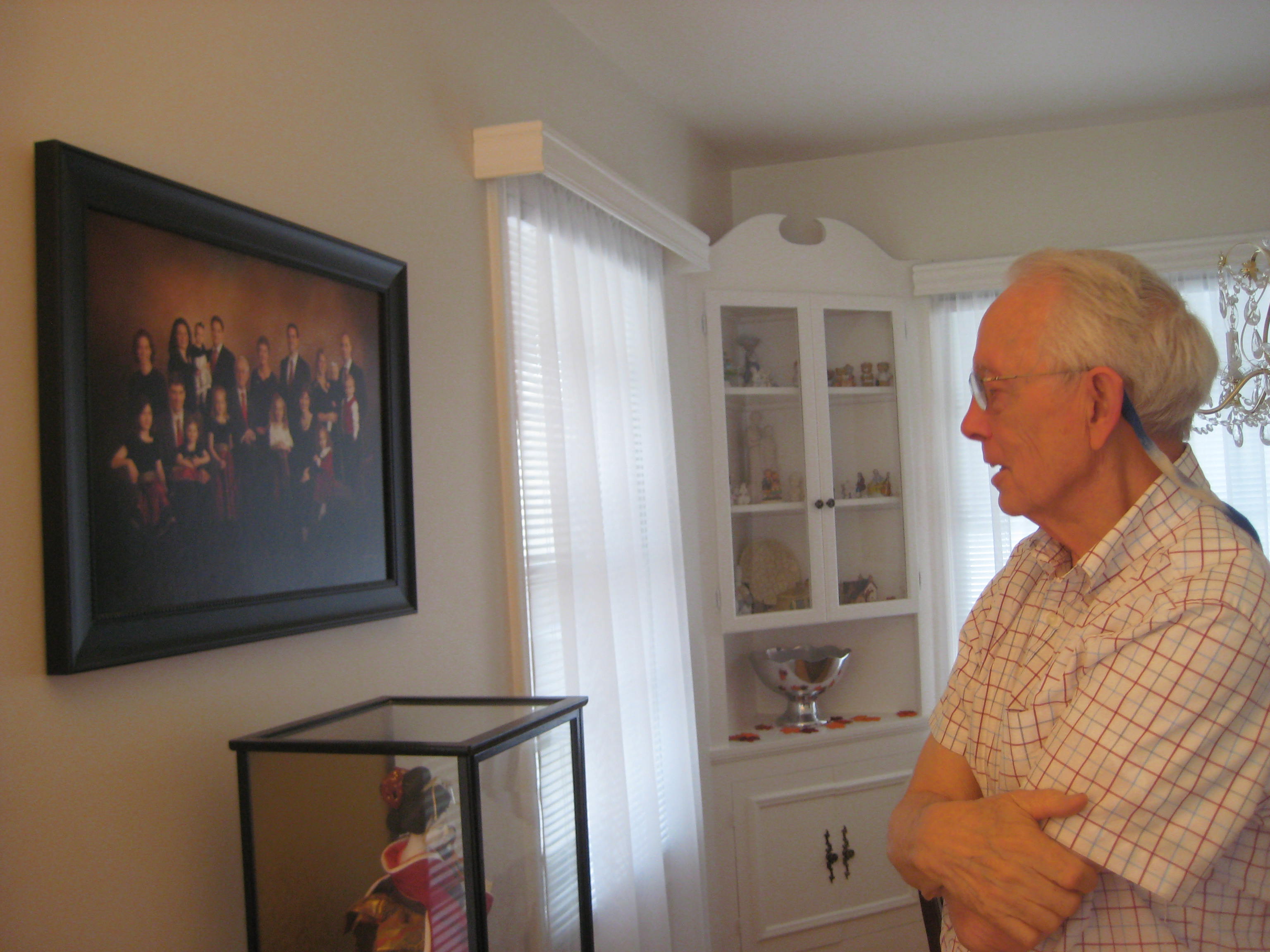
Fred Buchanan looks at a picture of his family, who he says has given him strength while suffering through Parkinson's disease.

begins to interfere more with his daily life. His first is to write a book about his wife’s family history that was central to Scottish immigration, primarily to Utah. His second project, with the help of his journal that he’s written in for the past 35 years, is an autobiography for his family and friends to remember him by.

“I like to think that something happens to you after you die,” he said.“But if not, this is what I will have left behind.”

Although his Parkinson’s is an obstacle, Buchanan said he wouldn’t let that get in the way of what he wants to do. With support of his family, friends and his faith, he says that he’ll be able to look past the complications the disease has given him.

“I don’t think God or nature gave it to me as a challenge,” Buchanan said. “But given that I have it, I look at it invariably, except for to take a nice nap in the afternoon.”