Spy Hop Productions: a different kind of school

By COLLIN McLACHLAN

Spy Hop Productions teaches self expression through multimedia

If a school had students only do one or two projects a semester, would that school be considered an effective learning facility? If you were to ask students at Spy Hop Youth Media Arts and Entertainment Center, the answer might be a resounding “yes.”

Spy Hop is a nonprofit organization that, according to its website, is committed to helping students ages 13 -19 “express their voice and with it create a positive change in their lives.” It does this by using digital technologies as a means of artistic expression. Spy Hop has programs that teach students self-expression through film, audio, music, web design and video game design.

Rick Wray and Erik Dodd founded Spy Hop in 1999. At the time, Wray and Dodd owned Higher Ground Learning, a for-profit academic tutoring facility. Matt Mateus, programs director at Spy Hop, said in an interview that what Wray and Dodd discovered while tutoring became the basis for forming Spy Hop.

“They found that when they introduced film and video into their tutoring it was way more engaging for the student,” Mateus said.

Since Spy Hop also focuses on the development of the student, rather than simply teaching them technical skills, it uses self-expression as a means to teach students principles such as community awareness, emotional competency and high productivity.

“Our success really comes when youth leave here as engaged productive citizens, they succeed in the work force or higher education and have an opportunity to share their voice with the rest of the world,” Mateus said.

In an effort to achieve this, Mateus told of five fundamental goals that Spy Hop focuses on for all of its programs. These goals focus around: providing a safe after-school program, fostering artistic expression, developing educational and workplace readiness skills, developing emotional competencies and increasing media literacy, personal awareness and global connections.
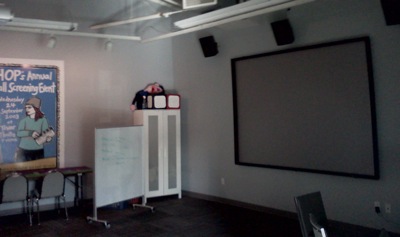
The theater room at Spy Hop

To better reach its vision, Spy Hop has a unique way of working with the students.

“We’re allowed to be different from a public school system. We’re allowed to sit down and really take the time to see what each student really wants to learn,” Matues said. “We really dig into, ‘what are the activities they are doing and how does that relate to our mission?’ ‘How does that relate to our program goals?’”

Because of this teaching technique, teachers at Spy Hop are called mentors. They spend one-on-one time with each of their students to establish a trusting and respectful relationship, along with helping with their projects.

This became apparent when Mateus, who’s a mentor in the music program, was giving a tour of the studio. He noticed a game-design student eating popcorn near the computers.

“Be careful with that popcorn. I don’t want butter all over the keyboard,” Mateus said while walking by. The student responded with a respectful, “Sure thing. Sorry Matt.”

“I still keep in contact with a dozen of my old students that I go to lunch with,” Mateus said. “The feedback I get is really positive.”

Shannalee Otanez, 24, an instructor for Loud & Clear said, “I love it all. I love seeing young people feel empowered to believe in themselves, and to feel like they have something important to share.” She feels she’s in a great position as a mentor at Spy Hop since she’s a former student. “I benefited from it myself, so I get what kind of impact it can have,” she said in a phone interview.
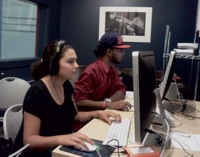
Shalom Khokhar, right, works on his audio project.

Shalom Khokhar, 19, from South Salt Lake, has come to understand that impact as well. Khokhar is a student in the audio apprenticeship class. He said the two main things that Spy Hop has taught him are priorities and responsibility.

“Once you come in, you sit down and it’s all about your work ethic, which you can apply in your other life too, in social settings, school, education, whatever,” Khokhar said.

When asked what his favorite part of Spy Hop was, Khokhar said, “I’d say the respect that Spy Hop has toward its students. They have a certain trust that they give to students to say, ‘OK come in here, use our equipment and stay in here as long as you want.’”

Spy Hop isn’t just helping students to become better people; it also helps to prepare them for the work force. The students work on projects during after-school hours using modern digital equipment. Khokhar and his apprenticeship class, for example, are currently working on the sound for a film produced by Spy Hop called “River’s End,” which is a story about a boy who, after his dad leaves his mom, goes and plays by a river and meets an imaginary friend. Him and his friend then run away and have some adventures. Khokhar says that a project like this takes skill in sound editing which he is happy to be developing.

Mateus is proud that Spy Hop is helping to create the next work force in the industry. Along with personal and life skills, Spy Hop is providing its students with a leg up by giving them hands-on training.

“To be able to walk into a studio and say, ‘I can work for you guys. I know Pro Tools. I know where to set these microphones up,’ at 17 years old. That’s crazy,” Mateus said. “Because what are they going to be doing when they’re 25?”

Utah nonprofits fighting to stay afloat in a rough economy

Story and photos by BROOKE MANGUM

With the downturn in the economy many businesses are losing their shirts, but what is seldom thought about is how nonprofits are impacted during these times.

According to the National Center for Charitable Statistics (NCCS) the U.S. is home to more than 1.5 million nonprofit organizations. There are nearly 10,000 registered nonprofits in Utah alone.

Although nonprofits may not be the first type of corporation that comes to mind when thinking about big business, it is still a moneymaking entity that relies on a healthy economy. Many Utah nonprofits are struggling to survive and are looking for strategies and ways to stay in business.

“Obliviously in this economy everybody suffers,” said Nancy Basinger, Ph.D., the Lowell Bennion Community Service Center assistant director. “Nonprofits maybe suffer more because there is more demand and there are fewer dollars coming in the door.”

Nonprofits have been an area of research for Basinger for about eight years. She received her master’s degree in nonprofit organizations and her doctorate studying the interactions between government and nonprofits. Basinger has also worked in the nonprofit sector as a bookkeeper and financial director.

Basinger said the main problem facing Utah nonprofits is that community needs are up but the revenues are down. Organizations are being forced to lay off staff members and downsize services even though the demand is still rising. This makes fulfilling the needs of the community extremely difficult, if not impossible.

The Community Foundation of Utah  reported that in 2010, 77 percent of reporting nonprofits in Utah saw an increase in demands for their services. Subsequently, organizations are looking for funding any way they can, since much of their savings have been depleted.

“Organizations that used to keep six months’ worth of expenses in the bank for a rainy day have now spent it all. This is the rainy day and now we have to figure out what to do,” Basinger said.

Nonprofits are tightening their belts and are working to become as cost efficient as possible. This means organizations are finding new ways to deliver their services as well as making changes in funding sources.

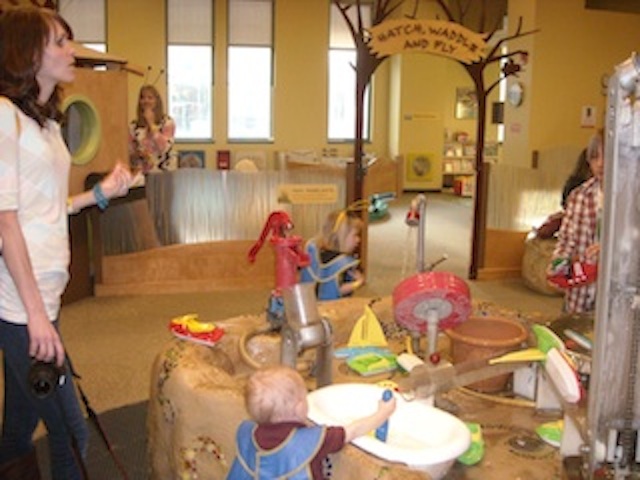
Discovery Gateway has fun interactive exhibits suitable for children of all ages

One organization that is doing this is the west-side nonprofit Discovery Gateway. Discovery Gateway specializes in children’s education through interactive exhibits, and like many nonprofits has experienced a drop in funds to the organization.

Steven Suite, chairman of the board of directors of Discovery Gateway, says the museum has been hit hardest by the decrease in donations given by foundations. Many foundations base their donation amount upon the interest they make on their investments. If the foundation’s investments do poorly, the donations to nonprofits suffer.

“Our strategy has been to put more focus on corporate sponsorship, more importantly, finding new donors to help fill the pot,” Suite said.

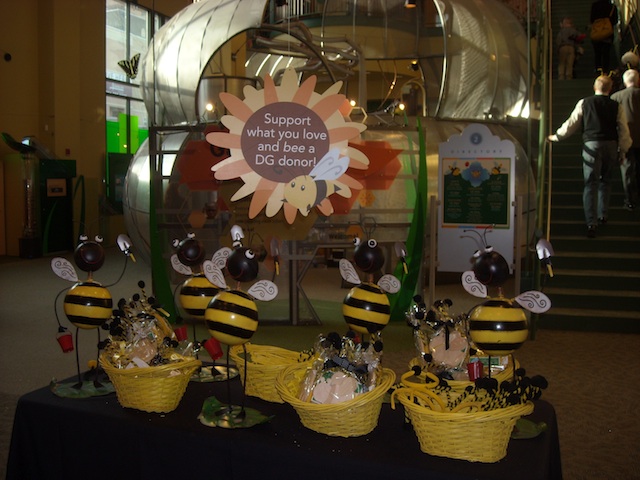
All donations to Discovery Gateway are tax-deductible

Discovery Gateway children’s museum is a 501 (c)(3) public charity. This type of nonprofit is tax exempt, benefits the community and derives at least one-third of its revenue support from the public.

“Discovery Gateway gets its funding from two places, the ZAP tax, which comes from the government and private donations and fundraising events,” Suite said. “Donations and fundraisers account for more than half of the museum’s yearly income. Without it the museum would cease to exist.”

According to the Community Foundation of Utah, 35 percent of Utah nonprofits have experienced a significant decrease in end-of-year giving. Twenty-eight percent reported a decrease in overall contributions and foundation, and corporate giving is down by nearly 50 percent. Overall, 64 percent of Utah nonprofits have seen donations decrease since the beginning of 2010.

Historically, Utah residents have given a great deal of support and funding to charitable organizations such as nonprofits. In fact, according to a report by the Community Foundation of Utah, the average charitable contribution per tax return in Utah is 4.9 percent while the national average is only half of that at 2.2 percent.

“Luckily, we have not had to go as far as raising our admission prices, or cutting down our hours but we did reorganize,” said Lindsie Smith, Discovery Gateway development and marketing director in a phone interview. “We have made changes in our staff and board of directors, and consolidated. To keep overhead costs down we have not rehired or filled any open positions.”

Rose Park: Diverse in culture, united by community

Story and photo by MELANIE HOLBROOK

The Salt Lake City neighborhood, Rose Park, is well known by its diversity in culture. However, what people may not know is that its groups and councils bring the community together.

Brad Bartholomew, Rose Park community council chairman, said in a telephone interview that groups such as the community council, the Lions Club and the Rose Park Revival are just a few organizations in the community.

“There are also a group of people who mainly like to get together just to hang out and get to know others in Rose Park. They have one or two food drives every year as well,” Bartholomew said.

Rose Park’s community council meets the first Wednesday of every month to discuss what’s happening in its neighborhood, to discuss concerns from community members or organize community events.

The Rose Park Revival, a committee created for fun in the neighborhood, has held events such as the “Crop Swap” and the “Fun-O-Rama.” The crop swap is an opportunity for residents to share produce from their garden and get to know their neighbors.

According to the revival’s website, “The feedback received was very positive but insightful as well. Folks here are so kind that the idea of selling the fruits of their gardens was a bit foreign, when they usually just give them away to neighbors and friends.”

The crop swap allowed people to swap things like Armenian cucumbers for a bushel of apples. The event was held in August 2011 and was a success. “I was even surprised at the quantity and quality of offerings given the late spring and earliness of the date,” wrote Jim Harper, a community member, in a post on Rose Park Revival’s website.

Mario Organista at Westpointe soccer field.

Mario Organista, 20, a Rose Park resident, said his neighborhood “definitely has several ways of bringing people together.”

One unifying activity for Rose Park community members is soccer. Residents from all over the neighborhood come together for games. It gives members a chance to interact and cheer for fellow friends and family. “Soccer games are just full of energy and puts everyone in a good mood. After having a good time with your neighbors, you don’t want to have tension,” Organista said.

Organista has lived in Rose Park his whole life and has enjoyed it. “There’s usually stuff going on for the community to get together and have fun,” he said.

He said a unique way that the community is unified is through there being a lot of different cultures. “There isn’t just one race or culture that is a minority; there’s so many different people, it makes us have more in common,” Organista said.

Spy Hop and UNP: Shining some light on the west side of Salt Lake City

Story and photo by COLLIN McLACHLAN

What if you turned on the radio and heard this: “A young man was stabbed today in a probable gang fight in Bountiful.” Would you be surprised? Now imagine if the radio said it was in Rose Park.

“Stereotypes don’t reflect crime statistics,” said Sarah Munro, associate director of University Neighborhood Partners.

Founded Nov. 1, 2002, UNP is a program that “brings together University and west side resources for reciprocal learning, action, and benefit.” According to its website, UNP collaborates with communities and nonprofit organizations in an effort to “provide access to higher education.” Its drive comes from the idea that education is the key to strengthening both families and communities.

“UNP is not a service organization,” Munro said. “What we do is meet with local nonprofit organizations on the west side and establish partnerships that will benefit the community.”

UNP has many challenges to its work. “The difficult thing is that people want to know what changes are happening,” Munro said.

She said it’s difficult for UNP to measure its success because success doesn’t come from UNP’s work alone. Since its main focus is to create partnerships, UNP finds success when its partners do.

This doesn’t mean that success cannot be tracked. One organization that UNP has partnered with in the past is Spy Hop Productions.

Spy Hop Productions works to help students on the west side.

Spy Hop Productions is a youth media arts and educational enrichment center. Spy Hop’s purpose, according to its website, is to “empower youth to express their voice and with it create a positive change in their lives.”

According to the site, Spy Hop works with some 1,800 students every year in the fields of documentary arts, video production, audio engineering, music and interactive media. Founded in 1999, Spy Hop has been “acknowledged by the Sundance Institute as setting the standard for media arts learning across the nation.”

Students learn things at Spy Hop that go beyond the classroom. “These kids are being taught to express themselves in a positive way,” said Virginia Pearce, director of Marketing and Community Programs in a phone interview. “It gives the kids a chance to be proud of something, which goes a long way.” A lot of students at Spy Hop live on the west side and come from backgrounds which Spy Hop refers to as “underprivileged.”

Spy Hop works directly with its students over long-term mentor-based instruction. The students get hands-on tutoring as they work on media stories, documentaries or music recordings. “There are so many success stories, I couldn’t think of just one,” Pearce said.

Matt Mateus, a programs director at Spy Hop, shared one student’s story that can be counted as a success for both Spy Hop and UNP. He says a student who grew up in Rose Park in an underprivileged family came to Spy Hop wanting to be a recording engineer. But he needed special classes that Spy Hop couldn’t provide. Spy Hop did, however, have contacts with universities that offered those classes. After the student had worked to raise the money, Spy Hop helped to send him to a school in Arizona that had a recording engineer program. “That student now works in Salt Lake where he owns his own recording studio,” Mateus said in a phone interview.

Spy Hop and UNP do still share a common belief that drives each organization. “Preparing students for higher education is directly related to Spy Hop’s programming goals,” Mateus said. The organization collaborates with Salt Lake Community College (SLCC) quite a bit.

“A lot of our students are underserved,” Mateus said. “They usually don’t have the opportunity to jump into the U of U, so they go to SLCC.”

These types of success stories are different from the articles normally published in the newspaper.

Sorenson Unity Center a product of collaborations

Story and photo by DEREK SIDDOWAY

Community gardens, dental services, recreation center and art gallery; the Sorenson Unity Center offers a plethora of activities for residents of the Glendale and Poplar Grave neighborhoods, all rolled into one convenient package.

Built in 2008, the Sorenson Unity Center (formerly the Sorenson Multicultural Center) is the result of combined labors between Salt Lake City, Salt Lake County and various nonprofit organizations. Located at 900 W. 1383 South, the center houses a combination of services — computer labs, fitness facilities and child care, to name a few — that community members can take advantage of.

“The great thing about the unity center is we have so many diverse programs and services,” said Director Nichol Bourdeaux, 36. “It really is a one-stop show for the community members of the Glendale area.” Past examples of the center’s “diverse programs and services” include Planned Parenthood, computer literacy classes, food preservation and canning, relationship and substance abuse workshops and film screenings.

This gallery, located at the southern entrance of the Sorenson Unity Center, features "Reflections" by Alyssa Chamber. It showcases a wide array of human emotion.

Bourdeaux says the community has “embraced” the center and uses it for various public and private functions. However, this “one-stop show” serves more than a stage for community activities. Numerous venues are available for long and short-term rent as well, including conference rooms, theatres and classrooms. The Sorenson Unity Center also allows community members to exhibit their art in two galleries positioned at the south and east entrances. Past exhibits include “Reflections,” an exhibit by community member Alyssa Chamber that explores the spectrum of emotion people experience throughout life’s trials.

“We are really working as a collaboration: nonprofit, community agencies and government agencies providing services to the community. It’s not one entity providing something,” Bourdeaux said. “Because of the variety of programming and services it’s a natural collaboration between all the different cultures; this is their community center.”

Examples include Horizonte, an alternative school that teaches adults English as a second language and basic education classes. KUED’s Ready To Learn Workshop spans a six-month period and covers a variety of parenting classes on topics ranging from child development to anti-bullying and nutrition. Salt Lake Donated Dental operates in the southeastern corner of the center and provides discounted or free dental hygiene services.

Patrons who take advantage of the center’s offerings don’t need to make special arrangements if they have children. Parents can place their children in the drop-off Child Care Center while exercising or attending classes. Children ages 8 weeks through 8 years can be placed in childcare Monday through Friday for as low as $1.50 per hour.

The Computer Clubhouse, a computer lab specifically for children ages 10 and up, allows neighborhood youth to “use technology creatively to acquire the tools, problem solving skills and confidence to lead successful lives,” according to the Sorenson Unity Center’s website. In addition to open access, children can attend scheduled classes such as Lego robotics, engineering, graphic design and film design.

The Sorenson Unity Center houses a variety of nonprofit organizations selected through its Programming Partnership.

Not just any program is admitted, however. In order to ensure the quality of nonprofit organizations, the Sorenson Unity Center developed a Programming Partnership in 2011. Programs must follow the stipulated guidelines in order to use the center. Requirements include proper food and business permits, identifying the Sorenson Unity Center as a partner and adherence to scheduled meeting times. Programs wishing to continue their service at the end of the year-long agreement must be re-approved by the center.

“We are working with 25 local nonprofit organizations that want to provide services to the community for free,” Angela Romero said. Romero is the program coordinator at the Sorenson Unity Center and is responsible for selecting partner organizations.

“Through the programming partnership we have specific guidelines to match what we do here,” she said.

While Romero admits fine tuning may be necessary, she sees the partnership as a vital part in the collaboration between the Sorenson Unity Center and outside organizations.

“Our biggest goal is to make sure everyone in the Salt Lake community is aware of the services we provide,” Romero said. “This place is for them.”

The Salt Lake Film Society shines the silver screen across community barriers

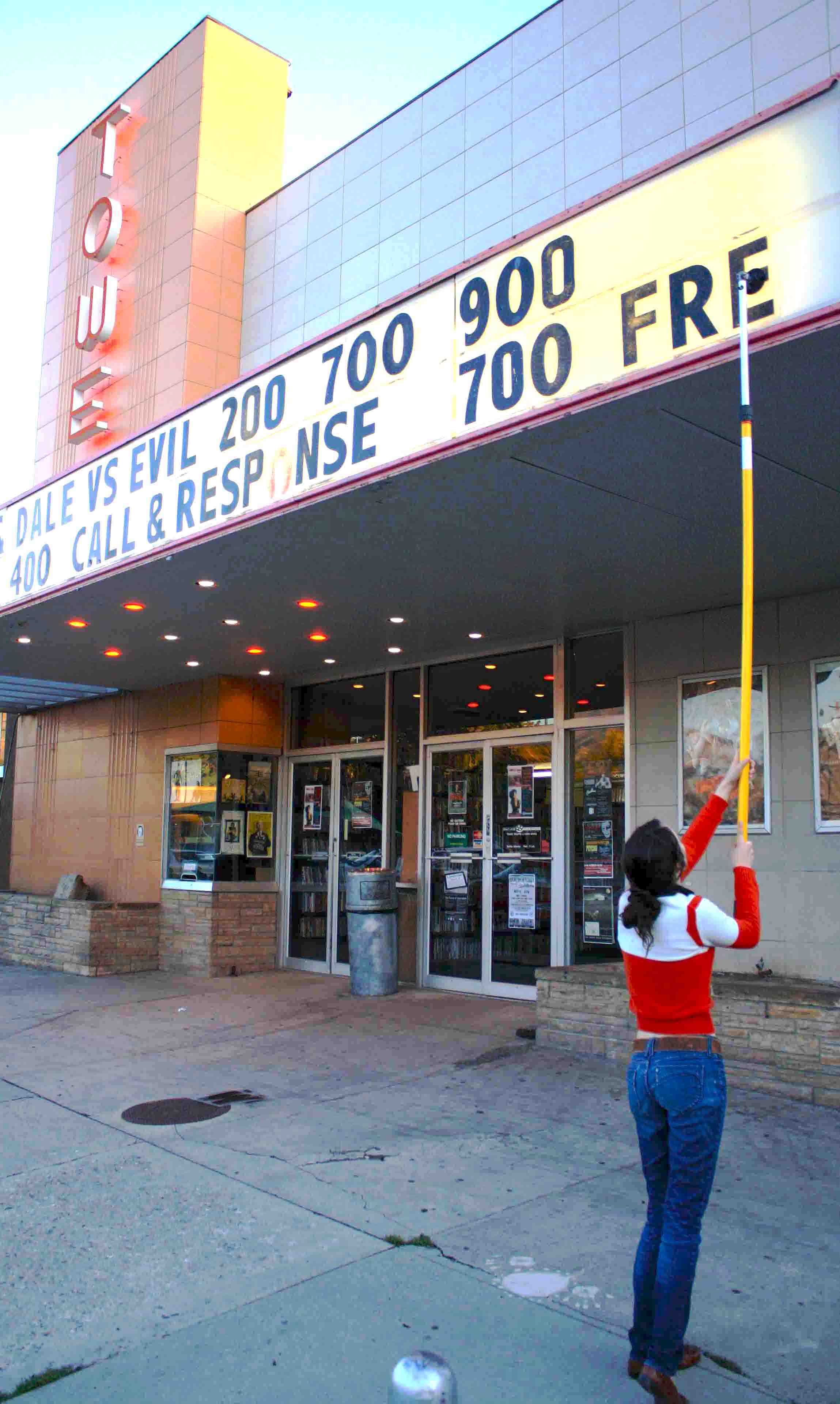
Dagny Horton of the Salt Lake Film Society changes the Tower Theatre marquee for a showing of the film "Call + Response" for the YWCA

Story and photo by ZACK RENNER

As he sits in front of the Coffee Garden at 9th and 9th in Salt Lake, 24-year-old film student at the University of Utah, Jordan Connelly looks paler than anyone should in early September.  It could be his natural complexion or just as well his passion.

Connelly, as well as a film student, has been a member of the Salt Lake Film Society (SLFS) for three years. He spends more than his fair share of time in a cool dark theater expressing his love the best way he knows.

“The quality of life in a community is reflected in how that community nurtures artistic expression within it,” Connelly said when asked what role art holds in a community.  As a community nonprofit organization and art house for the showcase of independent film, the SLFS reflects the culture and diversity present in Salt Lake’s communities.

What began with Kris Liacopoulos’s fight for preservation of the local Tower Theatre in 2001, has 10 years later has grown into what the SLFS mission statement calls, “the premiere film establishment of our community.”

Since its inception, SLFS has endeavored to keep independent film a part of the lives of Salt Lake City community members like Connelly. It currently owns and operates the Tower Theatre in the 9th and 9th neighborhood as well as the multiplex Broadway Centre Cinemas on 111 East and Broadway in Salt Lake City.

“We bring the art form of cinema in its most culturally diverse form on a daily basis. Without the Salt Lake Film Society and our community here in Utah in particular, we wouldn’t have access to these films and the thoughts and ideas behind these films,” said 39-year-old SLFS Executive Director Tori Baker in a phone interview, “It’s so important to bring that to any individual community in whatever form you can.”

The society coordinates educational programs about and through film. Its website boasts that over 950 local filmmakers have been able showcase their work on the Broadway and Tower theater screens during designated open screen nights and festivals.

Through programs like the ongoing Utah Screenwriters Project, the Society provides workshops to those who make it through the application process. The 30 that are accepted receive mentoring from Hollywood professionals in producing their own screen productions.

For those who simply want to enjoy film, SLFS theaters are also the only place to see independent and foreign films that otherwise would have no chance to shine on mainstream theater screens in Salt Lake.

One important tradition of community involvement for the SLFS is its youth outreach program: Big Pictures Little People. Each year for the last seven years, the SLFS has paid for and facilitated 900 to 1,000 low-income children, ages 5 to 12, to see family friendly cinema yearly. During the summer months, volunteers for the program organize buses, free concessions, commemorative toys and a comfortable seat in a cool theater with their friends and families.

Collaborating with nonprofits such as the YWCA, the Road Home and the Utah Health and Human Rights Project, the SLFS presents children an opportunity to see appropriate movies and shorts as its website describes. Of those movies was Hayao Miyazaki’s “Spirited Away,” a critically acclaimed Japanese animation film about a girl wandering into a mystic realm of gods and monsters.

“It was an enhancement of our program,” said Jacob Brace, Neighborhood Partners executive director. “It helped make opportunities that are culturally relevant and child friendly available to all children regardless of socio-economic background.”

However, it is not always as easy to drum up a bus full of enthusiastic patrons. When it comes to bringing in members of specific communities to the silver screen, it can be difficult to appeal to the right audience for each film.

“We are humble in terms of our capacity, and in terms of our number of staff for work on the marketing as well as fund raising components,” Baker said. The challenge in selecting films from current and past productions is making decisions on what is topical and what patrons want to see.

A part of being an advocate and art house for independent and foreign film is the ability to give diverse and often marginalized voices a platform for articulation.  These “crossover films,” as Baker calls them, help communicate to an audience that otherwise would not go out for a film.

For instance, the Tower Theatre hosts an LGBT movie night on the first Monday of the month. Through the event, members of the LGBT community have an occasion to gather and enjoy films and discuss narratives relevant to their community. While programs such as this one can pertain to a specific group of people, there are programs of interest that appeal to a wide audience, regardless of gender, age or ethnicity.

However, the complexity in promoting niche films raises as notice to the society of a film’s arrival is commonly as short as two weeks. In the past, advertisements in Spanish language newspapers proved a valuable avenue for promoting Latino cinema, but some communities are harder to target.  A flier or handbill is sometimes not enough to spread word and, as a result, a film often fails to reach the full breadth of its demographic.

While SLFS is a community nonprofit relying on grants from the government, it is also an art house meaning it sells venue to film as art. And unlike other nonprofits, it is able to generate revenue through tickets as well as membership and donations.

Looking to appeal to a variety of demographics, the Society has created assorted types of membership. It has tiers in different price ranges to suit varying levels of interest in film. The basic “Super 8” level membership costs $4.99 monthly or $50 annually and includes $1 off admission, two Tower Video rentals as well as Society news updates via newsletters and email. On the other hand, the higher echelon “Chronik” level membership costs $29.99 monthly or $300 annual and includes free admission to regular-run movies, limitless free rentals, and admission to two members only Sundance Festival screenings.

The Salt Lake Film Society is always looking for ways to expand its membership and donations. As the technology of film grows beyond its ability to keep up, pressure comes down on modernizing the aging theaters.

“We are going to see more challenges in keeping the facility presentable. People know that it’s different than a Larry Miller theater… Our challenge ahead of us now is to keep up with any of those things that are moving faster than we can raise money for [them],” said Baker.

University Neighborhood Partners, Bad Dog Arts collaborate for Salt Lake City’s west side

Story and photo by BROOKE MANGUM

The University Neighborhood Partners (UNP) and Bad Dog Arts are collaborating to provide underprivileged youth on Salt Lake City’s west side opportunities to learn, discover and express themselves through art.

UNP is a program at the University of Utah that forms partnerships with organizations like Bad Dog Arts to create a greater sense of community between the U and west-side neighborhoods. It serves as a liaison between the U and west-side nonprofit organizations, resident groups and city governments.

“The reason for the focus on the west-side neighborhoods was because those neighborhoods were historically marginalized within Salt Lake City socially and economically and were incredibly under-represented at the U in terms of where students came from,” said Sarah Munro, UNP associate director.

UNP has been in this building since 2003.

Originally called the West Side Initiative, UNP developed about 10 years ago in response to feedback gathered during 300 interviews with area residents. Currently, UNP has 34 partnerships with 43 departments at the U that each focus on identified issues within the community such as race, ethnicity, religion, political views and geography.

“All of the UNP partners contribute to the community in different ways depending on their area of expertise,” said April Daugherty, program coordinator at Bad Dog Arts during an email interview. “Since our focus is in the arts, our role is to bring art into the community. Our role with UNP fulfills our mission to inspire youth from diverse cultures and offer art experiences to populations who would otherwise not have the opportunity.”

Bad Dog Arts has partnered with UNP for three years. It is located at 824 S. 400 West in Salt Lake City. Bad Dog Arts is a nonprofit organization that aims to inspire “at-risk and underserved” youth ages 5 through 18 to experience the power and freedom to imagine, dare, learn and challenge themselves through art. The hope is that  youth will develop self-confidence and be able to use these skills throughout their lives.

“It is a form of expression that has no boundaries, transcending language barriers,” said Victoria Lyons, Bad Dog Arts co-founder and director, in an email interview. “Bad Dog programs instill confidence and pride and give children a safe space to discover their innate creativity, artistic ability, purpose, and potential.”

Through the partnership of Bad Dog Arts and UNP, art classes are offered on a weekly basis at UNP’s Hartland Partnership Center. The center, located at 1060 S. 900 West, is often used as a place for campus-community partnership activities to take place.

During the fall and winter of 2011 and the spring of 2012, Bad Dogs Arts will be working with UNP on a mural art project that will be displayed at the Hartland Partnership Center.

“This project will be a collaborative effort of all the residents and staff of Hartland, involving children, teens and adults,” Daugherty said. “The theme of the project is ‘Community.’ Art brings people together and on this scale can really function as a tool for building community.”

Through activities and programs like this, UNP and its partners hope to bring together the U and west-side resources and create a community environment of learning that is mutually beneficial.

“Learning is reciprocal,” said Sarah Munro, UNP associate director. “There is important knowledge in a lot of different places and different forms. It is critical for people to learn to recognize that in others.”

Musicians in Utah are finding alternative ways to have their music heard

Watch a multimedia video about a local record label.

Story and multimedia by HELEN COX

For musicians wanting to be heard, it’s all about who they know and how creative and resourceful they can get. Despite the current recession, bands are finding alternative ways to record and release their music.

Getting a good record deal has never been easy, and these days it’s even harder. While several record labels and distributors do exist, a legitimate contract that will pay for recording and pressing is more difficult to attain than some may realize. The money is simply not there. But several locals have been looking for and finding new ways to get their music out to the public on a low budget.

Gavin Hoffman, drummer of INVDRS and IX Zealot – and an employee of Raunch Records and SLUG Magazine – has been playing music in Salt Lake City for 18 years. He has noticed bands are more likely to find a label to pay for the release of their albums if they know someone or if they tour.

Neither of Hoffman’s bands tour. In order to get their music out, they must do it themselves by networking within the music world and paying out of pocket. It’s a sacrifice, but even in a recession he explains there is a positive aspect. People still want to hear new music.

“If we shell out the dough and the time to record, press, and send our stuff to people, someone will eventually hear it,” Hoffman said.

Even with good networking and reasonable prices, this is not inexpensive. Hoffman’s sludge punk band, INVDRS, spent about $1,300 to record, mix and master their full-length album. The record was co-released by Relapse Records. His blackened hardcore doom band, IX Zealot, spent close to $700 to record, mix, master and press their three-song demo.

“We don’t ever expect to make that money back. It’s a total investment, simply to record and get our music out to people,” Hoffman said. “Neither of my bands – in fact, no band I’ve ever been in – has ever done anything to make money. We play and record simply because that’s what we like to do.”

Local black doom metal band, Gravecode Nebula, has decided to save some money and record on their own. They brought a PC with recording software into their practice space and have spent the last several months experimenting with rehearsal recordings. They are also saving foam padding from a shipping room at a band member’s workplace in order to make sound-proofing material – padding that would otherwise be sitting in a landfill.

“With the advent of new technology and the modern PC, we see that getting a professional sound with a home recording is now easier than ever,” guitarist Eric Elde said. “Other than saving a lot of money, I think the main benefit of this is that you can take your time to perfect and enrich your music to the vision you have for whatever you want to do.”

With a label that will fund the pressing and release of Gravecode Nebula’s debut album, the band is confident that recording their guitar, bass, keyboard and vocal tracks in their own studio is ideal. Due to drums being more troublesome to record – it is difficult without proper equipment – they plan to pitch in a few hundred dollars for their drummer to be recorded in a professional studio.

While many bands have found reasonable ways to record, distribution is an even greater issue musicians face. Without decent promotion and distribution, the music may never be heard.

“After recording and pressing, we have to get the album out to the masses,” said Hoffman. “Local support is good. Sell the album at shows and get it into local shops like the Heavy Metal Shop and Raunch Records. You have to get it out into the universe. The best way I’ve found is to send as many copies as possible to local, national, and international magazines for review. Even a negative review will generate some amount of interest.”

While some bands like to stick with more traditional approaches to promotion, social media has also become a very popular and accessible outlet. With an increasing number of websites that allow musicians to upload and share their music for free, it is easier for bands to be heard. Some labels are taking these ideas to a new level.

This year Backscatter Media and its sub-label, Dungeon Recordings, launched a new website with a unique idea. Two digital compilation albums are available on the site, with the option to stream or download the music for free. Many local favorites are included on these compilations, and the labels feel this is a great way to help Salt Lake City bands get exposure.

“We were already affiliated with a bunch of different artists who we were helping out, just kind of selling their stuff on our website,” Kevin Cazier of Dungeon Recordings said. “None of these bands really had any distribution, they didn’t really have any websites built for themselves.”

Cazier believes traditional methods of promotion and distribution are still very effective, but the Internet has something to offer that is difficult to provide otherwise – free music for the public and free exposure for musicians.

“In the past we had done compilation CDs, and it kind of gave us the idea to do this,” said Cazier. “We took that idea one step further. We thought a free download would be excellent – one compilation to represent Backscatter and another to represent Dungeon. Generally when people are listening to music they don’t have as much of an open mind if they have to pay for it. It helps the bands and it helps our label.”

Skyler Sheen, a self-described artistic terrorist who runs Wee Gee Wee Gee Records, a sub-label of Touch of Horror, believes all sound should be free and utilizes his home studio and social media more than most.

“If you have a painting, you can’t really charge somebody to look at it,” Sheen said. “Music and audio – sound – should be 100 percent free. I think most people believe this or they wouldn’t be stealing, or whatever, music all the time.”

Sheen believes money should only be made from the more artistic aspects of music, and social media should be taken advantage of as free distribution. He sees live performances and creating fun, personal and interesting ways to release and promote physical albums and merchandise as the only acceptable ways of making money in the music biz.

“I don’t know why somebody would want to be signed to a record label anyway,” Sheen said. “Create your own label or create your own thing. That’s why the corporate music industry is in trouble, is because a lot of people are going and doing that.”

It is apparent that the recession has given local artists a reason to appreciate their independence, get away from outdated norms and come up with new ideas. These are qualities that could be beneficial in the long run, even though they are likely to give the music industry a run for their money.

“I think, if anything, the recession has taught musicians to value what they have, to look toward the future and find new and exciting ways to capture their music,” said Elde. “Any way to save a buck in this economic climate is beneficial.”

Community-based art education gives children an edge in the classroom

Watch a multimedia interview with Dr. Beth Krensky about her work at the Pioneer Craft House.

Story and multimedia by MICHAEL OMAN

In South Salt Lake, parents are using community-based art education to give their children an upper hand in the classroom. Studies suggest such programs are actually a success.

A recent Dan Jones study concluded that such programs help improve academic performance overall. “They do better in math; they do better in science, history, when arts are woven into the curriculum,” Lisa Cluff, the director of Friends of Art Works for Kids, told KSL.

Utah hosts a number of after-school programs dedicated to introducing youth to the arts. The good news is that many of these programs slipped past state legislators’ guillotine and will receive funding for at least another year.

For seven years now Dr. Beth Krensly’s students, from the University of Utah, have facilitated a program she calls, “Art in the Community.” Each year her students design and teach various forms of art to participating elementary-aged youth through the Pioneer Craft House. Typically there are three classes children may choose from: mosaics, ceramics, and, for the last two years, animation. At the end of a five-week period the class hosts an opening to present the completed projects to the community.

“It gives them an opportunity to get exposed to a lot of different things that they probably wouldn’t have known,” said Myrna Clark, who enrolled her then 9-year-old son William in a pinhole photography class a few years back. She pointed out that many children do in fact have art classes during normal school hours. To her this usually means just doodling pictures with crayons or paint. That’s what made Krensky’s program stand out. It goes beyond the ordinary art class permitting children to work with a variety of materials.

In fact, Myrna Clark noted, not only was her son exposed to a new form of art, he had to build his camera from scratch. “I’m sure he never would have known how to put together a camera with a box of oatmeal,” she said. Constructing his own camera provided him with knowledge about the inner mechanics of a camera.

Innovation is the key skill classes like this teach, she said. “You can totally use different stuff other than going and buying a Canon for 400 or 500 bucks.”

Krensky explained that innovative thinking is indeed one of the key ingredients to a successful community art project. Participants learn to “try something, be willing to fail and then try it again and be creative in addressing something in an engaged kind of way,” she said. “I think that idea of stepping into the realm of being able to fail is very important for creativity and for invention.”

The Clark family said what kids learn through these programs goes far beyond endowing its students with creative ability. “Today most kids only know about digital cameras,” said Bill Clark, William’s father. “The concept of where this came from and what it’s all about, they have no idea.”

Bill Clark said he likes the idea that Krensky’s program encompasses every aspect of education. It may be an art class but through this class his son also gained a thorough history lesson. “You can see it in a different light. […] And you can appreciate the art of the past,” he said.

“Collectively, you can put all your core classes into an art project,” Myrna Clark added. With the photography class kids also learned how to take measurements and how to properly prepare the chemical used to develop the photos, adding both a math and science aspect she said.

“It was fun,” William continued, “just to go into the dark room and process them.”

In addition, it’s also a place of possibility.

Audrey Livingston, a University of Utah student facilitating the mosaics class this semester,  said, “I think that this environment gives a great opportunity to the children to learn about art in particular but also it is a great opportunity for us as students at the University of Utah to get them excited about going to college and continuing their education.”

There are other programs similar to Krensky’s in Utah. The Beverly Taylor Sorenson Art Learning Program (BTS) is a program that works with 56 schools statewide. As explained on the Davis School District website, its goal is to integrate all varying fields of study into a single art class.

Despite all the good programs like BTS and Krensky’s “Art in the Community” class do, it can be a struggle to find funding. BTS faced the possibility of budget cuts state legislators proposed in early February as a remedy to the $313 million shortfall. Luckily, that’s no longer the case. Lawmakers decided not to make any cuts to the program.

It’s a bigger struggle for Krensky’s class, however. The number of students enrolling in the course determines the class budget. This means anywhere between $400 and $1200 each year she teaches the course. “This needs to cover all of the art materials […] and paying mentor artists,” she said. To cover the art materials alone is a minimum of $600.

University policy prohibits using class funds to purchase food provided at the event’s opening and to pay the artist mentors, forcing the class to seek additional outside funding. “The year-to-year looking for additional funds makes the course difficult to teach.” Krensky said. “We often rely on donated materials and I write additional grants to support mentor artists.”

Seeking outside support isn’t easy. During a fundraiser earlier this month on the university campus, the class outreach group only managed to raise $30. In addition, the group hoped to receive donations from local bakeries as a thank you to those donating. That effort fell through. Many backed out at the last minute needing more time to fill the order.

The Clarks say it would be devastating if the course were to disappear. They say the exposure to university students children receive through Krensky’s class is priceless. “Yeah, I can grab a group of kids from junior high and walk around the U of U but they see them once and then they come back,” Myrna Clark said. On the other hand, programs like Krensky’s last for several weeks she said, giving children repeated exposure to university students.

“I think it’s great that he had exposure to University of Utah students who have a passion for what they do,” Bill Clark added.

Reflecting on his experience, William, now 12, has one message to the university: “It’s one of their best programs and just continue it on as long as they can. Maybe longer.”

Utah venues and bands hope 2011 will be a better year for live, local music

Watch a video of Utah’s live music scene.

Story and video by HELEN COX

Hard times have presented themselves, but Salt Lake City’s performing hard rock bands hope 2011 will be much more promising than 2010.

For decades Utah’s counterculture has loved and supported heavy, aggressive music. This is evidenced by a multitude of local bands, consumer support of the Heavy Metal Shop since 1987 and the recent re-opening of Raunch Records, the local punk and metal store that was popular during the eighties and nineties.

Local musicians and venue workers say times have been tough for Salt Lake City’s comparatively small nightlife since the recession set in. In regards to live performance turnouts in Utah’s underground music scene, 2010 was particularly difficult. But many are seeing changes happening already in 2011.

Jeremy Sundeaus, manager of Burt’s Tiki Lounge, has undoubtedly seen the economy’s effects on the venue that has employed him for more than a decade. Burt’s, which is often described as the CBGB of Salt Lake City, is a live music mecca. With cheap cover charges, cheap drinks and specializing in punk, hardcore, stoner rock, metal and rockabilly, the bar and venue has been in business for nearly 20 years ­– long enough to see a number of highs and lows.

“In the past year-and-a-half or so, it’s been really hard to get people out to shows. Some shows that I thought would be no-brainers, nobody shows up for. And sometimes you get lucky and have a good show,” Sundeaus said. “In the past month or two, it’s actually started to pick up – it kind of feels like old Burt’s again. I feel like maybe the economy’s taking a turn.”

Not only is Sundeaus pleased 2011 has started out well for his venue, he is also excited to see a lot of support for his band Muckraker and the stoner rock genre itself – a hybrid of psychedelic rock, blues rock and doom metal – which has become quite popular in Salt Lake City.

Bassist Dave Jones of locally-based, stoner rock groups oldtimer and SubRosa has also noticed the same economic struggles and successes in Salt Lake’s live music industry.

“I don’t know exactly what has happened, but just in January I started noticing a difference where people were coming out to more shows,” Jones said. “Maybe it’s due to weather, maybe it’s tax refund season and people are feeling like spending some cash – I’m really not sure.”

Jones’ bands play at bar venues like Burt’s on a regular basis, oldtimer’s guitarist even works there, but they can also be found gigging at more do-it-yourself (DIY) types of shows. This is an alternative idea that has recently become more popular in Salt Lake City, particularly at locations such as Salt Lake Recording Service and Raunch Records.

Brad McCarley opened Salt Lake Recording Service three-and-a-half years ago. With a love for music and a passion for recording bands, he said he had a goal of making “solid recordings of some of the great local music we have in town.” Salt Lake Recording Service has recorded over 110 bands to date.

What McCarley did not know initially was that his studio would soon double as somewhat of an underground venue. About a year after opening, Jones suggested having a show there. It was successful, and similar small performances have continued to occur ever since. Shows at Salt Lake Recording Service are free to attend, with a recommended donation. This type of setup gives bands a place to play, and the donations benefit the studio and touring bands.

“Having shows is mostly about keeping the music going, but it’s not what we normally do here,” said McCarley, who is focused on recording, but happy to have a symbiotic relationship with bands looking for a place to play.

Many locals like this type of relationship too, and perhaps it is the answer to getting more people out to see live bands.

“It’s very comfortable, it’s DIY, and everybody pulls together as a community to throw shows and help each other out,” said Alex Ruiz, guitarist and vocalist of doom metal/crust punk band, Doomed to Extinction.

As an unemployed musician, Ruiz has felt the harsh blows of the recession. Still, he remains optimistic for local music because of people’s willingness to collaborate through the tough times.

“It’s just honest people having a good time,” Ruiz said. “I think that’s all that matters.”

In fact, most musicians seem strangely optimistic these days. While most cannot afford new instruments, they are still buying new guitar strings, renting jam rooms and playing gigs around town – whether people are showing up or not. Perhaps Salt Lake City’s music scene really is going in a more favorable direction.

“It’s just hard times right now,” said multi-instrumentalist Alejandro Gomez, who is known for his work in Incendiant, Yaotl Mictlan, Trigon Aion and others. “But people will figure it out. They’ll find a way. It’s worth it. I think it is.”