Why music matters: cultural anchors in the Polynesian diaspora

Story by ALLISON OLIGSCHLAEGER

To Ogden filmmaker Te Anu Tonga, music is more than a hobby.

“Music is a language to us, and maybe even a first language,” said Tonga, 37, who was born in New Zealand to a Maori mother and Tongan father. “It is our whakapapa.”

So when Tonga felt the need to reconnect with her whakapapa, a Maori concept of heritage, genealogy and identity, she returned to New Zealand to produce a documentary on kapa haka, an indigenous performance art based in music and dance. Kapa haka functions as a key source of cultural celebration and preservation for the Maori people and provided an ideal lens through which to view Tonga’s central questions of identity.

“At its core, kapa haka is, ‘Who are you?’ ‘What are you made of?’ ‘Where do you come from?’ And when you find that out, what are you going to do in the future?” Tonga said in an interview.

Tonga’s forthcoming documentary, “Keepers,” details kapa haka’s impact on the families, communities and identity development of three Maori teenagers from different Auckland high schools. The film follows each school’s kapa haka team through their competition season, a year of competitive performance that culminates in Ngā Kapa Haka Kura Tuarua o Aotearoa, or the National Secondary Schools Kapa Haka Competition.

IMG_6672

Maori teenagers perform at a regional kapa haka competition. This is a still image taken from the trailer for “Keepers,” Te Anu Tonga’s upcoming documentary on “kapa haka, culture, and keepin’ it real.” Courtesy of Te Anu Tonga.

Tonga, who immigrated to Utah as a 5-year-old girl, says the art is a powerful tool in developing a sense of identification with one’s heritage. For her, it seems natural that such a tool would take the form of music.

“Singing is just so natural for them back home,” she said. “They’re all bottle-fed on music.”

Joel Kongaika, a Tongan American who lived in Tonga, Samoa and Hawaii before moving to Utah in 2009, said music is a key feature of cultures throughout the Pacific.

“It’s not as formal — there’s no opera house, there’s no musical theater, it’s not as first world or institutionalized — but you get way more music with it not being that way,” Kongaika said in a conversation in his Centerville home.

Children in Polynesia learn music from a very young age, Kongaika said, beginning with exposure through their parents and churches and later through formal musical instruction in elementary school. Singing is not reserved for the “talented,” “expressive” or “effeminate” — it is considered an activity for everyone.

“As a young person, it’s never something that you’re ashamed to participate in,” Kongaika said.

For first-generation Utahns like Tonga and Kongaika, Pacific music and dance are invaluable links to their home cultures. They foster community, preserve language and articulate cultural history and values.

Kongaika’s daughters Anna and Eryn, who were born in Hawaii, have each taken several years of Polynesian dance classes here in Utah.

“Our hope is that the girls have exposure to their roots,” Kongaika said. “I’d rather they take hula lessons than piano lessons.”

Kongaika also tries to introduce his children to indigenous music. Two of his daughters are taking ukulele lessons from their grandfather, and Anna keeps a playlist of her favorite Hawaiian music for family road trips.

Kongaika’s father, Isileli Kongaika, lives in South Jordan, where he attends a Tongan-speaking congregation of the Church of Jesus Christ of Latter-day Saints. Although Isileli speaks excellent English, he prefers to attend a Tongan-speaking assembly where he can worship in his native tongue and sing the hymns he grew up with in the islands.

Between Salt Lake, Davis and Utah counties, the LDS Church has 42 designated Tongan congregations. But each meeting features a blend of English and Tongan language use, Isileli said – especially the musical numbers.

“One person will sing the English translation, the person next to him will sing the old Tongan language verse,” Isileli said in a phone call. “I find it difficult to do myself because I am used to the old one, so I just sing my own way.”

Isileli said the language chosen by each singer depends largely on their age, with the older congregation members typically opting for the Tongan originals and most second- and third-generation members singing in English. However, as their language skills improve, many young churchgoers find themselves drawn to the original Tongan versions of hymns they once sang in English.

“They’ll pick up some words, some language, and I do see some pick up the Tongan songs and hymns,” Isileli said.

Many second-generation church members cite a desire to learn their heritage language as their primary reason for attending a Tongan-speaking congregation or for joining a Tongan church choir, which typically performs traditional music or Tongan language hymns.

“Everyone who goes to church sings, so these choirs are basically the entire congregation,” Joel Kongaika said. “To see music still helping to care for Tongan language is a big deal.”

As in the islands, the choirs welcome each and every singer.

“With our culture, it’s not about who can sing really well,” Te Anu Tonga said. “You’ll get someone who’s singing and you can just tell they’re going home. It may not sound the best musically, but you can feel that he’s just missing home, and he’s going to go there and take us with him.”

From kapa haka to church choir, polished performances to impromptu a capella – for Polynesian Utahns, the music of the islands is a powerful cultural anchor.

“Wherever we are in the world, we are home,” Tonga said.

Cultural rediscovery in Utah’s Pacific Islander community

Story and photo by DIEGO ROMO

Pacific Islanders have a long history and legacy in the United States that spans multiple generations. In Utah specifically, according to many sources, Pacific Islanders can trace their roots to religious immigrants who arrived shortly after the original Mormon pioneers. The community has left its mark on Utah’s unique cultural heritage and has been shaped by it as well.

Statistics from the Utah Department of Health show that the state is home to 38,000 Pacific Islanders and the average age among the community is 20 years old. Only one-quarter of those who identify themselves as Pacific Islanders are foreign born, meaning that three-quarters of Utah’s Pacific Islander population has no physical tie to the cultural homeland of their ancestors. This leaves many in the community culturally severed from their history and people.

This void leaves many feeling lost, as if they are floating between the two identities that help them to establish their self-image.

“I always felt divided,” said Susi Feltch-Malohifo’ou, executive director of Pacific Island Knowledge 2 Action Resources, a Pacific Islander community resource group based in Salt Lake City.

Unlike many of the younger generations of Pacific Islanders in Utah, Feltch-Malohifo’ou has a direct, physical connection to her homeland. The daughter of a woman who worked as a housekeeper at a Mormon coconut plantation, Feltch-Malohifo’ou was born in Tonga, but was quickly adopted by a pair of Mormon missionaries who oversaw the estate.

She described the plantation as one very similar to the those of America’s deep South: rolling lawns with many trees and the key feature situated in the middle, the plantation manor.

Her life changed when she moved into the manor and began attending church school with the children of fellow Mormon church workers in Tonga.

“In my school picture, I’m the only Tongan,” she said. “I lived in Tonga, but didn’t have the real experience.”

Feltch-Malohifo’ou remembers celebrating American traditions like Halloween and Easter, and always having running hot and cold water, an uncommon luxury in Tonga at the time.

From a very young age she adapted to her new life with its unfamiliar traditions and culture, but began to lose some of her Tongan heritage in the process.

When she finally arrived in Utah after spending some time in Texas, she was eager to get back in touch with the Pacific Islander community. But initially she felt like an outsider among her people.

“When I interact with other Pacific Islanders I have a hard time relating,” she said.

Many who share similar experiences to Susi Feltch-Malohifo’ou express the same sentiment. This may be attributed to the fact that the Pacific Islander community in Utah is very diverse in and of itself.

According to 2010 census data, the community breaks down into four groups: native Hawaiians, Guamanian, Chamorro, Samoan and Other Pacific Islanders. However, the census is not fully representative of how diverse this community truly is.

For those who are second-, third-, even fourth-generation Pacific Islanders born in America or raised in its culture, it can be difficult to pinpoint which cultural identity to relate to.

“I always looked at what made me different from them,” Feltch-Malohifo’ou said, referring to her connection to the Pacific Islander community. “My parents gave me opportunities that other kids of my situation didn’t have.”

Those opportunities and experiences isolated her from the community that she considered family. With no cultural anchor, Feltch-Malohifo’ou began to reach back out to the Pacific Islander community. She was surprised when the welcome wasn’t as warm as she had hoped.

She recalls an early incident when a co-worker at a former Pacific Islander community resource group told her, “If I close my eyes, you think and sound white.”

Hokulani Aikau, a University of Utah professor can relate. “It’s hard to find a way to connect when you feel like an imposter in your community,” she said.

IMG_8322V2

Hokulani Aikau, a University of Utah professor in the Gender Studies department, is collaborating with fellow faculty to launch the Pacific Islander Studies Initiative.

Aikau was born in Hawaii but was raised in Utah for the majority of her life. She shares many of the same cultural dilemmas as Susi Feltch-Malohifo’ou because she was raised in a primarily Anglo society.  Aikau grew up going to schools with white student bodies who were taught by white faculty, about a primarily white history and subject matter.

“How can we claim Hawaiian identities when we were raised here?” Aikau said.

She brings up a major dilemma in the community. How can Pacific Islanders maintain cultural identities when travel back to the islands is sporadic and access to the native language is limited and even nonexistent in some cases?

“Where do we go for that information? Universities are supposed to be a place for that,” she said.

Aikau, along with other professors and staff at the University of Utah, are launching the Pacific Islander Studies Initiative, an enterprise set forth by the university in order to further diversify its faculty and curriculum.

She described it as a hiring initiative that responds to the cultural needs of the community. This initiative would provide Pacific Islander students — who make up about 1 percent of the university’s population — with a culturally relevant education that challenges and critiques the status quo, while at the same time teaching students alternatives that are culturally relevant to their backstories and histories.

“You have to provide students with alternatives,” Aikau said. Especially those that are culturally relevant.

“The most important thing is the building of confidence,” she said, adding that Pacific Islanders “need to know there is a place for them here.”

She also touched on the fact that cultural education needs to address the diversity that exists within the Pacific Islander community.

“To be Hawaiian does not equal dancing hula and working at taro farms. You can express your culture in a variety of ways,” she said.

Feltch-Malohifo’ou’s organization, PIK2AR, provides another avenue for cultural education within the community by empowering parents and families with culturally relevant resources. These resources then help parents take that information back into the home to begin teaching children of all ages about their heritage.

“There needs to be more avenues for diversity within the ethnic communities,”  Feltch-Malohifo’ou said. But ultimately, “It’s about connection. It feels good to be valued,” she added.

Brandon Ragland, whose mother moved to Utah from Hawaii as a young child, seems to agree that implementing cultural education in the home is key to helping children understand their identities.

“Growing up we did lots of things to learn about our heritage and people. Every Sunday the entire family would get together,” Ragland said in a Facebook chat conversation. “We would have endless amounts of amazing food from home and after we ate, my great aunt got all the kids together, she’d teach us some short history lesson as well as a few Hawaiian words for everyday things,” he said.

“And the importance of passing each of those down to through the family to keep the spirit of aloha alive,” he added.

Ragland is now a father and says that he has been and will continue teach his son all that he learned from his great aunt.

“There’s a vast amount of history coming out of the Hawaiian Islands and knowing about it helps keep our ancestors’ memories alive,” Ragland said.

Cultural education is one way to rediscover one’s culture, and it can come in many different forms. But ultimately, it helps to clear the foggy area between cultural intersections and can provide a sense of identity to many who feel lost.

A day in the life of a refugee

Story and photos by WESLEY RYAN

Refugees, within the past year, have had to deal with a gargantuan amount of resistance. However, there are two refugee students who attend Salt Lake Community College who proudly live an American life and have aspirations they want to achieve.

Jemima Singoma

Walking across Salt Lake Community College (SLCC) with a beaming smile and a confident stride, you’ll see Jemima Singoma heading to her weekly meeting at the Refugee Club. There, she meets and enjoys the company of other refugees with similar stories to hers.

“When we first got here they immediately took us. They took us and separated us from our parents,” Singoma says, remembering the day she arrived in the United States at 13 years old. “We didn’t speak any English and they tried to put us in foster care.”

To this day, Singoma still doesn’t know why she and her brothers were temporarily separated from her family. All she knows is the United States government approached her and her family and tried creating more fear in their life. Possibly never seeing her family again, Singoma was forced into the care of strangers who didn’t speak the same language as her and her siblings. Singoma was eventually reunited with her family, but it won’t change what had happened.

Although Singoma recalls this moment being petrifying, she recounted the story through a smile and laughter, never showing a sign of resentment toward the American government. As a matter of fact, she plans on working within the American justice system in the future. Studying political science, she hopes to one day become a divorce judge, whether that’s in America or in her native Congo is a different story.

“I’d prefer to live back home, in Africa. Anywhere in Africa, or Nigeria,” Singoma says. “It’s just so beautiful all over.”

It’s not as simple as buying a plane ticket and flying over to Nigeria for the weekend. Working two jobs, going to school and caring for a child can prevent a lot of travel. However, Singoma is determined to give her daughter the life she deserves.

Only recently did Singoma pick up the second job at the Sephora warehouse in West Valley City, Utah. Although, Singoma says she prefers her job as an after-school teacher, mainly because of her love for kids. There, she teaches the kids the importance of being curious, math and proper grammar. Five days a week she will devote her time to school and work, but the weekends are when she relaxes.

On the weekends, you will see her in various dancing spots with a group of her friends she went with or met that night. Never breaking a smile and answering questions with a slight laugh, it’s quick to see why she’s so good at making friends.

Singoma is no different than most people in their 20s: going out with friends, exercising, dancing and meeting people. Nevertheless, she also has responsibilities and goals she needs to accomplish: finishing college, becoming a marriage counselor, raising a child and, finally, becoming a divorce judge. Singoma is your everyday person, the only difference is she has a different history.

Peter Muvunyi

Entering the international room you immediately see Peter Muvunyi helping another student with her math homework. Wearing a striped polo and innovative “toe shoes,” Muvunyi guides this student to the answer.

Muvunyi is a first-year student at SLCC, trying to get his surgical technician certificate. While he doesn’t particularly find the medical aspect interesting, he finds the life of a surgical technician enthralling. The main reason being its ability to lead to a better and easier life. Meanwhile, his work as the communication director for his church allows him to harness his other skills.

“I’m in charge of the communication and without me it’s pretty much chaos,” Muvunyi says. Every Saturday, Muvunyi goes to his church to set up and work the sound for the service. He makes sure the music is playing properly and all the microphones are set up correctly. Yet, the work he is doing and the courses he studies doesn’t relate to his dream.

“My dream goal is to own a school, it’s going to be high-tech though,” Muvunyi says. “Like, a fun, superhero kind of school. Have talented people come [work].” He’s already designed his future school in a program created by the architecture department. The architecture isn’t what interests him though, it’s the software and development aspects. Muvunyi doesn’t see his school being outstanding because of the way it was designed. He sees his dream school as being the best because of the softwares and programs being used to enhance the student’s learning, not their surroundings.

When it comes to Muvunyi’s dream, he will gladly admit it’s unlikely this will happen. It doesn’t stop him from continuing this interest of his; that’s what makes it a dream for him. Muvunyi has vastly different goals in mind compared to his dream though.

“My main goal is to just get a diploma that I can give to my mom, and then pursue my own interests,” Muvunyi says. He admits he could do both but his family wants him to follow societal norms. Muvunyi is no different than millions of Americans in this design. Conforming to certain ideals not only because it’s the societal ideology, but because it’s what his family believes. Nevertheless, like most people, he swerves from the road.

To rebel against his family’s ideals he will use bitcoin. His family doesn’t see the worth or understand the point of bitcoin. For them, bitcoin is a game where you waste your money. It’s not a realistic approach to life, which is why his mom still has some control over his rebellion. For example, whenever he wants to acquire more bitcoin he can only use so much of his own money or else his mom will put a stop to it. Muvunyi can understand his mom’s resistance to let him pursue this, considering he knows her and his brother are “straightforward people.” Being what Muvunyi considers a “city boy” or a “privileged refugee” is why he is able to experiment with these technologies.

“The thing is, there are different types of refugees. There are refugees who have fled and are in camps. Other refugees who have settled in a country and are able to provide themselves with the basic necessities. Then there are the refugees who have those things but live in camps,” Muvunyi says. “I am one of the refugees — my parents were financially stable, my mom was financially stable.”

Muvunyi’s hardships aren’t diluted by the fact he is considered a privileged refugee. Talking about the long arduous process of trying to acquire asylum, traveling for a year from Zambia, to Rwanda, to the United Kingdom and then, finally, the United States of America.

This isn’t out of the ordinary for his family, though. Watching his parents constantly try to find a place they can call their own, he saw what he wanted to change for himself. It was only natural Muvunyi would learn from his parents and adapt to a life he perceives as better.

Being a refugee since 2000, Muvunyi has had to acclimate to American culture and is still in the process of it. He knows it’s not an easy path, but he will make sure it is the best one he can create.

American Life

Singoma and Muvunyi are no different than Barbara working at Jamba Juice or Miguel, the personal trainer. However, with the sentiments being thrown around regarding refugees it’s hard for many people to understand refugees are just normal people with dreams like anyone else.

“Have various cultures side-by-side; show and highlight the differences. Celebrations and activities help the most,” said Jason Roberts, the advisor and founder of the Refugee Club at Salt Lake Community College. Going to a festival celebrating the culture or visiting a restaurant specializing in the food of a country with a high refugee population are simple ways to immerse oneself in these differences.

“There’s a war with good and bad. Refugees are just people,” Roberts says.

This slideshow requires JavaScript.

The Refugee Club at Salt Lake Community College

Story and photo by WESLEY RYAN

Starting college is a wonderful time in people’s lives. However, it can also create moments of terrible stress. Being a refugee student intensifies many of those problems, but the Refugee Club at Salt Lake Community College (SLCC) plans on helping refugee students overcome them.

“On paper, they, the refugees, look like a resident. There was no way to distinguish them apart,” said Jason Roberts, one of the founders of the Refugee Club and a current advisor for the group.

Roberts said many organizations throughout campus noticed there wasn’t a direct source helping refugee students reach excellence. To resolve this issue the school created the Refugee Club in the fall of 2013 to act as a safe space for refugees. At the Refugee Club, members can share their stories and meet people with similar stories.

While Roberts isn’t a refugee himself he understands some of the challenges affecting refugees on a daily basis. Before Roberts, an English professor at SLCC, began working with the Refugee Club he was employed by the Granite School District, teaching English as a second language to students.

“American culture is different from others,” Roberts said. In Syria and the African countries where club members are from, there is a distrust toward authority out of fear of being wrongfully punished. For many of these refugees this mindset is ingrained into them. This leads students to not ask questions, even if they aren’t completely understanding the literature being taught to them. This frame of mind can devastate their academic career and can dissuade them from pursuing what they are passionate about.

“Teaching them how to support themselves and to teach them to ask questions,” Roberts said. Creating an environment where these refugees can feel comfortable enough to ask questions. Roberts believes that this cultural shift from fear and submission to empowerment and individualism is important to the advancement of refugees’ understanding of survival here in the U.S.

Keeping track of how many members the club regularly helps has been a challenge for Roberts and the president. Roberts has said the number fluctuates between six and 10.

The welcome sign to the international department, where the Refugee Club regularly meets.

“What I care [about] is you come sometimes, and get some help,” Roberts said. As an educator, he emphasized his desire to educate and help people. Roberts doesn’t want to force club members to come to the meetings, saying that a forced education will only create problems further down the road. That could be the reason for the fluctuating attendance.

The club meets every Wednesday from noon to 1 p.m. The first half of the meeting is dedicated to learning a new skill such as writing with commas, giving a proper presentation or learning more about American culture. They will then spend the next half of the meeting discussing relevant topics in the news or things from their everyday life. They treat these meetings as a safe place for everyone to communicate about their troubles and for the group to give positive advice toward fixing the problem presented.

Even though the club is called the Refugee Club, Peter Muvunyi, the acting chair and president of the club, wants it to be a place where everyone can come.

“So, if I say Refugee Club the first thing that should come to mind is everybody; it’s more inclusive,” Muvunyi said. As a refugee from Zambia, he decided to join this group because he wanted to meet other refugees. He wanted to share his story with others. It’s the same reason he visits the Black Student Union (BSU).

Muvunyi and the club teamed up with the BSU and the American Indian Club in late November 2017 for a cultural potluck. They’re also planning, at the beginning of March 2018 to go to schools in Cottonwood and assist these other refugee students with their applications.

This desire to help refugees receive a higher education is an important belief for many of these people. Aden Batar, the director of immigration and refugee resettlement for the Catholic Commuter Services, has said that “very few actually do” go to college.

“Many of them are illiterate and it can take years for them to fully understand the language,” Batar said. He and Roberts have found that language is a huge challenge for refugees. This could be another reason why they don’t further their knowledge.

The purpose of the Refugee Club is to help refugees find these resources to further their education and their life here in the U.S. However, when it comes to helping refugees, Roberts said “we’re definitely not doing enough.” This desire to continuously do more for refugees could be for a multitude of reasons but each person answered the same way, refugees are human beings who deserve equal treatment.

Many cultures, one table: Thanksgiving dinner with refugee chefs and families

Breaking bread at the International Rescue Committee fundraiser to bridge barriers in community

Story and slideshow by DANNY O’MALLEY

The International Rescue Committee hosted Breaking Bread, a pre-holiday feast on November 15, 2017, to bring the greater Salt Lake City community closer together. Guests enjoyed cuisine prepared by chefs with the Spice Kitchen Incubator, a program that helps refugees launch food-service businesses. The Breaking Bread event was held at This Is The Place Heritage Park and drew nearly 250 attendees including refugee families in the community.

Upon arriving, guests were greeted by volunteers who guided them to one of dozens of tables in the high-ceilinged room. A 10-foot tall curved chalkboard wall stood near the podium, covered in decorative art and Polaroid photographs filling the shape of Utah. A flowery inscription reading “This is the place we all call home” emblazoned the top.

An elaborate video setup occupied a side room, where guests recorded live greetings to welcome newcomers to Salt Lake City. Guests and volunteers flowed around the central seating, filling the mountain lodge-style space with a cheerful buzz of conversation between old friends and new acquaintances.

At the bar, local startup Kiitos Brewing donated a selection of beer from its new lineup. The craft beer operation is a newcomer to the Utah brewery scene, but already setting itself apart as a leader in sustainable business and local collaboration. Natalie El-Deiry, deputy director of IRC, said Kiitos donates spent grain from the brewing process to the East African Refugee Goat Farm, a project benefiting refugee farmers on the west side of the Salt Lake Valley. The brewery is located in the Granary District south of downtown, and celebrated its grand opening to the public over the weekend of December 1, 2017.

Food from four entrepreneurs took center stage at the feast.

For appetizers, guests enjoyed Mediterranean and Middle Eastern fare, courtesy of two sisters. Suha and Mayada run Olives & Thyme together. Originally from Baghdad, they arrived in Utah in 2012 and started cooking with the Spice Kitchen Incubator in 2015. “Americans like to try new things, but there is nothing like what we make — they don’t know Arabic food here,” Mayada said.

The sisters spent hours in the Spice Kitchen the day before the event, rolling dough and wrapping it around spinach and cheese. Savory pastries, falafel sliders and small rice and beef bites called “kubbah” filled guests’ platters during the pre-dinner mingling. The hors d’oeuvres proved too scrumptious to remain for long — the sizeable serving trays were stripped clean by the time dinner was served.

The entree course was served family-style in huge bowls and deep dishes. Each table was assigned a different cuisine — Burmese or Somali.

Haymar, originally from Burma, runs Januhongsar as her catering endeavor, as well as a specialty grocery store called Sonjhae Asian Market. Haymar has lived in Utah since 2008, and has been with Spice Kitchen since in late 2012. For the dinner, she served a chicken and kabocha squash curry with mixed seasonal vegetables over rice. The seasonal squash tasted like a tender semi-sweet pumpkin, and lent a vibrant orange glow to the plate like a late fall sunrise. Haymar’s mouth-watering dishes can be found often through the rotating Spice Kitchen To Go ordering on Facebook.

Najati, from Somalia, lived in the refugee camps in Kenya before coming to Utah in 2008. She learned Swahili recipes cooking with her mother in the camps. “There were no fresh vegetables, but here there is regional organic food I cook with,” she said. Najati dubbed her catering business Namash Swahili Cuisine, and wants to open a food truck or a restaurant someday. “I am used to cooking for 400 or so people. This event I only have maybe 100, much easier.” For the dinner, she served roasted goat from the IRC goat farm, and vegetable curry over Somali-spiced rice with a hot sauce known as “pilipili.”

To top it all off, the dessert course was capped with an intricately-designed cake featuring the event logo, thanks to M Bakeshop. Michaela started M Bakeshop with Spice Kitchen in early 2017, but has been baking her entire life. “I always loved to lick the bowl, ever since I was young. I could live off sweets,” she said. Born in Austria, she has lived in the U.S. since 1986 and Utah since 1995. In the last two years she has started to experiment with a different process that she calls “inside-out cake,” allowing her to bake delicate hand-drawn designs into her cakes. Because of her precision and care on each piece, Spice Kitchen approached her to add an upscale dessert to the event. “I love seeing the reaction of people to my creations,” she said.

Patrick Poulin, executive director of IRC Salt Lake, welcomed attendees and spoke about the importance of sharing cultures between community members.

Natalie El-Deiry presented awards to local groups that were integral in their contribution to the refugee community. One of the awards went to St. Mark’s Family Medicine for its work on the VeggieRx program, a pilot to help refugees address critical nutrition needs.

This is the second year of the Breaking Bread event. Proceeds from ticket sales, as well as additional in-person donations, will help the IRC continue its work and promote new opportunities for refugees. As the Spice Kitchen Incubator continues to aid more local entrepreneurs ply their palate-pleasing trade, the event is sure to grow. Details about next year’s event, as well as the chance to purchase advance tickets, will be available on the IRC’s website or the Facebook page.

“We need to paint a picture of refugee contributions to the community,” said Natalie el-Deiry in a previous interview. This event is just one part of that picture, growing a closer, stronger community through sharing a table and enjoying a meal together.

Salt Lake City’s farmers markets draw loyal consumers

Story and slideshow by JOSH SOUTAS

Experience all that the Winter Market has to offer.


“We never miss a market,” said Salt Lake City local Paula Butler. Her friend, Lori Martin, added, “We come every time.” Butler and Martin are just two of the many consumers who wander around the Winter Market at 10 a.m. every other Saturday from November until April looking for locally grown produce.

The two said the combination of fresh produce, and the get-together that the Winter Market has become, is what keeps them coming back.

“It’s now as much of a social event as it is a grocery shopping event for us,” said Butler, who is also a regular at the summer Saturday Market. “Not only do you know what you are buying is healthy and good for you, but it is fun to come and meet the farmers who grow and are selling their own local products.”

In its third year, the Winter Market is held in the historical Rio Grande Depot. The train station’s tracks were first used in 1910, according to Utah Communication History Encyclopedia writer Kelsie Haymond. The old train station is transformed into a paradise for consumers who are looking for locally grown produce during the winter months. Vendors, who set up shop where passengers used to load onto trains, give the landmark building a lively atmosphere again.

The market entrance runs through the Rio Gallery, located in the Grand Lobby of the Rio Grande Depot. Shoppers on the second floor get an overhead view of the artwork in the free gallery.

Alison Einerson, market manager of the Salt Lake City Farmers Markets, said in a phone interview that the Winter Market almost exclusively features food vendors who cater to local eaters.

The Winter Market occurs when many vegetables and fruits are out of season. Einerson said that challenge was not difficult to overcome.

“It’s really eye opening to see that there are still so many locally grown fresh fruits and vegetables available, even though it is December and snowing, or February and bitter cold outside,” Einerson said. “There [are] beets, asparagus, parsley, onions, potatoes, and in my opinion our market is home to the best local baked goods.”

Einerson also agreed with market regulars Butler and Martin that many people attend the market not only for the produce, but also for the social occasion that it has become.

It is not surprising to see the Winter Market be successful even though it has not been around as long as the established Saturday Market. Farmers markets have risen in popularity with more than 8,200 nationwide, a 76 percent increase since 2008, according to the USDA.

Steven Mountford is a honey farmer with White Lake Farms. The Genola, Utah, farm has been a vendor with the Winter Market since its opening. It also takes part in the Saturday Market during the summer.

Mountford said he understands why farmers markets have been growing in popularity and size, especially in the last few years.

His explanation? He said people are starting to be curious and are caring where their food is coming from.

“It is important to expose people to the reality of where their food is coming from,” Mountford said. “People are now questioning how their food is getting to them and if it is good for them.”

Mountford isn’t wrong, according to a 2011 food dialogues survey. The survey focused on opinions, attitudes and questions that consumers and farmers had about the state of how food is raised in the U.S. The study found that “consumers think about food production constantly, yet know very little about how food is brought to the dinner table.”

Mountford believes that consumers asking questions about their food and caring where it is coming from is making a difference.

“You get customers asking restaurant owners, ‘Where did this chicken come from?’ or ‘Where did these vegetables come from?’ People didn’t used to ask these questions. And it helps motivate restaurant owners to buy locally,” he said.

Salsa Del Diablo, a Salt Lake City company, has participated in the Winters Market for two years. It also took part in the Saturday Market for the first time in 2015, one of the four Utah summer markets it participated in last year.

The company carries eight different salsa flavors in the summer, and four in the winter. Salsa Del Diablo motivates customers to buy its products by donating 1 percent of profit to adaptive sports in Utah.

Employee Jennifer Lehmbuck said the local markets are what helped the company break through into grocery stores in 2015.

“Farmers Markets open doors for local companies like Salsa Del Diablo,” Lehmbuck said.

Besides the exposure that the market has provided, Lehmbuck said she has seen other benefits of participating in markets.

“These local farmers markets build community. It helps get people connected with their food and lets them get to know where and whom their food is coming from,” Lehmbuck said. Salsa Del Diablo sources the majority of its salsa ingredients from Bangerter Farms, located in Bountiful, Utah.

Michael Pollan, author of “Cooked: A Natural History of Transformation” and creator of the Netflix documentary series “Cooked,” told “Nourish” that “a farmers market is kind of like a public square, and there is a nice social energy. At the farmers market, city meets country. People learn about where their food comes from and the people who grew it.”

Market Manager Einerson said this growth in community is one of the main benefits of a farmers market. It supports the local farmers and vendors.

Winter Market Transitioning to Summer Saturday Market

 The Winter Market at Rio Grande closes for the season on April 23, 2016. But Einerson and vendors are looking ahead to the Saturday Market, which will be taking place for the 25th time this year. “It has been a staple of the community here in Salt Lake City,” Einerson said.

Many of the Winter Market vendors, including Salsa Del Diablo and White Lake Farms, will return for the weekly Saturday Farmers Market. They will be joined by dozens more who did not participate in the seasonal event.

Einerson said the time off in between the markets seems seamless to staff as they work throughout May to approve applications, finalize vendor lists and assign locations in Pioneer Park.

The summer Saturday Farmers Market, along with the Arts and Crafts Market, run June 11 through October 22, 2016, from 8 a.m. until 2 p.m.

“It doesn’t seem like a long break to us because we don’t stop working. But I am sure the public miss it,” Einerson said.

Indeed, for locals like Paula Butler and the Lori Martin who “never miss a market,” the month and a half without a farmers market is too long.

Interested in finding a local farmers market near you? Visit The Salt Lake Tribune for a list of farmers markets near you.


Education, skills and connections: Many say this is the pathway to one’s career

Story and slideshow by PEYTON M. DALLEY

Meet Chris Haston, the head photographer for NBC Studios.

In the small neighborhood on Catalina Avenue in Burbank, Calif., one may not recognize the flood light cameras and crew surrounding the house where the production is occurring. But it’s just another day in Hollywood. The crew and cast are filming a pilot for a television show that they hope will become an instant hit.

Among the hustle, directors are yelling “cut,” “quiet on set” and “that’s a wrap.” Assistants fix fly-away hair, and set designers find the perfect angle of lighting.

Chris Haston, NBC’s head photographer, is part of this scene. Haston has been working for the company for 23 years, and can be found behind the camera capturing the perfect angle of every noted Hollywood icon. He also has had cameo roles in sit-coms like “The Office.”

While Haston’s home may be the rolling green hills of Hollywood, he has also shot movies in Park City and Salt Lake City.

Focusing on the success of Chris Haston

Haston attended a junior college in El Camino, Calif., and tried to figure out which art college he wanted to attend. But he realized formal education wasn’t a good fit for him. “I’m glad I didn’t waste four to six years, when I’m already doing what I love,” he said.

Haston worked at a local camera store in Gardena Calif., a job that meshed with his interest in photography.

While working there, Haston began to take photos of off-road racing, and used a studio called Trackside to edit his footage, experiment with lighting and develop his skillset.

He had also built a connection with a man named Frank Carroll, who was an NBC photographer.

“I stayed on that guy constantly for a job at NBC,” Haston said.

After six years, Haston finally was hired for a lab position in the NBC Studios in Los Angeles producing and making film.

“Persistence and work ethic got me the job,” Haston said. “Being hungry and not letting words ‘it’s not possible’ cross your mind.”

Some aspects of success

Haston not only is doing what he loves, but he also knows his cast and crew. Haston said it’s important to treat everyone with kindness and respect in this industry, because it gets people further than any ego.

“Be nice, not egotistical,” Haston said. “Having egos make[s] it impossible to work with [people] in such a competitive field.”

Haston isn’t the only one making dreams a reality. He works alongside photographers Dave Bjerk, Rafael Ortega and Allan Nadel.

Bjerk said timing in the career process is crucial. “Just because something opens up does not mean a person is ready for it,” he said.

Ortega said, “Some people need to go to college for experience. I took pictures and figured out how to use a camera. Can’t say I’m in a better place than I am now.”

Nadel added, “You can definitely make connections in school.”

While the City of Angels may be the hot spot for future careers, connections play a valid role for hitting the big leagues, Haston said.

So how does one break into the field?

Although higher education wasn’t an ideal fit for Haston, others can benefit from taking classes that help them gain skills. The Career Services office located at the University of Utah can be a good resource for students. Director Stan Inman said his office helps current students as well as alumni to tell their story.

While Career Services provides both connections and help with resumes and portfolios, Inman said students “have to have the skillset to do the job.” That becomes the story students can share with their connections.

“Education credentials are important to have,” Inman said. “We provide contacts that can develop into opportunity.”

Students who have graduated from the U can be surveyed and  jobs they have acquired after graduation can be tracked. Although the survey isn’t inclusive, Inman said, the Career Services website shows students as well as potential employers who has hired Utah graduates. Currently, 35 jobs were booked in the film and media industry, and 11 were booked in the theater industry.

“It’s not a cut and paste process,” Inman said. While a job or internship may not happen immediately, it’s important to have the skillset and credentials.

Haston said even in Hollywood, “knowing someone doesn’t get you the job.” But being able to prove yourself with credentials or skillset can help you get a foot in the door.


Public art initiative continues cultural legacy for University of Utah, state

Story and photos by CHRIS SAMUELS

When University of Utah students walk down the main stairs of the Marriott Library, they may not notice a 50-foot-tall mosaic of a stack of books.

Students walk by a public art piece in the Marriott Library.

Students walk by a mosaic created by Paul Housberg in the Marriott Library.

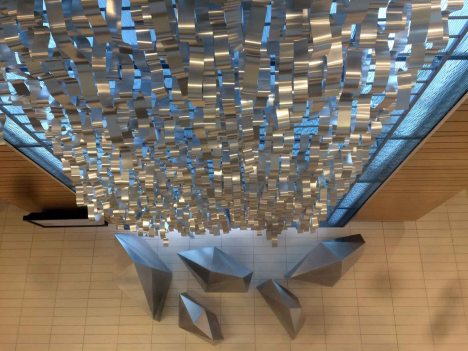
Or, while they’re studying on the third floor common area, they may not see a giant arch with Arabic and mathematical equations that wraps around the center of the open space.

Even in less noticeable areas, sculptures of books rest on bannisters and landings as students pass them by.

After they leave the library, many may be looking at their phones rather than observing sculptures at each of the Utah Transit Authority’s TRAX stations on campus.

Hidden in plain sight, public art can be noticed anywhere on campus.

Art instillations in spaces like the library and other buildings are actually a fixture of the university.

Luise Poulton, rare books manager at the Marriott Library, said three public art pieces were commissioned when the library was renovated in 2009. The works include a 50-foot glass mosaic that scales all floors of the grand staircase titled, “Another Beautiful Day Has Dawned Upon Us,” by Paul Housberg, and a collection of sculptures of books by Suikang Zhao.

But art in public spaces is not just an initiative of the University of Utah.

The state unveiled the Percent-for-Art Act in 1985 in an effort to introduce more art in public spaces and reach more audiences. According to the bill, the measure designates 1 percent of the cost of the building be spent on furnishing the space with permanent public art pieces. The intention of the act is to enhance “the quality of life in the state by placing art of the highest quality in public spaces where it is seen by the general public.” The act also “promotes and preserves appreciation for and exposure to the arts; and foster[s] cultural development in the state and encourage[s] the creativity and talents of its artists and craftspeople.”

A public art piece inside the Spencer Fox Eccles Building.

A public art piece inside the Spencer Fox Eccles Building.

Gay Cookson is director of the Utah Division of Arts and Museums, the state department that has authority over the bill. Cookson said public art enhances many of the newly created public spaces around the state, as well as the frequent construction projects that are going on around the U.

“I love that the statute is at 1 percent, and that public buildings have to be invested into arts,” she said. “Sometimes it’s hard to set aside a budget for arts, but with the statute, it’s really the one time when a building is being built that they recognize they need to do a significant investment in art. Even though it’s forced by statute, they were excited to be engaged in the work.”

Obtaining the art, Cookson said, is a process of application and determining what fits best with each publicly funded building. When it is nearing completion, a committee comprised of planners, building managers and those who will be using the space will review proposals for art pieces. At least one art expert is always included in the group.

Cookson said when a new project is considered, the Division of Arts and Museums can receive up to 40 different proposals by artists from Utah or across the country. The committee’s responsibility is to narrow the list down to three finalists. Those finalists are given $1,000 to construct a model to present to the committee. Then, a winner is selected and is given the funding to proceed with the art piece.

Cookson emphasized that the entire committee is not reliant on art expertise. She wants those who will view the instillations much more frequently than experts to make the decisions.

A sculpture of a book is displayed outside the Marriott Library

A sculpture of a book by artist Suikang Zhao is displayed outside the Marriott Library.

“We want the final say to be on who will be living in that space,” she said. “Which is kind of cool because you’re empowering people who really have no artistic experience to spend hundreds of thousands of dollars on art.”

Since the act’s inception in 1985, every new publicly funded building that is constructed must have 1 percent of the total cost of the building be dedicated to art, according to the bill. Buildings that were already completed by the time the bill was introduced are grandfathered in, and do not need to retroactively install pieces.

Administrators of public buildings can opt out of the art requirement if a certain percentage of the costs of building the structures are not met by public funds, according to the language of the bill. This was the case for the newly-completed S. J. Quinney Law School, which had enough private donor money in place to exempt it from the Percent-for-Art Act. However, Cookson said law school leaders wanted to honor the importance of art in public spaces, and complied with the mandate.

After a work is completed, the Division of Arts and Museums is responsible for the maintenance and repair of the pieces, according to the bill.

On the Utah public art website, finalists and commissioned artists of each project are publicly listed, with their website or portfolio attached.

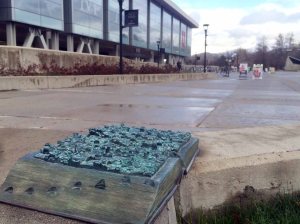
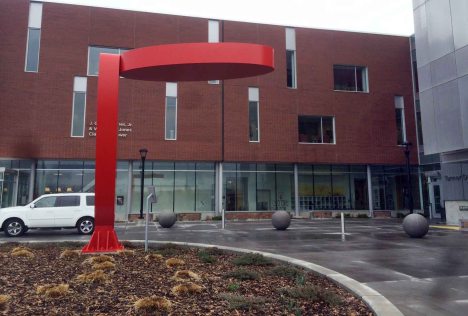
A public art piece outside the Sorensen Arts and Education Complex.

A public art piece outside the Sorensen Arts and Education Complex.

Traveling Exhibit Program provides Utahns access to high-quality art

Story and slideshow by JORDAN SENTENO

According to the Utah Division of Arts and Museums, the Traveling Exhibit Program (TEP) delivers high-quality, professional exhibits to numerous educational and nonprofit organizations, including underserved communities. The exhibits travel to museums, colleges, universities, community galleries, arts and cultural centers and libraries.

TEP Coordinator Fletcher Booth said the program is particularly important to rural communities where access to high quality, original art is limited. The exhibits nurture understanding of diverse art forms and cultures, promote creativity and encourage cultural activities in local communities. The program also provides artists a way to showcase their artwork, gain public recognition and increase the value of their art.

Laura Durham, who does marketing and communication for the Utah Division of Arts and Museums, said, “The Traveling Exhibition Program is one of the more far-reaching programs we have. It takes visual art to all the regions in the state of Utah, including a lot of schools and community centers that don’t get to see very much artwork.” She added, “The kids especially get very attached to the exhibits when they come to their schools and they hate to see them go. We provide educational materials for the teachers so the kids can interact with the artwork in a meaningful way.”

TEP aims to provide meaningful arts experiences by including educational components that teachers can download and use. The materials vary from exhibit to exhibit. For example, the Design Arts Utah exhibit provides two documents called “Why Teach Art?” and “Looking at Art.” They discuss why art is important and how to look at art in different ways.

“It [TEP exhibits] is the one thing that students will stand and talk about,” said Rhonda Harrison, principal of Fillmore Elementary School, in an interview at Hogle Zoo. “We have seen a lot of conversations about why they think it is drawn or painted. Students look forward to the art work coming [the zoo] once or twice a year.”

Every year, Hogle Zoo sponsors the World of the Wild, which showcases artwork of animals and the wild. According to the Utah Division of Arts and Museums, the goal of the exhibit “is to bring together the works of serious artists who are interested in displaying their view of wild animals, plants and places with which we share our world.”

According to a press release, “by highlighting animals and plants in the wild, this exhibition strives to educate viewers on the challenges faced by artists and techniques used when depicting animals. Additionally, this exhibition strives to draw public awareness to and increase appreciation for the animals and fragile ecosystems depicted.”

The companion curriculum, “Stamp Out Extinction,” “encourage[s] students to examine wild animals in their community that may be endangered or approaching extinction.” Teachers can help students use printmaking techniques to create posters that promote animal conservations.

Rose M. Milovich, preservation manager and exhibition program director at Utah State University Special Collections and Archives, said, “Having the opportunity to see and study original artworks from cultural, aesthetic and technical standpoints can really encourage creative/critical thinking and doing.” Milovich, who was at the zoo, added, “This kind of encouragement can happen for anyone at any age. Our world needs people who can think creatively – people who can examine the work and find solutions to all that faces us.”

Each year, the Utah Division of Arts and Museums curates about 20 traveling exhibits that feature many different mediums, processes and styles. For example, photographs that won prizes at the 2015 Utah State Fair are being shown at Grand County Library in Moab through April 26, 2016. The traveling exhibits are scheduled for one-month periods at $125 per exhibit and people can sign up for them online.

Fletcher Booth, as TEP’s coordinator, then creates a schedule. On average, he arranges about 80 exhibits each year.

Laura Durham said, “Not only does this provide the communities with a new show to look forward to, it’s also great for the artists who have work in the shows. Their audience is greatly expanded as a participant in these exhibitions and they can put all these locations on their resume of where individuals have viewed their artwork.”

Laura Durham: The work of an artistic woman

color

Laura Durham enjoys her job with the Utah Division of Arts and Museums. Photo courtesy of Durham.

Story by JORDAN SENTENO

Utah native Laura Durham has a bachelor’s degree in art history from Brigham Young University. She currently works for the Utah Division of Arts and Museums in Salt Lake City and manages marketing and special projects that encourage public value of the arts in the state.

Growing up as a young girl, she really enjoyed music and art. Both her parents were musicians so she was surrounded by music all the time. The turning point for her was when she was in high school. She went to London with her father when she was 17 to study art and music.

“Since my parents were both musical artists I knew I wanted to do something with art and music and kind of rebelled against them by going into the field of art history,” she said in an email interview.

She has 15 years of working experience with the Utah Division of Arts and Museums. Before being promoted to marketing and public value manager, she worked as the visual arts coordinator. She also does graphic design on the side as a hobby, but has used those skills to create a brand and unique look for the Utah Division of Arts and Museums.

Durham also enjoys cooking, traveling, writing and sharing stories in her spare time. With her enjoyment of music, she sings with the Utah Chamber Artists.

Durham works out of the division’s main office in the historic Glendinning Mansion at 617 E. South Temple in Salt Lake City. Also located there is the Alice Gallery, named after founder Alice Merrill Horne. Durham chose to work at the Utah Division of Arts and Museums because she wanted to work with the arts and build programs, while also giving back to the community.

She serves on many boards, including the Salt Lake Gallery and Utah Emerging Museums Professionals. And she sits on the Downtown Marketing and Events committee, assisting with the Downtown Farmers Market, Dine O’Round and other community events.

She has worked for several other arts programs within the Utah Division of Arts and Museums, and was the visual arts coordinator managing the Rio Gallery and Traveling Exhibits. She also served as the vice president of the Salt Lake Gallery Association from 2003 to 2006.

Durham was program director of the Salt Lake Gallery Stroll from 2005 to 2010. “It was significant because it’s a great anchor in Salt Lake City when it comes to the visual arts,” said Durham in an email interview. “It’s a community event that people can count on each month and it has fostered a fertile environment for new galleries to pop up and join. A lot of business have joined the fun too, as we see more small business rotating local artwork on their walls and opening up their doors for the Stroll.”

unnamed

A piece that Durham designed for “15 Bytes” about Utah artists. Image courtesy of Durham.

She regularly contributes to “15 Bytes,” which is an online visual arts magazine in Salt Lake City. She serves, too, as assistant editor and managing music editor. Durham has developed a longstanding partnership with Artists of Utah, publisher of 15 Bytes. The magazine publishes two free adds every month for the Utah Division of Arts and Museums so it can advertise what is going on in its galleries, literary arts programs and more.

Durham has developed many other partnerships, such as with the Salt Lake Film SocietyUtah Film Center and Utah.com. She is in the process of helping the latter showcase its website and direct tourists to the wide variety of arts that are available here in Utah.

In 2014, Durham completed the Change Leader Program, which is a professional development course. According to the Utah Division of Arts and Museums website, “Participants attend a three-day institute with instruction on assessing environment and the communication and facilitation skills necessary to implement change.” As part of the program, Durham initiated a project called “Utah’s 15 most influential artists.” In a press release about it, Durham said, “Hopefully this program will inspire more people to recognize how art has enhanced their quality of life as well. And hopefully we will nurture a society that more widely and visibly values artists and their contributions.” She  said in the release she believes artists influence our landscape and culture. “I sought to identify Utah artists who influence and impact our community,” she said.