KUDU: Gifts and decor from Africa helping others from Salt Lake City

Story and slideshow by DANEALLE PLASCENCIA

Visit KUDU gift shop in Salt Lake City, which features handmade items including baskets, masks and clothes.

Many people always think or dream about visiting other countries, states or continents, just to learn about different cultures, food, language and traditions. But sometimes this is impossible to accomplish due to money or time constrains.

However, what would you think if someone told you that you can learn the most important elements of the African culture in Salt Lake City and help poor families with your support?

KUDU, a small business located at 2155 E. 2100 South, does just that. The shop sells gifts and decors directly from Africa. And this is possible because of Susan Clissold.

Clissold was born in South Africa and studied culinary arts there.

She moved to Salt Lake City five years ago with the purpose of just visiting her friend, but she ended up staying and making Salt Lake City her second home.

Clissold got married and she and her husband had a daughter who now is 14 months old.

Clissold credits her mother-in-law, who had just returned from a trip to Africa, with the idea of opening a small shop with handmade items imported from Africa. It seemed a logical next step for the women, who had been working on obtaining the necessary permits to sell the imported items.

After the opening of KUDU three years ago, Clissold’s mother-in-law couldn’t work at the store. The main reason was the short time periods that she was living in Salt Lake City. So she asked Clissold to take over the small business.

The store is named after the kudu, a species of antelope that comes from the savannas and is popular in Africa because of its skin and meat. Also, the horns are used as musical instruments.

The store instantly reflects African culture. The walls are painted with warm colors such as brown and beige, and decorated with masks and paintings from different African artists.

KUDU offers hundreds of handmade items imported and made from African artists.

Some of those items are dishes such as mugs, spoons, spatulas and butter containers, all of which are hand painted.

Clissold sells clothing too, such as hand-knitted scarves made by women from Swaziland. Crocodile belts, baby shoes and animal skins, which are used as blankets or carpets most of the time, are sold at the store.

Musical instruments are indispensable for the African culture. KUDU sells handmade carved drums from different types of wood that makes every drum sound different and unique, as well as kudu horns. They are as long as regular drum sticks but thicker and beige in color.

Beaded giraffes, monkeys and dolls are the most detailed items that this store offers. The bright colors call the attention of any customer who is looking for a gift, especially one for children.

Home decoration is something that Clissold includes in her store. Lampshades made of bamboo, photo frames and Zulu hand-woven baskets are some of the articles that can be added in any home.

“I have items in my house that I bought for the store and I just loved them so much that I keep them as decoration,” Clissold said .

Showing art to the customers in different ways is the main objective of this store. Currently, the store has paintings by Daniel Novela, an African artist who now exhibits his work at Adlou Art Gallery.

“I was always interested in art, even when I was back home,” Clissold said.

Clissold also supports local businesses. She sells chocolate from the Millcreek Cacao; lotions, shampoos, soaps and shea butter are some other items that come from Africa but are packed in the United States that KUDU offers.

Meanings, shapes and animals are an important element for the store.

KUDU sells animal sculptures of elephants, giraffes, monkeys and zebras, which are a representation of the African continent and culture.

Colors as well teach every single customer a meaning. For example, green represents Africa as land, red the color of African ancestors, black the color of the African race and yellow the natural resources the community uses for living.

“Africa is all nature. If you are expecting to see big buildings and streets Africa is really far away from that,” Clissold said.

African culture is based on trading some items for others, and Clissold’s mission is to help African artists by buying the products so they can have a better life back home.

Such is the case for Zimbabwe, who is Clissold’s buyer.

He lives in Africa and talks to the artists and makes arrangements for prices or trading.

“With the money that I get from working with Susan now I have a small little truck that helps me move around to get the gifts,” Zimbabwe said in a phone interview.

But Clissold’s mission entails more than selling items from Africa to people in Salt Lake City.

Her motivation is helping families in Africa to have a better way of living and share her culture with the residents of Salt Lake City. The reason is to show residents what Africa is made of and what they can find in the continent.

Clissold has big plans for KUDU. Recently she started a sale day every month to attract new customers.

Since KUDU is in a two-story building and she only uses the lower floor, Clissold plans to offer massage sessions with oils from Africa. The massages are going to be held two times per month with unique arrangements and decorations from her shop.

Recently, she ordered new paintings that are going to be low cost so anyone can afford to have one at home and help others. She will be exhibiting them sometime during the month of May. Clissold will invite all of her regular customers to stop by.

Since Clissold likes being involved in charity work she is going to be part of a Westminster College event during May. She will donate 15 percent of the sales to an organization that helps poor minority families in Salt Lake City.

“I am really excited to help. It is just hard to be part of many different charity programs at the same time,” Clissold said.

Sales at the store have steadily increased since it opened. Clissold said she has been able to help many more families than she ever expected.

“The store is like my second home, where I can teach people about my culture and help my people to have a better life selling their work. I know Africa is a third-world country and it needs more than one person to change the poverty but I feel satisfied to help just a little bit,” Clissold said.

KUDU is open Monday through Saturday from 11 a.m. to 6 p.m. For more information call (801) 583-5838.

Mahider Ethiopian Restaurant and Market offers a taste from Africa

Story and photos by DANEALLE PLASCENCIA

What is your first reaction when you hear that Salt Lake City offers food directly from Africa? Probably the answer would be, that is impossible.

Next you might wonder how food from another continent tastes and what the principal ingredients are.

Salt Lake City offers an extensive variety of unique restaurants, especially in close proximity to one and other in the downtown area.

The number and location are the main attraction for some visitors.

Most of these restaurants are owned by local residents who have emigrated from their home town to look for better business opportunities in the Salt Lake  Valley.

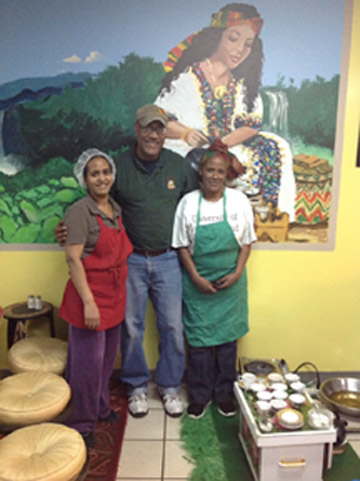
Sleshi Tadesse (center)

Sleshi Tadesse (center) with his cooks.

Such is the case with Sleshi Tadesse, who is a resident of Salt Lake City and the owner of Mahider Ethiopian Restaurant  and Market located at 1465 S. State St.

He emigrated from Ethiopia, Africa, 14 years ago to come to the United States because of personal desires.

First he lived in Los Angeles for a couple of years, and then he decided to move to Salt Lake City to go to school and find better life opportunities.

Tadesse got a bachelor’s degree in computer science from Weber State University.

After working in his career field, and getting laid off too many times, he decided to create his own business and experience something different from what he studied.

He started the project in fall 2011, with a small market with products imported directly from Africa, including the basic spices, meats, natural juices and traditional artifacts.

After some time, he realized that he needed something else to make his business more successful and attractive for the community.

That is how he started an addition for his market.

The project Tadesse had in mind was to create an Ethiopian restaurant in addition to his African market with traditional dishes.

After being just a draft idea, it became his own project that he named Mahider Ethiopian Restaurant and Market.

Now Tedesse is the owner of the first Ethiopian restaurant in Salt Lake City.

His restaurant represents some of the oldest dishes in the world that were created in Ethiopia, and recipes from his family back in Africa.

photo(2)

The flat bread vegetarian platter features a corn puree, green beans and carrots.

Mahider offers a variety of entrees made of beef, chicken and vegetarian delights made with collard greens, cabbage, split peas and lentils. The restaurant also offers salads as well as beers from Ethiopia.

Ljubisa Mijatovic, a first-time customer, said, “I am vegetarian, and I’m really surprised of all the vegetarian options that this restaurant offers, especially the veggie platter which is great.”

Herbs and spices are imported from Ethiopia to make the traditional flavor come out from the dishes and allow customers to have authentic African food.

Tradition is an important part of Mahider’s restaurant.

It encourages customers to eat the traditional flatbread and other dishes with their hands as is done in Ethiopia. Of course, utensils are provided in case that gets too complicated.

The famous Ethiopian flat bread is made of indigenous grain called “teff,” which is one of the oldest grains on Earth and makes interesting and unique flat bread.

Another important tradition and example of Ethiopian hospitality that Mahider’s Restaurant and Market offers are the coffee ceremonies. They are an integral part of Ethiopia’s social and cultural life, which describes how close the culture is.

These ceremonies consist of having home-roasted Ethiopian beans, and making fresh coffee.

“Coffee has social value in our society and is deep rooted in our culture,” Tedesse said.

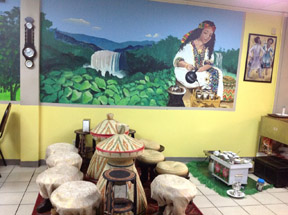
This is made right in front of the customer and is designed to share with family and friends in front of an interesting background. Short stools are decorated with different kinds of fabric and some of them are carved from wood.

The coffee ceremony is a mark of friendship or respect for the African community, and the ceremony can go for at least a couple of hours, depending on the customer’s time and ability.

Coffee ceremony  arrangements

The restaurant offers a unique space for the coffee ceremony.

“Experiencing the coffee ceremony is a plus of this restaurant. Besides sharing great dishes with your family, you get to enjoy coffee, and have a great conversation,” Mijatovic said.

Culture and community acceptance is really important for Tedesse, and he is really happy that the community has accepted well his traditional food and customs, which was the reaction that he was looking for.

Mahider Restaurant and Market has become increasingly popular with Salt Lake City residents, and customers who have tried the food have posted good  reviews on Urbanspoon.

“The business is going pretty good, especially Friday, Saturday and Sundays,” Tadesse said.

Mahider Restaurant and Market is open Monday through Thursday from 10 a.m. to 10 p.m., and weekends from 10 a.m. to 11 p.m. For more information call (801) 975-1111.

Ogden resident Stanley Ellington enjoys helping the community

Story and photos by GUSTABO RODRIGUEZ

Helping people in the community of different cultures is a job that not everybody can fulfill. Reasons for helping or not helping people can come in various answers or excuses, but not for one man who helps from his heart.

Stanley Ellington was born in Alabama and lived in Washington, D.C. for seven and a half years. Then he went to Germany for two and a half years. He returned to the U.S and lived in Kentucky in 1974.

In the U.S. Air Force, Ellington helped people solve their personal problems related with their job or family.

In 2000, he moved to Utah because of his job in the Air Force. He retired in 2002 after serving for 28 years. From there, he knew that he wanted to continue to help people. He moved to Utah where the diversity is lacking, and was further motivated to help marginalized communities.

“I’m a good bridge for helping out people in the community,” Ellington said.

He enjoys helping individuals. For example, he helps an elderly woman by taking her husband to the doctor.

Stanley Ellington

Stanley Ellington is a leader in the community.

Ellington also was the first executive director of the Utah Black Chamber of Commerce.

He is part of the National Baptist Association, which is divided in the states of the Utah, Idaho and Wyoming. He has many ways to help people not only in Utah, but other states by helping the other churches in those states.

He is a Christian minister for the New Zion Baptist Church in Ogden and now as a licensed minister he can help more people in the community. Ellington gets involved with the community in Ogden not only through his profession, but also through the church. He is the director of the Christian education of the church. By being in charge of the education department, his duties are to set classes for the Christians and prepare the four phases of the classes.

In 2006 he built his own business that provides consulting in business management. During this time he was made the first executive director of the Utah Black Chamber of Commerce. He helped small businesses in Salt Lake and the surroundings areas to thrive in the community.

People from the black community, like many other people, are always looking for a new opportunity. Ellington said that he knew a woman who went to look for a job and the first thing they asked was if she knew Stanley Ellington.

“Just because we’re black were supposed to know each other,” Ellington said.

He has experienced different cultures here and learned the customs of other individuals. Working for the State of Utah Governor’s Office of Economic Development he learned that some women don’t greet men or other people. So Ellington had to create a new way to greet a woman from a different culture.

Kathryn Crosby, a friend of Ellington, met him two years ago through their affiliation with the Utah Business Development Alliance.

Kathryn Crosby

Kathryn Crosby appreciates her friendship with Stanley Ellington.

Crosby has a great admiration for Ellington because of the way he can handle situations, and for his accomplishments with the community and his life.

“Stanley has a unique ability to see clear routes through complicated issues, and to communicate with people from all walks of life,” she said in an email interview.

Crosby also said Ellington has a contagious amount of energy and enthusiasm.

“I consider myself very fortunate to be able to call Stanley my friend and colleague,” Crosby said.

She respects Ellington because he works hard to help out people and he does not settle for reports that he is very sure do not make sense.

For example, he said that in Utah there was a report that locally-owned black business were increasing year after year, but he was not convinced.

Ellington said it is difficult for business owners to seek additional training because they can’t leave their business to go to school. If they do, they risk losing clients. He feels that the Utah Black Chamber of Commerce can help entrepreneurs by offering classes online. Webinars, or online seminars, also could be a good idea because people have become more computer savvy. He said a program on public television that would help educate business owners might be useful too. He said that it would be another way to educate not just the black community, but also people from different cultures who want to succeed in Utah.

Ellington has influenced many Utahns because of all the organizations he has been involved with.

“I’ve been labeled the African American representative,” Ellington said.

Cynthia Nielson met Ellington when she joined the Utah Business Development Alliance (UBDA). Nielson and Ellington have worked together on many projects, including managing, organizing and preparing presentations.

“Stanley has extensive training in business management and administration,” Nielson said in an email interview.

She also said that Ellington has been a big influence in the goals of UBDA, which includes assisting small businesses in finding and getting contracts that are going to help them succeed by getting their name out into the market.

“Stanley is a great teacher and donates a lot of time to our non-profit organization. Stanley is eager to improve himself through education and is dedicated to his religion. He has a kind heart and I admire him greatly,” Nielson said.

Stanley Ellington came to Utah to do what he was born to do: help people. That mission was his destiny.

“God brought me to the state of Utah,” Ellington said.”I don’t know why, but it was to fulfill my mission in Utah.”

James Jackson III and ACCEL help black-owned businesses in Salt Lake City

Story and photo by GUSTABO RODRIGUEZ

How can a person get help promoting their own small business here in Utah? Where can a person seek help, especially in a town like Salt Lake that has room to have a lot more of their own local businesses, compared to Los Angeles, New York, or Miami that have the most diverse local own business in the country.

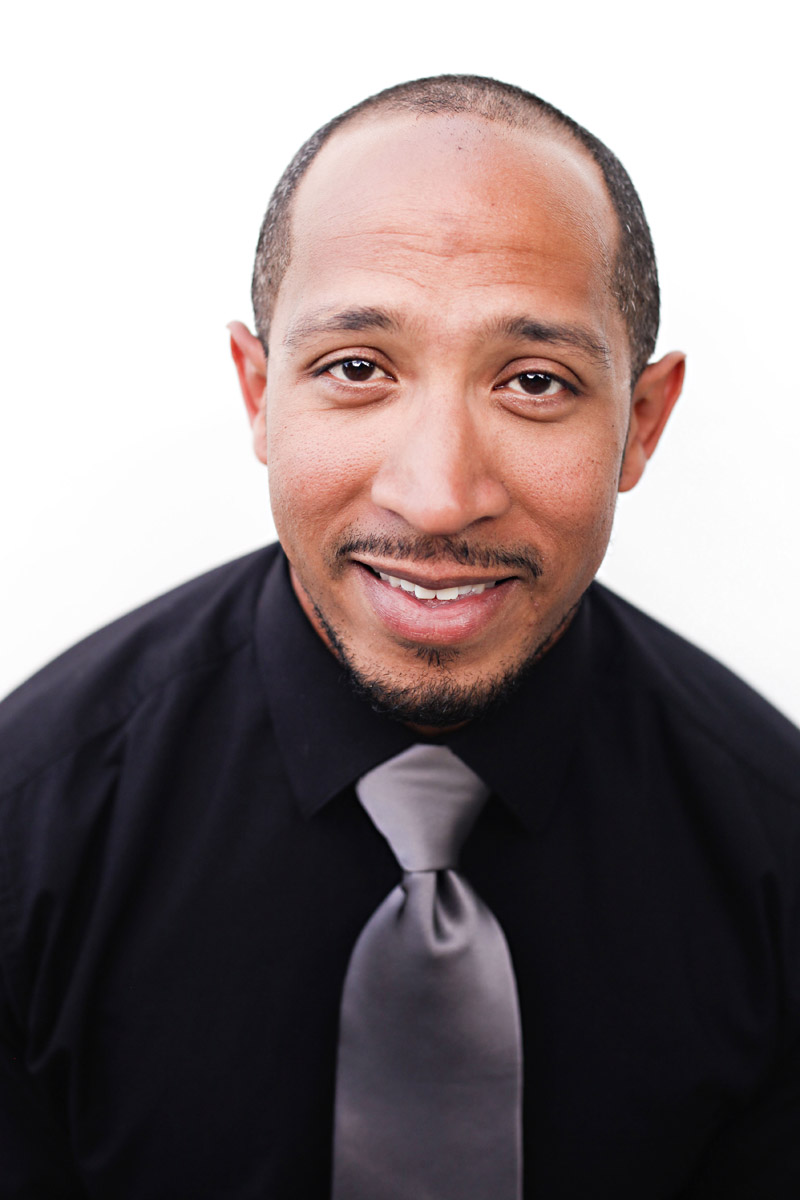
 Photo courtesy of James Jackson III founder of ACCEL

Photo courtesy of James Jackson III, founder of ACCEL

James Jackson III is a businessman who can help people, especially the black community, promote their own business.

Jackson was born and raised in Utah and like most of the diversity in the state he wanted to put his culture at the top of the list of this state. Jackson attended and graduated from Cottonwood High School in 1998.

He graduated from the University of Utah in 2002 with a Bachelor of Science in Marketing, and a Master of Business Administration from the University of Phoenix. Jackson wanted to help people in his community; he wanted to help them by promoting them and watching them grow.

In junior high Jackson already knew what he wanted to do in the future, unlike other kids that don’t know what career they want. He wanted to help people from his culture, from his community and one of the reasons why is because there is such a small portion of African Americans here in Utah. So as a minority his goal was to help them in every way possible, help them achieve their goals.

ACCEL, African-Americans Advancing in Commerce Community Education & Leadership, is an organization that helps African American business to achieve their goals in a small diverse market here in Salt Lake.

Jackson founded ACCEL in 2009 and has helped about a dozen businesses and counting because this was the goal of Jackson, helping as much black business as possible.

ACCEL with their executive director Jackson need some help too from large private companies so he started a partnership with Pepsi Co. and Zion’s Bank and wants to establish a relationship with Budweiser. He wants this partnership because they can help money wise with the local owned businesses.

At the University of Utah Jackson had a professor whom he admires and respects him and considers him a mentor throughout his career.

Wilfred D. Samuels English professor at the University of Utah

Wilfred D. Samuels, is an English professor at the University of Utah

Professor Wilfred D. Samuels knows very well Jackson from his childhood all the way up to when he became his pupil at the U.

The youngest of Samuels’s son’s was best friends with Jackson and ever since he has been a much known friend.

“Although it has been over ten years that James was here on campus, we attend the same church,” Samuels said in an email.

Samuel said Jackson came from a loving and caring Christian family  and was raised with the highest values. Jackson and his family have always attended church and loved music. Samuels said that’s why they formed part of the church choir — his grandparents too — and participated in all church activities.

“At the U of U, he pursued a career in business. He worked hard and remained passionate about his major,” Samuels said.

Samuels said after Jackson graduated from the U he went on and worked with the Utah Black Chamber of Commerce and tried every single way to get the church involved in business efforts. That showed his commitment to the chamber and that he wanted to help his community by starting with the church.

“I know James to be congenial, principled, dedicated and passionate about life. He is totally committed to his personal growth and development. I admire and respect him,” Samuels said.

Being passionate about life and wanting to help others in his community, Jackson never gave up and he sought out help to start and make ACCEL a reality.

Francisco J. Sotelo is the executive director for the Utah Hispanic Chamber Commerce and a good friend of Jackson. Sotelo and Jackson met through an event two and a half years ago.

“James is a great leader and a good representation for his community, representing the African American people,” Sotelo said in a phone interview.

Jackson approached Sotelo with a strategy to make ACCEL which was a great idea, it just needed a little help, Sotelo said. ACCEL and the Utah Hispanic Chamber of Commerce help each other by exchanging ideas to help their community. Sotelo took a lot from Jackson which later he applied to the Utah Hispanic Chamber of Commerce.

“Even right now we sit down and discuss ideas we can apply for our chambers and not just for one,” Sotelo said.

ACCEL and the Utah Hispanic Chamber of Commerce have a great relation and with the same objective: helping the community in every possible way.

Jackson said he is very grateful to the Utah Hispanic Chamber of Commerce for showing him the right way and steps to form ACCEL and in the process help the black community rise in the local market in Utah.

University of Utah students focus on diversity in innovation

Story and photo by TREVOR RAPP

On Jan. 8, 2013, the University of Utah was ranked as one of the “top institutions in the country for startup formation,” according to the latest survey by the Association of University Technology Managers released in December 2012.

“Startup formation is in our DNA,” said Bryan Ritchie, director of the U’s Technology Commercialization Office, in a news release.

The genetic complexion of business innovation has significant meaning for one U student. He is not just a business innovator, he is a black business innovator.

“Black-owned businesses are, especially where I’m from in Lake City, Fla., a rare commodity,” Enis Henderson said.

Ennis Henderson, UofU student.

Ennis Henderson, UofU student.

Henderson is part of a research innovation class that tasks students to research opportunities to improve local or national communities.

“I chose the problem that was near and dear to my heart, which was trying to improve the quantity of black-owned businesses in America,” Henderson said.

While contemplating his project, Henderson’s mind stretched back to Lake City, Fla., where he grew up. He described it as a “Mayberryesque” town where the white people lived on one side of the tracks and the black people on the other. There he gained his first working experience “doing the jobs no one else wanted to do” like picking the tobacco, corn, peanuts and melon grown in his community.

When he was 22, he got his first lesson in owning his own business.

That lesson came from a casual conversation with a white insurance agent. After “taking a liking” to each other, Henderson said the agent explained that he took his two sons out to cut wood and then bring it into town to sell it. Each time they made a sale they would subtract their revenue from their operating costs to calculate their gross and net profits.

“That was the first time I had heard the words ‘operating expenses’ and ‘gross profit’ in the same sentence,” said Henderson, “and I said ‘Wow, how old are your boys?’ and he said ‘7 and 9.’”

“You aren’t born with an innate sense of how to do business,” Henderson said. “Someone has to teach you, or you have to go out and learn it. And if those people who don’t own businesses never had anyone in their family to take them by the arm to say ‘let me show you how to do this’ … and if they’ve never seen it or heard it — odds are they won’t do it.”

And recent statistics are showing that when compared to other minorities, African-Americans are not doing it.

According to “Black (African-American) History Month: February 2013,” published by the U.S. Census Bureau News, the black population, whether of mixed or non-mixed backgrounds, is 43.9 million. This represents an increase of 1.6 percent from the April 1, 2010, census.

Nevertheless, in a separate 2007 Survey of Business Owners conducted by the U.S. Census Bureau found that only 1.9 million businesses out of 30 million were black-owned.

For Salt Lake City, black-owned businesses are only 2.7 percent of the almost 24,000 total businesses, according to the U.S. Census QuickFacts.

These numbers haven’t been lost on Henderson. As part of his project he researched statistics published by the U.S. Census Bureau, the Bureau of Economic Analysis, and IBISWorld.com, a database of industry-based research.

As he spoke, Henderson pointed to various charts from those sources as he explained that while blacks outnumber the most profitable minority, Asians, by about 3-to-1 by population, they own about the same number of businesses. Even more surprisingly, Asians were making about three times as much profit.

“It’s completely inverted,” Henderson said.

Henderson isn’t the only person who has noticed a lack of diversity in local businesses.

Most African-Americans who come from the South or the Midwest don’t want to come to Utah because of the stigma that Utah has of not being a diverse community, said James Jackson III, founder and executive director of ACCEL (African-Americans Advancing in Commerce, Community, Education, and Leadership), a nonprofit organization providing resources to African-American small businesses in Utah.

Neither Henderson nor Jackson point to current racial prejudices as the current cause of the problem. However, the “genesis” of the problem is deeply embedded in the history of slavery in the United States, Henderson said.

For Jackson, the most pressing need is increasing the level of education for all Utahns. Jackson was appointed by the governor to the Utah Multicultural Commission, an advisory group for issues relevant to local minority communities. “The main song that was sung through [the commission’s various] committees, whether it be health, education, corrections, economic development, all of them leaned toward education in some way,” Jackson said.

Those numbers are reflected in the April 1, 2010, US census as well, with only 18.4 percent of blacks reporting having earned a bachelor’s degree, and only 1.6 million blacks reporting having earned an advanced degree.

And the effects are real. The annual median income for black households declined by 2.7 percent from 2010, making it almost $10,000 less than the national median income for families, according to “Black (African-American) History Month: February 2013.” The U.S. Census Bureau News also reported a 27.6 percent poverty rate among blacks, almost double the national average.

For Henderson the answer is availability of resources. “What I recognize is that it’s a lack of information. Now there’s a ton of information out there on the internet there are types of agencies people can go to to get information. But they don’t know what to ask for if they did go to an agency,” Henderson said. “They’ve never been informed. The resources are there but they don’t know what it is, they don’t know what it’s for.”

James Jackson III: building a stronger African-American community

Story and photo by DANEALLE PLASCENCIA

How do you picture Utah when you know the majority of the population is Mormon? Do you picture only Caucasians? What about the minorities?

For almost two decades, Utah’s population continued to rise while the percentage of its people who are Mormon slowly and steadily declined, wrote Matt Canham in an article for The Salt Lake Tribune.

Newcomers have found that Utah is economically stable and offers different sources for the community to grow in comparison to the rest of the nation.

The job rate in Utah is increasing faster than the unemployment rate, and has an attractive cost of living which is making people to consider Utah as their new home.

Like any other state, Utah offers different sources to help the community, including the minorities.

One of those sources is ACCEL (African-Americans Advancing in Commerce, Community, Education and Leadership).

This organization is committed to being the premier organization in providing education, resources and visibility for the African-American small businesses owners of Utah.

Photo Courtesy of James Jackson III, Founder of ACCEL

Photo Courtesy of James Jackson III, founder of ACCEL

The founder of ACCEL is James Jackson III, who was born and raised in Utah.

Jackson, 33, graduated from The University of Utah with a bachelor’s degree in finance and marketing.

He earned a master’s degree from the University of Phoenix in 2010.

After working on his own for a while he decided to establish ACCEL in the winter of 2009.

The main reason for the creation of this organization is the passion for business that Jackson has, especially the necessity of helping those around him in their endeavors.

Being able to offer the community more resources for education to have a better future is a main focus.

Jackson develops the idea of creating an organization from his own experience of being the  owner of a small business dealing with the sale and management of properties.

That is how he noticed how the African-American community didn’t have enough resources and support to develop their business ideas.

“Creating ACCEL took a lot of time, and help from other people who I see as an example for my project,” Jackson said.

One of those people who helped Jackson is Francisco J. Sotelo, current executive director of  the Utah Hispanic Chamber of Commerce.

Jackson and Sotelo met three years ago, during an event of the UHCC. Jackson asked him for help to create a stronger organization.

Sotelo had meetings with Jackson to help him understand how a chamber works, and share his strategies that he had used to create a successful chamber.

During the meetings they shared ideas and new projects for both organizations.

Since then Jackson and Sotelo have a very good relationship.

They meet often to talk about Jackson’s projects, and to keep each other updated about their respective organization.

“Our relationship has grown over the years and as well the chambers, we had learned from each other through the years,” Sotelo said in a phone interview.

Official Logo of ACCEL

Official Logo of ACCEL

Networking plays a big role for ACCEL. Jackson believes that a networking community is more effective than one that is not really connected. That is why he is creating a new website for ACCEL with the help of Ronda Fisher.

Fisher said in a phone interview that her goal is to design the site so people can find resources and assistance more easily.

“I’m really excited to see the results,” Fisher said.

Besides being a successful business man, Jackson is a member of one of the most established black churches in Utah, the Calvary Chapel Salt Lake and makes time to be part of the church activities to be connected with the community.

Between his activities Jackson is the coach of a kids basketball team, and reads books like “Think and Grow Rich: Your Key to Financial Wealth and Power ” from the author Napoleon Hill, for personal enrichment at the start of the year.

Community is the main focus for Jackson in his life. He knows the African-American community population is only 1.3 percent in the state of Utah but that is enough for him to keep working hard to create a successful community.

“Things have changed in Utah. I remember when I was in elementary school, there were only a couple of black kids in my classroom, but things have changed since then,” Jackson said.

Jackson has dedicated the last four years to building a stronger African-American community in Utah, and all his work is being rewarded.

“Jackson works really hard every day, and has done a lot of things for ACCEL,” Fisher said.

Diversity of cultures in Utah is becoming more noticeable, and Jackson is trying to be part of it.

Jackson’s future plans for ACCEL include having more members, hiring an executive director who would be in charge of the organization, and creating scholarships like SOMOS, the prestigious award offered by the UHCC.

ACCEL, after four years of its creation, now is offering sources for 300 African-American small business owners in Utah.

“James is a great leader and represents the black community very well,” Sotelo said.

Utah’s Black Chamber of Commerce and ACCEL helping African American businesses and the Utah economy

Beyond Beauty is a black owned salon in Murray, Utah and is owned by Angel Bumpers

Beyond Beauty is a black-owned salon in Murray, Utah, and is owned by Angel Bumpers. She is also one of the founders of the Utah Black Chamber of Commerce.

Story and photo by ALEXA WELLS

The Utah Black Chamber of Commerce and ACCEL, African-Americans Advancing in Commerce Community Education and Leadership, are both organizations located in Utah with a focus on helping black-owned businesses with networking and coming together in the community.

The Utah Black Chamber of Commerce is a nonprofit organization whose mission statement is “to economically empower and sustain African American communities through entrepreneurship and capitalistic activity within the United States and via interaction with the Black Diaspora.”

Stanley Ellington is from Fort Knox, Ky., and has lived in Utah since September 2000. Ellington’s parents are both African American. Ellington has a bachelor’s degree in administrative management from Excelsior College, a master’s degree in management from the University of Phoenix, and is pursing a doctorate degree from Grand Canyon University in organizational leadership with an emphasis in organizational development. With these credentials, Ellington started and became the executive director of the Utah Black Chamber of Commerce.

Ellington has been labeled as the African American representative of business. He is on The Board of the Governor’s Office of Economic Development, a licensed Christian minister at the New Zion Baptist Church in Ogden, Utah, is serving as a board member on the Pastor France Davis Scholarship Fund,  and is a member of the Junior Achievement of Utah organization.

“I came to Utah to be a leader,” Ellington said.

Another local leader is James Jackson III. He was born and raised in Utah, and attended Cottonwood High School in Murray. He graduated from the University of Utah with a degree in finance and marketing. Jackson took a break from school for about seven years and then went back to obtain his MBA from the University of Phoenix.

Jackson has known what he wanted to do since he was in junior high school: work in the financial industry doing strategic and market planning.

He was a member of the Utah Black Chamber of Commerce until he saw the need to build an organization where the black community can network together. Jackson started ACCEL in the winter of 2009.

ACCEL is for helping black communities with starting new businesses and brings the diverse community together and builds an environment for networking. Utah has many black-owned businesses, and with ACCEL it gives them the resources that they need to gain exposure throughout the community.

With organizations such as the Utah Black Chamber of Commerce and ACCEL, black business owners are able to obtain scholarships and attend seminars and networking events to get their business running.

Both the Utah Black Chamber of Commerce and ACCEL are committed to providing training and education to help business owners become successful. These organizations are looking for ways to teach people how to run a business and share the resources to help them when they need it.

One option Stanley Ellington is considering is offering webinars through the Utah Black Chamber of Commerce.

Job opportunities in Utah are helping to bring more diversity to the state and increase the black population. ACCEL and the Utah Black Chamber of Commerce are both working on helping bring diversity to Utah’s business owners.

Ellington says that he would like to see more ethnic diversity in Utah, since the black population is only 1.3 percent.

Jackson said, “Utah’s economy is fairly stable and the black population is growing. Most African Americans come to Utah because of the job opportunity.”

According to the ACCEL website, “The growth is due to Utah being more stable economically than the national average, as the job rate is increasing faster than the unemployment rate and has an attractive cost of living.”

Derek Miller, active executive director of the governor’s Office of Economic Development, said on the ACCEL webpage, “Utah has been ranked as the No. 1 most dynamic economy in the nation in 2009 and has seen 50% growth since 2007.”

The Utah Black Chamber of Commerce and ACCEL have made goals for improvement during 2013. Ellington is on track to relaunch the UBCC website, and Jackson hopes to offer more events each month, increase the membership base, add a member-to-member discount and improve the website. With these goals, both the Utah Black Chamber of Commerce and ACCEL will continue to be a resource for black-owned businesses in Utah.

Two local organizations help black business owners in Utah

Story by ALYSHA NEMESCHY

ACCEL CARD

ACCEL business card emphasizes taking the community to the next level

Born and raised in Utah, James Jackson III was the only black person
in his school until he reached the fifth grade. When he reached high
school, Jackson was one of about a dozen black students.

Jackson said that Utah’s significant lack of diversity makes him
excited to see new black people in the community. He said there are
very few unfamiliar African American faces in the state.

Recognizing this diversity gap at a young age, he chose to make a
difference in Salt Lake City by launching a business called ACCEL,
African-Americans Advancing in Commerce, Community, Education and
Leadership.

The idea of such an organization began in late 2005. Angel Bumpers, an
African American who had recently started her own business, Beyond
Beautiful, realized that there was no black chamber of commerce to
assist her in her business journey.

After starting Beyond Beautiful, Bumpers became one of the original
founders of the Utah Black Chamber of Commerce, hoping to help other
business owners.

Bumpers was in her mid-20s when the chamber was founded. She said
many people thought she was too young to take on the responsibility.
Due to this, she said she was forced to step down from her position.
She chose to resign from the chamber altogether.

Jackson, also a co-founder of the chamber, said that by 2008, the
organization seemed to have stalled.

He established and founded ACCEL in 2009 as a place for the black
community to come together, network with each other and recognize
other black Utah business owners.

According to ACCEL’s website, the majority of Utah is unaware of
black-owned businesses in the state due to “lack of exposure and
support of the community.” If the black community came together for
this one purpose, “a powerful synergistic organization would be
created to stimulate and excite the black marketplace.”

According to the US Census Bureau, there has been a small increase of
black people in Utah over the last four years. Jackson attributes
this growth to Utah’s overall growth and the growth of the economy
itself. With ACCEL, the increased amounts of African Americans in the
state have a place to turn when they are in need of help with business
ownership.

Jackson said some of the black-owned businesses in Utah include
catering companies, barbershops, physical therapy offices, moving
companies, network marketing companies and many more.

Although there are many black-owned businesses in the state, Bumpers,
owner of one of the longest-run black-owned businesses in Utah, said
Utah is still falling far behind the rest of America in regards to
minority-owned business exposure. She believes this is due to a lack
of knowledge, lack of communication and lack of support.

Jackson hopes to overcome these obstacles by sharing details about
ACCEL and how it can help individuals who are interested in starting
businesses.

Providing these things to the community requires support from others.
ACCEL has built up a large array of supporters including Zion’s Bank,
Budweiser and PepsiCo, who all provide donations to the organization.
Jackson said these organizations are passionate about being involved
with diverse organizations.

Having the support of others gives Jackson the opportunity to do what
he loves — educate others. With ACCEL, Jackson is able to do exactly
that.

Jackson focuses on the strange paradox of Utah having a strong economy
yet a lacking educational system. Through ACCEL he hopes to improve
education for the youth of Utah by offering seminars, networking
events and scholarships.

By helping other business owners and educating the youth, an important
part of his journey through ACCEL is to “remain humble and
never be afraid to ask questions,” Jackson said. “You learn more when you’re humble
rather than prideful.”

Utah becoming the new frontier for booming black-owned businesses

Story and photo by TALON CHAPPELL

Cold, conservative, culturally closed, homogenous.

For many outsiders, these are the words used to describe the state of Utah and its values. But steadily, more and more diversity has moved within Utah’s borders.

The increasing job market has given birth to a new pilgrimage to the state, one vastly different than the one Brigham Young and his Mormon followers made some generations ago. It’s bringing a new wave of African Americans and their families who have uprooted their lives from the other side of the country, and have settled down in the Salt Lake Valley, eagerly attempting to start a new life, but simultaneously maintaining their Southern roots.

According to the 2010 U.S. Census, the African American population in Utah is at 1.3 percent, which is up 65.9 percent from the 2000 Census that listed the African American population at 0.8 percent. A major cause of the increase was Hurricane Katrina and relocation efforts in 2005. According to ABC News, nearly 600 evacuees were brought to Salt Lake City in the wake of Katrina.

The entire state saw a 23.8 percent increase in total population, which many believe to be a sign of Utah’s economic growth in times of dismal economic decline. According to Forbes.com, the employment growth average for the state of Utah is 0.6 percent per year, which differs drastically from the national average of -0.6 percent per year. This and many other reasons led to Forbes.com listing Utah as the best state for business for the third consecutive year.

James Jackson III is the founder and executive director of ACCEL (African-Americans Advancing in Commerce Community Education & Leadership). He is a firm believer that Utah’s increasing African American population is due to the state’s growing job market. “Most of them move [to Utah] because of a job,” said Jackson about African Americans moving from the other side of the country.

Jackson and ACCEL  have helped numerous black-owned small businesses in the greater Salt Lake area by offering members greater networking resources, financial guidance and emotional support from other members. Moving companies, catering companies, physical therapists, network marketing, financial services, barbershops and restaurants have all been opened by African American citizens and are aided by ACCEL. “The ethnic community is very tight … and the businesses reflect that,” Jackson said.

Papa O's Asset for Story 1

Marcus Brinson, part owner of Papa O’s restaurant in Draper, is hard at work in the kitchen. Papa O’s is one of the newest members of ACCEL.

Take a trip down to 11483 South State St. in Draper, and you might as well have driven down to a country kitchen in southern Florida. Papa O’s soul food restaurant is a newer member of ACCEL  and has been offering authentic Southern-style comfort food to Utahns since October 2012. Marcus Brinson is part owner and manager of Papa O’s. He and his family, including four of his seven children, moved to Utah from Naples, Fla. (near Fort Myers) last September, after his sister, who also lives in Utah, said there was no diversity in the food.

“I was really hesitant,” said Brinson about moving his family from Florida to open a restaurant. Brinson said the business went through a turbulent time when sales would be booming one day and excruciatingly slow the next.

In addition, he said some of his employees were not passionate about the food, or the restaurant’s customers.

“We had some employees that put us in a bad spot,” Brinson said.  “So I made a change.”

He decided to make the restaurant a family affair. His kids clean tables and take orders, he and his sister take turns managing the restaurant, and he even has his mother making all the desserts by hand. All of the restaurant’s dishes are family-kept recipes including juicy fried chicken, smoky barbecue ribs, creamy mashed potatoes and macaroni and cheese, crispy fried okra, and five different kinds of cornbread.

Stanley Ellington, the executive director of the Utah Black Chamber of Commerce frequently attends UBCC meetings at Papa O’s as well as at other black-owned businesses in the greater Salt Lake area. Ellington still thinks the state has a long way to go in reaching racial equality in small business platforms.

“I have discovered there is a great divide between the haves and the have not’s,” Ellington said. “They [African Americans] don’t have the resources that are needed in order to create their business … that’s why I’m in Utah … to be a leader.”

Ellington was born in Alabama and lived in Washington, D.C., both of which are considered hubs for the national African American community. He moved to Utah in 2000 while serving in the Air Force and decided to stay after retiring in 2002. Ellington believes that the number of black-owned businesses listed in the census information is overrepresented. He also believes that several black-owned businesses in Utah have failed due to a lack of knowledge and racial tension within the state.

“People know prejudice is alive and well,” Ellington said. “We’re [UBCC] coming [up] with a solution.”

Overall, the economic future looks bright for all Utahns. As employment rates rise, so too does the state’s diversity.

A report made by the Small Business Administration Office of Advocacy showed that Utah had 241,692 small businesses in 2008, accounting for almost 50 percent of private sector jobs. These numbers are expected to grow after another report by the U.S. Chamber of Commerce listed Utah in its  top-10 economic “Boom States.”

The importance of allies in the LGBT community

Story and photos by Chad Mobley

Attending a Safe Zone training, like the one held during Pride Week on Oct. 5, 2012, at the University of Utah, gives people a chance to gain a better understanding of the lesbian, gay, bisexual and transgender community.

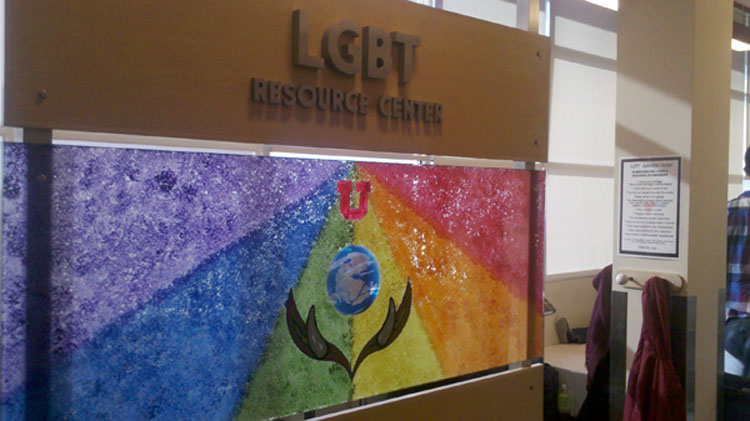
Lauren Jensen works tirelessly to build education and awareness of the LGBT community around the University of Utah and Salt Lake City.

This training was an open forum with conversations led by two facilitators to create dialogue among participants. Many of the talks focused on how straight people could become allies of the LGBT community and how important  allies are in the progress of equality among all genders and sexual orientations.

“Allies are underappreciated because it takes a lot to be a part of the LGBT community whether you are actually in the community or a supporter,” said Lauren Jensen, speakers bureau coordinator at the LGBT Resource Center at the U. “The LGBT community couldn’t exist without supporters on the outside. We need as many voices and as many supporters as we can get.”

But becoming an ally of the LGBT community may bring unwarranted connotations.

“There is a stereotype for allies as well,” Jensen said. “If they support gay marriage or gay rights, then people think ‘Oh they must be gay.’ When in fact all they believe is that everybody should have equal rights. Just because you support gay rights doesn’t make you gay and that’s something people need to realize.”

Jensen sets up panel discussions all over campus at professors’ requests. She also coordinates workplace panels for companies across the Salt Lake Valley. The purpose of these events is to create a situation for people to openly ask questions about anything that has to do with the LGBT community. These panels, in conjunction with events like Safe Zone trainings, educate straight allies about LGBT issues.

Janice Marcus of Parents, Families and Friends of Lesbians and Gays (PFLAG) recognizes these programs as an effective means to grow the allied community in Salt Lake City.

“PFLAG is aware of Safe Zone training and encourages members to attend trainings,” she said in an email.

In addition to Safe Zone trainings and panel discussions facilitated by the University of Utah LGBT Resource Center, PFLAG separately holds events to build and educate the straight ally population.

PFLAG provides a support group for parents, families and friends of the LGBT community the second Tuesday of every month from 7-9 p.m. at the Utah Pride Center, 361 N. 300 West. The first hour is spent as a support group helping people to understand the feelings of a friend or family member coming out to them. The second hour is used to educate members by providing accurate information about what it means to be LGBT, how it feels and how they can provide the best support.

“We provide support for parents, families and friends of gays and lesbians, as well as advocate for the LGBT community,” Marcus said. “We are willing to provide education and panel discussions for any group or work place that would like to contact us. I think that it’s critical that people understand that PFLAG is not associated with any political organization or religious belief.”

Thanks to events like these across the country, the LGBT community is gaining strength nationwide through growing allied support.

Sean Mehew, federal club co-chair for the Human Rights Campaign’s Utah steering committee, has seen this growth firsthand over the past few years.

“Voter approval of gay marriage is over 50 percent for the first time ever nationwide. Five years ago it was probably only 30 to 40 percent,” Mehew said.

One of the HRC’s top priorities is fighting for same-sex marriage. If it is ever going to become a reality, the LGBT community needs allies in high places.

“Look at President Obama coming out [as an ally]. That’s the first time that a president has ever even had a positive stance,” Mehew said. “When he originally came to office, he said he wasn’t sure what his stance was on gay marriage, but he evolved.”

Educating people and growing the straight ally community is the best means for gaining equal rights for lesbian, gay, bisexual and transgender people. People interested in becoming an ally can attend Safe Zone trainings, panel discussions or PFLAG support groups. A week much like Pride Week, called Ally Week, will be held on campus in April 2013 for students and community members.

“As allies mature in the process of providing support for the LGBT community, they transition from offering support to [the LGBT community], to speaking up when they hear inappropriate comments,” Janice Marcus of PFLAG said. “Regardless of the process in which they are involved, they cannot remain silent. Silence allows abuse and discrimination to continue unchecked, so that speaking up in small groups, followed by increased knowledge to provide education through interviews and panel discussions are critical.”

The LGBT Resource Center at the University provides a wealth of information on becoming an ally.

10 ways to be an ally and friend:

  1. Be a listener.
  2. Be open-minded.
  3. Be willing to talk.
  4. Be inclusive and invite LGBT friends to hang out with your friends and family.
  5. Don’t assume that all your friends and co-workers are straight. Someone close to you could be looking for support in their coming-out process. Not making assumptions will give them the space they need.
  6. Homophobic comments and jokes are harmful. Let your friends, family and co-workers know that you find them offensive.
  7. Confront your own prejudices and homophobia, even if it is uncomfortable to do so.
  8. Defend your LGBT friends against discrimination.
  9. Believe that all people, regardless of gender identity and sexual orientation, should be treated with dignity and respect.
  10. If you see LGBT people being misrepresented in the media, contact GLAAD.

Information courtesy of Lauren Jensen.