How the Refugee Services Office fights discrimination and empowers refugee women

Story and gallery by ALAYNIA WINTER

Approximately 60,000 refugees from all over the world live here in Utah. Unlike other traditionally red states, Republican Gov. Gary Herbert has openly pledged to keep Utah’s doors open to refugees. The UN Refugee Agency (UNHCR) reports at least 50 percent of refugee populations are women and girls. This means there are somewhere around 30,000 resettled women and girls attempting to pick up their lives and integrate into Utah’s society.

Women are especially vulnerable to violence when displaced or during times of war during the process of migration. According to a report by Amnesty International, women in refugee camps are raped every day while collecting water. This is just one example of the incredible hardships women face during the resettlement process. Gerald Brown, assistant director for the Refugee Services Office, said, “Five to six years ago, we realized women needed more resources. Just more.”

The Refugee Services Office (RSO), a division of Utah’s Department of Workforce Services, is a government organization filled with individuals working hard to improve the lives of refugees by assisting in finding employment, providing mental health services, and much more.

As a government organization, Refugee Services Office can’t have a volunteer program. Programs are primarily supported through the Know Your Neighbor program through the city mayor’s office. This program is very supportive, said Halima Hussein, a Somalian refugee herself and women’s refugee coordinator for RSO.

“There is always a need for more programming,” Brown said. Whether it’s funding for more women’s programs, or daily and after-school programs, help from the community is always appreciated. RSO has workshops available such as: family planning, domestic violence and sewing classes. Anyone is welcome to participate.

Issues facing women are often serious, ranging from domestic violence to public harassment stemming from antipathy to facial coverings. “If they go to the bathroom, or try to get on TRAX and someone is yelling at them — and it happens in any of those public spaces — we have [a safety escort] specifically assigned who walks with the refugee community,” said Hussein, referring to resources RSO offers to refugees when faced with abuse or harassment. She puts her hand down on the table with conviction. “But for Utah, I think compared to any other place it’s been better. I think it’s been better for our community. The community around us has been extremely supportive, including the LDS church.”

Despite the occasional incident, Hussein maintains Utah is a welcoming community. She warmly shares a story of a Utah family and a Somalian family who have become dear friends through the Know Your Neighbor Program.

There are a variety of resources available to refugees who experience discrimination or abuse. “We have a lot of mental health patients in the community, because of the trauma. And some people cope better than others,” Hussein said. “We are very big on therapy and medication — that kind of thing. We have social workers and therapists in the office who work very closely with domestic violence, sexual abuse, discrimination and gender identity issues.”

Hussein is highly respected, Brown said, and many women feel comfortable speaking to either her or Asha Parekh, the organization’s director. However, the caseload is large and Hussein is often stretched thin. “Halima is one of the few resources we have for these women,” Brown said.

In addition to struggling with roadblocks such as language and cultural barriers or not having a car, female refugees also face additional hindrances stemming from lack of equal opportunities and sociocultural factors. Such opposition can substantially hinder establishing friendships and support systems, which can lead to unhealthy alienation, depression and loneliness.

Due to a lack of trusted confidants and support systems, women refugees often struggle with having limited resources in talking about certain sensitive, yet vital topics. Brown said, women are often not comfortable discussing complex family issues, physical or sexual abuse, or hygiene issues in front of men and the organization needs Utah women to be involved.

The Refugee Services Office is committed to empowering women by also strengthening their families. Alexx Goeller, youth services coordinator for RSO, works directly with Utah school districts to help refugee families to know their rights and facilitate success in refugee children’s education.

Refugee women frequently struggle to communicate with their children and with the education system after resettling here in Utah. Goeller said, “Often families will know a kid is acting out and don’t know why and when we hear about things like this, we will facilitate a meeting with a translator.” Schools are legally mandated to communicate with parents in their native language, she said. RSO works diligently to partner with translation services and companies. Sending home letters to parents in their native languages is the school’s responsibility.

“It is costly for school and some schools are better than others,” Goeller said. “It’s important that schools are cognizant that New American families have different needs. It’s not that they don’t want to be involved, often they just don’t have the resources to now how.”

In many instances, refugee children’s parents aren’t able to communicate with the teachers, Halima said. The language barrier is much easier to overcome for children than for adults.

“For women to have stronger families, we really need to work with their kids especially because school is so hard for them” Hussein said. “Some will drop out and go to wrong places. The school system here is according to age and you cannot put a child who studies from kindergarten here and has had all the privileges from the school system in the same level.”

The Utah State Board of Education has been a huge support as far as letting families know their rights when it comes to education, said Goeller. The Utah Education Network (UEN) has a website that is designed for supporting refugees and Utahns in finding resources for education.  There are also parent resources specifically for refugee parents, such as translations in 30 languages.

“We see a lot of kids that get really discouraged because they can’t catch up in school or can’t learn English fast enough. We see these kids getting involved in gangs, or substance abuse,” Goeller said. “When we hear about these situations we have social workers visit the families and become involved.”

Despite the many barriers and setbacks refugees face, Hussein firmly believes in the perseverance and resilience of refugees. She has seen many positive changes and is hopeful for the future.

Looking forward, Halima hopes to see thriving, self-sufficient communities. She believes a more personalized and collaborative approach would empower communities to better serve members who are struggling.

“There are 17 communities, each with a woman leader. … So, my dream is to see each community apply for grants and do their own thing,” Hussein said. “And each community can work on something they need specifically. Maybe one community needs to focus on health issues. They can start their own programs — community-based programs. That’s my dream.”

Hussein encourages Utahns to dig deeper and to build friendships with communities that may be different from the mainstream population. “Some people see refugees, but don’t really know them. Many people are surprised by what they find.”

To get involved, read about opportunities to work with refugees in Salt Lake City.


Utah college students on refugee policy

Story and photos by BLAKE LANCASTER

College can be a life-changing part of anyone’s life. Many college students move out for the first time, start their journey to their careers, and real-life topics that may have not mattered as a kid suddenly start to mean more.

There’s a reason why refugee resettlement is such a hot topic around the world. The U.N.’s refugee agency reported in 2016 that 65.3 million people are displaced, which is one for each 113 people and the highest that number has ever been surpassing even the end of World War II. This has sparked political debate in many Western countries where refugees seek refuge, including America, regarding how many refugees should be admitted into the country each year.

“We’re going the wrong way,” said Warren Kidman, a student from the University of Utah, regarding the U.S. admitting 60,000 fewer refugees in 2017 so far compared to 2016. “So much on the news I see that more and more people are showing up at these refugee camps without slowing down and people just arguing about how many we should allow here.”

Kidman happened to be passionate on the subject. He said he doesn’t watch the news much, but something about the stories on refugees and immigration seem to interest him. Kidman isn’t a fan of the low refugee admittance number or recent travel ban from the Trump administration.

“I just think it’s funny how America’s origin is pretty much a bunch of white people claiming some land that other people were already living in and now we’re being stingy with it,” Kidman said.

While Kidman is unhappy with the current refugee crisis and how America is handling it, that isn’t the case for everyone. Jacob Breinholdt, a sophomore in the University of Utah’s pre-law program, said Trump is making smart moves in the refugee situation.

“Every day there’s a new story from one of the European countries that host lots of refugees. Whether it’s the bombings, fights breaking out, sex crimes, stealing, or whatever, I just don’t like all the negativity I’ve read or watched the news about,” Breinholdt said. “Why commit crimes in the place giving you refuge? It makes the whole refugee situation look bad.”

Barack Obama had an overwhelming focus on refugees especially from Syria as an estimated 11 million have fled their homes from a civil war. Donald Trump has cut the number of Syrian refugees that Obama had set by over 80 percent and cut the total number of worldwide refugees allowed in by over half.

“I hate to judge an entire group of people, but what has happened so far in Europe the last couple of years isn’t a small sample size. I don’t know if it’s clashing cultural values or what, but I stand with Trump’s choices until the violence and negativity in other countries of refuge stops,” Breinholdt said. “It’s not worth jeopardizing the safety of Americans and our country.”

However, McKenzie Sandler, a student at Salt Lake Community College and volunteer for The Refugee Education Initiative, doesn’t like to dwell on the negatives.

“I wish Trump, his team, and the people who support his decisions on refugees could just meet some of these kids I’ve worked with,” said Sandler, talking about refugee students she tutors through this program. “They’re people too, but a big difference from us is the amount of help they need right now.”

Sandler has tutored and mentored students from several countries at The Education Initiative, both online and at the downtown center at 101 S. 200 East. She went there once for a high school class and decided she wanted to do more. In spring of 2018 she will be transferring to the University of Utah’s College of Social Work in hopes to enter a career in a field similar to where she’s been volunteering.

“If someone told me five years ago that this would be my career plan, I probably wouldn’t have believed them,” Sandler said. “I had no idea a simple high school assignment would inspire me in this area this much.”

Sandler encouraged others to volunteer and if not to at least learn more about the The Education Initiative at the website.

While there are certainly dissenting opinions on refugee policy, it can be promising to see young people with an interest in refugees and other real world topics.


A day in the life of a refugee

Story and photos by WESLEY RYAN

Refugees, within the past year, have had to deal with a gargantuan amount of resistance. However, there are two refugee students who attend Salt Lake Community College who proudly live an American life and have aspirations they want to achieve.

Jemima Singoma

Walking across Salt Lake Community College (SLCC) with a beaming smile and a confident stride, you’ll see Jemima Singoma heading to her weekly meeting at the Refugee Club. There, she meets and enjoys the company of other refugees with similar stories to hers.

“When we first got here they immediately took us. They took us and separated us from our parents,” Singoma says, remembering the day she arrived in the United States at 13 years old. “We didn’t speak any English and they tried to put us in foster care.”

To this day, Singoma still doesn’t know why she and her brothers were temporarily separated from her family. All she knows is the United States government approached her and her family and tried creating more fear in their life. Possibly never seeing her family again, Singoma was forced into the care of strangers who didn’t speak the same language as her and her siblings. Singoma was eventually reunited with her family, but it won’t change what had happened.

Although Singoma recalls this moment being petrifying, she recounted the story through a smile and laughter, never showing a sign of resentment toward the American government. As a matter of fact, she plans on working within the American justice system in the future. Studying political science, she hopes to one day become a divorce judge, whether that’s in America or in her native Congo is a different story.

“I’d prefer to live back home, in Africa. Anywhere in Africa, or Nigeria,” Singoma says. “It’s just so beautiful all over.”

It’s not as simple as buying a plane ticket and flying over to Nigeria for the weekend. Working two jobs, going to school and caring for a child can prevent a lot of travel. However, Singoma is determined to give her daughter the life she deserves.

Only recently did Singoma pick up the second job at the Sephora warehouse in West Valley City, Utah. Although, Singoma says she prefers her job as an after-school teacher, mainly because of her love for kids. There, she teaches the kids the importance of being curious, math and proper grammar. Five days a week she will devote her time to school and work, but the weekends are when she relaxes.

On the weekends, you will see her in various dancing spots with a group of her friends she went with or met that night. Never breaking a smile and answering questions with a slight laugh, it’s quick to see why she’s so good at making friends.

Singoma is no different than most people in their 20s: going out with friends, exercising, dancing and meeting people. Nevertheless, she also has responsibilities and goals she needs to accomplish: finishing college, becoming a marriage counselor, raising a child and, finally, becoming a divorce judge. Singoma is your everyday person, the only difference is she has a different history.

Peter Muvunyi

Entering the international room you immediately see Peter Muvunyi helping another student with her math homework. Wearing a striped polo and innovative “toe shoes,” Muvunyi guides this student to the answer.

Muvunyi is a first-year student at SLCC, trying to get his surgical technician certificate. While he doesn’t particularly find the medical aspect interesting, he finds the life of a surgical technician enthralling. The main reason being its ability to lead to a better and easier life. Meanwhile, his work as the communication director for his church allows him to harness his other skills.

“I’m in charge of the communication and without me it’s pretty much chaos,” Muvunyi says. Every Saturday, Muvunyi goes to his church to set up and work the sound for the service. He makes sure the music is playing properly and all the microphones are set up correctly. Yet, the work he is doing and the courses he studies doesn’t relate to his dream.

“My dream goal is to own a school, it’s going to be high-tech though,” Muvunyi says. “Like, a fun, superhero kind of school. Have talented people come [work].” He’s already designed his future school in a program created by the architecture department. The architecture isn’t what interests him though, it’s the software and development aspects. Muvunyi doesn’t see his school being outstanding because of the way it was designed. He sees his dream school as being the best because of the softwares and programs being used to enhance the student’s learning, not their surroundings.

When it comes to Muvunyi’s dream, he will gladly admit it’s unlikely this will happen. It doesn’t stop him from continuing this interest of his; that’s what makes it a dream for him. Muvunyi has vastly different goals in mind compared to his dream though.

“My main goal is to just get a diploma that I can give to my mom, and then pursue my own interests,” Muvunyi says. He admits he could do both but his family wants him to follow societal norms. Muvunyi is no different than millions of Americans in this design. Conforming to certain ideals not only because it’s the societal ideology, but because it’s what his family believes. Nevertheless, like most people, he swerves from the road.

To rebel against his family’s ideals he will use bitcoin. His family doesn’t see the worth or understand the point of bitcoin. For them, bitcoin is a game where you waste your money. It’s not a realistic approach to life, which is why his mom still has some control over his rebellion. For example, whenever he wants to acquire more bitcoin he can only use so much of his own money or else his mom will put a stop to it. Muvunyi can understand his mom’s resistance to let him pursue this, considering he knows her and his brother are “straightforward people.” Being what Muvunyi considers a “city boy” or a “privileged refugee” is why he is able to experiment with these technologies.

“The thing is, there are different types of refugees. There are refugees who have fled and are in camps. Other refugees who have settled in a country and are able to provide themselves with the basic necessities. Then there are the refugees who have those things but live in camps,” Muvunyi says. “I am one of the refugees — my parents were financially stable, my mom was financially stable.”

Muvunyi’s hardships aren’t diluted by the fact he is considered a privileged refugee. Talking about the long arduous process of trying to acquire asylum, traveling for a year from Zambia, to Rwanda, to the United Kingdom and then, finally, the United States of America.

This isn’t out of the ordinary for his family, though. Watching his parents constantly try to find a place they can call their own, he saw what he wanted to change for himself. It was only natural Muvunyi would learn from his parents and adapt to a life he perceives as better.

Being a refugee since 2000, Muvunyi has had to acclimate to American culture and is still in the process of it. He knows it’s not an easy path, but he will make sure it is the best one he can create.

American Life

Singoma and Muvunyi are no different than Barbara working at Jamba Juice or Miguel, the personal trainer. However, with the sentiments being thrown around regarding refugees it’s hard for many people to understand refugees are just normal people with dreams like anyone else.

“Have various cultures side-by-side; show and highlight the differences. Celebrations and activities help the most,” said Jason Roberts, the advisor and founder of the Refugee Club at Salt Lake Community College. Going to a festival celebrating the culture or visiting a restaurant specializing in the food of a country with a high refugee population are simple ways to immerse oneself in these differences.

“There’s a war with good and bad. Refugees are just people,” Roberts says.

This slideshow requires JavaScript.

Women of the World: a safe haven for Salt Lake City’s refugee and immigrant women.

Story, photos and slideshow by DEVON ALEXANDER BROWN

Thanks to the steadily rising influx of technology companies, the Salt Lake City metropolitan area is becoming affectionately known as Silicon Slopes, a burgeoning parallel to California’s Silicon Valley.

But it wasn’t career advancement opportunities that brought Samira Harnish, a former semiconductor engineer for Micron Technology Inc., back to Utah. It was the chance to make a difference and fill a necessary void.

IMG_5587

Samira Harnish standing in her office at Women of the World, located at 3347 S. Main St.

Harnish immigrated to the United States from Baghdad, Iraq, in the late 1970s. She studied engineering at Utah State University, but frequently suffered discrimination due to her race and gender. She also endured depression because she felt isolated in her new community and found it difficult to express her feelings. The need for female advocacy and empowerment drove her to establish Women of the World, a nonprofit organization based in Salt Lake City, in 2010.

Harnish knew from an early age that she wanted to help others. As a result she’s amassed over two decades of volunteer experience and before founding Women of the World, she served as a medical interpreter for local organizations like Catholic Community Services, the International Rescue Committee, the Huntsman Cancer Institute and the Refugee and Immigrant Center – Asian Association of Utah.

But it wasn’t until her stint as an interpreter that she came to realize the true wants and desires of refugee and immigrant women.

“I actually listened to them to know what they want,” Harnish said. “They say, ‘I wish we had a woman that could hear us and guide us.’ When you are foreign in a country you don’t know anything. You need someone to guide you and to give you advice.”

And as she listened to the desires of refugee women from disparate cultural backgrounds, Harnish said they came to the same conclusion: they wanted a space of their own. Where they could freely share their concerns, interests and dreams without being overshadowed by the men in their lives.

Although Harnish stepped up to meet their needs, for a while she was alone in her efforts. For five years she operated without an office or case managers, simply visiting refugee homes, gathering contacts and securing much needed donations.

Salt Lake City is the nation’s second largest resettlement site for refugee women. It also has the largest proportion of single mothers and women-at-risk of any resettlement community. Four out of five refugees are women and many are survivors of teen marriage, domestic violence and rape. Once resettled they must juggle the effects of these traumas with unique economic and social challenges.

Yet, until Harnish founded Women of the World, there was no local organization dedicated to assisting such a notable demographic. And the women are grateful.

IMG_5598

Thank you letters displayed in the Women of the World office.

Apiel Kuot, a refugee from South Sudan, is one of these women. She said she was stressed and scared when arriving in Utah in the fall of 2016, but Women of the World helped her with winter clothing, a television and other essential household goods. She also learned to start thinking positively.

“I can’t count the things they’ve helped me with because there are so many things I have received from them,” Kuot said in a telephone interview. “And they give me encouragement which is much better than anything else someone can give.”

Now a year later, she is confident and self-reliant and is planning to earn a social work degree.

“There are some women who are at a camp that will soon be in this place, but they don’t know where to go with their issues,” Kuot said.  “I trust Samira and Women of the World and I will tell them because they (WoW) always give me positive things, not negative things.”

The Women of the World office, located at 3347 S. Main St., is considered a second home by women like Kuot. Women hailing from countries like Iraq, Nepal, Myanmar, Iran, Rwanda, Somalia and Uganda come there for help navigating community resources and often engage with one another over hot tea and desserts, sharpening their conversational English skills in a pressure-free setting. Most of the women learn of Women of the World through word of mouth.

“We love to warm everybody’s heart,” Harnish said, while preparing a cup of hibiscus tea. “I love the way everybody comes in here and feels comfortable. Some of them that wear hijab, they take it off because they know the windows are tinted and there are no men so they feel very secure.”

Women of the World seeks to empower women by promoting self-reliance through service, education and economic development programs. As a nonprofit, Women of the World operates without government funding, instead relying on charitable donations and an annual fundraiser held the day after International Women’s Day. Harnish says she prefers to operate without federal assistance because it allows her to tailor Women of the World’s services without worry of a pushed agenda.

“When the government gives you the money, they always tell you to go that way or this way, you know, their way,” Harnish said. “I’m here to listen to them (the women) and do whatever they ask.”

Harnish and the case managers she employs work to help women create resumes, tighten interviewing and job skills, plan for entrepreneurship and acquire mental health and legal assistance. More importantly, they help instill in participants a deeply rooted sense of self-confidence through their practical English program. Launched as a two-month pilot program for six women with no English skills, by its conclusion all six women were able to gain employment.

When discussing self-reliance, terms like education and employment tend to rank paramount. While earning potential is indubitably connected to the ability to provide for oneself and family, Women of the World knows it is only one aspect and it differs by individual.

McKenzie Cantlon, a case manager at Women of the World, worked with refugees in Buffalo, New York, and the United Kingdom before relocating to the Salt Lake Valley. She says the economic and social support refugees receive has been phenomenal in all areas, but she’s noticed a problematic pattern: proximity to services.

In Utah, voluntary agency affiliates like Catholic Community Services and the International Rescue Committee are based in Salt Lake City. That means refugees located farther north or south do not have the same access to essential resources. For this reason, Women of the World stresses self-reliance above all else.

“For some women self-reliance might be having the courage to leave the house and go grocery shopping or taking their children to the park,” Cantlon said in an email interview. “For other women this might mean going to school, getting a job and supporting their children without the help of others. Women of the World works to promote every kind of self-reliance.”

Courtney Bullard began working as a case manager for Women of the World in the summer of 2016. She lived in the Middle East for five years and attended graduate school in London. Bullard said she’s seen tremendous success from refugees working with Women of the World, but true economic independence isn’t always an option. Regardless, self-confidence is the first step to its path.

“There are a lot of barriers that refugees face upon coming to the USA because of how the resettlement process is set up,” Bullard said in an email interview. “We have women who might always rely on government assistance because of their various situations, however, when they advocate for themselves whether it might be asking for higher pay at work or looking the cashier at the grocery store in the eye at the store — I consider them on their way to self reliance.”

Regardless of definition self-reliance does not manifest overnight. Rather, it’s often an arduous journey that requires discipline and dedication. For Kaltum Mohamed, a Sudanese refugee, it’s taken four years to reach her dream of opening a restaurant.

IMG_5611

Kaltum Mohamed standing in front of her food truck “Mother of All.”

Mohamed was resettled in 2013 after years of moving between refugee camps. After receiving assistance from the IRC for 10 months, she met Samira Harnish. Through their shared Arabic language, they quickly formed a powerful friendship.

Harnish said Mohamed approached her early on with the desire to open a restaurant — refusing to allow any obstacles to deter her confidence. However, after attending a few practical English classes she stopped showing up.

“The last day she got really upset and said she just wants to find someone to give her a loan,” Harnish said. “I told her, ‘No one is going to give you a loan unless you finish that program. You go in there and finish.’”

So Mohamed persisted. She now operates Mother of All, a food truck that can be found at The Black Diamond Store and The Front Climbing Club in Salt Lake City.

“They (WoW) help me too much,” Mohamed said reflectively in her South Salt Lake apartment. “And I always tell everyone, don’t give up on the things you need. Continue doing it and face everything with confidence.”

To commemorate the successes of refugee women like Mohamed, Women of the World holds an awards banquet and social mixer at the end of every year. In addition to inspirational stories, small ethnic meals are brought and shared by members of the community and musical entertainment is provided.

This year’s event will be held Dec. 9, 2017, from 2-5 p.m. at the Salt Lake County South Building Atrium on 2100 S. State St. It is Women of the World’s 7th Annual Celebration for women who achieve their goals and is free and open to the public.


This slideshow requires JavaScript.

The Refugee Club at Salt Lake Community College

Story and photo by WESLEY RYAN

Starting college is a wonderful time in people’s lives. However, it can also create moments of terrible stress. Being a refugee student intensifies many of those problems, but the Refugee Club at Salt Lake Community College (SLCC) plans on helping refugee students overcome them.

“On paper, they, the refugees, look like a resident. There was no way to distinguish them apart,” said Jason Roberts, one of the founders of the Refugee Club and a current advisor for the group.

Roberts said many organizations throughout campus noticed there wasn’t a direct source helping refugee students reach excellence. To resolve this issue the school created the Refugee Club in the fall of 2013 to act as a safe space for refugees. At the Refugee Club, members can share their stories and meet people with similar stories.

While Roberts isn’t a refugee himself he understands some of the challenges affecting refugees on a daily basis. Before Roberts, an English professor at SLCC, began working with the Refugee Club he was employed by the Granite School District, teaching English as a second language to students.

“American culture is different from others,” Roberts said. In Syria and the African countries where club members are from, there is a distrust toward authority out of fear of being wrongfully punished. For many of these refugees this mindset is ingrained into them. This leads students to not ask questions, even if they aren’t completely understanding the literature being taught to them. This frame of mind can devastate their academic career and can dissuade them from pursuing what they are passionate about.

“Teaching them how to support themselves and to teach them to ask questions,” Roberts said. Creating an environment where these refugees can feel comfortable enough to ask questions. Roberts believes that this cultural shift from fear and submission to empowerment and individualism is important to the advancement of refugees’ understanding of survival here in the U.S.

Keeping track of how many members the club regularly helps has been a challenge for Roberts and the president. Roberts has said the number fluctuates between six and 10.

The welcome sign to the international department, where the Refugee Club regularly meets.

“What I care [about] is you come sometimes, and get some help,” Roberts said. As an educator, he emphasized his desire to educate and help people. Roberts doesn’t want to force club members to come to the meetings, saying that a forced education will only create problems further down the road. That could be the reason for the fluctuating attendance.

The club meets every Wednesday from noon to 1 p.m. The first half of the meeting is dedicated to learning a new skill such as writing with commas, giving a proper presentation or learning more about American culture. They will then spend the next half of the meeting discussing relevant topics in the news or things from their everyday life. They treat these meetings as a safe place for everyone to communicate about their troubles and for the group to give positive advice toward fixing the problem presented.

Even though the club is called the Refugee Club, Peter Muvunyi, the acting chair and president of the club, wants it to be a place where everyone can come.

“So, if I say Refugee Club the first thing that should come to mind is everybody; it’s more inclusive,” Muvunyi said. As a refugee from Zambia, he decided to join this group because he wanted to meet other refugees. He wanted to share his story with others. It’s the same reason he visits the Black Student Union (BSU).

Muvunyi and the club teamed up with the BSU and the American Indian Club in late November 2017 for a cultural potluck. They’re also planning, at the beginning of March 2018 to go to schools in Cottonwood and assist these other refugee students with their applications.

This desire to help refugees receive a higher education is an important belief for many of these people. Aden Batar, the director of immigration and refugee resettlement for the Catholic Commuter Services, has said that “very few actually do” go to college.

“Many of them are illiterate and it can take years for them to fully understand the language,” Batar said. He and Roberts have found that language is a huge challenge for refugees. This could be another reason why they don’t further their knowledge.

The purpose of the Refugee Club is to help refugees find these resources to further their education and their life here in the U.S. However, when it comes to helping refugees, Roberts said “we’re definitely not doing enough.” This desire to continuously do more for refugees could be for a multitude of reasons but each person answered the same way, refugees are human beings who deserve equal treatment.

Social media fundraising for refugees: A dream nightmare come true

Story and slideshow by JACE BARRACLOUGH

The creation of social media has connected people worldwide. For some, it’s a tool used to help refugees of war-torn countries. Through various organizations, a person can simply click a link that redirects them to a donation site where they can send money to provide relief to refugees struggling to survive financially, medically and educationally. But, knowing where the money is going is crucial.

Humanwire is a website geared toward assisting refugee families. It claims 100 percent of donations go to the cause. It was founded by Andrew Baron in Boulder, Colorado, in November 2015. It has marketed itself by encouraging its followers to share personal stories of their supported refugee families and donation campaigns via social media. Just like most businesses, Humanwire understands that word of mouth from those you trust bridges the gap between hesitation and execution when it comes to buying a product — or in this case, donating money.

“I was made aware of it because of another friend who posted about it on social media,” says Molly Jackson of Park City, Utah, in a phone interview. “When I saw her experience and how easy it was … [I said] I’m going to do that.”

Humanwire allows donors to choose a refugee family to support by way of social media-like profiles on its website. The amount that is donated, whether all at once or collectively, allows donors greater or lesser degrees of interaction with the family. Individuals providing smaller donations are awarded limited information about the family they have sponsored, whereas larger donations allow you to interact with them via live-stream on Skype.

Jackson says she hasn’t donated or posted about it for months. However, she receives email notifications that friends and strangers alike continue to donate to her chosen family as a result of her old social media posts. She’s received single donations to her Humanwire account totaling $1,000 to support her refugee family. Some are from people she doesn’t even know.

“It’s as easy as posting an Instagram post,” she says. “You just say, ‘Look at these people. They are in need. I’m the host. Here’s the link. Donate your money.’”

Trusting that their friends and loved ones are vetting the organization, it has left little thought for many to follow through with the research portion of the company before handing over their hard-earned dollars.

In the summer of 2017 it was claimed in a YouTube video, posted by Humanwire’s co-founder Andrew Baron, that the director of its “Tent to Home” program, Anna Segur, had stolen $10,000 via ATM withdrawals.

“The theft was followed by intense slander, criminal activity and harassment,” Baron says in the description portion of his video. “She caused many people to join her cause, misleading volunteers to believe that she owns and controls Tent to Home, and causing many of our staff members to quit out of pure fear for her slander.”

The other co-founder of Humanwire, Mona Ayoub, was living in Lebanon, taking care of the company’s donations, schools, students, teachers, employees, and registering refugees. In August 2017 after the funds stopped, Ayoub said via Facebook Messenger, she flew to the United States to get to the bottom of the issue. Unfortunately, she discovered Baron had mismanaged the funds and misrepresented the way they were being used. She said Baron claimed the money had gone toward operating costs even though Humanwire had promised all donated funds would go to the refugees.

In September 2017, Baron later admitted to the Denver Post to have taken as much as $80,000 over the last two years. However, after a police investigation, it was discovered that Baron had taken over $100,000 from Humanwire and was arrested on felony charges of charity fraud and theft.

Ayoub submitted her letter of resignation on November 1, 2017.

“Had I known the extent of mismanagement and misrepresentation prior to traveling to the United States, I would have resigned immediately,” Ayoub said.

Yet more problems have surfaced since the claims against Humanwire. The organization has started to lose its partnerships with other organizations dedicated to helping refugees.

“Standing With Alana” is a group whose mission is bringing awareness and aid to the Yezidi people from Syria who are facing a genocide at the hands of ISIS.

On October 8, 2017, Standing With Alana announced via Facebook, “Standing With Alana is no longer working through Humanwire due to financial problems within the organization. We are now communicating directly through Yezidi Emergency Support (YES).”

Yezidi Emergency Support team leader Anne Norona was one of Humanwire’s contacts overseas. As Baron tried to extinguish the flames of ridicule on Humanwire’s Facebook page, Norona added more fuel by expressing her frustrations in a reply to Baron’s YouTube video, which he later shared on Humanwire’s Faceboook page.

“I asked you in JUNE to send the money when I last went to Iraq,” she says. “There are FOUR Yezidi families you owe a LOT of money to.”

With allegations publicized, both internally and from its partners, it has left donors wondering what happened with the money intended to help their refugee families.

“I did photo shoots and donated all the money I made to them,” says Terra Cooper of Syracuse, Utah. “It was a sacrifice for my family since usually that’s how I pay for our Christmas.”

Through Humanwire, donors like Cooper have their own financial account to hold money for their refugee family. Whenever the family needs certain items they can use that money to purchase them on Humanwire’s site and have it delivered by local representatives. At least, that’s how it’s supposed to work?

“I’ve released money for surgeries and medical bills and they’ll send me a picture of them holding the check,” Cooper said in a phone interview. “They’ve been good at sending that kind of stuff.”

However, she says she’s noticed over the last few months things haven’t quite been the same. Cooper has had approximately $1,000 left of the $3,000 she raised in her family’s account, but she has been unable to use it.

“I’ve been trying to release that $1,000 for their rent for three or four months and it still hasn’t been released,” she says. “I have been emailing them and I haven’t heard back.”

Cooper even went as far as commenting on Humanwire’s Facebook page asking for answers, but says her post was deleted by the company. When trying to get in touch with her point of contact, she was made aware that person had left the organization.

“I’m sick about it,” she says. “I don’t care about me, though. That money was supposed to be rent money for my refugee family.”

Cooper’s love for her refugee family, with whom she has kept in contact, is what has fueled her to investigate the dealings of her funds. After all, at the end of the day it’s the refugees, not the donors, who suffer the biggest loss.

“The organization did do a lot of good in the beginning,” says Laurel Sandberg-Armstrong, a donor of Humanwire. “My guess is they expanded too fast and lost control,” She said in a phone interview.

The Federal Trade Commission encourages anyone who is thinking about donating to a charity to do research beforehand. Well-known organizations such as the United Nations High Commissioner of Refugees (UNHCR) and the International Rescue Committee (IRC) are generally good options for those wanting to donate.

Humanwire was contacted for comment. An employee replied via Facebook Messenger saying the accusations were misunderstood and they still encourage people to support their organization.

“Humanwire is awesome,” a representative from Humanwire said in a Facebook message. “Please give it a try and see for yourself.”


This slideshow requires JavaScript.

Working with refugees in the Salt Lake Valley

Story and photo by ZACH CARLSON

Chandra Sapkota lives with his wife and children in Salt Lake City. Sapkota currently works three different jobs. He works as a translator, he helps refugee families with children under the age of 3  at a local organization called Discover, Develop, and Impact (DDI) and he assists students part time at Cottonwood High School through the Granite School District.

Sapkota began educating people and helping parents while he was living in a refugee camp in Nepal. Sapkota lived in this camp for 18 years before the United States accepted him as a Bhutanese refugee in 2009 — one year after America began taking these refugees in.

Once Sapkota came here to Utah he met a friend who was working for DDI who helped him get a part-time job as a translator. Sapkota began to work his way up the corporate ladder and began to get more hours. He quickly became a full-time employee going into homes and doing what Sapkota referred to as “parenting.” This means that he helps the parent give their kid a better childhood, hopefully leading to a better adulthood and life.

“The DDI focuses on education and parenting,” Sapkota said. He goes into homes that have children up to 3 years old and helps the parent raise the children while honoring their culture. How Sapkota helps the family honor their culture varies from background to background, but with most cultures it involves making sure that they eat the proper foods to get enough nutrition without compromising their values on what foods are acceptable.

DDI works with families of all incomes and ethnic backgrounds in the Salt Lake Valley. Sapkota specializes in refugee families that typically fall beneath the poverty line. “I visit and work with 11 different families and spend 90 minutes with each of them,” Sapkota said.

One of the biggest unseen challenges that refugees face is not only getting enough food, but also getting healthy food. According to the Centers for Disease Control and Prevention, undernutrition has been reported in many cases with refugees. The CDC also stated that “although undernutrition is often associated with refugee status, concerns are increasing about overweight/obesity among refugees resettling to developed countries. Overweight and obesity are frequently assumed to be associated with assimilation to a U.S. lifestyle (increased availability of high-calorie foods, reduced physical activity), compounded by lack of nutritional education.”

This is where Laureen Carlson comes in.

Carlson is a frequent collaborator of Sapkota’s, working together to help Nepalese families. Carlson is an employee of the Expanded Food Nutrition Education Program (EFNEP), whose goal is teaching people and families, particularly those who are lower income, how to eat healthy on a budget.

EFNEP is available in every state and most territories, according to Carlson. EFNEP is funded in Utah by Utah State University in Logan, through its agriculture department.

She met Sapkota while teaching a Nepalese family with whom he was working as a translator. Sapkota contacts EFNEP and asks for Carlson to come and help these families with nutrition. He requests her because she is good with the families and everyone else working for EFNEP in the Salt Lake area has quit, citing low pay for their leaving within the last five years, according to Carlson.

Carlson said she has taught roughly 20 different refugee families about nutrition, most of them from Nepal. She said it has been quite a culture shock for her as well as the families she teaches. She said, “One of the things that surprised me the most was how many people live in these small living spaces. You’ll oftentimes have three or four generations of a family living in a two- or three-bedroom apartment.”

Another aspect of living that astounded her was the sleeping arrangements. “A lot of these families do not have enough mattresses for everyone. In some cases, everyone sleeps on the floor with blankets. One family had couches along the edge of their living room where they slept in shifts,” Carlson said. “Family members who worked the night shift would be sleeping on the couches during the day, then the rest would take the available couches when the others went off to work.”

Laureen Carlson with the cute puppy of a family she was teaching in Kearns, Utah. She is an avid dog lover.

Carlson said that one of the hardest parts of working with refugees is helping them eat healthy while also honoring their traditions and customs. When working with Nepalese families she said that most of them want to eat goat, lamb, or yak, which happen to be some of the more expensive types of meats. “Our goal isn’t for them to eat like us. Our goal is for them to eat healthy and affordably,” Carlson said.

What can be especially hard for some refugee families, Carlson said, is making food for everyone in the family. Carlson said that in every refugee family she has taught nutrition to, the children receive free breakfast and lunch from their schools, due to the family’s low-income status. Carlson said the kids really like the food here and ask her to teach their parents how to make it, which can cause problems at home.

“The kids like some western food like tuna casserole, and the parents are willing to make it for them. The problem comes in with the grandparents and great-grandparents. They only want to eat their home food, which is understandable, but sometimes the kids don’t. A lot of these families don’t have the money to make two separate dinners, so it can lead to a sort of rock and a hard place,” Carlson said.

Sapkota has been an active member of the refugee community in Utah since he arrived here, but Carlson is a much newer addition to the community. As Carlson works with the refugee families she becomes closer and closer with them, with her even being invited to some family parties and functions. Sapkota and Carlson both work hard with refugees trying to help them provide for and take care of their family.

The Boys and Girls Clubs of America step up to help refugees

Story and photos by KATIE UNDESSER

The Boys and Girls Clubs of America are making a positive impact on the refugee community by providing open activities for them to enjoy. Refugees come into a new country and more often than not do not know anyone. According to statistics from UNHCR an extraordinary 65.6 million people have been forcibly displaced from their homes. Among them are nearly 22.5 million refugees, over half of whom are under the age of 18.

The Boys and Girls Club of Sugarhouse located at 968 Sugarmont Drive offers several after-school programs.

During the day while the parents are at work the kids are either in school or at an after-school activity.

Ghufran, a refugee from Iraq, said, “While my parents are at work I have nothing to do but to sit by myself so I try to find things to keep myself busy. On Wednesdays, I am able to go bowling with some friends. I am a manager at Burger King and go to the Boys and Girls Club.”

Ghufran, who is 17, arrived in the United States in January 2017. She was fortunate enough to be educated in English years before arriving, which made her resettlement a little easier.

According to Brian Grace, who worked for Catholic Community Services (CCS) for a year as part of the AmeriCorps VISTA program, “Every story is different. You get some people like Ghufran who spoke English before they came here and succeed in school and have a plan for college. Then you have others that never spoke a word of English before they got here and are a senior in high school and they aren’t going to graduate.”

Amira, a refugee from a city in western Syria called Homs, said, “I first came to the States not knowing anyone. It was hard making friends. My mentor set me and my brothers up with the Boys and Girls Club to help us socialize more. I hadn’t heard of this place before and we had nothing like it back in Homs.”

The Boys and Girls Clubs of America (BGCA) mission statement says, “To enable all young people, especially those who need us the most, to reach their full potential as productive, caring, and responsible citizens.”

Refugees such as Ghufran and Amira opened up to the possibilities that the BGCA could offer them and their siblings. There are eight locations throughout the Greater Salt Lake area.

BGCA takes part in the McKinney-Vento Homeless Assistance Act in coordination with any school district and city council not only in Utah, but all across America to help families who are considered low income. This act essentially helps refugees and those with low incomes come to the Boys and Girls Club for free to use their amenities.

The BGCA has several grant-funded programs including Power Hour: Making Minutes Count, Career Launch, CyberSafety and Healthy Habits.

According to BGCA, Power Hour: Making Minutes Count provides Club professionals with the strategies, activities, resources and information to create an engaging homework help and tutoring program that encourages Club members of every age to become self-directed learners.

The playground at the Boys and Girls Club of Sugarhouse creates a space for children to get some recreation.

Along with the programs listed, the BGCA offers leadership programs, community service programs, resume help and skill building for job seeking.

Since Ghufran’s arrival in Salt Lake City, she has learned to be a successful manager at Burger King and has a plan for after high school. Ghufran is currently a senior at Murray High School and plans to pursue her college education at Salt Lake Community College after she travels for a couple of months.

“The Boys and Girls Club helped me build my resume for college and receive scholarships so it could even be possible for me to go to college. I am planning on traveling after high school, but I am sad it has to be in the States. I do not have [a] green card yet to travel. Then I plan on going to SLCC (Salt Lake Community College) for two years and then the U (The University of Utah),” Ghufran said.

Amira, who is 17, is currently a junior in high school. She arrived in Salt Lake City in March 2016 with little-to-no English skills. Amira is continuing to go to BGCA to receive the benefits from attending. Her English has gotten better over the year but she wants to improve it more.

Gerald Brown, the dedicated man behind Salt Lake City’s refugee community

Story and photos by KAYA DANAE

Gerald Brown, the assistant director of refugee services and state refugee coordinator at the Utah Department of Workforce Services, has lived a life dedicated to refugees.

Gerald Brown at his office in the Utah Refugee Education & Training Center at 250 W. 3900 South, Bldg. B.

Born and raised in North Carolina, Brown’s passion for humanitarian work began after college, when he spent two years working in Cairo, Egypt, developing programs for the YMCA. He then went on to teach English in Taiwan for a little over a year. When he returned to the U.S. he inquired about jobs that meshed with the work that he had been doing overseas. He learned about a refugee resettlement program in the U.S. that had started while he was out of the country. He got a job at its Houston location, where he says his real education began.

The first family Brown helped resettle was Cambodian. They arrived the same day Brown started his job. “There were four people in the family. A father, mother, baby and a little boy– the little boy was very malnourished,” Brown said.

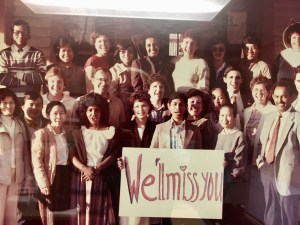
A photo given to Brown when he left his job in Houston. The man holding the sign is the Cambodian refugee whom Brown hired. Photo courtesy of Gerald Brown.

“They had been at the Khmer Rouge forced labor camps. The father told me their story and I couldn’t believe it. They were almost starved to death, it was very, very brutal,”  he said.

Throughout the ’70s tens of thousands of Cambodians fled to the Thai border because of the ongoing civil war and U.S.- led bombings. Khmer Rouge was a rebel-political group that established makeshift camps along the Thai border where Cambodian refugees were living under awful conditions. About one-fourth of the 8 million Cambodian people were murdered or starved during this time.

Brown spent four years working as a refugee resettlement job developer in Houston, and established a relationship with the father. Brown ended up hiring him to work the night shift at the refugee welcome center. The family has gone on to own a home and live a happy, healthy life, Brown said.

“He taught me that people are very resilient. It’s possible to overcome horrible experiences and go on. This job has shown me what people are capable of,” he said.

Brown was later hired as the director of refugee resettlement in New York City, where he met his wife and lived for 13 years. He began working for Asylum Corp. in 1995 and led a project where he brought social workers into Haiti with a military operation. After four years he felt restricted by the position and left.

He and his wife moved to Kanab, Utah, where he worked remotely giving technical assistance to a resettlement organization in Washington, D.C. Through this position he traveled to Saudi Arabia, where he worked with a U.S.- vetting organization. He also traveled to Macedonia, where he worked to prepare refugees for asylum, and Croatia, where he conducted the UN’s initial interview for Bosnian refugees.

Rachel Appel, the volunteer coordinator for the Know Your Neighbor Volunteer Program, has worked closely with Brown and emphasized his breadth of knowledge on refugees. “If I ever have any kind of question, he has the answer. He knows the policy, the cultural aspect of working with refugees, the history of refugees in the U.S. — really just all-encompassing,” Appel said. “He’s got really strong relationships with refugees here in Salt Lake City. One of the refugees, Joe Nahas, once said to me, ‘That man’s got heart,’ which just perfectly describes Gerald.”

Brown said with a smile, “I think working with refugees has enriched my personal life. It’s hard to imagine the two (work and personal life) being separate.” 

Utah Refugee Education & Training Center, where Brown, Appel, and Dulal work.

Gyanu Dulal, the refugee center program coordinator at the Utah Department of Workforce services, was a refugee from Bhutan. He recalls Brown’s dedication to his work. “I was introduced to Gerald in 2008 by one of our community members. Since then I have a very good relationship with him. I have never seen anybody so dedicated, motivated and committed to help the refugees.”

Dulal continues, “In these nine years that I have been working with him, I have never seen him say this cannot be done. Every refugee here has access to his personal cell phone. He is willing to talk to anyone at any time to find help the best way he can.”

Speaking about the most challenging aspect of his job, Brown said, “The way they (refugees) have been treated is infuriating. It’s very depressing and it just keeps getting worse and worse it seems. And that’s hard. I’ve had a hard time working within bureaucracy. There’s always red tape when you just want to cut to it and get stuff done. But, you know, you do what you can do.”

Brown quickly turned to the most rewarding aspect of his job. “Knowing refugees,” he said. “I know several people that have come out of camp with nothing. They are totally shell shocked, and there is PTSD and you just wonder how in the world are they ever going to make it, and they do. It’s perseverance, you know? It shows you what people can be capable of.”

While working with refugees has benefitted Brown in his personal life, Dulal emphasized how Brown has benefitted the refugee community.

“His tireless and dedicated effort to the Refugee Resettlement Center has been so helpful for all refugee communities to get the support that they need. We have employment, treatment, education, everything here. And this is a hub for people to come and learn about refugees as well, so it is an integrating space. Gerald reaches out to individuals to come forward, learn about refugees, make friends with refugees, that way they understand each other and help.”

Pamphlets advertising resources available to refugees.

Becoming emotional, Dulal said, “Gerald is the man I have known, he’s the best person I have ever found in my life. If anybody has a heart for the refugees, and knows more about refugees than anyone, it’s Mr. Gerald Brown. I have never found anybody so willing and so open to help refugees.”

Brown stressed the importance of education – learning about the global refugee crisis and understanding the situations facing people who are forced to flee their homes due to war and persecution.“Refugee resettlement is incredibly important. These people are refugees by no fault of their own. If anyone deserves support, it’s refugees and asylees,” Brown said. The Utah Refugee Education & Training Center offers many volunteer opportunities.

Granite School District forms charter school to serve refugees and immigrants

Story and photos by KATIE UNDESSER

Take a tour of Utah International Charter School.

Non-English-speaking children now have the opportunity to go to school with a curriculum catered to them in Granite School District.

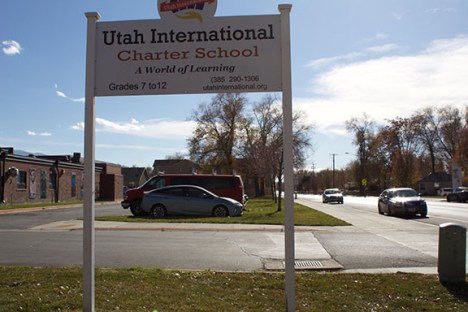
The Utah International Charter School (Utah International), located in South Salt Lake, Utah, held its first class in August 2013. When opened, it launched with a total of 94 students and six teachers, two of whom were part-time.

UTAH International11

Utah International Charter School, located at 350 E. Baird Circle in Salt Lake City, provides a curriculum catered to refugees and immigrants.

By Oct. 1, 2013, this seventh- through 12th-grade charter school had 104 students attending its classes.

There was another school before Utah International was established that educated refugees and non-English-speaking students. However, it was shut down due to segregation issues.

“District politicians decided they couldn’t have a school that segregates because it’s a Civil Rights violation,” said Angela Rowland, principal of Utah International.

According to Uncommon Schools, a charter school is an independently run public school that is granted greater flexibility in its operations, in return for greater accountability for performance. It is a publicly funded school established by teachers, parents or community groups under the terms of a charter with a local or national authority.

The Board of Trustees, including Steven Winitzky, Wanda Gayle and others, were concerned about the high drop-out rate of refugees. Some were falling behind because their English was not at grade level or they hadn’t learned any yet.

Now, Utah International has nearly tripled in enrollment with 245 students and 18 full-time teachers along with six staff members. Approximately 90 percent of the school’s enrollment consists of students whose first language is not English; 80 percent of whom are refugees.

“It’s like a little U.N. (United Nations) where you can walk down the halls and hear eight different languages,” said Heather Amir, one of Utah International’s para professionals who helps with the special education students.

“They (the kids) are mainstreamed into regular classes and so if they don’t need assistance, I can go help other students. Mainly the English-learners are the ones I help with when they need help with the understanding of words, spelling, definitions – that kind of stuff,” Amir said.

“I aid the special-education students by helping them get focused, receive the materials they need and assist them in following directions,’ she said.

The success of Utah International is based on the model of Sheltered English Instruction from the International Network for Public Schools, Rowland said. This model is designed to make every subject accessible to students no matter their proficiency in English.

Students are put into a classroom where they are assigned to groups. Within these groups, they all face each other. This set up makes it so the students are required to talk to each other to get their work done versus having a teacher talk at them.

ClassroomUtahInternational11

One of the classrooms at Utah International, where students work in groups.

“I feel almost like the aunt who’s not like a huge part of their lives, but they always know I’m there and if they ever need anything they can come to me,” Amir said. “Sometimes, I have to say ‘I can’t help you, but let me find somebody who can,’ and I think that really is an empowering tool for them to see.”

This model gives the opportunity for those students who speak different languages to find the one common ground in English.

“How do I make it so even my students with a low level of English can think about it to interact with that material?” Rowland wonders. “That’s called scaffolding.”

According to The Glossary of Education Reform, “scaffolding refers to a variety of instructional techniques used to move students progressively toward stronger understanding and, ultimately, greater independence in the learning process. The term itself offers the relevant descriptive metaphor: teachers provide successive levels of temporary support that help students reach higher levels of comprehension and skill acquisition that they would not be able to achieve without assistance.”

The majority of the funding for Utah International comes from the state of Utah

“We are chartered by Granite, but we pay full market rate, we don’t get any deal from them,” Rowland said.

Granite School District does not advertise Utah International on its website.

“The reason behind this,” Rowland said, “is because if a student goes down to a public school and they realize that student speaks zero English they will say ‘Oh, you speak no English, we’re going to send you to Utah International,’ when in fact that is when it becomes a segregating issue.”

uICS

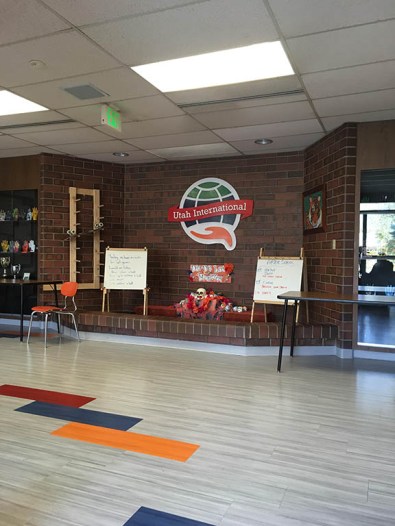
Utah International as you walk in the front door.

By law, Utah International is required to accept anyone who would like to attend as long as it has room for them.

Utah International is not just a school that teaches geography, science, math and more. It is a school that provides teenagers with vision and self-worthiness.

In 2016, Eagle Vision, a private nonprofit, volunteered to come to Utah International to give free eye examinations. Rowland said 90 students needed glasses.

That same nonprofit chartered two buses to take the 90 students to get their follow-up exam. A couple of days later, Eagle Vision came back to the school to fit those 90 students with cost-free glasses.

Utah International provides free breakfast, lunch and even dinner to most of its students. Between the time of school dismissal until dinner, the school is open to them all where it offers various after-school programs or activities. These activities include homework help, dance, soccer, basketball and cooking.

MuralUtahinternational

Murals of the graduating class of 2016 created by the summer art program.

Adrienne Buhler, the after-school programmer, was hired by the City of South Salt Lake. She partners with Utah International through the program Promise South Salt Lake.

Buhler said, “Our mayor (Cherie Wood) made three promises to the city: every student will graduate from high school and go onto a post-secondary degree, every neighborhood will be clean and safe and every family will have the ability to be healthy and prosper.”

Rowland said, “The library is opened so students can do homework and use the computers. Unlike a lot of schools, we allow them to use YouTube. At home, they don’t have Wi-Fi. They all have phones, but they’re almost always broken and never have phone service.”

During the summertime, Utah International hosts several different programs that its students can attend.

“These kids want to go to school. They don’t have cars, their parents work all day and there’s nothing for them to do,” Rowland said.

She added, “Some of the programs allow the students to show their creative side in art. Others inform them on topics such as sex, relationships or drugs.”

Amir, the para professional, said, “Most of the faculty want to be here. They are investing their time and energy for these kids.”

Utah International had its first graduating class of eight in 2016. Each year, Utah International is growing as the demand for English learning classes increases.