Educational accommodations for students with autism

Story and photo by MAKAYLA STOWELL

You’re confused and scared. You have no idea what’s going on around you. You feel completely alone. You are not sure why there are so many people around you. This is how school can feel for students with autism.

Experts say it can be difficult for students with autism to get an education and do well in school.  While autism has a very wide spectrum of symptoms, most students dealing with autism find it difficult to learn in a normal classroom setting.

Some individuals need very few educational accommodations. It can be as simple as a few extra minutes on a test or even an extra five-minute break in the middle of class. In these less extreme cases, it is often difficult to even tell that the student has a learning disability.

In advanced cases of autism, more specific accommodations may be necessary. Some students may require an assistant to take notes for them or walk with them to classes. Some students may need someone to assist them in the test taking environment and extra time to complete the exams.

Chris Burningham, an advisor for the Center for Disability Services at the University of Utah, said any reasonable accommodation the student needs will be provided free of charge to the student. It is all part of the American Disability Act which is a federal law that states that any company or institution is required to provide the necessary accommodations for those with disabilities. These can be anything from an interpreter for those who are hard of hearing to a note taker for those who have learning disabilities such as autism.

He said what they aim for is equal access. When a note taker is provided, the student is still required to attend the class. He said the office is now leaning more toward using Smartpens and not note takers.

A Smartpen records lectures while the student takes notes. It is used with a special notebook and can play back specific parts of lectures based on where the pen is touched on the paper.

Burningham also provided some statistics about the students that the Center for Disability Services helped during the 2011-2012 school year at the U. During that year,1,477 students were registered with the center. That is approximately 4.7 percent of the student population. He said that about 40 or 50 of them were autistic.

He said that ultimately the biggest service the center provides to students is advocacy with their professors. The advisors provide suggestions to the professors about how they can help students succeed and serve as a communication source between the student and the professors.

Another service provided to students with autism is a support group. The group meets every Friday afternoon. The goal of the group is to help students socialize and make friends who understand what having autism is like.

Kjersti Parkes, who teaches drama at Hunter High School in West Valley City, said she too provides accommodations for her student with autism.

“I have to be more patient with him and I grade him differently,” Parkes said. However, she said she did not receive any special training on how to deal with students with disabilities.

Parkes said she has to be familiar with his IEP, or individualized learning plan. This is a plan set up by the school, parents and teachers that outlines how to best help students learn. This is just one way students with disabilities are being accommodated in the public school system.

“Sometimes he gets anxious and I have to take some extra time and calm him down,” Parkes said. This is the only way having a student with autism has ever interrupted her class.

The student, who is in her beginning theater class, is required to perform a Shakespeare monologue like the other students. Parkes said this student’s monologue always gives everyone a good laugh. “He adds modern day words and loves to make the class laugh with his interpretation,” Parkes said.

Some students in the public school system receive assistance outside of the classroom as well.
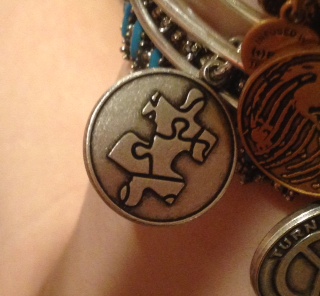
This charm bracelet features the symbol for autism awareness. Baker wears it every day.

This charm bracelet features the symbol for autism awareness. Baker wears it every day.

Leanne Baker works privately as an applied behavioral analysis therapist. Baker offers a unique insight into how autism effects education. She uses the principles of punishment and reward to help children with autism learn appropriate means of behavior that can be practiced in the classroom. These behaviors can include echoic or mimicking noises, motor movements and many other behaviors most individuals would consider normal.

“Students with autism often lack these basic developmental skills, especially those related to socializing,” Baker said.

She helps students with autism in kindergarten through high school learn to fit in with other students and learn how to socialize with them. This can help the students with autism ultimately do better in school when they feel they are welcomed and understood.

Baker typically works in private homes with students. Since private homes are not government-funded institutions, the students’ parents pay Baker. Sometimes the fee can be quite high depending on how many hours she spends with the students each week.

Not every student receives extra help at home, however. Some families cannot afford to provide their children extra assistance and accommodations at home. The only assistance they receive is at the schools themselves.

Some students with autism are extremely gifted and smart, but don’t know how to express those skills and use them to their advantage. Part of the accommodations provided in school helps students learn how to use their knowledge in the right way.

Disabilities services at University of Utah

Story and photo by WENDY DANG

The fact that the University of Utah has an office for students who need assistance in class with physical or mental disabilities is not a well-kept secret. The Center for Disability Services is working hard to ensure every student has an equal opportunity to further their education.

Chris Burningham says his responsibilities as a disabilities adviser at the CDS include starting incoming students on the processes of applying for services they may require, such as getting textbooks in Braille or American Sign Language interpreters to sign class lectures.

After scheduling an appointment to talk with an adviser and completing all of the paperwork, students must provide the necessary documentation from doctors or therapists that clearly state the restrictions of their disability.

“It’s a clear process throughout the office to take each student on a case-by-case basis,” Burningham said. “The (more complicated) disabilities aren’t usually like the last (ones we’ve dealt with) and we try to accommodate as best we can.”

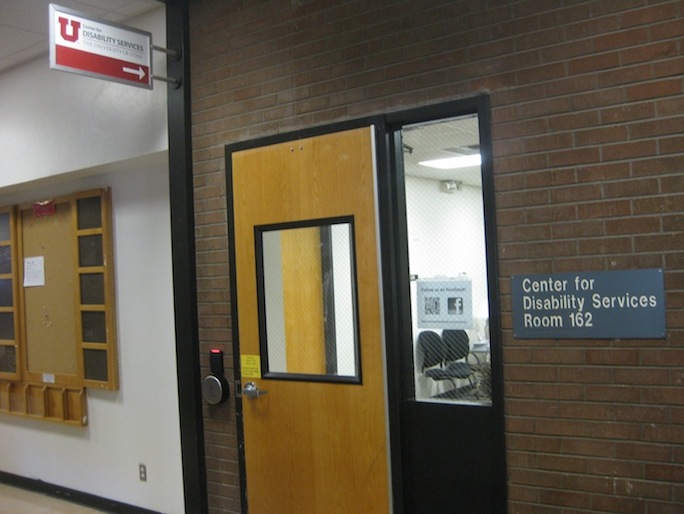
The Center for Disability Services is tucked away in the southwest corner of the Union building.

The Center for Disability Services is tucked away in the southwest corner of the Union building.

The CDS can provide extra time or a quiet place to take a test, convert textbooks to Braille or audio recordings, or even offer early registration for classes to students who might need to consider the accessibility of a classroom.

“If a student using a wheelchair can’t physically get into a classroom, we’ll move the class,” Burningham said.

However, the Center for Disabilities Services doesn’t make changes to the course requirements to show preference to students who use their services.

“If a student asks for a note-taker and they have no reason to be missing classes, we say no. They still have to complete all the coursework,” Burningham said. “Now if they request more time to complete the work, that is something we can do.”

Note-taking is a very common service the center provides for students who might have attention deficit disorder, autism or mobility limitations that make it difficult to copy down key points in a lecture.

Shawna Meyer, a senior who is majoring in English, has been a note-taker for the center before.

“It wasn’t any trouble,” she said. “I usually take good notes anyway and I thought ‘Why not? It’s easy money and a good cause.’”

Meyer filled out paperwork in the CDS stating that she agreed to submit her notes to the center. Throughout the semester, Meyer simply copied her notes and sent them to an email address the CDS provided.

“I would send the notes at the end of every week, sometimes every two,” Meyer said.

Of the 1,200 to 1,400 students who are eligible for resources offered by the CDS, only a handful are in the office more than once during a semester.

Burningham said the most basic requests can be handled over email. Students who require more complex services, such as personal campus guides for students who are blind, require daily interaction with the CDS.

“It’s about finding a balance between what we can legally provide and what the student needs to succeed,” Burningham said.

The Center for Disability Services, located in room 162 of the Union building on the south side of the ground floor, just past the pool tables, is currently available for walk-in appointments to students who are currently registered with the center. The office is open Monday to Friday from 8 a.m to 5 p.m.

Redefining success for African-American college students

Story by TREVOR RAPP

President Barrack Obama stood before the nation on Feb. 12, 2013, in his State of the Union address and showed just how much African-Americans can achieve, not necessarily by what he said, but just by being the one who said it.

While debate surrounded what he said, the fact that an African-American was standing in the office as president of the United States of America for a second term was indisputable.

His words also seemed to be directed at others who may struggle to find success because they are classified by others as a minority.

“It is — it is our unfinished task to restore the basic bargain that built this country,” Obama said, “the idea that if you work hard and meet your responsibilities, you can get ahead, no matter where you come from, no matter what you look like or who you love.”

So what does an African-American university student need to do to find success? For Ennis Henderson, a senior at the University of Utah studying business, one of the most important steps is to take control of the process himself instead of giving that control to others.

“I was brought up in the South by a family of strong and proud men and women,” Henderson said. “They raised me to be a capable, responsible and dignified man. It isn’t up to whites, blacks, Hispanics, Asians or anyone else to ‘Let Me’ enjoy anything, much less my own success. I won’t allow a person to position themselves in my life in such a way that they have that kind of power over me.”

A strong sense of self-sufficiency may be one of the reasons Henderson is experiencing success in a campus whose student demographics is only 1 percent African-American.

Defining African-Americans’ struggle for success based not upon outside limiting factors imposed upon them, but rather internal characteristics that have led to success is happening far too little, wrote Professor Shaun R. Harper, director of the Center for the Study of Race and Equity in Education at the University of Pennsylvania.

In “Black Male Student Success in Higher Education: a report from the National Black Male College Achievement Study,” Harper wrote, “For nearly a decade, I have argued that those who are interested in Black male student success have much to learn from Black men who have actually been successful. To increase their educational attainment, the popular one-sided emphasis on failure and low performing Black male undergraduates must be counterbalanced with insights gathered from those who somehow manage to navigate their way to and through higher education, despite all that is stacked against them — low teacher expectations, insufficient academic preparation for college-level work, racist and culturally unresponsive campus environments, and the debilitating consequences of severe underrepresentation, to name a few.”

The study deliberately quickly passes over “anti-deficit research,” such as the fact that in 2002 black males only represented 4.3 percent of students enrolled in higher education, a statistic that hasn’t changed since 1976. Those omissions are not because they are not important. Harper just wants to focus on what’s going right instead. This includes the stories and statistical analysis of more than 200 young, successful black males who were able to find success through the following factors:

  • having parents with consistently high expectations
  • having influential teachers previous to college
  • having a “college-bridge” opportunity that allowed them to get acquainted with the university and classes before starting
  • finding ways to minimize the stress of paying for college
  • being focused in their classes.

Harper wrote there are likely many African-Americans on college campuses who “completely contradict popular narratives of Black male hopelessness. They are somehow debunking longstanding caricatures of Black undergraduate men as lazy, unmotivated, under prepared for college, intellectually incompetent, and disengaged. Find them. Ask them how they got there.”

For Henderson, a student at the U who has achieved success in multiple areas, the success has come from himself. Whether it was from retiring from the United States Marine Corps as an “E-6 Gunnery Sergeant, with an impeccable record, numerous awards, accolades and abilities,” to helping his two daughters graduate from college with graduate and post-graduate degrees.

“I look at these clowns [who try to suppress African Americans] and laugh.” Henderson said. “Therefore — ‘No!’ No one has the power to allow or deny me the opportunity to enjoy my success, unless I’m foolish enough to give it to them. That won’t happen.”

Using genetics to debunk racism

Story and photos by ALYSHA NEMESCHY

Humans have been dealing with racism for hundreds of years, specifically those who are considered black-skinned by society. Africans have been faced with hardships, trials, slavery and even rejection of being human throughout history.

However, recent studies from geneticists may have the key to ending racism. Geneticists have proven that DNA studies show that all modern-day humans originated in Africa.

According to World•ology, as humans migrated north, “the less melanin they needed in order to gain protection from the risk of skin cancer. …Therefore, over several the course of several thousand years, somewhat lower levels of melanin were produced in the skin/hair of Asiatic humans, giving them a light brown pigmentation. The lightening effect was even more dramatic for humans in sun-poor Europe.”

Thus, prior to migration from Africa that took place roughly 60,000 years ago, the entire human race was black. Differences in skin color have only resulted due to sunlight exposure of ancient ancestors over the course of thousands of years. That completely negates every argument that humans have given for why racism is justified.

Demographic results of Eli Martinez, showing that his DNA comes from many different regions of the world, including Africa.

Demographic results of Eli Martinez, showing that his DNA comes from many different regions of the world, including Africa.

One Salt Lake resident, Eli Martinez, was fascinated by this information and chose to put it to the test by having his own DNA tested.

Martinez was born in Mexico and later moved to Utah. He considered himself 100 percent Mexican growing up and he, like other minorities, faced many difficulties with racism throughout his childhood and into his adult life.

Martinez was passionate about education and learning. He later went on to receive a bachelor of science degree in Spanish. However, while obtaining this degree he was exposed to many different issues regarding his own race that led him to be an extreme advocate for ending racism.

Melissa Sanford, a friend of Martinez, said, “Although a large chunk of society believes that racism is a thing of the past, many people are still faced with segregation and I have seen it firsthand growing up and going to school with Eli.”

After learning about the research being done to prove that all humans are of the same race, and that all people contain the same DNA lineage from an African woman from over 100,000 years ago, he thought that racism could soon be something of the past.

Martinez’ wife, Allison Evans, was interested in her husband’s passion with the African lineage and purchased a DNA test for his birthday. “He was constantly rebutting racist remarks online, at work and with his friends saying that we are all black and our racist ways are and always have been unjustified because, race is only something we as humans have created,” Evans said.

The DNA test results soon returned and his belief of being a full-blooded Mexican was halted. His DNA results showed that he was 40 percent East Asian and Native American. Nearly 30 percent of his background was European and, as expected, he also carried Sub-Saharan African genes as well. Five percent of his DNA showed African descent. He was amazed.

DNA results show those tested what percentage of their lineage comes from where.

DNA results show those tested what percentage of their lineage comes from where.

Martinez is one of many who are working toward ending racism by proving that we are all of the same human race. And ironically enough, we all come from the same race that has faced some of the most difficult hardships and brutalities because of racism.

With evidence being more available to the public, Martinez along with many others hope that racial differences will finally be a thing of the past, and acceptance toward one human race will be settled, officially making us a colorblind world.

Paleoanthropologist Richard Leaky said in a USA Today story, “ If you get to the stage where you can persuade people on the evidence, that it’s solid, that we are all African, that color is superficial, that stages of development of culture are all interactive, then I think we have a chance of a world that will respond better to global challenges.”

University of Utah offers organizations for African Americans

Story and slideshow by ALYSHA NEMESCHY

Take a campus tour and see details about some diversity resources.

University of Utah students’ schedules are filled with events, dances, organizations, clubs, parties and much, much more to keep them busy throughout their academic careers. With all of these opportunities made available to students the question is raised, is the — as a university — making a large enough effort to cater such events to minority students, specifically, those of African descent.

According to the diversity demographics report of 2012-2013 the total number of African Americans studying at the U was 1 percent. Compare that to the 72 percent population of whites, and it becomes obvious why African Americans are often underrepresented at the school.

Comprising only 1 percent of a population makes it is easy and an unfortunate normality to get lost in a sea of those people making up the majority, causing them to go unrecognized and unnoticed.

However, the U is going to great lengths to provide events, organizations and clubs to help African Americans maintain their culture and individual differences while still fitting in on campus. Additionally, the U is making a significant effort to recognize the African American community not just for the minority, but to spread cultural awareness to the majority as well.

The U has an Office for Equity and Diversity that is geared to catering to diverse groups and aiding in their college careers in any way possible. The associate vice president for equity and diversity, Dr. Octavio Villalpando, gives this message on the office’s homepage: The office “is committed to removing barriers that have been traditionally encountered by individuals from underrepresented groups; strives to recruit students, faculty and staff who will further enrich our campus diversity; and makes every attempt to support their academic, professional and personal success while they are here.”

Furthermore, on the office’s homepage there are links for underrepresented groups where information can be found regarding activities, events and calendars showcasing what is being offered to represent different minority groups on campus.

Throughout Black Awareness Month, the office showcased several events for African Americans including a keynote speech by Capt. Marshall E. Allan, a film screening, a black culture night featuring African dance and music, and much more.

One such event that was very popular among students and faculty was a keynote address by the Rev. Jesse Jackson. He spoke to the audience  about success, barriers and how to overcome them.

Jackson addressed the idea of keeping hope alive at the U through equality and said, “We are the generation of hope…Keep hope alive.”

African Americans were brought together and recognized at Jackson’s speech that brought strength to those who made up the minority and brought awareness to those who make up the majority of the population on campus.

In addition to the Office for Equity and Diversity there is a club available to African American students to help them not feel as though their cultural background is being lost while attending a school with such a small percent of African Americans, the Black Student Union.

According to the club webpage, “the mission of the BSU is to foster a sense of community among all students of the African Diaspora at the U. Our goal is to simulate the intellectual, political, cultural and social growth of the Black/African American student body.”

The BSU helps to establish a sense of community while promoting interaction among African American students at the U. Additionally, the BSU organizes venues and means to help address issues.

Jasmine Walton, secretary of the BSU, said in an email that she believes it is still common for African Americans not only on campus, but also in Utah to feel ostracized from the community due to their very low demographic make-up in the state and the division between cultures.

However, Walton believes that through clubs and organizations like the BSU, more can be done to help represent smaller cultural groups on campus and by doing so help spread cultural awareness throughout the U community.

“The BSU helps college students become more successful because they are given a support system on campus,” she said.

In addition to the presidents and secretaries of these clubs going to great lengths to help make the U feel more like home for African Americans, the university in its entirety is trying to be more culturally aware by helping African Americans stand out and take pride in their background rather than blend in.

By funding events for African Americans on campus students both of African descent and of European descent are given the opportunity to learn more about cultural differences and broaden their understanding and respect toward others.

In addition to offering clubs and organizations for African American students at the U, scholarships are also offered to African American students on campus to help further their education and in addition to help increase the amount of diversity that the U offers.

David Pershing, University of Utah president, said scholarships “will provide African American students with important financial assistance, mentoring and academic support as they complete their education.”

It is vital for racial barriers to be brought down at the U in order for African Americans to be able to succeed while gaining an education. With the bringing down of these barriers African American students can better overcome obstacles, further educate themselves and have greater success in life.

According to the diversity demographic report the increase of African American transfer students enrollment from the 2003-2004 school year, to the 2012-2013 school year has more than tripled in number.

Organizations that bring down barriers and help to represent African American students at the U such as the Black Student Union and the Office for Equity and Diversity could be attributed to the growth of African American students on campus.

In the future, the increase of African American cultural awareness among students and faculty will hopefully help drive more diversity to the school and in addition help diverse groups feel welcomed and comfortable while on campus. Ultimately, making the U a better school for diverse students.

Black Student Union at the University of Utah helps students connect

Story and slideshow by GUSTABO RODRIGUEZ

Explore the Student Involvement Wing and the Center for Equity and Student Affairs and the Office for Equity and Diversity.

The University of Utah is a school where high school students can expand their educational horizons.

Students from a diverse background also apply to the U to expand and get a higher education. But some of them need help adjusting to the new school and to obstacles they might face as they attend the U.

The U has a variety of clubs and organizations that help students of diverse backgrounds with college life. For example, these clubs might help them get into classes for their majors, academic advising and financial advice.

There is one organization in particular at the U that helps African-American students.

The Black Student Union is one of the diverse organizations at the U that is dedicated and focused on helping the underrepresented students. BSU helps black students get involved with the school and within their community.

BSU has even hosted a special day at the U for black high school students to get them interested in higher education and inspire them to apply to the U or other institutions. BSU members have workshops, activities, and they give the visiting students a tour around campus.

The conference also helps students apply and enroll at the U or another school by telling them what to expect when they enroll.

This is why BSU is there ­­­— to help incoming U students get to know not only the school but also other students if they feel lost during their first semester.

James Jackson III founded ACCEL (African-Americans Advancing in Commerce Community Education & Leadership). Jackson was part of BSU in his early years at the U. This organization helped him become comfortable on campus. He did not feel like he was in a strange place anymore after he joined BSU.

“It was an opportunity for me to socialize and I made friends on campus,” Jackson said in an email.

He also had help from older students in BSU to show him around campus. This was also another opportunity to make new friends.

Not only does BSU work with the black students, but it also helps other clubs on campus. For example, they have participated in events for the Social Justice Advocates and the Asian American Student Association. This is a way to let students know that BSU helps other groups regardless of their background. They’ve also worked with the Kick off Black Social where other black students and staff bond and have a stronger community.

Fattima Ahmed got involved with BSU when she got an email stating the group needed volunteers to participate in the annual high school conference her freshman year.

“Coming to a new environment I was wanting to get involved in my campus and community. I was eager to grasp the exciting opportunity!” Ahmed said in an email interview.

To seize her opportunity to join BSU, Ahmed went to an advisor at the Union Building and the advisor recognized her from the high school conference.

The advisor told her to attend the next BSU meeting to see what BSU was about and what to expect.

“Before I knew it they were encouraging me to run for an executive position,” Ahmed said.

Ahmed has had students from high school reaching out to BSU to get the black students in their high school to get together to form a stronger community.

“I’ve personally worked closely with students to help them toward the intense processes of college; including college admissions, financial assistance, and certainly support,” Ahmed said.

The Black Student Union has 200 members and counting, according to the email addresses BSU has in their directory. These are not only former students from the U, but also members within the faculty at the U, alumni and community members.

Future college students at the U can count on BSU to help them throughout their college years. BSU has a service and supporting faculty and advisors who provide personal mentoring, not just for school but also to the students.

“They whole-heartedly support our future endeavors and provide any support to make sure we get there,” Ahmed said.

Faculty and the advisors help BSU and their students connect with other resources on campus and share their personal experiences in an attempt to aid students in their college endeavors.

The financial questions from students are a specialty of Ahmed.

“It’s an interesting hobby of mine to personally assist students with situation such as these,” Ahmed said.

Ahmed is not only involved with BSU as a member, but she is there to work with the new college students here at the U one-on-one.

“I’ve worked with students in a more collective manner, but I’ve had so many experiences interacting with them one on one on a personal level. I love being able to specifically learn about interests, family, and academics,” Ahmed said.

If students are confused or don’t know what classes to take next, BSU works with the Center for Ethnic Student Affairs. The center, located on the second floor of the Student Union, provides academic advising for students.

“Denise E. Francis Montaño has provided so much help for students who come to receive advising,” Ahmed said.

Montaño is one of the many advisors CESA has for students who seek help or guidance to pick their classes. She is more than an advisor— she treats every student as a friend and will listen to them. It doesn’t matter if a student has a question about school or just wants to talk; Montaño will be at the CESA office.

“Any student who walks through our doors can connect with any and all of our advisors,” Montaño said in an email interview. “Students connect with advisors for a variety of reasons and may talk about their academic progress, negative and positive experiences in the classroom/campus/or SLC, issues that cause them to feel discouraged/stuck, family challenges — anything.”

She is not Ahmed’s advisor but she welcomes any question that she might have. Ahmed and Montaño have shared work-related experiences with the Inclusion Center for Community Justice. This is a nonprofit organization being hosted at the U; this is a small program that provides experiential programing to promote dialogues for inclusion and social justice for the state of Utah.

“Fattima has been a consultant for BSU and even though her schedule is filled with services she does as a social justice advocate she took on the role of a BSU officer,” Montaño said.

Volunteer work is also an emphasis of BSU. This year the group has partnered with the Bennion Community Service Center to bring the US Dream Academy to campus. This mentoring program is designed for students from third and eighth grade levels who have parents in jail and help them understand and keep going to school.

On April 20, 2013, board members Jasmine Walton and Charity Jefferson worked together to provide the BSU Black Affairs to celebrate the end of the spring semester. This was a dance event for every student to get a chance to dress up and have a good time with friends.

To find out more about BSU, students can visit the CESA office at the Union or follow the group on Twitter (@UofUBSU). BSU has an annual membership fee of $10 that each person, including the executive board members, pays in order to join. This helps BSU fund the opening social they have at the start of every year.

If students are interested in joining the BSU board or have any questions, they can email BSU at bsuoftheuofu@gmail.com.

“No you do NOT have to be black to be in BSU nor do you have to be in order to run,” Fattima Ahmed said in an email. “We stand as a group who welcomes all!”

Thelina Smith, Miss Black Utah USA, strives for science education

Story and photo by LORIEN HARKER

On the Miss Black USA pageant website there is a statement that reads, “It’s time to redefine what it means to be a courageous, compassionate [and] CONFIDENT black woman today. We’ve got obstacles to overcome and stereotypes to smash. Sound like your kind of revolution? Join the movement.”

Thelina Smith has got some smashing of her own to do.

524502_4026434416872_1145373459_n

Smith competing for the title of Miss Pioneer Valley in August 2012.

Smith is the current reigning Miss Black Utah USA. She also is a junior at the University of Utah who is studying biomedical engineering with an emphasis in biomaterials and leadership studies.

Smith is extremely busy with duties of the crown and sash, such as being an advocate for heart health while promoting her own platform. However, she makes sure to be involved with her studies. Smith started the first chapter of the National Society of Black Engineers at the U, reactivated the U’s Society of Women Engineers and is a biomedical engineering ambassador for the College of Engineering.

As a requirement for her title, Smith also promotes a platform, or an issue she feels needs to be addressed within the community. Smith says her platform, “Engineering the Leaders of Tomorrow, Because Tomorrow Matters Today,” is meant to “motivate minorities and underrepresented students to engage in STEM education.”

Smith says her platform has three goals. First, to reach out to the community, specifically women, through educating them on STEM (Science, Technology, Engineering and Math) education. Second is to “continue to charter diverse student organizations throughout Utah that serve to recruit and retain minority and underrepresented students in STEM fields.” And third, she wants to “establish a council” to mentor the youth she hopes to recruit into math and science education.

“I feel that this pageant allows me to take my efforts to the next level,” Smith says in an email interview. “I want to challenge young ladies to think about what it is to be beautiful and smart and to capture the attention of young men to let them know they can have a future within STEM education.”

Smith has also been working on partnering with the National Society of Black Engineers, The Society of Hispanic Professional Engineers, The American Indian Science and Engineering Society, and the Society of Women Engineers, of which she has been an active participant. Smith wants to partner with these societies to form a council called STEM-Diversity Industry Advisory Council.  This council would include “community leaders and local STEM company representatives that will [oversee] the support of these student chapters,” Smith says.

Despite her full schedule, Smith is making time to run for Miss Black USA in Washington, D.C., in August 2013.

Although there have been women of color to win larger national and international pageants, Smith doesn’t feel women of color are being represented to their full potential within these programs.

 “I wouldn’t consider myself ‘marginalized’ in pageantry but rather ‘underrepresented.’ There have been women of color to capture the crown as Miss America, Miss USA, Miss Universe, [but] this is still relatively a small number in comparison to the number of years that these organizations have existed,” Smith says.

Lana Thompkins, the public relations spokeswoman for Miss Black USA, says in an email interview that the Miss Black USA is necessary because women of color do not feel beautiful with today’s standards of beauty.

 “Self-esteem is the core of a woman’s belief in herself. Miss Black USA sets our own standards of beauty,” Thompkins says.

African-American women have been faced with many stereotypes, Thompkins says, and the purpose of the Miss Black USA pageant is to disprove these stereotypes.

“While 80% of Miss Black USA contestants are graduates or professionals and represent a new generation, we are often negatively typecast, demeaned, and portrayed in the media and in the workplace as ‘broken,’ ‘unattractive,’ ‘alone,’ ‘hard to work with,”’ and even ‘violent,’” Thompkins says.

Raychellene Talbot, the wardrobe coordinator for Miss Utah under the Miss America Organization, feels that Miss Utah has a “melting pot of pageant girls” despite the fact that there has yet to be an African-American Miss Utah.

“We have so many different contestants at the local and state level. I know Miss Utah Outstanding Teen 2011 had 6 different nationalities,” Talbot says.

The Miss Black USA pageant was founded in 1986 by Karen Arrington. The scholarship program boasts a two-year tuition scholarship to Miles College, a historically black college in Fairfield, Ala.  The scholarship also awards a fully furnished apartment close to campus. If contestants such as Smith win and choose not to attend Miles College, they do not receive the housing benefits.

Women who have competed for the title of Miss Black USA have gone on to win titles within the Miss USA organization. Chenoa Greene, Miss Black New Jersey 2007, went on to become Miss New Jersey USA in 2008.

Thelina Smith says, “The Miss Black USA pageant is a showcase of women who otherwise may have been overlooked.”

University of Utah students focus on diversity in innovation

Story and photo by TREVOR RAPP

On Jan. 8, 2013, the University of Utah was ranked as one of the “top institutions in the country for startup formation,” according to the latest survey by the Association of University Technology Managers released in December 2012.

“Startup formation is in our DNA,” said Bryan Ritchie, director of the U’s Technology Commercialization Office, in a news release.

The genetic complexion of business innovation has significant meaning for one U student. He is not just a business innovator, he is a black business innovator.

“Black-owned businesses are, especially where I’m from in Lake City, Fla., a rare commodity,” Enis Henderson said.

Ennis Henderson, UofU student.

Ennis Henderson, UofU student.

Henderson is part of a research innovation class that tasks students to research opportunities to improve local or national communities.

“I chose the problem that was near and dear to my heart, which was trying to improve the quantity of black-owned businesses in America,” Henderson said.

While contemplating his project, Henderson’s mind stretched back to Lake City, Fla., where he grew up. He described it as a “Mayberryesque” town where the white people lived on one side of the tracks and the black people on the other. There he gained his first working experience “doing the jobs no one else wanted to do” like picking the tobacco, corn, peanuts and melon grown in his community.

When he was 22, he got his first lesson in owning his own business.

That lesson came from a casual conversation with a white insurance agent. After “taking a liking” to each other, Henderson said the agent explained that he took his two sons out to cut wood and then bring it into town to sell it. Each time they made a sale they would subtract their revenue from their operating costs to calculate their gross and net profits.

“That was the first time I had heard the words ‘operating expenses’ and ‘gross profit’ in the same sentence,” said Henderson, “and I said ‘Wow, how old are your boys?’ and he said ‘7 and 9.’”

“You aren’t born with an innate sense of how to do business,” Henderson said. “Someone has to teach you, or you have to go out and learn it. And if those people who don’t own businesses never had anyone in their family to take them by the arm to say ‘let me show you how to do this’ … and if they’ve never seen it or heard it — odds are they won’t do it.”

And recent statistics are showing that when compared to other minorities, African-Americans are not doing it.

According to “Black (African-American) History Month: February 2013,” published by the U.S. Census Bureau News, the black population, whether of mixed or non-mixed backgrounds, is 43.9 million. This represents an increase of 1.6 percent from the April 1, 2010, census.

Nevertheless, in a separate 2007 Survey of Business Owners conducted by the U.S. Census Bureau found that only 1.9 million businesses out of 30 million were black-owned.

For Salt Lake City, black-owned businesses are only 2.7 percent of the almost 24,000 total businesses, according to the U.S. Census QuickFacts.

These numbers haven’t been lost on Henderson. As part of his project he researched statistics published by the U.S. Census Bureau, the Bureau of Economic Analysis, and IBISWorld.com, a database of industry-based research.

As he spoke, Henderson pointed to various charts from those sources as he explained that while blacks outnumber the most profitable minority, Asians, by about 3-to-1 by population, they own about the same number of businesses. Even more surprisingly, Asians were making about three times as much profit.

“It’s completely inverted,” Henderson said.

Henderson isn’t the only person who has noticed a lack of diversity in local businesses.

Most African-Americans who come from the South or the Midwest don’t want to come to Utah because of the stigma that Utah has of not being a diverse community, said James Jackson III, founder and executive director of ACCEL (African-Americans Advancing in Commerce, Community, Education, and Leadership), a nonprofit organization providing resources to African-American small businesses in Utah.

Neither Henderson nor Jackson point to current racial prejudices as the current cause of the problem. However, the “genesis” of the problem is deeply embedded in the history of slavery in the United States, Henderson said.

For Jackson, the most pressing need is increasing the level of education for all Utahns. Jackson was appointed by the governor to the Utah Multicultural Commission, an advisory group for issues relevant to local minority communities. “The main song that was sung through [the commission’s various] committees, whether it be health, education, corrections, economic development, all of them leaned toward education in some way,” Jackson said.

Those numbers are reflected in the April 1, 2010, US census as well, with only 18.4 percent of blacks reporting having earned a bachelor’s degree, and only 1.6 million blacks reporting having earned an advanced degree.

And the effects are real. The annual median income for black households declined by 2.7 percent from 2010, making it almost $10,000 less than the national median income for families, according to “Black (African-American) History Month: February 2013.” The U.S. Census Bureau News also reported a 27.6 percent poverty rate among blacks, almost double the national average.

For Henderson the answer is availability of resources. “What I recognize is that it’s a lack of information. Now there’s a ton of information out there on the internet there are types of agencies people can go to to get information. But they don’t know what to ask for if they did go to an agency,” Henderson said. “They’ve never been informed. The resources are there but they don’t know what it is, they don’t know what it’s for.”

Bringing diversity to Utah classrooms through the Teacher Recruitment Scholarship Program

Story and photo by LORIEN HARKER

According to a 2010 survey by the National Congress for Black Women, less than 9 percent of educators in the United States are African-American.

The Teacher Recruitment Scholarship Program is looking to raise the percentage of diverse educators in Utah.

The TRS is a scholarship for those of an ethnic background who are majoring in early education. The scholarship is available through the University of Utah, Salt Lake Community College, and the Granite, Jordan, Salt Lake, and Davis school districts. According to the Salt Lake Community College Financial Aid website, the scholarship “is designed to increase the number of culturally and ethnically diverse students accessing higher education and completing teaching preparation programs.”

Fennel and I in Park City.

Fennel and reporter Lorien Harker enjoying the fresh air in Park City, Utah.

The scholarship offers compensation for tuition costs for a full two years and $500 a semester for books. Kailie Fennel, a prospective 2014 University of Utah student currently majoring in early elementary education at SLCC, is a recipient of the TRS.

She says in a phone interview that having a diverse field of educators would help students broaden their thinking process, as well as become more exposed to people of different ethnic backgrounds. Fennel says through students becoming more acclimated to different races, they can avoid awkward situations like she had in a middle school history class.

“In middle school, a teacher asked me if it was OK to talk about slavery. They made it a big deal,” Kailie says.

She also says she has yet to have an African-American educator.

“I’ve never had a black teacher,” she says. “I was looking up statistics on something and found there were only 8 percent black people in Salt Lake.”

According to the Utah census in 2010, the African-American population in Salt Lake was 2.7 percent.

Kailie says if there were more ethnic teachers, it would prevent awkward situations for students from happening, and students need to be exposed to culturally diverse teachers for this to happen.

Mary Burbank, the director for the Urban Institute for Teacher Education, says the goal of the TRS is to “broaden the traditional audience of teachers.”

The population of diverse students is increasing, and Burbank says the teachers need to reflect that diversity. In addition, diverse teachers would offer a “broad spectrum of contributions.”

She also says students would benefit from diverse teachers because of language differences, life histories and perspectives of the educators. Burbank says oftentimes, a single student of a particular race is often singled out in class and seen as the “token representative” to their class of that race. A field of diverse educators would “open up perspective” for students in the classroom, Burbank says.

“Any group of kids would be strengthened,” she says.

Cheryl Fennel, Kailie’s mother, said in a phone interview that she has felt the impact of the lack of diversity on her children in the community of South Jordan. Cheryl has three African-American children, one Korean child, and three white children.

“I think there can be some struggle socially,” Cheryl says. “They can’t be raised in an area like South Jordan without it affecting them.”

Cheryl says her children are “in a weird spot” because they are African-American, but raised in the predominantly white and Mormon culture of Utah. She also says she is concerned about her youngest daughter, Tara, going to school out of state. She has talked to other adoptive parents who have sent their children to college elsewhere, and they say that their children were shunned by the African-American students as well as by the white students.

However, Cheryl says compared to other children of adoptive parents in other areas surrounding South Jordan, her children have it relatively easy. Though she admits sometimes her children — her youngest son Josh in particular — relish the attention, she says education should focus more on the academics rather than diversity.

“It shouldn’t be about color,” Cheryl says. “I wish the issue would just go away and Kailie could just be a person.”

As far as Kailie’s awkward situation, her mother says to “handle it with a giggle,” because you can’t force complete acceptance of diversity into a class that is inexperienced with diverse students.

Kailie says she wants to be an educator her students can talk to about their personal lives and academic concerns.

“I hope to teach not only core curriculum but to give students a way to be themselves and be proud of it,” Kailie says. “I feel like there’s something to learn from everyone, whether it’s from a student, a peer, or a co-worker.”

Kailie says she knew she wanted to be a teacher when she helped her older sister grade papers for her elementary school class.

“I got to sit with this girl who had dwarfism. She was a first grader and she was probably shorter than my nephew, who is 2,” she says. “I had the opportunity to read with her during their recess as she couldn’t go outside because of medical problems. I would help her sound out each word and help with the ones that she didn’t know. Anyway, it’s satisfying to see that your service helps out someone else. It was a growing love for teaching that started with helping out my sister but was solidified when I got to teach a group of primary children.”

Kailie’s sister, Shaunna Page, was a teacher in Payson for the Nebo School District. Besides her sister, Kailie has an aunt who teaches children with disabilities. A grandmother and cousin are also educators.

“Seeing children learn is such a reward to me,” Kailie says, “probably more than anyone else.”

You don’t have to die alone from AIDS in Utah

Story and slideshow by SASCHA BLUME

Visit the Utah AIDS Foundation.

It was the day after Christmas, and it was 25 degrees outside with an abundance of snow on the ground. The building inside was bare, disorganized and in the middle of re-creating itself, the building was busy using the holiday weekend to install new paint and carpet.

The only room that was intact was the decorated memorial room.

The Utah AIDS Foundation was started in 1985 to battle the then AIDS epidemic and worldwide AIDS pandemic.

Today, the Utah AIDS Foundation, located at 1408 S. 1100 East in Salt Lake City, aims to prevent and eradicate AIDS.

In the 1980s and early 1990s there was a stigma around AIDS (Acquired Immunodeficiency Syndrome).

People thought they could get infected with HIV (Human Immunodeficiency Virus) by playing basketball with an HIV/AIDS-infected person.

People thought that if they shopped in a grocery store with an HIV-infected person they would get AIDS.

In response to the HIV/AIDS epidemic, the U.S. government provided funding for HIV/AIDS prevention and management for large cities/states.

The horrors of living with HIV/AIDS

The victims of AIDS vomit most of the day, they have continuous diarrhea, and develop purple blotch marks on their skin.

They lose their hair, their ability to eat and the function of their blood.

The intellectual and emotional damage a human who suffers from HIV/AIDS leads to self-isolation and a disproportionally high rate of suicide.

A plan was hatched

“No one talks about AIDS,” said Mario Duran, the MSM (Men who have Sex with Men) and HIV prevention coordinator for the Utah AIDS Foundation.

According to Duran, they want to end that stigma.

In response to the HIV/AIDS epidemic, The Utah AIDS Foundation created a five-point program that is designed to educate the general public and HIV-positive men about HIV/AIDS.

The Five-Point Program

(1)  Testing

At the Utah AIDS Foundation, the general public is welcome and encouraged to come in for a free HIV/AIDS test Monday through Thursday. People are also encouraged to get tested for all sexually transmitted diseases while they are at the foundation.

Brianne Glenn, the HIV/STI testing coordinator for the Utah AIDS Foundation, says everyone who tests gets an “anonymous number and they are referred to, as their number” while they receive HIV/STI testing.

“About 100 to 200 people come in a month for testing and one to two people a month test positive for HIV/AIDS,” Glenn said.

When a person has a preliminary positive test, they are immediately given a more comprehensive HIV/AIDS test. This procedure is called a confirmatory test.

The Utah AIDS Foundation’s free testing isn’t just for gay men. Straight males/females, swinger groups, and any other type of sexually at-risk person is encouraged to participate in the free testing program.

(2)  Gays and Geeks

According to Duran, the Gays and Geeks club was started because “there is so much stigma around gay masculinity and hyper sexuality.” The Gays and Geeks program is designed for HIV-positive men to come together in a safe environment for friendship and support.

The program is also designed to break down gay social stereotypes. For example, there is a common stereotype that gay men are only interested in working out, wearing high end fashion and having promiscuous sex with as many partners as possible.

The group meets once a month, usually at a movie, park or somewhere “geek orientated.” The Gays and Geeks meetings typically host five to 20 people per outing.

(3) 3-D Doctors

Duran said the Doctors, Dudes and Dinner program was an idea that was “borrowed directly from a Baha’i tradition.”

The Utah AIDS Foundation and two volunteers from the University of Utah spend a significant amount of time locating a doctor and venue that is willing to host the event. During this program a doctor will give an hour-long lecture on their specialty. The lecture is then followed by a free dinner.

The Utah AIDS Foundation set up this program as a response to the social stereotypes that gay men face. Many of these stereotypes include the idea that gay men are unhealthy and make irresponsible sexual decisions that heighten their risk for HIV/AIDS infection.

Because there is so much focus on gay men’s sexual health, the Utah AIDS Foundation felt there was a need for gay men to receive free health advice concerning other health issues that they might deal with.

According to the Utah AIDS Foundation’s website, “each 3-D event has a different intriguing health topic, (travel health, relationships, self-compassion, nutrition, skin care, etc.).”

The website also states, “3-D is a stepping stone to start the conversation on normalizing health in conversations about the gay community because of the unique way 3D is structured.”

(4) Outreach

Often on the weekend you will see Duran and a group of highly trained volunteers canvass the downtown Salt Lake bars and nightclubs handing out sex kits.

These sex kits include two condoms, one packet of silicone lubricant, and several promotional cards highlighting the work and contact information for the Utah AIDS Foundation. Workers distribute 75,000 kits annually.

We want to “talk about sex openly, we want to get a contact list and we try to get people in to test,” Duran, said.

That is the reason why they canvass.

The Utah AIDS Foundation is not interested in ending gay sexual relations, even if, having sexual relations means an HIV-positive man is involved.

(5) Case Management

Despite the dramatic decrease in HIV/AIDS infectious disease cases, people still get HIV/AIDS. When a person tests positive for HIV/AIDS, the Utah AIDS Foundation relies on a few staff members to help them rehabilitate their lives. One of these people is Zoe Lewis, a case manager for the Utah AIDS Foundation.

“This is a place that fights for people,” Lewis said. Because the Utah AIDS Foundation has been helping people battle the virus for almost 30 years, it’s much easier for people to receive great medical treatment when under the support system of the Utah AIDS Foundation. Lewis explained that many people often get very confused and lost when they try to get medical and insurance help on their own.

Lewis is one of several case managers who make sure the HIV-positive man gets complete encouragement to fight the battle against the virus. Case managers make sure every person is “teamed up with doctors and have a health provider.” They also make sure the individual is introduced to a wide and vast support system. This is why the programs Gays and Geeks and 3-D exist. The Utah AIDS Foundation wants to ensure that all HIV-positive men receive not only physical life management skills but, they also want these HIV-positive men to be emotionally happy and stable.

In Utah, AIDS is not a death sentence

“Most clients are afraid to have sex because they are afraid to pass it on. Abstinence is not necessary for an HIV/AIDS-infected person,” Lewis said. “It’s quite possible to have a good sex life.”

Part of the Utah AIDS Foundation’s objective is to adapt to modern HIV/AIDS medical research and prevention techniques.

“Our programs are always trying to accommodate all people’s needs – that’s why, you always see change,” Duran, said.

Part of this worldwide intellectual change is: gay men who are HIV/AIDS-positive can have safe sex.  The Utah AIDS Foundation has numerous suggestions for safe-sex practice for men who have sex with men. These techniques include wearing condoms, practicing oral sex instead of anal sex and many other techniques.

Despite the Utah AIDS Foundation’s best attempt at getting people to consistently practice safe sex, people in Utah still get HIV/AIDS. Regardless of the modern medical advancement of curtailing HIV/AIDS there still is no clinically proven cure for the virus.

This means people still frequently die from HIV/AIDS.

There is a reason why the memorial room stayed intact during the foundation’s Christmas remodeling. No human dies alone at the Utah AIDS Foundation.