Ugurt, a delicacy designed for U

Story and photos by SYDNEY BULL

Sam Webster, a University of Utah graduate in Information Systems, wasn’t planning on opening a frozen yogurt business the day of his graduation.

The idea of Ugurt was inspired by the lack of dessert joints around the U. Brothers Sam and Adam Webster wanted to celebrate Sam’s graduation with their family, but were unable to find a place that served desserts.

While driving past The Pie Pizzeria at the bottom of campus, the Webster brothers saw the old Utah Textbook Exchange building was vacant and available for a new lease. That moment, the two rookie business owners came up with the name, “UGURT.” The Websters didn’t want to open a franchise yogurt shop because they wanted to market their brand freely. Since the location is so close to the U, it offers a closer association with the university and the students.
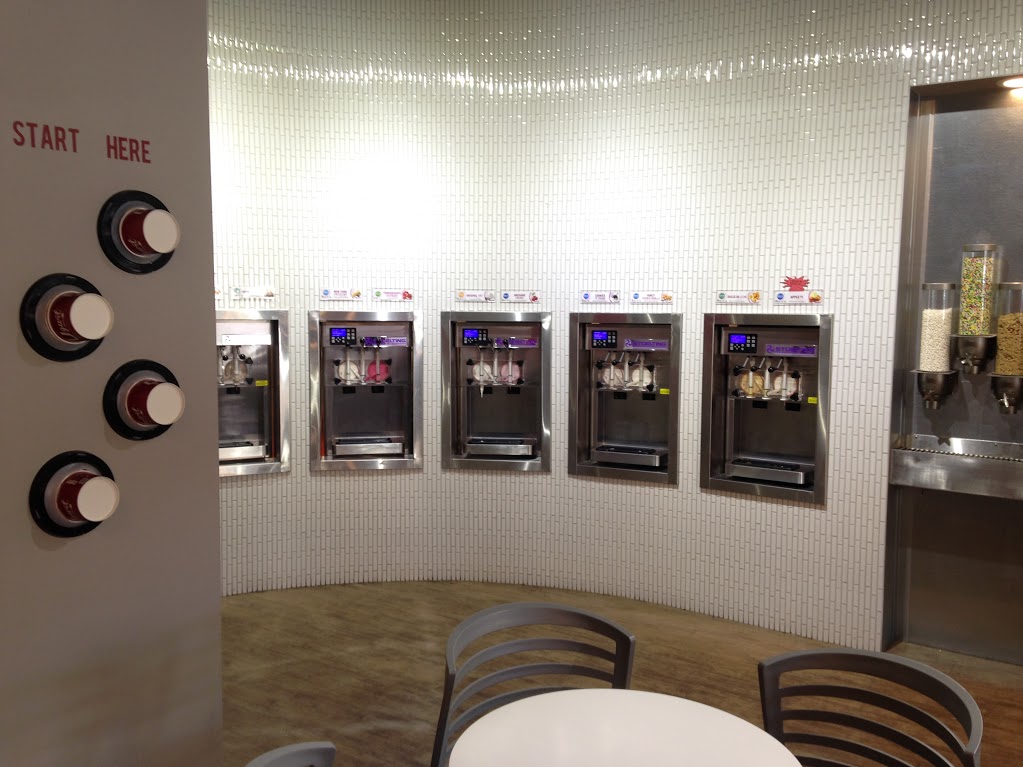
Customers take their cup and begin filling it with yogurts and toppings as they make their way through the line.

Customers take their cup and begin filling it with yogurts and toppings as they make their way through the line.

“We can market directly to campus, with the fraternities and sororities,” Adam Webster said, while accompanied by his wife Paola. “This month and next month we’re going to be doing a lot of philanthropy nights. So they will be coming over here and 20 percent of what they purchase will be given straight to whatever cause they are working for at the time.”

Neither of the brothers had previous experience in running a business. In fact, Adam is a student at the U, working toward his masters in International Studies. Being new to the small-business world didn’t deter them from opening Ugurt in October 2013. The entire family pitched in to help get the business up and running.

The Websters work hard to create a great environment for their customers and employees alike. While providing flexible work hours and a solid payroll, they aim to hire students because they want to cater to all aspects of the college life. The Websters understand what it’s like to be a working college student, so providing a job that is located on campus is quite convenient.

Kassidy Samuels, an employee at Ugurt, agrees that it is a great business to be involved in.

“I love working for Ugurt. It’s so fun and I love that we’re super associated with the U,” she said. “I’m on the dance team, so I get to really see how they cater to athletics, the spirit squad and marketing and all that. They really try to support the U as much as possible and vice versa. It’s such a great atmosphere and that’s why I have been here since they opened.”

Most of Ugurt’s success originates from the owners’ passion to provide the best experience possible for their customers. Ugurt can easily cater to students’ needs because it is open until midnight and offers free Wi-Fi. This gives plenty of options for students, whether it is a place to host late-night study sessions, socialize with friends or satisfy those late-night munchies.
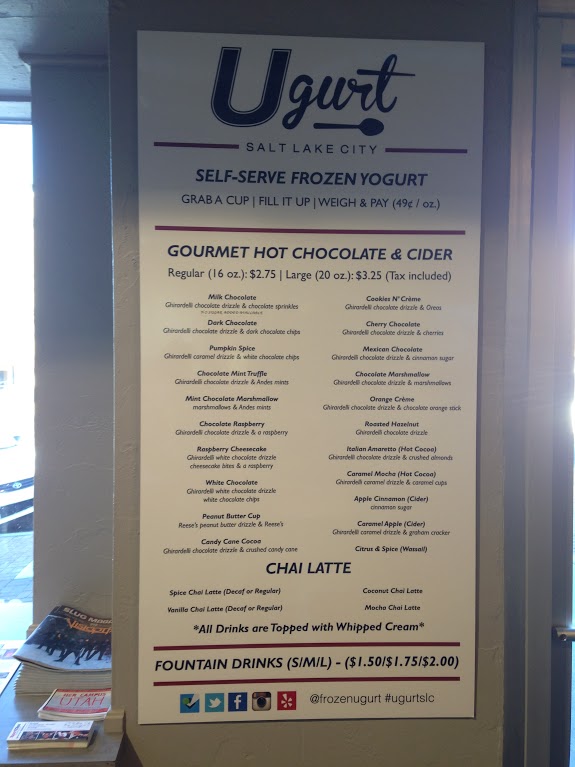
Ugurt's menu lists many different options other than frozen yogurt treats.

Ugurt’s menu lists many different options other than frozen yogurt treats.

Compared to franchises, local businesses do not have that automatic public awareness of the new products, which can make starting a brand-new business really difficult. Marketing wise, the Websters believed it would be a good idea to incorporate as many local events into their business as possible, such as weddings, banquets and school and sporting events. Social media’s role in advertising and promoting has led to improved interaction with their customers and the University of Utah student body as well.

“We’ve worked (catered) at Crimson rally and Crimson Night,” Samuels said. “We have posters set up around campus all the time. We really try to keep a super open environment and make it feel like everyone’s welcome.”

The environment of Ugurt alone has brought in a lot of customers, but their new promotions continue to bring in new people every week. All thanks to the Websters’ new promotion of “Light the U.”  This season, customers get buy-one-get-one-free on cups of frozen yogurt every time the Utes basketball and gymnastics teams win. It has benefitted Ugurt because it encourages customers to come in and buy their product even during the wintertime when frozen desserts aren’t as appealing.

“This last week there was a home game and a lot of people came over and took advantage of the buy-one-get-one-free promotion,” Adam Webster said. “Not to mention it has brought us a ton more business.”

Ugurt attracts its customers with a wide range of yogurt flavors, toppings and gourmet hot beverages. The frozen yogurt flavors rarely change, which is why cookies ‘n’ cream, raspberry/pomegranate, peanut butter and cake batter tend to be the most popular. With the variety of flavors and toppings, Ugurt gives customers freedom to choose. At 49 cents an ounce, chocolate addicts and fruit fanatics can fill their cup however they want.

The display of toppings allows customers to choose however much they want and whatever they want.

The display of toppings allows customers to choose however much they want and whatever they want.

The owners purchase their frozen yogurt and most of their toppings from U.S. Foods and their fresh fruit from local markets. The hot chocolate is bought locally from Stephen’s Gourmet Hot Cocoa. Their hot chocolate bar adds a nice twist to the Ugurt menu, and is a clever way to keep business steady during the winter.

The Webster family hopes to expand their company to other areas in the near future. Even without business degrees, Adam and Sam Webster are successfully running Ugurt and just took over management of the Hokulia Hawaiian Shaved Ice franchise in Utah.

“It’s basically the best shaved ice,” Paola Webster said. “They just have such a following because it’s so different; it’s like the thinnest, lightest shaved ice with ice cream in the middle. We were super fans way before we even knew it would be a possibility to acquire them. So Hokulia Hawaiian shaved ice will be another thing Ugurt, as a company, will work on this summer.”

Chili Beak, adding some spice to the community

Story and photos by DAVID FISHER

Sometimes food just needs an extra kick. Additional flavors and heat can make what was once bland, become a brand-new taste full of extra zing and spice.

Giselle and Jason McClure of Salt Lake City have concocted an original flavor booster known as chili oil. The McClures create the chili oil in their own basement, only to later be distributed to 22 different locations in the Salt Lake Valley available for purchase. Their concoction prompted them to start their own business, Chili Beak.

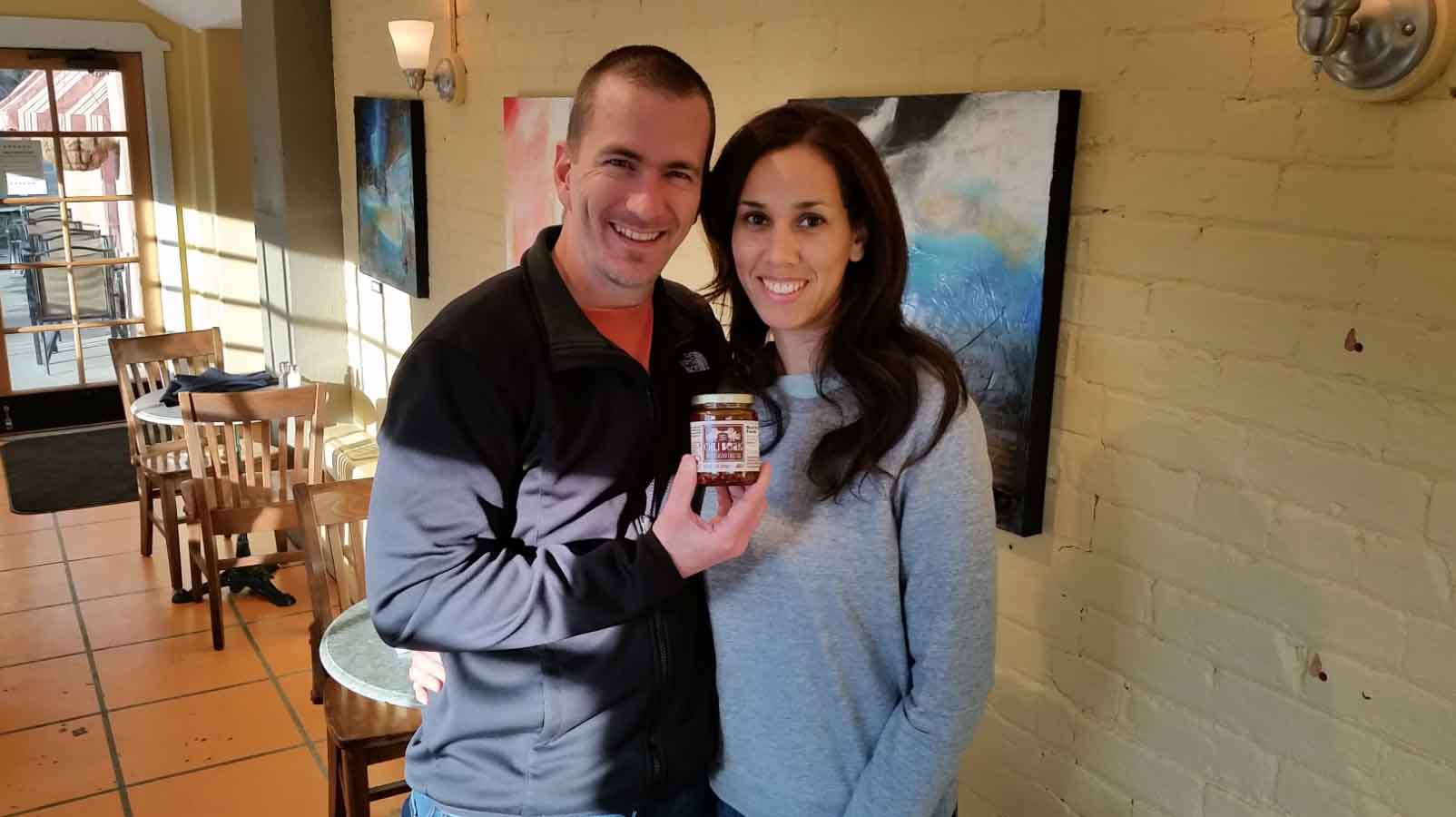
Giselle and Jason McClure show off their latest flavor of Chili Beak.

Giselle and Jason McClure show off their latest flavor of Chili Beak.

Unlike hot sauces and salsas, tomato and vinegar is not added to create chili oil. It is a unique blend of a variety of chili peppers with oil and other spices. The main pepper that is used is called chile de arbol, which means bird’s beak chili. This is where the name Chili Beak came from. It is a completely unique product which the McClures ultimate long-term goal is to see on tables at many restaurants as a replacement to Sriracha.

Chili oil is the ultimate condiment. It can be added to everything from eggs, soups, brownies, and even popcorn. Simply just stir it with a spoon, and scoop it onto food. Its smooth consistency and natural ingredients create a unique flavor that does not upset the stomach. No preservatives are added, and all ingredients are all-natural. It can be used as a marinade, mix in, or even added into recipes to create original new flavors. The flavor of chili oil will be felt first, and then a subtle heat begins to creep into the taste buds.

While visiting Giselle’s family in Mexico years ago, the McClures discovered chili oil. They could not find any product like it in Salt Lake City, so they decided to make it themselves as amateur chefs. After seven months of constant trial and error, and a multitude of coughs and sneezes, they created the perfect mixture.

They considered it better than the recipe they tried in Mexico because of an added smoky flavor. The smokiness is created with a lack of sugar and ginger. This was something different that needed to be experienced by people of the United States. Even Giselle’s family in Mexico was requesting that they have their own to share with their friends and family.

“This would be more than just a food company,” Jason said. “This would be a people company. As a company it is about family and community. We want to bring people together and have fun with it.”

Chili oil is meant to be stirred and served with a spoon.

Chili oil is meant to be stirred and served with a spoon.

Food connects people, creates conversation and promotes new communities. Giselle explains, “If I can share food with somebody, I am happier.”

Only having started their business in August 2014, Chili Beak has expanded tremendously through word of mouth and social media. A Facebook, Twitter and even an Instagram page have been created to promote the business. The McClures wanted to create a responsive community in which people get involved with Chili Beak digitally. This is what began the creatively catchy “Let me Spoon You” campaign, which is named after the unique way to prepare chili oil.

Through social media, and using the hashtag SpoonYourFriends, families are showing how they are using and preparing Chili Beak in their foods. This creates an interactive experience in which creative ideas to use chili oil are shared on Twitter, Facebook and Instagram. It was through this that the ingenious idea of using chili oil on top of vanilla ice cream was discovered by a customer.

For Valentine’s Day, the #SpoonYourValentine campaign was created to share how people were preparing meals for their loved ones with Chili Beak. Chili Beak has created a community for all to get involved with, and has inspired the McClures to want to create a chili oil recipe book based on the inventive recipes customers have shared.

All ingredients that are used to make the chili oil that Chili Beak produces are bought from local businesses within Utah. For example, the salt used within the oil is bought from Utah’s Redmond Real Salt. Local businesses are their own community, and they do whatever it takes to help each other out.

People share their recipes online, such as this mango chutney made with Chili Beak.

People share their recipes online, such as this mango chutney made with Chili Beak.

Kristen Lavelett, executive director of Local First Utah, explains that “locally-owned business create personal stability because of the relationships we build with people. It’s another way to love your neighbors.”

While sampling Chili Beak at farmers markets in the area, the McClures use locally-produced chips and chocolate from Hatch Family Chocolates. The chili oil is added to things like hummus and ranch dressing for people to taste. It’s a challenge when people ask about the hummus and ranch, and not the chili oil itself. The chili oil is what creates the unique spicy flavor to the condiments. But, the McClures enjoy promoting a product that is different to a local community. It is a matter of experimentation to truly discover the one-of-a-kind flavor chili oil produces.

“We love doing this because we truly enjoy it,” Giselle said. “We committed ourselves to something different. We want to inspire people to do more with chili oil. If we can have fun with it and get the community involved, that is a plus.”

Unique, local restaurants bring cultural value to Utah

Story and slideshow by William Phifer III

This slideshow requires JavaScript.

In Layton, Utah, there is a strip of real-estate running along the east side of Interstate 15 that the locals call “restaurant row.” Littered with a copious amount of national chains, the area also has a few unique, local restaurants that bring an irreplaceable cultural value to the community.

Corbin’s Grille is one of those restaurants. Located at 748 W. Heritage Park Blvd., Corbin’s is a family-owned business that is operated by Jake Garn, whose father is the landlord of the location. Since its opening in 2006, Garn has learned a lot about running a small local restaurant.

“I’ve learned that appreciating the local food, instead of chains, isn’t something that comes automatically to most Utahns,” he said in a phone interview.

However, as time has progressed and people have learned about Corbin’s Grille, Garn said, “I’d like to think everyone is starting to appreciate the value of local flavor a little bit more.”

Garn said his favorite way to make the restaurant a unique place for patrons is by “bringing something that’s a local creation – something people out of town can try and look forward to.”

To help him consistently achieve this goal, Garn appointed Jimbo Snarr the executive chef in 2014. Snarr understands that the owners of Corbin’s Grille are looking to provide a unique experience for their customers.

“Our goal is to take good classic dishes that people really like and make them classy and higher-end,” Snarr said.”[To do] this we use a lot of fresh ingredients and we make everything in house.”

One example of a popular dish that is made at Corbin’s Grille is the spinach artichoke dip. While almost every restaurant has its own variation of this common appetizer, Snarr said most receive it pre-made and frozen from other vendors. Unsatisfied with any of those inexpensive variations, Snarr said that Corbin’s Grille preps its spinach artichoke dip in-house using fresh ingredients.

Another popular dish at Corbin’s Grille is the lemon asparagus salmon, created at the restaurant during a cooking competition among the cooks. The fresh sushi-grade king salmon is pan-seared in a sauce consisting of white wine, lemon juice, fresh tomatoes, asparagus and other ingredients. This particular salmon dish is one of three offered at Corbin’s Grille and it is the only one that is not cooked over a wood fire grill.

Chefs utilize a white almond wood fire to grill everything from steak, seafood, chicken and burgers, to asparagus and lemon wedges, which are used on seafood dishes. Snarr said the intense heat sears the edges of the steak and really locks in the flavors and juices.

While the food itself is a unique part of Corbin’s Grille, Snarr says that is just part of what makes eating there a distinctive dining experience. Snarr believes the open kitchen and experienced staff also create an inviting atmosphere for the clientele.

“We’re an open book, come on in. We have an open kitchen. Anybody can walk up,” Snarr said, “and watch my guys cook. We do it proper, we do it right … and everybody can see it and know it. I think that’s what makes us popular.”

In the spirit of transparency, Corbin’s Grille does cooking demonstrations where restaurant management share their recipes and techniques. Snarr said some people don’t understand why they are divulging “restaurant secrets” and giving people the tools to make their dishes at home.

In his experience, Snarr said, “People are still going to come to us when they don’t want to cook, because they still like to come out” and have a fine dining experience.

Anthony Lella also recognizes the value of unique restaurants, which is why he is entertaining the idea of opening his own Italian restaurant in the Ogden area.

Lella, formerly the general manager of Iggy’s Sports Grill in Layton, is from a family with strong Italian roots.

He has identified a lack of quality Italian restaurants in the northern Utah area. He also has recognized an increasing trend toward homemade food and cultural culinary diversity.

Recalling a visit to Utah years before he moved to Ogden, Lella said he went out to eat with someone who had never eaten prosciutto, which is an Italian cured ham.

“I was so shocked that this grown woman had no idea what this was, that I’d been eating all my life,” Lella said. “So I think things like that, specialty markets, are just emerging in Utah.”

Lella has considerable experience working in restaurant management, both in and out of state, and knows that location is a key factor in making a restaurant unique.

“If there’s anything I’ve learned about running a restaurant the last 13 years – location is key,” Lella said. “Think about where you’re at now [and] what has the opportunity to be there in five years.” If someone else builds a similar, competitive restaurant right across the street, he said both restaurants can lose their unique quality.

Lella has been searching for an ideal restaurant location in the Davis County area to bring authentic Italian food and culture to the beehive state.

He already has a clear vision of what the menu will include: four different risotto dishes, homemade fettuccine and gnocchi. He has also considered making his own sausage, meatballs, mozzarella and ricotta.

Like management at Corbin’s Grille, Lella is eager to provide a unique venue where patrons can enjoy fresh food made in-house.

My ride-along with Meals on Wheels

Story and slideshow by IAN SMITH

Experience the ride-along as we delivered meals to about 70 homes.


From the moment I hopped into the truck I knew I was in for more than I could have ever expected. I saw the route list. I saw the 70-plus houses that I was going to have to visit. I was excited about the journey I was about to embark on.

The emotions that I would feel throughout the day were making me shake. It wasn’t the feeling of fear, however, more of just a heightened sense of things.

The Salt Lake County Meals on Wheels program was the right choice for me to bring out my emotions on paper. The program itself has an eligibility that older adults must meet to become part of the program.

I walked downstairs and met my driver for the day, John Neerings. I quickly noticed his big smile. It put me at ease. Usually there is some tension between two people when they first meet, but that feeling was nowhere to be found when I was with him.

Of course, we took our time so he could show me exactly where all the meals are cooked and processed. He began walking around the kitchen, which is in the basement of the south county building on 2001 S. State St. I was surprised to see how fast all the employees and volunteers worked.

Meals were taken to different trucks, which were outfitted with a refrigerator and a warming oven. Drivers then quickly left on their routes.

Neerings showed me how the holding section of his truck worked. He had controls by the steering wheel that regulated the temperature.

We got everything ready and it was time for my ride-along. He packed me a Coke and muffins for the ride.

Vital to the community

Jeremy Hart, the independent aging program manager of Salt Lake County Aging and Adult Services, said he realized how important the program is to the community once he experienced a ride-along for himself.

In a phone interview, he talked about how vital the meals are for people’s overall health. He told me that the recipients get one-third of their required dietary intake with the meal they get daily.

Hart said the program is growing quickly. Meals on Wheels delivers 1,300 meals per day and currently has around 1,500 clients. In 2013, he said, 330,000 meals — 11,000 more than the previous year — were delivered in Salt Lake County alone.

The volunteer support is substantial. One-third of the drivers who deliver the meals are volunteers. Hart said having them is important to the community and keeps the program from having to start a waiting list for clients.

“The senior population is going to be expanding exponentially by 2020,” he said. “Really soon you’ll have more seniors than you’ll have school-aged kids.”

Meals on Wheels is “a godsend”

As we pulled out of the parking lot, I asked Neerings how he likes his job. The response was more than I had imagined.

“I do love the clients,” he said. “I do care about them. I feel like I’ve got 80 grandmas. I love the job and the people and it gets me exercise.”

Neerings said he enjoys being that “sparkle in their eyes.” That is what motivates him to get going every day — so much so that one of his clients told him the same happy story for about a month straight.

I could see in his eyes that he was struggling when the topic of death was mentioned. I asked if he has many instances of clients who die. He said it happens too often.

I asked Neerings about negative events he’s been through. When he related a few troubling stories, I knew I was in for a long day of emotions.

One client fell during the night and broke her hip. She was unable to reach her phone, so she lay on the floor for hours. Neerings found her in the morning when he brought her a meal. He said he had trouble sleeping for weeks because of it.

Our route took us to places around the city that I didn’t even know were there. Some places I’d like to forget; others were really nice and clean.

One stop after another, we checked homes off the delivery list. We often stayed for longer visits with clients.

June Poulton, 86, who lives near Highland High School, called Meals on Wheels “a godsend.”

“They are the most wonderful people,” she said. “The treat you with respect. They are so comfortable and the food is always so good.”

After visiting about 20 more houses, we talked with Ruth Newbold, 89. She said the food is very good and nutritious and that every once in a while, the driver brings her a treat just to be polite.

Many of the older adults we talked with were very emotional. For example, a woman named Beth was in tears because her son was having some health problems. She looked so lonely. Neerings tried to help her, but there wasn’t that much he could do.

We got back into the truck and an urge to cry came over me. Neerings said he has dealt with instances like that in the past and it is never really easy for him to handle.

“They unload on you when you get there,” he said. “They just need someone to talk to.” He said that Beth was one of the stronger women whom we would be seeing all day.

Neerings also has to deal with frightening situations. Toward the end of the ride, we drove through one of the roughest neighborhoods I’ve ever seen in Utah. As we pulled up to a motel, I was shocked by the awful conditions that Neerings faces weekly. But, he still stopped and said hello to everyone.

As the ride came to an end, he told me about some of his clients who have made him appreciate his job and his health. Neerings, who is 74,  looked forward to returning to the county building in the morning and starting all over again.

Mahider Ethiopian Restaurant and Market offers a taste from Africa

Story and photos by DANEALLE PLASCENCIA

What is your first reaction when you hear that Salt Lake City offers food directly from Africa? Probably the answer would be, that is impossible.

Next you might wonder how food from another continent tastes and what the principal ingredients are.

Salt Lake City offers an extensive variety of unique restaurants, especially in close proximity to one and other in the downtown area.

The number and location are the main attraction for some visitors.

Most of these restaurants are owned by local residents who have emigrated from their home town to look for better business opportunities in the Salt Lake  Valley.

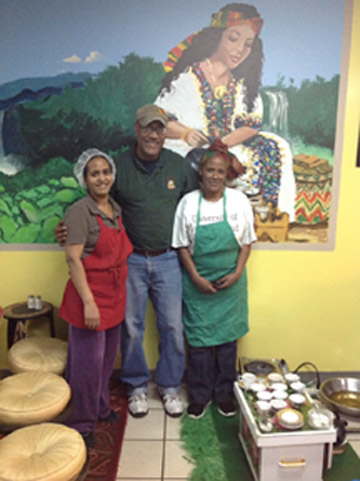
Sleshi Tadesse (center)

Sleshi Tadesse (center) with his cooks.

Such is the case with Sleshi Tadesse, who is a resident of Salt Lake City and the owner of Mahider Ethiopian Restaurant  and Market located at 1465 S. State St.

He emigrated from Ethiopia, Africa, 14 years ago to come to the United States because of personal desires.

First he lived in Los Angeles for a couple of years, and then he decided to move to Salt Lake City to go to school and find better life opportunities.

Tadesse got a bachelor’s degree in computer science from Weber State University.

After working in his career field, and getting laid off too many times, he decided to create his own business and experience something different from what he studied.

He started the project in fall 2011, with a small market with products imported directly from Africa, including the basic spices, meats, natural juices and traditional artifacts.

After some time, he realized that he needed something else to make his business more successful and attractive for the community.

That is how he started an addition for his market.

The project Tadesse had in mind was to create an Ethiopian restaurant in addition to his African market with traditional dishes.

After being just a draft idea, it became his own project that he named Mahider Ethiopian Restaurant and Market.

Now Tedesse is the owner of the first Ethiopian restaurant in Salt Lake City.

His restaurant represents some of the oldest dishes in the world that were created in Ethiopia, and recipes from his family back in Africa.

photo(2)

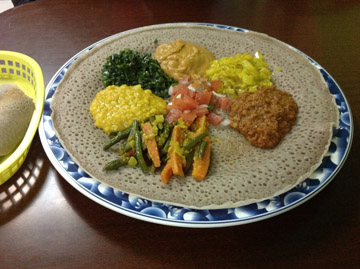
The flat bread vegetarian platter features a corn puree, green beans and carrots.

Mahider offers a variety of entrees made of beef, chicken and vegetarian delights made with collard greens, cabbage, split peas and lentils. The restaurant also offers salads as well as beers from Ethiopia.

Ljubisa Mijatovic, a first-time customer, said, “I am vegetarian, and I’m really surprised of all the vegetarian options that this restaurant offers, especially the veggie platter which is great.”

Herbs and spices are imported from Ethiopia to make the traditional flavor come out from the dishes and allow customers to have authentic African food.

Tradition is an important part of Mahider’s restaurant.

It encourages customers to eat the traditional flatbread and other dishes with their hands as is done in Ethiopia. Of course, utensils are provided in case that gets too complicated.

The famous Ethiopian flat bread is made of indigenous grain called “teff,” which is one of the oldest grains on Earth and makes interesting and unique flat bread.

Another important tradition and example of Ethiopian hospitality that Mahider’s Restaurant and Market offers are the coffee ceremonies. They are an integral part of Ethiopia’s social and cultural life, which describes how close the culture is.

These ceremonies consist of having home-roasted Ethiopian beans, and making fresh coffee.

“Coffee has social value in our society and is deep rooted in our culture,” Tedesse said.

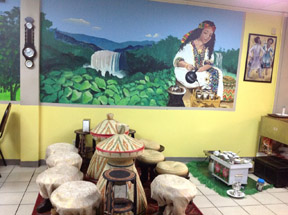
This is made right in front of the customer and is designed to share with family and friends in front of an interesting background. Short stools are decorated with different kinds of fabric and some of them are carved from wood.

The coffee ceremony is a mark of friendship or respect for the African community, and the ceremony can go for at least a couple of hours, depending on the customer’s time and ability.

Coffee ceremony  arrangements

The restaurant offers a unique space for the coffee ceremony.

“Experiencing the coffee ceremony is a plus of this restaurant. Besides sharing great dishes with your family, you get to enjoy coffee, and have a great conversation,” Mijatovic said.

Culture and community acceptance is really important for Tedesse, and he is really happy that the community has accepted well his traditional food and customs, which was the reaction that he was looking for.

Mahider Restaurant and Market has become increasingly popular with Salt Lake City residents, and customers who have tried the food have posted good  reviews on Urbanspoon.

“The business is going pretty good, especially Friday, Saturday and Sundays,” Tadesse said.

Mahider Restaurant and Market is open Monday through Thursday from 10 a.m. to 10 p.m., and weekends from 10 a.m. to 11 p.m. For more information call (801) 975-1111.

Utah becoming the new frontier for booming black-owned businesses

Story and photo by TALON CHAPPELL

Cold, conservative, culturally closed, homogenous.

For many outsiders, these are the words used to describe the state of Utah and its values. But steadily, more and more diversity has moved within Utah’s borders.

The increasing job market has given birth to a new pilgrimage to the state, one vastly different than the one Brigham Young and his Mormon followers made some generations ago. It’s bringing a new wave of African Americans and their families who have uprooted their lives from the other side of the country, and have settled down in the Salt Lake Valley, eagerly attempting to start a new life, but simultaneously maintaining their Southern roots.

According to the 2010 U.S. Census, the African American population in Utah is at 1.3 percent, which is up 65.9 percent from the 2000 Census that listed the African American population at 0.8 percent. A major cause of the increase was Hurricane Katrina and relocation efforts in 2005. According to ABC News, nearly 600 evacuees were brought to Salt Lake City in the wake of Katrina.

The entire state saw a 23.8 percent increase in total population, which many believe to be a sign of Utah’s economic growth in times of dismal economic decline. According to Forbes.com, the employment growth average for the state of Utah is 0.6 percent per year, which differs drastically from the national average of -0.6 percent per year. This and many other reasons led to Forbes.com listing Utah as the best state for business for the third consecutive year.

James Jackson III is the founder and executive director of ACCEL (African-Americans Advancing in Commerce Community Education & Leadership). He is a firm believer that Utah’s increasing African American population is due to the state’s growing job market. “Most of them move [to Utah] because of a job,” said Jackson about African Americans moving from the other side of the country.

Jackson and ACCEL  have helped numerous black-owned small businesses in the greater Salt Lake area by offering members greater networking resources, financial guidance and emotional support from other members. Moving companies, catering companies, physical therapists, network marketing, financial services, barbershops and restaurants have all been opened by African American citizens and are aided by ACCEL. “The ethnic community is very tight … and the businesses reflect that,” Jackson said.

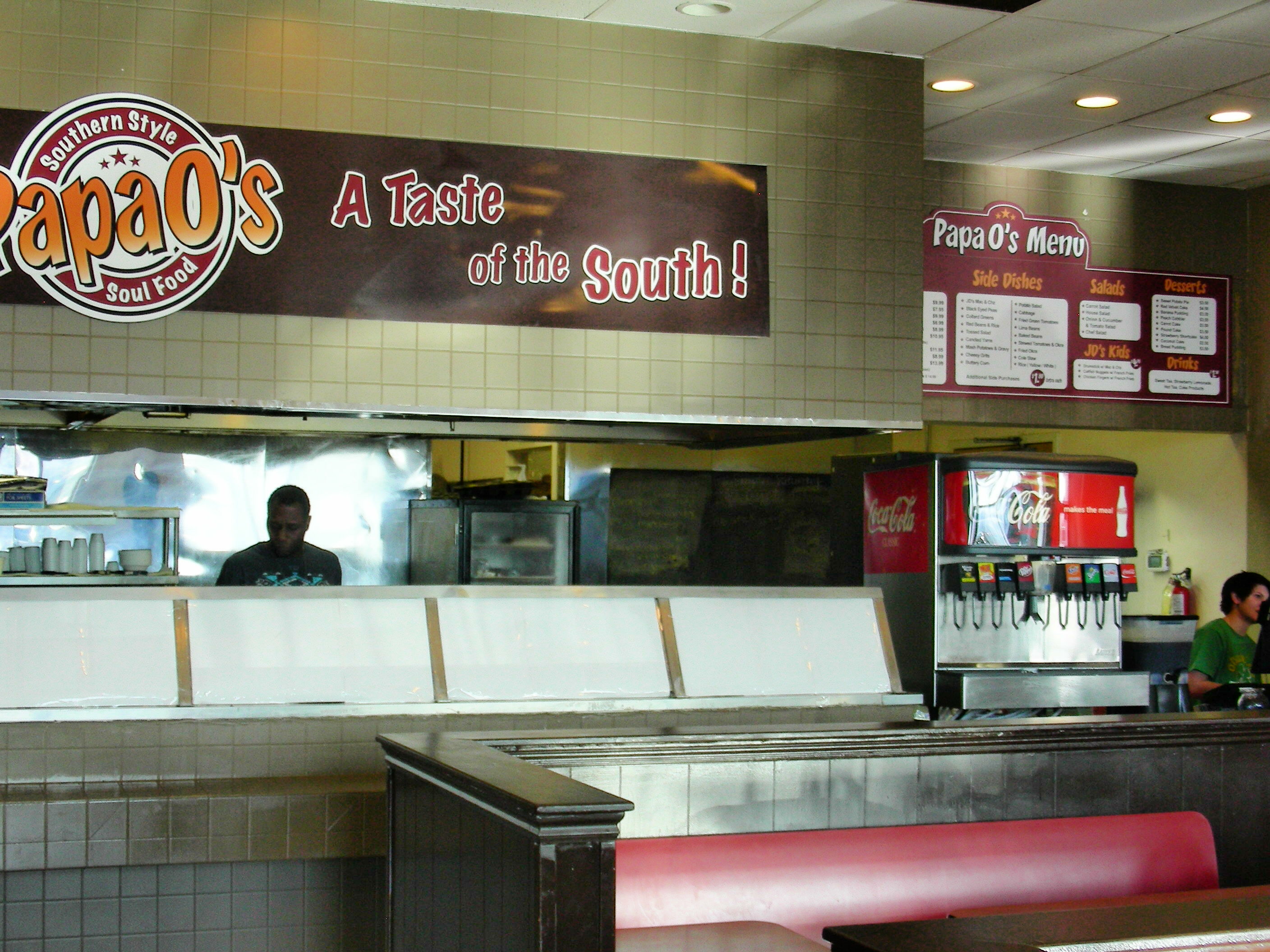
Papa O's Asset for Story 1

Marcus Brinson, part owner of Papa O’s restaurant in Draper, is hard at work in the kitchen. Papa O’s is one of the newest members of ACCEL.

Take a trip down to 11483 South State St. in Draper, and you might as well have driven down to a country kitchen in southern Florida. Papa O’s soul food restaurant is a newer member of ACCEL  and has been offering authentic Southern-style comfort food to Utahns since October 2012. Marcus Brinson is part owner and manager of Papa O’s. He and his family, including four of his seven children, moved to Utah from Naples, Fla. (near Fort Myers) last September, after his sister, who also lives in Utah, said there was no diversity in the food.

“I was really hesitant,” said Brinson about moving his family from Florida to open a restaurant. Brinson said the business went through a turbulent time when sales would be booming one day and excruciatingly slow the next.

In addition, he said some of his employees were not passionate about the food, or the restaurant’s customers.

“We had some employees that put us in a bad spot,” Brinson said.  “So I made a change.”

He decided to make the restaurant a family affair. His kids clean tables and take orders, he and his sister take turns managing the restaurant, and he even has his mother making all the desserts by hand. All of the restaurant’s dishes are family-kept recipes including juicy fried chicken, smoky barbecue ribs, creamy mashed potatoes and macaroni and cheese, crispy fried okra, and five different kinds of cornbread.

Stanley Ellington, the executive director of the Utah Black Chamber of Commerce frequently attends UBCC meetings at Papa O’s as well as at other black-owned businesses in the greater Salt Lake area. Ellington still thinks the state has a long way to go in reaching racial equality in small business platforms.

“I have discovered there is a great divide between the haves and the have not’s,” Ellington said. “They [African Americans] don’t have the resources that are needed in order to create their business … that’s why I’m in Utah … to be a leader.”

Ellington was born in Alabama and lived in Washington, D.C., both of which are considered hubs for the national African American community. He moved to Utah in 2000 while serving in the Air Force and decided to stay after retiring in 2002. Ellington believes that the number of black-owned businesses listed in the census information is overrepresented. He also believes that several black-owned businesses in Utah have failed due to a lack of knowledge and racial tension within the state.

“People know prejudice is alive and well,” Ellington said. “We’re [UBCC] coming [up] with a solution.”

Overall, the economic future looks bright for all Utahns. As employment rates rise, so too does the state’s diversity.

A report made by the Small Business Administration Office of Advocacy showed that Utah had 241,692 small businesses in 2008, accounting for almost 50 percent of private sector jobs. These numbers are expected to grow after another report by the U.S. Chamber of Commerce listed Utah in its  top-10 economic “Boom States.”

One World Café heightens the food expectations of the non-profit world

This slideshow requires JavaScript.

by Tricia Oliphant

Imagine a menu that offers so much variety it actually changes on a daily basis. You choose your portions and then pay what you are able or what you think your meal was worth. If you do not have money to buy a meal, you can volunteer an hour of your time and eat for free.  Those who serve your food are also the people who helped prepare it, allowing you to find an immediate answer to the age-old question “It looks good, but what’s in it?”

Sounds too good to be true, right?

Such is the organization of One World Café, a non-profit community café in downtown Salt Lake City.

Denise Cerreta founded One World Café in 2003. It is now part of several non-profit cafés nationwide that make up the One World Everybody Eats Foundation. The café provides delicious, healthy meals to all who desire to eat, regardless of their financial situation.

When I heard about this revolutionary idea of choosing my portions and what I wanted to pay for them, I was curious about how it worked. I decided to give it a try with a friend.

Upon entering the café, we immediately noticed the friendly atmosphere. We were greeted kindly by one of the cooks/servers who directed us to choose our plate size. Although we were only required to pay what we deemed fair, we did see price suggestions according to the size of plate written on a blackboard (small: $4 to $6, medium: $7 to $9, large: $10 to $12.)

Our server then described each of the dishes laid out in front of us, buffet style. The main dishes included sweet curry over brown rice, a unique asparagus quiche on a potato crust, and seasoned beef bursting with flavor.

An assortment of fresh salads complimented each of the main dishes, including a zesty marinated carrot and cucumber salad, and a wild rice salad with celery and tomato.

We tried a bit of everything. We also chose a drink from a selection of coffee, tea, soymilk, almond milk, or water.

The One World Café offers a cozy, “feel like you’re eating in your mother’s dining room” atmosphere.  Each of several dining rooms contains only a couple of dining tables to provide a sense of privacy. A patio in front allows for dining al fresco.
In addition to the warm, inviting atmosphere and the plethora of food and dining options, the food itself at One World Café was simply succulent and mouthwatering. The ingredients were clearly fresh. Most were organic.

“I believe in getting food as close to the source as possible,” One World Café manager David Spittler said.

Sunflower Farmers Market donates many of the ingredients used at One World Café.  The café also participates in Community Supported Agriculture (CSA), where a monthly fee is paid to a local farm for its fresh produce.

Spittler became an advocate of fresh, organic food while he worked on a peach farm after high school.  The peaches they shipped to places such as Wal-Mart, Spittler said, were picked while they were still green, thus robbing the produce of many vital nutrients.

Using several of their favorite cookbooks, Spittler and a group of regular volunteers decide how to use the fresh ingredients as they prepare a weekly menu — about a week in advance.

“We try to make the menu as friendly to everyone as possible,” he said.

“My favorite cold dish was the Cucumber and Carrot Zest,” said customer Lauren Snow on a recent visit. “The ingredients were so simple but it had so much flavor, and it’s something I can make at home.”

One other point in One World’s favor: very little food at the café goes to waste. Because customers choose their portion sizes, they eat most of their food.

Furthermore, the food that is left over at the end of the day, such as salads, can often be reused in another dish the following day. Although the hot dishes are not reheated, Spittler said, they are often reused in a soup. Any leftover waste is recycled as compost.

One World’s kitchen is small, but out in the open for all to see.  Customers can watch their meals being cooked. With only one six-burner stove in operation, something is always cooking.

“We can’t prepare large quantities [of food] at one time,” said volunteer Isaac Hoppe. “This is a good thing because it’s fresh.”

Whether you’re looking for a pleasant dining atmosphere, a delicious variety of well-prepared dishes, or would simply like to help feed the hungry of Salt Lake City, the One World Café has something for everyone.

One World Café

41 S 300 East, Salt Lake City, UT 84111

Hours: Wed -Sun, 8 a.m. -7 p.m.; Fri –Sat, 8 a.m. -9 p.m.

Phone: 801-519 – 2002519- 2002

###

https://docs.google.com/presentation/pub?id=1VmCCD4YaEfZgTKii2zE8Y05ysQrLDltQH62rw_XFxUk&start=false&loop=false&delayms=3000

City Creek Center opening brings thousands to downtown Salt Lake City

This slideshow requires JavaScript.

by Tricia Oliphant

Crowds lined the walkway. Parents gripped the hands of their squirming children, who were eager to run off and explore. The shutters of cameras repeatedly clicked.

In one corner a musician put his soul into playing the blues on his saxophone.  In another, musician and performer Steven Sharp Nelson of The Piano Guys entertained a crowd with playful tunes on his cello. The laughter of a nearby group of adolescents resonated as they talked about their plans and what they wanted to see first.

That overflowing excitement most often only theme parks can create filled the masses swarming downtown for the opening of Salt Lake City’s first downtown mall in three decades.

City Creek Center opened on Thursday, Mar. 22, 2012. Like many others, I was drawn to the novelty and newness of City Creek. I decided I had to join thousands of others in visiting City Creek on its opening day so I could answer the question posed by a dear friend of mine, “Is it really as big a deal as it has been made out to be?”

Although City Creek offers ample parking in a giant, heated three-level underground parking garage, I chose to take the TRAX (Utah’s light rail system) to the new shopping center.  In spite of the train being loaded with anxious shoppers of all ages who were also heading for the mall, I thought it offered the convenience of not fighting downtown traffic or hunting for a parking place.

City Creek Shopping Center was funded entirely by cash reserves of the LDS Church and built on three church-owned blocks in downtown Salt Lake City. A sky bridge over Main Street connects two of the blocks and allows shoppers on the second level of the center to cross from one side to the other.

Upon arrival, I was impressed by the classy architecture and design of City Creek Center. I quickly realized this wasn’t just any ordinary mall when I noticed the glass roof is actually retractable. City Creek opens the roof when the weather is just right, providing a view of the open sky and surrounding skyscrapers.

Along with over 90 stores and restaurants, the shopping center offers a wildlife landscape downtown with the re-creation of the historic City Creek that winds through the shopping center’s walkways and plazas—complete with live fish.

In addition to the creek, the shopping center offers a variety of waterfalls, ponds and fountains (one of which is open to children who would like to cool off while splashing in the choreographed blasts of water.) I found each water feature to be quite beautiful and each added a sense of natural serenity to the busy shopping center.

“Standing at the base of the skyscrapers surrounded by rivers and waterfalls was a striking experience of both outdoors and the big city at the same time,” shopper Matt Argyle said. “It’s really breathtaking.”

Benches and tables rest on the edge of the creek and beside the waterfalls. These provide places to relax and enjoy the peaceful atmosphere.

Some believe the quality of the food court can often make or break a shopping center.  City Creek’s food court is nothing to scoff at.

The massive food court is located next to the creek and a waterfall. Diners can eat inside (with many of the tables located next to giant windows in front of the water features) or can dine al fresco.  Both options offer a relaxing place to eat.

The food court is made up of everything from Subway to the Taste of Red Iguana to the Great Steak and Potato Company. Other restaurants, such as The Cheesecake Factory and Texas de Brazil Churrascaria, are also located in the shopping center.

By wandering through City Creek Shopping Center, it soon became clear that people came for much more than shopping and spending. This was a public event, a place for relaxing and enjoyment with friends and family. While taking all this in, I wondered about the future of City Creek and its potential impact on surrounding malls (such as The Gateway, a mere two blocks to the west).

Although City Creek attracted large numbers of people opening weekend, The Gateway was not left completely desolate.

“We were actually pretty busy opening weekend,” said Kara Johnson, an employee at Down East Basics, at The Gateway. Down East Basics, a moderately priced casual apparel store, is not duplicated at the new City Creek Center. “I expected it to be dead,” Johnson said.

Despite the crowds of people at City Creek Center opening weekend, many realized the stores at City Creek were more expensive than they had expected. “They came to Gateway because they knew what to expect,” Johnson said.

Unlike The Gateway, City Creek Center is closed on Sundays. This gives the older mall an extra day to attract shoppers and therefore compete with the novelty of the new shopping center.

Furthermore, although some of the stores are duplicated at both shopping centers (such as Forever 21), many are not. This gives a distinct shopping opportunity at each location.

Johnson said that because she has never been to many of the stores now located at City Creek, she would like to go there just to see what they’re like. “I just want to say I’ve been in a Tiffany’s.”

The uniqueness of the new stores to Utah clearly attracted crowds to City Creek Center.  However, many Utahans are known for being “frugal” and “resourceful”. Higher-end stores may not sit so well with a thrifty people.

“I love City Creek. It’s just so nice,” said Jannali Ouzounian, a new mother from Holladay. “I just wish I could afford to shop at all the stores. A wallet at Tiffany’s [costs] $600.”

“I think Utah could do a lot better by bringing in the outlets,” said University of Utah student Kelly Wolfe. She said that putting in stores such as the Tommy Hilfiger Outlet and Bloomingdale’s Outlet would not reduce the classy appeal of City Creek and would attract a greater portion of the Utah market.

Being a bargain hunter myself, I would love to shop at classy outlet stores downtown. However, I find the higher-end stores at City Creek to be alluring.

How long this allure will last remains in question.

“I think once all the hype wears off, City Creek will be just another mall,” said Utah State University student Elise Olsen. However, once all the hype does wear off, Olsen said she plans to shop at City Creek with hopes of finding good sales on high-priced items.

Only time will tell the fate of City Creek Center and whether it will continue attracting large crowds of people to the downtown area. In spite of this, I found City Creek Center to be beautifully constructed and thought it added class to Salt Lake City.

In answer to my friend’s question, City Creek is quite a big deal — for now.

The convenience of college obesity

Story and photos by Blakely Bowers

The United States has the highest obesity rate in the world. Obesity is an issue that reaches far beyond the way someone looks. Medical experts have linked excess weight to everything from heart disease and diabetes to chronic back, hip and knee pain.

According to the U.S. Surgeon General, 74.6 percent of Americans are overweight or obese. For the past decade the rates have risen steadily for Americans of all ages and population groups. The difference between being overweight and obese is determined by a person’s body mass index (BMI). Adults with a BMI between 25 and 29.9 are considered overweight. Adults with a BMI of 30 or higher are considered to be obese. Try calculating your own BMI

Studies performed by the Centers for Disease Control and Prevention show that one in every 50 Americans is obese. This number is significantly higher than it was even five years ago. As the number rises, so do the costs. Chronic obesity costs the individual, but the problem has its impact on others fiscally, as well. “Obesity not only costs the patient a whole lot of extra money, but it costs us as doctors. We spend more time with patients who are overweight. The health issue creates many other issues in which rises the rate of diseases and disorders, which in turn impacts us,” said Dr. Cassandra Quigley.

As the obesity rate increases, so do the rates of obesity-related medical problems. Medical problems such as cardiovascular disease, diabetes, and hypertension affect the cost and availability of insurance benefits, which increase the cost for the average person. The rates also cause government programs to pay enormous amounts for those benefiting from the programs.

The Surgeon General estimates the annual medical costs of obesity are as high as $147 billion. On average, obese people have medical costs that are $1,429 more than medical costs of people of healthy weight. More information regarding the dollar amounts of these medical costs can be found at http://www.cdc.gov/obesity/causes/economics.html

“The increasing amount of obese patients I see, is really getting terrifying,” Quigley said.

“I am learning more details of the personal causes behind this disorder, said Laura Welch, a certified nutritionist and health fitness coach. She graduated from BYU with a degree in nutrition, and has been studying it ever since.

“Most of my clients admit that their issue comes from within. They slowly start feeling bad about themselves and overeating and not exercising is their way of coping. The other major problem underlying obesity is accessibility and convenience to fast food and treats that help pack on the extra pounds.”

We can get online, make an order and wait 15 minutes for our meal to show up at our door. We can drive through the local McDonald’s and have our food within seconds. We have instant macaroni and cheese, instant brownies, instant everything. It has become about convenience and price. Fast foods are always the least healthy, but the least expensive option.

The number of overweight college students has also significantly increased in the past decade. In order to understand the increase, I decided to observe and research the habits of students. College lifestyles have a major influence on obesity. We’ve all heard about the “freshman 15,”, a familiar reference to the standard weight gain new college students typically pack on. Studies have shown that three-quarters of students gain weight their freshman year of college. These students can easily form a habit of overeating and overlooking regular exercise. These habits continue to impact their weight for years to come. Research by science daily.

Some University of Utah students say that “convenience” is the main reason for their unhealthy eating habits. It is hard for students to find the right balance while attending college. In a study performed by researchers at the Mayo Clinic in 2009, researchers found that lack of sleep and skipping breakfast are prominent promoters of obesity among students. A jam-packed school schedule, late nights, early morning lectures and exam cramming leave little room for healthy eating habits. Students often reach for the quickest and cheapest options—fast foods low in nutrients but high in calories, fat, and sugar.

“ I go for whatever is cheapest and fastest during my school breaks. I have all the intentions of eating healthier, but when the time comes I don’t want to spend the extra money, or take the time out of my crazy studying and work schedule to make a healthy option.” Mary Earl, a U freshman said.

Sleep is another factor that affects obesity in college students. When the proper amount of sleep gets cut in half, along with a scattered diet, a body has a hard time sufficiently metabolizing. Students are at the most vulnerable state, and the habits are not a top priority. More sleep and obesity related studies can be found here.

“When healthy food becomes more convenient to pick up and cheaper, that’s when I will start eating healthier during this time in my life. It sounds lazy, but it’s true. Convenience and cost are just the factors that play into these habits for me,” Earl said.

obesity(1)

Chowing down with SuAn Chow, goddess of SLC mobile cuisine

by BILLY YANG

Food trucks have come a long way in recent years. The mobile restaurateurs of today are shedding the “roach coach” moniker and moving toward haute cuisine.

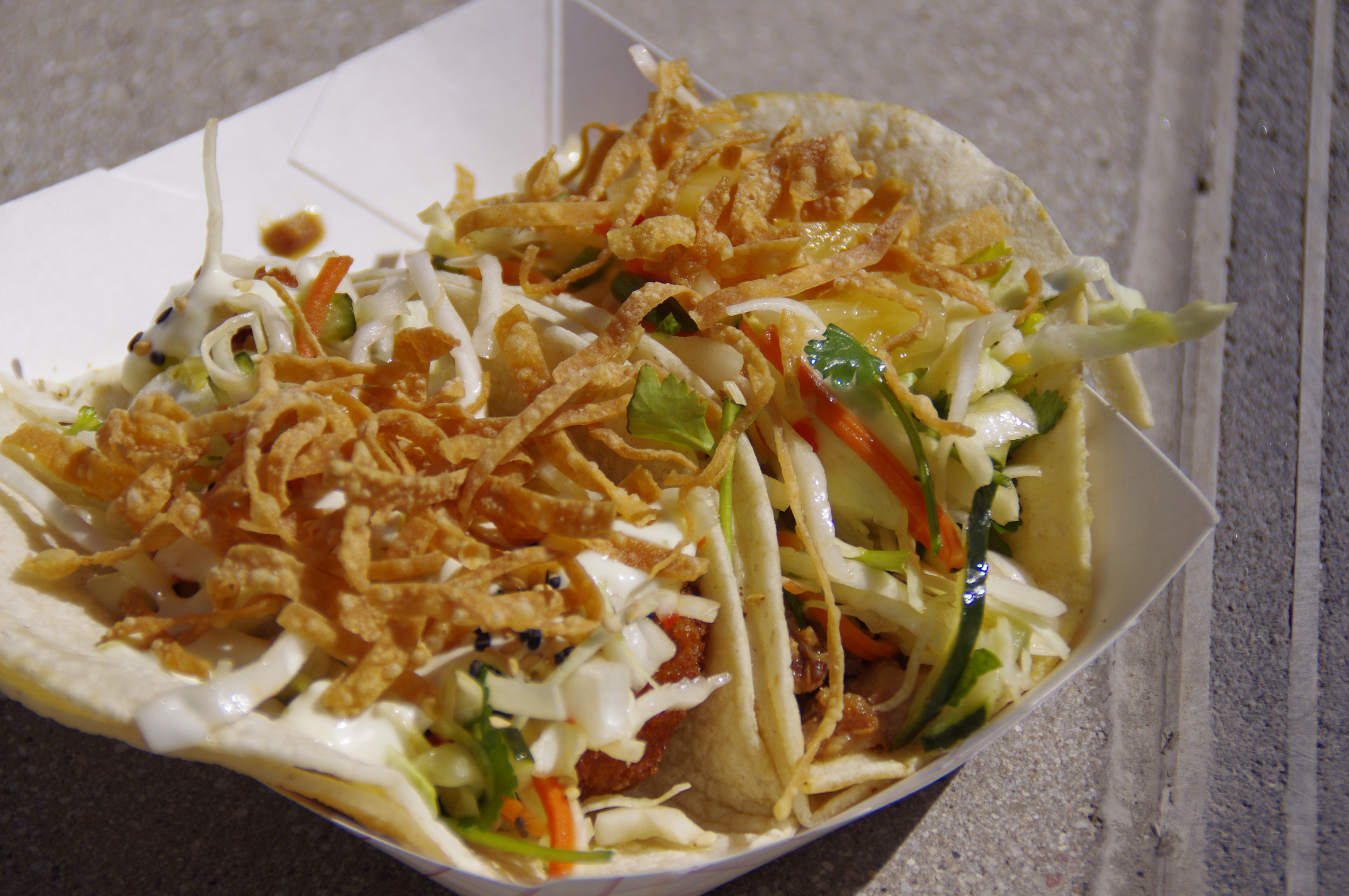
Since 2010, SuAn Chow has been at the forefront of this movement in Salt Lake City with her blazing yellow Chow Truck, where she serves up her unique brand of fusion cuisine. The Chow Truck’s menu includes tacos, sliders and salads infused with flavors from Asia.

“Everyone understands tacos or sliders or salads,” Chow said. “The twist is the actual base, the marinade, the sauces.”

Panko-crusted tofu, coconut lemongrass chicken and pineapple ginger pork are some of the mainstays of the menu, and Chow offers them in the above-mentioned familiar forms.

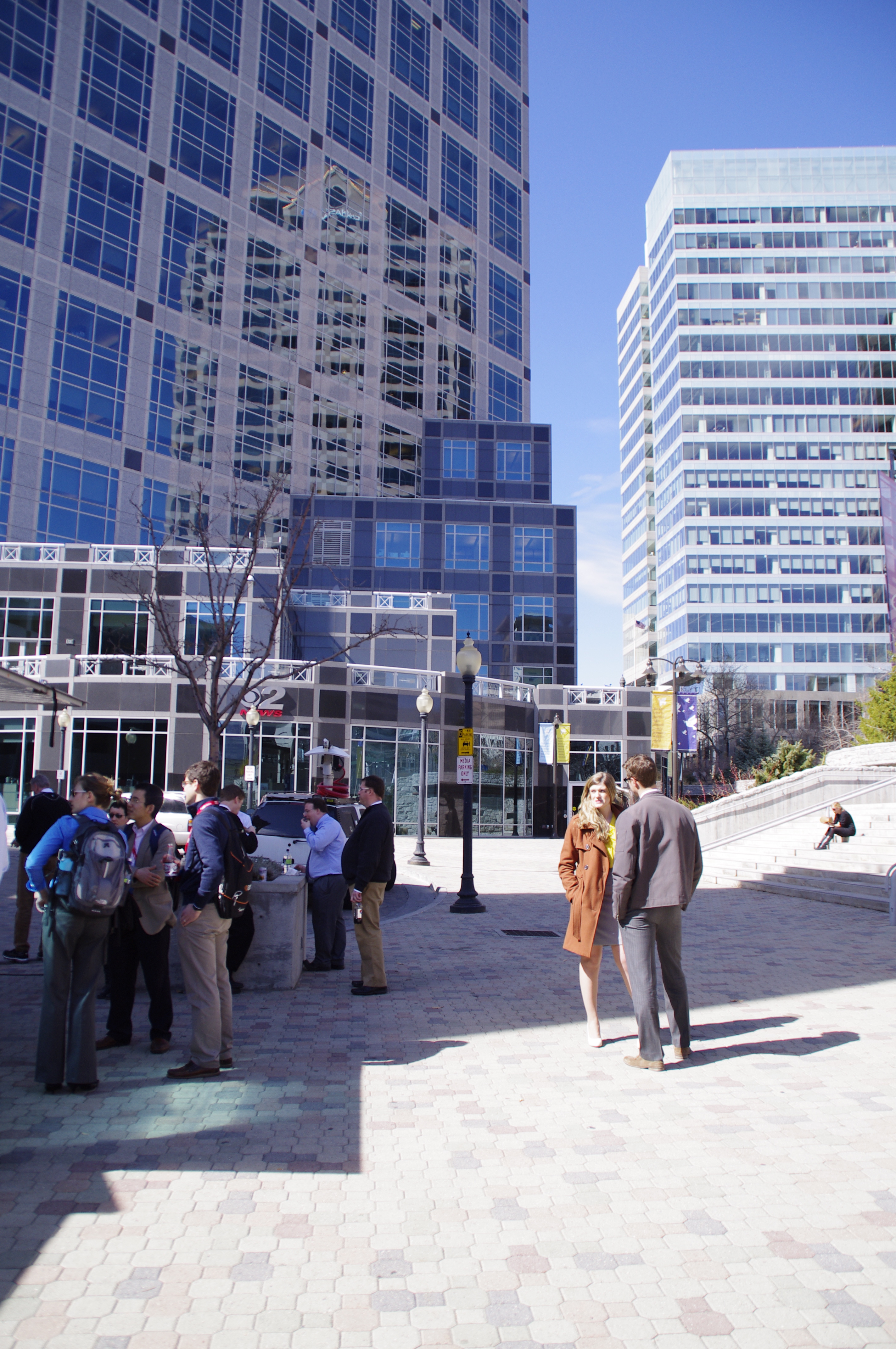
Xiaoyuay Lou, a visitor from New York who was in town for the National Association of Corrosion Engineers (NACE) Conference, stopped by the Chow Truck while parked at its weekly spot at the Gallivan Center in downtown Salt Lake.

“The sliders are really good – they’re delicious,” Lou said.

Chow’s flare for blurring the lines between different regional cuisines must have come from her upbringing.

She is a second-generation Chinese-American, born and raised in Salt Lake City. Growing up, her parents owned a restaurant that featured Polynesian themed décor and a menu with both Chinese and American dishes – similar to the campy Trader Vic’s, a legendary California-based franchise popular in ‘50s and ‘60s.

“On his menu, my father had great American comfort food,” Chow said. “He used to make the best breaded veal cutlets and chicken fried steak and roast turkey.”

These are some of the foods she grew up enjoying because her family spent a lot of time at that restaurant, Chow said.

“I always vowed never to get in the business,” she said. “I saw how hard my parents worked and thought there had to be a better way to make a living.”

But in 1985, she started her own restaurant, Charlie Chow’s, in downtown Salt Lake. It was her way of providing a venue for her father to cook traditional Chinese dishes, which is what he made for the family at home.

“I wanted to rescue my father from his restaurant, which was a dying concept,” Chow said.

She noticed the general public was becoming savvier about food and travel and saw a market for authentic Chinese food in Salt Lake.

“We did black bean mussels and clams. I was the first to offer dim sum as appetizers on the regular menu,” Chow said.

Her father died of colon cancer about a year after the opening of Charlie Chow’s, but she held on to the restaurant until 1993.

After she sold the restaurant, Chow moved to New York to explore new career paths. She was the director of creative services at Joseph Abboud and later sold real estate in Manhattan.

Even during her hiatus from the restaurant business, Chow kept an eye on evolving trends in the food world. In the late 2000s, she was reading about the food truck scene in Los Angeles and decided to head west to see what the hype was about.

“I went to L.A. and spent some time on some trucks and I felt it was something that could be great for Salt Lake,” Chow said. “No one else was doing it and I felt that this was something I could do and do well.”

The Chow Truck has been in business for just over two years and already has garnered awards from City Weekly and Salt Lake Magazine for its distinctive offerings. But all the accolades haven’t come easily.

Operating a food truck can be harder than running a brick-and-mortar restaurant, Chow said. With the mobile model, she has to battle the elements and stay on the move to comply with city ordinances that won’t allow mobile food services to stay in one location for more than two hours.

Technical difficulties aside, Chow’s truck has allowed her to connect with her customers and community in a way that’s not possible with a traditional restaurant.

Because of how the food truck is set up, with its large bay windows, Chow and her kitchen staff are able to gauge diners’ responses immediately.

“I always tell my kitchen staff that I’m offering them a kitchen with a view,” Chow said.

There is no full-time chef on board the Chow Truck. Instead, Chow relies on a steady rotation of local chefs to craft special items. Past collaborators include Ryan Lowder of The Copper Onion, who contributed a pork belly taco, and Takashi Gibo of Takashi, who gave the Chow Truck the tako taco – tako is the Japanese word for octopus.

In March, the Chow Truck is featuring a Utah elk slider with himichurri sauce by Ethan Lappe of Cafe Niche.

A first-time customer who was lured in by the intoxicating aromas permeating the Gallivan Center seemed impressed by the Chow Truck.

“I chose the Chow Truck because I could smell it from way over there,” Lindsey Goodman said. “I had the elk slider and it was amazing.”

That kind of reaction keeps Chow motivated.

“Being able to hear people respond to the food is very gratifying,” she said.