Ensuring small business survival by learning from failure

Story and photo by LIZ G. ROJAS

Starting a business is never an easy step, especially when the odds are stacked against aspiring business owners.

According to a study published on statisticbrain.com, 44 percent of businesses fail within the first three years in operation.

Pyramid Auto Sales on Redwood Road in Salt Lake City.

Pyramid Auto Sales on Redwood Road in Salt Lake City.

The Alpizar family owns Pyramid Auto Sales, a used car dealership that has been operational in Salt Lake City for 18 years.

Silvia Alpizar said in a phone interview that she decided in 2013 to open a second location in Pleasant Grove replicating the business model used in Salt Lake City. She invested approximately $20,000 in preparing the dealership for the opening in August 2013.

As months passed, Alpizar noticed that the Utah County location was different from the Salt Lake City location, especially in the demographics of the clients. In the original location, clients were mostly Hispanic and therefore the advertising centered on that community.

But the demand from the Latino community was close to nonexistent in Utah County. Instead, with two universities in the area, college students made up the new market.

For Alpizar, the momentum of working with young adults held for only a few months.

As summer 2014 approached, students started heading back home.

“Sales dropped and we didn’t have enough money to keep on paying rent or [for advertising],” Alpizar said.

Low sales because of the inconsistent market made money tight for Alpizar. And she said cars weren’t being turned over within the 90-day window that is necessary for dealerships to make a profit.

About 10 months after opening Pyramid Auto Sales in Pleasant Grove, Alpizar was forced to close the business.

Since then, the Alpizar family has focused their efforts on the Salt Lake City dealership and have expanded business into online sales and advertising. KSL is currently one of the many platforms in which sales are promoted and increased.

In January 2015, statisticbrain.com reported numbers on business closures from the U.S Census Bureau. One of the biggest problems businesses faced was not enough cash flow through sales. This was either by underestimating the market, lack of planning or not being able to achieve successful funding.

One organization works to help Utah businesses gain sales by educating the public on the importance of buying local. Kristen Lavelett, executive director of Local First Utah, said that out of every $100 spent at an independent business, $55.40 is returned to the local economy. Conversely, only $13.60 is returned to Utah’s economy when people shop at franchises.

Some residents, such as Armando Castillo, a student at LDS Business College, said if given the choice to buy from a franchise or local business, he chooses local. “I work with locally owned businesses so I try to help them be successful,” Castillo said.

The awareness and education that local organizations are offering the public may help in increasing sales for independent businesses, which in turn increases cash flow.

However, entrepreneurship is no easy task and recognizing that the success of the business itself depends on the entrepreneur makes it no easier.

In the study cited earlier about business failures, the No. 1 cause for small business failure is incompetence, which is defined as lack of knowledge about business, or spending beyond means, etc. This amounted to 46 percent of start-up failures. Other causes included lack of managerial experience and insufficient inventory.

Starting a business is not an easy step. Silvia Alpizar closed her second business even though she has 18 years of experience owning a car dealership.

Extensive market research, financial knowledge and determination are necessary assets for success.

“We weren’t familiar with the market; we feel like we wasted time and money,” Silvia Alpizar said.

Using genetics to debunk racism

Story and photos by ALYSHA NEMESCHY

Humans have been dealing with racism for hundreds of years, specifically those who are considered black-skinned by society. Africans have been faced with hardships, trials, slavery and even rejection of being human throughout history.

However, recent studies from geneticists may have the key to ending racism. Geneticists have proven that DNA studies show that all modern-day humans originated in Africa.

According to World•ology, as humans migrated north, “the less melanin they needed in order to gain protection from the risk of skin cancer. …Therefore, over several the course of several thousand years, somewhat lower levels of melanin were produced in the skin/hair of Asiatic humans, giving them a light brown pigmentation. The lightening effect was even more dramatic for humans in sun-poor Europe.”

Thus, prior to migration from Africa that took place roughly 60,000 years ago, the entire human race was black. Differences in skin color have only resulted due to sunlight exposure of ancient ancestors over the course of thousands of years. That completely negates every argument that humans have given for why racism is justified.

Demographic results of Eli Martinez, showing that his DNA comes from many different regions of the world, including Africa.

Demographic results of Eli Martinez, showing that his DNA comes from many different regions of the world, including Africa.

One Salt Lake resident, Eli Martinez, was fascinated by this information and chose to put it to the test by having his own DNA tested.

Martinez was born in Mexico and later moved to Utah. He considered himself 100 percent Mexican growing up and he, like other minorities, faced many difficulties with racism throughout his childhood and into his adult life.

Martinez was passionate about education and learning. He later went on to receive a bachelor of science degree in Spanish. However, while obtaining this degree he was exposed to many different issues regarding his own race that led him to be an extreme advocate for ending racism.

Melissa Sanford, a friend of Martinez, said, “Although a large chunk of society believes that racism is a thing of the past, many people are still faced with segregation and I have seen it firsthand growing up and going to school with Eli.”

After learning about the research being done to prove that all humans are of the same race, and that all people contain the same DNA lineage from an African woman from over 100,000 years ago, he thought that racism could soon be something of the past.

Martinez’ wife, Allison Evans, was interested in her husband’s passion with the African lineage and purchased a DNA test for his birthday. “He was constantly rebutting racist remarks online, at work and with his friends saying that we are all black and our racist ways are and always have been unjustified because, race is only something we as humans have created,” Evans said.

The DNA test results soon returned and his belief of being a full-blooded Mexican was halted. His DNA results showed that he was 40 percent East Asian and Native American. Nearly 30 percent of his background was European and, as expected, he also carried Sub-Saharan African genes as well. Five percent of his DNA showed African descent. He was amazed.

DNA results show those tested what percentage of their lineage comes from where.

DNA results show those tested what percentage of their lineage comes from where.

Martinez is one of many who are working toward ending racism by proving that we are all of the same human race. And ironically enough, we all come from the same race that has faced some of the most difficult hardships and brutalities because of racism.

With evidence being more available to the public, Martinez along with many others hope that racial differences will finally be a thing of the past, and acceptance toward one human race will be settled, officially making us a colorblind world.

Paleoanthropologist Richard Leaky said in a USA Today story, “ If you get to the stage where you can persuade people on the evidence, that it’s solid, that we are all African, that color is superficial, that stages of development of culture are all interactive, then I think we have a chance of a world that will respond better to global challenges.”

Interracial marriage acceptance is on the rise in the US

Story and photo by ALEXA WELLS

Anti-miscegenation laws were laws that enforced racial segregation with marriage and intimate relationships by criminalizing interracial marriage and sometimes also sex between members of different races. According to Wikipedia, these laws were first introduced in the United States from the late 17th century by several of the 13 colonies, and also by many states that remained in effect in many U.S. states until 1967. Since this law against interracial marriages was repealed, acceptance has been on the rise.

Fewer than 1 percent of the nation’s couples were interracial in 1970. However, from 1970 to 2005, the number of interracial marriages nationwide increased from 310,000 to almost 2.3 million, or about 4 percent of the nation’s married couples, according to U.S. Census Bureau.

“Utah, like many other states, had a law at one time that prohibited interracial marriages. It was passed by territorial Legislature in 1888 and it wasn’t repealed until 1963,” said Philip Notorianni, director of the Division of State History in an article from Deseret News.

Fitzgerald Royal was born and raised in Salt Lake City and met his wife, Sandra Naybom in 2006 during a Christmas party at Sandra’s neighbors house. Royal is African American and his Naybom is white. They have a 3-year-old  daughter and moved to Los Angeles for work in September 2010.

“My family was very accepting of me marrying a white woman, but her family was not happy with it at first. They thought that I was not worthy of their daughter because of the stereotypes that follow. I think that they have warmed up to me now because of our daughter being in their lives,” Royal said over a phone interview.

With Utah being only 1.3 percent African American, 13.2 percent Hispanic, and 2.2 percent Asian, it is not as likely to have an interracial marriage than in other states with higher diversity.

test

Patricia and Peter Cho with their daughter Nicole.

Peter Cho was born in Hong Kong and moved to London on his own for high school. When he graduated, Cho came to Salt Lake City to attend Westminster college, where he graduated with a degree in computer programming. While he was at Westminster, he met his wife, Patricia Cho, and has now been married to her for twenty five years. Patricia Cho, who was born and raised in Mexico City, also moved to Salt Lake City to attend college and now works as a reservations agent for JetBlue Airlines.

“We like to make sure that our children learn about both sides of their heritage by keeping up with family traditions that we both have experienced from childhood. Traditions such as Chinese New Year and Cinco De Mayo are a big deal in our household,” Peter said. “We travel and visit family in Mexico and Hong Kong quite often because of Patricia’s flying benefits. It gives us the opportunity to show our children where we grew up and learn about their nationality.”

Patricia often feels stereotyped for being in an interracial marriage. “I think that people still have a long way to come on accepting interracial marriage. I get strange looks and judged because I am married to an Asian and I am Mexican. My friends at work ask me why I married Peter, but I don’t see him as being any different than me. I don’t care because I love him and our family that we have made together. I wouldn’t change it if I could.”

In an NBC News story, “Interracial Marriage in US hits new high: 1 in 12,” Daniel Lichter, a sociology professor at Cornell University, said, “The rise in interracial marriage indicates that race relations have improved over the past quarter century. Mixed-race children have blurred America’s color line. They often interact with others on either side of the racial divide and frequently serve as brokers between friends and family members of different racial backgrounds. But America still has a long way to go,” he said.

Fitzgerald Royal and Sandra Royal with their daughter. Photo by Sandra Royal.

Fitzgerald and Sandra Royal with their daughter. Photo courtesy of Sandra Royal.

According to Pew survey data of social and demographic trends, about 83 percent of Americans say it is “alright for black and whites to date each other” jumping up from 48 percent in 1987. With these statistics on the rise, the US society is building its acceptance. The US has come a long way since slavery and black segregation, and the statistics are improving year by year.

“When I look at someone, I don’t really notice their race nor do I care,” Sandra Royal said. “I am just concerned about what type of a person they are. Race does not matter to me at all.”

You don’t have to die alone from AIDS in Utah

Story and slideshow by SASCHA BLUME

Visit the Utah AIDS Foundation.

It was the day after Christmas, and it was 25 degrees outside with an abundance of snow on the ground. The building inside was bare, disorganized and in the middle of re-creating itself, the building was busy using the holiday weekend to install new paint and carpet.

The only room that was intact was the decorated memorial room.

The Utah AIDS Foundation was started in 1985 to battle the then AIDS epidemic and worldwide AIDS pandemic.

Today, the Utah AIDS Foundation, located at 1408 S. 1100 East in Salt Lake City, aims to prevent and eradicate AIDS.

In the 1980s and early 1990s there was a stigma around AIDS (Acquired Immunodeficiency Syndrome).

People thought they could get infected with HIV (Human Immunodeficiency Virus) by playing basketball with an HIV/AIDS-infected person.

People thought that if they shopped in a grocery store with an HIV-infected person they would get AIDS.

In response to the HIV/AIDS epidemic, the U.S. government provided funding for HIV/AIDS prevention and management for large cities/states.

The horrors of living with HIV/AIDS

The victims of AIDS vomit most of the day, they have continuous diarrhea, and develop purple blotch marks on their skin.

They lose their hair, their ability to eat and the function of their blood.

The intellectual and emotional damage a human who suffers from HIV/AIDS leads to self-isolation and a disproportionally high rate of suicide.

A plan was hatched

“No one talks about AIDS,” said Mario Duran, the MSM (Men who have Sex with Men) and HIV prevention coordinator for the Utah AIDS Foundation.

According to Duran, they want to end that stigma.

In response to the HIV/AIDS epidemic, The Utah AIDS Foundation created a five-point program that is designed to educate the general public and HIV-positive men about HIV/AIDS.

The Five-Point Program

(1)  Testing

At the Utah AIDS Foundation, the general public is welcome and encouraged to come in for a free HIV/AIDS test Monday through Thursday. People are also encouraged to get tested for all sexually transmitted diseases while they are at the foundation.

Brianne Glenn, the HIV/STI testing coordinator for the Utah AIDS Foundation, says everyone who tests gets an “anonymous number and they are referred to, as their number” while they receive HIV/STI testing.

“About 100 to 200 people come in a month for testing and one to two people a month test positive for HIV/AIDS,” Glenn said.

When a person has a preliminary positive test, they are immediately given a more comprehensive HIV/AIDS test. This procedure is called a confirmatory test.

The Utah AIDS Foundation’s free testing isn’t just for gay men. Straight males/females, swinger groups, and any other type of sexually at-risk person is encouraged to participate in the free testing program.

(2)  Gays and Geeks

According to Duran, the Gays and Geeks club was started because “there is so much stigma around gay masculinity and hyper sexuality.” The Gays and Geeks program is designed for HIV-positive men to come together in a safe environment for friendship and support.

The program is also designed to break down gay social stereotypes. For example, there is a common stereotype that gay men are only interested in working out, wearing high end fashion and having promiscuous sex with as many partners as possible.

The group meets once a month, usually at a movie, park or somewhere “geek orientated.” The Gays and Geeks meetings typically host five to 20 people per outing.

(3) 3-D Doctors

Duran said the Doctors, Dudes and Dinner program was an idea that was “borrowed directly from a Baha’i tradition.”

The Utah AIDS Foundation and two volunteers from the University of Utah spend a significant amount of time locating a doctor and venue that is willing to host the event. During this program a doctor will give an hour-long lecture on their specialty. The lecture is then followed by a free dinner.

The Utah AIDS Foundation set up this program as a response to the social stereotypes that gay men face. Many of these stereotypes include the idea that gay men are unhealthy and make irresponsible sexual decisions that heighten their risk for HIV/AIDS infection.

Because there is so much focus on gay men’s sexual health, the Utah AIDS Foundation felt there was a need for gay men to receive free health advice concerning other health issues that they might deal with.

According to the Utah AIDS Foundation’s website, “each 3-D event has a different intriguing health topic, (travel health, relationships, self-compassion, nutrition, skin care, etc.).”

The website also states, “3-D is a stepping stone to start the conversation on normalizing health in conversations about the gay community because of the unique way 3D is structured.”

(4) Outreach

Often on the weekend you will see Duran and a group of highly trained volunteers canvass the downtown Salt Lake bars and nightclubs handing out sex kits.

These sex kits include two condoms, one packet of silicone lubricant, and several promotional cards highlighting the work and contact information for the Utah AIDS Foundation. Workers distribute 75,000 kits annually.

We want to “talk about sex openly, we want to get a contact list and we try to get people in to test,” Duran, said.

That is the reason why they canvass.

The Utah AIDS Foundation is not interested in ending gay sexual relations, even if, having sexual relations means an HIV-positive man is involved.

(5) Case Management

Despite the dramatic decrease in HIV/AIDS infectious disease cases, people still get HIV/AIDS. When a person tests positive for HIV/AIDS, the Utah AIDS Foundation relies on a few staff members to help them rehabilitate their lives. One of these people is Zoe Lewis, a case manager for the Utah AIDS Foundation.

“This is a place that fights for people,” Lewis said. Because the Utah AIDS Foundation has been helping people battle the virus for almost 30 years, it’s much easier for people to receive great medical treatment when under the support system of the Utah AIDS Foundation. Lewis explained that many people often get very confused and lost when they try to get medical and insurance help on their own.

Lewis is one of several case managers who make sure the HIV-positive man gets complete encouragement to fight the battle against the virus. Case managers make sure every person is “teamed up with doctors and have a health provider.” They also make sure the individual is introduced to a wide and vast support system. This is why the programs Gays and Geeks and 3-D exist. The Utah AIDS Foundation wants to ensure that all HIV-positive men receive not only physical life management skills but, they also want these HIV-positive men to be emotionally happy and stable.

In Utah, AIDS is not a death sentence

“Most clients are afraid to have sex because they are afraid to pass it on. Abstinence is not necessary for an HIV/AIDS-infected person,” Lewis said. “It’s quite possible to have a good sex life.”

Part of the Utah AIDS Foundation’s objective is to adapt to modern HIV/AIDS medical research and prevention techniques.

“Our programs are always trying to accommodate all people’s needs – that’s why, you always see change,” Duran, said.

Part of this worldwide intellectual change is: gay men who are HIV/AIDS-positive can have safe sex.  The Utah AIDS Foundation has numerous suggestions for safe-sex practice for men who have sex with men. These techniques include wearing condoms, practicing oral sex instead of anal sex and many other techniques.

Despite the Utah AIDS Foundation’s best attempt at getting people to consistently practice safe sex, people in Utah still get HIV/AIDS. Regardless of the modern medical advancement of curtailing HIV/AIDS there still is no clinically proven cure for the virus.

This means people still frequently die from HIV/AIDS.

There is a reason why the memorial room stayed intact during the foundation’s Christmas remodeling. No human dies alone at the Utah AIDS Foundation.

Immigration and gay rights discussed at the University of Utah

Story and photos by CONNOR WALLACE

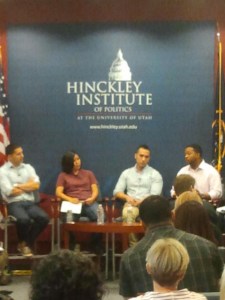
Immigration and gay rights are usually thought about as two separate topics. This becomes a problem when individuals are both immigrants and identify as being gay. A panel at the Hinckley Institute of Politics on Oct. 4, 2012, titled “Pride Has No Borders” discussed both immigrant and gay rights during the University of Utah’s Pride Week. The panel included immigration attorney Mark Alvarez; Utah AIDS Foundation Hispanic Outreach Coordinator Alex Moya; and Mariana Ramiro-Gomez, a staff member of the U’s LGBT Resource Center. The topics of gay and immigration rights are not only pressing in this state, but also on a federal level.

According to the organization Immigration Equality, in May 2012 Pres. Obama announced his support for same-sex marriage. His administration then created a “written guidance that will extend discretionary relief to lesbian, gay, bisexual and transgender (LGBT) immigrants with U.S. citizen spouses and partners.”

Even though important steps are being made toward immigration equality, it is still very unequal.

“Same sex couples are not able to apply for certain immigration benefits the way heterosexual couples would be able to,” Alvarez said at the panel discussion.

He said that even though the U.S. is a progressive country, other countries are farther ahead in gay rights.

“There’s sometimes a misimpression that Latinos are slow on LGBT issues. That’s not true. I lived in Spain,” Alvarez said. “Spain has marriage equality. Argentina has marriage equality. Colombia allows same-sex couples rights in immigrating.”

According to the Library of Congress, the Uniting American Families Act of 2011 hopes to “amend the Immigration and Nationality Act to include a ‘permanent partner’ within the scope of such Act. Defines a ‘permanent partner’ as an individual 18 or older who: (1) is in a committed, intimate relationship with another individual 18 or older in which both individuals intend a lifelong commitment; (2) is financially interdependent with the other individual; (3) is not married to, or in a permanent partnership with, anyone other than the individual; (4) is unable to contract with the other individual a marriage cognizable under this Act; and (5) is not a first, second, or third degree blood relation of the other individual.”  This act, if passed, would affect the lives of thousands of people in the U.S.

“There are 36,000 couples affected by the inability to apply for immigration benefits. This is according to the 2010 U.S. Census,” Alvarez said. “The Uniting American Families Act, which has been proposed before the Congress for a decade, would allow permanent partners to be sponsored for residence.”

Alex Moya’s main focus at the Utah AIDS Foundation is speaking with gay Spanish-speaking immigrant men about health promotion and HIV prevention. It is this kind of boundary crossing that shows the division between immigration rights and gay rights.

“I think in publications and the mainstream discourse we talk about straight immigration rights and in the gay movement we talk about white men who want marriage but we don’t talk about what happens in between,” Moya said at the panel.

In an interview with Moya, he said that gay marriage isn’t thought about the same way in the gay Hispanic immigrants as it is in the mainstream gay community.

Alex Moya sees a unique side of the gay marriage debate due to his work with gay Hispanic immigrants.

Alex Moya sees a unique side of the gay marriage debate due to his work with gay Hispanic immigrants.

“When mainstream citizens are talking about gay marriage as a right, sometimes that has a different meaning for the guys that I work with,” Moya said. “There’s the idea that yes we should care because if same-sex marriage is legal then there’s another way to gain the green card, but there are many that don’t want to get married to a citizen. So I think that the conversation about the rights of the LGBT people is sometimes a little bit different on what we’re looking for as immigrant Latino men.”

Moya, who graduated from the University of Utah, said information about the gay minority community is not taught in schools.

“I think education needs to change. I think I was here five years and most of the important learning about queer people of color I’ve done outside of this institution,” Moya said during the panel. “I think teachers who don’t decide to dedicate the last class to talk about queer issues or to talk about Latinos needs to happen. I don’t see why it is more important to teach about one culture or one race over the other. I think that it should be more balanced.”

Mariana Ramiro-Gomez works for the LGBT Resource Center at the U. She is originally from Mexico, and is a legal resident in the US. When she and her family applied for their green cards, she feared coming out to her parents would ruin her chances for legal residency.

“I didn’t know if [my mother] was going to kick me out or if she was going to disown me or if I would have a family, and ironically when I was coming out is when we were in the middle of the process of getting our green cards,” Ramiro-Gomez said. “I was afraid that they would not include me as part of the process and the paperwork to get my permanent residency.”

She hopes that laws will change to make gaining legal residency and moving from one country to another easier.

Mariana Ramiro-Gomez said that being gay and Hispanic means she has to censor her identities depending on which group she is with.

Mariana Ramiro-Gomez said that being gay and Hispanic means she has to censor her identities depending on which group she is with.

“Nature doesn’t stick to these arbitrary borders that we’ve placed upon it. So I do believe that anything and everything that’s living would freely transfer,” Ramiro-Gomez said. “Especially between Canada, US and Mexico there is NAFTA so all of our produce and all of our trade travels freely but our bodies cannot. Ideally, our bodies would be part of that transfer. Realistically, I would love to see some sort of legal path toward legalization where everyone who is here already who is undocumented would get access to a green card to at least be here temporarily, ideally permanently.”

Ramiro-Gomez said the fear of her partner being deported is ever present for her. She would have to choose between going back with her partner to Mexico, which would disqualify her from legal residency here, or she would have to stay here and hope that laws change to the point where her partner can come back to the US.

There is hope for change. The Uniting American Families Act is one such option that allows permanent partners to stay in the US. This, coupled with gay marriage being passed in nine states as well as the District of Columbia, shows signs of change coming sooner rather than later.

Pride Week at the University of Utah, a ‘top-25’ LGBT-friendly school

Story and photos by DAYLAN JONES

Pannel style discussion at the Hinkley Institute, Oct 4, 2012

Panel discussion at the Hinkley Institute of Politics, Oct. 4, 2012.

The University of Utah was named one of the top 25 most LGBT-friendly colleges and universities in the U.S. by Campus Pride in August 2012. The ranking gave the U something else to celebrate during the annual Pride Week celebration, held Oct. 1-5, 2012.

The rankings are based on data from the Campus Pride Index, which rates colleges and universities on things such as LGBT-friendly policies.

The U received high scores in all categories but LGBT Housing and Residence Life, where it scored a 3.5 of 5 stars.

“We are currently working towards that with the housing department and other necessary departments to have that by the fall [of 2013],” said Kai Medina-Martínez, director of the LGBT Resource Center at the U.

“It’s a good thing,” Medina-Martínez said about the publicity. “When the list came out the major news outlets contacted us, the U’s webpage acknowledged us, and in addition to the school, it’s a really good thing for the state.”

The Pride Week panel at the Hinckley Institute of Politics, Oct. 4, 2012.

The Pride Week panel at the Hinckley Institute of Politics, Oct. 4, 2012.

Pride Week has a different focus or theme every year to educate students and the public about issues in the LGBT community. This year’s theme was “Pride Has No Borders.”

The panel, “Pride Has No Borders: Immigration,” held Oct. 4 at the Hinkley Institute of Politics, focused on the challenges lesbians and gays of color face as they apply for immigration, get jobs and try to make a difference.

“As a woman of color and an immigrant myself I can connect with this,” said Valeria Moncada, a student who attended the panel. “It hurts my heart to see the hardships and unfairness we as people of this country place on immigrants. Immigrants as individuals are treated unfairly but because you are LGBT, you have less rights than a traditional immigrant.”

Pride Week also featured fun events. The Drag Show was a hit and gave new insight to one student. Madeline Smith commented on the “feisty” performers and “huge variety of looks and performances.”

The show, also Oct. 4, was held at Sugar Space in Salt Lake City. “My favorite performance was Klaus von Austerlitz,” Smith said. “He lip-synced to ‘Call Me Maybe,’ but mixed the song so it would change from the original song to a really creepy version and he would dance accordingly. He walked out all stiff like a doll and had 666 written on his hand so every time it said ‘here’s my number…’ he pointed to his hand.”

Smith, who was attending her first drag show, said she was “in awe at how Klaus fought the stereotype that all drag queens have to have fake boobs [and] wear heels…. He creeped out the crowd but everyone loved him.”

Sterling Anderson, a gay student at the U said about Pride Week, “I feel like I can be myself, and accepted for who I am on this campus. I don’t feel I have to hide my status and know I will be respected in that aspect. I feel very fortunate.”

The racial frisk: profiling a concern in Utah

By KATIE HARRINGTON

Asher Koles has a thin black mustache, a dark-olive complexion, and a slim build. He often drives his old Subaru Outback across long, open roads to go fishing and camping. His adventures take him to quiet and beautiful lands.

But sometimes, Koles’ adventures on the road are interrupted by the flashing lights and sirens of police cars.

Koles, a 24-year-old Salt Lake City native, said he is one of many people who are profiled by law enforcement for no reason other than the way they look. His most recent experience occurred last summer when he was driving back to Salt Lake City from a two-month trip in the Pacific Northwest.

“Cars were speeding all around me. But I was the one who got pulled over,” Koles said. “The cop walked up, stuck his head in, and started sniffing around. I said, ‘Do you smell something?’ And he wouldn’t leave me alone until I let him search my car,” Koles said.

But the officer found nothing.

“That experience pretty much sealed the deal for my eternal distrust of police officers,” Koles said. “He pulled me over for a bogus reason because my car looked dirty, I looked dirty, and I was an easy target.”

Magaly McMannis, a legal immigrant from Mexico, said she has been profiled countless times as well. A police officer once issued her a traffic ticket that indicated she was of Indian descent, McMannis said.

“I am not Indian,” Mcmannis said. “And even if I was, I don’t know why that is relevant.”

Amid immigration debates and post-9/11 distrust, racial and ethnic profiling of motorists has become a growing concern in the United States.

The American Civil Liberties Union, or ACLU, has dedicated an entire sector of programming to combat issues associated with racial and ethnic profiling, a practice that disproportionally targets people for investigation and enforcement based solely on skin color or ethnic background.

“[There are] clear and significant racial disparities in the way in which motorists are treated once they have been stopped by law enforcement”, said a national report released by the ACLU in 2007.

The report found that blacks and Latinos are three times more likely to be searched by a police officer once they are pulled over. Blacks are twice as likely to be arrested and four times as likely to be threatened by, or to be victims of the use of force by a police officer.

“While the Department of Justice says that the higher rate of searches of blacks and Hispanics is not necessarily the result of racial bias, it begs a critical question: why are blacks and Hispanics subject to searches disproportionately?” said Dennis Parker, the director for ACLU’s national Racial Justice Project. “It’s a question that needs to be answered.”

In the last seven years, the federal government has transferred substantial responsibility for the enforcement of civil immigration laws to the state and local level, according to a national ACLU report in 2009.

Perhaps the most infamous among recent state laws to address immigration is the 287 (g) program, which allows designated officers in various state and local agencies to perform immigration law enforcement functions that would have otherwise been performed by federal government officials.

The 2009 ACLU report said that the program has been criticized for allowing and encouraging the illegal racial and ethnic profiling and harassment of both immigrants and U.S. citizens.

But Salt Lake City Police Chief Chris Burbank said he will not tolerate racial and ethnic profiling in his police department.

In the 2010 U.S. Census, 22.5 percent of the population in Salt Lake City was documented as Latino and that number was nearly 31 percent in the school system, Burbank said.

“To alienate one-third of the population in Salt Lake City is ridiculous,” Burbank said. “We need the interaction and involvement of everybody.”

Burbank said he is setting the tone for his team of officers so that this problem does not take hold in his department.

“I am a very effective arm of oppression,” Burbank said. “Profiling is wrong. It is my responsibility to not allow this to happen.”

But McMannis said she has simply learned to accept the way she is perceived by certain people in the community.

“People do look at me and it does feel weird,” McMannis said. “But I have learned to not care because it is what it is, I am who I am. My dream as a girl was to live the United States, and my dream came true. That’s what is important.”

Standing against Utah’s conservativism, a few fight against HB 497

by TODD PATTON

In 2011, the Utah Legislature passed a controversial bill pertaining to illegal immigration throughout the state.  In subsequent months, outcry from the Latino community and leaders around Salt Lake City, led to a court challenge against House Bill 497.

HB 497, would allow police officers to check the immigration status of most individuals they encounter, making it necessary for those of Latino background to carry their documents with them wherever they go.

And in May 2011, just after Utah Gov. Gary Herbert signed HB 497, the American Civil Liberties Union (ACLU) sued the state of Utah. That action suspended the bill, and Judge Clark Waddoups of U.S. District Court for the District of Utah, recently postponed the case, citing that he will wait until the U.S. Supreme Court decides on a similar bill from Arizona.

While the courts will ultimately decide the fate of HB 497, Salt Lake City Police Chief Chris Burbank and other opponents have urged the courts to consider the problems a bill of this nature could create for officers.

“I should not take into account who [citizens] they are, what language they speak, the color of their skin, where they might be from, and all those other things.” Burbank said.  “We all have these biases built into us. But does that hold true? Absolutely not.  And if officers start using that [biases] as a basis to make enforcement decisions, that is wrong.”

Burbank also let his thoughts be known in a Feb. 16th op-ed column in The Salt Lake Tribune, the day before Waddoups moved to suspend the bill.  Headlined “ ‘Papers-please’ law would harm all Utahns,” Burbank pleaded for the judicial system to block HB 497.

As Burbank—2011 recipient of the Tribune’s “Person on the Year” honor, spoke the same day his column was printed, he reiterated the overriding sentiments toward  the issue. And more specifically, he addressed the influence HB 497 would have on the growing Latino community in the state of Utah.

“In Salt Lake City, last year’s census had 22.5 percent of the population being documented as being Hispanic or Latino,” Burbank said. “The school census, when you look at the enrolled children in school, that number is about 31 percent of the population.  And to alienate one-third of the population is ridiculous.”

Passing by 59-15 in the Utah House and 22-5 in the Utah Senate it was clear that lawmakers overwhelmingly supported HB 497. However– like Burbank–not all Utah leaders were on board with the controversial bill.  Rep. David Litvack D-Salt Lake City, agrees that HB 497 would only create unnecessary issues for police officers and citizens alike.

“I think it does a disservice to the entire community,” Litvack said. “You can’t resolve immigration issues through enforcement only, it’s misleading.  And as far as law enforcement, as well as the immigrant community, it puts them in a very compromising position. Law enforcement relies on a good relationship with the entire community, including the undocumented community.”

Being one of the 15 House opponents to the bill last legislative session, Litvack adamantly defended his decision to vote against a bill that many supported.

“My big concern for witnesses of crime, is how willing they will be cooperate, to speak with law enforcement if their big fear is that they’re going to be arrested or deported,” Litvack said.

And while HB 497 has clearly been met with resistance from some, in the end, the law must really be about guaranteeing the safety and rights for all those who live in the state of Utah, Burbank wrote in his guest column.

“In order to perform our job effectively, all people – including those who lack authorization to be in this country – should feel confident approaching police officers and coming forward as victims of or witnesses to crime without fear this interaction may lead to an investigation of their immigration status.”

America, land of the free: Salt Lake City police chief outlines a long history of racial profiling

by FRANCES MOODY

“We are an affective arm of oppression because we stand ready,” said Salt Lake City Police Chief Chris Burbank. He was speaking of the existing biases within legal systems. Prejudicial laws, he said, can act as weapons inflicting unfair oppression against one group of people. To Burbank, biased laws make it OK for police and politicians to “stand ready” and discriminate. This form of discrimination prompts racial profiling, Burbank said.

Burbank’s 21 years of experience on the Salt Lake City police force helped form his opinion on the subject of illegal immigration. He has witnessed an increase in illegal immigration and has noticed peoples’ inclination to strictly crackdown on undocumented workers. When speaking to a University of Utah class, Burbank explained how current biases in law enforcement trace back to historical occurrences.

According to Burbank, racial profiling helped construct a legal system with biased laws. Perhaps, these prejudice laws of generalization created the segregated workforce in the United States today.

Segregation in the United States has a long history. From slavery to Jim Crow laws, segregation created a trend of racial profiling against African immigrants. The 12th Amendment to the U.S. Constitution allowed the legalization of slavery. Africans were imported and put to work, working hard labor jobs. When slavery ended with the Civil War, the South designed another form of segregation by enforcing Jim Crow laws

Jim Crow created a caste system in many southern states. For instance, African Americans were segregated from white people. They were forced to drink from their own drinking fountains, use different bathrooms, etc.Though free, African-Americans still worked hard labor jobs that no one else wanted and the segregation cycle continued. .

Today, racial profiling against African-Americans may be prominent. Burbank stressed that the majority of people conclude that African American people are criminals. “What’s the majority population in prison? African-American males between the ages of 18 and 35, they’re obviously criminal, aren’t they?” Burbank said, with a hint of sarcasm.

Along with the immigration of African slaves came other immigrants. New groups traveling to the United States came for a fresh start. History documents that they discovered a similar form of prejudice and favoritism experienced by African slaves. Biased opinions against Irish immigrants became prominent in the mid 1800s.  “Jobs were hard to find. Employers often advertised their unwillingness to take on the newcomers by hanging out ‘No Irish Need Apply’ signs. Irish women did find work as domestics, stereotyped as “Biddies,” short for Bridget,” published website, assumption.edu, said.

Finding work as an Irish man or woman proved itself a difficult task. “Back east all the Irish families are cops or firefighters. Nobody of any dignity wanted to be police officers…The Irish couldn’t get anything else. Segregated as we segregate Hispanics, they all became cops.” Burbank said. The idea of discrimination in the mid 1800s created an Irish family occupation trend.

Burbank also mentioned Italian immigrants struggles against biases. Some citizens viewed Italians as violent people; they also faced the problem of finding a job.  After poor treatment, Italians banned together and generated revenue in alternative ways.  During prohibition the American/ Italian Mafia produced profits through illegal sales of alcohol. Historical figures like Al Capone became prominent in U.S. history and media.

The Italian Mafia is present in pop culture. Reality Television shows like Growing Up Gotti and Mob Wives showcase media’s view of American-Italian decedents. Yet another form of biased opinion stands prominent in contemporary society.

After explaining biases in history, Burbank highlighted the struggles that a new group of immigrants are facing. He offered the idea that while prejudice opinions and laws rise up in culture on a national level, those preconceptions also surface on a local level. Illegal immigration prances to the hotspot of political attention, even in Salt Lake City legislation and business. As police chief, Burbank encounters such local issues.

People of Hispanic descent migrate to the United States everyday. However, many of them find difficulty in becoming legal. As illegal immigrants, the process of finding work may show to be a daunting task. In order to find work, some have been known to buy or forge documentation that looks legal.

The struggle of becoming legal punctures the well being of many businesses that hire employees with false documentation. In Salt Lake City, a local bed and breakfast faced turmoil when the entire housekeeping staff proved to be illegal. For protection, the names of the manager and hotel shall remain anonymous. “They all had documentation that looked totally legitimate. They came into my office and said we are all illegal… Because they told me that, I had to verify our entire staff,” the manager said.

The entire staff lost their jobs and livelihood. Most of them remained in Utah, but have not found work due to new policies of employee verification.

The hotel and its manager faced the task of replacing its view of hardworking employees who work for low wages. In cultural and business viewpoints, staff like this hotel’s housekeepers will work hard for near to nothing. Burbank finds oddness that these hardworking employees are often categorized as criminals in society’s mind.

This local hotel is just among many businesses that have suffered. Another prominent Salt Lake City hotel, The Grand America, faced the task of firing their housekeeping staff after an investigation.

Burbank closed his discussion with the U of U class and left students to ponder on new ideas and different outlooks. Among the new opinions Burbank offered that if new opinions and laws emerged, people like these housekeepers can become legal and break away from the criminal profiling they all face.

In political standards, many Utah politicians and law official hold the same existing biases in United States past and present history. Officer Burbank hopes to break away from racial profiling. Being in the minority, his viewpoints face scrutiny. “Salt Lake City, sanctuary Burbank, they actually have a wall with my name on the hill now because they are actually going to throw out all the police chiefs who don’t enforce immigration laws as they see fit. Not only do Hispanics have no judicial process, review or civil rights, neither do police chiefs,” Burbank said.

###

Mestizo Arts and Activism: a result of U, community collaboration

Story and slideshow by RYAN McDONALD

In a coffeehouse located at 631 WNorth Temple in Salt Lake City, a group of about 15 teenagers and young adults gathers twice a week to discuss issues that concern them, such as media misrepresentation and stereotypes. It is one link in a large chain of community projects that University Neighborhood Partners (UNP) at the University of Utah is involved in.

UNP (originally called West Side Initiative) was created in 2001. Bernie Machen, the president of the University of Utah at the time, was concerned that if a better effort wasn’t put into helping first-generation underrepresented youth graduate from high school and get into college, the U would not have the student body to be considered the flagship university in the state.

“Since west-side neighborhoods were so totally underrepresented at the U it was a clear geographically-defined place to start,” said Sarah Munro, who currently works as the associate director of UNP. “The charge was to set up collaborative partnerships between the university and west Salt Lake neighborhoods.”

Sarah Munro, associate director of University Neighborhood Partners.

Early in UNP’s existence, an assessment was conducted in seven west Salt Lake neighborhoods to determine what was needed in order for Machen’s concern to be eased. Munro said direct student recruitment was one way of accomplishing this, but that it was not the most effective.

“The vision for this was long-term engagement,” Munro said. “By being engaged in the community, that’s how you create access. You’re addressing barriers to access to higher education. Our charge was to look at those needs and priorities that came out of the neighborhoods and say, ‘What are the university resources that could be brought to this and then how do we bring them to work in a collaborative partnership with one or more organizations?’” Munro said.

By 2003, UNP had begun working with organizations, individuals and government to help west-side residents overcome challenges Munro referred to as “systemic barriers,” obstacles that take a long time to change. The staff of UNP does not participate directly in this work, but the organization serves as a bridge between the university and these entities to enable collaborative work.

“I think that people are more creative and more motivated when they work in teams and that’s what these partnership groups really are,” Munro said.

She referenced changes that have been made in the Salt Lake City School District to respond to the growing Latino and refugee populations, in part due to collaborative work. As an example, she indicated that in-home visits are made to parents who might not otherwise be able to attend a traditional parent-teacher conference.

Members of MAA meet twice a week at Mestizo Coffeehouse.

Munro’s philosophy of teamwork is evidenced by Mestizo Arts and Activism (MAA), which meets each Monday and Wednesday afternoon at the Mestizo Coffeehouse. MAA is a partnership between the U and Mestizo Institute for Culture and Arts (MICA).

Having finished a project working with youth on community issues about five years ago, Matt Bradley, an adjunct professor in the Honors College  at the U, wanted to do more. He got in contact with the directors of MICA to explain that he wanted to do a similar project. With MICA’s support, MAA began. The Honors College is the entity that represents the U in the partnership.

MICA’s mission is, “To strengthen and build community through arts, civic engagement, and dialogue. Provide space to those who engage community through their work, are from underrepresented communities, or use art as a tool for social change.”

In that spirit, MAA brings students, primarily from West High School, together to talk about issues related to remembering and preserving their native culture. An ultimate goal is to “create the ability and potential for civic participation,” Bradley said.

During a recent meeting, students discussed the portrayal of Latinos in the media.

“I saw an episode and I got pissed,” said one teen in reference to a time he watched “Family Guy.” “It was a whole attack on Mexicans.”

Sujey, a student at West High School, said she is involved in MAA because it gives her a chance to remember a big part of who she is.

“I feel like all of us are forgetting our roots,” she said. “A lot of people at school are just trying to fit in. Over here you can just come and talk about your culture. You remember who you are and you remember where you came from. It’s a place where you can just come and talk about and relate to things with everyone. You can’t be doing that at school.”

Kania is another student from West who is involved in MAA.

“Your name, your family came from somewhere,” she said. “It began somewhere. Everybody has a different story. The people before you lived a whole different life. Everything that you’re learning, you’re learning from the mistakes that they made. Keeping our culture alive is a way of honoring them for the lessons that they are giving us.”

Another student named Israel discussed a cultural challenge he feels many of those at MAA experience.

“I just feel that mixing two cultures is a lot more difficult than you might think,” Israel said. “I feel like we have to be more Mexican than the Mexicans because not even Mexicans accept us. You have to be more American than the Americans because not even the Americans accept us. We’re just kind of in the middle sitting there wondering which way to go. It’s a big culture clash that we can’t get into. I’m glad I am (involved in MAA) because I’m able to bring two cultures together.”

Although the students discuss serious topics, fun is a core element of the activities at MAA. From having a chance to reflect on Disney movies they watched as kids to playing group games, the students are able to form close friendships through the things they do there together.

José Hernandez, left, and Alonso Reyna, at Mestizo Coffeehouse, 631 W. North Temple.

“We build a sense of family here and that has been incredible,” said Alonso Reyna, a student at the U majoring in sociology who volunteers at MAA.

José Hernandez, another mentor, began his involvement at MAA in 2008, his senior year of high school. He is now majoring in gender studies at the U and plans to become a teacher.

“I didn’t go to college just for myself, but for my family and I wanted to help my community,” he said. “Mestizo allows me to apply what I learn at the U and even learn more than I would normally learn.”

The opportunities that MAA provides these students to explore their culture is only part of its story, however. Part of UNP’s mission is to provide faculty and students at the University of Utah the chance to conduct community-based research through the work its partners are doing.

Ashley Edgette is an undergraduate student who is helping to teach students at MAA how to be community researchers and organizers. She is majoring in political science and environmental studies and minoring in French. Upon graduation she plans to attend graduate school to study city and metropolitan planning and community development. She is currently researching how best to involve people in the creation and maintenance of a community garden.

“Working with these students makes it a more involved community project,” she said. “I think this is the only way to do this kind of research. I think our students (at MAA) get a perspective that you don’t get otherwise.”

U student Ashley Edgette is researching ways to involve people in the creation of community gardens.

Edgette feels this research model helps the students at MAA and the surrounding neighborhoods. She also said it helps the U become more involved in the city.

“It’s not only beneficial for the U to be connected to high school students and community members, but I think it’s also really beneficial to do these kinds of studies that are based on community knowledge and based on student participation, because it shifts the way the U interacts with communities,” she said. “It makes it a relationship where they’re (the U) invested and have responsibility and are expected to participate in the action with these communities. It’s been really beneficial for my education.”

Hernandez, the volunteer who wants to one day be a teacher, said the things happening at Mestizo Coffeehouse exemplify why UNP exists. Its goal is to build bridges between the U and the community and he feels that this is beneficial for MAA. Participants get to discuss community issues and learn about the university.

“It really represents what community and higher education can be together,” he said.