Spice Kitchen Incubator helps refugees start food businesses

Story and photos by RYAN CARRILLO

Spice Kitchen Incubator gives certain Utah residents a unique opportunity: a chance to plan and develop a food-based business.

The kitchen incubator primarily assists international refugees who have relocated to Salt Lake City, but also provides services to immigrants and lower-income individuals. The program is part of the International Rescue Committee in Salt Lake City, or IRC SLC, which helps in international crises and relocates refugees in 22 different cities throughout the U.S.

Spice Kitchen Incubator provides everything from ovens to large prep space for the chefs

Spice Kitchen Incubator provides everything from ovens to large prep space for the chefs.

Refugees are individuals forced to leave their native country due to political unrest, war or safety concerns. When they are relocated to the United States, they have to adapt to a completely new culture and way of living.

Spice Kitchen Incubator helps them adjust to some of these changes.

Entrepreneurs, or participants, in Spice Kitchen Incubator aspire to start their own business. These individuals will mostly likely run their own catering business, food truck or farmers market booth by the end of the program.

The program is designed to help each entrepreneur achieve these goals and be successful in the American business market.

“Every entrepreneur’s goals are different but our overall goal is to build self-sufficient businesses,” said Genevieve Healey, the program coordinator for Spice Kitchen Incubator. “Those are the things we are helping them with, [things] like accounting, marketing and connecting them to resources. At a certain point they are comfortable doing that all on their own and they know how to use those resources.”

Spice Kitchen Incubator is divided into two different levels: pre-incubation and incubation. Pre-incubation is designed to help entrepreneurs develop a business plan and teach them how to run a successful business. Incubation is focused on real experience and exposure, putting each participant in control of their business.

Entrepreneurs begin in pre-incubation. They participate in this level for six months before advancing to incubation, depending on their individual needs and progress. During this phase of the program, they are building the foundation for running a business.

Each Saturday, the kitchen incubator hosts workshops for those individuals, covering everything from profit-and-loss and advertising to marketing positioning and food costing. Additionally, each entrepreneur will participate in a focus group. The focus group plays an essential role in the development of the aspiring business owner’s business plan.

“Volunteers from the food industry and the community come and try the entrepreneur’s food and those are entrepreneurs in pre-incubation so they are just developing their menu and what they are going to sell,” Healey said.

Feedback from volunteers is essential. It helps the chefs make adjustments to the business plan. It also can help them develop a mentorship with people in the community.

Kamal is one of 10 entrepreneurs in the pre-incubation stage. As a Bhutanese refugee, he was resettled in the U.S. almost five years ago. He has participated in the Spice Kitchen Incubator for almost a year.

Kamal’s focus group met on March 11, 2015. The chef spent several hours preparing food to present to the group. He said he has enjoyed participating in the program and was excited to share his culture and food with the volunteers and staff. He said he is very appreciative for the help of his wife and daughter, as well as a local volunteer, while preparing for his focus group.

Kamal prepares for his focus group with the help of his wife, daughter and a community volunteer.

Kamal prepares for his focus group with the help of his wife, daughter and a community volunteer.

After pre-incubation, entrepreneurs advance to incubation. This portion of the program typically lasts for 4 to 4 1/2 years. In all, entrepreneurs are able to be in the program for five years. There are currently three entrepreneurs enrolled in the incubation portion of the program. Since the Spice Kitchen Incubator was only opened in 2013, no one has graduated from the program yet.

During incubation, the aspiring business owners begin running an operational business. They start by applying for their business license. Once received, the entrepreneurs begin catering events and participating in local farmers markets.

During the winter, the chefs sell pre-packaged food at the market that they prepare at the Spice Kitchen Incubator’s facilities. The winter market is held every other Saturday at the Rio Grande Depot (300 S. 300 West) from 10 a.m. until 2 p.m. It runs through April 2015.

During the summer farmers market, entrepreneurs rotate between packaged and prepared foods. Prepared foods are cooked on-site rather than at the Spice Kitchen Incubator facilities. Healey said the kitchen hopes to expand its services at this year’s summer market to include one booth dedicated solely to packaged foods and another just for prepared foods. This would give the entrepreneurs more exposure and increase their ability to build a client base. The summer market runs from June 13 to Oct. 24, 2015, and is held each week at Pioneer Park on 300 W. 400 South.

Healey said the farmers market demonstrated how beneficial the incubator’s programs can be for both the business owners as well as the community as a whole.

“The farmers market was a really awesome experience, especially the summer farmers market because it is where we can do prepared foods,” she said. “We’ve said that there is a need for this in the community but it was really cool to have that hands-on [experience], like ‘oh yeah, people really want this.’”

Community members can get involved with the incubator through several different ways. The Spice Kitchen Incubator is always looking for individuals to serve on focus group panels, which requires a commitment of a couple hours each session, as well as help with any other topics related to running a business. Donations can also be made on the incubator’s website.

Maria Gigourtaki, who works as the volunteer and communications coordinator for the kitchen, said volunteers can have some amazing experiences with the program. “[The entrepreneurs] are all so passionate,” she said. “I mean, food is something that gets people together and it’s awesome. You can get to see and meet people, new cultures, new flavors, history, languages, everything. It’s amazing!”

KUDU: Gifts and decor from Africa helping others from Salt Lake City

Story and slideshow by DANEALLE PLASCENCIA

Visit KUDU gift shop in Salt Lake City, which features handmade items including baskets, masks and clothes.

Many people always think or dream about visiting other countries, states or continents, just to learn about different cultures, food, language and traditions. But sometimes this is impossible to accomplish due to money or time constrains.

However, what would you think if someone told you that you can learn the most important elements of the African culture in Salt Lake City and help poor families with your support?

KUDU, a small business located at 2155 E. 2100 South, does just that. The shop sells gifts and decors directly from Africa. And this is possible because of Susan Clissold.

Clissold was born in South Africa and studied culinary arts there.

She moved to Salt Lake City five years ago with the purpose of just visiting her friend, but she ended up staying and making Salt Lake City her second home.

Clissold got married and she and her husband had a daughter who now is 14 months old.

Clissold credits her mother-in-law, who had just returned from a trip to Africa, with the idea of opening a small shop with handmade items imported from Africa. It seemed a logical next step for the women, who had been working on obtaining the necessary permits to sell the imported items.

After the opening of KUDU three years ago, Clissold’s mother-in-law couldn’t work at the store. The main reason was the short time periods that she was living in Salt Lake City. So she asked Clissold to take over the small business.

The store is named after the kudu, a species of antelope that comes from the savannas and is popular in Africa because of its skin and meat. Also, the horns are used as musical instruments.

The store instantly reflects African culture. The walls are painted with warm colors such as brown and beige, and decorated with masks and paintings from different African artists.

KUDU offers hundreds of handmade items imported and made from African artists.

Some of those items are dishes such as mugs, spoons, spatulas and butter containers, all of which are hand painted.

Clissold sells clothing too, such as hand-knitted scarves made by women from Swaziland. Crocodile belts, baby shoes and animal skins, which are used as blankets or carpets most of the time, are sold at the store.

Musical instruments are indispensable for the African culture. KUDU sells handmade carved drums from different types of wood that makes every drum sound different and unique, as well as kudu horns. They are as long as regular drum sticks but thicker and beige in color.

Beaded giraffes, monkeys and dolls are the most detailed items that this store offers. The bright colors call the attention of any customer who is looking for a gift, especially one for children.

Home decoration is something that Clissold includes in her store. Lampshades made of bamboo, photo frames and Zulu hand-woven baskets are some of the articles that can be added in any home.

“I have items in my house that I bought for the store and I just loved them so much that I keep them as decoration,” Clissold said .

Showing art to the customers in different ways is the main objective of this store. Currently, the store has paintings by Daniel Novela, an African artist who now exhibits his work at Adlou Art Gallery.

“I was always interested in art, even when I was back home,” Clissold said.

Clissold also supports local businesses. She sells chocolate from the Millcreek Cacao; lotions, shampoos, soaps and shea butter are some other items that come from Africa but are packed in the United States that KUDU offers.

Meanings, shapes and animals are an important element for the store.

KUDU sells animal sculptures of elephants, giraffes, monkeys and zebras, which are a representation of the African continent and culture.

Colors as well teach every single customer a meaning. For example, green represents Africa as land, red the color of African ancestors, black the color of the African race and yellow the natural resources the community uses for living.

“Africa is all nature. If you are expecting to see big buildings and streets Africa is really far away from that,” Clissold said.

African culture is based on trading some items for others, and Clissold’s mission is to help African artists by buying the products so they can have a better life back home.

Such is the case for Zimbabwe, who is Clissold’s buyer.

He lives in Africa and talks to the artists and makes arrangements for prices or trading.

“With the money that I get from working with Susan now I have a small little truck that helps me move around to get the gifts,” Zimbabwe said in a phone interview.

But Clissold’s mission entails more than selling items from Africa to people in Salt Lake City.

Her motivation is helping families in Africa to have a better way of living and share her culture with the residents of Salt Lake City. The reason is to show residents what Africa is made of and what they can find in the continent.

Clissold has big plans for KUDU. Recently she started a sale day every month to attract new customers.

Since KUDU is in a two-story building and she only uses the lower floor, Clissold plans to offer massage sessions with oils from Africa. The massages are going to be held two times per month with unique arrangements and decorations from her shop.

Recently, she ordered new paintings that are going to be low cost so anyone can afford to have one at home and help others. She will be exhibiting them sometime during the month of May. Clissold will invite all of her regular customers to stop by.

Since Clissold likes being involved in charity work she is going to be part of a Westminster College event during May. She will donate 15 percent of the sales to an organization that helps poor minority families in Salt Lake City.

“I am really excited to help. It is just hard to be part of many different charity programs at the same time,” Clissold said.

Sales at the store have steadily increased since it opened. Clissold said she has been able to help many more families than she ever expected.

“The store is like my second home, where I can teach people about my culture and help my people to have a better life selling their work. I know Africa is a third-world country and it needs more than one person to change the poverty but I feel satisfied to help just a little bit,” Clissold said.

KUDU is open Monday through Saturday from 11 a.m. to 6 p.m. For more information call (801) 583-5838.

Immigration and gay rights discussed at the University of Utah

Story and photos by CONNOR WALLACE

Immigration and gay rights are usually thought about as two separate topics. This becomes a problem when individuals are both immigrants and identify as being gay. A panel at the Hinckley Institute of Politics on Oct. 4, 2012, titled “Pride Has No Borders” discussed both immigrant and gay rights during the University of Utah’s Pride Week. The panel included immigration attorney Mark Alvarez; Utah AIDS Foundation Hispanic Outreach Coordinator Alex Moya; and Mariana Ramiro-Gomez, a staff member of the U’s LGBT Resource Center. The topics of gay and immigration rights are not only pressing in this state, but also on a federal level.

According to the organization Immigration Equality, in May 2012 Pres. Obama announced his support for same-sex marriage. His administration then created a “written guidance that will extend discretionary relief to lesbian, gay, bisexual and transgender (LGBT) immigrants with U.S. citizen spouses and partners.”

Even though important steps are being made toward immigration equality, it is still very unequal.

“Same sex couples are not able to apply for certain immigration benefits the way heterosexual couples would be able to,” Alvarez said at the panel discussion.

He said that even though the U.S. is a progressive country, other countries are farther ahead in gay rights.

“There’s sometimes a misimpression that Latinos are slow on LGBT issues. That’s not true. I lived in Spain,” Alvarez said. “Spain has marriage equality. Argentina has marriage equality. Colombia allows same-sex couples rights in immigrating.”

According to the Library of Congress, the Uniting American Families Act of 2011 hopes to “amend the Immigration and Nationality Act to include a ‘permanent partner’ within the scope of such Act. Defines a ‘permanent partner’ as an individual 18 or older who: (1) is in a committed, intimate relationship with another individual 18 or older in which both individuals intend a lifelong commitment; (2) is financially interdependent with the other individual; (3) is not married to, or in a permanent partnership with, anyone other than the individual; (4) is unable to contract with the other individual a marriage cognizable under this Act; and (5) is not a first, second, or third degree blood relation of the other individual.”  This act, if passed, would affect the lives of thousands of people in the U.S.

“There are 36,000 couples affected by the inability to apply for immigration benefits. This is according to the 2010 U.S. Census,” Alvarez said. “The Uniting American Families Act, which has been proposed before the Congress for a decade, would allow permanent partners to be sponsored for residence.”

Alex Moya’s main focus at the Utah AIDS Foundation is speaking with gay Spanish-speaking immigrant men about health promotion and HIV prevention. It is this kind of boundary crossing that shows the division between immigration rights and gay rights.

“I think in publications and the mainstream discourse we talk about straight immigration rights and in the gay movement we talk about white men who want marriage but we don’t talk about what happens in between,” Moya said at the panel.

In an interview with Moya, he said that gay marriage isn’t thought about the same way in the gay Hispanic immigrants as it is in the mainstream gay community.

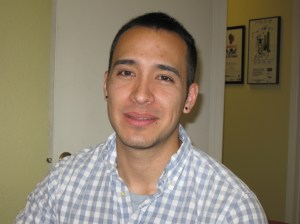
Alex Moya sees a unique side of the gay marriage debate due to his work with gay Hispanic immigrants.

Alex Moya sees a unique side of the gay marriage debate due to his work with gay Hispanic immigrants.

“When mainstream citizens are talking about gay marriage as a right, sometimes that has a different meaning for the guys that I work with,” Moya said. “There’s the idea that yes we should care because if same-sex marriage is legal then there’s another way to gain the green card, but there are many that don’t want to get married to a citizen. So I think that the conversation about the rights of the LGBT people is sometimes a little bit different on what we’re looking for as immigrant Latino men.”

Moya, who graduated from the University of Utah, said information about the gay minority community is not taught in schools.

“I think education needs to change. I think I was here five years and most of the important learning about queer people of color I’ve done outside of this institution,” Moya said during the panel. “I think teachers who don’t decide to dedicate the last class to talk about queer issues or to talk about Latinos needs to happen. I don’t see why it is more important to teach about one culture or one race over the other. I think that it should be more balanced.”

Mariana Ramiro-Gomez works for the LGBT Resource Center at the U. She is originally from Mexico, and is a legal resident in the US. When she and her family applied for their green cards, she feared coming out to her parents would ruin her chances for legal residency.

“I didn’t know if [my mother] was going to kick me out or if she was going to disown me or if I would have a family, and ironically when I was coming out is when we were in the middle of the process of getting our green cards,” Ramiro-Gomez said. “I was afraid that they would not include me as part of the process and the paperwork to get my permanent residency.”

She hopes that laws will change to make gaining legal residency and moving from one country to another easier.

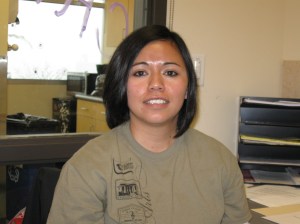
Mariana Ramiro-Gomez said that being gay and Hispanic means she has to censor her identities depending on which group she is with.

Mariana Ramiro-Gomez said that being gay and Hispanic means she has to censor her identities depending on which group she is with.

“Nature doesn’t stick to these arbitrary borders that we’ve placed upon it. So I do believe that anything and everything that’s living would freely transfer,” Ramiro-Gomez said. “Especially between Canada, US and Mexico there is NAFTA so all of our produce and all of our trade travels freely but our bodies cannot. Ideally, our bodies would be part of that transfer. Realistically, I would love to see some sort of legal path toward legalization where everyone who is here already who is undocumented would get access to a green card to at least be here temporarily, ideally permanently.”

Ramiro-Gomez said the fear of her partner being deported is ever present for her. She would have to choose between going back with her partner to Mexico, which would disqualify her from legal residency here, or she would have to stay here and hope that laws change to the point where her partner can come back to the US.

There is hope for change. The Uniting American Families Act is one such option that allows permanent partners to stay in the US. This, coupled with gay marriage being passed in nine states as well as the District of Columbia, shows signs of change coming sooner rather than later.

Pride Week at the University of Utah, a ‘top-25’ LGBT-friendly school

Story and photos by DAYLAN JONES

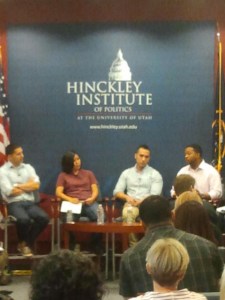
Pannel style discussion at the Hinkley Institute, Oct 4, 2012

Panel discussion at the Hinkley Institute of Politics, Oct. 4, 2012.

The University of Utah was named one of the top 25 most LGBT-friendly colleges and universities in the U.S. by Campus Pride in August 2012. The ranking gave the U something else to celebrate during the annual Pride Week celebration, held Oct. 1-5, 2012.

The rankings are based on data from the Campus Pride Index, which rates colleges and universities on things such as LGBT-friendly policies.

The U received high scores in all categories but LGBT Housing and Residence Life, where it scored a 3.5 of 5 stars.

“We are currently working towards that with the housing department and other necessary departments to have that by the fall [of 2013],” said Kai Medina-Martínez, director of the LGBT Resource Center at the U.

“It’s a good thing,” Medina-Martínez said about the publicity. “When the list came out the major news outlets contacted us, the U’s webpage acknowledged us, and in addition to the school, it’s a really good thing for the state.”

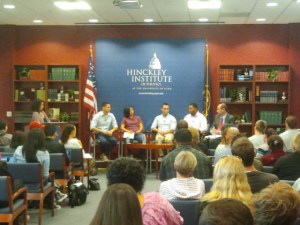
The Pride Week panel at the Hinckley Institute of Politics, Oct. 4, 2012.

The Pride Week panel at the Hinckley Institute of Politics, Oct. 4, 2012.

Pride Week has a different focus or theme every year to educate students and the public about issues in the LGBT community. This year’s theme was “Pride Has No Borders.”

The panel, “Pride Has No Borders: Immigration,” held Oct. 4 at the Hinkley Institute of Politics, focused on the challenges lesbians and gays of color face as they apply for immigration, get jobs and try to make a difference.

“As a woman of color and an immigrant myself I can connect with this,” said Valeria Moncada, a student who attended the panel. “It hurts my heart to see the hardships and unfairness we as people of this country place on immigrants. Immigrants as individuals are treated unfairly but because you are LGBT, you have less rights than a traditional immigrant.”

Pride Week also featured fun events. The Drag Show was a hit and gave new insight to one student. Madeline Smith commented on the “feisty” performers and “huge variety of looks and performances.”

The show, also Oct. 4, was held at Sugar Space in Salt Lake City. “My favorite performance was Klaus von Austerlitz,” Smith said. “He lip-synced to ‘Call Me Maybe,’ but mixed the song so it would change from the original song to a really creepy version and he would dance accordingly. He walked out all stiff like a doll and had 666 written on his hand so every time it said ‘here’s my number…’ he pointed to his hand.”

Smith, who was attending her first drag show, said she was “in awe at how Klaus fought the stereotype that all drag queens have to have fake boobs [and] wear heels…. He creeped out the crowd but everyone loved him.”

Sterling Anderson, a gay student at the U said about Pride Week, “I feel like I can be myself, and accepted for who I am on this campus. I don’t feel I have to hide my status and know I will be respected in that aspect. I feel very fortunate.”

When it comes to the University of Utah, pride has no borders

Story by VALERIA MONCADA
Photo from the Utah Legal Immigration blog

The University of Utah celebrated Pride Week in October 2012 with many different activities. 

A discussion panel on Oct. 4 was open to U students to inform them about “Pride has no borders,” the theme for the immigration panel. Immigration and equality are two much discussed topics in the United States, and lesbian and gay individuals want to have rights in the U.S just as much as an immigrant does.

Panelists discussed issues that focused on different countries, states throughout the U.S and at one point religion was involved as well. Life becomes much more complicated as a gay immigrant who is interested in issues such as marriage, benefits, receiving citizenship and adopting children.

Panelist Ricky Gutierrez, a graduate student in education, culture and society, said, “I think we need to recognize the way both immigration and sexuality have been intimately connected. We cannot have ideas around being gay without ideas around being white or being black.”

Another discussion was about religion and the LGBT community. Mariana Ramiro Gomez, a graduate assistant at the LGBT Resource Center, said that when she came out her mother didn’t attend church for about two years due to the conflicts that she faced there for supporting her daughter.

Max Green, an advocacy coordinator with Equality Utah said, “The truth is, gay people go to church.”

Green also said that the best way to break down stereotypes is to communicate with church leaders.

“This probably won’t change their opinion, but it will let them know that the people they preach about are in their audience,” he said.

Utah office

The immigration center in Salt Lake City, Utah.

Other concerns had to do with immigration and same-sex marriages. Due to the federal immigration law lesbian or gay citizens cannot marry an immigrant and hope to start the citizenship process. Lesbian and gay individuals face double discrimination: not only are they discriminated against for being immigrants, but they also are discriminated against by the immigrant community for being gay. This also includes the issues they face in the process of coming out to the community.

According to the Immigration Legal Resource Center’s webpage on LGBT immigrant rights, “many immigrants have fled their country of origin due to sexual orientation or gender identity also referred to as SOGI based persecution. Others fear social isolation from their community in the United States.”

Not only does this mean that lesbian, gay, bisexual or transgender immigrants need legal and social services that are unavailable to them because they are both immigrants and gay or bisexual, but they could also face difficulties in obtaining a lawful immigration status.

Max Green of Equality Utah added, “You have absolutely no safeguard, you have no rights and these things prevent people from having real and meaningful relationships.”

Lack of marriage equality for LGBT hinders immigrants’ ability to come to America

Story and photos by MATT ELLIS

For years there has been a struggle for the nationwide recognition of same-sex marriage. Some states have legalized the marriage of same-sex couples, but most have not and political battles wage on. At the center of the debate are liberties that are denied non-married couples. Though these discussions have taken a more prominent role in our culture over recent years, the implications of these policies on immigration have been discussed in far smaller circles.

The University of Utah Hinckley Institute of Politics is where five panelists gathered to discuss rights for LGBT immigrants on Thursday, Oct. 4, 2012.

The challenges that face same-sex couples where both partners are American citizens are compounded exponentially when crossed with issues of immigration, mostly because of the denial of rights that would normally be afforded to a couple trying to enter America.

Many pieces of legislation are under fire by those fighting for same-sex couples’ immigration rights, but the one that may be the most central is the Defense of Marriage Act (DOMA), passed in 1996. Section 3 of DOMA defines marriage exclusively as the union of a man and woman, and the word “spouse” as a reference only to a partner of the opposite sex.

Under these definitions, an American citizen can request citizenship for their partner so long as that partner is of the opposite sex. For same-sex couples, immigration to the U.S. can be vastly more complicated.

Mark Alvarez, an immigration lawyer in Salt Lake City, spoke at a panel at the University of Utah in October 2012 on the difficulties that face same-sex couples who want to immigrate to the U.S.

“It’s because of DOMA,” Alvarez said. “A same-sex couple cannot petition for normal family rights.”

Because an individual has no legal grounds for petitioning for the citizenship of a same-sex partner, the partner often has no way of achieving that status and is forced to leave the country with or without their companion.

Mariana Ramiro works with the LGBT Resource Center at the U. She is originally from Mexico City and has had personal experience with the difficulties of immigration.

She and her family immigrated here illegally, and lived illegally for more than a decade. She eventually got a green card and is now in a five-year probationary period before citizenship where she can still be deported for any reason.

Mariana Ramiro smiles for the camera. She and her partner are enduring the very issues that the panel was assembled to discuss.

Her partner is in a similar situation, which puts a great deal of stress on their relationship.

“I can be with my partner here, but if my partner ends up getting deported there’s no way to [bring us back together],” Ramiro said at the panel. “I either stay here and try to become a citizen, and maybe hope that in the future there is something that will change that I can bring my partner back. But realistically we are going to be separated unless I choose to go back there, but then that would disqualify me from citizenship.”

These fears are very real, even for those who have been legally married in the U.S.

In the case of Pablo Garcia and Santiago Ortiz, whose story was published on immigrationequality.org, the two were legally married in Connecticut but Garcia is not an American citizen.

Ortiz, who was born in New York, is an American citizen but because DOMA overrides local laws even he and his partner are not exempt.

Ortiz has tested positive for HIV and sometimes has to travel abroad to receive treatment. Garcia is unable to accompany him on those trips because he fears he would not be allowed reentry. When Ortiz’s father died Garcia couldn’t even attend the funeral in Caracas, Venezuela.

“You are putting yourself at risk for legal ramifications, for jail time, for pursuit under the state,” Max Greene, the advocacy coordinator for Equality Utah, said at the panel. “Those things prevent people from real meaningful relationships because you are already in the society where some of us aren’t valid. Imagine what that does to someone’s ability to be who they really are.”

But hope is on the horizon for couples like Ortiz and Garcia.

In 2011 the Obama administration announced that it found Section 3 of DOMA to be unconstitutional as it relates to issues of immigration, bankruptcy and public estate taxes. Though there has not been a formal repeal of the law, the administration decided that it would no longer be defended in court.

Eight federal courts, including the First and Second Circuit Court of Appeals, have also found Section 3 to be unconstitutional and as of 2012 several cases regarding immigration were awaiting a response to review in the U.S. Supreme Court.

Additionally, according to the Global Post, the Immigration and Customs Enforcement Agency has announced that deportation will not be a priority for illegal immigrants who have strong family ties in the U.S., specifically those in the LGBT community.

Many have compared the struggles of the LGBT community with the African-American civil rights movement and while that does entail subjugation and oppression, some are hopeful that the end result will be similar and that equality will soon emerge.

Alvarez is confident that, in spite of the political dealings moving at such a slow pace, America is ready for the next step.

“I think our society is [moving] forward,” the immigration lawyer said at the panel. “I firmly believe this country is on its way to marriage equality. The question is when, and I think it’s coming sooner rather than later.”

The racial frisk: profiling a concern in Utah

By KATIE HARRINGTON

Asher Koles has a thin black mustache, a dark-olive complexion, and a slim build. He often drives his old Subaru Outback across long, open roads to go fishing and camping. His adventures take him to quiet and beautiful lands.

But sometimes, Koles’ adventures on the road are interrupted by the flashing lights and sirens of police cars.

Koles, a 24-year-old Salt Lake City native, said he is one of many people who are profiled by law enforcement for no reason other than the way they look. His most recent experience occurred last summer when he was driving back to Salt Lake City from a two-month trip in the Pacific Northwest.

“Cars were speeding all around me. But I was the one who got pulled over,” Koles said. “The cop walked up, stuck his head in, and started sniffing around. I said, ‘Do you smell something?’ And he wouldn’t leave me alone until I let him search my car,” Koles said.

But the officer found nothing.

“That experience pretty much sealed the deal for my eternal distrust of police officers,” Koles said. “He pulled me over for a bogus reason because my car looked dirty, I looked dirty, and I was an easy target.”

Magaly McMannis, a legal immigrant from Mexico, said she has been profiled countless times as well. A police officer once issued her a traffic ticket that indicated she was of Indian descent, McMannis said.

“I am not Indian,” Mcmannis said. “And even if I was, I don’t know why that is relevant.”

Amid immigration debates and post-9/11 distrust, racial and ethnic profiling of motorists has become a growing concern in the United States.

The American Civil Liberties Union, or ACLU, has dedicated an entire sector of programming to combat issues associated with racial and ethnic profiling, a practice that disproportionally targets people for investigation and enforcement based solely on skin color or ethnic background.

“[There are] clear and significant racial disparities in the way in which motorists are treated once they have been stopped by law enforcement”, said a national report released by the ACLU in 2007.

The report found that blacks and Latinos are three times more likely to be searched by a police officer once they are pulled over. Blacks are twice as likely to be arrested and four times as likely to be threatened by, or to be victims of the use of force by a police officer.

“While the Department of Justice says that the higher rate of searches of blacks and Hispanics is not necessarily the result of racial bias, it begs a critical question: why are blacks and Hispanics subject to searches disproportionately?” said Dennis Parker, the director for ACLU’s national Racial Justice Project. “It’s a question that needs to be answered.”

In the last seven years, the federal government has transferred substantial responsibility for the enforcement of civil immigration laws to the state and local level, according to a national ACLU report in 2009.

Perhaps the most infamous among recent state laws to address immigration is the 287 (g) program, which allows designated officers in various state and local agencies to perform immigration law enforcement functions that would have otherwise been performed by federal government officials.

The 2009 ACLU report said that the program has been criticized for allowing and encouraging the illegal racial and ethnic profiling and harassment of both immigrants and U.S. citizens.

But Salt Lake City Police Chief Chris Burbank said he will not tolerate racial and ethnic profiling in his police department.

In the 2010 U.S. Census, 22.5 percent of the population in Salt Lake City was documented as Latino and that number was nearly 31 percent in the school system, Burbank said.

“To alienate one-third of the population in Salt Lake City is ridiculous,” Burbank said. “We need the interaction and involvement of everybody.”

Burbank said he is setting the tone for his team of officers so that this problem does not take hold in his department.

“I am a very effective arm of oppression,” Burbank said. “Profiling is wrong. It is my responsibility to not allow this to happen.”

But McMannis said she has simply learned to accept the way she is perceived by certain people in the community.

“People do look at me and it does feel weird,” McMannis said. “But I have learned to not care because it is what it is, I am who I am. My dream as a girl was to live the United States, and my dream came true. That’s what is important.”

Standing against Utah’s conservativism, a few fight against HB 497

by TODD PATTON

In 2011, the Utah Legislature passed a controversial bill pertaining to illegal immigration throughout the state.  In subsequent months, outcry from the Latino community and leaders around Salt Lake City, led to a court challenge against House Bill 497.

HB 497, would allow police officers to check the immigration status of most individuals they encounter, making it necessary for those of Latino background to carry their documents with them wherever they go.

And in May 2011, just after Utah Gov. Gary Herbert signed HB 497, the American Civil Liberties Union (ACLU) sued the state of Utah. That action suspended the bill, and Judge Clark Waddoups of U.S. District Court for the District of Utah, recently postponed the case, citing that he will wait until the U.S. Supreme Court decides on a similar bill from Arizona.

While the courts will ultimately decide the fate of HB 497, Salt Lake City Police Chief Chris Burbank and other opponents have urged the courts to consider the problems a bill of this nature could create for officers.

“I should not take into account who [citizens] they are, what language they speak, the color of their skin, where they might be from, and all those other things.” Burbank said.  “We all have these biases built into us. But does that hold true? Absolutely not.  And if officers start using that [biases] as a basis to make enforcement decisions, that is wrong.”

Burbank also let his thoughts be known in a Feb. 16th op-ed column in The Salt Lake Tribune, the day before Waddoups moved to suspend the bill.  Headlined “ ‘Papers-please’ law would harm all Utahns,” Burbank pleaded for the judicial system to block HB 497.

As Burbank—2011 recipient of the Tribune’s “Person on the Year” honor, spoke the same day his column was printed, he reiterated the overriding sentiments toward  the issue. And more specifically, he addressed the influence HB 497 would have on the growing Latino community in the state of Utah.

“In Salt Lake City, last year’s census had 22.5 percent of the population being documented as being Hispanic or Latino,” Burbank said. “The school census, when you look at the enrolled children in school, that number is about 31 percent of the population.  And to alienate one-third of the population is ridiculous.”

Passing by 59-15 in the Utah House and 22-5 in the Utah Senate it was clear that lawmakers overwhelmingly supported HB 497. However– like Burbank–not all Utah leaders were on board with the controversial bill.  Rep. David Litvack D-Salt Lake City, agrees that HB 497 would only create unnecessary issues for police officers and citizens alike.

“I think it does a disservice to the entire community,” Litvack said. “You can’t resolve immigration issues through enforcement only, it’s misleading.  And as far as law enforcement, as well as the immigrant community, it puts them in a very compromising position. Law enforcement relies on a good relationship with the entire community, including the undocumented community.”

Being one of the 15 House opponents to the bill last legislative session, Litvack adamantly defended his decision to vote against a bill that many supported.

“My big concern for witnesses of crime, is how willing they will be cooperate, to speak with law enforcement if their big fear is that they’re going to be arrested or deported,” Litvack said.

And while HB 497 has clearly been met with resistance from some, in the end, the law must really be about guaranteeing the safety and rights for all those who live in the state of Utah, Burbank wrote in his guest column.

“In order to perform our job effectively, all people – including those who lack authorization to be in this country – should feel confident approaching police officers and coming forward as victims of or witnesses to crime without fear this interaction may lead to an investigation of their immigration status.”

From Mexico to Utah, a man gave his family freedom

A life buried to create another

LEWIS WALKER

What is a human being with no true place to call home? And what would it feel like to be abandoned by your own country and risk your life to create a better life for yourself.

“My job is not to be popular, It’s to do what’s right,” said Salt Lake City Police Chief, Chris Burbank. Utah, being one of the highest cities that hold refugees makes it a vulnerable situation for discrimination and racial profiling because they are not from this country, or state for that matter. “People are unaware of the rights they have in this country,” said Burbank.

Efron is a 45-year-old custodian at a Salt Lake County recreation center. He has seen and experienced many things in his life before crossing the border into a country that offered him a much healthier lifestyle. “Thirty years ago I was in Mexico where I was born, and had many horrible things happen to me and my family,” said Efron, whose name is being withheld to protect his identity. He said, at one point he had to sell cocaine to support his family after his mother was killed because of the troubles his father brought to the family. Wanting a much better life, Efron ran away from his home, trying desperately to cross the border and transform his life.

In January 2010, according to the U.S. Department of Homeland Security, there were nearly 11 million unauthorized residents living in the 50 states, which were approximately the same as 2009, but less than 11.8 million in 2007.

“The first time I tried to cross over to the U.S. I was 15, but I didn’t make it very far and bad things happened to me,” Efron said. In 2010 there were 0.7 million unauthorized citizens in the U.S. that were 18 and younger, which is where Efron would have been if he made it the first time. Instead many years later, when he finally made it to the U.S. he joined the highest amount of Immigrants from the DHS source of 2.3 million men of the age’s 25-34-years old.

“Discrimination and racial profiling is not the way to solve this problem,” Burbank said. “The number one goal is to protect the constitutional right of every individual.”  Burbank was very into protecting the individual rights of people as he talked to a journalism class at the University of Utah.

Efron, although has admitted to doing a lot of illegal things just to gain possession of a green card and become a citizen of the United States, would not trade any of the hardship he went through to get to this point of time in his life. “Now that I have made it to a better place, I do not look back at all,” said Efron. Happy to have finally buried his past and created a better one for his children, Efron is happy where his hard work and faith has landed him. “I gave my children freedom that I didn’t have, I had to force myself out of fear to allow them to have a life they can enjoy and I am happy with that,” Efron said.

-30-

Salt Lake City police chief, Utah representatives combat new immigration laws

by JAVAN RIVERA

What would you say if you saw the police carting off your neighbor? His only crime is that he hasn’t waded through the years of paperwork and processing in order to obtain legal citizenship in the U.S. What about a friend who gets pulled over and asked for immigration papers or proof of citizenship solely because of her skin color? Would you step up and say something then? Or by then would it already be too late?

These are the questions Salt Lake City Police Chief Chris Burbank is asking, as he fires yet another salvo in the ever increasing debate over illegal immigration in the state of Utah.

Burbank, whose infamously lenient take on illegal immigration has earned him the nickname “Sanctuary Burbank,” from opponents, said that the current proposed “solutions” for illegal immigration in Utah represent a serious threat to the civil liberties of U.S. citizens and could actually increase the crime rate of Utah should they be enacted.

“These are ridiculous laws,” Burbank said of proposed immigration laws similar to those passed in Arizona.

Arizona’s SB 1070 require police officers to actively check immigration status during legal stops, and require all aliens, legal or otherwise, to carry proper documentation of their citizenship at all times. Failure to do so could result in a misdemeanor charge.

“Any time we as a society can say one segment of our population—because of who they are, what they look like, the language they speak—is more engaged in criminal behavior [as a result]. Well that’s as racist and biased as anything I’ve ever heard,” Burbank said.

Burbank said that he believes by creating laws that target illegal immigrants, Utah will create significant problems for the community on two levels—crime increase, and the all too slippery slope of racial profiling.

“You actually increase crime when you enforce these kinds of laws,” Burbank said.

He cited the formation of the Italian Mafia as an example of racially specific profiling leading to increased crime, saying that due to the shunning of the Italian people on the East Coast, they began to look to each other for support and eventually turned to crime as an alternative to pursuing legal jobs outside of their own community.

One of Burbank’s main concerns with the proposed laws, is that the threatened deportation of illegal immigrants increases the likelihood those immigrants won’t feel comfortable reporting crimes to the police for fear of calling deportation down on themselves.

“When we have a segment of society that turns their back or says ‘We’re not going to interact with the police,’” Burbank said. “Well, the criminal element thrives.”

The other great threat Burbank believes these laws represent is that of selective racial profiling.

“We are a very effective form of oppression,” Burbank said of the dangers associated with racial profiling. “Those things [profiling] are wrong and it’s my job to prevent that from happening in my profession. I will not allow my officers to be involved in that behavior.”

Burbank isn’t the only one interested in seeing Utah’s illegal immigration status solved through non-aggressive legislation. State Rep. Rebecca Edwards, R-North Salt Lake, also stated concerns similar to Burbank’s regarding an increase in crime, should these laws be enacted.

“I think that [Burbank’s view] is probably true,” Edwards said. “I’ve talked to people in law enforcement who believe that it [immigration laws] would drive people who might report crime underground.”

Not only did Edwards express concerns regarding a possible increase in crime, but also the potentially disastrous effect such laws could have on Utah’s economy, citing the numerous illegal immigrants who help maintain Utah’s farmland.

“They [immigration laws] in the end are not realistic because of the devastation to the economy and tearing families apart,” Edwards said. “If people are going to be here anyway, let’s help them to be responsible.”

Of course not everyone is satisfied with Utah’s current policies on illegal immigration such as HB116, which passed last year, allowing illegal immigrants who fulfill certain requirements to obtain jobs and in-state tuition at Utah’s public colleges and universities.

State Rep. Chris Herrod, R-Provo, is particularly adamant about the problems that illegal immigration is causing for those waiting to immigrate to the U.S. legally.

“By us tolerating illegal immigration, we are hurting those who are waiting up to 20 years for legal immigration,” Herrod said. “Where is the compassion for those who are waiting in line? Nobody is talking about those individuals.”

Herrod, who has a number of legal immigrants in his family, including his wife, a native of Russia, supports the proposed laws that would crack down on illegal immigration. He believes that by acting as what he calls a “sanctuary state,” Utah is hurting legal immigrants as much as, if not more than, the illegals who come into the state.

“As a sanctuary state, what we’re saying is that we love illegal immigrants more than we do legal immigrants,” Herrod said. “That’s, to me, simply warped.”

With the gulf of opinion regarding illegal immigration widening with each new approach, there is at least one thing both sides of the issue agree on—obtaining legal citizenship should be easier.

“We ought to be about making the process of legal immigration easier,” Rep. Edwards said. “Right now it’s onerous, expensive, and time-consuming.”

In the end, it’s hard to say which side of the argument is correct, or if a proper solution can ever truly be enacted. According to Edwards, the problem can merely be managed and will ultimately be solved only if the government gets involved at a federal level.

“States are attempting to solve this in their own ways, but in the end it’s a federal problem,” Edwards said. “We can deal with people once they’re here in our state, but the issue of immigration is a federal one.”