Ukrainians flee the iron fist

Story and photo by JACE BARRACLOUGH

“Me and my wife had to escape and almost got killed since we never supported Russia”


Protesters rally in the Maidan. Photo courtesy of Art Ira via Facebook.

The winter of 2013-14 changed the lives of Ukrainians forever. Thousands were displaced and forced to find shelter in either refugee camps located in more peaceful areas of Ukraine or across the border in Russia.

This happened when former Ukrainian President Yanukovych decided to back out of joining the European Union (EU), which would have allowed better trade with European countries and a step toward westernization.

Instead, Yanukovych rejoined with Russia. In the bitter cold, citizens took to the streets to protest the decision and demand the impeachment of their president.

Thousands of protesters filled the town square in Kiev, also known as the Maidan. Not even the Berkut (riot police) could force them out. A civil war erupted between the Berkut and protesters. It was then that President Yanukovych fled to Russia and gave the Russian military permission to take control of the situation.

As bombs shook some homes and demolished others, thousands of Ukrainians fled, only taking what they could fit inside the suitcases they would be carting around for months, potentially years.

According to the United Nations, there are over 2 million Ukrainians displaced and another 300,000 seeking asylum in neighboring countries.

Aden Batar, immigration and refugee resettlement director for Catholic Community Services, says that refugee camps are crowded and some of the tents may be filled to capacity, forcing people to make their own shelter using other resources.

Batar says one can receive refugee status for various reasons, but in the case of Alex Evgeniya — it was his political affiliation.

“We are refugees from Ukraine, but our status is still pending,” Alexey Evgeniya says.

Evgeniya and his wife are from Crimea, a peninsula that was part of Ukraine until Russia invaded in February 2014. Russia then decided to annex the peninsula making it its own.

“Me and my wife had to escape and almost got killed since we never supported Russia,” he says.

Along with their escape comes anonymity. They, as well as many other Ukrainian refugees, are reluctant to divulge information in fear of Russian intelligence intercepting any and all channels of communication, thus putting their own lives in danger.

Ukraine is no stranger to conflict. Ukraine fought for Germany in World War I. In World War II Ukrainians were divided. Some fought for Germany, others Russia and many for their own independence.

As a country pinned between the influences of the Soviet Union and Eastern Europe, it seems they’ve battled a constant game of tug-of-war being pulled in all different directions. It wasn’t until 1991 that Ukraine declared its independence from the USSR.

However, in 1994 Ukraine signed an agreement to be protected by the Russian military. Thus, allowing Russia to once again grab hold.

“I feel that refugees [are] afraid to talk about their stories,” says Oleh Kernytsky, mission facilitator  at St. Jude Maronite Catholic Church in Murray. “It is not only for security reason[s], but they don’t want [to] go again through all troubles they had in the past.”

Kernytsky says most refugees he associates with tend to focus more on life since their resettlement and choose to leave the past where they believe it belongs — in the past.

One of Kernytsky’s congregation members was a professional bobsledder who trained for the Nagano, Japan, Winter Olympics. Though she was the superior athlete, another candidate bribed the officials and made the team instead.

She was discouraged but decided to continue training for the Salt Lake City Winter Olympics. This time she made the team.

It was unclear as to what the “bribe” entailed. However, it would be one of the major factors as to why she didn’t dare go back to Ukraine following the 2002 Olympics after making and competing in the bobsledding event she was denied four years prior.

Seeking asylum, she stayed in Utah and graduated from the University of Utah with a Ph.D. in physical therapy. She is now married with children and works as a physical therapist in Salt Lake City.

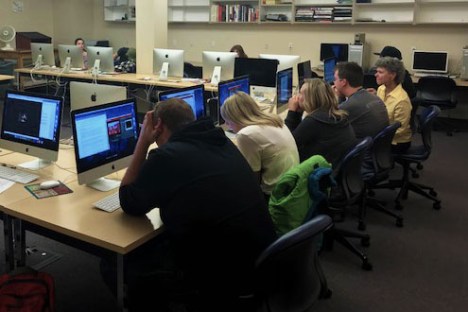
Class at the University of Utah.

It’s likely tough to imagine something good on the horizon when you are engulfed in such hostile and tense situations. But tragedy often helps one to understand and appreciate the most important things.

Aden Batar helps us to recognize most of those things aren’t necessarily tangible.

He says, “Peace is something you cannot buy.”


Public art initiative continues cultural legacy for University of Utah, state

Story and photos by CHRIS SAMUELS

When University of Utah students walk down the main stairs of the Marriott Library, they may not notice a 50-foot-tall mosaic of a stack of books.

Students walk by a public art piece in the Marriott Library.

Students walk by a mosaic created by Paul Housberg in the Marriott Library.

Or, while they’re studying on the third floor common area, they may not see a giant arch with Arabic and mathematical equations that wraps around the center of the open space.

Even in less noticeable areas, sculptures of books rest on bannisters and landings as students pass them by.

After they leave the library, many may be looking at their phones rather than observing sculptures at each of the Utah Transit Authority’s TRAX stations on campus.

Hidden in plain sight, public art can be noticed anywhere on campus.

Art instillations in spaces like the library and other buildings are actually a fixture of the university.

Luise Poulton, rare books manager at the Marriott Library, said three public art pieces were commissioned when the library was renovated in 2009. The works include a 50-foot glass mosaic that scales all floors of the grand staircase titled, “Another Beautiful Day Has Dawned Upon Us,” by Paul Housberg, and a collection of sculptures of books by Suikang Zhao.

But art in public spaces is not just an initiative of the University of Utah.

The state unveiled the Percent-for-Art Act in 1985 in an effort to introduce more art in public spaces and reach more audiences. According to the bill, the measure designates 1 percent of the cost of the building be spent on furnishing the space with permanent public art pieces. The intention of the act is to enhance “the quality of life in the state by placing art of the highest quality in public spaces where it is seen by the general public.” The act also “promotes and preserves appreciation for and exposure to the arts; and foster[s] cultural development in the state and encourage[s] the creativity and talents of its artists and craftspeople.”

A public art piece inside the Spencer Fox Eccles Building.

A public art piece inside the Spencer Fox Eccles Building.

Gay Cookson is director of the Utah Division of Arts and Museums, the state department that has authority over the bill. Cookson said public art enhances many of the newly created public spaces around the state, as well as the frequent construction projects that are going on around the U.

“I love that the statute is at 1 percent, and that public buildings have to be invested into arts,” she said. “Sometimes it’s hard to set aside a budget for arts, but with the statute, it’s really the one time when a building is being built that they recognize they need to do a significant investment in art. Even though it’s forced by statute, they were excited to be engaged in the work.”

Obtaining the art, Cookson said, is a process of application and determining what fits best with each publicly funded building. When it is nearing completion, a committee comprised of planners, building managers and those who will be using the space will review proposals for art pieces. At least one art expert is always included in the group.

Cookson said when a new project is considered, the Division of Arts and Museums can receive up to 40 different proposals by artists from Utah or across the country. The committee’s responsibility is to narrow the list down to three finalists. Those finalists are given $1,000 to construct a model to present to the committee. Then, a winner is selected and is given the funding to proceed with the art piece.

Cookson emphasized that the entire committee is not reliant on art expertise. She wants those who will view the instillations much more frequently than experts to make the decisions.

A sculpture of a book is displayed outside the Marriott Library

A sculpture of a book by artist Suikang Zhao is displayed outside the Marriott Library.

“We want the final say to be on who will be living in that space,” she said. “Which is kind of cool because you’re empowering people who really have no artistic experience to spend hundreds of thousands of dollars on art.”

Since the act’s inception in 1985, every new publicly funded building that is constructed must have 1 percent of the total cost of the building be dedicated to art, according to the bill. Buildings that were already completed by the time the bill was introduced are grandfathered in, and do not need to retroactively install pieces.

Administrators of public buildings can opt out of the art requirement if a certain percentage of the costs of building the structures are not met by public funds, according to the language of the bill. This was the case for the newly-completed S. J. Quinney Law School, which had enough private donor money in place to exempt it from the Percent-for-Art Act. However, Cookson said law school leaders wanted to honor the importance of art in public spaces, and complied with the mandate.

After a work is completed, the Division of Arts and Museums is responsible for the maintenance and repair of the pieces, according to the bill.

On the Utah public art website, finalists and commissioned artists of each project are publicly listed, with their website or portfolio attached.

A public art piece outside the Sorensen Arts and Education Complex.

A public art piece outside the Sorensen Arts and Education Complex.

Utah leaders advocate for more diverse leadership in the future

Story and photos by CHRIS SAMUELS

Kyle Reyes, chief diversity officer for Utah Valley University, said he wished that members of the Utah State Legislature — standing on the steps behind him — could be as diverse as the collection of several hundred middle school and junior high students gathered in front of him.

Kyle Reyes speaks to gathered students at Multicultural Youth Leadership Day at the Utah State Capitol, Tuesday, Feb. 16, 2016.

Kyle Reyes speaks to gathered students at Multicultural Youth Leadership Day at the Utah State Capitol, Tuesday, Feb. 16, 2016.

“Wouldn’t it be great to have our legislature reflect the diversity here,” Reyes said. “Our teachers that are in our schools reflect the diversity here in the state, so I think there is always work to be done. I think we can do a lot more, frankly.”

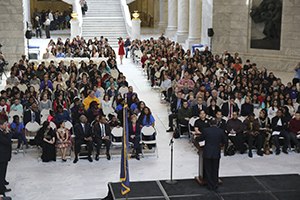
Reyes and other state and education leaders met Feb. 16, 2016, at the Utah State Capitol to speak to about 300 students for Multicultural Youth Leadership Day. In addition to Reyes, other speakers included Utah Gov. Gary R. Herbert and state legislators. A local spoken word group, Truth Cypher, gave a performance, as did a youth step troupe from the True Vine Baptist Church.

Speaking to the gathered youth, Gov. Herbert supported his state for having a long history of diversity and inclusion.

“Our early settlers came from western Europe whether they were Scandinavians, or English people, or Germans, others from Western Europe,” Herbert said. “That diversity is making us even stronger and more successful, particularly in the world’s economy of today, because we have so many different cultures and speak so many different languages in Utah. … We really speak the world’s languages, and that gives us some opportunity for economic growth as we go forward.”

Utah Gov. Gary Herbert speaks to assembled youth at Multicultural Youth Leadership Day at the Utah State Capitol, Tuesday, Feb. 16, 2016.

Utah Gov. Gary Herbert speaks to assembled youth at Multicultural Youth Leadership Day at the Utah State Capitol, Tuesday, Feb. 16, 2016.

Claudia Nakano, director of the Office of Multicultural Affairs, shared Gov. Herbert’s statement, and added that the state continues to be diverse.

“The U.S. Census is predicting by the year 2043, this nation will be a majority-minority nation, and in Ogden and in West Valley, they are already majority-minority cities here in Utah,” Nakano said. “One out of four preschoolers is ethnic and comes from an ethnic background. We’re hoping to inspire leadership, getting involved in your community, civic engagement, and take those seats up here on the hill and pass legislation.”

Youth came from as far as Ogden and Payson to attend the summit. Students listened to the program for about an hour and 20 minutes, which was followed by lunch and tours of the Capitol.

Students from across the state listen to speakers at Multicultural Youth Leadership Day at the Utah State Capitol, Tuesday, Feb. 16, 2016.

Students from across the state listen to speakers at the leadership day, Tuesday, Feb. 16, 2016.

The day at the Capitol is part of a greater initiative by the Office of Multicultural Affairs to involve diverse youth from around the state to become more involved civically. The office also organizes and holds a Multicultural Youth Summit every October, which hosted 2,000 students in October of 2015. The aim of the state-run department is to aid the state in making better outreach efforts to promote civic engagement and cultural diversity in government across the state. The summit is part of these efforts.

The summit, Nakano said, was designed in part by Gov. Herbert’s “66 by 2020” initiative. The project, according to the governor’s website, sets the bar of having 66 percent of Utah’s working-age population with a postsecondary degree or certificate by the year 2020.

“We want to help raise that graduation rate, and now with our changing demographic, we are becoming more diverse, not only in Utah but across the nation,” Nakano said.

Not all sentiments are positive on Utah’s outlook. Nakano conceded that the current makeup of state legislators needs to be more ethnically diverse, which would help support more diversity initiatives and better legislation on equality. Although no statistics are available on the ethnic makeup of the current legislative body, the vast majority are white male.

Kyle Reyes, UVU’s chief diversity officer, echoed these feelings, adding that higher education administrators from around the state are collaborating on diversity reform. But, he said state legislation still needs to be impacted.

“When I talk to people about multiculturalism, I like to say it’s not just another thing we do. It’s how we do business, it’s a lens that we wear,” Reyes said. “And if we can get more people, especially more people in powerful positions to wear those lenses and be a little more sensitive and be more culturally responsible, I think that will go a long way.”

Youth from the True Vine Baptist Church perform at Multicultural Youth Leadership Day at the Utah State Capitol, Tuesday, Feb. 16, 2016.

Youth from the True Vine Baptist Church perform at the Capitol, Tuesday, Feb. 16, 2016.

In the coming years, the Office of Multicultural Affairs will plan additional youth leadership summits and events across the state. Nakano said a smaller summit in addition to the large one in October 2015 was held in Ogden, which hosted 300 children. Smaller summits are anticipated in other cities in Utah, such as St. George, Cedar City and Vernal. The 2016 legislative session added an additional $30,000 in funding for the summit.


The Utah Cultural Alliance: Past, present and future

Story by JORDAN SENTENO

It all began in 1981 as Utah Citizens for the Arts. According to a history of the organization, it led the development of the public art programs in Utah. It also held events to help educate the community and elected officials.

Then, in 1993, it assumed a new identity and became the Utah Cultural Alliance (UCA). Its job is to work with the art and culture organizations as well as the legislators and county governments to solidify funding throughout the state of Utah and its community.

“Everyone and anyone can work with the arts and make a contribution to the community,” said Kate Ithurralde in an email interview. Ithurralde serves on the UCA board as treasurer.

According to UCA’s website, the organization serves as “the voice of the arts, humanities and cultural sector of Utah.” Its mission is to “empower and strengthen this community through advocacy, professional development and awareness.”

Crystal Young-Otterstrom, executive director of UCA, said, “It’s a great way to help the Utah community and for others to get involved and make a difference in the community as well.”

According to the website, UCA has transformed into a membership-driven organization comprised of many museums, corporations, and groups such as the Utah Division of Arts and Museums, the Stewart Foundation and the Salt Lake City Arts Council.

UCA has joined to help support the Utah community through cooperation, communication and advocacy in an attempt to help increase the value of the arts program in the state.

“I choose to be involved because the arts and humanities have a rich history in our state and I think we can do a better job supporting the sector,” said UCA Board Chair Jason Myers in an email interview. “By doing that I believe we will have more vibrant and rich communities — culturally and economically,” said Myers, who manages internal communications at Children’s Miracle Network Hospitals.

Young-Otterstrom said one way that community members can become involved is by becoming an advocate. “The most important part of advocacy is anyone can choose to be involved, can talk to an elected official. It’s really not a hard thing to get in touch with one of them and get involved,” she said in a phone interview.

UCA seeks community involvement to help impact the culture in Utah. The organization is committed to working with people to increase their individual and organizational knowledge of policy issues. UCA also involves the community by hosting events like Arts Day on the Hill in February, which UCA notes is an opportunity for residents to connect with their legislators and discuss why the arts are important.

UCA has a new five-year strategic plan for 2016-2020 that outlines its desire to become the forefront organization of Utah’s cultural issues. A subcommittee of the board factored in the mission, vision and value statements when creating the plan.

The subcommittee identified several guiding principles to help UCA accomplish its goal. For example, the small group recommended creating a separate advocacy branch that will enable UCA to endorse candidates and pursue fundraising to directly support advocacy efforts in Utah.

Another guiding principle is awareness. The organization aims to expand marketing and public relations in order to increase appreciation of the arts. It also plans to develop a Utah Culture Wiki, a comprehensive site about the arts and humanities.

According to UCA’s website, “the Utah Cultural Alliance [looks] to become the top voice of the arts, humanities and cultural sector of Utah.”

Marriage equality for people with disabilities

Story and slideshow by ANGIE BRADSHAW

Learn more about marriage equality for people with disabilities.

According to the Cornucopia of Disability Information, approximately 43 million Americans, or almost one out of five people, have a disability, making it the largest minority group in the U.S.  They are also among some of the poorest individuals. According to The World Bank, about 20 percent of the world’s poorest people have some kind of disability.

Employment is another challenge faced by people with disabilities. According to the United States Department of Labor, the 2013 unemployment rate for people with disabilities is 13.1 percent compared to 6.8 percent for people without a disability.

This could be the reason why so many individuals rely on assistance such as Social Security to help sustain a healthy living.

Among the many decisions faced by people with disabilities, marriage can be one of the most difficult.

Only 50 percent of individuals with a severe disability end up getting married, according to the Americans with Disabilities report.

The Utah state government assists single people with disabilities to help cover costs and provide accommodations where needed. But, if those individuals decide to get married, they could lose all their state-funded benefits or they could be substantially decreased. This leaves them to decide between marriage or continuing to receive benefits.

According to the Social Security Administration, the 2012 rates and limits are:

  • SSI will change from individual rate to couple rate.
  • If two people who receive Social Security Income (SSI) get married, they automatically receive 25 percent less.
  • Income limits: You can’t make more than $698 per month individually or $1,048 for couples to qualify for SSI.
  • Asset limits: You can’t have more than $2,000 individually or $3,000 as a couple to qualify. All of the following are counted as assets: cash, checking account, savings account, stock/bonds, and motor vehicles (except for one). If you exceed these amounts you do not qualify for SSI.

The difference in the benefits amounts between married and unmarried individuals is termed the “marriage penalty” by the National Council on Disability. Furthermore, the SSI can deem a couple married even if they are not legally wed. According to an article in Apostrophe magazine and the Social Security Administration, “The Social Security policy states that a man and a woman who live in the same household are married for SSI purposes if they hold themselves out as husband and wife to their community.”

Disability Rights North Carolina reported, “SSI beneficiaries are deterred from marrying because it will cause a reduction in crucial benefits that are already hardly enough for basic food, shelter and disability related expenses.” The document further noted, “For example, a national housing study published in 2007 found that the national average rent for a studio efficient apartment was more than a full SSI monthly benefit.”

With the cost of living on the rise, the amount of SSI benefits becomes more and more inadequate.

Drew Hanson, a senior at the University of Utah, has dealt firsthand with this. Hanson was diagnosed at age 4 with hearing loss. His parents made the decision to get him hearing aids, which he extremely disliked at first. “I would take them off and throw them across the room,” Hanson said. He has since gotten used to them and continues to use his hearing aids on a daily basis and uses lip reading as a back up.

At 24 years old he met Becky, who later became his wife. They waited two full years before finally deciding to get married. They had to weigh the options of having his benefits decrease and get married or hold off. Ultimately, they decided to get married.

Luckily, his wife got a job with the state and they now have benefits through her work..

They now have a 2-year-old daughter named Takira, which means, “treasure” in Japanese.

In several online articles many people believe the marriage penalty is an “anti-family” law and that something should be done. Citizens are advocating the marriage penalty and getting petitions signed, including a Facebook page called “Marriage Equality for People with Disabilities.” Their mission statement says, “Fighting for the right for people with disabilities to be married in all 50 states without financial, medical and economic penalties.”

There is also a website called thepetitionsite.com whose goal is to get 10,000 signatures to remove the marriage penalty against people with disabilities. So far, the petition has only 846 signatures.

Carly Fahey, also a senior at the University of Utah, has cerebral palsy. She said many people with disabilities wait a very long time before getting married or decide not to do it all because of the negative impact it could have on their lives.

“I’m confident that marriage will be wonderful,” Fahey said, “but figuring out the legal details will be an obstacle for sure. Something needs to be done.”

Randal Serr, director of Take Care Utah said in a phone interview that many people with disabilities are having difficulties with health insurance coverage and knowing where to start.

TCU provides assistance to those who are uninsurable because of their disability and pre-existing conditions. Employees work with individuals as well as 13 organizations in the Salt Lake Valley to navigate the health insurance process.

Serr said many health insurance companies are reluctant to insure individuals with disabilities because the state provides coverage through Medicaid and Medicare. Furthermore, he explained that under those programs there are many stipulations making it difficult to qualify and stay qualified.

For instance, the Social Security office decides who is considered disabled. People are asked a series of questions such as: are you working, is your condition severe and is your condition listed as a disabling one. From there, staff decide whether individuals fall under the disabled category.

“With Obamacare I think it will drastically change and be a positive direction for people with disabilities, on the application they don’t ask about pre-existing conditions,” Serr said. “In fact the only health-related question they ask, is if they use tobacco.”

As for marriage the fight continues in creating equality. Blogger Ashley Lasanta wrote, “To love and be loved in return is inherent to all human beings. To overlook or deny the rights of the disability community in their capacity to love and be loved undermines our ability to truly fulfill our commitment to better the lives of others.”

Tax incentives in Utah for hiring people with disabilities may go unnoticed

Story and photos by DYLAN LIERD

Federal and state tax credits aim to help Utah businesses hire people with disabilities. However, many companies may be unaware of the incentives that also strive to reduce the number of unemployed Utahns with disabilities.

Work Ability Utah, located at 1595 W. 500 South in Salt Lake City, advocates for unemployed Utahns with disabilities.

Work Ability Utah, located at 1595 W. 500 South in Salt Lake City, advocates for unemployed Utahns with disabilities.

According to Work Ability Utah, an organization that links employers with the workforce of people with disabilities, tax credits such as the Work Opportunity Tax Credit and the Utah Targeted Job Tax Credit are available for all businesses who are willing to hire Utahns with disabilities. But Carol Rudell, project director for Work Ability Utah, said not enough businesses are taking advantage of these credits.

“I see businesses that are perfectly willing to hire people with disabilities, but there are others that don’t know about the incentives,” Rudell said. “I see a lot of misses out there and a lot of stereotypes that are not true, and when people have more information they are more than happy to hire people with disabilities.”

The Work Opportunity Tax Credit is a federal tax credit that is designed to encourage cooperation with the Americans with Disabilities Act. According to Work Ability Utah’s website, businesses can earn an annual tax credit of $2,400 per hired person with a disability. Businesses can also earn a $9,000 yearly tax credit when hiring a disabled veteran. To receive these incentives, businesses must complete the Internal Revenue Service Form 8850 and the Employment and Training Administration Form 9061.

Businesses can also receive state tax credit by applying for the Targeted Job Tax Credit. According to the Utah State Tax Commission’s website, the purpose of its creation is to entice companies to hire people with disabilities in order to foster an integrated workforce.

The allotted credit minimizes the amount of income tax the business has to pay, and the amount of money the company receives is based on the salary paid to employed individuals. The maximum credit given is $3,000 per employee per year. This is a credit that can be received for the first two years that the person with a disability is employed. Companies are also not limited by the amount of individuals they can claim under the Targeted Job Tax Credit.

The Division of Services for People with Disabilities ensures the rights of Utahns with disabilities. DSPD is located at 195 N. 1950 West
 in Salt Lake City.

The Division of Services for People with Disabilities ensures the rights of Utahns with disabilities. DSPD is located at 195 N. 1950 West
 in Salt Lake City.

In order to apply for these services, the person with the disability must be eligible for services from the Division of Services for People with Disabilities. Businesses must then complete a TC-40HD form and have it approved by an authorized representative from DSPD.

Tricia Jones-Parkin is the program administrator for DSPD. She is the authorized person who accepts these tax credit forms. Jones-Parkin is tasked with training job coaches and approving businesses that apply for the Targeted Job Tax Credit. Job coaches are responsible for teaching employers how to professionally treat people with disabilities, and how employers can receive tax credits by hiring Utahns with disabilities. However, she said more businesses should be taking advantage of The Targeted Job Tax Credit.

“I haven’t received a single form turned into me this year,” said Jones-Parkin in a phone interview. “When I do training for job coaches, I tell them to tell businesses about the Targeted Job Tax Credit, but there is still not many businesses that do.”

Jones-Parkin also said that nationally, people with disabilities are the most under employed demographic. In Utah, the state is not doing much better than the national average.

According to the Department of Labor’s website, the unemployment rate for people with disabilities is 13.1 percent. This is more than double the unemployment rate for people without disabilities, which is 6.8 percent. That is why Jones-Parkins said that beyond the tax credits that Utah businesses receive, it is important to hire Utahns with disabilities in order to reduce this number.

In Utah, the Governor’s Committee on Employment of People with Disabilities works to advocate the importance of hiring people with disabilities to employers.

Leslee Hintze, executive director for the Governor’s Committee, said its members speak to employers about the tax benefits for hiring people with disabilities in order to entice businesses to hire these individuals.

“Once we advocate tax incentives to employers who have a tendency to say, ‘I don’t know if I can take this on,’ they are more likely to hire and continue to hire people with disabilities,” Hintze said in a phone interview. “Businesses really find out that they are great employees, they make the workplace better and they really do a lot for the business they are working for.”

According to the Committee’s website, businesses will also not see their Worker’s Compensation Insurance or Medicaid Insurance rates rise when they hire people with disabilities. Regardless of the incentives, Hintze said it also benefits the U.S. economy to hire people with disabilities so they can contribute financially to society.

“People with disabilities can give back tenfold by becoming taxpayers, which means they will become tax producers and not tax users,” Hintze said. “A country that does not take care of its least fortunate citizens, to me is pretty deplorable. It is a moral imperative, which is why businesses should be looking for opportunities like these because everyone will benefit.”

Is the LGBT equality movement the civil rights movement of the 21st century?

Story and slideshow by RENEE ESTRADA

Explore the Utah Pride Center and the Office for Equity and Diversity.

Throughout America’s history there have been movements toward equality. Americans who felt alienated or limited by the government protested, petitioned and fought for their rights.

The African-American civil rights movement followed after and spanned three decades, the 50s, 60s and 70s.

Currently, the LGBT equality movement is under way. The basis of the equality movement is to allow gay, lesbian and transgender couples the right to marry and all the rights that come with it, including, but not limited to health insurance benefits, tax benefits and estate filings.

According to David Frum of the Daily Beast, proponents of marriage equality have called it the “civil rights movement of our time.”

Not everybody is happy about this, including Frum and Jack Hunter, another conservative opinion columnist.

In Hunter’s article, “Why Gay Marriage isn’t the 60’s Civil Right’s Fight,” he argues, “There have been instances during the gay-rights movement that arguably could be compared to the black civil rights struggle, like the Stonewall riots of the 1960s or Matthew Shepard murder in 1998. … Still, with the possible exception of the mistreatment of Native Americans, there has been nothing quite like the systematic exploitation and institutional degradation experienced by earlier black Americans.”

Edward Buendía, an associate professor in the ethnic studies department at the University of Utah, disagrees with this notion.

“One of the arguments, against this movement as a civil rights movement, is that you don’t have lynching,” Buendía said in a phone interview. “Yes, there are not gay people being lynched, but we do have individuals that have lost their lives. Some people believe you have to be on the same level of scope to legitimize it and from my point of view, one life is too many to lose.”

In Frum’s article, “Let’s not call marriage equality the civil rights movement of our time,” he argues, “And while homosexuality has always had a large stigma attached to it, the number of gay people denied a job because of their sexuality just utterly pales in comparison to the number of black people denied jobs because of their skin color.”

Frum’s statement brings up another point. You can see when someone is African American. Meanwhile, you cannot see that someone is a homosexual.

The National Association for the Advancement of Colored People has endorsed same-sex marriage. According to a statement from the organization, “The NAACP Constitution affirmatively states our objective to ensure the ‘political, education, social and economic equality’ of all people. Therefore, the NAACP has opposed and will continue to oppose any national, state, local policy or legislative initiative that seeks to codify discrimination or hatred into the law or to remove the Constitutional rights of LGBT citizens.”

Regarding the endorsement, NAACP President and CEO Benjamin Todd Jealous said at a press conference, “Civil marriage is a civil right and a matter of civil law. The NAACP’s support for marriage equality is deeply rooted in the Fourteenth Amendment of the United States Constitution and equal protection of all people.”

In 2004, Utah residents voted to amend the state constitution to include a ban on same-sex marriage. In 2013, three couples challenged it. One of the couples is married in Iowa, but the marriage is not recognized in Utah.

Considering the Advocate, a national gay and lesbian news magazine, named Salt Lake City the gayest city in America in 2012, the statewide same-sex marriage ban is interesting. Granted some of the criteria were more humorous than serious, but the title still revealed Salt Lake City has a large, active, gay community.

“They [same-sex marriage bans] don’t make sense. They are restrictive and anti-people, because anytime the government says, you as a people, even though you didn’t do anything wrong, we are going to deem your existence illegal. That’s discrimination, and that’s wrong,” said Max Green, Equality Utah’s advocacy coordinator.

Green also offers another point. He believes the equality movement is taking an approach that is not seen very often. Supporters and advocates are tackling the most challenging aspect, and then moving on to more basic issues.

“This is the first time we’ve seen a sort of top down approach to an equality movement,” Green said. “In all other movements we’re seen bottom up. With the Civil rights movement, it was let’s start with something like desegregating the buses and desegregating schools, and then desegregating the military … so they went from the base up to the top. With the marriage equality movement it’s really starting at the top and going down, which is an interesting way to do things.”

Civil unions are offered as an alternative to same-sex marriage.

Thomas Allen Harris, who directed and produced a short documentary titled, “Marriage Equality,” disagrees with this alternative.

During an interview with NPR, Harris said that civil unions create a second-class label for gays and lesbian couples, making them less than heterosexual couples.

Some same-sex marriage advocates, including the three couples who are challenging Utah’s same-sex marriage ban, believe these bans are illegal, because of the decision affirmed by Loving v. Virginia.

The case Loving v. Virginia dealt with the legality of interracial marriage. According to a story in Slate, Mildred Loving and Richard Loving were sentenced to one year in prison for violating Virginia’s anti-miscegenation statute, the Racial Integrity Act of 1924. Eventually the Supreme Court ruled that the act violated the Due Process Clause and the Equal Protection Clause of the Fourteenth Amendment. It was clear in the decision of the court that the Justices found this to issue to be a civil rights issue.

In 2007, Mildred Loving issued a statement for her support of same-sex marriage.

“I believe all Americans, no matter their race, no matter their sex, no matter their sexual orientation, should have that same freedom to marry … said Loving. I am still not a political person, but I am proud that Richard’s and my name is on a court case that can help reinforce the love, the commitment, the fairness and the family that so many people, black or white, young or old, gay or straight, seek in life.”

Some say Loving v. Virginia has paved the way for Hollingsworth v. Perry, given their similarities.

Hollingsworth v. Perry is a case that was heard by the US Supreme Court on March 25, 2013. Plaintiffs argued Proposition 8, a voter-approved initiative to ban same-sex marriage in California, violated the Due Process and Equal Protection Clauses of the Fourteenth Amendment to the United States Constitution.

The decision of Hollingsworth v. Perry will not be out until June 2013. It seems until then Americans will have to see if the court deems same-sex marriage to be a civil rights issue.

Buendía sees the legal aspect is where the two movements intersect and share the most similarities. There were been many legal battles over segregation, and there are ongoing legal battles over LGBT rights, including housing and workplace rights.

While the movements bear some resemblances, it is clear there are distinct differences.

“We have to be careful of the significant difference for some people around race and color versus gender and sexual orientation,” Green said. “For some people those qualities don’t mix. We have to respect that and be aware not to rob someone of their identity.”

Shades of grey: understanding African-American voices on gun control.

Story and graphics by TREVOR RAPP
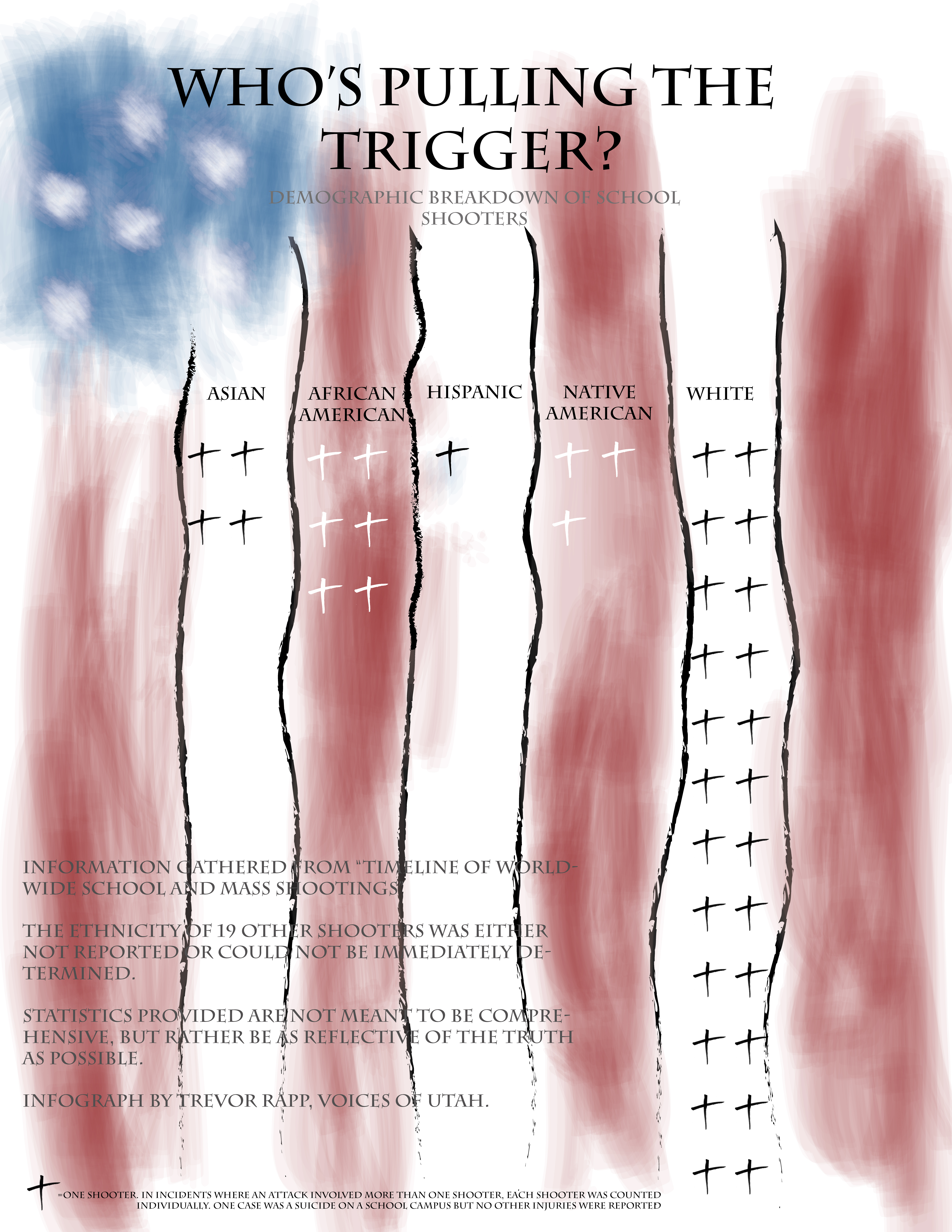
Break downs of the demographics of shooters in school shootings show the vast majority are not ethnic minorities.

What does a gun in a hand of a black man symbolize?

Three highly publicized photographs demonstrate the complexity and disparity of portrayals of the African-American gun culture.

In one, an African-American man stands alone in an apartment facing away from the camera, his head slightly bowed, enough to make out an outline but no details of his face. An AR-15 assault rifle with custom grips, a 30-round magazine and collapsible stock hangs from a sling off his back. His left hand grips a pistol of unknown make and caliber that he points at the ground.

In another, smoke explodes from the barrel of a shotgun being held by an African-American man with salt-and-pepper hair wearing a black Nike polo tucked neatly into blue jeans. He wears black sunglasses and ear protection.

In a third, a young African-American man’s face and upper torso fill the camera frame. Graffiti lines the background and tight braids slip out from underneath his black bandana. His chest is bare and he curls his bottom lip under to better show off the two rows of gold-capped teeth. Both his hands, with his index and middle fingers, form imaginary guns pointed at his head.

The first is of Colion Noir, a self-proclaimed “YouTube Personality, Gun Enthusiast, Budding Attorney, Regular Guy who happens to love Guns.” Noir is also a correspondent for the National Rifle Association.

The second is a photo released on the White House’s Photo Stream on Flickr with the caption, “President Barack Obama shoots clay targets on the range at Camp David, Md., Saturday, Aug. 4, 2012. (Official White House Photo by Pete Souza).” Much debate followed as to whether the photo was genuine or a staged photo-op to appeal to gun rights advocates.

The third is of rapper A$AP Rocky, who was praised by the New York Times for his debut album, “Long.Live.Asap.” the Times described him as being “a Harlem native with an expansive ear … one of hip-hop’s brightest new stars,” and, “a peacock, [rapping] with flair and authority.” One of the hit songs on the album, titled “F**kin Problems,” describes putting “your chrome to your dome,” a reference to putting a gun to your head. Other descriptions include acts of fellatio as making “it pop like an automatic or a nine,” references to automatic weapons and 9 mm pistols.

So what does it symbolize? Does the image of the average Joe portray a means of protection or a sign of paranoia? Is the image of a politician a depiction of high-class recreation or calculated propaganda? And for young, black males and females struggling to create their own identity, does this “art-imitates-life” photo provide insight and inspiration surrounding a successful artist, or social commentary on the numbing allure of becoming someone by racking up “street cred” points?

The answer is multi-faceted, with similar local and national conversations but quite different realities. Most importantly though, it’s a complicated answer that must be looked at through the lens of history, socio-economic factors and influences of the African-American family culture and African-American pop culture.

In the Salt Lake City area the true story for African-American gun violence, or crime for that matter, is not much different than the story for whites, said Salt Lake City Police Sgt. Shawn Josephson.

“It actually is one of those misnomers,” he said. “People tend to think that there is a significant difference [in crime] in the east side [a more densely white-populated area] to the west side [a more densely minority-populated area] and there really hasn’t been over the course of the history of the police department.”

However, the African-American population in Salt Lake City is extremely low. According to the United States Census Bureau, only a mere 2.7 percent of the population of Salt Lake City is African-American compared to 75.1 percent white. When taken in the context of the entire state the amount drops to 1.1 percent.

This makes it very difficult to get a statistical perspective on things like gun violence in the African-American community, Josephson said.

“As far as African-American [population], we are very, very low as far as our percentages go. … One person that’s a bad person can skew the whole percentages,” Josephson said. “I don’t believe [statistics] tell the true story most of the time.”

The same story seems to hold true in local school districts.

Jason Olsen, communication officer for the Salt Lake City School District, said, “We don’t see a greater propensity for violence in schools with a lot of minority students or schools without a lot of minority students. Our concern for school safety spreads across the entire district. It’s not really based on the ethnic diversity of certain schools.”

Olsen admits that concern for school safety was heightened in minority communities post-Sandy Hook, but also says it’s hard to gauge how much.

For example, though an astounding 200 Utah teachers poured into a single concealed weapons class right after the Sandy Hook incidents, Olsen has no way of knowing which teachers have concealed-carry permits, much less how the demographic breakdown is.

“In the Salt Lake School District we abide by the state law, that teachers with a concealed-carry permit are allowed to bring their weapon to school, but that weapon has to remain concealed and in their control at all times,” Olsen said. “Also the key point of what a concealed-carry permit is, is that it is concealed. We don’t necessarily know who would have a weapon and who wouldn’t.”

Later Olsen said, “Were there concerns in those [minority] communities? Yes. Were they greater than any concerns in any other communities? I didn’t get the feeling they were. I think the one thing that especially Sandy Hook has taught us is that acts of violence like this can happen anywhere. … It’s going to take the districts, the students, the community, community leaders, businesses, organizations, it’s going to take everybody to end this problem.”

But even in the apparent lack of a local problem, some Salt Lake City groups have expressed deep concerns about a very different reality of the effect of gun violence on the African-American community on the national level.

Jeanetta Williams, president of the NAACP Salt Lake Branch and tri-state conference of Idaho, Nevada and Utah, wrote a letter to Sen. Orrin Hatch detailing the epidemic proportions of gun-related deaths.

“The leading cause of death among African-American teens ages 15 to 19 in 2008 and 2009 was gun related homicide,” Williams wrote on April 12, 2013. “African-American children and teens accounted for 45 percent of all child and teen gun related deaths in 2008 and 2009 but were only 15 percent of the total child population. Clearly we have a stake in the debate.”

Earlier in the same letter, Williams “strongly” urged Hatch to “support the strongest policies possible, including implementation of a universal background check system; a ban on military-style assault weapons and high capacity ammunition clips; and tough new penalties for ‘straw purchasers’ of any size.”

But the presence of strong African-American voices like Williams’ hasn’t been seen much on the national stages. Since the Sandy Hook massacre of 20 children, the debate over gun control has raged like a white man’s Nor’easter blizzard, causing a whiteout in the mainstream media that has marginalized the African-American community. It’s a sea of Caucasian talking-heads with only a Black “blip” here and there. It leaves many wondering not just what is the African-American perspective, but where is it?

President Barrack Obama has probably been the most visible African-American in the debate. He made similar comments when he returned to Newtown on April 8, 2013, the place of the Sandy Hook massacre, to drum up support for more active gun control measures.

“I know many of you in Newtown wondered if the rest of us would live up to the promises we made in those dark days … once the television trucks left, once the candles flickered out, once the teddy bears were gathered up,” the Huffington Post quoted Obama as saying. “We will not walk away from the promise we’ve made.”
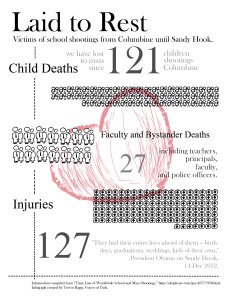
Since the attacks on Columbine rocked the nation until realizations of the Sandy Hook massacre, hundreds of people have been injured or died.

Since the attacks on Columbine rocked the nation until the more recent horrors of the Sandy Hook massacre, hundreds of people have been injured or died in school shootings.

Those promises included 12 Congressional proposals and 23 executive actions, according to a Jan. 16, 2013, New York Times story, “What’s in Obama’s Gun Control Proposal.” Some of the more controversial points included universal background checks, a ban on assault rifles and pistols that have more than one military characteristic (such as pistol grips, forward grips, detachable or telescoping stocks and threaded barrels), a ban on all rifles or pistols that have a fixed magazine that can take more than 10 rounds and a ban on all magazines or clips that hold more than 10 rounds.

In stark contrast to this opinion are other African-Americans like Colion Noir.

“No one wants to fight for their protection, they want the government to do it,” Noir said in a video posted on the NRANews YouTube channel on March 1, 2013. “The same government who at one point hosed us down with water, attacked us with dogs, and wouldn’t allow us to eat at their restaurant, and told us we couldn’t own guns when bumbling fools with sheets on their heads were riding around burning crosses on our lawns and murdering us.”

But all Noir’s bluster hasn’t necessarily allowed him to break through any publicity ceilings. Noir’s YouTube videos for the past month have averaged 60,000 total views, while Piers Morgan, a white male and frequent gun control advocate and commentator on CNN, still beat out those numbers in spite of drawing an all-time low of 87,000 viewers in the 25-54 demographic for his show “Piers Morgan Tonight.”

Still, Noir’s comments prompted a firestorm of blog and Twitter comments from various people. Among them was Russell Simmons, a business magnate who founded Def Jam recordings and Phat Farm clothing.

“Our community is not interested in a corporate sponsored gun group telling us what to do, when their real mission is to make more money for the corporations that line their dirty pockets with rolls of cash and silver bullets,”  Simmons wrote in “The NRA & Black People: Ain’t Nobody Got Time For That!” posted on globalgrind.

If the composition of the NRA board of directors is a reflection of its level of commitment to African-Americans, then perhaps Simmons’ mistrust is not off base. Of the 75 members, only four are African-American. Of these four, one is Karl Malone, the former NBA star who played for the Utah Jazz.

“We’re much smarter than that and certainly can see through their motives,” Simmons wrote. “Until they show a real interest in solving the violence problem in our community, they can keep their Yankee hat-wearing spokesman and their African-American ‘campaigns’ for themselves. In the words of another internet star, ‘ain’t nobody got time for that.'”

While Noir isn’t the only prominent African-American to reference historical violence enacted upon blacks to promote gun rights, such disparate opinions speak not just to the divisive nature of the debate, but also the depth and complexity that underlies the debate about the role guns should play in the African-American community.

Justice Clarence Thomas, the second African-American to serve on the United States Supreme Court, used various references to black history when he wrote in partial support of a 2010 court opinion. In the case involving a Second Amendment challenge to a Chicago ordinance that “effectively bann[ed] handgun possession by almost all private citizens,” Thomas observed that “organized terrorism … proliferated in the absence of federal enforcement of constitutional rights” following the Civil War. In particular, he addressed the Ku Klux Klan and its reign of terror. Thomas wrote that “the use of firearms for self-defense was often the only way black citizens could protect themselves from mob violence.” He added that Eli Cooper, “one target of such violence,” reportedly explained, “‘The Negro has been run over for fifty years, but it must stop now, and pistols and shotguns are the only weapons to stop a mob.”’

Thomas also quoted another man whose father had stood armed at a jail all night to ward off lynchers. That empowering experience, Thomas wrote, left the man feeling hopeful that mob violence could be halted by individual acts of “standing up to intimidation.”

Others have noted the necessity of being armed during the civil rights movement.

“It is a myth that the civil-rights movement was exclusively nonviolent,” wrote Akinyele Umoja, a professor in the Department of African-American Studies at Georgia State University, in “Black Ambivalence about Gun Control.”

Umoja detailed some of the provocations African-Americans suffered during the summer of 1964. Workers and volunteers in the Student Nonviolent Coordinating Committee, a civil rights organization trying to register local African-Americans to vote, were being harassed by “night riders,” white vigilantes who terrorized the SNCC. One night as a posse of night riders followed SNCC workers from the registration office, an 89-year-old woman armed and organized her children, grandchildren and neighbors and formed an ambush which so surprised the night riders that they never returned.

Umoja said in a phone interview that there was a shift between the 1950s and ’60s in how children got guns. Where before the “elders” took an involved role in teaching their children how and for what purposes to use guns, shifts in the general American culture that made it easier to obtain a gun illegally put more guns in the hands of “unstable elements.”

“It was a rite of passage for rural black families to teach children to use arms as a means of survival, for both food and protection. And black girls were trained to shoot to protect themselves from white rapists,” Umoja wrote in the article, which was published in the Chronicle of Higher Education.

But even deep-seated traditions of armed heroism don’t make for clear delineations among African-Americans on issues of gun control.

“There are some people in our community that don’t identify with either of the positions put out by the NRA or liberals,” Umoja said in the phone interview.

Though the rhetoric can be polarizing, the views certainly are not just black and white among the African-American community. Rather, the nuanced grey areas have to be understood through the many factors shaping and influencing the African-American community.

Umoja wrote in the article about social issues including the destabilization of families due to cuts in the federal government’s welfare system, increased individualism among blacks, declines in the manufacturing economy which employed many blacks, and increases in gang activity and the influx of drugs — all of which have led to an increase in cycles of poverty and gun violence, and by extension a motivation to support gun control.

But the fear of violence among under ground elements within the black community hasn’t erased the memory of violence from outside the black community, Umoja wrote. “Gun control for many black activists is at heart an issue of self-determination, self-reliance, and self-defense. But at the same time, we need to provide economic alternatives for black youths trapped in the drug economy; end the ‘war on drugs’ through decriminalization and the treatment of substance abuse as a public-health issue, and provide accessible and culturally relevant education that prepares black students for professions and entrepreneurship.”


From the Journalist’s Notebook, some reflections:

What does a gun in a hand of a black man symbolize?

For Utahns afraid of an overspill of violence from the 1 percent — a non-issue.

For those tired of being political puppets of a national white gentlemen’s club — white ignorance.

For those tired of being in the crosshairs of white oppressors — power.

And for those tired of looking down the wrong end of it — a call to find more peaceful way to build a community.

Salt Lake residents share perspectives on President Obama’s terms

Story and photo by RENEE ESTRADA

Could you imagine millions of people criticizing the decisions you make? Imagine millions of people weighing in on what you ate for breakfast, the clothes you chose to wear, and the car you drive.

In some respects this is what happens to the president, every day. Millions of people critique his decisions, speeches and beliefs. It is safe to say it is an exhausting position.

As if being judged by millions of Americans wasn’t difficult enough, he has the added pressure of representing a large minority group. According to the 2010 Census, African Americans make up 13.2 percent of the US population.

On Monday, Jan. 21, 2013, President Barack Obama was inaugurated into his second presidential term. There he promised to continue to lead the US, despite the exhausting nature of being the president. While the second term is often referred to as the “legacy term,” Obama’s second inauguration makes Americans reflect on the past four years and consider what may happen in the next four years to come.

In Utah, which is an overwhelmingly red state, African Americans make up a mere 1.3 percent of the total population. So would African Americans and other Salt Lake City residents here be proud, disappointed, or indifferent about Obama’s first term and the years to come?

Kendra Arado, who is African American, is a junior studying stage management at the University of Utah. She volunteered on the 2008 Obama campaign before she was even eligible to vote.

“Of all of his accomplishments, I am most proud of his work on health care. The Affordable Care Act will benefit the lives of millions of Americans. I think that will truly be his legacy,” Arado said.

Bridges

Bridges, an Obama supporter, studying at her home.

Zoey Bridges, also African American, is a junior studying biology at the U. Bridges also volunteered on the Obama campaign this year. She felt this election was going to be much closer than the 2008 election and decided to help out. She too is most proud of Obama’s work on health care.

“His work on health care is incredible,” Bridges said. “I am so proud of that achievement because it directly affects me. My sister, who is a diabetic, will be able to get the coverage and care she needs … and that’s just amazing.”

Kurt Bagley, a U alumnus who is white, was a field director on the Obama 2012 campaign. He echoed Bridges’ sentiments.

“Obama’s biggest accomplishment during his first term was passing comprehensive health reform,”  Bagley said. “Had President Obama not been able to pass this bill, it could have been a decade or longer for any other legislation to come about and the country would have missed the opportunity to address health care.”

Americans, regardless of political affiliation, have worries and concerns about the president. Everyone hopes that he will steadfastly guide the nation through difficult times and be able to make calculated decisions in distressing circumstances. Some Americans may hope he accomplishes his goals or hope that he will reach across the aisle when making policy decisions.

Both Bridges and Arado shared the same concern for Obama.

“Honestly, I hate to say it, but I thought it was entirely possible he could have been assassinated during his first term,” Arado said. “That would have been devastating.”

Bagley had a different concern.

“My biggest concern of his first term was that his opposition in the House of Representatives would ruin the economic progress he had already made,” Bagley said.

Obama has another four years in office, so looking forward to the next term Bridges and Arado share some similarities in what they hope Obama will accomplish.

Arado hopes to see more job creation and Bridges said, “I hope to see the unemployment rate come down. I’m concerned that I may not be able to find a job after college.”

Meanwhile, Bagley, who is currently a legislative intern for Planned Parenthood, had concerns about global warming.

“I’m hoping that he will find ways to continue to reduce carbon emissions, and take measures to help reverse the effects of global warming,” Bagley said.

Making progress in Washington is no easy task. It takes an incredible amount of energy and persuasion to get people to agree.

Stanley Ellington, president of the Utah Black Chamber of Commerce, believes that some progress has been stifled because Obama is African American, and furthermore believes a lot of the negativity about Obama is racially motivated.

Bridges suggested that political stagnation is just typical of Washington politics.

Arado said, “There is too much partisanship getting in the way. Democrats and Republicans need to find common ground.”

While this is a small sampling of Utahns, it is interesting to see that these individuals can have such different perspectives about the president. What he may symbolize to someone may be entirely different than to another person who also supports him. It seems that no matter what he symbolizes to someone, every American has hope for not only his future, but also America’s future.

University of Utah students focus on diversity in innovation

Story and photo by TREVOR RAPP

On Jan. 8, 2013, the University of Utah was ranked as one of the “top institutions in the country for startup formation,” according to the latest survey by the Association of University Technology Managers released in December 2012.

“Startup formation is in our DNA,” said Bryan Ritchie, director of the U’s Technology Commercialization Office, in a news release.

The genetic complexion of business innovation has significant meaning for one U student. He is not just a business innovator, he is a black business innovator.

“Black-owned businesses are, especially where I’m from in Lake City, Fla., a rare commodity,” Enis Henderson said.

Ennis Henderson, UofU student.

Ennis Henderson, UofU student.

Henderson is part of a research innovation class that tasks students to research opportunities to improve local or national communities.

“I chose the problem that was near and dear to my heart, which was trying to improve the quantity of black-owned businesses in America,” Henderson said.

While contemplating his project, Henderson’s mind stretched back to Lake City, Fla., where he grew up. He described it as a “Mayberryesque” town where the white people lived on one side of the tracks and the black people on the other. There he gained his first working experience “doing the jobs no one else wanted to do” like picking the tobacco, corn, peanuts and melon grown in his community.

When he was 22, he got his first lesson in owning his own business.

That lesson came from a casual conversation with a white insurance agent. After “taking a liking” to each other, Henderson said the agent explained that he took his two sons out to cut wood and then bring it into town to sell it. Each time they made a sale they would subtract their revenue from their operating costs to calculate their gross and net profits.

“That was the first time I had heard the words ‘operating expenses’ and ‘gross profit’ in the same sentence,” said Henderson, “and I said ‘Wow, how old are your boys?’ and he said ‘7 and 9.’”

“You aren’t born with an innate sense of how to do business,” Henderson said. “Someone has to teach you, or you have to go out and learn it. And if those people who don’t own businesses never had anyone in their family to take them by the arm to say ‘let me show you how to do this’ … and if they’ve never seen it or heard it — odds are they won’t do it.”

And recent statistics are showing that when compared to other minorities, African-Americans are not doing it.

According to “Black (African-American) History Month: February 2013,” published by the U.S. Census Bureau News, the black population, whether of mixed or non-mixed backgrounds, is 43.9 million. This represents an increase of 1.6 percent from the April 1, 2010, census.

Nevertheless, in a separate 2007 Survey of Business Owners conducted by the U.S. Census Bureau found that only 1.9 million businesses out of 30 million were black-owned.

For Salt Lake City, black-owned businesses are only 2.7 percent of the almost 24,000 total businesses, according to the U.S. Census QuickFacts.

These numbers haven’t been lost on Henderson. As part of his project he researched statistics published by the U.S. Census Bureau, the Bureau of Economic Analysis, and IBISWorld.com, a database of industry-based research.

As he spoke, Henderson pointed to various charts from those sources as he explained that while blacks outnumber the most profitable minority, Asians, by about 3-to-1 by population, they own about the same number of businesses. Even more surprisingly, Asians were making about three times as much profit.

“It’s completely inverted,” Henderson said.

Henderson isn’t the only person who has noticed a lack of diversity in local businesses.

Most African-Americans who come from the South or the Midwest don’t want to come to Utah because of the stigma that Utah has of not being a diverse community, said James Jackson III, founder and executive director of ACCEL (African-Americans Advancing in Commerce, Community, Education, and Leadership), a nonprofit organization providing resources to African-American small businesses in Utah.

Neither Henderson nor Jackson point to current racial prejudices as the current cause of the problem. However, the “genesis” of the problem is deeply embedded in the history of slavery in the United States, Henderson said.

For Jackson, the most pressing need is increasing the level of education for all Utahns. Jackson was appointed by the governor to the Utah Multicultural Commission, an advisory group for issues relevant to local minority communities. “The main song that was sung through [the commission’s various] committees, whether it be health, education, corrections, economic development, all of them leaned toward education in some way,” Jackson said.

Those numbers are reflected in the April 1, 2010, US census as well, with only 18.4 percent of blacks reporting having earned a bachelor’s degree, and only 1.6 million blacks reporting having earned an advanced degree.

And the effects are real. The annual median income for black households declined by 2.7 percent from 2010, making it almost $10,000 less than the national median income for families, according to “Black (African-American) History Month: February 2013.” The U.S. Census Bureau News also reported a 27.6 percent poverty rate among blacks, almost double the national average.

For Henderson the answer is availability of resources. “What I recognize is that it’s a lack of information. Now there’s a ton of information out there on the internet there are types of agencies people can go to to get information. But they don’t know what to ask for if they did go to an agency,” Henderson said. “They’ve never been informed. The resources are there but they don’t know what it is, they don’t know what it’s for.”