Jacob Rueda

MY STORIES:

MY BLOG:

Spring 2020 has been one of the most challenging semesters yet. The outbreak of COVID-19 plus a 5.7 earthquake were among the things that made this semester a particularly difficult one.

Jacob RuedaDespite the drawbacks, there were highlights as well. Receiving recognition for work I did the previous semester was something that felt good. I worked hard to carry on the dedication and focus of the previous semester in the face of whatever challenges took place this year. Needless to say it was tough but I got through it as best I could.

One skill I developed throughout the semester is the ability to self-correct and refine my work to improve my storytelling ability. In some instances it’s easy to state the obvious or use clichés to accentuate a point in the story but it takes greater skill to do something different that might get readers not just to keep reading but to develop their thinking about something, be it a situation, a person or a condition of their environment.

When this beat was announced, I was not sure how I felt about it. I had low expectations of the area and of what I thought I would be reporting on. My perceptions ultimately stayed the same after reporting on Salt Lake City’s west side but there were a few bright spots. I was able to get more in-depth views of the area and there were some things that were interesting. In the end, exposing marginalization in all its forms from the socioeconomically and politically imposed to the self-imposed is one thing I learned working this beat. I tried to show a reality that was honest and factual but not without triumph from those who experience it. In other words, I wanted to show that despite the conditions that give way to marginalization, individuals still thrived and were helping others do so.

Covering a beat like this was a great way to learn about reporting issues of strife like drug abuse, poverty and perhaps, I would say, war and social conflict. One doesn’t learn anything about the world covering routine or commonplace things unless it’s done in a manner that evolves the perception or function of what one is covering. I also believe that reporting on strife improves how positive stories are reported which I think is important.

Professionally speaking, I believe news outlets benefit from someone with varied experience. Beat reporting has a purpose and there are individuals who sculpt such reporting to provide angles never explored. For me, that’s fine for a while but I would want to cover something else after a time. For example, the opioid crisis was something I enjoyed covering. I also enjoy covering business and how it relates to seemingly unconnected topics. Like I mentioned earlier, I think it would be interesting to cover a war zone or the impact of war on various aspects of life. As a writer and a journalist, there is much more to see and experience than a single beat and although I may approach some assignments with trepidation, it will teach me something about the world and about myself.

I like shedding light on perspectives that are not explored. I believe that is a skill I am still developing at this point. The challenge in doing it well is finding an angle that hasn’t been explored yet. Most people know the basic information about the things they’re exposed to. If they look at something for a while and move just a little in any direction, they’ll encounter it from a perspective they’ve never seen before. It’s something that a lot of people take for granted but it is a phenomenon that, if taken more seriously, would reshape how we live our lives or relate to the environment around us.

ABOUT ME:

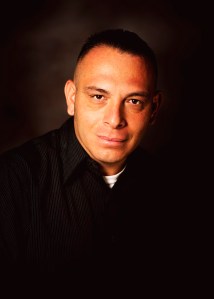
I am currently a junior at the University of Utah majoring in communication with an emphasis in journalism. I am originally from Quito, Ecuador, but I have lived in the United States the majority of my life. Aside from writing, I enjoy food, music and travel.

Utah’s air: Not good for what ails you

Inversion

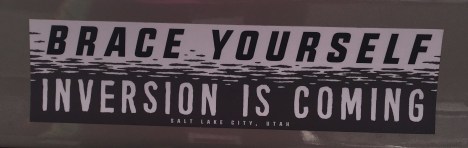
Brace yourself — The inversion is coming. This is the text of a bumper sticker.

Story and photos by SARAH SAIDYKHAN

On July 24, 1847, Brigham Young and the Mormon pioneers of what is now The Church of Jesus Christ of Latter-day Saints arrived on the outskirts of the Great Salt Lake Valley looking for a new place to corral their wagons and set up camp. The church’s archives state that as Young gazed over the vast and barren land sprawled out before him, he said, “This is the right place.”

City View

Salt Lake City.

Nowadays we know that what Brigham Young was looking at were massive mountain ranges surrounding a desert-valley landscape. This mountain range design creates a makeshift bowl that protects the valley from strong winds and other harsh elements. Along with adventurous recreation, the mountains assist in creating high- and low-pressure systems that trap toxic particulate matter in the air during winter inversions and smoke-filled haze pollution resulting from possible summertime fires.

Kellie McCleve lives in the southern end of the Salt Lake Valley and is a mom to five kids under the age of 14. From her home, she is able to see the smog pollution that covers the Valley. She said, “Sometimes the sky’s so gross you can’t see anything but like, a yucky, brownish haze. It covers the whole Valley.” McCleve said that when she takes her kids into the city, she has a mask for each of them to wear. “It’s so gross! We shouldn’t be breathing that in. No one should be breathing that in.”

Smog Lake City

Light haze covering the Salt Lake Valley.

But every day, hundreds of thousands of people do breathe it in. McCleve said that when she moved, the inversions were something she could see from a distance. But now she knows her home was never actually immune. “I worry because when we moved out of the city, I really thought we escaped it, we didn’t. We just see it now from a distance. It’s always around us but it’s worse down in the Valley.” McCleve believes that no one person can fix the depleted air quality and for now, she continually looks for ways to lower her carbon footprint saying, “We’re all responsible for the problem and that means, we’re all responsible for cleaning it up. If we don’t, we’re all in trouble.”

Today, Utah is home to over three million people and the Kem C. Gardner Policy Institute projects that by 2065, Utah will be home to roughly six million people. Even as the state grows more diverse, there is still an environmental justice divide visible in the Valley.

The east side houses a predominantly white population. One can usually find new and remodeled schools and readily available public transportation. There are pricey coffee shops every few blocks and multiple grocery stores within walking distance where residents can purchase organic, fresh fruits and vegetables. The east side of the Valley also sits at a higher elevation and in a way, overlooks the west side. But even at higher elevations, the air is still filling with particulate matter from emissions, just not at the same levels as what accumulates in the air down on the Valley floor.

West Side Industry

Westside industry.

The west side of the Valley houses a large majority of Utah’s lower-income families. There’s more diversity in the communities and predominantly, most people of color live on the Valley’s west side. Grocery stores are spread miles apart from residents, creating food deserts, and there’s a significant lack of public transportation. Instead of coffee shops and farmers markets littered throughout the neighborhoods, there are factories, refineries and major transportation, and trucking hubs all contributing to the air quality.

With the depleted air quality in the Valley, who is affected the most? Anthony Sudweeks is one of the principals at Wallace Stegner Academy (WSA), located on Bending River Road on the west side of the Salt Lake Valley. The school offers a free, college preparatory education for grades K-8. With over 600 students, the majority of kids attending WSA are Hispanic, students of color and/or from low-income families who reside in the neighborhoods surrounding the school.

Sudweeks said he is asked by parents frequently, “Can you keep all the kids inside for indoor activities?” As much as he wishes that were possible, it’s not a reality. A few days of inside play are OK, but kids need to run and expel their energy so they can pay attention and learn while the teacher is instructing. Instead of packing hundreds of energy-filled kids in a crowded lunchroom like sardines in a can, the school adheres to strict guidelines on how the red, orange and yellow days are handled.

utahblueskyslc

A “green day” in Utah.

Sudweeks said, “On red days, no kids play outside. On orange and yellow days, students with asthma or heart conditions, who have to have a doctor’s form filled out, don’t go outside.”

The school uses one of the state’s outdoor air quality monitoring websites to decide who or if any students go outside during the orange and yellow days. “There are air testing monitors that the state funds all over the place,” Sudweeks said. “There’s one about two blocks from here.” He and the other employees at WSA are vigilant in making sure that the kids are not outside when the inversions are happening and when the air quality monitors show that any unnecessary exposure to the air would not be safe.

WSA checks the air quality website multiple times daily because, even though the weather is not the culprit, the pressure systems may change from morning to afternoon. But Sudweeks said, “It’s not really dependent on the weather. High- and low-pressure fronts can change it, but the air quality’s not very unpredictable. It’s predictable. In the morning we know what it’s going to be like in the afternoon, it doesn’t randomly change. It doesn’t predict green and turn into a red.”

Sudweeks did say that during the winter inversions the forecast will sometimes show a yellow day in the morning, but by the afternoon it will have turned into a red day. Those days, he said, “It’s a constant check, constant.”

An inversion builds, trapping pollution.

The area of WSA is surrounded by four major freeways. Sudweeks explained that the neighborhoods around the school are some of the worst polluted spots in the state when it comes to bad air quality. So, why knowingly put a school in an area that suffers from some of the most polluted air in the state? “Because this is where our students live,” Sudweeks said. “This is Glendale, and most of our students live in Glendale. If we moved the school somewhere else, what we’d be saying is, these kids don’t deserve a good charter school.” Glendale is a suburb of Salt Lake City and according to Statistic Atlas, roughly 40 percent of the population living there is Hispanic.

Sudweeks quickly affirmed, “This is their neighborhood and these kids absolutely deserve to have a great school in their own neighborhood.” He said that one of the reasons why the school’s location was decided was “to make sure that the kids living in some of the most polluted and lower-income parts of the city still have access to the best education possible.”

Sudweeks explained the environmental justice issues the school and area are facing. “It’s a nationwide phenomenon where the lower the income neighborhoods are, the more likely they are to live in bad air quality. Nearer to freeways and industrial areas.” He said that’s also particularly true in Utah. The area is economically growing and with that growth brings large diesel-fueled trucks, more traffic, congestion and, overall increased pollution.
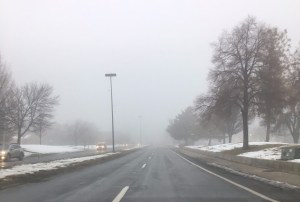
Winter Smog

Eastside winter smog — University of Utah’s family housing.

Sudweeks also ran for state legislature in 2018. One of his platforms was Utah’s air quality, more specifically, the air quality monitors and their need to be updated. He said, “They need about $3 million invested into them because they’re falling apart. The session before the last, they voted to not put any money into them and this last session they put $1 million. But they are in desperate need of upgrades on the monitors themselves.”

Sudweeks said he feels like the majority of the legislature just doesn’t care because it would mean truly facing the air pollution problem. “They just pretend like it’s an issue we have no control over, which is not true.” Sudweeks said the state could completely move to Tier 3 fuel, which is low in sulfur and according to the EPA, reduces carbon dioxide emissions into the air.

Sudweeks said the state is also needing a revamp of the public transit system to meet the needs of the people. “Buses don’t get people on public transits, trains do,” he said. “We’re a big enough county where we could justify a large investment into public transits. Because of our air quality needs, we have no business not investing heavily in public transits.” Sudweeks referenced the recent legislature and said, “No money for public transit, but a lot of money for widening and expanding roads.”

He said Utah’s inversions give residents a false sense of security in believing the air is only bad when inversions are happening. A large study by Harvard T. H. Chan School of Public Health agrees. The study found that EPA standards may not be strict enough in preventing premature deaths from air pollution. The research showed that if particle pollutions in the air could be lowered by roughly 10 percent, the death rates of people 65 and older would be lowered, possibly saving 7,000 to 10,000 lives each year.
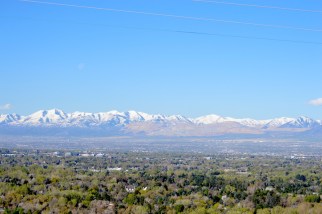
Hazy City

Haze building over the Salt Lake Valley.

Improvements to the air quality in Utah have been made over the years. Technological advancements created cars that run on natural gas and batteries. Electric vehicles, trains and buses are carrying more people around the Salt Lake Valley, reducing the need to get in a gas-operated vehicle for a quick drive to the store. More homes are being powered through renewable solar energy, and in general, more people are aware of the issues of air pollution and what contributes to it. Still, with all the improvements, there is a visible racial divide when it comes to air we breathe.

Rep. Angela Romero represents Salt Lake Valley’s House District 26. She is also one of the many advocates fighting for clean air in Utah. Of the roughly 39,000 people living in her district, almost 60 percent are Hispanic and people of color.

Romero said in a phone interview that when the topic of air pollution comes up, people have to realize there’s more to it than just air pollution. “There’s an environmental justice concern for those affected the most.” The EPA recognizes environmental justice as the fair treatment of all people regardless of race, color, national origin, and income with regard to the development, implementation, and enforcement of environmental laws, regulation, and policies. This means that every person living has a right to a fair and meaningful life and protection from environmental and health hazards. This is not the case for hundreds of thousands of people living in the most polluted parts of the Valley bowl.

Romero said, “Most working-class communities and communities of color, live in areas that are more industrial, so they’re going to be exposed to more toxins in the air than others.” She and her colleagues are looking at the intersectionality of all issues facing people of color and marginalized communities. “We’re not looking at how they collide and how they displace people, it’s how they all work together,” Romero said.

As the Valley becomes denser in population, Utahns must continue being vigilant in finding and implementing ways to stay ahead of the added pollution. Romero said, “It’s kind of hard for us to solve the problem if we’re not coming up with innovative ways to address it [air pollution].”

Public Transportation

Riding public transit lowers dependence on fossil fuels.

Cleaning up the air is not a one-person job. It’s everyone’s job to work together to make it better. Romero said that a lot of time people want to put all the blame on industry and other heavy air polluters. But, she said, “We don’t look at ourselves and what small things we can do when we’re looking at air quality and energy. How do we play a role in that? What are some practices that we can change in our own lives?”

Romero said she’d like to see the state focus on using more renewable energy sources like adding roof-top solar panels to all state-run buildings and offering higher discounts to homes using solar panels. Businesses and homes can also update their heating and air-conditioning units to function more efficiently. Romero said it comes down to all residents making the commitment to change the habits that are contributing to the depleted air quality.

Utah has over 200 sunny days a year. Roof-top solar is an important investment for Utah’s future economy. More importantly, using a 100 percent renewable and clean energy source can help to improve the long-term health of all residents.

In the Salt Lake Valley’s mountain landscape environment, there will always be air pollution concerns. “We have inversions,” Romero said, “and they’re never going to go away, but what can we do to be more proactive, so we don’t make them worse?” Romero said that people can make little changes like taking public transit. Even though it may take a bit longer to get somewhere, plan for it and make it part of the routine. Walk or ride a bike if only going short distances and carpool whenever possible. The more we drive, the more we’re creating dirtier air with our cars. Romero said, “Getting people out of their vehicles and onto public transportation is a great way to start.”

Bikes are readily available around the city.

About the future of Utah’s air quality, Romero said, “We’re trying to be more proactive. We’re looking at inversions and air quality and we’re looking at it more from a public health perspective.” She also said, “If we truly want to change the route we’re going, we have to reevaluate systems that are in current existence. It’s not only about communities of color and marginalized communities. It’s about us as an entire community.”

Romero said all it takes are small changes in everyday routines to help improve air quality. Any day is a great day, to start a new and healthy habit.

To make improvements to Utah’s air quality, follow the CLEAN AIR plan:

C: Carpool whenever possible
L: Limit cold starts on cars and combine trips
E: Engage in clean air advocacy
A: Access public transportation
N: Navigate smog ratings and engine types
A: Avoid unnecessary commutes
I: Idle less or not at all
R: Ride a bike or walk when possible

To learn more ways to help clean up Utah’s air, visit the Utah Department of Environmental Quality, Utah Department of Health, or Air Now.


This slideshow requires JavaScript.

Utah may be next to experience a physician crisis

Story and photos by Justin Trombetti

The concept of representation in modern society can often be a fickle thing. It’s also becoming a hard conversation to avoid; it was a massive focal point of the most recent midterm elections, it’s garnered both highly positive and staunchly negative critiques of our modern media landscape, and for better or worse, the political climate of 2019 America has thrust an unending array of opinions to the front of our social commentary.

Emotions aside, the reality is that minorities and historically marginalized groups are not represented visibly in proportion to the population percentages they make up.

While this issue is far from exclusive to them, it is especially relevant to Hispanic populations. In fact, it’s a large part of the reason why California is currently facing what has been termed a physician crisis. That is, while Hispanics make up over 40 percent of the state’s population, they account for only 12 percent of graduating physicians.

It’s been posited that this has resulted in disproportionately poor health and community-wide vulnerability that, at its current rate, would take over 500 years to equalize.

It would seem that, upon a deeper dive into the matter, the issue is far from specific to California. Further, while healthcare is an immediate concern, it may well be a problem that extends beyond just a single sector of the service economy.

Utah is experiencing its own tension in the local health sector, as its rapidly growing population has begun to feel the strain of underrepresentation. Yehemy Zavala Orozco, preventive health manager of Comunidades Unidas, has been on the front lines of this reality for eight years.

The West Valley City-based organization’s primary mission is to “keep families healthy and together,” and Zavala Orozco (whose preferred pronoun is they) believes that the odds are stacked against the communities it serves.

They believe the underlying issues of representation are just the beginning of a multifaceted dilemma facing the Hispanic community. “No one gives you a guide,” they said of first-generation immigrants who often struggle to find resources that not only speak their language, but also understand them on a cultural level.

Zavala Orozco recalled a story of a first-generation mother from Guatemala with whom they recently worked. “The doctors found a lump in her breast and she needed surgery. They thought she might have cancer.”

On top of the woman dealing with the gravity of her diagnosis, Zavala Orozco said she found little help with the hospitals and offices she dealt with. Language barriers alone created a back and forth with her care professionals that made treatment more stressful and time consuming. Instances where miscommunications led to hospitals completely missing information along the way were also prevalent.

Zavala Orozco believes that there’s an extreme lack of investment and effort from the government to shift these paradigms. They cited the backpedaling on the 2018 initiative Proposition 3, which dealt with Medicaid expansion that would have had a strong impact on the Hispanic population, as a primary example of this.

They strongly suggest that Utahns must begin bolstering the opportunities available to Hispanics that allow them to ultimately join the professional sectors where their communities are underrepresented.

“We need to ensure they know college is an option, they just don’t see options other than places like [Salt Lake Community College] or trade schools,” Zavala Orozco said. They also believes that access to higher education is often too expensive for minority groups, and helping to remove the financial barriers of access is essential to reversing these trends.

In Utah, physical health is not the only concern Hispanic populations are faced with. In a state where suicide rates among this group are close to double the national average, mental health treatment is just as important.

Brad Drown, a licensed clinical social worker in Murray, has seen some of the same problems in his field that Yehemy Zavala Orozco discussed. He stated that it’s common for Hispanics in Utah to go without mental healthcare. Drown added in his multiple decades as a social worker, he’d only ever treated a small handful of Hispanic patients, and that while this could be a geo-demographic reality, independent research and data from his colleagues show similar trends.

According to Drown, this is very much a cultural issue, and less so a linguistic one. He noted that Utah boasts a higher number of multilingual resources available in his line of work due to the growing population of Latinos and the large number of return missionaries who lived abroad in Spanish-speaking nations.

The issues lie partially in a pattern of cultural stigmas he’s noticed, but more prevalent is the problem of a shared cultural experience that can often make therapy more effective. While he believes it isn’t always a necessity for everyone, many people feel more comfortable seeking treatment when they believe there are providers who understand them on a deeper level.

Perhaps most important to note, however, is that a common experience does not always mean a common result. While it’s crucial to recognize the hardships that many Hispanics face, assigning victimhood to an entire population, especially one with so many positive victories, can be short-sighted.

Andres Rivera, who runs Myo Tensegrity Massage in Draper, provided some context on this. He said he’s been lucky to experience a different side of the matter.

“We moved to California when I was 8, and everyone spoke Spanish [where we lived],” he said. Even in Utah, he lived in areas with a dense Hispanic population, and he believes this made integration easier.

“My mom spoke OK English, but mostly Spanish. It made it a little difficult but going to certain places that were recommended [by other Spanish speakers] was a big thing,” he continued. “It helped to have connections where she felt comfortable as far as speaking Spanish, especially with finding places of employment, things like that.”

However, Rivera felt it important to acknowledge that he does not think that’s how it is for every immigrant family. “Older people that came here is where it’s more of a thing where it makes sense to befriend someone with a shared cultural experience. I can see why someone [that didn’t immigrate as a child] would really want people who understand where they’re coming from.”

The idea of representation is important to minorities and oft-marginalized groups, especially when it comes to health. While it doesn’t necessarily affect everyone equally, it’s a pressing concern that currently has no end in sight for a significant population of Hispanics in Utah and nationally.

Zavala Orozco said that beyond empowerment, investment in local organizations like Comunidades Unidas can have an enormous impact on the day-to-day lives of Utahns. It may not be a problem that can solve itself overnight, but awareness and grassroots effort can go a long way.


La Quinceañera: A girl’s coming-of-age celebration is a rite of passage

Story and photos by SARAH SAIDYKHAN

It could be said that most people have at least one tradition or celebration they carry with them throughout their lives. Weddings, family reunions, bar mitzvahs, cultural holidays, coming-of-age celebrations and more. These traditions become a safety net; a way to keep focus in a sometimes crazy world. No matter where you live, it can be important to keep traditions alive.

In Latino communities, one of the many traditions is the Fiesta de quince años or the quinceañera. When a young Latina girl turns 15, she is celebrated with a party unlike any other event in her life. According to an article in the Journal of New York Folklore, this birthday is a rite of passage.

For young Latino men though, there are no special coming-of-age celebrations. Alejandro Garcia, human resource director at the Marriott City Center in Salt Lake City, said he remembers back to when he asked his mom, “When do I get my quinceañera?” Garcia said his mom chuckled and explained, “It’s just for girls.”

In a quinceañera, the girls are honored through this special celebration and then introduced back into their communities as young women. This event is a milestone in Hispanic culture, but not all young girls feel they need to have such a lavish party.

La Bella Piastra

La Bella Piastra

Mercy Garcia, who works at La Bella Piastra on Gallivan Plaza, said, “I chose to have a quinceañera, but my sister decided not to have one. She is very shy and didn’t want all the attention this type of celebration brings.” Garcia said she loved her quinceañera and wants to carry on the tradition.

Before the young Latina girl turns 15, she is given a choice as to what she wants for her special day. The girl’s parents could throw her a birthday party extravaganza or almost anything else she would like to do. If she chooses the party, the only issue is finding a space big enough to hold the possible hundreds of guests — families, friends, neighbors and more — who will join in the celebration.

The quinceañera ceremony today typically has six main parts to it with dancing and meals throughout the event. According to Bella Ballroom, first is the formal entry where the young girl makes her grand entrance. Second, one or both of the parents or godparents make a toast to the birthday girl. Next is the first dance, usually a waltz danced with the girl’s father. The events move on throughout the celebration with a group dance for the immediate family and then the preferred song and dance, which is going to be a favorite of the birthday girl. Last is the final dance, often a waltz. Some families also choose to add other components to the ceremony depending on local traditions and desires of the birthday girl.

According to one published history of the quinceañera, the tradition has changed over the years. Before the 20th century, girls were considered for marriage once they turned 15 and potential suitors would give gifts to the girl’s family as dowry. This is when the idea of a quinceañera started — a small party to celebrate the transition into womanhood. While mingling with family and friends, the young girl would be able to meet and visit comfortably with these potential suitors.

In preparation for the girl’s birthday, Q by DaVinci, a company that specializes in quinceañera dresses, said the women in the community would pull together and plan the event. They would spend time teaching the girl the responsibilities she would need to know, like cooking, cleaning, laundering and even details about childbearing. Then, these older women would bestow upon this new young woman their inspirations to help her throughout life.

During the Chicano Civil Rights Movement in the 1960s, more Latino families were traveling into and around the United States. As they moved around, their traditions were carried and shared with others. Over time, the quinceañera changed into a celebration that young girls experience today — elaborately themed attire, ballgowns, home-cooked or catered feasts, plentiful drinks, delicious cakes along with family, friends and lots of dancing.

You Are InvitedSalt Lake City resident Emily Thompson recently attended her first quinceañera and said, “When I walked into the room, the decorations were as extravagant as any wedding I had ever been to. The girl’s dress was beautiful and almost matched Cinderella’s ballgown.” Thompson said the event was mostly in Spanish. Even though she’s learning the language, she said it was a little too difficult for her to fully follow. But she said, “I couldn’t control my tears when they did a portrayal of the daughter growing into adulthood.” Thompson said it reminded her of being both a young woman and also being a mother of two young women. “This moment touched my heart and helped me understand the entire meaning of the event.” With watery eyes, Thompson smiled and said, “This celebration was about the love for their daughter.”

Ermy Jaco, who also works in the hotel industry, said she prefers the quinceañera over a larger wedding celebration later on, due to the special traditions. “The surprise dance, the changing of the shoes and the last toy,” Jaco said, “these are all part of the special change into womanhood.”

In the book, Once Upon a Quinceañera: Coming of Age in the USA. Julia Alvarez writes about the traditions of the shoes and the last toy as symbols of leaving childhood and entering womanhood. The shoe ceremony allows the young girl to go from wearing flat, dress shoes to wearing heels. Because girls are wearing heels much younger than 15 nowadays, Alvarez said this is now done for symbolism.

IMG_4792

Eventos Reception Center

The last toy is meant to signify the last doll the young girl will receive. Alvarez also explains the clothing on the doll should match the quinceañera and during the ceremony, the girl will usually cradle the doll to symbolize the end of her childhood. In addition, the doll may represent the child that she herself could be having in the not-too-distant future.

But what happens when the birthday girl decides she doesn’t want this huge celebration? “A lot of girls are deciding not to have a quinceañera and are choosing things like a new car,” Jaco said. “My daughter chose the new car.” Jaco said girls today have different priorities and need different things. “And at 15 they’re definitely not looking for a suitor!”

Now, not all girls want a new car. Blogger Grecia Hernandez writes on Quinceañera, an online party-planning resource, that some girls just want something different. They might choose a VIP dinner at their favorite restaurant with their best friends or a girls-only weekend. Some will choose to visit a theme park or even take a family vacation instead. Hernandez said, “A quinceañera is not about spending tons of money but more about celebrating such a special moment in your life, your coming of age [party].”

The last step after the ceremony, according to the Joyful Event Store, is when the parents give thanks to the young girl for being beautiful. They also thank God for bringing her to them. The girl then acknowledges her parents for everything they do and for giving her the party and then tells the guests she appreciates their presence.

It doesn’t matter what theme the girl chooses for her party or if she even wants to be honored with this celebration. A quinceañera is about celebrating the young girl as she grows into womanhood.

IMG_4794

Eventos — Hours

Planning for this special event takes time. Multiple event centers in Utah specialize in catering and hosting quinceañeras, including Eventos Reception Center, Arcoiris Reception Center, Villa Magnolia Eventos or the Colonial Reception Center. Event coordinators understand the importance of this celebration and work hard to make the day memorable for the birthday girl, her family and the friends who have come to celebrate her.

Multilingual churches of Utah, Spanish-language growth in LDS community

Story and photos By BRIANNA WINN

It’s a snowy, dreary mid-January Sunday in Springville, Utah. A group of Hispanics is gathering outside the Kolob Stake just off of 1230 South and 500 East, with their families dressed in their suit and ties, fancy dresses, and normal church attire. They are holding copies of the Book of Mormon, translated into Spanish.

They enter a welcoming, snug room full of other members of their faith whilst “Holas” and “Cómo Estás” are instantly spread around the room. The hymns start and everyone can sing along.

IMG_2376

Imagine living in a world where there is a mass amount of viewpoints, and no place to find truth, express your faith or worship your God because of a language barrier.

The Book of Mormon Alma 29 says, “For behold, the Lord doth grant unto all nations, of their own nation and tongue, to teach his word, yea, in wisdom, all that he seeth fit that they should have…”

The Mormon religion was founded in 1830 by Joseph Smith. The Book of Mormon, sacred and holy text of the church, was originally said to be written in Egyptian, according to the church’s official website. Today, it offers scriptures in over 90 different languages and plans on translating scriptures in 34 more languages.

The LDS church has grown immensely in Spanish-speaking countries and the Spanish-speaking LDS community is growing substantially in the state of Utah.

Church officials say the presence of Mormonism began to first grow in Mexico in 1875. Brigham Young, president of the church at the time, called on six missionaries from Salt Lake to bring Spanish-language materials about the church to Mexico according to LDS.org.

Salvador Gonzalez is a bishop for the LDS church at Kolob 14th Ward in Springville, Utah. Gonzalez moved to the United States from Spain where he joined the church in 1982.

“There are 58 Spanish-speaking wards and branches in the state of Utah,” Gonzalez said in an interview via email.

A ward is a single congregation, containing 300 or more members. A branch is smaller, typically having 200 or more members, according to Mormon.org.

Pew Research Center says the Church has more than 15 million members worldwide. Seven percent of those members belong to the Latino(x) community and the number is only growing.

“The Latino(x) community have a connection with the Book of Mormon and the history,” says Gonzalez. “Hispanics in other countries are connected with the history written in the text. When missionaries go and teach in these countries, the people recognize the history and are drawn towards the church. They have a connection within the church.”

Bret Ellsworth, manager of Immigrant Services Welfare Department of the Church, said in a telephone interview “The Hispanic community has been coming to the church, and to Utah in particular, in record numbers. The Hispanic growth rate is growing quite rapidly, he said for example, in West Valley the Latino population is up to 28%.”

According to LDS.org, Spanish is the second largest language group in the church. By the year 2020, it is presumed that Spanish will be the largest language group.

Ellsworth works with immigrants every day, especially Latinos. “The Immigrant Services program reaches out to Hispanics and helps them by giving them free and reliable resources and information he says, and by ensuring they’re not taken advantage of in any way.”

Missionary work has had a great impact on the increase in the Hispanic community. The Mormon News Room says missionaries serve in pairs, teaching the gospel and baptizing believers in the name of Jesus Christ. They travel to many different Spanish-speaking countries.

Gonzalez says, “Missionaries travel to over 21 different Spanish-speaking countries.”

The Missionary Training Center, or MTC, is a training center to prepare missionaries before they go on their mission. This is where they learn Spanish language if needed or required.

After serving a Spanish-speaking mission in the country of Ecuador in 1994, Bryon Buchmiller didn’t want to give up his association with the Spanish-speaking community. “Serving my mission in Ecuador was an incredible experience, he says. “Everything about it was great, from the language to the people, to baptizing new members. I would love to go back.”

IMG_2383

Buchmiller says he tries to keep up with his Spanish language, although it is hard. He tries to attend a Spanish-speaking ward every once in a while, to keep up on his Spanish and speak with the other members.

He said being immersed into the culture and being around the natives was really the easiest way to pick up the language and continually improve at it.

“Sometimes when I drive, I try to speak Spanish to rekindle my memory, Buchmiller says, “since it’s been so long since my mission, I don’t get to speak it every day.”

The article on LDS.org, How Can I Better My Mission Language, is a useful resource for returned missionaries looking to improve on their language skills or keep up with their learned language.

“There are more Spanish-speaking people being converted than English-speaking people in the church,” Gonzalez says.

Today, all LDS scriptures are available in Spanish.

Spanish-language is becoming one of the prominent languages in the church next to English. There is a staggering amount of Latinos(x) being baptized causing Spanish-speakers to take up a huge chunk of the church’s worldwide membership, according to Mormon.org.

Cultural diversity has long been a part of the American experience. The way the church is growing, Mormonism continues to lean heavily towards diversity, specifically in the Latino(x) community.

IMG_2330 (2)

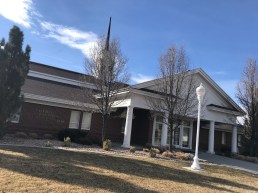
The Church of Jesus Christ of Latter-Day Saints located on 1230 South and 500 East in Springville Utah.

Kolob Stake in Springville is just one of the many Stakes in Utah that offer a welcoming religious place to the Hispanic community. Find a Meeting House or Ward is a helpful resource that shows where different wards/branches are, including Spanish-speaking wards and branches.

Now, Hispanic families all over the state of Utah can worship and read scriptures in their own native language.

Kilee Thomas

MY STORIES:

Processed with VSCO with m5 preset

MY BLOG:

Throughout the semester, this course has challenged and broadened my perspectives, not simply on the Latinx community, but on my role as a professional reporter. It would be bold of me to say that I was completely comfortable covering this beat. To put it bluntly, I was terrified. And for one reason only: I felt that I didn’t have the right authority or background to poke around and write these stories. Thankfully, as time went on and as I began interviewing my sources, I gained the confidence I needed to present myself and my work the way a true journalist would.

My confidence came from realizing that all beats need to be covered and not just simply from a journalist perspective with similar upbringings, but covered by all journalists. What makes a compelling story, a great story, is telling it from a different perspective, a different pair of eyes. Journalists come in all different shapes and sizes and our approach to a story or beat is what’s going to challenge and engage our readers.

As a student trying to further and expand my professional development, this experience pushed me to become a better writer, a better interviewer, a better researcher and all-in-all, a better journalist.

At first, I was a little taken aback at how timid I was asking sources for a potential interview. As a journalism student, I have interviewed dozens of people throughout the span of my college career, but these interviews were always lined up for me. Having to ask a stranger for permission to interview them caused more anxiety than I had initially anticipated going in. This class gave me the opportunity to practice seeking out interviews and feeling secure in doing so.

As for the interview itself, I am very comfortable. I have no problem posing questions and leading the interview in the direction I want it to go. There’s no better feeling than asking a question and getting an answer that lights a spark within your interviewee and uncovers some hidden truth or fascinating story. The instant gratification of question and answer is the most satisfying part of being a storyteller. I feel like Indiana Jones unearthing this great revelation.

The biggest truth I’ve dug up throughout the semester is that I’m still learning how and what it means to be a journalist. I have a long way to go and there’s no end in sight because a great journalist is a lifelong learner.

Covering this beat gave me the chance to further my development as a broadcast journalist by helping me create diverse story ideas, angles and locate non-white sources to interview. I’m excited to see what I will learn and what I will teach others from utilizing my voice as a journalist.

ABOUT ME:

Kilee Thomas ’19 is from West Jordan, Utah. Kilee graduated from University of Utah with a B.S. in Communications with an emphasis in journalism. She currently holds an internship at ABC4 news and previously held an internship for Good Things Utah. She has written published articles as a writer for HerCampus, an online magazine publication, as well as for Voices of Utah. After graduating, Kilee is hoping to become a news reporter/multi-media journalist.

Kimberley Mangun

MY STORIES:

  • My headline goes here

MY BLOG:

ABOUT ME:

Kara D. Rhodes

MY STORIES: 

MY BLOG:

This beat was not a far cry from topics I usually choose to write about. I will be graduating Spring 2019 with a B.S. in Gender Studies as well as Journalism. You could say that I major in social justice – if you wanted to. I tend to write about the LGBTQ+ community therefore I chose to incorporate that with the chosen beat.

While my first story is not about the LGBTQ+ community I wanted to learn more about the idea of culture within the Latinx community. I am not one who has such a rich culture and it has always fascinated me. Throughout the semester I was thrilled at the response I got from members of the LGBTQ+ and Latinx communities. Everyone was so willing to tell me their stories and it was very inspiring.

While I was reporting on this beat there were often times I felt like an “outsider.” There is this whole other beautiful community that I got to see that I hadn’t before. I prefer to be an outsider when reporting because it forces you to get the facts out. I’ve got my fair share of opinions when something is associated with the LGBTQ+ community so it’s difficult to be non-biased. When writing these stories that connected the two it was completely different. I enjoyed seeing my perspective of something with slight twist on it. It showed how similar we all are but how different our journeys are.

Over all, this semester and this beat have been a success. I furthered my education in journalism, which is ever growing. I learned so much about the Latinx community and I attained more published pieces for my resume.

ABOUT ME: 

Kara is a University of Utah student graduating in Spring 2019 with two B.S. degrees — in Communication and Gender Studies. Kara has a passion for making a positive change in the ever changing world today. Journalism assists her by making her Gender Studies degree applicable to the world.

Kara began her love for writing by reading all the Junie B. Jones novels and creating a blog in her adolescent years that dramatically explained why boys didn’t like her.

Processed with VSCO with c1 preset

When Kara is not studying at the university she is participating in every yoga opportunity that she can. Licensed with a 200-hour YTT (Yoga Teacher Training), Kara is passionate about yoga. Music, fashion, and pop culture are other hobbies that Kara enjoys talking, writing, and speaking about. She dreams of changing the world, looks at dog videos on Instagram, and reads books she wishes to understand.


Iasia Beh

MY STORIES: 

MY BLOG: 

The biggest challenge for me was time. My car broke down at the beginning of this school year so I wasn’t able to drive anywhere, but I didn’t realize how far everything in this valley truly was. I tried to keep my stories on campus as much as possible, but it was hard as the semester progressed because students got busy with midterms and such so they didn’t have time to sit and chat with me anymore.  

Other than that major inconvenience, I enjoyed working with the beat. I am pretty active in the Latinx community so it wasn’t hard for me to find things to write about, just hard for me to get to them. I love that I was able to use the resources that I already had and put them to use.

I never felt like an “outsider” because this is a community I interact with on a daily basis. The biggest thing for me was staying unbiased and to interview new people. To be honest, I was kind of jealous of the people who aren’t part of the community as it would be easier for them to not have a conflict of interest and to meet new people. I was often racing to find people I didn’t know.

It was often hard for me to figure out what was a story because I am so engrossed in the community that everything that happens just feels like every day. It was nice, however, to be in a more comfortable space. As a woman of color, it’s hard sometimes to go into super white spaces and have them take me seriously.   

Working in this beat solidified my career goals for me. I have always loved working with communities of color and have become even more sure that it is what I want to do. I hope to use my legal degree to help people like the ones I interviewed live the lives they are entitled to.

ABOUT ME: 

Iasia Beh is a current law student at Pepperdine University in Malibu, California.

A Murray, Utah, native, she graduated from the University of Utah with a BS in Communication in 2019.

Beh credits her skills in writing to not having television as a child and her interest in journalism to her father, who forced her to listen to NPR on car rides.

Beh hopes to become a public defender in the future and to one day meet Michelle Obama. She can be found on Twitter (@IasiaBeh) and on Instagram (@iasiabeh).


Sayaka Kochi

MY STORIES:

MY BLOG:

Recalling the past few months, I have been through multiple challenges that I had been afraid of tackling. One of the biggest challenges was getting out of my comfort zone and making myself feel excited when I talk to new people.

As a non-native English speaker, the language barrier was one of the biggest concerns. I was scared that I might say something inappropriate, which has the potential to hurt someone who takes time for me and share their personal stories with me.

Because of this fear, I couldn’t enjoy from the bottom of my heart the times spending with the interviewees at the beginning. However, as I interviewed multiple persons who were not fluent in English like me, I was really inspired by how strong their words were. They spoke with passion no matter how difficult to speak the non-native language.

Listening to their strong voices, I came to be able to focus more on what I want to tell but not how I tell. Language is a significant tool in communication. But, more importantly, I could realize that I had to be more open to those who talk with me. As I was encouraged by those interviewees, I could find myself excited without feeling any fear when I talked to new people.

I also found difficulty in setting my own viewpoints aside. It was really tough. Since I am in the minority group as the interviewees are, I had resonance with their feelings at some point. I compared their stories with mine, which let me stand at their side. Hence, each time I finalized the drafts, I showed them to a third person so that I could see my stories from the readers’ viewpoints.

Through getting over some challenges, I could learn the basic skills of reporting, such as how to interview and how to write an eye-catching title or lead. I still have so many skills that need to be trained, but at least, I have recognized that I can get a little bit closer to be a professional journalist. I’m sure this experience will help my future self, involving in the communication field.

ABOUT ME:

IMG_0493I am a senior-year student majoring in communication with a journalism emphasis at the University of Utah. Meeting new people and listening to their stories always makes me feel excited and empowered. But, actually becoming a journalist was not on top of my career choices.

I used to dream of becoming an ecologist. Since I grew up around nature and animals in Japan, I have naturally desired to know more about ecology and save it from environmental destruction. I, therefore, started learning biology when I got into Shizuoka University in Japan. As I spent time in the classrooms and outside the campus, I had a lot of opportunities to see new people who inspired me in many ways. Their words showed me another world. I could talk to various researchers as well. Their stories struck me. In a series of these experiences, I came to be more motivated to seek new stories, new people, and new experiences than research. After I completed the bachelor’s degree in biology, I flew to the United States in 2017 to see the whole new world. Now, I desire to be an environment journalist.