ACCEL business card emphasizes taking the community to the next level
Born and raised in Utah, James Jackson III was the only black person
in his school until he reached the fifth grade. When he reached high
school, Jackson was one of about a dozen black students.
Jackson said that Utah’s significant lack of diversity makes him
excited to see new black people in the community. He said there are
very few unfamiliar African American faces in the state.
Recognizing this diversity gap at a young age, he chose to make a
difference in Salt Lake City by launching a business called ACCEL,
African-Americans Advancing in Commerce, Community, Education and
Leadership.
The idea of such an organization began in late 2005. Angel Bumpers, an
African American who had recently started her own business, Beyond Beautiful, realized that there was no black chamber of commerce to
assist her in her business journey.
After starting Beyond Beautiful, Bumpers became one of the original
founders of the Utah Black Chamber of Commerce, hoping to help other
business owners.
Bumpers was in her mid-20s when the chamber was founded. She said
many people thought she was too young to take on the responsibility.
Due to this, she said she was forced to step down from her position.
She chose to resign from the chamber altogether.
Jackson, also a co-founder of the chamber, said that by 2008, the
organization seemed to have stalled.
He established and founded ACCEL in 2009 as a place for the black
community to come together, network with each other and recognize
other black Utah business owners.
According to ACCEL’s website, the majority of Utah is unaware of
black-owned businesses in the state due to “lack of exposure and
support of the community.” If the black community came together for
this one purpose, “a powerful synergistic organization would be
created to stimulate and excite the black marketplace.”
According to the US Census Bureau, there has been a small increase of
black people in Utah over the last four years. Jackson attributes
this growth to Utah’s overall growth and the growth of the economy
itself. With ACCEL, the increased amounts of African Americans in the
state have a place to turn when they are in need of help with business
ownership.
Jackson said some of the black-owned businesses in Utah include
catering companies, barbershops, physical therapy offices, moving
companies, network marketing companies and many more.
Although there are many black-owned businesses in the state, Bumpers,
owner of one of the longest-run black-owned businesses in Utah, said
Utah is still falling far behind the rest of America in regards to
minority-owned business exposure. She believes this is due to a lack
of knowledge, lack of communication and lack of support.
Jackson hopes to overcome these obstacles by sharing details about
ACCEL and how it can help individuals who are interested in starting
businesses.
Providing these things to the community requires support from others.
ACCEL has built up a large array of supporters including Zion’s Bank,
Budweiser and PepsiCo, who all provide donations to the organization.
Jackson said these organizations are passionate about being involved
with diverse organizations.
Having the support of others gives Jackson the opportunity to do what
he loves — educate others. With ACCEL, Jackson is able to do exactly
that.
Jackson focuses on the strange paradox of Utah having a strong economy
yet a lacking educational system. Through ACCEL he hopes to improve
education for the youth of Utah by offering seminars, networking
events and scholarships.
By helping other business owners and educating the youth, an important
part of his journey through ACCEL is to “remain humble and
never be afraid to ask questions,” Jackson said. “You learn more when you’re humble
rather than prideful.”
For many outsiders, these are the words used to describe the state of Utah and its values. But steadily, more and more diversity has moved within Utah’s borders.
The increasing job market has given birth to a new pilgrimage to the state, one vastly different than the one Brigham Young and his Mormon followers made some generations ago. It’s bringing a new wave of African Americans and their families who have uprooted their lives from the other side of the country, and have settled down in the Salt Lake Valley, eagerly attempting to start a new life, but simultaneously maintaining their Southern roots.
According to the 2010 U.S. Census, the African American population in Utah is at 1.3 percent, which is up 65.9 percent from the 2000 Census that listed the African American population at 0.8 percent. A major cause of the increase was Hurricane Katrina and relocation efforts in 2005. According to ABC News, nearly 600 evacuees were brought to Salt Lake City in the wake of Katrina.
The entire state saw a 23.8 percent increase in total population, which many believe to be a sign of Utah’s economic growth in times of dismal economic decline. According to Forbes.com, the employment growth average for the state of Utah is 0.6 percent per year, which differs drastically from the national average of -0.6 percent per year. This and many other reasons led to Forbes.com listing Utah as the best state for business for the third consecutive year.
James Jackson III is the founder and executive director of ACCEL (African-Americans Advancing in Commerce Community Education & Leadership). He is a firm believer that Utah’s increasing African American population is due to the state’s growing job market. “Most of them move [to Utah] because of a job,” said Jackson about African Americans moving from the other side of the country.
Jackson and ACCEL have helped numerous black-owned small businesses in the greater Salt Lake area by offering members greater networking resources, financial guidance and emotional support from other members. Moving companies, catering companies, physical therapists, network marketing, financial services, barbershops and restaurants have all been opened by African American citizens and are aided by ACCEL. “The ethnic community is very tight … and the businesses reflect that,” Jackson said.
Marcus Brinson, part owner of Papa O’s restaurant in Draper, is hard at work in the kitchen. Papa O’s is one of the newest members of ACCEL.
Take a trip down to 11483 South State St. in Draper, and you might as well have driven down to a country kitchen in southern Florida. Papa O’s soul food restaurant is a newer member of ACCEL and has been offering authentic Southern-style comfort food to Utahns since October 2012. Marcus Brinson is part owner and manager of Papa O’s. He and his family, including four of his seven children, moved to Utah from Naples, Fla. (near Fort Myers) last September, after his sister, who also lives in Utah, said there was no diversity in the food.
“I was really hesitant,” said Brinson about moving his family from Florida to open a restaurant. Brinson said the business went through a turbulent time when sales would be booming one day and excruciatingly slow the next.
In addition, he said some of his employees were not passionate about the food, or the restaurant’s customers.
“We had some employees that put us in a bad spot,” Brinson said. “So I made a change.”
He decided to make the restaurant a family affair. His kids clean tables and take orders, he and his sister take turns managing the restaurant, and he even has his mother making all the desserts by hand. All of the restaurant’s dishes are family-kept recipes including juicy fried chicken, smoky barbecue ribs, creamy mashed potatoes and macaroni and cheese, crispy fried okra, and five different kinds of cornbread.
Stanley Ellington, the executive director of the Utah Black Chamber of Commerce frequently attends UBCC meetings at Papa O’s as well as at other black-owned businesses in the greater Salt Lake area. Ellington still thinks the state has a long way to go in reaching racial equality in small business platforms.
“I have discovered there is a great divide between the haves and the have not’s,” Ellington said. “They [African Americans] don’t have the resources that are needed in order to create their business … that’s why I’m in Utah … to be a leader.”
Ellington was born in Alabama and lived in Washington, D.C., both of which are considered hubs for the national African American community. He moved to Utah in 2000 while serving in the Air Force and decided to stay after retiring in 2002. Ellington believes that the number of black-owned businesses listed in the census information is overrepresented. He also believes that several black-owned businesses in Utah have failed due to a lack of knowledge and racial tension within the state.
“People know prejudice is alive and well,” Ellington said. “We’re [UBCC] coming [up] with a solution.”
Overall, the economic future looks bright for all Utahns. As employment rates rise, so too does the state’s diversity.
A report made by the Small Business Administration Office of Advocacy showed that Utah had 241,692 small businesses in 2008, accounting for almost 50 percent of private sector jobs. These numbers are expected to grow after another report by the U.S. Chamber of Commerce listed Utah in its top-10 economic “Boom States.”
Additional Photos courtesy of CAROLYN STWERTKA and CRAIG GRITZEN.
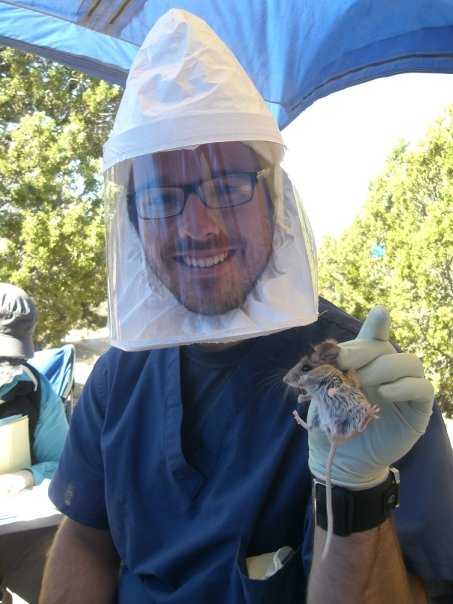
Craig Gritzen doing fieldwork in the Great Basin Desert, in Juab County Utah, 2009. Working with the sin nombre virus requires the use of specialized headgear to prevent human infection.
It’s a delicate and time-consuming process.
University of Utah graduate researcher Craig Gritzen spends his days at the U’s Dearing Lab viewing parasites through microscopes and testing for the sin nombre virus. However, it’s not medical research he’s doing, but biological studies of parasite and virus correlation in Utah’s population of deer mice.
The U is well known for being on the cutting edge of medical research and innovation. With an entire section of the campus dedicated to a fully-functioning research hospital, it can be easy to forget that the university also serves as a quality institution of scientific research that spans from biology and immunology, to meteorology and paleontology and more.
Gritzen is just one of the many students and professionals at the U doing important research that rarely gets the press of its better-known medical counterparts. But that doesn’t make it any less vital.
“There’s a lot of opportunity for students to pursue their interests,” Gritzen said. “You really find yourself as a scientist when you do research.”
Doing research is exactly how Gritzen spends most of his days. A graduate student pursuing his master’s in biology, the core of Gritzen’s work is investigating possible correlations between the numerous parasites that can be found in the guts of deer mice, and the deadly sin nombre virus that the rodents carry.
Gritzen’s work represents an important step forward in understanding the dangers of at least one type of Hantavirus, a genus of virus that can be fatal to humans if inhaled. He hopes his research can help to track sin nombre virus infection in future deer mice populations and provide more warning for the people who live in deer mice populated areas, such as Emigration Canyon.
“Understanding what parasites are infecting these mice and identifying the effects of the parasites on the mice will allow for researchers to understand whether the parasites will increase or decrease the likelihood of the mice becoming infected by the virus, which in turn can determine the likelihood of humans getting infected due to close proximity to the mice,” Gritzen said.
Protospirura numidica is just one of the many parasites that can infect the digestive tract of Deer Mice.
Gritzen’s research could benefit Utahns who live in close proximity to the mice, who are, by default, at risk of inhaling the rodents’ feces and contracting sin nombre virus. The virus, which fills human lungs with liquid, literally causes the infected human to slowly drown.
“Humans who live in close quarters with the mice are the ones in danger of being infected,” Gritzen said. “It [his research] is important for people who live in environments where the mice can live and thrive.”
Of course, biology isn’t the only field of lesser known, but important research going on at the U. Two graduate researchers at the U’s Atmospheric Sciences Department are working on separate research projects that could shape the future of pollution regulation and legislation, and save energy investors millions of dollars.
Carolyn Stwertka is one of those researchers. She is working on a revolutionary new atmospheric model that could help us truly understand and accurately measure carbon dioxide emissions.
An inversion creeps across the city as Carolyn Stwertka hikes up the Grandeur Trail to gather carbon dioxide density measurements of Salt Lake City’s surface air.
Stwertka, a graduate researcher in the U’s Atmospheric Sciences Department, is working with a unique set of carbon dioxide measuring sensors set up across the Salt Lake Valley that help measure and compare carbon dioxide output across the valley and into the upper atmosphere. The outcome, Stwertka explained, should help scientists truly understand the amount of carbon dioxide circulation in our atmosphere and its effect on the population.
These sensors, she said, represent the “longest standing, consistently running set of stations in a city in the world.”
Part of what makes Stwertka’s research unique, besides the network of established carbon dioxide sensors, is that Salt Lake City represents an exceptional staging ground for her research and the development of her carbon dioxide tracking model.
“Essentially, Salt Lake City is a great place to study [carbon dioxide circulation] because it’s so isolated,” Stwertka said. “It’s very difficult for air to drain out of this valley.”
What has Stwertka discovered so far?
With research that has spanned from crunching years of data, to a hike up Millcreek Canyon’s Grandeur Peak lugging a backpack full of electronic, atmospheric measuring equipment, Stwertka’s unpublished results seem to indicate an interesting atmospheric affect.
Carbon dioxide seems to create a sort of bubble around cities like Salt Lake, which is quite similar to another scientific phenomenon known as the “heat island effect.”
“That [her research] is important because the human population is growing, more people are moving into cities, and more carbon dioxide is being added in the atmosphere,” Stwertka said. “If there is going to be [future] regulation on carbon dioxide, they should be enforced in cities because that is where the highest concentrations of human-created emissions are.”
Stwertka’s research represents real progress, not only in helping to solve Utah’s inversion and pollution problems, but could even be used to better understand global climate change and pollution regulation around the world.
With climate change and global warming becoming a hot topic around the world, Stwertka’s work is extremely relevant, if unconnected to U researcher Ryan Oates’ atmospheric studies.
Ryan Oates uses global climate models to simulate massive increases of carbon dioxide in earth's atmosphere in order to make observations of its affect on the polar vortex.
Oates, whose work is also based in the Atmospheric Sciences Department at the U, is based around an established phenomenon known as a “Stratospheric Sudden Warming Event.”
These warming events take place above the North Pole in the upper part of the atmosphere, known as the troposphere. The events are basically destabilization of the polar vortex, a massive circulation of the atmosphere during the winter months above the North Pole that directly affects mid-latitude weather.
Oates said the cause of these polar vortex destabilization is simply strong weather fluctuations below the vortex.
“The troposphere affects the polar vortex but it also works the other way,” Oates said. “So when you have these sudden warming events, that then impacts storm tracks. ”
That’s where the money comes into play with Oates’ research. With energy representing a billion dollar industry that relies on weather forecasting and the understanding of storm tracks and weather patterns during the winter, adding more knowledge to that database is priceless.
“That [research] is important to investors because it increases both the opportunity and risk of their investments,” Oates said.
Oates’ work is very similar to Stwertka’s research because, much like her, he is interested in discovering the effects of carbon dioxide on the atmosphere, and more specifically, the effects of carbon dioxide increase on the polar vortex.
“I’m seeing how the vortex changes with climate change,” Oates said. “It’s really important because we’ll be able to identify the behavior and frequency of these sudden warming events, thus we’ll be able to see if there is an increase or decrease in [large-scale] tropospheric weather.”
Oates’ preliminary results seem to point to a direct correlation between carbon dioxide increase and an increase in stratospheric sudden warming events, something many weather-sensitive commodity investors will likely find interesting—and profitable.
In the end, whether they’re studying climate change and weather patterns, or mice and deadly viruses, the quiet but deliberative scientific research going on at the University of Utah is more important than most people realize.
“For me science ties into everyday things,” Oates said. “What I love about science is that you can’t isolate it to just one thing. It always has real life implications.”
Crowds lined the walkway. Parents gripped the hands of their squirming children, who were eager to run off and explore. The shutters of cameras repeatedly clicked.
In one corner a musician put his soul into playing the blues on his saxophone. In another, musician and performer Steven Sharp Nelson of The Piano Guys entertained a crowd with playful tunes on his cello. The laughter of a nearby group of adolescents resonated as they talked about their plans and what they wanted to see first.
That overflowing excitement most often only theme parks can create filled the masses swarming downtown for the opening of Salt Lake City’s first downtown mall in three decades.
City Creek Center opened on Thursday, Mar. 22, 2012. Like many others, I was drawn to the novelty and newness of City Creek. I decided I had to join thousands of others in visiting City Creek on its opening day so I could answer the question posed by a dear friend of mine, “Is it really as big a deal as it has been made out to be?”
Although City Creek offers ample parking in a giant, heated three-level underground parking garage, I chose to take the TRAX (Utah’s light rail system) to the new shopping center. In spite of the train being loaded with anxious shoppers of all ages who were also heading for the mall, I thought it offered the convenience of not fighting downtown traffic or hunting for a parking place.
City Creek Shopping Center was funded entirely by cash reserves of the LDS Church and built on three church-owned blocks in downtown Salt Lake City. A sky bridge over Main Street connects two of the blocks and allows shoppers on the second level of the center to cross from one side to the other.
Upon arrival, I was impressed by the classy architecture and design of City Creek Center. I quickly realized this wasn’t just any ordinary mall when I noticed the glass roof is actually retractable. City Creek opens the roof when the weather is just right, providing a view of the open sky and surrounding skyscrapers.
Along with over 90 stores and restaurants, the shopping center offers a wildlife landscape downtown with the re-creation of the historic City Creek that winds through the shopping center’s walkways and plazas—complete with live fish.
In addition to the creek, the shopping center offers a variety of waterfalls, ponds and fountains (one of which is open to children who would like to cool off while splashing in the choreographed blasts of water.) I found each water feature to be quite beautiful and each added a sense of natural serenity to the busy shopping center.
“Standing at the base of the skyscrapers surrounded by rivers and waterfalls was a striking experience of both outdoors and the big city at the same time,” shopper Matt Argyle said. “It’s really breathtaking.”
Benches and tables rest on the edge of the creek and beside the waterfalls. These provide places to relax and enjoy the peaceful atmosphere.
Some believe the quality of the food court can often make or break a shopping center. City Creek’s food court is nothing to scoff at.
The massive food court is located next to the creek and a waterfall. Diners can eat inside (with many of the tables located next to giant windows in front of the water features) or can dine al fresco. Both options offer a relaxing place to eat.
By wandering through City Creek Shopping Center, it soon became clear that people came for much more than shopping and spending. This was a public event, a place for relaxing and enjoyment with friends and family. While taking all this in, I wondered about the future of City Creek and its potential impact on surrounding malls (such as The Gateway, a mere two blocks to the west).
Although City Creek attracted large numbers of people opening weekend, The Gateway was not left completely desolate.
“We were actually pretty busy opening weekend,” said Kara Johnson, an employee at Down East Basics, at The Gateway. Down East Basics, a moderately priced casual apparel store, is not duplicated at the new City Creek Center. “I expected it to be dead,” Johnson said.
Despite the crowds of people at City Creek Center opening weekend, many realized the stores at City Creek were more expensive than they had expected. “They came to Gateway because they knew what to expect,” Johnson said.
Unlike The Gateway, City Creek Center is closed on Sundays. This gives the older mall an extra day to attract shoppers and therefore compete with the novelty of the new shopping center.
Furthermore, although some of the stores are duplicated at both shopping centers (such as Forever 21), many are not. This gives a distinct shopping opportunity at each location.
Johnson said that because she has never been to many of the stores now located at City Creek, she would like to go there just to see what they’re like. “I just want to say I’ve been in a Tiffany’s.”
The uniqueness of the new stores to Utah clearly attracted crowds to City Creek Center. However, many Utahans are known for being “frugal” and “resourceful”. Higher-end stores may not sit so well with a thrifty people.
“I love City Creek. It’s just so nice,” said Jannali Ouzounian, a new mother from Holladay. “I just wish I could afford to shop at all the stores. A wallet at Tiffany’s [costs] $600.”
“I think Utah could do a lot better by bringing in the outlets,” said University of Utah student Kelly Wolfe. She said that putting in stores such as the Tommy Hilfiger Outlet and Bloomingdale’s Outlet would not reduce the classy appeal of City Creek and would attract a greater portion of the Utah market.
Being a bargain hunter myself, I would love to shop at classy outlet stores downtown. However, I find the higher-end stores at City Creek to be alluring.
How long this allure will last remains in question.
“I think once all the hype wears off, City Creek will be just another mall,” said Utah State University student Elise Olsen. However, once all the hype does wear off, Olsen said she plans to shop at City Creek with hopes of finding good sales on high-priced items.
Only time will tell the fate of City Creek Center and whether it will continue attracting large crowds of people to the downtown area. In spite of this, I found City Creek Center to be beautifully constructed and thought it added class to Salt Lake City.
In answer to my friend’s question, City Creek is quite a big deal — for now.
Paper, snail mail and telephones are a thing of the past. With the Internet and on-line activity at its peak, criminals have had to evolve with the times. According to the Federal Trade Commission identity theft and fraud cost Americans $1.52 billion last year alone.
And Internet crimes are not just a problem nationally. Salt Lake’s Police Chief, Chris Burbank acknowledges that identity theft is one of the biggest issues as far as crimes go that needs to be solved in Salt Lake.
“Everyone gets upset if someone is shot and killed, but fraud costs more and because no one is dying it doesn’t get the attention of the public. That’s the challenge of the future. It is a failure of a single person if we allow someone to be victimized,” Burbank said in Holly Mullen’s Communications 3660 class, at the University of Utah, February 16th.
These thieves have come up with a plethora of ways to go about stealing money and identities. However, the most common ways of identity fraud involve, surfing the social network, dumpster diving, phis-hing for information, your family and friends and skimming for dollars.
Social networking is a great way to connect with love ones, but it’s also a way that Internet criminals get personal information like age, birthday, and place of employment. A lot of people don’t tear up things like credit card offers and bills from the bank. Crooks will take the information found on those items and use it. Phis-hing is the oldest practice of the five. Phis-hers are the ones who send things to personal emails. These emails will be under the guise of winning something or look like an already familiar website. Both will often direct you to sites that ask for personal information. Often times the scam will look like a refuge in another country asking for help or even a family member asking for help. In fact, family and friends account for half of all fraud cases. Skimming for dollars is where thieves will steal bank and credit information when a debit or credit card used during a gas purchase or ATM withdrawal. It’s called skimming because often times the perpetrator will take small often unnoticeable amounts over a period of time.
Rebecca Jarrett was a victim of both phis-hing and family and friends methods. Jarrett’s grandparents received an email one day indicating that she was in the hospital and needed help to pay some of the medical bills. Her grandparents upon seeing that the email address was in fact hers immediately sent money to the bank account and routing number provided. A few months later Jarrett tried to contact her grandparents and got no response. Jarrett finally found out from another relative what happened. “They said they were upset that they had sent money that they needed back. They were even more upset that they hadn’t heard from me after they’d sent it,” Jarrett said. Jarrett later reconnected with her relatives after they found out that they had been the victims of an Internet crime. However, the damage had been done.
Jared White (this person’s name has been changed at his request) was a victim of social networking. It was during the chaos of the holidays. White and his wife were out of town visiting one of their children. There had been a charge to his primary credit card for an international plane ticket. The airline had called their home phone to verify the charge, but they weren’t home and because the crook had all the necessary information they approved the purchase. White didn’t realize what happened until a few weeks later when he went to check his account and saw that it was way over their limit.
Fortunately after a talk with his credit card company they removed the charges to his account contingent on him completing a fraud report. Unfortunately the villain was never caught. As long as they got their money that neither the credit card company or the airline cared about catching the criminal.
“The whole incident emphasized to me why credit card fraud is at epidemic proportions: the ease by which it is accomplished; the difficulty in catching and prosecuting the perpetrators; and most of all, the apathy of the companies involved. It made it clear to me a lot of fraud is written off with the final cost being borne by the consumer in terms of tighter credit, higher interest rates and fees,” White said.
It’s as Burbank stated. If no one has died the importance of crimes like this go unnoticed and often unpunished, which is why identity theft and fraud is rapidly rising to become the most committed and expensive crimes.
White reflects that he would have done things differently. He would have checked his accounts more frequently so that the individual could have been caught when he tried to fly. White also suggests to, “Check your credit card accounts, even your inactive ones every week or so. Try to limit your online purchases using your major cards, use other sources, like Paypal, which offers good fraud protection. If you have fraudulent charges on one of your cards, report it immediately, first by phone (record the important information about the call), then follow immediately in writing. As I understand the law, consumers have the right to dispute any charge if they report it in writing within 30 days of the charge.”
Immigration has always been an issue in the United States, and continues to be. With immigration comes the issue of racial profiling, or singling an individual out for criminal suspicion based solely on skin color or ethnicity. Racial profiling is illegal, but often this discriminatory pigeonholing sets the enforcement tone for those in the law enforcement profession.
“If you give the public an example of conduct to follow, get them to enlist and help stand up for what’s right instead of just accepting or allowing these wrong things to happen in their society, then we can make progress” said Salt Lake City Police Chief Chris Burbank. “We need to make sure that criminal behavior profiling is setting the tone, not racial profiling.”
According to Burbank, immigration is the biggest issue facing law enforcement in Salt Lake City, and it’s a matter in dire need of reform. Salt Lake City has one of the highest percentages of legal refugees in the country, he said, along with a steadily increasing number of illegal immigrants. As the number of immigrants rises, so does the need for change.
A Salt Lake City police officer who asked to not be named because of his current work as a narcotics agent, said, “In the past 20 years on duty, I have never seen an issue so impacting on so many levels as immigration is. In some way my job as an officer is impacted by immigration on a daily basis.”
The language barrier plays a big role in this change. “In order to narrow the divide between those who speak English and those who don’t, the community should provide more assistance and printed material in other languages” Burbank said. Some say it is unfair that we make exceptions or change our ways to accommodate non-English speakers, seeing it only fit that immigrants learn the language. The only way for them to progress as contributors to our society is by providing them the necessary measures to know how to follow the laws, to start off on the right foot, and to learn the language.
Burbank tells a story he said is far too common in Salt Lake City, about an immigrant who was misinformed by an acquaintance that he could purchase a license plate from him, slap it on the back of his car and drive legally. The inevitable happens: he is pulled over by the police, confused and still unsure of exactly what’s going on. Driving an unregistered vehicle with stolen plates, this is just the beginning of his troubles.
By preventing the undocumented from having the right information regarding laws and regulation, society is not preventing illegal immigration, Burbank said. “We are allowing them to drive improperly; we are allowing them to break the law unknowingly.” The Salt Lake City Police Department now publishes a handbook for people to read in more than 14 languages. This handbook provides immigrants with the information they need in order to become legal, to properly drive, to register vehicles and to observe neighborhood zoning rules.
You can read detailed information about these handbooks and more immigration assistance here.
Paul Ahlstrom, a long-time Salt Lake City resident, moved his family to Monterrey, Mexico almost three years ago to run a venture capital firm. He has a strong relationship with the state of Nuevo Leon, the state in which Monterrey is located. Watching first-hand the immigration issue from both sides, Ahlstrom became a driving force behind HB 466, which became law in 2011. In brief, the bill passed to start a state program corresponding with the federal guest worker program beginning a partnership between Utah and Mexico to start bringing guest workers here.
“The main factor in this bill is creating a proper way to study the legal, economic, cultural, and educational impact of illegal immigration on Utah. Providing a way to find the right answers in the right ways, not just creating a temporary solution,” Ahlstrom said. To read about Ahlstrom’s current progress in assisting Mexican entrepreneurs, you can visit the Alta Ventures website.
He advocates for providing the right aid and information for immigrants, not simply continuing to allow their illegal entrance to the U.S. He believes the answer is to assist Mexican citizens in strengthening their own countries by building their economies. “We need to see the positive impact these immigrants have on our country, as well as the positive impact we can have on theirs. The best immigration policy for Utah is aiding in building the Mexican economy.”
Taking action to solve Utah’s homeless problem could save Salt Lake City taxpayers thousands of dollars.
Homeless men and women wander the streets of downtown Salt Lake City every day. Many avoid the homeless, brush off their panhandling and go about their daily business. They never stop to think about how these people ended up in their current situation, much less how the growing problem of the mentally ill homeless population might cost far more in taxes than a handful of quarters to a panhandler ever will.
Since 2001, the Salt Lake County mental health court has been helping to reduce the rate of criminal recidivism among Salt Lake City’s mentally ill. Through a system of what Salt Lake County District Attorney Sim Gill likes to call “restorative justice,” the mental health court has reduced repeat offenses through weekly court dates and proper medication. This therapeutic take on justice is what Gill believes will not only help with Salt Lake City’s homeless criminal offense problem, but also save taxpayers a lot of money.
“We are bankrupting ourselves into oblivion,” Gill said of the current system of “zero tolerance” enacted by most of U.S. law and justice systems. “We need to seek out alternatives to incarceration; we need to focus on therapeutic justice, and we need to focus on locking up those we are afraid of, not those who we don’t like.”
Salt Lake County’s mental health court works on what Gill calls a “system approach,” something he thinks of as simple problem-solving. He believes that all too often, the legal system relies on “crisis management” rather than proactively preventing repeat offenses by taking active measures right away. This is the core of mental health court.
“The neat thing about the people we serve in mental health court is that simple medication is often enough to reduce recidivism,” said Jeannie Edens, supervisor of the Day Reporting Center of Criminal Justice Services (DRC).
Edens’ work at DRC allows her to see the benefits of mental health court both for the participants who are sent to the program as well as the taxpayers whose money is being put to more efficient use. She feels that the work being done at DRC is important to a fair judicial system.
DRC provides an alternative to jail time by allowing criminals to participate in intensive case management that includes treatment, educational and employment opportunities to prevent criminal recidivism. DRC works regularly with Salt Lake County’s mental health court.
“In a regular court setting a judge may not know that a person has mental health problems,” Edens said. “They think it’s just another substance abuse problem and could sentence them to longer and harsher punishments.”
It’s those longer sentences that usually end up costing Utah taxpayers. According to Gill, conservatively, the average cost of detaining, treating and processing a mentally ill criminal offender is often in the range of thousands of dollars. That includes the cost of police dispatch, ambulance, medical treatment, court processing, and jail time—all of which, Gill said, is coming out of the taxpayer’s wallet.
“So it’s not just a good progressive idea that I’m talking about,” Gill said. “It’s become a fiscal reality as well.”
For Gill, however, mental health court provides more than just an opportunity to reduce repeat offenses and increase fiscal efficiency in Salt Lake County’s criminal justice system. It also allows the criminal justice system to treat these mentally ill offenders in a manner that denotes respect and dignity, despite their current situation.
“The worst thing you can do to a person is make them insignificant, to disrespect them,” Gill said. “This program [mental health court] respects them.”
It’s that respect that Gill believes has helped to bring about the success of mental health court in Salt Lake County. Through the program, officials have seen a decrease of recidivism from 68 percent to between 17 to 19 percent among participants, Gill said. Additionally, the number of “event failures,” the amount of time between significant lapses of criminal behavior, have increased from an average of 230 days to more than 1,300 days.
“Is this a perfect model? Absolutely not,” Gill said. “Is it a better one? Damn straight.”
The Utah State Courts report that arrests for drug-related crimes have doubled in recent years, which has become motivation for the state to turn to drug court programming over incarceration.
Salt Lake County District Attorney Sim Gill helped to implement drug courts in Utah more than 10 years ago.
But with continually rising drug arrests, the program has become important in recent years as a way to lower costs of incarceration for the Utah taxpayer.
“Drug courts work by recognizing that unless substance abuse ends, fines and jail time are unlikely to prevent future criminal activity,” according to the Utah State Courts.
Gill said the average cost to jail someone in Salt Lake County is $71 a day, a sum that quickly adds up when the rate of incarceration for non-violent drug users is consistently increasing.
“Crime is going to be around,” Gill said. “My challenge has been to create a situation where we can proactively reach in and collaborate with our communities in order to not be crisis managers, but be proactive agents who contribute to alleviating these issues.”
Gill said the way to do this is by promoting rehabilitation. After treatment in drug courts, Gill said, the recidivism arrest rate—that is, the likelihood in which people commit new crimes—decreased from 68 percent to around 23 percent.
John Anderson, a criminal defense attorney in Salt Lake City, said the criminal recidivism rate is universally accepted in the legal system as statistical fact and speaks to the success of the programming.
According to the Urban Institute and the Center for Court Innovation, the success of drug courts has been seen nationwide. A study of 23 drug courts in seven states showed that drug use was reduced by one-third after 18 months of participation in the programs, and the case studies were responsible for half as many criminal acts as those not participating in drug court.
“Largely because of these reductions in criminal behavior, drug courts ended up saving an estimated $5,680 dollars per participant,” the study said.
But Anderson said that drug courts are only successful for those who actually want to be there.
“The courts are hard-core. The requirements to participate are onerous. If someone puts in some effort and takes it seriously, they can curb the addictions and behaviors that got them there in the first place.”
If someone doesn’t want to actively participate in the programming, jail time seems to be the easier alternative, Anderson said.
Tiffany Brown, who served as a Utah Assistant Attorney General and Salt Lake County District Attorney, has actively worked with drug court participants.
“It’s hard for me as a taxpayer or as a member of the legal system to incarcerate a person who is solely ingesting substances that are harmful to him or herself,” Brown said. “So when you have that straight drug user who doesn’t go out and commit property crimes or violent crimes, or doesn’t harm anyone else, I don’t want to waste money on that person—ever.”
Brown said drug court programming is an effective way to reduce costs because the taxpayers are not providing health care, foster care, and other programming for incarcerated people or their children.
But the system is not perfect, Brown said.
“It’s a uniquely designed system that helps take a step back from traditional legal procedures and promotes rehabilitation,” Brown said. “But flaws exist as a result of the inability to totally fund the system in the way that it needs to be funded, in order to ensure that the people who are participating are more concerned about usage and less concerned about being caught.”
If the person lacks the desire to recover, the program’s benefits drop substantially, Brown said.
But Gill said that overall, drug court is both the economically and psychologically sound alternative.
“It’s not just a good progressive idea that I’m talking about,” Gill said. “It has become a fiscal necessity.”
“The worst thing you can do to a person is make them feel insignificant.” Drug court programming has started to prevent that, he said.
During the holiday season in Salt Lake City, many families and people find themselves with nowhere to turn. To help those in need of shelter and other necessities for livelihood, The Road Home helps accommodate those who may not have the resources to live a somewhat comfortable life.
“I think people are shocked to learn that both locally and nationally, families are the fastest growing segment of the homeless population,” said Celeste Eggert, the director of development. Between 2007-2009 the number of families in homeless shelters jumped 124 percent, Eggert said.
“Our goal is to help these families return to housing as quickly as possible,” Eggert said.
There are a few things the Road Home, located at 210 S. Rio Grande St., does during the winter season to help those in the shelters.
On the first of October, the Road Home opens a Community Winter Shelter. The Winter Shelter serves as an overflow shelter so that the Road Home does not need to turn anybody away during the cold months of the year.
Every December, the Road Home creates a holiday store, called the Candy Cane Corner Store; usually it occupies an empty or vacant building.
This year the Candy Cane Corner Store is located at 502 West 300 South in Salt Lake City. It is open Mondays through Fridays from noon to 7 p.m. and Saturdays and Sundays from noon to 5 p.m.
The store is made up of new or donated things gathered from the community, like rattles, shoes, hats and gloves.
The Candy Cane Corner Store provides a “wish list” every year supplying information for things they need to fill the store.
On the 2011 Wish List, there are different sections that need to be filled for newborns to fathers and mothers. In each section there are items that people in the Road Home need or want for the holidays, like sweaters, socks and shoes.
The Road Home also gives the men and women in the shelter gift bags. Every person gets something for the holidays, Eggert said.
The Road Home supplies a “needs list” that asks for donations for the gift bags. The men’s gift bag list this year has things like shampoo, razors and deodorant.
Donations for the gift bags are to be delivered by Dec. 14. Donations can be brought to the donation drop-off area located at the south of the Road Home building. For all the donations, the Road Home gives out tax receipts.
The week before Christmas, volunteers put the items into pillowcases and hand them out on Christmas Eve.
About 700 Christmas bags are handed out each year.
“All the parents in our programs get to come over to the store with their case managers and hand select clothing and toys for their children,” Eggert said. “Last year we served over 2,000 people, most of which were children.”
Children aren’t allowed to come in the store because the store is designed for parents to surprise their children on Christmas.
The case managers help the client pick a few items for their family members. Usually every child and adult gets a new outfit and children get a toy and a book.
Additionally, families get a household item like towels or an alarm clock, which will help them with everyday life.
Once all the presents are chosen, families get to wrap their gifts and store them until Christmas, when the families can give out the gifts.
“Last year, we helped more than 400 households move into a variety of housing settings,” Eggert said. During 2010, 88 percent of the people who were placed into housing did not have to return to the Road Home shelter after only about a year in the Housing Program.
The Housing Program has many different services and uses “traditional transitional units for the families with significant housing barriers,” Eggert said. There are also “many other options including Tenant Based Rental Assistance in partnership with three local Housing Authorities, Shelter Plus Care vouchers in partnership with two local housing authorities, Rapid Rehousing subsidies, and Permanent Supportive Housing,” Eggert said.
For chronically homeless men and women there are many community projects that provide permanent housing for them.
During the holidays, the Road Home has a radio broadcast that is held on Dec. 20, 21 and 22 at the Road Home Homeless Shelter. There are 10 local radio stations that will broadcast live from the shelter.
The radio broadcasts encourage radio listeners to donate financially or donate items. All the items donated will directly go to the homeless men, women and families with children.
During the radio broadcast, the Road Home is in need of volunteers to collect and sort through the donations. To volunteer during the radio broadcast contact Josh Stovall.
The Road Home is always in need for help from volunteers.
Currently, the Road Home is looking for volunteers to help at the Candy Cane Corner holiday store throughout the whole month of December. The store provides history and backgroundinformation about the store when you sign up to help to volunteer.
To volunteer for the Candy Cane Corner holiday store you can sign up online. For any more questions about donating or volunteering contact Becca Dupaix.
Stores are still playing Bing Crosby’s version of “White Christmas” and shoppers are still anxiously looking for the perfect gift. Walking into a local retailer this holiday season, shoppers will notice not much has changed over the years.
Another constant for nearly 120 years is the Salvation Army bell ringers, who have become a staple of the holiday season. Bundled up from head to toe they ring their bells, sing songs and wear funny costumes — anything they can do to help collect donations for the many individuals who can’t afford to be in the store buying that perfect gift.
According to the Salvation Army website, the Red Kettle program began in the winter of 1891 when a Salvation Army Captain by the name of Joseph McFee was upset over the amount of poor people going hungry in San Francisco.
McFee decided he would take matters into his own hands and provide a free Christmas dinner to all of San Francisco’s poverty-stricken residents. But he needed a way to pay for the dinner. He remembered during his military days there was a giant kettle in London in which people would put money to help the poor.
He placed a similar kettle at the Oakland Ferry Landing. McFee raised enough money to feed the community and the rest is pretty much history. Today there are countless kettles across the world.
Here in Salt Lake City the Salvation Army continues what McFee started long ago. There are 91 reported kettle stands in the Salt Lake Valley and Provo, according to Salvation Army’s administrative offices, which are located at 252 S. 500 East in Salt Lake City.
The kettles bring in between $50,000 and $100,000 in Salt Lake City. But the kettles don’t fill themselves. Volunteers and employees found through different employment agencies spend long hours on their feet while trying to keep warm and raising all sorts of donations.
Bell ringers begin hitting the stores the day after Thanksgiving and they are there until Christmas Eve. The bell ringers are out Monday through Saturday, snow, rain or shine. Groups are able to sign up and take shifts from 10 a.m. to 7 p.m. Individuals and families are also encouraged to sign up. If individuals feel they will not be able to devote a whole day to bell ringing they can sign up for shorter shifts.
“My favorite part of my job is being able to see people giving their time to help others,” said Adriane Colvin, volunteer director for the Salvation Army.
People from all walks of life donate their time to help bring in money for those in need throughout the Salt Lake Valley. But is there a little competition between the bell ringers to see who can get the most donations?
“The people who get the most donations are usually people who do something a little more,” Covin said.
“We actually have two groups who wear ‘Star Wars’ costumes while they collect donations,” Colvin said. “Those people always seem to stay a little warmer and bring in a few more donations.”
Salt Lake City is not a place to be a Salvation Army bell ringer if you don’t enjoy the cold weather. How do they stay warm while working for up to a nine-hour shift? “Many stores will allow you to stand inside the door ways to keep warm,” Colvin said.
But a good scarf and knit cap are usually the best trick. “If you don’t have the appropriate clothing for the Utah winters we will provide it for you,” said Ray Young, a member of the Salvation Army and longtime bell ringer.
Young has been ringing a bell for the Salvation Army since 1998. “Every time I ring the bell I feel enormously grateful to be giving my time to such a good cause,” Young said. “It’s a great tradition and I’m proud to be part of it.”
In all those years of ringing a bell for the Salvation Army Young has seen his fair share of donations. His most memorable donation came his first year of bell ringing. Someone donated a number of gold doubloons valued at over $2,500 apiece.
“You always get a few ‘buh hum bug’ guys. But the majority of people are very receptive of what we do and are happy to donate,” Young said.
Along with gold doubloons Young has had people donate expensive tennis bracelets and diamond rings.
In 2010, according to the Salvation Army website, the organization served more then 30 million individuals in need, provided 60 million meals for the hungry, and sheltered 10 million people with nowhere else to go, all because people were willing to give.
The Salvation Army in Salt Lake gets thousands of donations every year. Just like ringing the bell is a yearly tradition to some, donating to the Salvation Army is a tradition for others.
“Every time I leave a store during the holidays and there is someone from the Salvation Army ringing a bell I make sure to put my spare change and sometimes a few dollars into the bucket,” said Joeseph Johnson, 22, who says he has been donating money to the red kettles for as long as he can remember.
“It just makes me feel good knowing my little bit helps,” Johnson said.
Individuals visiting the Salvation Army’s website are able to sign up for a virtual red kettle. Then, they can invite family and friends from all over to donate money to that online kettle. That is something Joseph McFee, the founder of the red kettle project, probably never dreamed he would see happen.
The Salvation Army and it’s red kettles can be found as far away as Korea. But they remain a great way to give back to people in need, either by donation of a person’s time or money. Who knew a kettle and a bell could make such a difference?






 voices-of-utah.com