Fresh starts and fiscal success: refugee businesses are booming in Salt Lake City

Story and graphics by DANNY O’MALLEY

Refugees are opening new businesses and bringing new solutions to Salt Lake City, thanks largely to the International Rescue Committee and other local organizations that coordinate resettlement.

“The refugee and immigrant community has a higher rate of entrepreneurship than natural-born citizens,” said Natalie El-Deiry, deputy director of development and strategic initiatives at the International Rescue Committee office in Salt Lake City.


Her eyes light up when talking about the growth she has seen. While no one may be able to quantify the exact figures, she estimates that dozens of businesses owned and operated by refugees have opened since 2012.  “They’re a thread that weaves through the community and brings us closer together,” she said.

Immigrant-owned businesses in Utah employed over 31,000 people in 2007, according to a report from the Partnership for a New American Economy. Another NAE report shows that refugees and immigrants brought an estimated $56.3 billion of spending power to the national economy in 2015. They paid $20.9 billion in taxes.

Such colossal numbers also serve as a bittersweet reminder of greater struggles.


The global number of forcibly displaced people is over 65 million, according to the United Nations Refugee Agency. Refugees comprise nearly one-third of that number. On average, Utah takes in around 1,200 refugees per year through the two primary resettlement organizations: the International Rescue Committee and Catholic Community Services.

Aden Batar, director of immigration and refugee resettlement at Catholic Community Services, reports that the final fiscal quarter of 2017 brought less than half of the people expected.

“We take a capacity survey every year, and report that we can handle a certain number of cases. We only got 20 [assigned] for September. It’s normally more than 50,” he said. Utah is unlikely to receive any more refugees in 2017, although the groups within the state could help resettle many dozens more. The current administration is apathetic, the New York Times reported, to fixing the global humanitarian crisis through open doors. That story pointed out that the economic contributions of refugees were apparently censored by White House officials. The released document excluded anything but the cost burden presented by initial resettlement and government assistance. The White House is ignoring billions of dollars of income tax, discretionary spending and wages paid to employees by refugee business owners.

Fewer refugees means that fewer opportunities for integration of new ideas — not to mention potential jobs and workers — will arrive in the near future.

Batar said that about 85 percent of the refugees CCS works with are self-sufficient within six months, and generally start contributing to the local economy immediately. A report from the National Bureau of Economic Research estimates that refugees have higher employment rates than native-born citizens once they have lived in the U.S. for several years.

But as much as refugees want to work, they must be welcomed into a community to do so.

Batar, a Somalian refugee himself, is unwavering about this global plight of humanity. “It is the hardest thing a human being can ever do,” he said, referring to the journeys undertaken by refugees. “When you don’t have a choice, it doesn’t matter where you’re going, as long as it’s a peaceful place,” he said, his voice firm and insistent.

“Someone may come with a myth in their mind of the United States providing everything,” he said, so instilling new concepts like paying bills and making rent on time can take some adjustment. Programs such as those offered by the International Rescue Committee, Catholic Community Services and their partners are crucial for stability, smooth transitions and the livelihood of the community overall. Thanks to local initiatives, volunteer outreach and business incubators, refugees can start to lay a foundation for future success.

The Spice Kitchen Incubator has provided a hands-on educational workspace since 2012 to launch food service businesses. Refugees and underprivileged people prepare and profit from their native cuisines in a new place. With over 30 businesses introduced to the greater Salt Lake City region, including a baker’s dozen just since 2016, the results are unmistakably successful.

Ze Min Xiao, director of the Office of New Americans in Salt Lake County, has hope that the successes outweigh the challenges for the refugee population and the groups serving them. “Utah is doing relatively well compared to other parts of the country when it comes to refugee integration, but the situation always has room for improvement,” she said in a phone interview. “We’ve recognized the need to ensure groundwork is laid down early for long-term opportunities,” including mentoring and business resources for immigrant and refugee entrepreneurs.

“Government agencies can’t do everything,” she said. “My office right now is just me and a temp. But we are convening outside stakeholders and bringing a vision together.” Those outside stakeholders include businesses employing or founded by many of the refugees in Salt Lake City. The chance to work with new arrivals every year demands big-picture thinking, as evidenced by the New Americans Task Force Welcoming Plan.

The community has a lot to give to refugees. But refugees have even more to give back, whether it’s tax dollars or cultural diversity. They just need a safe place like Salt Lake City to start.


An Interview with Kim Kettle Allison Smith

Kim Kettle is one of many Licensed Clinical Social Workers who has a passion for helping people create a life worth living. She helps others find better ways to deal with their mental health issues. She received her Bachelors in Social Work from Brigham Young University and then went on to get her Masters in Social Work at the University of Utah School of Social Work. When asked why she chose to go into the social work profession, she stated when she was in high school, she was participated in student government. Throughout her years in high school there were a number of completed suicides and an incident where due to a peer driving intoxicated killed three other peers that all attended Alta High School. Kettle along with other class officers, and high school administration, represented the school at funerals, visiting with the families of those who completed suicide and the survivor of the accident where three other youth were killed.  She said that ever since that she wanted to help people figure out better alternatives and help them realize that they have so much to live for. “I have a passion for what I do because I believe everyone can change to create a life worth living.” Her specific training is in dialectical behavior. This is an evidence based practice that treats individuals with severe self harming, sexual prostitution, running away, mood and stability, inability to make and maintain relationships and tolerate stressful situations.


Kettle was always one to put smiles on others faces, and she still is. She grew up in a home where her mother graduated with her Bachelors in Social Work and a father who received a Masters in Public Administration. Given this,  her father was the Chief Financial Officer for Valley Mental Health for 35 years , she was raised with compassion for individuals who struggle with various so while growing up their family often did Sub for Santa. Kettle also had an aunt and uncle who were handicapped (blind and unable to walk). They lived with her paternal grandma and grandpa where they were cared for until their death. Kettle often cared for them and tried to make them as comfortable as possible. She loved the feeling that she got when helping others. She was always volunteering for anything she could get her hands on. She has always been very involved with her community and everyone loves her. One of Kettle’s services included sitting on the board of human rights for a company called TKJ serving adults with intellectual disabilities and mental illness.


Kettle has twenty years of experience working with children, adolescents and their families with mental health issues. While finishing up her undergrad she accepted her first job as a social worker in a nursing home.  She also worked on call at Primary Children’s Hospital as a trauma social worker. She has practiced social work in various capacities and is currently working for the University Neuropsychiatric Institute (UNI) where she is the program manager over a high mental health residential program for adolescent female residential program ages 12-17 with high mental health needs. She has taken over the division and is currently in the process of expanding the building. In this center they take girls of the state and help them understand that there is hope for them in their lives. They only take about 8 girls at a time and most of them stay a couple months. Kettle is changing these girls lives and helping them to create better ones. She states “There is hope and help for people who struggle with mental health disorders.”


Not only does Kettle run a division of UNI, she also has her own private practice. Kettle could possibly be the busiest person I know, but she wouldn’t have it any other way. She has something going on every single day. She takes clients in for her private practice when they know their issues and they need help to execute them. She has been helping different clients privately for about five years now, and doesn’t plan on closing it anytime soon. She started seeing clients privately because of her expertise in working with people who are high risk of suicide, self harm and are difficult to treat. “It makes me sad to see an increase in completed suicides among youth and young adults because there is a different solution if people know where to go to get therapy and medication.”  She goes on to say “I believe in the kind of treatment I do and have seen it chance lives so I wanted to offer it to a private insurance population.”

Opioids, Good or Bad? Allison Smith

When you hear “prescription drugs”, what is your first thought? There are many different reactions to this, good and bad. Some people have personal stories of loved ones who are either addicted or have died from addiction or misuse. On the other hand, there are those who will tell you that they have saved their life in a time of crisis. There are so many mixed emotions about this topic and it has been a big controversy, especially in Utah.


Utah has increased 400% since 2000 in prescription drug related deaths. You probably wouldn’t have guessed that right? The question is, why? According to Thegaurdian.com Utah has a high rate because of the primary religion, Mormon or LDS. It goes on to say that many Mormons fall back on prescription drugs to deal with the pressure of the religion. It talks about a faithful church member who was unknowingly addicted to prescription drugs. Her sister said that she had been addicted for about 15 years until they would not prescribe them anymore. She didn’t think that it was an issue or an abuse because they were prescribed to her, they weren’t illegal, but soon after prescription was taken away she went to more extreme measures. To cope with the sudden loss of her pills she tried heroine. She tried it one time, and then died. In the article it says that “Maline Hairup was a devout Mormon. No alcohol, no coffee. She didn’t smoke. Until the day she died, she had never used illegal drugs. Yet she was an addict for most of her adult life.”


According to Health.utah.gov every single month in Utah there are 24 people who die from prescription drug overdose. They are killing more people than fire arms, falls, and motor vehicle accidents in Utah. Some of the dangers with prescription drugs include: dependence, slower brain activity, irregular heart beats, high body temperature, heart failure, and lethal seizers. You may wonder how people get these drugs when they do not have a doctor to prescribe them, well a story from Strib.com can answer that. In this article it talks about the biggest opioid pill press in Cottonwood Heights, Utah. This man was a “narcotics trafficker” and was selling thousands and thousands of these knock off prescription drugs. He was said to have 1.3 million in cash just at his house. This was a huge bust in Utah’s history.


You may be wondering why we even have prescription drugs at all? What is the point with all these negative aspects? According to psychecentral.com “people who take their medications consistently demonstrate more healthy behavior overall.” I talked with Braxton Rose, a pharmacy tech at the LDS Hospital, and asked him his view on prescription drugs. His response was, “They are fantastic and do a lot of good for those who need it. There are blood pressure and cholesterol issues that these drugs help regulate. Pain pills that people genuinely need in hospitals after serious accidents.” He may be saying this just so he can keep his job, I still cant tell!


When prescription drugs are used correctly, they are a huge help with pain. Can you imagine shattering your femur and all the doctor gives you is a few ibuprofens? Or if you have a serious mental disease and the only way to regulate your behavior is through prescribed drugs? There are times when prescription drugs are at need for the comfort of others. Pharmacist need to make sure they are giving the right prescription as well, if not, it could be a bitter pill to swallow!


Prescription drugs cure what you need. If one uses their prescription exactly how they are told to, it can do much good, it can save peoples lives, and it can prevent other diseases in the future. They can be the answer to life threatening conditions. Something that is beneficial as well, is that they have short term effects such as,  helping when someone is sick with strep throat or another common sickness.


Some prescription drugs can not only help with what you are suffering, but other issues as well that you may not be aware of. According to http://www.aarp.org/health/drugs-supplements/info-06-2013/surprising-good-side-effects-of-meds.html, there are drugs that have multiple benefits, some of these drugs include Paroxetine, an antidepressant, causes lower risk of heart failure, Beta-blockers, for lower blood pressure, can reduce risk of dementia, Metformin for diabetes, avoids breast cancer, and many more. Many people do not realize that prescription drugs can have benefits as well.


There are so many good and bad facts to prescription drugs. This is one of the reasons why it is a huge topic of conversation here in Utah. So next time you or a loved one is prescribed a narcotic, what will be your action?

Good cop, good cop

By: Mike Haglund

With all the bad publicity and negative media, it’s hard to believe that anyone would want to put up with all of that. I talked with two individuals to discuss just that. Sergeant Bryan Peterson of the West Valley City Police, and Mario Widdowson, an intern for Unified Police currently under going the interview process to become an officer. For both of them, the desire to become a policemen started out as a child’s dream, and confirmed later in life when they had a positive interaction with a policeman.

For Sergeant Peterson, that experience came when he was in 5th grade he was a victim to an attempted mugging and had a knife held to his throat. “The detective assigned to my case” he said, “was very caring and worked very hard on my case. I was never able to ID the suspect, but the professionalism by the detective impacted me and my desire to be a police officer.”

“I want to be a policeman first and foremost” Widdowson explained, “because it was a police officer who had the most positive impact on my life when I was 18 years old and getting into trouble.” He also hopes to be accepted into the program so that he can have a positive influence on the community that he was raised in and have the opportunity to change a life like the officer who changed mine.

Two individuals with very different backgrounds, both with the desire to help their community. So why do the police have such big targets on their backs, and are put in such a negative light? As Widdowson and I discussed this question, we both agreed that where you grow up, and the experiences you have with the police have the most impact on your personal perception of them. We discussed that perhaps socioeconomic status played a big factor in crime. The majority of people don’t commit crimes because they’re bored, they do so out of necessity. If someone grows up in the projects of Baltimore and has negative interaction with the police from the time they’re very young, there’s a pretty good chance that they won’t grow up to respect the police.

We’re all human and humans make mistakes. When we make a mistake in school, we get a few points docked off our grade. At work when we make a mistake, your boss will bring you into their office and take corrective measures. Just like anywhere, there are good apples, and there are bad apples. But, when you are a public servant working out in public, everybody has their eyes on you, watching everything you do. When you do something wrong, people will pull out their cameras and start recording you, and in the blink of an eye that video will be posted on countless social media outlets. Soon enough it will be circling the news on a 24-hour cycle.

While talking with Sergeant Peterson, and Widdowson I asked them if their departments do anything from a public relations perspective to help counter all the negative media. Sergeant Peterson said that for a long time his department didn’t do anything PR wise, and thought that might have hurt them. They now have someone in charge of their social media, they have even posted pictures to Facebook of people they are trying to identify to get the public involved as well. Every summer, Unified Police holds an annual event called “Night Out Against Crime.” The goal of the event is to increase public awareness of crime prevention, build bridges between law enforcement and the community, and send the message to criminals that neighborhoods are organized and fighting back against crime. Widdowson also told me that they host a citizen’s academy where you take a class once a week for a few months and learn a variety of things that relate to police work. He says “people really do learn a lot from this experience and I would welcome anyone to go to it. You start to think more like a police officer and can better put yourself in their shoes.”

I asked Sergeant Peterson I asked him if there was anything the public can do to help change the effects of the negative media. He replied by saying, “I wish the public would ask the media for more heartwarming stories, or even call in to the media when they see good things happening. There are a lot of cops in the Salt Lake Valley doing a lot of good work that goes unnoticed.”

Salt Lake City’s Gallery Stroll benefits artists and galleries alike

Story and slideshow by CHRIS SAMUELS

Watch the creative process of local artist Dane Goodwin as he makes a screen print.

Blending older buildings with gentrification, downtown Salt Lake City is playing host to a transformative arts scene with the Salt Lake Gallery Stroll as a backbone of the city’s cultural growth.

Locals and visitors alike meander down streets, gazing at the best visual art that Utah’s artists create on a monthly basis.

Similar scenes take place in the Sugarhouse neighborhood farther south, with galleries on 1500 East, and on the city’s improving west side surrounding the Gateway Mall.

The Salt Lake Gallery Stroll has been around for as long as many in the local arts community can remember. But, according to its website, the program actually started in 1983. A group of local galleries started keeping their doors opened later than usual to hold special events or gatherings in order to showcase local art.

Since then, the organization has grown to become its own entity and nonprofit organization, acting as a coordinator for the different galleries to showcase visual arts. Using more than 35 public and private organizations as sponsors, the Gallery Stroll helps a collection of more than 50 local galleries stay open late every third Friday of the month, except December when it’s the first Friday, to showcase group art, single artist showcases, or prize winners for local art competitions for students or up-and-coming artists.

University of Utah student Dane Goodwin, a winner of such a competition, was first featured in the Gallery Stroll after submitting art to a university board which displayed a few of his pieces in a participating gallery. Since then, the junior who is majoring in printing has been featured several times, most recently in April 2016 at the Copper Palate Press, a workshop and gallery located in an alleyway off 200 South near 200 East.

Goodwin was approached by the owner, Brian Taylor, to feature his abstract drawings and print art in a group exhibition, or a collection of artists showing off their work. To Goodwin and other artists, the Salt Lake Gallery Stroll is the premier event on the arts calendar to earn profits.

“It gives me a chance to sell my work,” he says. “A lot of people come out to see [artists’] works and become more exposed to [them] than if you were just trying to set something up yourself.”

Goodwin said other opportunities to sell his art, such as large arts festivals or outside concerts, become “huge ordeals.” Featuring and selling art at the Gallery Stroll creates an atmosphere of casual art enthusiasts who may be more inclined to buy his art.

Kandace Steadman, the visual arts program manager at the Salt Lake City Arts Council, agrees that the Salt Lake Gallery Stroll gives artists — and galleries — much needed exposure to the public.

“The Gallery Stroll gives that opportunity for galleries to be open and for the people to see art. Arts in general get a lot of benefit from the Gallery Stroll,” she said in a phone interview.

Galleries can feature different visual art pieces at every stroll, and artists can bounce around and apply to be featured in a different gallery each month.

Steadman and the Salt Lake City Arts Council, which supports and sponsors arts events throughout the city, manage a small gallery near the University of Utah named Finch Lane. Steadman says that without the Gallery Stroll, many of the nonprofit galleries in Salt Lake wouldn’t have a sufficient reason to stay open past normal business hours, when most members of the public will actually be available to see art.

As many as 40 galleries participate in the monthly event. That variety, Steadman said, can also be a drawback.

“There’s so many places to go, that you can’t get to every gallery on Gallery Stroll [nights]. For me, when I go I always choose three or four galleries to go to, and that’s about all I can go to …. There’s so many places to see local art, that you can’t get to in one night.”

According to information found on the Gallery Stroll website, different clusters of galleries make having a central location difficult. On a map from the March 2016 Gallery Stroll, the majority of galleries featured were downtown, grouped in areas near the Gateway Mall, Main Street and the 200 South, 200 East neighborhood. Several other participating galleries were on 400 South, near the main library, and in Sugarhouse.

In a quieter and more gentrified neighborhood, located away from many of the clusters of art galleries that attract the bulk of guests, 15th Street Gallery, appropriately located on the northeast corner of 1500 South and 1500 East, is a modern, chic art space that benefits from the Gallery Stroll every third Friday.

“That’s probably all the advertising that we do,” said Lucy Heller, the art director of the gallery, in a phone interview. “Primarily we do a really good gallery stroll, because we feel like that’s good entertainment for people to come out and see what’s available.”

Dane Goodwin thinks each gallery’s location reflects the culture that exists in the area. He said the 15th Street Gallery has less abstract art that could appeal to residents of that area, rather than the more radical cultural movements of the 200 South 200 East neighborhood, where many local artists have their studios.

Steadman, from the Salt Lake City Arts Council, says this can give the artist consistency and somewhat of a following, due to the cooperation that exists between galleries.

“The galleries that are associated with the Gallery Stroll are showing local art or works, which really benefits the arts and shows who is doing what,” she says. “And if you go enough, you start to see ‘oh yeah, I saw this person in an exhibition a year ago, and now they’re having another exhibition,’ and you can track their art career.”

What the Gallery Stroll might lack is the amount of diverse artists who are selected and featured each month. While the Gallery Stroll does not have a direct say in which artists are featured — that decision is left to the individual participating galleries — artists are left to fend for themselves getting an opportunity to be showcased.

Kandace Steadman with the Salt Lake City Arts Council recognized the lack of cultural diversity in the Salt Lake
arts scene, but said the process for any artist to be known is a “two-way street.”

Public galleries, like Salt Lake City’s Finch Lane, do not reach out to artists like private galleries do. Instead, an application process is used to determine who is featured every month.

“In order to have a diversity of artists showing, you have to have a diversity of artists applying,” she said. “We can help artists, and we do represent a broad variety of artists, but unless an artist with a diverse background applies, it’s really hard for us to show their work.”

Local artist Dane Goodwin also recognizes the lack of minorities in local arts, but said at least one gallery actively represents minority artists and culture. The Mestizo Institute of Culture and Arts, which operates the Mestizo gallery and coffee shop at 631 W. North Temple, focuses its gallery on Hispanic and African American issues, according to a recent article by the Deseret News.

Salt Lake City’s farmers markets draw loyal consumers

Story and slideshow by JOSH SOUTAS

Experience all that the Winter Market has to offer.


“We never miss a market,” said Salt Lake City local Paula Butler. Her friend, Lori Martin, added, “We come every time.” Butler and Martin are just two of the many consumers who wander around the Winter Market at 10 a.m. every other Saturday from November until April looking for locally grown produce.

The two said the combination of fresh produce, and the get-together that the Winter Market has become, is what keeps them coming back.

“It’s now as much of a social event as it is a grocery shopping event for us,” said Butler, who is also a regular at the summer Saturday Market. “Not only do you know what you are buying is healthy and good for you, but it is fun to come and meet the farmers who grow and are selling their own local products.”

In its third year, the Winter Market is held in the historical Rio Grande Depot. The train station’s tracks were first used in 1910, according to Utah Communication History Encyclopedia writer Kelsie Haymond. The old train station is transformed into a paradise for consumers who are looking for locally grown produce during the winter months. Vendors, who set up shop where passengers used to load onto trains, give the landmark building a lively atmosphere again.

The market entrance runs through the Rio Gallery, located in the Grand Lobby of the Rio Grande Depot. Shoppers on the second floor get an overhead view of the artwork in the free gallery.

Alison Einerson, market manager of the Salt Lake City Farmers Markets, said in a phone interview that the Winter Market almost exclusively features food vendors who cater to local eaters.

The Winter Market occurs when many vegetables and fruits are out of season. Einerson said that challenge was not difficult to overcome.

“It’s really eye opening to see that there are still so many locally grown fresh fruits and vegetables available, even though it is December and snowing, or February and bitter cold outside,” Einerson said. “There [are] beets, asparagus, parsley, onions, potatoes, and in my opinion our market is home to the best local baked goods.”

Einerson also agreed with market regulars Butler and Martin that many people attend the market not only for the produce, but also for the social occasion that it has become.

It is not surprising to see the Winter Market be successful even though it has not been around as long as the established Saturday Market. Farmers markets have risen in popularity with more than 8,200 nationwide, a 76 percent increase since 2008, according to the USDA.

Steven Mountford is a honey farmer with White Lake Farms. The Genola, Utah, farm has been a vendor with the Winter Market since its opening. It also takes part in the Saturday Market during the summer.

Mountford said he understands why farmers markets have been growing in popularity and size, especially in the last few years.

His explanation? He said people are starting to be curious and are caring where their food is coming from.

“It is important to expose people to the reality of where their food is coming from,” Mountford said. “People are now questioning how their food is getting to them and if it is good for them.”

Mountford isn’t wrong, according to a 2011 food dialogues survey. The survey focused on opinions, attitudes and questions that consumers and farmers had about the state of how food is raised in the U.S. The study found that “consumers think about food production constantly, yet know very little about how food is brought to the dinner table.”

Mountford believes that consumers asking questions about their food and caring where it is coming from is making a difference.

“You get customers asking restaurant owners, ‘Where did this chicken come from?’ or ‘Where did these vegetables come from?’ People didn’t used to ask these questions. And it helps motivate restaurant owners to buy locally,” he said.

Salsa Del Diablo, a Salt Lake City company, has participated in the Winters Market for two years. It also took part in the Saturday Market for the first time in 2015, one of the four Utah summer markets it participated in last year.

The company carries eight different salsa flavors in the summer, and four in the winter. Salsa Del Diablo motivates customers to buy its products by donating 1 percent of profit to adaptive sports in Utah.

Employee Jennifer Lehmbuck said the local markets are what helped the company break through into grocery stores in 2015.

“Farmers Markets open doors for local companies like Salsa Del Diablo,” Lehmbuck said.

Besides the exposure that the market has provided, Lehmbuck said she has seen other benefits of participating in markets.

“These local farmers markets build community. It helps get people connected with their food and lets them get to know where and whom their food is coming from,” Lehmbuck said. Salsa Del Diablo sources the majority of its salsa ingredients from Bangerter Farms, located in Bountiful, Utah.

Michael Pollan, author of “Cooked: A Natural History of Transformation” and creator of the Netflix documentary series “Cooked,” told “Nourish” that “a farmers market is kind of like a public square, and there is a nice social energy. At the farmers market, city meets country. People learn about where their food comes from and the people who grew it.”

Market Manager Einerson said this growth in community is one of the main benefits of a farmers market. It supports the local farmers and vendors.

Winter Market Transitioning to Summer Saturday Market

 The Winter Market at Rio Grande closes for the season on April 23, 2016. But Einerson and vendors are looking ahead to the Saturday Market, which will be taking place for the 25th time this year. “It has been a staple of the community here in Salt Lake City,” Einerson said.

Many of the Winter Market vendors, including Salsa Del Diablo and White Lake Farms, will return for the weekly Saturday Farmers Market. They will be joined by dozens more who did not participate in the seasonal event.

Einerson said the time off in between the markets seems seamless to staff as they work throughout May to approve applications, finalize vendor lists and assign locations in Pioneer Park.

The summer Saturday Farmers Market, along with the Arts and Crafts Market, run June 11 through October 22, 2016, from 8 a.m. until 2 p.m.

“It doesn’t seem like a long break to us because we don’t stop working. But I am sure the public miss it,” Einerson said.

Indeed, for locals like Paula Butler and the Lori Martin who “never miss a market,” the month and a half without a farmers market is too long.

Interested in finding a local farmers market near you? Visit The Salt Lake Tribune for a list of farmers markets near you.


Education, skills and connections: Many say this is the pathway to one’s career

Story and slideshow by PEYTON M. DALLEY

Meet Chris Haston, the head photographer for NBC Studios.

In the small neighborhood on Catalina Avenue in Burbank, Calif., one may not recognize the flood light cameras and crew surrounding the house where the production is occurring. But it’s just another day in Hollywood. The crew and cast are filming a pilot for a television show that they hope will become an instant hit.

Among the hustle, directors are yelling “cut,” “quiet on set” and “that’s a wrap.” Assistants fix fly-away hair, and set designers find the perfect angle of lighting.

Chris Haston, NBC’s head photographer, is part of this scene. Haston has been working for the company for 23 years, and can be found behind the camera capturing the perfect angle of every noted Hollywood icon. He also has had cameo roles in sit-coms like “The Office.”

While Haston’s home may be the rolling green hills of Hollywood, he has also shot movies in Park City and Salt Lake City.

Focusing on the success of Chris Haston

Haston attended a junior college in El Camino, Calif., and tried to figure out which art college he wanted to attend. But he realized formal education wasn’t a good fit for him. “I’m glad I didn’t waste four to six years, when I’m already doing what I love,” he said.

Haston worked at a local camera store in Gardena Calif., a job that meshed with his interest in photography.

While working there, Haston began to take photos of off-road racing, and used a studio called Trackside to edit his footage, experiment with lighting and develop his skillset.

He had also built a connection with a man named Frank Carroll, who was an NBC photographer.

“I stayed on that guy constantly for a job at NBC,” Haston said.

After six years, Haston finally was hired for a lab position in the NBC Studios in Los Angeles producing and making film.

“Persistence and work ethic got me the job,” Haston said. “Being hungry and not letting words ‘it’s not possible’ cross your mind.”

Some aspects of success

Haston not only is doing what he loves, but he also knows his cast and crew. Haston said it’s important to treat everyone with kindness and respect in this industry, because it gets people further than any ego.

“Be nice, not egotistical,” Haston said. “Having egos make[s] it impossible to work with [people] in such a competitive field.”

Haston isn’t the only one making dreams a reality. He works alongside photographers Dave Bjerk, Rafael Ortega and Allan Nadel.

Bjerk said timing in the career process is crucial. “Just because something opens up does not mean a person is ready for it,” he said.

Ortega said, “Some people need to go to college for experience. I took pictures and figured out how to use a camera. Can’t say I’m in a better place than I am now.”

Nadel added, “You can definitely make connections in school.”

While the City of Angels may be the hot spot for future careers, connections play a valid role for hitting the big leagues, Haston said.

So how does one break into the field?

Although higher education wasn’t an ideal fit for Haston, others can benefit from taking classes that help them gain skills. The Career Services office located at the University of Utah can be a good resource for students. Director Stan Inman said his office helps current students as well as alumni to tell their story.

While Career Services provides both connections and help with resumes and portfolios, Inman said students “have to have the skillset to do the job.” That becomes the story students can share with their connections.

“Education credentials are important to have,” Inman said. “We provide contacts that can develop into opportunity.”

Students who have graduated from the U can be surveyed and  jobs they have acquired after graduation can be tracked. Although the survey isn’t inclusive, Inman said, the Career Services website shows students as well as potential employers who has hired Utah graduates. Currently, 35 jobs were booked in the film and media industry, and 11 were booked in the theater industry.

“It’s not a cut and paste process,” Inman said. While a job or internship may not happen immediately, it’s important to have the skillset and credentials.

Haston said even in Hollywood, “knowing someone doesn’t get you the job.” But being able to prove yourself with credentials or skillset can help you get a foot in the door.


Public art initiative continues cultural legacy for University of Utah, state

Story and photos by CHRIS SAMUELS

When University of Utah students walk down the main stairs of the Marriott Library, they may not notice a 50-foot-tall mosaic of a stack of books.

Students walk by a public art piece in the Marriott Library.

Students walk by a mosaic created by Paul Housberg in the Marriott Library.

Or, while they’re studying on the third floor common area, they may not see a giant arch with Arabic and mathematical equations that wraps around the center of the open space.

Even in less noticeable areas, sculptures of books rest on bannisters and landings as students pass them by.

After they leave the library, many may be looking at their phones rather than observing sculptures at each of the Utah Transit Authority’s TRAX stations on campus.

Hidden in plain sight, public art can be noticed anywhere on campus.

Art instillations in spaces like the library and other buildings are actually a fixture of the university.

Luise Poulton, rare books manager at the Marriott Library, said three public art pieces were commissioned when the library was renovated in 2009. The works include a 50-foot glass mosaic that scales all floors of the grand staircase titled, “Another Beautiful Day Has Dawned Upon Us,” by Paul Housberg, and a collection of sculptures of books by Suikang Zhao.

But art in public spaces is not just an initiative of the University of Utah.

The state unveiled the Percent-for-Art Act in 1985 in an effort to introduce more art in public spaces and reach more audiences. According to the bill, the measure designates 1 percent of the cost of the building be spent on furnishing the space with permanent public art pieces. The intention of the act is to enhance “the quality of life in the state by placing art of the highest quality in public spaces where it is seen by the general public.” The act also “promotes and preserves appreciation for and exposure to the arts; and foster[s] cultural development in the state and encourage[s] the creativity and talents of its artists and craftspeople.”

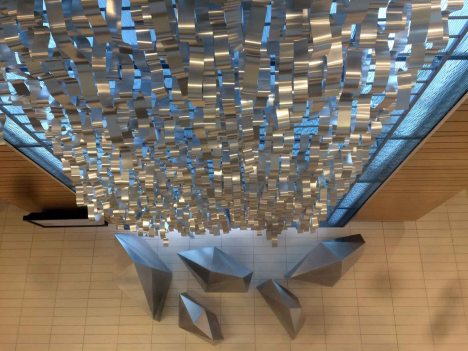
A public art piece inside the Spencer Fox Eccles Building.

A public art piece inside the Spencer Fox Eccles Building.

Gay Cookson is director of the Utah Division of Arts and Museums, the state department that has authority over the bill. Cookson said public art enhances many of the newly created public spaces around the state, as well as the frequent construction projects that are going on around the U.

“I love that the statute is at 1 percent, and that public buildings have to be invested into arts,” she said. “Sometimes it’s hard to set aside a budget for arts, but with the statute, it’s really the one time when a building is being built that they recognize they need to do a significant investment in art. Even though it’s forced by statute, they were excited to be engaged in the work.”

Obtaining the art, Cookson said, is a process of application and determining what fits best with each publicly funded building. When it is nearing completion, a committee comprised of planners, building managers and those who will be using the space will review proposals for art pieces. At least one art expert is always included in the group.

Cookson said when a new project is considered, the Division of Arts and Museums can receive up to 40 different proposals by artists from Utah or across the country. The committee’s responsibility is to narrow the list down to three finalists. Those finalists are given $1,000 to construct a model to present to the committee. Then, a winner is selected and is given the funding to proceed with the art piece.

Cookson emphasized that the entire committee is not reliant on art expertise. She wants those who will view the instillations much more frequently than experts to make the decisions.

A sculpture of a book is displayed outside the Marriott Library

A sculpture of a book by artist Suikang Zhao is displayed outside the Marriott Library.

“We want the final say to be on who will be living in that space,” she said. “Which is kind of cool because you’re empowering people who really have no artistic experience to spend hundreds of thousands of dollars on art.”

Since the act’s inception in 1985, every new publicly funded building that is constructed must have 1 percent of the total cost of the building be dedicated to art, according to the bill. Buildings that were already completed by the time the bill was introduced are grandfathered in, and do not need to retroactively install pieces.

Administrators of public buildings can opt out of the art requirement if a certain percentage of the costs of building the structures are not met by public funds, according to the language of the bill. This was the case for the newly-completed S. J. Quinney Law School, which had enough private donor money in place to exempt it from the Percent-for-Art Act. However, Cookson said law school leaders wanted to honor the importance of art in public spaces, and complied with the mandate.

After a work is completed, the Division of Arts and Museums is responsible for the maintenance and repair of the pieces, according to the bill.

On the Utah public art website, finalists and commissioned artists of each project are publicly listed, with their website or portfolio attached.

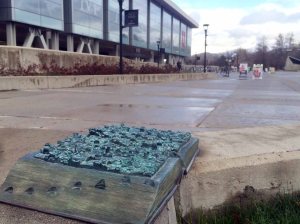
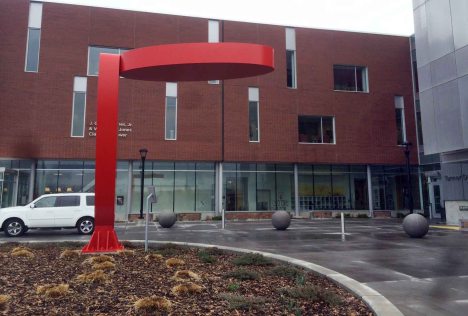
A public art piece outside the Sorensen Arts and Education Complex.

A public art piece outside the Sorensen Arts and Education Complex.

Traveling Exhibit Program provides Utahns access to high-quality art

Story and slideshow by JORDAN SENTENO

According to the Utah Division of Arts and Museums, the Traveling Exhibit Program (TEP) delivers high-quality, professional exhibits to numerous educational and nonprofit organizations, including underserved communities. The exhibits travel to museums, colleges, universities, community galleries, arts and cultural centers and libraries.

TEP Coordinator Fletcher Booth said the program is particularly important to rural communities where access to high quality, original art is limited. The exhibits nurture understanding of diverse art forms and cultures, promote creativity and encourage cultural activities in local communities. The program also provides artists a way to showcase their artwork, gain public recognition and increase the value of their art.

Laura Durham, who does marketing and communication for the Utah Division of Arts and Museums, said, “The Traveling Exhibition Program is one of the more far-reaching programs we have. It takes visual art to all the regions in the state of Utah, including a lot of schools and community centers that don’t get to see very much artwork.” She added, “The kids especially get very attached to the exhibits when they come to their schools and they hate to see them go. We provide educational materials for the teachers so the kids can interact with the artwork in a meaningful way.”

TEP aims to provide meaningful arts experiences by including educational components that teachers can download and use. The materials vary from exhibit to exhibit. For example, the Design Arts Utah exhibit provides two documents called “Why Teach Art?” and “Looking at Art.” They discuss why art is important and how to look at art in different ways.

“It [TEP exhibits] is the one thing that students will stand and talk about,” said Rhonda Harrison, principal of Fillmore Elementary School, in an interview at Hogle Zoo. “We have seen a lot of conversations about why they think it is drawn or painted. Students look forward to the art work coming [the zoo] once or twice a year.”

Every year, Hogle Zoo sponsors the World of the Wild, which showcases artwork of animals and the wild. According to the Utah Division of Arts and Museums, the goal of the exhibit “is to bring together the works of serious artists who are interested in displaying their view of wild animals, plants and places with which we share our world.”

According to a press release, “by highlighting animals and plants in the wild, this exhibition strives to educate viewers on the challenges faced by artists and techniques used when depicting animals. Additionally, this exhibition strives to draw public awareness to and increase appreciation for the animals and fragile ecosystems depicted.”

The companion curriculum, “Stamp Out Extinction,” “encourage[s] students to examine wild animals in their community that may be endangered or approaching extinction.” Teachers can help students use printmaking techniques to create posters that promote animal conservations.

Rose M. Milovich, preservation manager and exhibition program director at Utah State University Special Collections and Archives, said, “Having the opportunity to see and study original artworks from cultural, aesthetic and technical standpoints can really encourage creative/critical thinking and doing.” Milovich, who was at the zoo, added, “This kind of encouragement can happen for anyone at any age. Our world needs people who can think creatively – people who can examine the work and find solutions to all that faces us.”

Each year, the Utah Division of Arts and Museums curates about 20 traveling exhibits that feature many different mediums, processes and styles. For example, photographs that won prizes at the 2015 Utah State Fair are being shown at Grand County Library in Moab through April 26, 2016. The traveling exhibits are scheduled for one-month periods at $125 per exhibit and people can sign up for them online.

Fletcher Booth, as TEP’s coordinator, then creates a schedule. On average, he arranges about 80 exhibits each year.

Laura Durham said, “Not only does this provide the communities with a new show to look forward to, it’s also great for the artists who have work in the shows. Their audience is greatly expanded as a participant in these exhibitions and they can put all these locations on their resume of where individuals have viewed their artwork.”

Laura Durham: The work of an artistic woman

color

Laura Durham enjoys her job with the Utah Division of Arts and Museums. Photo courtesy of Durham.

Story by JORDAN SENTENO

Utah native Laura Durham has a bachelor’s degree in art history from Brigham Young University. She currently works for the Utah Division of Arts and Museums in Salt Lake City and manages marketing and special projects that encourage public value of the arts in the state.

Growing up as a young girl, she really enjoyed music and art. Both her parents were musicians so she was surrounded by music all the time. The turning point for her was when she was in high school. She went to London with her father when she was 17 to study art and music.

“Since my parents were both musical artists I knew I wanted to do something with art and music and kind of rebelled against them by going into the field of art history,” she said in an email interview.

She has 15 years of working experience with the Utah Division of Arts and Museums. Before being promoted to marketing and public value manager, she worked as the visual arts coordinator. She also does graphic design on the side as a hobby, but has used those skills to create a brand and unique look for the Utah Division of Arts and Museums.

Durham also enjoys cooking, traveling, writing and sharing stories in her spare time. With her enjoyment of music, she sings with the Utah Chamber Artists.

Durham works out of the division’s main office in the historic Glendinning Mansion at 617 E. South Temple in Salt Lake City. Also located there is the Alice Gallery, named after founder Alice Merrill Horne. Durham chose to work at the Utah Division of Arts and Museums because she wanted to work with the arts and build programs, while also giving back to the community.

She serves on many boards, including the Salt Lake Gallery and Utah Emerging Museums Professionals. And she sits on the Downtown Marketing and Events committee, assisting with the Downtown Farmers Market, Dine O’Round and other community events.

She has worked for several other arts programs within the Utah Division of Arts and Museums, and was the visual arts coordinator managing the Rio Gallery and Traveling Exhibits. She also served as the vice president of the Salt Lake Gallery Association from 2003 to 2006.

Durham was program director of the Salt Lake Gallery Stroll from 2005 to 2010. “It was significant because it’s a great anchor in Salt Lake City when it comes to the visual arts,” said Durham in an email interview. “It’s a community event that people can count on each month and it has fostered a fertile environment for new galleries to pop up and join. A lot of business have joined the fun too, as we see more small business rotating local artwork on their walls and opening up their doors for the Stroll.”

unnamed

A piece that Durham designed for “15 Bytes” about Utah artists. Image courtesy of Durham.

She regularly contributes to “15 Bytes,” which is an online visual arts magazine in Salt Lake City. She serves, too, as assistant editor and managing music editor. Durham has developed a longstanding partnership with Artists of Utah, publisher of 15 Bytes. The magazine publishes two free adds every month for the Utah Division of Arts and Museums so it can advertise what is going on in its galleries, literary arts programs and more.

Durham has developed many other partnerships, such as with the Salt Lake Film SocietyUtah Film Center and Utah.com. She is in the process of helping the latter showcase its website and direct tourists to the wide variety of arts that are available here in Utah.

In 2014, Durham completed the Change Leader Program, which is a professional development course. According to the Utah Division of Arts and Museums website, “Participants attend a three-day institute with instruction on assessing environment and the communication and facilitation skills necessary to implement change.” As part of the program, Durham initiated a project called “Utah’s 15 most influential artists.” In a press release about it, Durham said, “Hopefully this program will inspire more people to recognize how art has enhanced their quality of life as well. And hopefully we will nurture a society that more widely and visibly values artists and their contributions.” She  said in the release she believes artists influence our landscape and culture. “I sought to identify Utah artists who influence and impact our community,” she said.