Salt Lake Gallery Stroll Spotlight: Mod a-go-go

Story and photos by PEYTON M. DALLEY

Clear pane windows line the walls and the smell of old furniture fills the room. In the background, a smooth-jazz album spins on the record player.

Welcome to Mod a-go-go, at 242 E. South Temple in Salt Lake City,  and step into the scene of the iconic sitcom “Mad Men.” Jon Hamm’s character, Don Draper, would not be disappointed. With local artwork on the walls as well as a compilation of old-school furniture, this store-turned-gallery is just one of the 36 galleries featured in the monthly Salt Lake Gallery Stroll.

On the main floor, buyers or patrons of the event can look at both furniture and artwork.

But the real masterpieces are located upstairs, where Mod a-go-go hosts its stroll event. And on the night of Feb.19, that event, which focused on landscapes, captured the essence of what artists here in Utah have to offer.

The idea became a reality

Eric Morley and Marcus Gibby are the owners of this local gallery. When artists choose to have Mod a-go-go promote them, Morley and Gibby split the profit 50/50. “We’re a launching pad for artists,” Morley said. “We have had people here who now are featured outside of Utah.”

20160219_191134

Eric Morley, left, and Marcus Gibby, owners of Mod a-go-go, enjoy a break during February’s Salt Lake Gallery Stroll.

He and Gibby set up everything for the artists. “We don’t even require volunteer work,” Morley said, unlike some galleries. “Our goal here is to get artists out of cafes and restaurants and give them a place to showcase their work.”

Morley came up with the idea for the gallery during a project he was working on as part of his MBA. He said his entrepreneur class at Westminster College in Salt Lake City helped spark the idea, because students had to identify a gap in the market. Morley knew the business of art, while his business partner, Gibby, was an artist. Together, the two balance out the scene of the gallery.

Emergining artists

Artists who are interested in showcasing their work through Salt Lake Gallery Stroll must contact the specific gallery they want to work with. For example, Mod a-go-go has an online application that individuals can submit with a sample of their portfolio.

20160219_185011

Artist Laura Beagley and husband James stand by a piece they designed together. James creates the base, and Laura uses copper wire and precious stones to construct the piece.

Artist Laura Beagley promoted three pieces for the first time at Mod a-go-go. She showed delicate sculptures created as part of a “Wishing Forest” theme.

“Wishing trees and the tree of life are what inspire me. Every culture has a tree of life in it [that] links us to the world and heaven,” Laura said. She handcrafts the works with copper cord and precious stones that her husband, James, finds from the Utah mountains. He also helps her set the foundation for her works of art.

20160219_192058

Artist Oscar Da Silva stands in front of his canvas artwork portraying the theme of the West. He was exhibiting for the first time at Mod a-go-go.

“I get different inspirations. I like the feeling of the seasons,” Laura said. Her pieces also reflect a mythical approach and include fairies and fantasy.

Local artist Oscar Da Silva also had his first showing at Mod a-go-go. He had on display six of his original oil pieces portraying the theme of the West.

“I like working with subjects that don’t limit my creativity,” Da Silva said.

He said he prefers to paint portraits, but said he loves the land.

“Take a look around you, that’s inspiration,” Da Silva said. “Inspiration comes, let it find you.”

He is passionate about what he does. S0 passionate, in fact, he quit his full-time job in customer service at the University of Utah to pursue his art. He has shown in galleries across northern Utah.

Gallery Stroll draws crowds of all ages

Word of mouth, and promotions by local media such as City Weekly and SLUG Magazine, are how artists and viewers alike get a snippet of what is offered at the Salt Lake Gallery Stroll.

Natassja and Ryan Turek said it is their second time attending the gallery stroll. They said they are merely “art appreciators,” but hope to one day buy pieces of their own.

The Salt Lake Gallery Stroll on the night of Feb.19, 2016, drew crowds of all ages to venues such as Mod a-go-go. With the scent of old finished wood still lingring in the air, and the record player spinning jazz music, the gallery slowed down for the night. But a  few visitors lingered in the “Mad Men”-like setting.


How My enterprise story came about

My original idea for my enterprise story was to do a feature on the University of Utah Basketball Scout team but the  teams travel for end of season tournaments and my own travels I never found time to sit down with those players. Instead I had to find a new idea. I decided to do a story on my uncle who at the time was down in Peru in a hospital recovering from the H1N1 virus. I felt like the story was worth writing about and gave me the opportunity to step away from it and view the event from another perspective. Finding sources for my story was easy. I wanted to talk to family members specifically his parents and siblings who just happen to be my Grandparents, Aunts, Uncles, and my Dad. I found that the most challenging part of this story was not finding the information I could use but writing the story in a way that my feelings on the matter did not show through. I found it hard not to throw in my reactions and feelings to the events that took place. Overall though I feel like I did a pretty good job of stepping back and writing a story from an outsiders perspective.Another challenge was including what information to use in the story. The whole thing happened over the course of a couple weeks and there were a lot of things happening at once. I wanted my audience to see the kind of person Bryce is as well as how powerful a small group of people can be when they reach out to a larger audience. I still think I had some trouble narrowing my focus and really getting out what I wanted to but that is something I can improve upon in the next draft. I was surprised once I started writing how easily I just kept going. I was sure I would have a tougher time getting the words out but they seemed to flow easily and next thing I knew I had over 1000 words and I was trying to find a way to wrap the story up before I wrote another thousand. Overall I feel like this story helped me improve as a writer because it forced me to keep my bias out of the story and helped me learn how to organize my writing in better ways.

Open mic night at Alchemy Coffee in Salt Lake City

Story and photos by JOSH SOUTAS

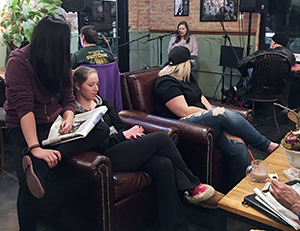
It’s a Tuesday night. You make your way through the maze of empty guitar cases to sit down in one of the low, comfy armchairs, with a latte or café mocha in hand, and a scone or muffin on the way. The strong smell of coffee fills the air. The walls are lined with vibrant local art and photography for sale. In the back room you hear the tuning of guitars, while a poet quietly recites one of his newest poems to himself, bouncing his knee nervously.

Next to you, an older man swiftly hand rolls himself a cigarette and tucks it into his pocket for later. Nearby, college students are busy talking about a group project they have just been assigned. All this commotion stops, however, when Bob Bland reaches for the mic.

Welcome to open mic night at Alchemy Coffee, he says.

Alchemy Coffee, located on 390 E. 1700 South in Salt Lake City, is host to open mic night every Tuesday.

Amateurs are drawn to this opportunity to perform original songs or poetry. No “covers” of songs are allowed, which means audiences never know what to expect on any given Tuesday.

A Salt Lake City local performs at Alchemy Coffee.

A Salt Lake City local performs at Alchemy Coffee.

“Some of the performances are awful, some are terrific,” said host Bland, who also is a folk artist. “Regardless we encourage everybody the same.”

Bland, who has been playing folk music for as long as he can remember in private or for friends, said he finally started playing in public after being continuously encouraged by those who had heard him play around the campfire.

“The first few times I played in public I was a nervous wreck,” Bland said.

It is because of this experience that Bland tries to create a warm, welcoming atmosphere. Whether it’s the tradition of holding one finger in the air during the first few seconds of a newcomer’s song or poem to signify that person’s inaugural appearance at Alchemy Coffee, or excessively cheering them on during and after their performance, Bland said it is important to let them know the audience is on the their side.

“The people here at Alchemy Coffee in the audience want you to succeed,” Bland said. “In most cases, like my own, you are your own worst enemy.”

IMG_0255

Desirae Sizemore performs poetry in front of a live audience for the first time.

This was the case for Desirae Sizemore, who took the stage for the first time on the night of March 8, 2016. Sizemore, a poet from Salt Lake City, uses poetry as an outlet for her emotions. She said her friends talked her into performing at Alchemy Coffee.

“I was anxious and afraid of judgment. But decided to take the risk,” Sizemore said after performing. “The worst that can happen is to be rejected. We have all survived worse, I know I have.”

After her performance she said she was very pleased with how warm and welcoming the atmosphere and audience were, and added that she would definitely return.

Calzone, a folk artist who goes by that one name, frequents open-mic nights in Salt Lake City. He said the audience at Alchemy Coffee is one of the best he plays for.

“The audience is laid back, the people are respectful and it is always busy,” he said. He has appeared at the coffee shop numerous times over the past year.

Open mic host Bob Bland, who also participates in many different open mic nights as a performer, said the audience at Alchemy Coffee is there to listen. And that is what sets them apart.

“At open mics at bars, or other coffee shops many times people are talking, there are televisions on, people are drinking and you are playing in the background,” Bland said at the end of the evening. “Where here people come to listen, the open mic is the center of attention. As a performer you want to go somewhere where people are listening to the music you worked hard on writing.”

Bland compares performing to rock climbing, another hobby that he is passionate about.

“You can’t improve unless you go for it,” he said. “You fall and the rope catches you. When you perform if you fall the audience will catch you. The anticipation of failing is worse than actually failing.”

Bland encourages performers to remember that even if you think you have failed, you wake up in the morning and are still surrounded by friends and family who love you, and those few minutes in front of the audience don’t matter anymore.

Bland also invites individuals who may be unsure about performing to come to Alchemy Coffee on a Tuesday night.

“Come out, take a deep breath. It isn’t a big deal,” Bland said. “Keep things in perspective and play for yourself, be happy with how you performed. And just go for it.”

Sign ups for open mic start at 6:15 p.m. every Tuesday and fill up quickly, so performers are encouraged to come early. Performances start at 7 p.m. and end at 9 p.m. The limit is 15 minutes per performance or three songs or poems.

Beverley Taylor Sorenson Arts Learning Program: bringing art back into the classroom

Story and photo by JOSH SOUTAS

Elementary school students, due to a greater focus on core subjects, have seen their arts programs shrink and almost disappear. The Beverley Taylor Sorenson Arts Learning Program (BTSALP) is focusing on bringing art back into the classroom.

The BTSALP serves more than 200,000 students in 300 schools across 31 school districts in the state of Utah, including 21 schools across the Salt Lake City School District.

The program, headquartered in Salt Lake City, is administered statewide through the Utah State Office of Education.

According to the website, BTSALP collaborates with deans and staff from the state’s universities to train and provide art specialists to the elementary schools. Those teachers, who are paid for by the organization, help faculty integrate art into their core lesson plans. The specialists also hold weekly art classes that focus on visual art, dance, music and theater, the four disciplines that are sponsored by BTSALP. The program incorporates these different forms of art as a unique approach to reinforce the core curriculum.

The organization reports on its website that student performance is increased in every subject, from language arts and math to social studies and science.

Mountain View Elementary is one of the schools that benefits from the Beverley Taylor Sorenson Arts Learning Program.

Mountain View Elementary is one of the schools that benefits from the Beverley Taylor Sorenson Arts Learning Program.

Mountain View Elementary is one of the 21 schools in Salt Lake City that participates in BTSALP. Kindergartners to fifth graders are introduced to dancing.

Principal Kenneth Limb said his students integrate science into their dance class. “Our fourth graders learn about land forms, and in their dance class they will use dance moves to depict land forms,” Limb said in a phone interview.

North Star Elementary, located in North Salt Lake, has been part of BTSALP for two years.

The school’s visual arts teacher, who started part time, moved to full-time employment after Principal Lew Gardiner saw the impact visual arts had on the students. North Star covers the other half of her salary that is not paid by BTSALP.

“Kids learn in different ways,” Gardiner said in a phone interview. “The BTSALP gives kids a different opportunity to shine and grow because of art, where in the traditional classroom they might not have that chance. Art is key when it comes to learning.”

Janelle Wride, visual arts teacher at Lincoln Elementary, said in a phone interview she believes that creativity is one of the main reasons that art needs to be in the classroom.

After nine years of teaching at the Salt Lake City school, Wride has seen how integrating the arts with the core subjects has made the curriculum more memorable and relevant to students.

Wride said another benefit she has seen in her schools is that art has no language barrier.

“It gives many of the kids in my school whose first language isn’t English a chance to participate, where in the classroom they don’t get that opportunity as often because of the language barrier. It lets the teachers see them in a different light,” Wride said.

She said she also likes to invite faculty into her classroom when she is teaching their students visual art.

“This program is functioning at its best when there is co-teaching, when the teacher is doing artwork with their own students. It gives the students a ‘we are all in this together’ feeling,” Wride said.

Wride also works with a large ethnic diversity and takes culture into consideration when planning lessons.

“Our fourth grade has a lot of Polynesian students, so I decided to incorporate Polynesian art forms into the lesson for that week,” Wride said. “And the Polynesian students really responded, it was interesting to see how well they reacted because they knew what I was teaching about related to them and their culture.”

Peggy Patterson, principal of Lincoln Elementary School in Salt Lake City, said in a phone interview that BTSLAP provides instructors who teach the arts in a way that her teachers cannot.

Patterson also said her music classes have helped the kids with math and science. The students use the beats in music to help them with addition and subtraction.

She has seen the fun that the arts can bring to the core curriculum.

“Every semester we have an informance — not a performance — but an informance, where parents and family are invited to see their kids perform and what they have been working on all semester in the classroom,” Patterson said.

Patterson said she believes that Beverley Taylor Sorenson Arts Learning Program has accomplished what it was created to do — better help students learn core subjects through the use of art.

Utah leaders advocate for more diverse leadership in the future

Story and photos by CHRIS SAMUELS

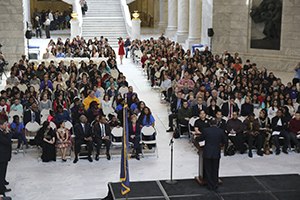
Kyle Reyes, chief diversity officer for Utah Valley University, said he wished that members of the Utah State Legislature — standing on the steps behind him — could be as diverse as the collection of several hundred middle school and junior high students gathered in front of him.

Kyle Reyes speaks to gathered students at Multicultural Youth Leadership Day at the Utah State Capitol, Tuesday, Feb. 16, 2016.

Kyle Reyes speaks to gathered students at Multicultural Youth Leadership Day at the Utah State Capitol, Tuesday, Feb. 16, 2016.

“Wouldn’t it be great to have our legislature reflect the diversity here,” Reyes said. “Our teachers that are in our schools reflect the diversity here in the state, so I think there is always work to be done. I think we can do a lot more, frankly.”

Reyes and other state and education leaders met Feb. 16, 2016, at the Utah State Capitol to speak to about 300 students for Multicultural Youth Leadership Day. In addition to Reyes, other speakers included Utah Gov. Gary R. Herbert and state legislators. A local spoken word group, Truth Cypher, gave a performance, as did a youth step troupe from the True Vine Baptist Church.

Speaking to the gathered youth, Gov. Herbert supported his state for having a long history of diversity and inclusion.

“Our early settlers came from western Europe whether they were Scandinavians, or English people, or Germans, others from Western Europe,” Herbert said. “That diversity is making us even stronger and more successful, particularly in the world’s economy of today, because we have so many different cultures and speak so many different languages in Utah. … We really speak the world’s languages, and that gives us some opportunity for economic growth as we go forward.”

Utah Gov. Gary Herbert speaks to assembled youth at Multicultural Youth Leadership Day at the Utah State Capitol, Tuesday, Feb. 16, 2016.

Utah Gov. Gary Herbert speaks to assembled youth at Multicultural Youth Leadership Day at the Utah State Capitol, Tuesday, Feb. 16, 2016.

Claudia Nakano, director of the Office of Multicultural Affairs, shared Gov. Herbert’s statement, and added that the state continues to be diverse.

“The U.S. Census is predicting by the year 2043, this nation will be a majority-minority nation, and in Ogden and in West Valley, they are already majority-minority cities here in Utah,” Nakano said. “One out of four preschoolers is ethnic and comes from an ethnic background. We’re hoping to inspire leadership, getting involved in your community, civic engagement, and take those seats up here on the hill and pass legislation.”

Youth came from as far as Ogden and Payson to attend the summit. Students listened to the program for about an hour and 20 minutes, which was followed by lunch and tours of the Capitol.

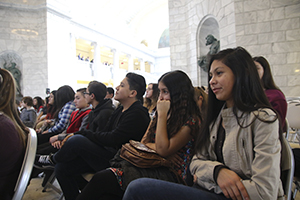
Students from across the state listen to speakers at Multicultural Youth Leadership Day at the Utah State Capitol, Tuesday, Feb. 16, 2016.

Students from across the state listen to speakers at the leadership day, Tuesday, Feb. 16, 2016.

The day at the Capitol is part of a greater initiative by the Office of Multicultural Affairs to involve diverse youth from around the state to become more involved civically. The office also organizes and holds a Multicultural Youth Summit every October, which hosted 2,000 students in October of 2015. The aim of the state-run department is to aid the state in making better outreach efforts to promote civic engagement and cultural diversity in government across the state. The summit is part of these efforts.

The summit, Nakano said, was designed in part by Gov. Herbert’s “66 by 2020” initiative. The project, according to the governor’s website, sets the bar of having 66 percent of Utah’s working-age population with a postsecondary degree or certificate by the year 2020.

“We want to help raise that graduation rate, and now with our changing demographic, we are becoming more diverse, not only in Utah but across the nation,” Nakano said.

Not all sentiments are positive on Utah’s outlook. Nakano conceded that the current makeup of state legislators needs to be more ethnically diverse, which would help support more diversity initiatives and better legislation on equality. Although no statistics are available on the ethnic makeup of the current legislative body, the vast majority are white male.

Kyle Reyes, UVU’s chief diversity officer, echoed these feelings, adding that higher education administrators from around the state are collaborating on diversity reform. But, he said state legislation still needs to be impacted.

“When I talk to people about multiculturalism, I like to say it’s not just another thing we do. It’s how we do business, it’s a lens that we wear,” Reyes said. “And if we can get more people, especially more people in powerful positions to wear those lenses and be a little more sensitive and be more culturally responsible, I think that will go a long way.”

Youth from the True Vine Baptist Church perform at Multicultural Youth Leadership Day at the Utah State Capitol, Tuesday, Feb. 16, 2016.

Youth from the True Vine Baptist Church perform at the Capitol, Tuesday, Feb. 16, 2016.

In the coming years, the Office of Multicultural Affairs will plan additional youth leadership summits and events across the state. Nakano said a smaller summit in addition to the large one in October 2015 was held in Ogden, which hosted 300 children. Smaller summits are anticipated in other cities in Utah, such as St. George, Cedar City and Vernal. The 2016 legislative session added an additional $30,000 in funding for the summit.


Dario Jokic

MY STORIES


MY BLOG

The reason why I choose to write about prisons an education is because, one day I had a bunch of homework and I was driving by the Utah State Correctional facility and I was wondering if college student end up in prison a lot. Then that changed to a story about educations in prisons, after Sheena explained how difficult it could be to find someone who is imprison looking for a college education. Sheena also explained to me what recidivism was. As I was writing the piece I started learning more about recidivism and how expensive prisons can be, so I changed my piece to write about how we view prisoner and how education is changing the ideas of prison.

ABOUT ME

My name is Dario, I’m  an immigrant from Sarajevo, Bosnia. I have been living in the US for 15 years. I love Hip Hop, Funk, and Movies. I also enjoy break-dancing. When I grow up I want to be a Film Maker or Journalist :). When I was little I wanted to be a Basketball player/rapper/lawyer. I love animals, especially dogs. I used to do Parkour, but then I got electrocuted, lesson learned. My favorite movies are typically crime related or comedies. My favorite dessert is Tiramisu, cause it’s alcohol and coffee mixed together with cookies. I think Samurais would win in a fight against Spartans. I think Disney is overrated and I prefer the Looney Tunes; I’m serious I would drop kick Mickey Mouse for Bug Bunny._DSC8137. This is picture of me being exhausted in London
The Utah Cultural Alliance: Past, present and future

Story by JORDAN SENTENO

It all began in 1981 as Utah Citizens for the Arts. According to a history of the organization, it led the development of the public art programs in Utah. It also held events to help educate the community and elected officials.

Then, in 1993, it assumed a new identity and became the Utah Cultural Alliance (UCA). Its job is to work with the art and culture organizations as well as the legislators and county governments to solidify funding throughout the state of Utah and its community.

“Everyone and anyone can work with the arts and make a contribution to the community,” said Kate Ithurralde in an email interview. Ithurralde serves on the UCA board as treasurer.

According to UCA’s website, the organization serves as “the voice of the arts, humanities and cultural sector of Utah.” Its mission is to “empower and strengthen this community through advocacy, professional development and awareness.”

Crystal Young-Otterstrom, executive director of UCA, said, “It’s a great way to help the Utah community and for others to get involved and make a difference in the community as well.”

According to the website, UCA has transformed into a membership-driven organization comprised of many museums, corporations, and groups such as the Utah Division of Arts and Museums, the Stewart Foundation and the Salt Lake City Arts Council.

UCA has joined to help support the Utah community through cooperation, communication and advocacy in an attempt to help increase the value of the arts program in the state.

“I choose to be involved because the arts and humanities have a rich history in our state and I think we can do a better job supporting the sector,” said UCA Board Chair Jason Myers in an email interview. “By doing that I believe we will have more vibrant and rich communities — culturally and economically,” said Myers, who manages internal communications at Children’s Miracle Network Hospitals.

Young-Otterstrom said one way that community members can become involved is by becoming an advocate. “The most important part of advocacy is anyone can choose to be involved, can talk to an elected official. It’s really not a hard thing to get in touch with one of them and get involved,” she said in a phone interview.

UCA seeks community involvement to help impact the culture in Utah. The organization is committed to working with people to increase their individual and organizational knowledge of policy issues. UCA also involves the community by hosting events like Arts Day on the Hill in February, which UCA notes is an opportunity for residents to connect with their legislators and discuss why the arts are important.

UCA has a new five-year strategic plan for 2016-2020 that outlines its desire to become the forefront organization of Utah’s cultural issues. A subcommittee of the board factored in the mission, vision and value statements when creating the plan.

The subcommittee identified several guiding principles to help UCA accomplish its goal. For example, the small group recommended creating a separate advocacy branch that will enable UCA to endorse candidates and pursue fundraising to directly support advocacy efforts in Utah.

Another guiding principle is awareness. The organization aims to expand marketing and public relations in order to increase appreciation of the arts. It also plans to develop a Utah Culture Wiki, a comprehensive site about the arts and humanities.

According to UCA’s website, “the Utah Cultural Alliance [looks] to become the top voice of the arts, humanities and cultural sector of Utah.”

Artist exposed: What does it take to make it in Utah?

Story and photo by PEYTON M. DALLEY

While blue skies and daunting summers may claim Utah’s geography, the passion driven from local artists shines brighter than any summer day could.

From public art outside to Saturday morning farmers markets, local artists can be seen from every part of the state, enlightening audiences from Saint George to Logan.

What exactly does it take to be a successful artist in this state? Utah has world-renowned programs at the University of Utah and Brigham Young University that focus on art-related programs, and platforms like the Utah Cultural Alliance that allow local artists to be showcased.

However, does education play a role in the success of the artists that Utah is producing? Or is it the connections made by individuals that create their success?

Young-Otterstrom

Crystal Young-Otterstrom

Crystal Young-Otterstrom, executive director of the Utah Cultural Alliance and a noted opera singer, is one example of Utah success. She has been named one of Utah Business Magazine’s “40 under 40″ and boasts an impressive resume that includes performances in Vivace, an opera group based in the Utah area, helping to start the Utah Symphony and founding her own company, Foursight Partners. Young-Otterstrom is an artist who has shown success in the Utah community.

Young-Otterstrom earned a music theory degree from BYU, and completed her master’s degree at Queens College in New York. She credits her success to her knowledge of the field and the skill sets she learned in college. But, she added, “You [also] learn along the way.” Young-Otterstrom currently promotes her own company while serving on the board of several art organizations, including LDS Composers Network.

Young-Otterstrom said connections can help people get from one step to the next. She said she has gained valuable contacts through the wide variety of work she has done with local organizations.

Another success story in the Utah community is Pat Bagley, the editorial cartoonist for the Salt Lake Tribune. He said in a phone interview that he “immersed” himself in the arts community and took history and political science classes. Bagley said “it helps to be exposed to what you want to do.”

Bagley’s work has been featured in Time magazine, the Wall Street Journal and the Washington Post. Bagley, also a  graduate of BYU, has been putting pen to paper at the Tribune since 1979. He said connections are helpful, but skill set is more valuable. He obtained his job at the newspaper based on his portfolio.

While success can be found in the Utah market, what are the necessary steps to get there?

Tanner Forbes aspires to one day make Broadway headlines. Photo courtesy of Tanner Forbes.

Tanner Forbes aspires to one day make Broadway headlines. Photo by Wendy Clymore.

Tanner Forbes, a student at BYU who is triple majoring in the Music Dance Theater Program, is hoping to one day break into the arts field, locally as well as nationally.

“I think there needs to be a balance of talent and connectivity,” Forbes said in an email. “I strongly believe that all talent will eventually make its way to the top, but there’s communities of artists everywhere and you have to immerse yourself in that world in order to expand your success as an artist. But always be trained! Always be trained before you jump into communities of artists. Education works wonders with that.”

Forbes is currently a BYU Young Ambassador. He credits his ambitions to the skill set he has developed in his courses and  through outside training. He also studies the work of individuals such as the late actor Heath Ledger, who died in 2008, for  inspiration.

Forbes is focused on his future and is passionate about his career choice. He hopes to land an audition on Broadway after his training at BYU, and hopes to play a role such as Elder Price in “The Book of Mormon” in New York City.

“I’ve found that Utah is extremely diverse,” Forbes said. “Sure, it’s no New York or [Los Angeles,]  but we have so many different types of people pursuing so many different types of paths, especially in the Salt Lake area. There’s really opportunities for everyone here.”


Josh Soutas

MY STORIES:

MY BLOG:

At the start of this semester I could easily have pointed out my two greatest weaknesses when it came to reporting and writing. First, punctuation, and second, interviewing sources.

BiopicThrough this class I feel that I have grown greatly in both of these two areas of my craft. Although I am still working on punctuation, I feel that I have learned how to properly use it better this semester, through both in-class exercises and the out-of class stories.

Where I have had the most growth in my eyes, however, is learning how to ask better questions when interviewing sources. Through this class, the discussions, readings and assignments, I feel that I have been able to ask better, more meaningful questions to get the information I need from a source.

For me, one of the most difficult parts of being a professional storyteller is remembering to keep your voice and opinion out of a story, but still be able to influence that piece with your style. I have learned this semester that this is a difficult but very rewarding challenge. On the other hand, the most satisfying part of being a storyteller, is when you complete and publish a story and see that you gave someone, or something, a voice that it did not have before.

 My reporting increased my understanding of our “Arts and Culture” beat tremendously. It is funny to think how we struggled to describe what “Arts and Culture” meant to us in the beginning of the semester. One way that my reporting increased my understanding of our beat is by getting the stories and opinions of the arts and culture here in Salt Lake City through interviewing my sources.

I think that the biggest benefit of covering this beat was getting to know and become fairly connected to the culture here in Salt Lake City. Being a transfer student who spent the last two years in Florida, I knew very little about the arts and culture here in Salt Lake City. Because of our out-of class stories, I feel that I became more connected with the city that I live in.

As a result of my reporting this semester, I have improved in multiple, if not all areas of my writing/reporting. I am no longer nervous when preparing to interview a source, and have learned how to paraphrase, and paraphrase well.

ABOUT ME:

I am currently 21 and a junior at the University of Utah. I spent the first two years of my college education at the University of Tampa in Florida. I will graduate with a degree in communication with a sequence in journalism. I am interested in both sports and advocacy journalism. I love to meet new people, which is why I moved to Florida alone when I had the opportunity. It is also is why I am passionate about journalism. I like to hear people’s stories, get their viewpoint and see something through someone else’s eyes.

I have a love for all sports, especially soccer. You will never see me miss a Manchester United game. I am a hard worker, go to school and work full time, and enjoy nature even if the mountains are second best to the beaches in Florida.

My passion for advocacy journalism comes from my parents and family background. I am the oldest of eight kids, four of whom are adopted, including one boy and one girl from Ethiopia, Africa. My Mom, who is finishing up her master’s degree in social work, and my Dad, who is a dentist, help lead mission/free dentistry trips for the Ordinary Hero Foundation. My parents have preached equality and human rights in my house for as long as I can remember and I want to use journalism to give a voice to those who are otherwise voiceless.

Peyton M. Dalley

MY STORIES: 

MY BLOG: 

I transferred to the University of Utah after two years at Dixie State University. My goal was to get more journalism experience and pursue the passion for writing I’ve had my whole life. Not only was I able to get writing opportunities, but I also had a one-on-one interaction with my future employer.

Within three months I was able to execute my passion for writing, while developing a skillset that can be used through a variety of fields, not just in the journalism world. This prepared me for face-to-face interviews and on-the-spot writing that led up to my final enterprise story, where I was able to have a taste of my future career at NBC down in Los Angeles.

JSsummer2015-122-1677x2516

Photo by Alyssa Ence.

Reporting and being a hands-on journalist this first semester helped me realize that silence sends the most powerful message. Seeing that I often ask many questions at once, reporting helped me realize that one question can lead to another and listening can be more powerful than asking. However, I did struggle with staying on one specific beat this semester. My reporting and journalism took more than one route and it was hard to re-route my objective back to one specific beat.

While my enterprise story was by far the hardest to execute, because of the time frame and deadlines, writing profiles and other side stories in between helped me develop the concept for my final story. I was also able to learn how to meet those deadlines in a short time. It not only gave me the confidence to know I could write a well-constructed story in a short time,  but also helped me multitask with several stories on the line with similar deadlines.

Both my media classes this semester provided me with the tools for constructing a well-written story. They also gave me connections for internships and opportunities to meet new people. On top of writing for class, I was also able to write as an intern for the Daily Utah Chronicle and become a co-editor for Odyssey Online. Both have helped get my work published on a platform for an audience to engage with.

Overall I would say this was a successful semester that pushed me to limits I didn’t even think were possible. I’m looking forward to what the next semester has in store and as a result of my reporting this semester, I have realized this is what I want to do with my life.

ABOUT ME: 

My name is Peyton Dalley, or TinaPey on social media. Since I was 8, I’ve had the desire to write and perform on NBC’s “Saturday Night Live” — a dream I’m currently in the process of living.

If I’m not at my tiny pink laptop writing about a millennial-related topic, I can be found at a local coffee shop or head-banging at one of my favorite concerts. Little-dog videos are what get me through the day, and Amy Schumer’s voice soothes me to sleep at night. I love connecting with people on a real-world level, and enjoy laughing at the little things.

Currently I write for the Daily Utah Chronicle, as well as Odyssey Online, where I get to write what I love about this thing called life. I have been called the song bird of my generation, and am often times mistaken for the actor Tina Fey. Most importantly, I’m fluent in both English and sarcasm, and majoring in mass communication at the University of Utah.