Transracial adoptions on the rise in Utah families

Story and photo by TALON CHAPPELL

The home of Jim and Connie Child in Layton is a traditional Mormon dwelling: a spotless front room with a pearly white couch, followed by a stairway with artisanal wooden handrails and family photos hanging from the adjacent wall.

But, one look at the family photos and it is clear that the Childs are different from other families who belong to the Church of Jesus Christ of Latter-day Saints.

Jim and Connie have adopted two children in their 23-year marriage, 15-year-old Ashton and 8-year-old Camilla, both of whom are of African American descent.

The Childs are just one of numerous families who have taken part in transracial adoption in Utah over the past several years. While actual numbers are rough estimates, the American Adoption Agency says that transracial adoptions are on the rise not only in Utah, but nationally as well.

After a two-year wait, Jim and Connie learned that they were going to be parents for the first time. Baby Ashton was brought to the Childs’ home in August 1997. Baby Camilla was brought home the same month in 2005. Finally, the Childs had their perfect little family, and nothing could take that away from them.

“We were ecstatic about having a child,” Jim said after officially adopting baby Ashton.

Initially, the Childs didn’t think about the difference of parenting black children in a white household. But they couldn’t ignore it forever.

“We knew white, black, green or pink that we would raise our children to be good members of the church and share our values,” Connie Child said. “But we also didn’t want to shun our children from their cultural background.”

Kayleen Vidal ran into this quandary often when she worked at A Act of Love Adoption Agency.

A Act of Love Adoption Agency has been assisting expecting adoptive parents since 1993.

A Act of Love Adoption Agency has been assisting adoptive parents since 1993.

“Lots of transracial adoptive parents wonder how they can maintain some kind of lifeline to their child’s cultural roots…. Some parents just ignore it, but we encourage them to be involved and do m

any different kinds of cultural activities that coincide with their values and beliefs,” Vidal said.

Vidal herself was adopted and after she learned that she could not bear children, she chose to adopt. After bringing home her baby girl, she decided to help other hopeful parents take in the thousands of

newborn and foster children up for adoption. She loves seeing interracial families and was so proud when she was able to help create one through adoption.

“Multiracial and multiethnic families need to be more commonplace in Utah,” Vidal said. “I believe racism will diminish when people see the happy, healthy families that transracial adoptions create.”

So, what exactly do the Childs teach and do with their children to avoid the cultural pitfalls that can occur in transracial adoptions?

Ashton Child says his parents are a big influence on him and who he surrounds himself with. “My parents are really involved in the stuff I like … the music I listen to, and the games I play, and the kids I hang around with, and the girls I hang out with.”

Ashton’s goals offer a snapshot of how his white, LDS family background merges with his fondness for black cultural icons and figures.

“Well, I haven’t thought about it much [future career] but maybe a music producer or artist … after I serve my mission, of course,” Ashton said.

Ashton’s future goals are sweet music to the ears of Shawna, Ashton’s birth mother.

Shawna still stays in touch with the Child family from time to time, making visits on holidays and special occasions. But she makes a point to not be too involved in Ashton’s life.

“I was comfortable with my decision,” Shawna said. “I gave my baby to that family with the trust t

hat they could take care of him better than I could, and I believe they have.”

Shawna says she is proud of Ashton’s aspirations and she hopes that he becomes successful in whatever he chooses.

“Although it’s not my faith, I’m glad he wants to serve a mission,” she said. “It’s good for children to have faith in their lives and the Childs have instilled real faith in him … and I don’t care if he’s a producer, doctor, teacher or whatever. I just want him to be happy and not make some of the decisions I made when I was young,” she added, with a crack of emotion in her throat.

The U.S. does not have a system to keep track of the total amount of adoptions per year, but there are several reports that offer estimates of public and private adoptions.

According to the North American Council on Adoptable Children, 6 percent of Utah’s foster-care children are African American and of that number, only 3 percent have been adopted.

Those interested in adoption can find numerous adoption websites both locally and nationally. Foster parenting is also a viable option for those who do not wish to wait the typical amount of time for an adoption to open up, or who cannot afford the costs of a traditional adoption. Utah law requires that adoptive parents be single or married, but couples living in an unmarried sexual relationship (including gay and lesbian couples) may not adopt in Utah.

Thelina Smith, Miss Black Utah USA, strives for science education

Story and photo by LORIEN HARKER

On the Miss Black USA pageant website there is a statement that reads, “It’s time to redefine what it means to be a courageous, compassionate [and] CONFIDENT black woman today. We’ve got obstacles to overcome and stereotypes to smash. Sound like your kind of revolution? Join the movement.”

Thelina Smith has got some smashing of her own to do.

524502_4026434416872_1145373459_n

Smith competing for the title of Miss Pioneer Valley in August 2012.

Smith is the current reigning Miss Black Utah USA. She also is a junior at the University of Utah who is studying biomedical engineering with an emphasis in biomaterials and leadership studies.

Smith is extremely busy with duties of the crown and sash, such as being an advocate for heart health while promoting her own platform. However, she makes sure to be involved with her studies. Smith started the first chapter of the National Society of Black Engineers at the U, reactivated the U’s Society of Women Engineers and is a biomedical engineering ambassador for the College of Engineering.

As a requirement for her title, Smith also promotes a platform, or an issue she feels needs to be addressed within the community. Smith says her platform, “Engineering the Leaders of Tomorrow, Because Tomorrow Matters Today,” is meant to “motivate minorities and underrepresented students to engage in STEM education.”

Smith says her platform has three goals. First, to reach out to the community, specifically women, through educating them on STEM (Science, Technology, Engineering and Math) education. Second is to “continue to charter diverse student organizations throughout Utah that serve to recruit and retain minority and underrepresented students in STEM fields.” And third, she wants to “establish a council” to mentor the youth she hopes to recruit into math and science education.

“I feel that this pageant allows me to take my efforts to the next level,” Smith says in an email interview. “I want to challenge young ladies to think about what it is to be beautiful and smart and to capture the attention of young men to let them know they can have a future within STEM education.”

Smith has also been working on partnering with the National Society of Black Engineers, The Society of Hispanic Professional Engineers, The American Indian Science and Engineering Society, and the Society of Women Engineers, of which she has been an active participant. Smith wants to partner with these societies to form a council called STEM-Diversity Industry Advisory Council.  This council would include “community leaders and local STEM company representatives that will [oversee] the support of these student chapters,” Smith says.

Despite her full schedule, Smith is making time to run for Miss Black USA in Washington, D.C., in August 2013.

Although there have been women of color to win larger national and international pageants, Smith doesn’t feel women of color are being represented to their full potential within these programs.

 “I wouldn’t consider myself ‘marginalized’ in pageantry but rather ‘underrepresented.’ There have been women of color to capture the crown as Miss America, Miss USA, Miss Universe, [but] this is still relatively a small number in comparison to the number of years that these organizations have existed,” Smith says.

Lana Thompkins, the public relations spokeswoman for Miss Black USA, says in an email interview that the Miss Black USA is necessary because women of color do not feel beautiful with today’s standards of beauty.

 “Self-esteem is the core of a woman’s belief in herself. Miss Black USA sets our own standards of beauty,” Thompkins says.

African-American women have been faced with many stereotypes, Thompkins says, and the purpose of the Miss Black USA pageant is to disprove these stereotypes.

“While 80% of Miss Black USA contestants are graduates or professionals and represent a new generation, we are often negatively typecast, demeaned, and portrayed in the media and in the workplace as ‘broken,’ ‘unattractive,’ ‘alone,’ ‘hard to work with,”’ and even ‘violent,’” Thompkins says.

Raychellene Talbot, the wardrobe coordinator for Miss Utah under the Miss America Organization, feels that Miss Utah has a “melting pot of pageant girls” despite the fact that there has yet to be an African-American Miss Utah.

“We have so many different contestants at the local and state level. I know Miss Utah Outstanding Teen 2011 had 6 different nationalities,” Talbot says.

The Miss Black USA pageant was founded in 1986 by Karen Arrington. The scholarship program boasts a two-year tuition scholarship to Miles College, a historically black college in Fairfield, Ala.  The scholarship also awards a fully furnished apartment close to campus. If contestants such as Smith win and choose not to attend Miles College, they do not receive the housing benefits.

Women who have competed for the title of Miss Black USA have gone on to win titles within the Miss USA organization. Chenoa Greene, Miss Black New Jersey 2007, went on to become Miss New Jersey USA in 2008.

Thelina Smith says, “The Miss Black USA pageant is a showcase of women who otherwise may have been overlooked.”

Mahider Ethiopian Restaurant and Market offers a taste from Africa

Story and photos by DANEALLE PLASCENCIA

What is your first reaction when you hear that Salt Lake City offers food directly from Africa? Probably the answer would be, that is impossible.

Next you might wonder how food from another continent tastes and what the principal ingredients are.

Salt Lake City offers an extensive variety of unique restaurants, especially in close proximity to one and other in the downtown area.

The number and location are the main attraction for some visitors.

Most of these restaurants are owned by local residents who have emigrated from their home town to look for better business opportunities in the Salt Lake  Valley.

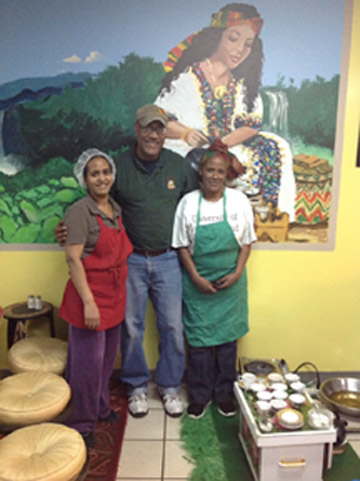
Sleshi Tadesse (center)

Sleshi Tadesse (center) with his cooks.

Such is the case with Sleshi Tadesse, who is a resident of Salt Lake City and the owner of Mahider Ethiopian Restaurant  and Market located at 1465 S. State St.

He emigrated from Ethiopia, Africa, 14 years ago to come to the United States because of personal desires.

First he lived in Los Angeles for a couple of years, and then he decided to move to Salt Lake City to go to school and find better life opportunities.

Tadesse got a bachelor’s degree in computer science from Weber State University.

After working in his career field, and getting laid off too many times, he decided to create his own business and experience something different from what he studied.

He started the project in fall 2011, with a small market with products imported directly from Africa, including the basic spices, meats, natural juices and traditional artifacts.

After some time, he realized that he needed something else to make his business more successful and attractive for the community.

That is how he started an addition for his market.

The project Tadesse had in mind was to create an Ethiopian restaurant in addition to his African market with traditional dishes.

After being just a draft idea, it became his own project that he named Mahider Ethiopian Restaurant and Market.

Now Tedesse is the owner of the first Ethiopian restaurant in Salt Lake City.

His restaurant represents some of the oldest dishes in the world that were created in Ethiopia, and recipes from his family back in Africa.

photo(2)

The flat bread vegetarian platter features a corn puree, green beans and carrots.

Mahider offers a variety of entrees made of beef, chicken and vegetarian delights made with collard greens, cabbage, split peas and lentils. The restaurant also offers salads as well as beers from Ethiopia.

Ljubisa Mijatovic, a first-time customer, said, “I am vegetarian, and I’m really surprised of all the vegetarian options that this restaurant offers, especially the veggie platter which is great.”

Herbs and spices are imported from Ethiopia to make the traditional flavor come out from the dishes and allow customers to have authentic African food.

Tradition is an important part of Mahider’s restaurant.

It encourages customers to eat the traditional flatbread and other dishes with their hands as is done in Ethiopia. Of course, utensils are provided in case that gets too complicated.

The famous Ethiopian flat bread is made of indigenous grain called “teff,” which is one of the oldest grains on Earth and makes interesting and unique flat bread.

Another important tradition and example of Ethiopian hospitality that Mahider’s Restaurant and Market offers are the coffee ceremonies. They are an integral part of Ethiopia’s social and cultural life, which describes how close the culture is.

These ceremonies consist of having home-roasted Ethiopian beans, and making fresh coffee.

“Coffee has social value in our society and is deep rooted in our culture,” Tedesse said.

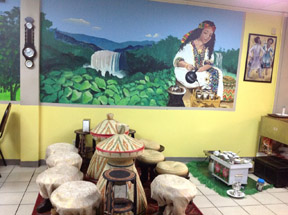
This is made right in front of the customer and is designed to share with family and friends in front of an interesting background. Short stools are decorated with different kinds of fabric and some of them are carved from wood.

The coffee ceremony is a mark of friendship or respect for the African community, and the ceremony can go for at least a couple of hours, depending on the customer’s time and ability.

Coffee ceremony  arrangements

The restaurant offers a unique space for the coffee ceremony.

“Experiencing the coffee ceremony is a plus of this restaurant. Besides sharing great dishes with your family, you get to enjoy coffee, and have a great conversation,” Mijatovic said.

Culture and community acceptance is really important for Tedesse, and he is really happy that the community has accepted well his traditional food and customs, which was the reaction that he was looking for.

Mahider Restaurant and Market has become increasingly popular with Salt Lake City residents, and customers who have tried the food have posted good  reviews on Urbanspoon.

“The business is going pretty good, especially Friday, Saturday and Sundays,” Tadesse said.

Mahider Restaurant and Market is open Monday through Thursday from 10 a.m. to 10 p.m., and weekends from 10 a.m. to 11 p.m. For more information call (801) 975-1111.

‘Django Unchained’ — the ‘d’ is silent, but not the critics

Story and photo by RENEE ESTRADA

The 2013 Academy Awards were held on Feb. 24, 2013. Films, actors and others in the industry were honored for their talents. While all the films got their moment in the spotlight, one film seemed to stand out from the rest, and that film was “Django Unchained.”

“Django Unchained” stood out from the rest because of the controversy it garnered in the weeks prior to the awards ceremony. Many spoke out against the film because they believed it to be racist, crude or desentizingly violent.

“Django Unchained” received two Academy Awards: one for best original screenplay, awarded to Quentin Tarantino, and one for best actor in a supporting role, awarded to Christoph Waltz.

The movie is about a freed slave, Django, who joins bounty hunter King Schultz in his search to find criminals. He does so in order to earn the money to buy his wife, Broomhilda, her freedom, and the two can be together again. All along the way he mercilessly kills white slaveowners.

Some critics, namely Aisha Harris of Slate, say the entire film is a blatant slave revenge fantasy. In her piece, “When Blaxplotation Went West,” she argues, “He’s [Django] not standing up on behalf of his fellow subjugated man. You can choose to identify with Django, but if you do, you’re rooting for his overcoming of oppression, not a collective victory for the black race.”

IMG_0214

Meanwhile, blogger and critic Jamelle Bouie argued that while the story of Django may be unrealistic, at least the movie depicts some true aspects of slavery, which is very unlike Hollywood. There is no gentle and kind slaveowner. Calvin Candie, played by Leonardo DiCaprio, accurately portrays the cruel slaveowner who was depicted in history books and imaginations. He is ruthless and probably doesn’t have an ounce of compassion.

Ingrid Gonzalez, a student at the University of Utah, agreed with these sentiments.“’Django’ showed how blacks were treated at that time. The director didn’t cover anything up,” Gonzalez said. “When it came to the treatment of slaves I feel that it was spot on, and to me that’s rare in movies because most movies show kind slaveowners, and there really weren’t many of those.”

Some critics, namely James Rocchi of Box Office, defended Tarantino’s work, suggesting the violence and language used is his style. In his review he wrote that the film combines “his maniacal style of mashed-up fragments from the cultural canon with a seriousness of intent that turns Django into a discussion of both pop and politics.”

A few years ago Tarantino made “Inglorious Basterds,” a fictitious movie in which Jews went in search of Nazis to kill and scalp them. The film enraged Germans for the depiction of Nazis. In an article for the U.K Telegraph, Richard Alleyne wrote, “Germans fear it will turn the Second World War into a comic book adventure in which their countrymen have no redeeming value.”

Others say the language in “Django Unchained” is over the top, considering the n-word is used more than 100 times. “Pulp Fiction,” another film written and directed by Tarantino, is not a movie involving slavery and Tarantino was criticized for his usage of the n-word in that. Given that “Django Unchained” is set in the antebellum South, some might argue the word is more historically relevant than a film set in California during the 1990s.

Some critics say that the violence is what is excessive. Jermaine Spradely, the multicultural editor at the Huffington Post, argues, “The problem is that, by showing non-stop killing, maiming, whipping and beating throughout the entirety of the film, by the end, the viewer is so desensitized….”

Some viewers agreed with that. Sara Scott, a student at the U, said, “I liked the movie but the gore definitely took away from it. The violence was over the top in my opinion, but I knew before I watched it that’s Tarantino’s style.”

While critics may not agree on what the film represents, movies like “Django Unchained” prove that viewers need to watch with a close eye. As controversial as movies can be, that doesn’t always negate their value. Some aspects can be surprisingly accurate, while others can be outright appalling.

Ogden resident Stanley Ellington enjoys helping the community

Story and photos by GUSTABO RODRIGUEZ

Helping people in the community of different cultures is a job that not everybody can fulfill. Reasons for helping or not helping people can come in various answers or excuses, but not for one man who helps from his heart.

Stanley Ellington was born in Alabama and lived in Washington, D.C. for seven and a half years. Then he went to Germany for two and a half years. He returned to the U.S and lived in Kentucky in 1974.

In the U.S. Air Force, Ellington helped people solve their personal problems related with their job or family.

In 2000, he moved to Utah because of his job in the Air Force. He retired in 2002 after serving for 28 years. From there, he knew that he wanted to continue to help people. He moved to Utah where the diversity is lacking, and was further motivated to help marginalized communities.

“I’m a good bridge for helping out people in the community,” Ellington said.

He enjoys helping individuals. For example, he helps an elderly woman by taking her husband to the doctor.

Stanley Ellington

Stanley Ellington is a leader in the community.

Ellington also was the first executive director of the Utah Black Chamber of Commerce.

He is part of the National Baptist Association, which is divided in the states of the Utah, Idaho and Wyoming. He has many ways to help people not only in Utah, but other states by helping the other churches in those states.

He is a Christian minister for the New Zion Baptist Church in Ogden and now as a licensed minister he can help more people in the community. Ellington gets involved with the community in Ogden not only through his profession, but also through the church. He is the director of the Christian education of the church. By being in charge of the education department, his duties are to set classes for the Christians and prepare the four phases of the classes.

In 2006 he built his own business that provides consulting in business management. During this time he was made the first executive director of the Utah Black Chamber of Commerce. He helped small businesses in Salt Lake and the surroundings areas to thrive in the community.

People from the black community, like many other people, are always looking for a new opportunity. Ellington said that he knew a woman who went to look for a job and the first thing they asked was if she knew Stanley Ellington.

“Just because we’re black were supposed to know each other,” Ellington said.

He has experienced different cultures here and learned the customs of other individuals. Working for the State of Utah Governor’s Office of Economic Development he learned that some women don’t greet men or other people. So Ellington had to create a new way to greet a woman from a different culture.

Kathryn Crosby, a friend of Ellington, met him two years ago through their affiliation with the Utah Business Development Alliance.

Kathryn Crosby

Kathryn Crosby appreciates her friendship with Stanley Ellington.

Crosby has a great admiration for Ellington because of the way he can handle situations, and for his accomplishments with the community and his life.

“Stanley has a unique ability to see clear routes through complicated issues, and to communicate with people from all walks of life,” she said in an email interview.

Crosby also said Ellington has a contagious amount of energy and enthusiasm.

“I consider myself very fortunate to be able to call Stanley my friend and colleague,” Crosby said.

She respects Ellington because he works hard to help out people and he does not settle for reports that he is very sure do not make sense.

For example, he said that in Utah there was a report that locally-owned black business were increasing year after year, but he was not convinced.

Ellington said it is difficult for business owners to seek additional training because they can’t leave their business to go to school. If they do, they risk losing clients. He feels that the Utah Black Chamber of Commerce can help entrepreneurs by offering classes online. Webinars, or online seminars, also could be a good idea because people have become more computer savvy. He said a program on public television that would help educate business owners might be useful too. He said that it would be another way to educate not just the black community, but also people from different cultures who want to succeed in Utah.

Ellington has influenced many Utahns because of all the organizations he has been involved with.

“I’ve been labeled the African American representative,” Ellington said.

Cynthia Nielson met Ellington when she joined the Utah Business Development Alliance (UBDA). Nielson and Ellington have worked together on many projects, including managing, organizing and preparing presentations.

“Stanley has extensive training in business management and administration,” Nielson said in an email interview.

She also said that Ellington has been a big influence in the goals of UBDA, which includes assisting small businesses in finding and getting contracts that are going to help them succeed by getting their name out into the market.

“Stanley is a great teacher and donates a lot of time to our non-profit organization. Stanley is eager to improve himself through education and is dedicated to his religion. He has a kind heart and I admire him greatly,” Nielson said.

Stanley Ellington came to Utah to do what he was born to do: help people. That mission was his destiny.

“God brought me to the state of Utah,” Ellington said.”I don’t know why, but it was to fulfill my mission in Utah.”

Growing up biracial in Utah

Story and photo by CHRISTIE TAYLOR

According to the King of Pop, Michael Jackson, “it doesn’t matter if you’re black or white!” But what about being black and white, or any other biracial mix for that matter?

According to 2010 Census research, people who claim two or more races in Utah make up .027 percent of the total population of 2.7 million. That means just 75, 518 people identify as mixed-race. Eighty-six percent of Utahns, or 2.4 million, are white.

Kenna Scott, 28, whose mother is half white and half Italian and father is African-American, is among those of mixed races. Growing up biracial in Utah proved difficult for her. With little diversity in the state, she learned early that she was different.

Scott, whose darker skin, brown curly hair and big brown eyes are a complete contrast to her fair-skinned, blond-haired, blue-eyed mother, recalled her first experience with racial discrimination.

While attending a preschool in Cottonwood Heights, she was told by a fellow classmate “that their mother did not want me playing with them because I was black,’” she said in an email interview.

It had an enormous impact on her at the time because she never thought of herself as anything but a person, she said.

“I never realized I was black, it never came up,” she said. Her parents divorced prior to her birth and Scott never met her father.

Her mother, who had always taught her to love and accept everyone equally, contacted and met with the parents of the child. “I can remember playing with the other child while our parents yelled in the background,” she said.

It was the first of many times her mom would have to defend her daughter against racism.

While in the first grade a child came into class with mud on his face saying, “Look, I’m Kenna, a black pig,” she said. All the kids in the class laughed, and she spent the rest of the day crying. The hurtful nickname stuck with her through elementary school.

“I could not understand why my skin color affected people, why was I different? What was wrong with me?” she said.

Scott recalled the first time she finally had some answers to those questions.

While in the third grade she learned about Martin Luther King Jr. and saw other people being treated poorly because of their skin color, she said.

“For many reasons I remember that day clearly and remember feeling confident in my skin color, feeling proud,“ she said. Scott realized that being treated poorly by others wasn’t a reflection on her, but on those who saw her only as a black person.

After that life-changing moment, she began telling kids who were teasing her, “You were taught to hate, you do not have to hate me because your parents tell you to,” she said.

While at Butler Middle School, she experienced some diversity and met kids of other races, which helped her feel less lonely, Scott said. The experience was short-lived.

When Scott attended Brighton High School, in Cottonwood Heights, it was a lot less diverse and she was exposed to more extreme adversity. The first week of school someone wrote on her locker, “Your mom is a nigger lover,” she said.

When she complained to the principal, she was told she would need to stay after school to clean it off.

Scott’s mother met with the principal. She told him he better find out who wrote the slur and punish those individuals, not her daughter, Scott said. Two weeks went by and the racial remark remained on her locker. It was finally removed after Scott’s mother threatened to sue.

Shortly after the incident, Scott remembers being ecstatic when she met an African-American girl at school, and the girl seemed equally excited to meet her.

As an attempt to better fit in with the majority white student body, Scott had blond highlights dyed into her hair and wore blue contacts to school. She was shocked when her new friend reacted by telling her she was trying to “act white,” she said.

The girl accused her of being a “traitor” and continuously barked like a dog at her in the hallways over the next couple of weeks. “Without knowing it, she made me dislike or be afraid of black people. Would they all say this?” she remembers thinking.

She felt betrayed by white and black people and wondered where she fit in being both, she said.

“This constant battle is the ultimate metaphor of someone growing up biracial in Utah. We simply do not know where we belong,” Scott said.

Raising Biracial Children,” a book by Kerry Ann Rockquemore and Tracey Laszloffy, tries to help parents and professionals build a better understanding of multiracial identity issues, like those experienced by Scott.

The book, written in 2005, tries to decrease “a wide divide between academics who research biracial identity, and the everyday world of parents and practitioners who raise and deal with mixed-race children.”

Roquemore and Laszloffy’s book description states, “As the multiracial population in the United States continues to rise, new models for our understanding of mixed-race children and how their conception of racial identity must be developed.”

The idea was timely, because five years after the book was published new research showed an increase in interracial marriage.

The Pew Research Poll released in February 2012 shows 71,227 couples entered into interracial marriages in Utah from 2008 to 2010.

The data showed the overall interracial marriage percentage has increased nationally from 6.7 percent in 1980 to 15 percent in 2010.

The poll stated, “43 percent of Americans say that more people of different races marrying each other has been a change for the better in our society.” That is more than four in 10 Americans who feel the change has been positive (44 percent had no opinion either way and 11 percent found it a negative change).

With 22 percent of national, interracial marriages happening in Western states, growing up biracial in Utah seems to be have a new tone for the generations after Scott.

Ussery1600

The Usserys at Maddi’s 2012 graduation from Tooele High School. From left: Morgan, Ben, Maddi and Diana.

Diana Ussery and her husband, Ben, moved to Tooele, Utah, from Illinois when their daughters were 6 and 2 years old. Maddi, now 19, and her sister Morgan, now 15, are half white and half black.

“No one has been blatantly rude or excluding to the girls,” Ussery said in an email interview. Maddi has brought up discussions with friends who were curious about her race, but she’s never mentioned any fights about it.

She said the racial tone in Utah is overall friendly and feels it has been a good place to raise her girls. Some people have been surprised when they discover her husband is black, but they’ve never been rude about it.

“I don’t see actions, mine or others, coming from the race perspective,” Ussery said.

Trying to connect her girls to both sides of their racial identities hasn’t been a big issue in raising them either. “I am very open and I encourage the girls to be so as well. I’ve tried to teach them to look at the person, not the race,” she said.

A part of her does wonder if race has contributed to the lack of close relationships her family has with other families in their community. She also considers religion as a possible problem. The Usserys, who are not Mormon, live in a tight-knit Mormon community.

Karen Henriquez and her husband, Tony, have two kids, Nia, 11, and Ben 6. Karen is African-American and Tony is Salvadoran. Growing up in Midvale, the Henriquez kids have been exposed to a bit more diversity than that offered in Tooele.

In an email interview, Henriquez said her kids “assumed they were Mexican because their sitter is, and a lot of their friends are,” in reference to their racial identities.

When the couple explained to the kids that their dad was actually from El Salvador and mom was African-American, their response was, “but mom you are from Colorado.”

Ben also asked once, “I just thought dad was brown and you were browner, but you are black?” she said.

“I have known black children that have grown up in all-white communities that have struggled when exposed to primarily black communities,” she said.

A trip to Texas last summer to visit Henriquez’s family proved her children didn’t have a problem making that adjustment. The children got along great with their African-American side of the family, she said.

The children had a great time in Texas and can’t wait to go back for a visit, but they seem happy in Utah for the most part, Henriquez said.

As a way of helping their kids develop healthy identities in a state with little diversity, they spend quality time with each child and support and encourage their interests, Tony said in an email interview.

When they were younger, the children were enrolled in a Spanish-speaking daycare. And, even though the provider spoke mostly English, they were surrounded with Latino foods and culture, Henriquez said.

More than anything else, both parents hope their children “have a good education, succeed in life and have patience to deal with the remaining people that do not have the education and wisdom to see past the differences of skin color.”

Salt Lake residents share perspectives on President Obama’s terms

Story and photo by RENEE ESTRADA

Could you imagine millions of people criticizing the decisions you make? Imagine millions of people weighing in on what you ate for breakfast, the clothes you chose to wear, and the car you drive.

In some respects this is what happens to the president, every day. Millions of people critique his decisions, speeches and beliefs. It is safe to say it is an exhausting position.

As if being judged by millions of Americans wasn’t difficult enough, he has the added pressure of representing a large minority group. According to the 2010 Census, African Americans make up 13.2 percent of the US population.

On Monday, Jan. 21, 2013, President Barack Obama was inaugurated into his second presidential term. There he promised to continue to lead the US, despite the exhausting nature of being the president. While the second term is often referred to as the “legacy term,” Obama’s second inauguration makes Americans reflect on the past four years and consider what may happen in the next four years to come.

In Utah, which is an overwhelmingly red state, African Americans make up a mere 1.3 percent of the total population. So would African Americans and other Salt Lake City residents here be proud, disappointed, or indifferent about Obama’s first term and the years to come?

Kendra Arado, who is African American, is a junior studying stage management at the University of Utah. She volunteered on the 2008 Obama campaign before she was even eligible to vote.

“Of all of his accomplishments, I am most proud of his work on health care. The Affordable Care Act will benefit the lives of millions of Americans. I think that will truly be his legacy,” Arado said.

Bridges

Bridges, an Obama supporter, studying at her home.

Zoey Bridges, also African American, is a junior studying biology at the U. Bridges also volunteered on the Obama campaign this year. She felt this election was going to be much closer than the 2008 election and decided to help out. She too is most proud of Obama’s work on health care.

“His work on health care is incredible,” Bridges said. “I am so proud of that achievement because it directly affects me. My sister, who is a diabetic, will be able to get the coverage and care she needs … and that’s just amazing.”

Kurt Bagley, a U alumnus who is white, was a field director on the Obama 2012 campaign. He echoed Bridges’ sentiments.

“Obama’s biggest accomplishment during his first term was passing comprehensive health reform,”  Bagley said. “Had President Obama not been able to pass this bill, it could have been a decade or longer for any other legislation to come about and the country would have missed the opportunity to address health care.”

Americans, regardless of political affiliation, have worries and concerns about the president. Everyone hopes that he will steadfastly guide the nation through difficult times and be able to make calculated decisions in distressing circumstances. Some Americans may hope he accomplishes his goals or hope that he will reach across the aisle when making policy decisions.

Both Bridges and Arado shared the same concern for Obama.

“Honestly, I hate to say it, but I thought it was entirely possible he could have been assassinated during his first term,” Arado said. “That would have been devastating.”

Bagley had a different concern.

“My biggest concern of his first term was that his opposition in the House of Representatives would ruin the economic progress he had already made,” Bagley said.

Obama has another four years in office, so looking forward to the next term Bridges and Arado share some similarities in what they hope Obama will accomplish.

Arado hopes to see more job creation and Bridges said, “I hope to see the unemployment rate come down. I’m concerned that I may not be able to find a job after college.”

Meanwhile, Bagley, who is currently a legislative intern for Planned Parenthood, had concerns about global warming.

“I’m hoping that he will find ways to continue to reduce carbon emissions, and take measures to help reverse the effects of global warming,” Bagley said.

Making progress in Washington is no easy task. It takes an incredible amount of energy and persuasion to get people to agree.

Stanley Ellington, president of the Utah Black Chamber of Commerce, believes that some progress has been stifled because Obama is African American, and furthermore believes a lot of the negativity about Obama is racially motivated.

Bridges suggested that political stagnation is just typical of Washington politics.

Arado said, “There is too much partisanship getting in the way. Democrats and Republicans need to find common ground.”

While this is a small sampling of Utahns, it is interesting to see that these individuals can have such different perspectives about the president. What he may symbolize to someone may be entirely different than to another person who also supports him. It seems that no matter what he symbolizes to someone, every American has hope for not only his future, but also America’s future.

James Jackson III and ACCEL help black-owned businesses in Salt Lake City

Story and photo by GUSTABO RODRIGUEZ

How can a person get help promoting their own small business here in Utah? Where can a person seek help, especially in a town like Salt Lake that has room to have a lot more of their own local businesses, compared to Los Angeles, New York, or Miami that have the most diverse local own business in the country.

 Photo courtesy of James Jackson III founder of ACCEL

Photo courtesy of James Jackson III, founder of ACCEL

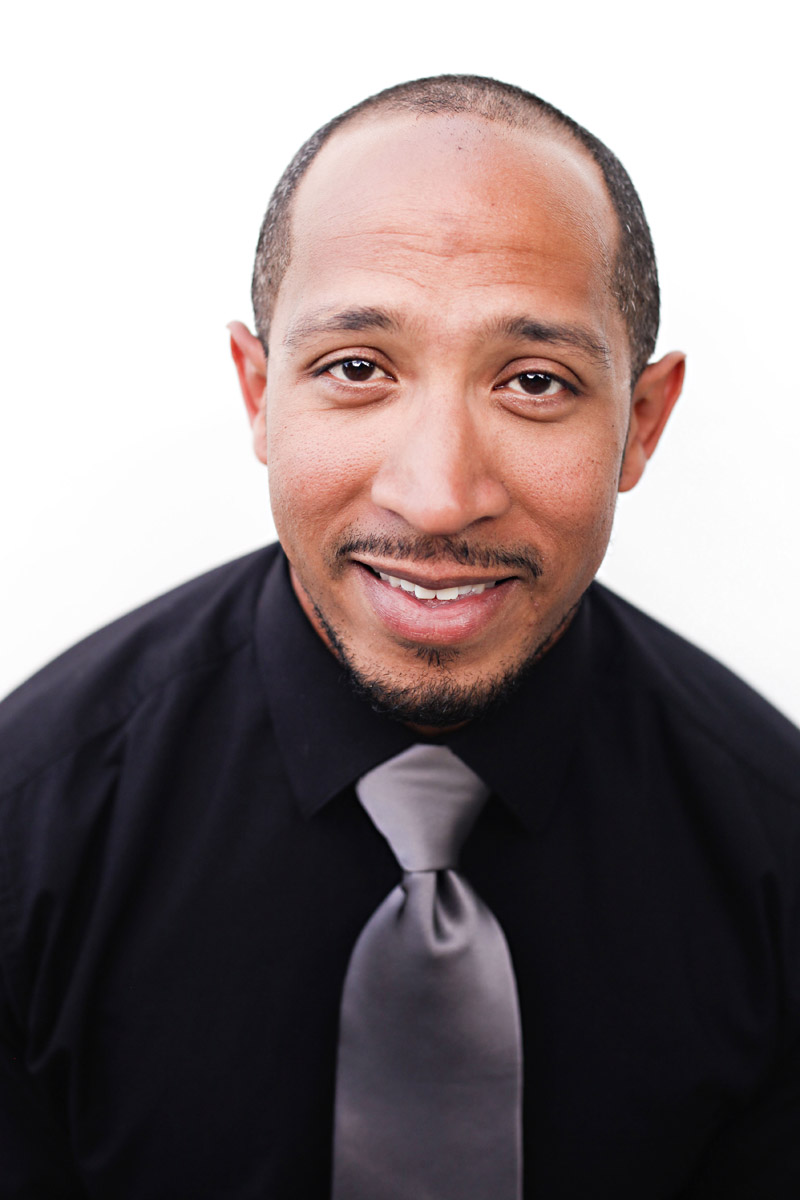
James Jackson III is a businessman who can help people, especially the black community, promote their own business.

Jackson was born and raised in Utah and like most of the diversity in the state he wanted to put his culture at the top of the list of this state. Jackson attended and graduated from Cottonwood High School in 1998.

He graduated from the University of Utah in 2002 with a Bachelor of Science in Marketing, and a Master of Business Administration from the University of Phoenix. Jackson wanted to help people in his community; he wanted to help them by promoting them and watching them grow.

In junior high Jackson already knew what he wanted to do in the future, unlike other kids that don’t know what career they want. He wanted to help people from his culture, from his community and one of the reasons why is because there is such a small portion of African Americans here in Utah. So as a minority his goal was to help them in every way possible, help them achieve their goals.

ACCEL, African-Americans Advancing in Commerce Community Education & Leadership, is an organization that helps African American business to achieve their goals in a small diverse market here in Salt Lake.

Jackson founded ACCEL in 2009 and has helped about a dozen businesses and counting because this was the goal of Jackson, helping as much black business as possible.

ACCEL with their executive director Jackson need some help too from large private companies so he started a partnership with Pepsi Co. and Zion’s Bank and wants to establish a relationship with Budweiser. He wants this partnership because they can help money wise with the local owned businesses.

At the University of Utah Jackson had a professor whom he admires and respects him and considers him a mentor throughout his career.

Wilfred D. Samuels English professor at the University of Utah

Wilfred D. Samuels, is an English professor at the University of Utah

Professor Wilfred D. Samuels knows very well Jackson from his childhood all the way up to when he became his pupil at the U.

The youngest of Samuels’s son’s was best friends with Jackson and ever since he has been a much known friend.

“Although it has been over ten years that James was here on campus, we attend the same church,” Samuels said in an email.

Samuel said Jackson came from a loving and caring Christian family  and was raised with the highest values. Jackson and his family have always attended church and loved music. Samuels said that’s why they formed part of the church choir — his grandparents too — and participated in all church activities.

“At the U of U, he pursued a career in business. He worked hard and remained passionate about his major,” Samuels said.

Samuels said after Jackson graduated from the U he went on and worked with the Utah Black Chamber of Commerce and tried every single way to get the church involved in business efforts. That showed his commitment to the chamber and that he wanted to help his community by starting with the church.

“I know James to be congenial, principled, dedicated and passionate about life. He is totally committed to his personal growth and development. I admire and respect him,” Samuels said.

Being passionate about life and wanting to help others in his community, Jackson never gave up and he sought out help to start and make ACCEL a reality.

Francisco J. Sotelo is the executive director for the Utah Hispanic Chamber Commerce and a good friend of Jackson. Sotelo and Jackson met through an event two and a half years ago.

“James is a great leader and a good representation for his community, representing the African American people,” Sotelo said in a phone interview.

Jackson approached Sotelo with a strategy to make ACCEL which was a great idea, it just needed a little help, Sotelo said. ACCEL and the Utah Hispanic Chamber of Commerce help each other by exchanging ideas to help their community. Sotelo took a lot from Jackson which later he applied to the Utah Hispanic Chamber of Commerce.

“Even right now we sit down and discuss ideas we can apply for our chambers and not just for one,” Sotelo said.

ACCEL and the Utah Hispanic Chamber of Commerce have a great relation and with the same objective: helping the community in every possible way.

Jackson said he is very grateful to the Utah Hispanic Chamber of Commerce for showing him the right way and steps to form ACCEL and in the process help the black community rise in the local market in Utah.

University of Utah students focus on diversity in innovation

Story and photo by TREVOR RAPP

On Jan. 8, 2013, the University of Utah was ranked as one of the “top institutions in the country for startup formation,” according to the latest survey by the Association of University Technology Managers released in December 2012.

“Startup formation is in our DNA,” said Bryan Ritchie, director of the U’s Technology Commercialization Office, in a news release.

The genetic complexion of business innovation has significant meaning for one U student. He is not just a business innovator, he is a black business innovator.

“Black-owned businesses are, especially where I’m from in Lake City, Fla., a rare commodity,” Enis Henderson said.

Ennis Henderson, UofU student.

Ennis Henderson, UofU student.

Henderson is part of a research innovation class that tasks students to research opportunities to improve local or national communities.

“I chose the problem that was near and dear to my heart, which was trying to improve the quantity of black-owned businesses in America,” Henderson said.

While contemplating his project, Henderson’s mind stretched back to Lake City, Fla., where he grew up. He described it as a “Mayberryesque” town where the white people lived on one side of the tracks and the black people on the other. There he gained his first working experience “doing the jobs no one else wanted to do” like picking the tobacco, corn, peanuts and melon grown in his community.

When he was 22, he got his first lesson in owning his own business.

That lesson came from a casual conversation with a white insurance agent. After “taking a liking” to each other, Henderson said the agent explained that he took his two sons out to cut wood and then bring it into town to sell it. Each time they made a sale they would subtract their revenue from their operating costs to calculate their gross and net profits.

“That was the first time I had heard the words ‘operating expenses’ and ‘gross profit’ in the same sentence,” said Henderson, “and I said ‘Wow, how old are your boys?’ and he said ‘7 and 9.’”

“You aren’t born with an innate sense of how to do business,” Henderson said. “Someone has to teach you, or you have to go out and learn it. And if those people who don’t own businesses never had anyone in their family to take them by the arm to say ‘let me show you how to do this’ … and if they’ve never seen it or heard it — odds are they won’t do it.”

And recent statistics are showing that when compared to other minorities, African-Americans are not doing it.

According to “Black (African-American) History Month: February 2013,” published by the U.S. Census Bureau News, the black population, whether of mixed or non-mixed backgrounds, is 43.9 million. This represents an increase of 1.6 percent from the April 1, 2010, census.

Nevertheless, in a separate 2007 Survey of Business Owners conducted by the U.S. Census Bureau found that only 1.9 million businesses out of 30 million were black-owned.

For Salt Lake City, black-owned businesses are only 2.7 percent of the almost 24,000 total businesses, according to the U.S. Census QuickFacts.

These numbers haven’t been lost on Henderson. As part of his project he researched statistics published by the U.S. Census Bureau, the Bureau of Economic Analysis, and IBISWorld.com, a database of industry-based research.

As he spoke, Henderson pointed to various charts from those sources as he explained that while blacks outnumber the most profitable minority, Asians, by about 3-to-1 by population, they own about the same number of businesses. Even more surprisingly, Asians were making about three times as much profit.

“It’s completely inverted,” Henderson said.

Henderson isn’t the only person who has noticed a lack of diversity in local businesses.

Most African-Americans who come from the South or the Midwest don’t want to come to Utah because of the stigma that Utah has of not being a diverse community, said James Jackson III, founder and executive director of ACCEL (African-Americans Advancing in Commerce, Community, Education, and Leadership), a nonprofit organization providing resources to African-American small businesses in Utah.

Neither Henderson nor Jackson point to current racial prejudices as the current cause of the problem. However, the “genesis” of the problem is deeply embedded in the history of slavery in the United States, Henderson said.

For Jackson, the most pressing need is increasing the level of education for all Utahns. Jackson was appointed by the governor to the Utah Multicultural Commission, an advisory group for issues relevant to local minority communities. “The main song that was sung through [the commission’s various] committees, whether it be health, education, corrections, economic development, all of them leaned toward education in some way,” Jackson said.

Those numbers are reflected in the April 1, 2010, US census as well, with only 18.4 percent of blacks reporting having earned a bachelor’s degree, and only 1.6 million blacks reporting having earned an advanced degree.

And the effects are real. The annual median income for black households declined by 2.7 percent from 2010, making it almost $10,000 less than the national median income for families, according to “Black (African-American) History Month: February 2013.” The U.S. Census Bureau News also reported a 27.6 percent poverty rate among blacks, almost double the national average.

For Henderson the answer is availability of resources. “What I recognize is that it’s a lack of information. Now there’s a ton of information out there on the internet there are types of agencies people can go to to get information. But they don’t know what to ask for if they did go to an agency,” Henderson said. “They’ve never been informed. The resources are there but they don’t know what it is, they don’t know what it’s for.”

James Jackson III: building a stronger African-American community

Story and photo by DANEALLE PLASCENCIA

How do you picture Utah when you know the majority of the population is Mormon? Do you picture only Caucasians? What about the minorities?

For almost two decades, Utah’s population continued to rise while the percentage of its people who are Mormon slowly and steadily declined, wrote Matt Canham in an article for The Salt Lake Tribune.

Newcomers have found that Utah is economically stable and offers different sources for the community to grow in comparison to the rest of the nation.

The job rate in Utah is increasing faster than the unemployment rate, and has an attractive cost of living which is making people to consider Utah as their new home.

Like any other state, Utah offers different sources to help the community, including the minorities.

One of those sources is ACCEL (African-Americans Advancing in Commerce, Community, Education and Leadership).

This organization is committed to being the premier organization in providing education, resources and visibility for the African-American small businesses owners of Utah.

Photo Courtesy of James Jackson III, Founder of ACCEL

Photo Courtesy of James Jackson III, founder of ACCEL

The founder of ACCEL is James Jackson III, who was born and raised in Utah.

Jackson, 33, graduated from The University of Utah with a bachelor’s degree in finance and marketing.

He earned a master’s degree from the University of Phoenix in 2010.

After working on his own for a while he decided to establish ACCEL in the winter of 2009.

The main reason for the creation of this organization is the passion for business that Jackson has, especially the necessity of helping those around him in their endeavors.

Being able to offer the community more resources for education to have a better future is a main focus.

Jackson develops the idea of creating an organization from his own experience of being the  owner of a small business dealing with the sale and management of properties.

That is how he noticed how the African-American community didn’t have enough resources and support to develop their business ideas.

“Creating ACCEL took a lot of time, and help from other people who I see as an example for my project,” Jackson said.

One of those people who helped Jackson is Francisco J. Sotelo, current executive director of  the Utah Hispanic Chamber of Commerce.

Jackson and Sotelo met three years ago, during an event of the UHCC. Jackson asked him for help to create a stronger organization.

Sotelo had meetings with Jackson to help him understand how a chamber works, and share his strategies that he had used to create a successful chamber.

During the meetings they shared ideas and new projects for both organizations.

Since then Jackson and Sotelo have a very good relationship.

They meet often to talk about Jackson’s projects, and to keep each other updated about their respective organization.

“Our relationship has grown over the years and as well the chambers, we had learned from each other through the years,” Sotelo said in a phone interview.

Official Logo of ACCEL

Official Logo of ACCEL

Networking plays a big role for ACCEL. Jackson believes that a networking community is more effective than one that is not really connected. That is why he is creating a new website for ACCEL with the help of Ronda Fisher.

Fisher said in a phone interview that her goal is to design the site so people can find resources and assistance more easily.

“I’m really excited to see the results,” Fisher said.

Besides being a successful business man, Jackson is a member of one of the most established black churches in Utah, the Calvary Chapel Salt Lake and makes time to be part of the church activities to be connected with the community.

Between his activities Jackson is the coach of a kids basketball team, and reads books like “Think and Grow Rich: Your Key to Financial Wealth and Power ” from the author Napoleon Hill, for personal enrichment at the start of the year.

Community is the main focus for Jackson in his life. He knows the African-American community population is only 1.3 percent in the state of Utah but that is enough for him to keep working hard to create a successful community.

“Things have changed in Utah. I remember when I was in elementary school, there were only a couple of black kids in my classroom, but things have changed since then,” Jackson said.

Jackson has dedicated the last four years to building a stronger African-American community in Utah, and all his work is being rewarded.

“Jackson works really hard every day, and has done a lot of things for ACCEL,” Fisher said.

Diversity of cultures in Utah is becoming more noticeable, and Jackson is trying to be part of it.

Jackson’s future plans for ACCEL include having more members, hiring an executive director who would be in charge of the organization, and creating scholarships like SOMOS, the prestigious award offered by the UHCC.

ACCEL, after four years of its creation, now is offering sources for 300 African-American small business owners in Utah.

“James is a great leader and represents the black community very well,” Sotelo said.