Tauna Lynne Price

MY STORIES:

MY BLOG:

The chosen beat for our class was the Asian American community. To be quite frank, I never had much interest in the countries that comprise Asia or even local communities. I lived in Germany and traveled Europe. I speak German. I never thought much about becoming involved with the local Asian community.

I was wrong. I found my mind flourished with ideas, thoughts and stories. But, I had to figure out how to visually adapt those thoughts. The local Asian American community is rich in culture, resonating beauty through sound, color, language and more —something I never knew until I worked on my Kenshin Taiko piece.

I knew I wanted to capture the beauty of the drum. I needed close-ups, close enough to reveal the marks on the stretched skin, the marks left by bachis from the drummers. Those marks represent a “communing” between the drum and the drummer, said Matthew Stevens, a Kenshin Taiko member, during an interview.

I filmed Kenshin Taiko during a practice and then I attended a performance at Utah Valley University. I was extremely close during the filming at the practice. I could feel the beating of the drum through my whole body. I wanted the audience to experience that feeling as well. I kept the camera close to the drums to give the feeling of being right there. The drummers played with such passion and feeling, allowing their bodies to be one with the motion.

The one aspect I avoided was the writing. I am a visual artist. I see everything being created as film or a photograph. I see life, news and the future as though I am looking through a lens. It was an extremely challenging task to write about Kenshin Taiko. My epiphany came when I realized this article ended up being the hardest yet most gratifying to complete. The reason, I think, I was simultaneously creating the art on paper and the art in film. Working on these two projects simultaneously allowed me to view them together and also use one to work off the other. I would constantly roll the footage in my head — the drumming, interviews, costumes, lighting — and this helped me successfully write my piece.

Aside from being a field camera operator in the news, documentaries have always interested me. The addition of my writing classes to my media and film classes has helped me reach a whole new level of confidence. I have been able to successfully bring my profession of news media and print full circle. I feel more empowered to make decisions, appropriately narrow my ideas, conduct interviews professionally and carry myself with the assurance and determination needed to become a successful documentarian and journalist.


ABOUT ME:

My name is Tauna Lynne Price. I was born in Oklahoma. Since my father was in the Army, I had the priviledge of living and traveling all over the U.S. and Europe.

I originally started my college career as a film student. I obtained a Film Production Technician from Salt Lake Community College. After stumbling into the broadcast world, my career choice suddenly changed.

I decided to transfer to the University of Utah and begin my quest for a bachelor of arts in journalism and a minor in documentary studies.

I’ve been working for a local television station for roughly three years. My end goal for a job is to be a field photographer. My passion is capturing footage, editing and delivering the final piece to the news director to air. It’s an amazing feeling to see your work displayed.

I have a dog named Thor and a cat named Sox.

I currently have a full-time job and am attending school full time. Being this busy has its difficult moments, but it pales in comparison to the extraordinary feeling of accomplishment.

Lauren Carter

MY STORIES:

MY BLOG:

When Professor Mangun told our class we would be covering the Asian- American beat for the entire semester, I was more than a little worried. I had no ties to the Asian-American community in Salt Lake City and realized very quickly that this semester was going to be a lot of hard work.

At the beginning of the semester it was hard to think of story ideas to look into within the Asian-American community. But as I got more familiar with the community, the stories were easier to come by. However, executing these story ideas often became more and more difficult. I quickly learned that journalists are really at the mercy of their sources, often leading me to have to come up with a plan B. I also learned that almost everyone has a story they would like to share, if only given the chance to do so. I have met several amazing people whose life stories will stay with me forever. Their strong, optimistic attitudes have inspired me to try looking for the positive view even when the situation displays none.

I learned a lot about Salt Lake City’s Asian-American community from covering this beat. I learned that it is a very strong community that is stitched together by different organizations, offices and strong leaders. I also learned about different nonprofit organizations that help Asian refugees and their families once they move to Salt Lake City.

Although this semester was a lot of work, I am happy that I got the chance to go outside my comfort zone and learn from people I would not have met otherwise.

ABOUT ME:

I am a sophomore at the University of Utah, expecting to graduate Spring 2013 with a degree in mass communication with a focus in journalism. I have always enjoyed reading books and newspapers, which led me in my choice to study journalism for an undergraduate degree. I hope to one day have a job that deals with law, maybe by covering law in a beat or becoming a lawyer.

Catholic Community Services helps refugees in Utah

by LAUREN CARTER

Approximately 1,000 Asian refugees take solace in Utah every year, according to the State of Utah Refugee Office. Most of these refugees come from Third World Countries, and have lived in refugee camps for the majority of their lives.

The majority of these people were driven from their homes because they did not support the ruling class that was currently in power. Some refugees are from the formal ruling class and ended up living in camps because their group was thrown from power, said Linda Oda, the director of Asian Affairs in Utah.

According to the State Department’s Foreign Affairs Manual, all refugees go through a several year process before being allowed to come live in the U.S. This process involves the work of the United Nations High Commissioner for Refugees and the Department of State’s Bureau for Population, Refugees and Migration.

It usually takes about three to four generations for a refugee family to become in tune with the American way, Oda said. This transition involves learning English, taking life skills classes, learning American culture and establishing a life in the U.S.

Since 1945, the Catholic Community Services of Utah, has been helping refugee families throughout the first year of their lives in Utah.

“Utah is considered a welcoming state because we have organizations that truly advocate refugees,” Oda said.

When a refugee is relocated to Utah, their case is assigned to CCS or the International Rescue Committee. CCS and IRC are the only two agencies in the state of Utah that are allowed to handle refugee resettlements, said Rebecca Van Maren, the former assistant volunteer coordinator for CCS who also worked with Bhutanese refugees.

CCS’s work begins before the refugee or their family arrives in Utah. CCS finds out information about the family to arrange housing for the family. This information involves knowing the number of people within the family, and if they have any children, knowing the ages and gender of the children. CCS makes sure that the house is ready for the family to move in upon arrival, including fully furnishing the entire house, Van Maren said.

Van Maren said when refugees arrive, CCS sends a case manager to greet them at the airport. From the airport, the case manager then helps the refugee and their family get settled into their new housing. The refugee’s case manager’s job is to help the refugee and their family adapt to American life, and are available for the first year that the refugee is living in the U.S.

“Their case manager is primarily the person who is explaining the services that CCS provides,” Van Maren said.

CCS’s goal is to help the refugees and their families reach a state of self-sufficiency in Utah. This goal is achieved through taking classes, creating a stable life within the community and with the help of their case manager. A case manager’s help can range from signing the refugee up for classes, to explaining how to shop at a grocery store.

One of the biggest difficulties that refugees face is not being able to speak or understand English. CCS can find education classes that teach people who are 90 years old, down to small children the English language, Oda said.

“Without English these people will never get anywhere,” said Maung Maung, an Asian Advisory Council member in Salt Lake City.

CCS offers life skills classes that refugees can take. They also can coordinate volunteers and interns to mentor and visit with the families. These mentors can go to the refugee’s home to teach them basic life skills, as well.

CCS has job developers, who will work with the refugee’s case manager, to find employment for the refugee. These job developers can also help refugees write resumes in English, because a lot of CCS employees speak multiple languages, such as Vietnamese and Mandarin Chinese.

They also offer a refugee foster care program for children. This program provides guardians until the child’s family can be found or until the child reaches 18 years of age.

CCS occasionally works in conjunction with other agencies in Salt Lake to provide opportunities for people from other countries, Van Maren said. Over the summer, CCS provided filing work for Koreans who were here for a three-month language learning internship, she said.

They also offer an array of assistance programs, which include help with immigration status, substance abuse treatment facilities and many facilities to help provide basic services and goods to low-income and homeless individuals all across Utah.

Former Miss Asia Utah says pageantry is more than beauty

by KENDRA WILMARTH

Lipstick and nylons fly across the room. Hairspray pollutes the air as women hold down aerosol nozzles sculpting each strand of hair in place. Women glide down runways with chiseled smiles and a glimmer of confidence in their stride. But this isn’t a fashion show, this scene is one of hopeful women competing at local beauty pageants to be considered for a crown identifying them as the next year’s titleholder.

In Utah countless pageants are available for young girls and women to compete in. Pageantry has become a popular outlet for women to get involved in their community, while at the same time earning scholarship money.

Miss Asia Utah is one of these pageants. The program began in 2008 and now takes place every June when the Utah Asian Festival is held in Salt Lake City. Asian women aged 17 to 25 are given the opportunity to showcase their talent and elegance while on stage. The pageant is open to anyone who is at least 50 percent of Asian descent and willing to be a role model for her community and the Asian-American community.

“We believe that these young women have a responsibility to do something in the community, it’s not just a pageant,” said Agnes Higley, chairwoman of Miss Asia Utah, in a phone interview.

Higley said the pageant is a way for women to personally develop. The program helps women gain and maintain confidence as well as high self-esteem. According to the pageant’s mission statement,  participants through this program will be able to foster relationships through friendship and cultural interactions. Higley said one of the main reasons for starting this pageant was the lack of knowledge in younger generations about their ethnic roots.

“There’s a lot of Asian-Americans who were born here, and they don’t know a lot about their cultures,” Higley said.

Women competing will also learn to understand about their own heritage and embrace others in their cultural differences. According to the mission statement, the pageant promotes intercultural unity among Asian-Americans in Utah. Judges pick winners based on talent, national costume, evening gown and eloquence in interviews. Each year different sponsors finance the pageant and provide the winner with a unique scholarship amount.

courtesy of Nicole Abalos

Abalos wins crown and title of Miss Asia Utah in 2009. Courtesy of Nicole Abalos.

Nicole Abalos was crowned Miss Asia Utah in 2009. The University of Utah student and former ROTC cadet says the program is a great way to showcase the diversity and multicultural societies here in Utah. In an e-mail interview Abalos said pageantry brings young women from all over the state to represent their ethnic heritage and unites them in many different ways.

Abalos became involved in pageantry in 2007 when she was given the title of Miss Philippine. Although she is one-half Filipino, one-fourth Japanese and one-fourth German, Abalos was mainly raised with Filipino traditions and also speaks some Tagalog, a major language in the Philippines.

Many doors have been opened for Abalos since her crowning, including opportunities with school, volunteering and even job interviews. Through the preparation of the pageant Abalos says she learned more about herself, was able to gain confidence and the self gratitude from helping others. Winning the pageant gave her not only a window to become a role model in her community, but also was an educational experience.

“The pageant has taught me a great deal about my ethnic roots which include, respect to elders, giving back, and keep traditions through every generation,” Abalos said in her e-mail.

Abalos, now 20, competed for the title of Miss Utah USA on Oct. 22. While she had hoped to receive the crown, for her it wasn’t about winning.

“It’s about finding who you are and why you should be the face or example of communities within the state,” Abalos said.

The Miss USA program is gaining more cultural depth. The current Miss USA is the first Arab-American titleholder. The 2010 Miss Utah USA is Russian and the previous winner was Bulgarian. Abalos says she believes it’s exciting to have contestants with such varied cultural backgrounds competing in pageants.

“This just proves how diverse our country is and the opportunities available to everyone,” Abalos said.

The former Miss Asia Utah says being involved in these competitions helps her learn from many amazing women who live around the state. Although Abalos didn’t win the title of Miss Utah USA, she said she will continue to be a great example and leader.

“I work hard for what I deserve and give back to those less fortunate,” Abalos said. “Hoping to be a role model to younger girls is all I could ask for.”

Educating the community about Filipino culture through dance

Story by RICH FAHEY

Filipino children in the Salt Lake Valley are getting involved in a new dance group as a way to help maintain tradition. Kulturang Pinoy Ensemble, or Filipino culture ensemble, gives Filipino youngsters the opportunity to learn traditional dances, and educates the community about the culture as well.

“We have a lot of young Filipinos growing up here, and we’d like for them to learn their culture,” said Teena Jensen, vice president of the Kulturang Pinoy Ensemble, in a phone interview. “It’s also a way to keep them out of trouble.”

The ensemble was developed at the end of August 2010 when some Filipino families became concerned that their children were losing their heritage. Jensen was a dancer in a similar Salt Lake City program that discontinued performances in 1998. The group’s main focus was to educate others about Filipino culture. While the new ensemble is following in their footsteps, it is a learning tool for both the audience and performers.

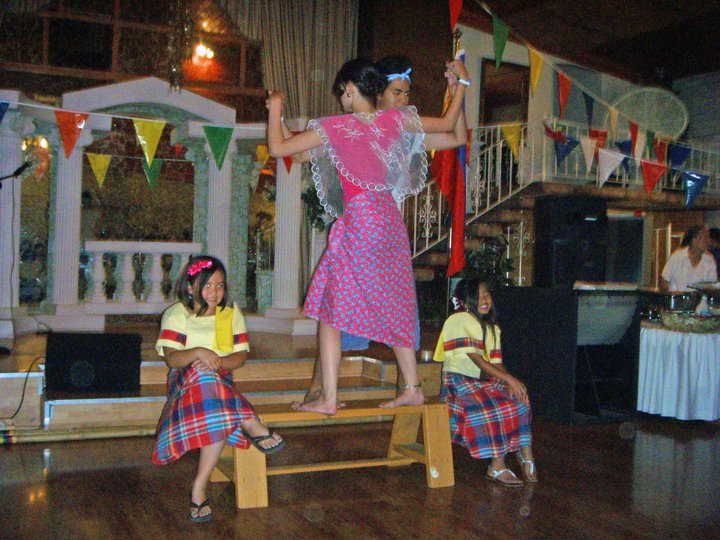
Dancers performing Sayaw sa Bangko, or the bench dance, at the fundraiser. Photo courtesy of Teena Jensen.

The Kulturang Pinoy Ensemble currently consists of 10 children between the ages of 13 and 18. The first performance was held on the evening of Sept. 11, 2010, during a fundraiser to raise money for costumes and props. The girls will wear a balintawak, which is a long dress with butterfly sleeves and a brightly colored overskirt that matches the sleeves. The boys will wear a chino, or brightly colored shirt. When the children outgrow them, plans are in place to pass the costumes down to younger children in hopes of getting more people involved in the ensemble.

Jensen said the program has seen a lot of interest from parents and children alike. When fully developed, the ensemble will have children as young as 5 years old dancing with the group.

“The younger ones come out and watch their brothers and sisters and say, ‘when are we going to start dancing,’” Jensen said.

However, it’s not just about the dancing. The ensemble also encourages the youngsters to learn the Filipino language. During each practice and performance, the children are given a Filipino word of the day. The group includes children who are from the Philippines, as well as those born here. The interaction between them is good for both groups, especially those learning the Pinoy language, Jensen said.

“It’s also learning respect from other Filipino children,” she said. “In the Philippines they respect their parents more than some of the children here do.”

The Philippines are made up of more than 7,000 islands, which creates diversity between the various areas. Jensen said each island has a unique dialect and is like a totally different culture. These different cultures allow for variety in the dances. Each dance has its own meaning and represents a story. Every performance is divided into suites that feature a dance native to a particular area or Filipino culture.

In an e-mail interview, Jensen said one dance suite the ensemble will perform is the Barrio Fiesta Suite. This is comprised of four different dances. The first is the Pista, which displays the lavish preparation for a party. Next is the Gala, also known as the Boholano. This dance comes alive with the clashing of pans, pots, plates, ladles and brooms with firewood, pails and knives to represent a wedding. The third dance is the Kalatong, a popular dance from the province of Batangas that uses bamboo percussion tubes. The finale, and perhaps the most well known of all Filipino dances, is the Tinikling, named after the Tikling bird. For this part the dancers imitate the bird as it avoids traps set by farmers.

The ensemble plans to perform the Barrio Fiesta Suite and others at schools, churches, fundraisers and any time the opportunity presents itself. However, the ultimate goal is to dance at the Living Traditions Festival in May and the Utah Asian Festival in June.

“That’s one of the main reasons for the ensemble, because people were asking – how come there are no Filipino groups performing at these events?” Jensen said.

Eunice Jones, president of the Kulturang Pinoy Ensemble and chairwoman of the Utah Asian Festival, said, “It’s not going to be just a dance group for one organization. It has to be for the whole community.”

Both Jensen and Jones are excited to share the Filipino culture with the community through the Kulturang Pinoy Ensemble.

Utah Asian Chamber of Commerce looking to expand scholarship program

Story and photos by KAREN HOLT BENNION

Growing up near a small village in the Philippines, she would often go to bed on an empty stomach. She spent her summers selling snacks like a vendor at a baseball game just to earn enough money to buy school supplies. She and her 10 brothers and sisters got by without running water or electricity. The only positive aspect in her life was the looking forward to each new school year. For Eunice Jones, education would be her salvation.

Eunice Jones discusses her life, past and present, with student-journalists at the University of Utah.

In her early teens, her parents moved the family to a small apartment in nearby Manila. Jones said the two-bedroom, one bathroom home seemed like a far cry from their “humble beginnings” back in her village. Life became a little easier for the family.

She eventually graduated from high school, and with the financial help from a college scholarship and her family, graduated in the top 10 of her class from a college in Manila. “That’s what we do,” Jones says. “We all help each other.” She got a job and settled down with her husband. They had two sons. However, after her husband left them, Jones decided it was time to venture outside of her home country. This meant breaking the rules of Philippine culture. She was supposed to live with her parents until she remarried.

She left her sons — one of whom was still breastfeeding — behind with her family and moved to Los Angeles, where she had been offered a job with the Hyatt Corp. “It was quite eye opening,” Jones says about her arrival in in that city. However, after three years of saving enough money she was able to obtain visas for her children and fly them to the U.S.

After marrying her second husband, they moved with him to Salt Lake City where she still worked in the hotel business. Finally, Jones decided she was ready for another challenge and earned her realtor’s license. During her first year as a realtor Jones was chosen as Rookie of the Year by Better Homes and Gardens magazine for her outstanding sales skills. She admits she owes it to selling snacks as a little girl in the summer. “I was in sales since I was a little girl,” she says.

In 2005, Jones, along with former Third District Judge Ray Uno, decided to establish the Utah Asian Chamber of Commerce. That same year, they also founded the Chamber’s scholarship program with the help of founding sponsor Zion’s Bank. Three scholarships were awarded at $1,000 each. Currently, the Chamber’s charitable foundation offers partial scholarships to an average of 15 students a year. Jones would like to see the scholarship program grow with more sponsors helping to offer full scholarships to high school seniors.

U student Amy Tran received a UACC scholarship in 2010.

One of last year’s recipients, Amy Tran, says the UACC Scholarship Program has helped her in more ways than one. A sophomore in business at the University of Utah, Tran says not only does the program give financial help, it also offers the students chances to receive training in leadership skills from local UACC members.

“The UACC is really supportive and motivating,” she says.

An awards gala and fundraiser for the scholarship program is held every spring. All of the students are invited to attend. They meet each other and are introduced to members of the UACC. The members then teach the students how to network and make connections. Tran says, “They all really try to get to know you.”

Another student at the U has been awarded the UACC’s scholarship for three years in a row. The last time she was awarded the scholarship she received the highest score of all the applicants. Michelle “Mika” Lee is currently earning her master’s degree in occupational therapy. She is also a part-time intern for the UACC. Lee works as the event coordinator.

“Education is placed high in my family — my father got a Ph.D. and my mother got her B.S. early,” Lee wrote in an e-mail interview.

UACC President Lavanya Mahate congratulates Mika Lee at the 2010 Scholarship Gala.

Both students agree that more publicity is needed in order for the scholarship program to grow. Tran heard about the scholarship through her uncle, who is a member of the UACC. She never heard anything about it at her high school. Scholarship co-founder, ZeMin Xiao, says their program is still small compared to other minority programs in the area. The main reason for this, she believes, is due to a stereotype that Asian-Americans do not need scholarships. People view Asian-Americans as the “Model Minorities,” she says. Tran agrees; when she told her friends she was going after different scholarships they told her she didn’t need them.

“You’re Asian, you’re smart, you’ll be fine,”  her friends said.

Xiao would like the Salt Lake community to know there is a scholarship specifically targeting Asian-Americans.  She says the program is constantly trying to find more sponsors. Some of the supporting companies include Merrimack Pharmaceuticals, Crocker Ventures Ltd. and vSpring Capital.

Now divorced, Eunice Jones dedicates more time with members of the UACC to help mentor Asian-American students and to try to get the Salt Lake community to realize that by helping to fund their scholarship program, it is investing in the future of all Utahns. After all, her family invested in her.

Karen Holt Bennion

MY STORIES:

MY BLOG: The returning student

Going back to school as an older student, I’ve brought with me years and years of life experiences. However, this doesn’t mean that I know everything; quite the contrary. I’ve met so many students and professors who have left their mark on me and I will continue to use what I’ve learned from them in my everyday life. As soon as one closes the mind, all opportunities and possibilities disappear.

Digging into the Asian-American beat has led me to meet very fascinating Utahns. After reflecting on the various people I have spoken with, one word comes to my mind to describe all of them: courage.

It takes a huge amount of courage to leave your family behind and travel to a new country. It takes courage to stand up for yourself in the face of discrimination. It takes courage to change careers and to follow your dream, even if it means starting all over. Finally, it takes courage to admit to yourself and others that to be slightly different from society’s “norm” is OK.

If we can each stand up and be counted as responsible members of our community and end bullying, we have then accomplished a gigantic feat. Thanks to the people with whom I’ve met and the tireless commitment they’ve made,  the movement has already begun and it is gaining momentum.

When this semester began, I felt anxious about jumping into the beat and into writing practically full-time about something so unfamiliar to me. But now, as the class is coming to an end, I find myself wishing for more time. More time to expand on my stories, more time to explore my beat further and more time to concentrate on the “magical” aspects of writing. I’ve discovered that certain places will produce certain moods for my writing. I’ve also realized that I do most of my best work after midnight. I am indeed a nocturnal person. Also, I’ve found that to open my own self up and let my personality flow into my writing is just what I’ve needed to grow as a writer.

As a writer I will continue to produce truthful stories in order to educate, and to draw out just enough emotion to prompt the reader into taking action. After all, a community is only as good as the citizens who support it. Talk is cheap and action speaks volumes. It is our civic duty to become involved – even if it’s just one step at a time.

ABOUT ME:

I will aways remember my mother’s words when I first decided to return to the U: “You can be everything you want, just not all at the same time.”

I’ve been a mother, a full-time employee, a supportive wife and a homemaker. Now, I am an empty nester who is searching for a new adventure in the next stage of my life. My husband, Doug, and I enjoy traveling, and I am looking forward to doing just that now that I’ll be graduating soon. I love the outdoors and can’t wait to explore more of it with both of my four-legged best friends, Koty and Bella. Family is very important to me so I plan to still extend my shoulder as far as I can for them whenever they need it.

I am grateful for a supportive family who has helped me keep my nerves intact when I was feeling like checking myself into a mental hospital. My children’s hugs mean more to me than a month at the most exclusive spa. My husband is a rock and I admire his patience for me while I’ve been on this physically exhausting yet exciting journey. Soon it will be time to play. Then I will take time to look for work using all I have learned at the U, especially in this class.  Thank you to all.

Kendra Wilmarth

MY STORIES:

MY BLOG:

As a journalist I believe that everyone has a story. This semester has only validated this notion. Everyday people here in Utah have tales that seem so distant to our conservative communities. Covering the Asian-American beat has shown me how diverse Utah really is. We have neighborhoods throughout Utah that most people don’t even know exist.

For example, the article I wrote on gangs. How many residents in Utah know that just in Salt Lake there are around 3,000 documented gang members? And that among those members are some gangs designated just for Asian kids? I was shocked to discover this information. To speak with someone who is involved in this lifestyle was a wake-up call. Utah has a mixture of all types of people. People whose stories need to be told. Our public has no idea of the struggle that most Utahns face. Especially the struggle that new Utahns face.

During this beat I have become more aware of the social injustice between races. Not only do different races feel inferior to each other but I have learned that within the Asian community there is pride and competition between the different ethnicities.

We had two incredible women come and speak to our class. To see someone of their success and hear of their stories is inspiring. It proved to me that not every story of success is an easy one. These Asian-American women came from difficult circumstances. Now they are two publicly recognized women who have reached the top. I have found that the cliché statement of “you can’t judge a book by its cover” is simply true.

That’s why as a new reporter I have learned to keep my eyes open to all communities and walks of life. Media have a responsibility to cover stories of all backgrounds. Because just around the corner could be a life-changing story that someone needs to tell and the public would love to hear.

ABOUT ME:

I am currently 21 and a senior at the University of Utah. I will graduate in Spring 2011 with a degree in mass communication with an emphasis in journalism and a minor in political science. My goal is to become a field reporter for a TV news station. Curiousity drives my life. Whether it’s interviewing someone for a story or talking to a personal friend, I ask a lot of questions. I am passionate about my career choice and feel that, if used wisely, journalism is a very powerful tool. I am a lover of football, especially Utah football. I enjoy dancing, jogging outside and rock climbing. I love to connect with nature and feel water running between my toes. I spent the past summer in Germany and traveled through Northern Europe. I was lucky enough to see many beautiful and historic places. My family is very important to me and from them I learned the influence of communication. I believe that just by listening to someone’s story you can help improve their life and you might just be surprised at what they can offer you. I am interning at KUTV 2News right now and am learning the tricks of the trade. Also, I am currently on the U’s news broadcast, Newsbreak. I am excited for my future and hope this won’t be the last you’ll hear from this reporter.


Nepalis work hard to keep their culture alive in Utah

Story and photo by KENDRA WILMARTH

Imagine you are in a store. Casually running your hands along various items, looking for something that grabs your attention. Wishing you could find apparent character in a product, something different from the same old mass-produced item you saw at your neighbor’s house on Tuesday. For Salt Lake County residents, stores are starting to fill their shelves with something a little more unique.

Artisans from all over the world are working hard right here in Salt Lake City to provide the local consumer with products such as gloves, necklaces, scarves, blankets and handbags.

Many of these artists are refugees who have come from countries around the globe, such as Somalia, Burma and Nepal. They left their homes due to the dangers of war and moved to refugee camps. Now they have found refuge here in Utah.

The Global Artisans program was created by Salt Lake County to assist these refugees in countless ways and to also help ease their transition to a new way of life. The program was founded in 2008 and is a division of the Pathways to Self Sufficiency project. Ze Min Xiao, refugee services liaison for Salt Lake County, said it was set up as a way to address the gap in the refugee community.

“There is a large population of refugees who are not being engaged,” Xiao said. “This program provides them with the opportunity to get together in a safe place, keep their traditions alive and earn supplemental income for their family and also at the same time gives them the opportunity to be encouraged and empowered to achieve more.”

One of the largest groups seeking refuge here in Utah are the Bhutanese from Nepal. After 18 years of being in camps these refugees have found freedom in Salt Lake City. Now, these individuals are provided the opportunity to capitalize on their own skills by taking part in the Global Artisans program.

Xiao said around 80 participants are enrolled in this program and more than half of them are Nepali refugees. They meet a couple times (sometimes more) per week to knit and sew.

When crafts are complete, artisans have the opportunity to sell their products to the Global Artisans program for an estimated $32,000 a year. However, program participants can also independently sell their own products if they wish to do so.

“It’s teaching them that they can take their culture and make some good of it,” said Linda Oda, director of Asian Affairs.

Oda calls Utah the “welcoming state” because of the state’s willingness to allow refugees to settle within its borders. According to the State of Utah Refugee Services Office an estimated 1,000 refugees have resettled in Utah just in 2010 alone.

Several stores around Salt Lake County sell Global Artisan products, including Little America Boutique, Dancing Queen and Jolley’s Pharmacy. Soon BYU and the University of Utah’s bookstores will  carry their goods. Many of the artisans are also selling their products on Overstock.com. Xiao says the program is in the process of finding new businesses to carry their handcrafted items. They hope to add another 10 stores to the list by the end of 2010.

Refugees meet in the Pioneer Craft House in South Salt Lake, where they are given the proper instruments to fashion various crafts. This equipment is financed through a grant given to the program from American Express.

“This generous grant allows us to purchase supplies, equipment, hire a part-time coordinator and also for marketing purposes,” Xiao said.

Heidi Ferguson is the project coordinator of Global Artisans. Ferguson meets regularly with the program participants. She said most of the individuals in the program already possess the talent and ability to knit and sew and that her job is to help train refugees in the basics of business and teach them new ways to improve their craft.

“All of these refugees are very talented and willing to work hard,” Ferguson said. “They feel comfortable here in Utah, and are glad they can add a little more to the community that has given them a safe place to live.”

Shaantai Leary

Photo by Tauna Lynne Price

MY BLOG:

I have never taken my major, mass communication/journalism, seriously — until now. I picked communication because I wanted to write; I love to write. The feeling I get when my pen meets the paper for the initial takeoff, to the final period at the end of a story, is magical, and for me the whole experience is stress-relieving and makes me feel powerful.

With the sole purpose of pleasing my family, I have been furthering my education by attending the University of Utah. My family wanted me to experience college life. I do not blame them; it is an experience worth taking and I see that now. This class and this beat have made me realize my true passion. I felt right at home interviewing sushi chefs at Yellowfinn and The Flying Sumo, and I didn’t want to stop talking with the staff at The Kura Door, who were always making certain that I was comfortable.

I am now taking things more seriously. I have always loved talking with people, so that was never a challenge. I think my biggest challenges were figuring out how to get started with a story and deciding which direction to go with it. Professor Mangun has been there for me from the very beginning. If ever I had a question I would get almost an immediate response.

Honestly, I did not take my first two stories as seriously as I would have hoped because my epiphany did not occur until I was putting together my enterprise memo. It was at that moment that I realized I could write what I wanted to write and I could publish it for the world to see. No longer was my work personal; I could share it with the world. What a great profession journalism is: I’ve been able to share my experiences with an audience who is intrigued by the idea that I wrote on their favorite sushi restaurant or I wrote about a day spa that sounds soothing to the mind and body.

My favorite quote in high school was, “Things don’t have to be beautiful to be extraordinary. The ordinary can be just as beautiful.” Josh Hartnett said this in the movie, “Wicker Park.” It means so much more to me now than it ever did. I want my readers to experience the extraordinary through something most people would see as average and ordinary. I want to give a new perspective and a vision to people who struggle with envisioning beauty.

ABOUT ME:

At 22 years old, I am in my final semesters at the University of Utah, majoring in mass communication with an emphasis in journalism. My passions are writing, dancing and photography. Ever since I was a little girl I have always loved all of these things.

I currently work at Olympus Gymnastics as the dance coach and I am hoping to start up some freelance writing by next year, potentially to get a job with Travel and Leisure Magazine. I am also pondering taking some French classes and traveling to France as soon as I graduate (at this rate it may take 10 years, only joking of course). My next big investment, other than my time, will be to get a better digital camera. I would like one with interchangeable lenses; currently, I am looking into the Sony α NEX-5.

The true love of my life is my dog Kedo. He is a Siberian husky with one blue eye and one brown. My goal is to be able to have him travel the world with me, as I write and take photographs of different hotels, food and spas around the world.