Black artists bringing #Blackjoy to Utah

Story by NINA TITA

Utah Black Artists Collective is a nonprofit of professional Black artists from across Utah who are building a community of acceptance and love for their art. The Collective includes graphic designers, poets and classical ballerinas.

Jayrod Garrett, co-founder of UBLAC, said the mission is to create Black space, a place where Black people are the majority.

“Things I learned as we went about putting this together, I found out that I was not alone in that idea that I felt isolated as a child. Many of the Black people I’ve spoken to who live here in Utah felt isolated because the state’s 2% black,” Garrett said in a Zoom interview.

Working as a teacher full-time, poet and storyteller, Garrett’s passion is about sharing stories of the lived human experience. His written collection of poems titled, “Being Black in White Space,” captures the essence of what Black artists have gone through. Garrett is aware of the difficulty his audience has relating to the Black experience.

“You can go up in front of an audience and share like one of these really vulnerable poems that talks about what it feels like to be Black in that space and then afterwards you get superficial clapping because they’re like ‘we don’t really know what you just said but this what we’re supposed to do right?’” Garrett said.

Garrett founded UBLAC in July 2020 at the start of the pandemic when organizations were forced to move to virtual platforms. Black artists are using the opportunity to share their work and collaborate on social media, such as Instagram. The current project Garrett is directing is titled #BLACKJOY, a means of breaking barriers.
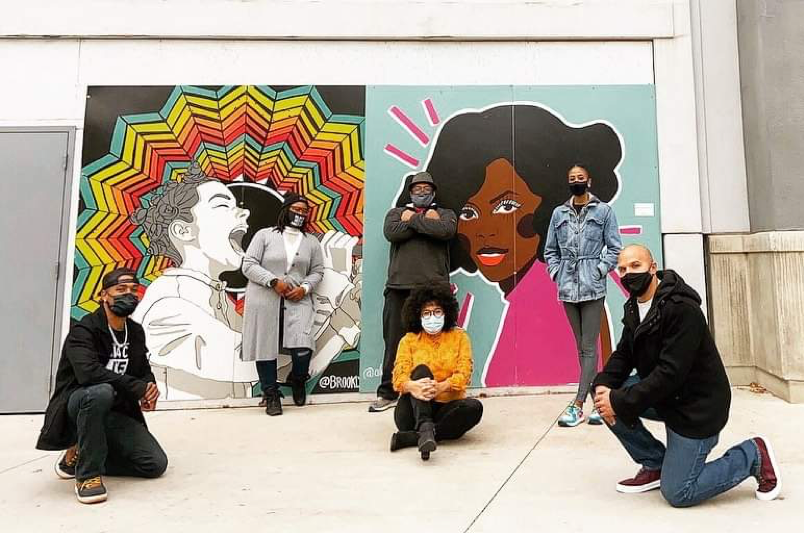
UBLAC artists gather in front of art that inspires them to continue to showcase their talents and bring #BLACKJOY to the community. Photo courtesy of Jayrod Garrett.

“We started talking about the idea of what Black joy sounds like and what does that look like. Is that praise community the only place you see Black people in joy? And it’s not, but like that’s the only way people seem to think about Black people having joy, is in that faith-based community,” Garrett said.

Changing stereotypes has been a challenge other Black artists are passionate about. Daney Lin, an acrylic painter, recalls being the only Black American in his class growing up in Ogden, Utah.

“Being a Black American in Utah, I feel like we are bound to a certain stigma, let’s break down those barriers, let’s knock them down. Let’s be everything, let’s be bank owners, let’s be grocery owners,” Lin said in a Zoom interview.

As a teenager, Lin found art to be his comfort while he was trying to pursue an athletic career in basketball and track and field. He struggled with his mental health and said he was diagnosed with bipolar, ADHD and depression.

“[Art] helped me relieve my stress, it helped me relieve my depression and kind of just showed it in different ways I couldn’t speak it,” Lin said.

He also struggled with the fear of getting better and losing his artistic ability, he said. Utilizing therapy and medication, Lin discovered his talents were not dependent upon his mental health, but provided him relief from stress.

After submitting his artwork on a whim to UBLAC, Garrett immediately saw all of Lin’s potential. Inspired by colors, peace and love in Japanese and Chinese cultures, Lin’s paintings capture emotion.

“I find myself feeling colors,” Lin said.

One of Lin’s paintings in currently on display at the Hogle Zoo’s World of the Wild Art Show. He cried when he saw it in the gallery. “Growing up I didn’t know any Black artists,” Lin said. Now he is honored to have his art out for all to see and be inspired by.

“I want other Black artists to not be afraid and not feel like they have to live up to a certain stigma. You don’t have to be an athlete, you don’t have to be a rapper, you don’t have to be a singer,” Lin said. “If that’s what you do, hey hats off to you, do it, please do it, strive to be better.”

Schkyra Morning, known as Wynter the Poet, co-founder and executive manager of UBLAC, echoes Lin’s sentiments, acknowledging how racial stereotypes can be detrimental to artistry.  “Being an artist can already be challenging at times because you are asking someone to essentially love who you are and what you are creating. So that can already be a lot. You’re a Black woman and an artist and it kind of makes things a little harder,” Morning said in a Zoom interview. “It makes the road a little harder for you, and that’s OK, I’m not afraid of hard work.”

Morning said that many of the UBLAC artists are fueled in their work by racial injustice that is being seen across the country. Her recent poems are about her personal experience of having police guns drawn on her.

It fuels me. The things that I go through fuel me to write about them to share my experiences with other people who are probably going through, who may not even know how to even express it,” Morning said.

UBLAC artists have started to collaborate on projects regarding racial injustice and rewriting what #BLACKJOY looks like. Lin, Garrett, Morning and other artists created their first YouTube video dedicated to Martin Luther King Jr.’s legacy, which will be posted to their YouTube Channel soon.  

Looking forward, UBLAC is expanding its community impact with youth mentorship programs. The goal is to provide Black youth of all ages with Black role models in the artistic industry to help cultivate talent.

“It’s being able to be in Black space on a regular basis,” Garrett said.

The UBLAC community is excited for the future of the organization. There are plans for in-person galleries, more social media artist collaborations and #BLACKJOY art pieces coming.

The Black Student Union provides space for Black students, even during pandemic

Story by MASON HARDY

The Black Student Union at the University of Utah provides a safe space for both Black and Indigenous students to be themselves and work together to achieve racial equality in the community. The organization continues to press on, despite being unable to meet in person during the COVID-19 pandemic.

Maryan Shale, BSU president, described the organization as a cultural space to cultivate conversations and discussions for Black students on the U campus.

“We’re trying to promote ethnic pride for Black students, and making sure they have a sense of belonging on campus,” she said during a phone interview.

The mission of BSU is “to foster a sense of community among all students of the African Diaspora at the University of Utah. Our goal is to simulate the intellectual, political, cultural, and social growth of all Utah students.”

The mission statement also includes goals to educate the U community, with the goal of raising awareness to ignite change in communities.

During a normal semester, the BSU would set out a table during student orientations in attempt to recruit new students to the organization. But the pandemic has forced campus organizations and the U to devise other ways to recruit members.

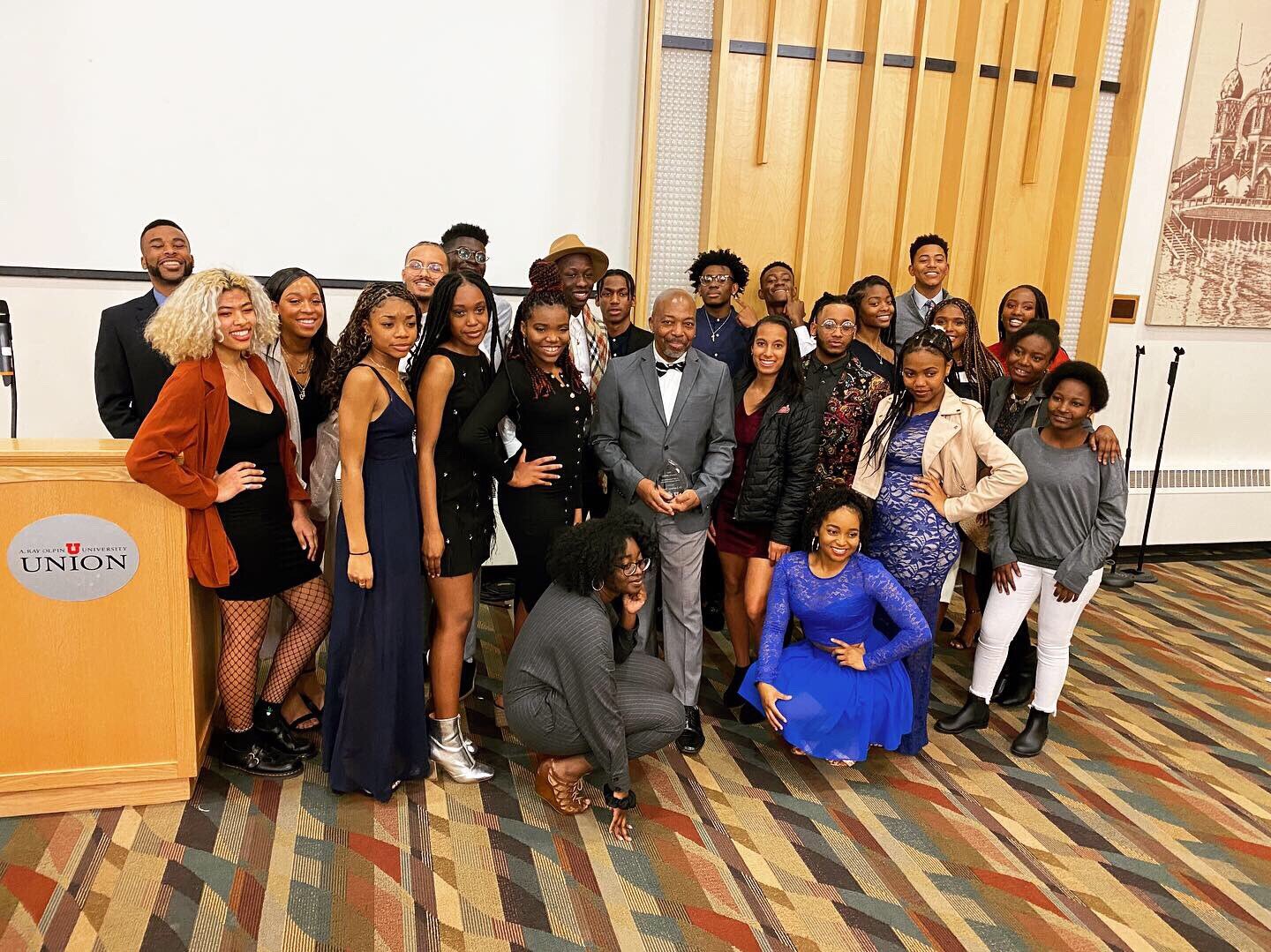
BSU members at the 10th Annual Legacy Banquet, honoring Dr. Laurence Parker, 2020. Photo courtesy of Maryan Shale.

“We’re just here as a reminder, a space for Black students. Like, hey, we got your back,” Shale said.

The University of Utah held a virtual festival where new students could go to see what clubs and organizations exist on campus. Students had the opportunity to see each club and organization via the internet, learn more and join the groups. Shale said this festival presented accessibility issues with students being unaware of the website, and others not having internet access at home.

“A lot of students don’t even know how to navigate Campus Connect when they’re first coming to campus,” she said, explaining the small turnout the BSU faced this year.

The organization continues to use social media, email and word of mouth to promote the BSU to students, with little response. Shale said the BSU utilizes hashtags via Instagram to direct-message potential members. The organization also uses a group message to spread the word of meetings and events.

The BSU utilizes its Facebook page and Twitter account to engage the community. It is here that announcements for events are posted, students share their experiences with the organization, as well as share fundraising opportunities. The social media accounts serve as a way to connect to current BSU members and connect with people and students who may not have otherwise discovered the organization.

Tierra Yancey, a four-year member of BSU, said she’s been able to foster positive relationships through the organization. Not just with fellow students, but also with faculty and with community members outside the university.

Among student population at the University of Utah, only about 1% of students identify as Black or African American.

Arnold Gatoro, former president of the Black Student Union, said in a May 2020 interview he hoped to help “create a more diverse school at the U so we can all open our eyes just a little wider.” Another goal was to “increase the retention of black students and create a better sense of community here at the U.”

In addition to increasing awareness and educating the community, the BSU puts on events to promote pride within the Black community. In 2020, activities included a Welcome Back Family Reunion where the BSU provided food, music and activities, a movie screening with food and discussion, and a Black History Trivia night.

Along with events, the BSU promotes social justice on campus. With injustices such as the killings of Breonna Taylor and George Floyd, the BSU wanted to play a political role at the University of Utah.

“We actually wrote a resolution in support of Black students at the university,” BSU President Shale said. “We had the help and support of the Associated Students at the University of Utah (ASUU).” It included 22 recommendations toward improving the lack of diversity in faculty and staff, lack of retention of Black students and lack of scholarships and resources for Black students. The Academic Senate approved the resolution on July 16, 2020.

While the organization does work to combat racial injustices, Shale said the BSU does not discriminate against political views. “We don’t discriminate against anybody. You don’t have to be a Democrat or Republican to be in our organization.”

The Black Student Union continues to push for a place, whether online or in person, for all Black students at the University of Utah, regardless of background, political views or academic major.

While the pandemic makes it difficult to meet, the Black Student Union continues its work to ensure a safe and uplifting space for its members and fellow students.

“We are more than just a number. We are more than just a student. We are trailblazers, we are resilient, and we belong at the U,” BSU member Tierra Yancey said.

University of Utah Friday Forum tackles racial inequity

Story by MASON HARDY

A panel of leaders in community philanthropy met Feb. 26, 2020, for a virtual Friday Forum focused on efforts to achieve racial equity in the workplace and the impact of philanthropy on communities of color. University of Utah President Ruth Watkins acted as moderator to the forum.

On the Equity, Diversity, and Inclusion website, Friday Forums are described as a way to bring in “national thought leaders to lead discussions and provide opportunities for participants to share ideas on actionable items towards a diverse, equitable, and inclusive campus.”

Clockwise from top left: University of Utah President Ruth Watkins with Kym Eisner (Craig H. Nielsen Foundation), Valerie Rockefeller (Rockefeller Brothers Fund), Corie Pauling (TIAA Financial Services). Caroline Altman Smith (Kresge Foundation).

Watkins began the forum by asking Corie Pauling, chief inclusion and diversity officer of the TIAA, to share her perspective of philanthropy and the kinds of interests in institutions that she has seen.

“Equity is the promise of what inclusion stands for. It is some of the gaps that we see in education, socioeconomics, health care and unemployment. We are going to tackle those,” Pauling said.

She said 2020 was an eye-opening year for many American citizens regarding the reality of modern-day racism. She talked about philanthropist organizations, and the intent to make racial inequity less of a moment and more of a movement, making investments accordingly.

“What was really groundbreaking about it was that it unearthed a desire to talk about anti-racism as a calling and obligation, and responsibility of everyone,” she said.

Pauling emphasized the importance of data when it comes to social and racial equity as it relates to inequality in America. She said making an investment in accurate data can form complete opinions of “what is my role in this?”

To put racial inequity and racial injustice into perspective and give some context to what the panelists discussed, a July 2020 Brookings survey of 5,500 nationally representative respondents from each of the 50 states, revealed the following:

  • 1 in 3 Black men born in 2001 will spend time in prison in their lifetime
  • 1 in 1,000 Black men and boys will die at the hands of police
  • 1 in 3 Black children live in poverty
  • 1 in 10 Black adults were not able to pay rent or mortgage in the past three months

The information listed above is only a small portion of the results from that survey.

“It’s hard to argue with data,” Pauling said.

Watkins asked panelist Caroline Smith, deputy director of the Kresge Foundation’s education program, to discuss the research the foundation is doing.

She said the organization surveyed people to see what it should focus on in the next three years. The response overwhelmingly called for racial justice.

“We did this survey at the end of 2020. I don’t think you would have seen that answer at the end of 2019 or the end of 2018. It’s certainly quite indicative of the racial reckoning that began in the last year,” Smith said.

Watkins acknowledged the work the Craig H. Neilsen Foundation is doing with the University of Utah to help advance diversity and inclusion.

Kym Eisner, executive director of that foundation, brought up its research, and the focus on researching data for policymakers.

“Being able to get good, solid, evidence-based information into their hands to inform decision making, is a very valuable contribution,” she said.

Smith emphasized the work of researchers to improve racial equity in the workplace, and called on them to make a difference in the community.

The Friday Forum series are free events for the community and students to attend. They offer a way for Salt Lake City residents to gain a better perspective of the community around them. Prior forums covered “A Call for Racial Healing,” “Confronting our Racism” and Establishing Anti-Racist Policy.”

For more information, or to sign up for future events, visit the website.

A video-on-demand version of the Racial Equity and Philanthropy Friday Forum is available here.

Message of hate empowers Black students to demand more from Salt Lake Community College administration

Story by HARRISON FAUTH

A thief hidden behind a computer screen disrupted an event meant to celebrate Black poetry. Few students saw the white supremacy message, but many felt the ripple of hatred within Salt Lake Community College and Utah. The aftermath left a Black student community determined and resilient to not let hate win.

After a Black Student Union Zoom event in February 2021 was hijacked with messages of hate intended to quiet the voice of Black students, the opposite occurred. It created action and a resolve to ask for more from their community and college administrators. The event continued live and provided inspiration for those in attendance. 

After the attack, SLCC’s president sent an email to each student and staff member expressing regret and disappointment about the Zoom “bombing.” No mention of concrete action steps from school administration was mentioned in the email. 

Joy Tlou, director of public relations at SLCC, said in a phone interview, “Diversity, equity and inclusion is something that SLCC is committed to. The administration shares the concerns of the Black students and they are fully aware of the trauma that was felt by those at the event and on Zoom.”  

To bring understanding to the school’s response, it is important to examine the student population. According to the website College Factual, college campuses in Utah share a similar degree of diversity. SLCC, University of Utah and Weber State all report a white student population of 69% and Black population of 2%. The largest diversity comes from the 17% Hispanic population that is enrolled at SLCC. This may matter when it comes to the school’s policies and priorities. 

SLCC responded quickly to the incident, but many students felt it was reactive and not proactive. In an email interview, BSU President Jaycee Glavin said that prior to the event most Black students felt a lack of support. But after the event, Black students felt an outpouring of support. Some of it was genuine, such as questions about “how can we do better?” While others were more halfhearted as a way to fulfill an obligation. Glavin said, it remains to be seen if support will continue.

In email interviews members of  BSU leadership expressed feeling worried, anxious, and fear, but the overwhelming feeling was anger. Anger that they were attacked. Angry, but resilient. Glavin said, “Haters did not stop us, but they did affect us.” He also expressed concern that the person who did the Zoom bombing is still unknown. This fact has created a heightened awareness of safety on the SLCC main campus.

Black students have requested that the SLCC administration show more interest in activities on campus that support diversity. One member of the BSU leadership who did not want their name publicized said in an email interview, “Come to our events and show you care. You attend birthday parties and retirement parties. Why not make some time to attend a Black sponsored event.” 

This was also discussed in relation to police presence on campus. BSU leadership wants law enforcement to normalize their presence at events so students feel less fear and more cooperation. Glavin said, “I just met the highway patrol force over SLCC, and I think we are working towards making a relationship without awkward encounters.”

For years Black students have asked the school administration for an updated Black history curriculum taught by Black professors. “I want to have Black history taught by someone who shares the experience of being Black,” one BSU member said in an email. 

Glavin said he felt the curriculum on campus was “whitewashed” like most school experiences in Utah. 

SLCC Globe reporter Heather Graham said in an email interview that she feels the “intent on campus is to be inclusive, but this is not often met.” Many Black students are the only person of color in their classroom and often do not see professors who are Black teaching at the school.

BSU members have asked the administration to actively recruit Black professors. Joy Tlou, the PR director, said, “SLCC is widening their search for professors outside of Utah to increase teacher diversity.”

Another request is to provide Black counselors to better address the needs of Black students. BSU leadership feels this need is invisible until something bad happens. Then it becomes part of the discussion.

Black students want Black counselors who understand their reality. Black students have different cultural experiences and want to speak to someone who shares their same experience. As one BSU member who did not want their name mentioned said, “We are missing strong allies on campus.”

BSU leadership also wants white students as allies, but this is often misunderstood. To be an ally means to “listen when you are in a Black space and not speak up to share an experience.” The same BSU member added in an email interview, “Until you walk in a Black person’s shoes you can never understand what we felt.”

BSU plans to reschedule the poetry slam that was hijacked. SLCC information technology security and law enforcement have begun the work to make future events more secure. They are also hoping to have more school administration in attendance at the event.

The SLCC administration, like society, has a serious challenge to address. As Joy Tlou said, “Campus needs to be safe, healthy and supportive; it is not a destination, it is a journey, and everyone needs to come along.”

University of Utah athletic team use their platforms to promote social justice

Story and photo by BRIANNA PEARSON

“I can’t breathe.” Those were the last words uttered by George Floyd before he was killed on May 25, 2020. “Black Lives Matter,” “No justice, no peace,” were chants millions of protestors shouted throughout many cities in the United States during summer 2020.

The office of Equity, Diversion, and Inclusion at the University of Utah quickly issued a statement: “EDI stands in solidarity with our Black family, friends, neighbors, students, faculty, staff, and colleagues. We mourn with them as we collectively process the more profound meaning and complexities of the wounds that have been inflicted with the injustices and deaths over the past 400 years.”

After multiple deaths occurred throughout the Black community, many sports teams across the world took action in showing support for the BLM movement and social justice. Some of the University of Utah sports teams have been recognizing the university’s call to action throughout their programs.

Nona Richardson, the executive senior associate athletics director, said two social justice groups within the Department of Athletics have been created. “The student-athletes UTAH group, (United Together Against Hate) as well as the staff UTUA, (United Through Understanding and Action) allows us to educate, have open conversations and partake in activities that engage in action (voting, marches, unity walks, etc.),” Richardson said in an email interview.

“The UTUA group was formulated after the murders of George Floyd and Breonna Taylor; the UTAH Group expanded in size and scope and has been a catalyst for change amongst the student-athlete population,” Richardson said. 

Richardson said from the formations of these two groups, she has hope that the work in the social justice realm will continue in all areas of social justice issues.  

Many teams — like Utah football, men’s basketball, women’s basketball, women’s soccer, women’s volleyball, track and field, and gymnastics — all released statements on their social media platforms in 2020 to show their support of their fellow student-athletes.

Utah women’s soccer team members wearing their warm up jersey before a game against Oregon in support of social justice.

The gymnastics team in particular, posted a unique Instagram post. Athletes came together and created a video that had different gymnasts and staff members speaking. This video gave a message to the community about how they “stand together in peaceful solidarity to demand equality and change.”

A video was later created that included different athletes of a few different Utah sports teams standing in solidarity. This post specifically shows videos and pictures of student-athletes demanding to see change. 

Whitney Hessler is a sprinter on the Utah track team. She said she thinks certain teams at the U are doing a better job at recognizing this call to action as opposed to others. In a FaceTime interview she said, “As a whole throughout Utah athletics, I have seen improvement, but we have a long way to go.” 

The track team has had open forums for discussion about social justice, and some of the women of color on the team spoke on things that are important to them. Hessler said, “This has been a great platform within our team for us to learn more and listen.” 

But, this has been the only thing the track team has done.

The Utah football team was the first team to put words such as “Equality,” “Unity,” “Love,” and “Peace” on the back of their jerseys during the 2020 season. 

Players on the women’s basketball team wore all the same shooting shirts with the team’s social justice verse highlighted during their 2021 season.

“I love the idea of having some sort of word on the back of our jerseys. I am surprised we haven’t done that yet, honestly,” Hessler said. 

Taylor Watson, another Utah track member, said in a FaceTime interview she would love to see a moment of silence or some sort of kneeling before each track meet to recognize social equality. 

Watson said she wonders whether the track team will recognize social equality in the future. “Honestly, it’s sad to say, but I feel like we won’t talk about it again unless there is another situation that happens, like another death or another protest,” she said.  

Her teammate, Hessler, said, “I hope we keep moving in the direction we are, especially with actionable items like bringing girls on here who are diverse, and having a community where everyone feels welcome and comfortable.” 

She wishes the track team was more open about what they stand for, and use their platform to bring awareness to social justice issues. She gives an example of this by explaining how she wished her team did something to acknowledge Black History Month.

“The student-leadership in this area has been outstanding and it encompasses both our men’s and women’s teams, and not only student-athletes of color, but allies as well,” Richardson said. The strength of Utah athletics is in the diversity of its population, she said, “but also like mindedness for change.” 

Out of state student-athletes of color at the University of Utah speak out

Story by BRIANNA PEARSON

A high school student athlete’s ambitious dream is to attend a Pac-12 university, compete at one of the highest levels in the nation, all while accomplishing their academic goals. 

Yet, for student athletes who pack up their life from out of state this can be a challenge. This can especially be challenging for those athletes who are of color at the University of Utah. 

According to a fact sheet released by the Kem C. Gardner Policy Institute, African Americans/Blacks only make up 1.2% of Utah’s population. Black student athletes often experience an immense culture shock when their feet step on the grounds of the U for the first time. 

Branden Wilson, from Orange County, California, and a junior on the Utah Lacrosse team, talks about some of his experiences when “fitting in” in Utah. 

Wilson is one of only three players on a roster of 44 who is not white. Wilson said he grew up around a predominantly white neighborhood and went to a primarily white high school. He was not surprised with the Utah demographics being predominantly white.

Fitting in at Utah, however, has been something he has struggled with. “I definitely feel like I didn’t fit in freshman year. I still feel like I don’t fit in,” Wilson said in a FaceTime interview. “I feel like I can’t really relate to people as much here, people don’t really understand me.” He said he tends to go away from the crowd, which is how he has always been since he can remember.

Wilson said his coaches have been very “welcoming,” which has helped his experience tremendously. In a follow up email, Wilson said they would always check up on him when he first arrived at the U. This has made him feel very welcome. 

Wilson said he has a very strong support system from his coaches but not as much from his teammates. He said his support system mainly comes from himself as well as his family members. 

Niyah Becker, a junior on the women’s basketball team, had a different experience. She moved to Salt Lake City from Winnipeg, Canada. Becker said during her freshman year she quickly became friends with players of color on both the women’s and men’s basketball teams. She said she loved her freshman year and how she got brought into the college lifestyle.

But then, everything changed. 

“It was more towards the end of my sophomore year that I had realized everything that was going on, especially since all of my Black friends on the teams had transferred and left the U,” Becker said in a phone interview. “I soon asked myself, what the heck, where did all the Black people go?” 

This year, there are a total of three Black student athletes on the women’s team. “I’m not Black, but I’m not white,” Becker said. She said that being the only biracial player is a little weird, and sometimes she doesn’t know where she fits in. 

When the Black Lives Matter protest occurred in summer 2020 and there was a spotlight on the Black community, the coaches and staff of the women’s basketball team made sure all their athletes were mentally and physically supported. They took their feelings into consideration as team-related decisions were made. At that moment, Becker realized, “Oh wait, I am the only light skin on the entire team.”

Becker said she has felt very welcomed by her teammates and coaches. She said the leadership of one teammate in particular, a senior named Megan Huff, helped lead the way for Becker and made her transition easier. 

She said her team is really well educated and respectful. The team knows what is right versus what is wrong, and would never treat someone differently because of the color of their skin. 

Maya Lebar, a junior track star at the U who came from Spokane, Washington, has a similar “team culture” experience as Becker. 

The track team, unlike the basketball team, had only one Black student athlete in the program prior to Lebar’s class. 

“When my class came in, it was a big shift for our team culturally and socially, and I think we’ve adapted pretty well,” Lebar said in a FaceTime interview. “We have all blended and created a space where everyone can feel welcome and included, and that is so valued.”

On the contrary, Lebar’s transition from high school in Spokane to college in Salt Lake City, was very “unfortunate” as no one specifically helped her acclimate to the state of Utah’s culture. She talks about how being a person of color, there wasn’t anyone who took the time to help her adjust to the culture of Utah. 

“When I came in, there wasn’t really a support system for Black student athletes here,” Lebar said. She said she felt welcome here just as any student athlete would. But, being a Black student athlete, she said, “There was not that focus on being a Black student athlete in a predominantly white state within a predominantly white institution.” She said this was disappointing but the Department of Athletic has begun to change its policies. Lebar is hopeful this will contine to improve.

Lebar later said, “I don’t think it was a bad welcome, I felt like I was made to fit in within athletics.” She said if she had the opportunity to change it for others, she would.  

These student athletes have lives outside of their sport and for all three, their experiences in public are similar.

University of Utah athletes, Maya Lebar, Branden Wilson, and Niyah Becker in action during their competition. Photo illustration by Brianna Pearson.

Lebar said she has seen people stare at her when she is at a mall or eating at a restaurant. “I almost expect for people to look at me when I go out,” she said. “It used to make me feel angry, but I’ve had to adapt to where now, I know they aren’t staring at me in a negative way, it is more just curiosity.” 

Becker said, “I’m surprised when I see someone of color out in public, which is very disappointing, but with Utah being how it is, it’s not shocking.”

And Wilson, the lacrosse player, said, “Going out in public, I definitely get looks, I find myself having eyes on me.”

Being an athlete from out of state as well as being a person of color can be challenging. The experiences these three athletes have been through while being at the U so far has only made them stronger and has given them a voice for future student athletes.

A group called UTAH (United Together Against Hate) has now been formed within Utah athletics, which allows student-athletes to have open discussions and educate others.

More than a Black female athlete

Story by EMALI MACKINNON

For student athletes, being recruited by a top university is a goal. They spend years practicing and traveling to events, often missing out on school activities such as dances and free time with friends and family.

The stress of being a top athlete is even more difficult as a Black female competitor, who may experience racism, sexism or isolation. 

Maya Lebar, a sprinter with the University of Utah Track and Field team, became interested in sports as a child growing up in Spokane, Washington. 

Her adoptive mother allowed Lebar to pursue anything she was interested in. At the age of 4 she developed an interest in competitive skiing. 

“Skiing was always something that my family has loved to do,” Lebar said in a text interview, “so it’s really just a family tradition. My mom had skied since she was little and was happy to find out that we had a really good ski program up on Mount Spokane for me to learn how to ski.”  She graduated from the program and became a completive skier. 

A few years later, Lebar knew she wanted to do more than skiing.

Cecil Jackson, a competitive track and field coach, noticed Lebar when she was in eighth grade and competing in local middle school meets. “He was the person who really helped me learn about track and field and feel confident enough in my abilities to pursue it seriously throughout high school,” she said. She began to train with Jackson with an eye toward running at a collegiate level. 

Shortly after training with Jackson, she began to get recruited from local and out of state colleges. 

The University of Utah was one of those schools that stood out to her the most during the recruitment process. 

Lebar caught Coach Chad Colwell’s attention during her senior year of high school.

She set a personal record in the 400M. The sprinting coach quickly noticed her potential. 

Lebar, who is Black, said she was initially hesitant about attending school in Utah. There is little diversity at the university and even less among the Utah athletics.

“My family was concerned for me and questioned my decisions for coming to Utah. I was nervous that there weren’t a lot of Black people and were less in the athletic community,” Lebar said in a FaceTime interview.

But, once she began to talk to her potential coaches and take a tour of the campus, she said she immediately fell in love. 

Colwell said in an email interview, “After speaking with Maya over the phone, I knew she was someone who we would be interested in not only as an athlete, but as a student, teammate and person. I remember after our phone call thinking how articulate, confident and smart Maya was. And this was reinforced after speaking with her High School coach who raved about Maya both as an athlete and a teammate/leader.” 

Lebar committed to the University of Utah and adjusted quickly. 

Maya Lebar was recruited to run the 400M, 200M and relays. Now she runs short sprints focusing on the 100M and 200M. Photo courtesy of Maya Lebar.

She said her teammates became her best friends. She appreciates how they push her into becoming the athlete she wanted to be. They had the same goals in mind and were just as committed as she was.

One of her teammates at the time was Kat Lakaye. Lebar and Lakaye instantly become best friends and roomed together their freshman year. “Maya was someone who is so strong, determined, intelligent, and would have your back no matter what, she was the type of person you always wanted around,” Lakaye said in a FaceTime interview. 

Despite becoming friends with teammates, she faced challenges as a Black female athlete. 

There wasn’t a space or environment created for her and Black teammates. Over the years, Lebar has been one of the main student athletes on her team to advocate for the rest of the Black athletes and talk about the problems they were facing among their teams.

 After speaking out and creating an environment to be heard, Lebar said she feels more supported now than ever. 

“The school has done a really good job at listening and responding to our needs. People need to see us and create an environment where we feel supported and welcomed also,” Lebar said. “It has become easier to be a Black female athlete now with all the resources and communities Utah has created for us.”

Lebar decided to major in political science with an emphasis in law and politics. She has a dream of one day becoming a lawyer or a civil rights attorney. Her passions include speaking out for social justice and being an advocate for those who have been wronged by the justice system. “ It is so important to know what is going on in the world. Educating yourself and having the ability to speak out on important topics is so empowering,” she said. 

She is a part of a group called “UTAH Group,” which stands for United Together Against Hate. Within this group she plans events and puts together meetings that cover important topics about social injustice within the community and Utah. 

Some events she has organized are Say Their Names Memorial, United Walk, Indigenous Peoples Day Art Walk and Black Reflections Exhibit at the Utah Museum of Fine Arts. This type of work is what Lebar is most passionate about. 

The reason this became her passion was due to the event that took place in Charlottesville, Virginia, in 2018. “I have always been so passionate about social justice stuff. But it all started after the Charlottesville rally in 2018,” Lebar said. “I then realized systemic injustice is really real. This was such a huge moment for me. Yes, I grew up in a white family but I am Black and I am extremely affected by it. I knew I had to become more educated about everything. I began to read about everything like people in history and people that no one knows about. I researched everything until I understood.” 

A fire was lit inside her and she knew something must change and she was going to be that change. 

Academic success and social happiness for student-athletes: mentorship and support is just as crucial off the field as on the field

Story by LEIF THULIN

Collegiate student-athletes aspire to reach the highest level in their sport. However, the reality is that only one NCAA sanctioned sport, baseball, has a percentage above 2 percent for college athletes becoming professional athletes. 

Many students who attend universities like the University of Utah travel far from home for the first time, naively entering college with expectations of becoming a professional athlete. They may have assumed that there would be no problems adjusting to the academic and social demands of their new situation.

Though the racial demographics of colleges are less skewed than that of the city within which the campus is located, many students experience culture shock. Salt Lake City is 87.2 percent white, University of Utah students are 70 percent white, yet an average of only six starters per collegiate football team is white. 

What this means is that many minority athletes attend the University of Utah for athletics and encounter entirely new racial demographics everywhere but the field of play. School alone is an adjustment for adolescents, but especially for minority athletes. There must be a liminal space or person to create a space for minority athletes to acclimate and grow academically and socially within the new environment. 

T.J. Burnett, who worked as the U’s football learning specialist, helped create comfort and prowess in the classroom. 

T.J. Burnett was the the University of Utah’s football learning specialist. Photo courtesy of T.J. Burnett.

Burnett, a former four-time Academic All-American, and a five-time All-American track athlete, proudly aided African American student-athletes at the U in their educational and social maturation on campus for two years. 

Burnett knew firsthand from his experience as a first-generation African American student the importance of prioritizing academics and social transitions. These can be overlooked, yet adjusting to these challenges may prove more difficult than the leap to collegiate athletics, which can form a shelter from the outside world. 

Burnett recalled in a Zoom interview, “Transitioning from high school to college, I honestly had no idea what it was going to be like to go to school, to go to college. When I got letters from schools, a lot of times it would be overwhelming. I didn’t really know what it would be like for me to go to college. I didn’t know if it was even affordable or accessible.” 

Nearly five years removed from his final days as a student, Burnett reminisced about his growth as an individual. He attributed much of it to the importance of education, and his gratitude for having African American role models to show him that people who look like him can thrive in the world of academics. 

“I truly believe education is the great equalizer in terms of getting people to have the opportunity for vertical mobility but it isn’t accessible to all students from all backgrounds,” he said. 

Burnett, who hails from Grand Rapids, Michigan, spoke of Dr. Damon Arnold, the special associate to the athletic director at Grand Valley State University.  Arnold inspired Burnett to take a job that remained within the realm of athletics while influencing students in a long-lasting way through academics. 

“He was somebody that young Black athletes could look at and be like, it doesn’t matter where you start it matters where you finish,” Burnett said. 

Burnett gratefully reflected that without the mentorship of Arnold and other mentors, many student-athletes including himself would have been worse off in their college experiences. 

“When I was graduating, trying to figure out what I wanted to do, I wanted to have this impact on student-athletes as well, paying it forward, and also it is meaningful work,” Burnett said.

U offensive lineman Braeden Daniels said in text message, “He [Burnett] helped relate the school material that was being taught in our classes to our lives as student athletes, men, and real life examples … He understood life from our perspective as he was a student athlete.”

Elijah Shelton, an African American Salt Lake City native and transfer from Utah State University to the U, did not struggle with culture shock, or making friends with either team. 

Elijah Shelton practices for the Utes. Photo courtesy of Elijah Shelton.

Though his transition from high school to college was not difficult, Shelton recognized that many of his former teammates who came from other states struggled mightily adjusting to the academic workload and the 82.4 percent white population of students at USU.

In a Zoom interview, Shelton noted that at Utah State, a class called Connectionsbecame important because it explained Utah’s culture and the importance of getting to know people and appreciating the cultures of everyone.   

“We kind of made our own culture within the Logan culture,” Shelton said. 

Josh Nkoy, a collegiate rugby player at Stanford University from Salt Lake City,  acknowledged several facets in his university experience that contributed to his academic and social acclimation and success. He listed campus organizations for African Americans and members of the African diaspora, including the Black Cultural Center, where Black people can congregate and study.  

People like Burnett provide a Black athlete an excellent academic role model, and can relate to issues of culture shock inherent in attending predominantly white institutions. He understands the balance of school and athletics, and can remind students to prioritize academics because there are worthwhile jobs beyond professional athletics. 

While sports fans focus on athletic feats, Daniels, Shelton, and Nkoy have found succeeding in college relies on a confluence of mentorship, university support, communities of peers, and cultivating a culture of prioritizing academic excellence. 

Nkoy put it best when he observed, “You’ll see a Black face doing good things at all times — I guess all of that really mitigates culture shock for everyone.”

Judge Shauna Graves-Robertson on sisterhood, service, and Alpha Kappa Alpha 

Story and infographics by STEPHANIE ROSILES 

“I serve my fellow men and women throughout my life,” Shauna Graves-Robertson said. She is the president of the Upsilon Beta Omega chapter of Alpha Kappa Alpha at the University of Utah, which focuses on sisterly relations and has an established and respected presence in the Salt Lake community. AKA, the sorority that Graves-Robertson pledged at Arizona State University, is the first intercollegiate historically African American Greek-lettered organization. “Regardless of race, creed, color, I am committed to serve as long as I can. As long as I am able. That is my primary commitment as being a part of this organization.” 

The Salt Lake chapter of Alpha Kappa Alpha consults with organizations such as the NAACP, local churches, the U, Salt Lake Community College, Utah State University, YWCA Utah, Utah Black Chamber of Commerce, Zions Bank, Fidelity Investments, KWANZAA committee, and public and private schools. 

Graves-Robertson is a graduate of West High School in Salt Lake City. She earned a Bachelor of Science in Criminal Justice from Arizona State University as well as a Master’s in Public Administration and a Juris Doctor from the University of Utah. She was appointed to the Salt Lake County Justice Court in 1999. She is a life member of Alpha Kappa Alpha and the NAACP. Additionally, she chairs the Utah Supreme Court’s community relations subcommittee and is a member of the National Bar Association, National Association of Women Judges, Women Lawyers of Utah, and the Utah Minority Bar Association. 

According to the Alpha Kappa Alpha website, the organization was created in response to the desire to break barriers for African American women in areas where they had little power or authority due to a lack of opportunities as women in the early 20th century. It was founded on Jan. 15, 1908, at Howard University in Washington, D.C. Today, the organization has a membership of more than 300,000 women in 1,204 chapters across the world, as it has gone global. 

In a phone interview, Graves-Robertson said, “Alpha Kappa Alpha was founded by African American women. To be the first, there is always a draw there. That group of women were just one generation out of slavery. To have the fortitude to want to come together, to serve the communities that they had come from was what it was all about.” 

Alpha Kappa Alpha, she said, made a significant difference in her life and career. “I chose Alpha Kappa Alpha because of the quality of women,” she said. “This sorority gave me a sisterhood. In the raising of my children, I had other women to lean on. They supported my children. I knew educators in schools. We have women in different fields, and we have mentorships. All of those areas have supported me throughout my career in Utah and throughout the United States.” 

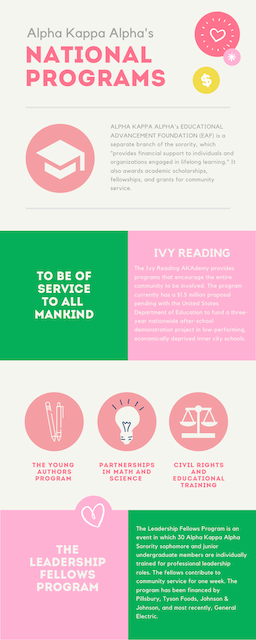
According to the Alpha Kappa Alpha website, the sisterhood is based on five basic tenets: to cultivate and encourage high scholastic and ethical standards, to promote unity and friendship among college women, to study and help alleviate problems concerning girls and women in order to improve their social stature, to maintain a progressive interest in college life, and to be of “Service to All Mankind.” 

According to the website, the sorority participates in service that has been instrumental in establishing programs beneficial to the African American community. Most notably, the sorority participated in the 1913 Women’s Suffrage March, assisted the Travelers Aid Society during the Great Migration, has joined the American Council of Human Rights, and started the Alpha Kappa Alpha Educational Advancement Foundation that promotes lifelong learning. 

During her time in college and now as the president of the Salt Lake City chapter, Graves-Robertson reflected on the service initiatives that she has been a part of. She said, “During college, we had a member of the graduate chapter who was a vice principal at an elementary school, and so we’d go to the school and read with the students. I really liked that.” 

Alpha Kappa Alpha also rises to its tenet of lifelong friendships. Graves-Robertson said, “The difference is in a majority of sororities and fraternities, you join in college and after college, that’s it. A Divine Nine is a lifetime commitment.” Divine Nine, or the National Pan-Hellenic Council, refers to the organization composed of nine historically African American Greek-lettered fraternities and sororities.

Graves-Robertson attributed the current success of the sorority to the current international president, who has chosen to move the focus to five particular target areas: HBCU (Historically Black Colleges & Universities) for Life, women’s health, economic well being, the arts, and global awareness. Projects include collecting items for women and children experiencing homelessness, offering seminars on finances and participating in musical programs. The group also holds seminars for high school students on applying for college, including teaching them how to get letters of recommendation and even how to fill out the FAFSA form. 

During 2019 and 2020, she was the chairwoman of the judicial council of the National Bar Association. The group had planned the mid-winter meeting for January 2020 in South Africa. Her daughter —also an Alpha Kappa Alpha— had made contact with the chapter in South Africa. The members came to the reception and presented Graves-Robertson and her daughter with special pins that represented their chapter and region. Additionally, they also had a briefing by the State Department and the young woman that presented the briefing was also a member of Alpha Kappa Alpha. 

The Salt Lake City chapter is currently for students at the graduate level, but interest in pursuing an undergraduate chapter is up in the air. “We have tried to start an undergraduate chapter,” Graves-Robertson said. “We need a certain number of girls. We’ve been working on campus and looking to see how they (the university) can help establish the chapter. The university has been willing to be a partner.” 

Sophia Gener, one member of a sorority at the University of Utah, said in a phone interview, “I think the university would very much benefit from more chapters that are focused on diverse identities. I also think we need to do better for the chapters we do have that are centered around diversity. We need to make sure they’re known about.”

Another sorority woman — Samantha Motta — said in an email interview, “At the moment, I feel that it might be more challenging for more Greek chapters that focus on diversity to be recognized. I’ve noticed that the recruitment numbers and inclusion of other chapters are hardly remembered and oftentimes forgotten. Since Utah is a predominately white campus, it’s hard to work on trying to appeal to both white and BIPOC communities when it comes to more than just Greek life; and although I feel as if it is an excellent idea to incorporate new chapters surrounding diversity, I fear that it will be an uphill battle for them to gain recognition. I have observed that Greek spaces [on campus] are putting in the work to retain and recruit people of different backgrounds and I think it is a great start.” 

Graves-Robertson said of the impact that Alpha Kappa Alpha has had on her life, “Wherever you are, you can locate someone that can help you navigate where you are or what you are trying to do.”

University of Utah discusses racialization of homeownership on President Biden’s first day

Story by SUNWHEE MIKE PARK

MLK Day 2021 arrived in a timely manner – just two days before the inauguration of President Joe Biden. The transition marked a political shift that many Americans saw as synonymous with the return to progressive social attitudes and the renewed start of efforts at racial unity after four tumultuous years under the previous presidential administration.

In celebration of Martin Luther King Jr.’s lasting legacy, the University of Utah’s Department of Equity, Diversity and Inclusion hosted a series of events throughout the week of Jan. 18, aptly titled “Good Trouble.” Those words were uttered by John Lewis, the Georgia congressman and civil-rights icon who died in 2020.

One event during the week held particular significance: a virtual seminar on the topic of redlining. This practice was exercised by American banks and federal bodies until the mid-20th century to exclude minority families in underprivileged neighborhoods from receiving mortgages or homeowner loans. Areas were defined by red lines on maps, hence the term “redlining.”

While the practice has been outlawed for over half a century in the United States, the vestiges of this discriminatory act are still widely visible to this day.

The event, “Reframing the Conversation: Good Trouble & the Red Line,” was held via Zoom on Jan. 20, the day of Biden’s inauguration. Afterward, he signed multiple executive orders. One extended the CDC’s federal eviction moratorium to allow nearly 40 million Americans to keep their homes until late March, according to the Washington Post. Many of the homeowners that the order impacts are minorities who reside in redlined regions, the Aspen Institute reports.

The virtual seminar introduced a panel of leaders from within the Salt Lake City community: Ciriac Alvarez Valle, a recent graduate of the U and policy analyst at Voices for Utah Children; Ashley Cleveland, a board member for Utah’s Outdoor Recreation Advisory Committee and nonprofit Curly Me; Fatima Dirie, policy advisor for the Mayor’s Office of New Americans; and Franci Taylor, director of the U’s American Indian Resource Center. The conversation was moderated by Jennifer Mayer-Glenn, director of University Neighborhood Partners.

Mayer-Glenn posed a series of prepared questions which covered a range of topics — from the implicit ways redlining practices remain today to their long-term effects in modern American society. Some panelists shared personal stories about the challenges they have faced in homeownership as Black and Indigenous women of color.

“Redlining went from legal to insidiously hidden,” Taylor said about the ways discrimination can still be seen in homeownership today. (The Fair Housing Act banned the practice in 1968, according to the Department of Housing and Urban Development website.)  She said it is painfully obvious when noting how many exits and entrances go in and out of Salt Lake City’s minority-rich, lower-income west side compared with the whiter, richer east side. Taylor said this was an intentional design implemented by the government to minimize access into wealthier Salt Lake City neighborhoods.

Other panelists discussed how redlining affects their personal lives. Cleveland, a new mother, explained that redlined minority neighborhoods pose serious health issues, especially to children and pregnant women. Their proximity to freeways causes rampant asthma, and a lack of healthy food options in these “food deserts” leads to high numbers of patients with diabetes and hypertension. But minority families are unable to escape these conditions because of the continued effects of redlining today, Cleveland said, expressing how difficult it is for her and her daughter to live healthily.

The seminar, however, was not restricted to a gloomy discussion about how minority groups have been, and still are, disenfranchised by redlining practices. The latter half of the event breathed an air of hopefulness to an otherwise dismal topic, as panelists were asked how they fight to overcome discriminatory challenges, and how American society as a whole can move forward.

Valle, the youngest panelist, suggested the equal dispersion of resources to all communities, regardless of their populations’ racial backgrounds or financial statuses in order to ensure their growth. She explained that constant participation in community activities, especially by the younger generation including students, would gradually help to raise redlined neighborhoods out of a continuous cycle of poverty and neglect.

Later in the discussion, in a moment undeniably evocative of King and Lewis during the Civil Rights Movement era, Taylor said the fight against discrimination and hatred must be taken on as a daily chore. The key, she said, lies in refusing to tolerate discrimination nor embracing the fear that comes with it each day.

In a separate email interview with Mayer-Glenn, she explained that conversations like these play an important role in informing communities about how certain laws and policies are enacted to promote discrimination. When people become educated about structural racism and biases in their communities, she said, they can then take part in “good trouble” by voting for representatives who will fight to eliminate inequality and racial disparities.

As the event neared its end, it was clear that the hour-long conversation represented a much larger phenomenon occurring at that very moment: America ushering in a new administration with the dire hope of overcoming its deep and painful racial divisions. Panelists and moderator of the event alike seemed to be ardently optimistic as the conversation came to a close.

Valle, the young panelist, quoted the words of Lewis himself as the mantra for her work, “If not us, then who? If not now, then when?”