Roberto Elguera

IMG_2578MY STORIES:

MY BLOG:

This semester writing for Voices of Utah helped me realize the work and talent on the west side of Salt Lake City. Through meeting many new faces and seeing new places, I feel connected with the city more than ever. The city doesn’t feel like concrete slabs, shopping malls, and piercing skyscrapers. No. I see vibrant walls and hear the hissing of the spray decorating a once blank wall. I hear spoken word and mantras of encouragement coming from the local Hip-Hop artists pushing themselves to get their voices heard and put Utah on the map. I feel the care and unity in the community gathering centers. Providing spaces for youth to stretch their creative and academic skills.

The least I can do is amplify these voices and make people more aware of each person’s story. It wasn’t easy, and at times nerve-racking. But as Yoda says, “Do or do not, there is no try.” There was no time, in mulling over how I was going to give a “perfect” interview, I just needed to put myself out there. At times I felt lost. No story in sight, but it was that one detail that helped me to see the bigger picture. Seeing the crowd go wild at Kilby Court helped me realize the impact the Hip-Hop scene can have on a bigger scale.

A book that helped me in my feature writing is William E. Blundell’s The Art and Craft of Feature Writing. Blundell’s story-telling and breakdown of what he’s learned in his years as a journalist, helped me understand the structure, pacing, and word selection, to help me develop my own style. 

ABOUT ME:

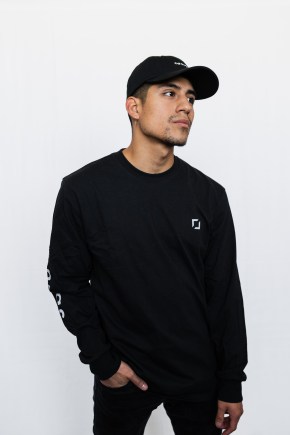
I’m, as you can see, Roberto Elguera. I was born in Lima, Peru, and raised in Provo, Utah. I’m now living in Salt Lake City, where I’ll be graduating as part of the 2020 class at the University of Utah with a bachelor’s degree in communication with an emphasis on journalism. Having a diverse background, I was always interested in people’s stories. In my career, I hope to give people the opportunity to share those experiences. Part of my time at the U included an internship at K-UTE Radio. I was able to pursue my interests in Hip-Hop culture and entertainment by hosting “The Hip Hop Drip.” I got to interview artists, partake in shows in Salt Lake City, and build my radio chops.

Ballet Folklórico de las Américas: a home away from home

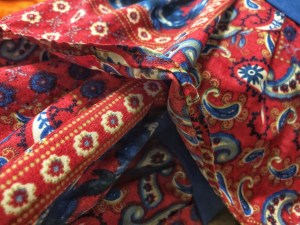
Details on a costume used by the group.

Story and photos by PALAK JAYSWAL

On the edge of downtown Salt Lake City, just behind the Gateway Mall, resides a small building in a fenced-off area. During the day, the white brick shines, the title on top proudly giving it an identity. The Centro Civico Mexicano, on 155 S. 600 West, is a nonprofit organization that is home to many different local groups. 

Late on a weekday night, you’re bound to run into a youth soccer group in the middle of practice. On the opposite side of the gym, behind a polyester red curtain, lives a stage. It is set for the dancers from Ballet Folklórico de las Américas. The oldest Latin American folk dancing group in Utah practices in the building twice a week, undeterred by conditions such as freezing cold temperatures in the winter. Each member arrives with a smile and a welcoming hug to all the members (and guests alike). They’re ready to immerse themselves in cultural dance for the next two hours. The silent message from the group is clear: everyone is welcome here. 

Ballet Folklórico de las Américas celebrated its 40th anniversary in November 2019. The group, originally formed in 1979, has continued to uphold its original mission “to unite the community under one heart as we communicate with the universal language of music and dance to show that Latinos are an important group contributing in our mainstream society with traditions and celebrations that bring enrichment to families and communities together as we celebrate diversity.” 

Legacy and Roots 

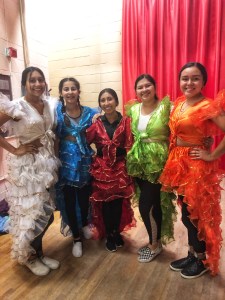
Members of Ballet Folklórico de las Américas.

The group celebrates diversity within Latin American countries as well as within a community of Latinos in Utah. Giselle Cornejo, a past dancer and continued supporter of the organization, identifies as Afro-Latina. She has been with the group since it originated when she was 15 years old. Her mother is one of the original founders and Cornejo’s experience and legacy with the group has helped her find her own identity. “When you’re learning a dance from Latin America, you learn why you do things a certain way. You learn what the movement means. It’s deeper than just a dance. It’s a projection of a culture,” Cornejo said. 

It is a culture that Cornejo has passed along to her own two daughters, now older, who also joined the group. The folk dance group not only becomes a second home for many immigrants, helping them adjust to their new lives and retain their identities, but also helps them stay in touch with their culture. In fact, Cornejo encourages involvement for this very reason. “If you have Latin American roots, I would say this would be a good place to bring your kids. It’s a fun group and it keeps families together. I think it helps [kids] identify who they are,” she said. 

Hats used in one of the dances.

While Cornejo is a generational legacy within the group, even the newer participants share the same sentiment. Miztly Montero, another dancer, has only been dancing for three months and she can already attest to the difference she feels in her life. “It’s an extended family, in a way, and it’s part of the culture you don’t get in any other scenarios where other people dominate the sectors,” Montero said.

As a first-generation child of an immigrant, Montero felt increased pressure to prove herself to her family and to the world. “You feel like people are looking down on you,” she said. “Part of that led me to work harder in school, at work, but it also led me to miss part of my culture and not embrace it as much.” The part of her culture that Montero missed out on is rediscovered through folk dancing — where she gets to learn about her heritage through songs, dance moves and community. 

Montero urges everyone to support groups like Ballet Folklórico de las Américas through attendance and inclusion. “It’s cool to embrace the value groups like this bring. Not just to the Hispanic population, but to other cultures and how we can come together and embrace those differences.” 

Resiliency, Teamwork and Patience 

Those differences are exactly what led Artistic Director Irma Hofer to her discovery of the dance group over 36 years ago. Hofer found herself drawn in by the different cultures of Latin America, not just the sole focus on her own Mexican heritage. “Latin American folk dancing has more variety and more stories. I learned history, traditions, celebrations and customs through that. The idiosyncrasies of Latin Americans,” Hofer said.  Through learning dances like the merengue, salsa, mamba and others she continues to grow. 

Boots and Decorations used during the dances.

Through her leadership, Hofer strives to make the group a place where her dancers can not only embrace their identities, but also learn to be better people. “We learn a lot of our personal and human values in this group,” Hofer said. “We learn resiliency, teamwork and patience.” 

All three of these traits are being put to work as the folk dance group, among various others who use the civic center, raise funds for a new building. With so many different groups using one center, there is simply not enough room for everyone. More often than not, Ballet Folklórico de las Américas has its practices canceled because other groups can’t get their work done with music playing. 

“The Mexican Civic Center is in much need of funding because we need a new building. We need dance classrooms, art classrooms, conference rooms where people can meet and not be canceled,” Hofer said. “This is the space we have. This is it.” 

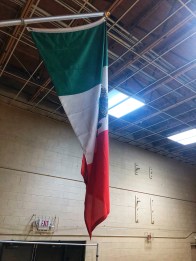
The Mexican flag at the Civic Center.

Despite the circumstances, the dancers and members of Ballet Folkórico de las Américas continue to dance away, committed to making the most of what they have with a group that has offered so many of them a home away from home. The energizing music of the mambo, the dance the group is practicing, fills the cold building. Costumes are brought out for the dancers’ performance that weekend and a Mexican flag proudly waves next to the stage at the Centro Civico Mexicano, welcoming anyone who is looking for a place to belong.


Women from all walks of life: how the Glendale community came together to celebrate International Women’s Day

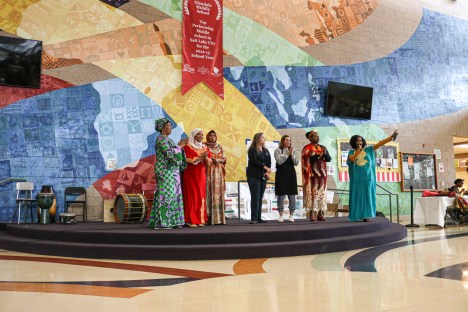
Glendale Middle School, at 1430 W. Andrew Ave. in Salt Lake City, hosted community members for a celebration of International Women’s Day on March 7, 2020.

Story and photo by IVANA MARTINEZ

Women from all nationalities dressed in their own traditional garments took to the Glendale Middle School cafeteria floor in Salt Lake City on March 7, 2020, to celebrate the annual International Women’s Day. 

The women dotting the dance floor swayed back and forth clapping to the music. They cheered on one another in vibrant headscarves and textiles embracing each other in the name of womanhood. 

“As you can see most of these women [are] dressed in their traditional clothing, they want to embrace their true identity and who they really are. And they want to be recognized and to have a voice,” said Fatima Dirie, the refugee community liaison from the Salt Lake City Mayor’s Office. 

The official International Women’s Day is celebrated annually on March 8, which is meant to acknowledge the political, social and economic accomplishments of women all over the world. According to the New World Encyclopedia, the day commemorates women who took to the streets in 1911 to demand voting rights, better wages and shorter working hours. 

The event was sponsored by the United African Women of Hope (UAWH) and co-sponsored by the Utah Refugee Connection, Salt Lake City School District, Department of Workforce Services Refugee Services Office and the Mayor’s Office. 

United African Women of Hope is an organization that started in 2004 after a local woman died in Salt Lake City. 

 Antoinette Uwanyiugira, UAWH organizer, told Voices of Utah the group initially consisted of refugee women who came from the Congo. Now the group works with women from all nationalities.  

“We all manifest the same. It doesn’t matter where you come from, where your background [is], what your religion is. We have the same issues,” Uwanyiugira said.

The organization hosts workshops on topics including domestic violence and substance abuse. United African Women of Hope receives support from the Utah Refugee Connection.

Amy Dott Harmer of the Utah Refugee Connection said the organization helps local refugee communities come together and gather. She mentioned one of the reasons it gets involved is because most refugee groups are learning how to plan an event, especially events that involve the general community.

“Well, I think one of the important things is we’re a much better community,” Harmer said about the women who came together to celebrate International Women’s Day. “When we invite people of different faiths, different cultural backgrounds to come and be involved because then we have a much better understanding of each other.” 

According to the 2017 report by the Kem C. Gardner Policy Institute, approximately 60,000 refugees live in Utah. The vast majority of refugees reside in Salt Lake County and represent countries such as Somalia, the Democratic Republic of Congo, Syria, Iraq, Vietnam, the former Soviet Union and Burma.

A Celebration of Cultures

A handful of dance groups came to Glendale Middle School, located at 1430 Andrew Ave. in  Salt Lake City, to celebrate their country’s traditional dances as a part of the women’s day celebration. 

Evelyn Cruz, who is from Mexico and currently studies at Granger High School, arrived with her dance group to perform traditional Mexican dances such as the jarabe tapatío. 

Evelyn Cruz and her friend dancing the jarabe tapatío at Glendale Middle School on March 7, for International Women’s Day.

She said it feels good to see others who are celebrating their cultures through dance.

“I feel proud, especially seeing others dancing and moving,” Cruz said. 

Fatima Dirie, the refugee community liaison, said how unique these types of events are for women of color. She mentioned how it can be difficult to be the only woman of color in a space that is predominantly white. 

“In today’s event, you actually see women from all walks of life and so the more we’re able to insert ourselves in these different spaces, the more people are going to appreciate diversity and include diversity at the table,” Dirie said, “allow these women to actually be on boards of commission, take a leadership role and allow them to not really be limited to only being mothers because we can do more than that.”  

Dirie mentioned how women can multitask and occupy multiple positions. She said women are more than one identity marker. 

But barriers still exist. Gender pay gap and gender inequality in leadership positions affect women — and particularly higher for women of color. 

According to the Institute For Women Policy Research, women of all major racial and ethnic groups earn less than men of the same group, and also earn less than white men.  

This is why International Women’s Day is still celebrated today — to shed light on issues women continue to face and to celebrate women for how far they have come. 

Dirie said it is important to have allies in the community who can support women on issues such as health care. She said one way to do that is to allow women to talk and men to listen. 

“Once you listen you start understanding and you start realizing you’re not listening just to respond,” Dirie said, “but you’re listening to sort of understand why these women had to go through those challenges, and how they can overcome those challenges.”

This slideshow requires JavaScript.

Residents of Salt Lake’s west side say new dog park will benefit all

Story and photo by CASSANDRA ROSENKRANTZ

Take a moment to think about all the different spaces you go to meet people. In regards to the west side of Salt Lake City, some wonderful places come to mind. Libraries, schools and public centers are among the great places to eat, relieve stress and explore with neighbors.

Our pets, on the other hand, don’t have the same opportunities. They get locked up inside, taken on the shortest of walks and don’t always have enough space to run around. Enter the dog park. This sounds ideal, but dog parks can be hard to find on the west side.

Ray Parker, a manager at Dogs All Day SLC in the Ball Park neighborhood of Salt Lake City, said he has not seen any particularly large dog parks in the area. “That alone is a sign that something needs to happen in order for a dog’s level of happiness to be improved,” he said.

“Salt Lake City is such a big, cramped city — it is challenging to give a dog enough exercise in this environment. Plus, there are so many stress-inducing factors that cause anxiety in dogs. They need a place to cool down and hang with other pups,” he said.

Parker believes that both families and dogs can benefit from a neighborhood dog park that checks all the boxes. It’s much more than just a regular park — it is a place where people can relax, enjoy being in the company of their dogs and share time with like-minded neighbors. 

The Utah Animal Adoption Center (UAAC) in Rose Park took an interest in this issue. In an email to Voices of Utah, the center emphasized the need for dogs to have plenty of room to exercise and socialize. “We have a 3.5-acre field near Jordan River Parkway,” the center explained. “Our dogs can get exercise, play with other dogs and have a space to relax out in the fresh air.” 

Residents on the west side have shared their opposition to the idea of larger dog parks because there are few empty lots where something of this size could fit. “So many new houses, apartment buildings and other structures are being built. No one wants a constant dog barking and children yelling outside their window,” the UAAC said in the email.

The UAAC said that other residents, though, have expressed concern about the cost. They believe the community council members would rather spend money on more significant projects in the neighborhood. The shelter reminds us that there are many considerations when building a park.

Dogs can enjoy many features in a space made just for them. Most parks have a shaded area where dogs and their owners can rest, as well as a specific place for smaller dogs where they can safely play away from the bigger dogs. 

Throw in areas with fresh, clean water to drink and a bathing station and mister to keep everyone cool and you have a recipe for a perfect place for adventure with your best pal.

Tiffany Laedrow, a resident in the Westpointe area, has a 2-year-old mixed breed dog named Baxter who gets walked almost every morning. “It would be great if we could have a park nearby that hosted events where we could meet other dogs and their owners,” she said.

Baxter taking a break from his walk in the Westpointe area.

Laedrow said other cities in Utah have group activities for dog owners every week. She said the Cottonwood Heights Dog Playgroup is one such group. It is comprised of community members with dogs who get together at a local dog park in their neighborhood. Laedrow wishes that the west side of Salt Lake City would offer something similar. 

In a later interview, Laedrow said she had noticed how the community dog meetings impacted the way high-energy Baxter acted throughout the day. “After attending two meetups, Baxter started to calm down when we were at home.” He used up most of his energy playing with other dogs at the park or on a group hike.

“I thought that Baxter was just a young dog with too much energy and that there was nothing I could do except wait until he grew out of it. I was shocked when I learned that he wasn’t the problem, but the problem was me,” Laedrow said. “I live in an apartment and don’t have the space for him to run around like he can when he is at the meetups with other dogs.”

Laedrow is planning to bring this matter up at a community meeting in April 2020 in the hopes of getting a group started on collecting donations to build a gathering place on the west side for dogs and their owners to get to know each other.

Ellie Cook

MY STORIES:

MY BLOG:

The objective I found sometimes difficult was to assure the content was related to the subject we’ve focused on this semester. We had such a specific beat to focus on, and sometimes it became easy to lose sight of that focus. Neighborhoods on the west side of Salt Lake City have some individuality, but they also have a lot of similarities to other areas within the city. I found it tricky to sometimes differentiate as to why a certain story that took place in the western area of Salt Lake City needed more attention, while I could touch on the same thing in another area of the city.

I think the most moral/ethical issue I faced with this beat was being politically correct when talking about the populations in which I touched on. I didn’t want to come across as prejudiced and share inaccurate content when referring to certain classes, races, etc. and their involvement within certain areas of the city. That was a huge aspect of my articles and I needed to ensure I respected everyone regardless of race, age or class. Researching other articles written about similar subjects helped, as well as listening to the way politicians referred to these populations. I never want to sound politically incorrect, nor disrespect anyone as my goals are to represent people appropriately.

The COVID-19 pandemic has definitely made things difficult for journalists. For me, I wasn’t able to conduct in-person interviews or visit locations I talked about within my stories. I wasn’t able to provide pictures or videos either. My compromise became contacting a giant amount of sources rather than hoping one or two would respond. This was to be sure I would have enough sources to touch on a subject, and I felt since I couldn’t visit these locations myself, interviewing more people who are there regularly would fill in some blanks for my article that I was unable to cover myself.

Overall things were pretty difficult during this time for reporting, but it was good practice for situations in which I won’t be able to get information firsthand. Many situations are out of our control, and it is important for other journalists and me to find other ways to cover stories in these troubling times.

ABOUT ME:

IMG_2367Ellie Cook studied communications with a minor in psychology at the University of Utah and graduated in the class of 2020. Some of her notable work in the communications field has been working as the fashion week coordinator for Trend Prive Magazine and as concerts vice-chair for the Associated Students of The University of Utah. Her writing work has been published in Trend Prive Magazine, U NewsWriting, and the Utah Communication History Encyclopedia. She’s also worked as a Youth Mentor at La Europea Academy, a rehabilitation home for adolescent girls that treats patients with mental health disorders, eating disorders, those suffering from substance abuse, etc. She hopes to one day combine her passion for writing and working with troubled teens and publish research articles regarding the psychology of adolescents. In her leisure time, Ellie enjoys volunteering with animals, participating in community theater, and modeling/acting for NIYA Management. 

Glendale/Mountain View Community Learning Center broadens early childhood educational opportunities

Story and photos by ELLIE COOK

Within the streets of the western neighborhoods of Salt Lake City, Navajo Street stands out because it is not your typical neighborhood block. Sitting in between Mountain View Elementary and Glendale Middle School lies the Community Learning Center. A place with a plethora of services for the locals, it also houses the Salt Lake City School District Early Childhood Program (ECP). For decades, the ECP headquarters has sat within the main district building in downtown Salt Lake City. However, moving the office has allowed easier access for families, and assisted in a significant expansion of classrooms and various educational opportunities.

The community center offers various education options for children and their families. More hands-on curriculum has been introduced, which allows the parents and children to learn together.

The program is recognized by Utah State Office of Education as a High-Quality Program. Though the district provides early childhood programs across the Salt Lake Valley, it centers its attention toward Title-1 schools. As time went on, the program became more needed, but that caused overcrowding. Families were being turned away because all classrooms were at the maximum of 18 kids. This left financially strapped parents with few other options. “Families require some type of care/schooling for their child. Preschool programs are much more productive than throwing their child in a daycare,” said Ann Cook, former director of the ECP. So, what could be done to provide for more families?

After much contemplation and planning, in 2012 the  board of education decided to construct a 30,000-square-foot facility to serve the west-side community and house the headquarters for the early childhood program.

Cook and her colleagues helped oversee the construction to assure the center provided a beneficial layout for their classroom and office needs. This included more/larger classrooms, garden beds, larger playgrounds, and appliances such as sinks, toilets and water stations that accommodated 3-4-year-olds. Lastly, it allowed the ECP to create a spacious office area to serve the community. “Moving our office from the main district building allowed us to assist our patrons much easier by making it more accessible for families who live on the west side,” Cook said.

By 2013, the dream center had become a reality. Since then, the ECP has been able to assist many more families and host various programs. The center has occupied multiple pre-kindergarten (half-day and full-day) classrooms, four kindergartens, and a Head Start room for infants.

The center sits between Mountain View Elementary and Glendale Middle School. There are various services offered within the center, including a public kitchen, a food pantry and dental office.

With the sudden growth of classrooms needing occupants, the expansion opened the doors for employment as teachers and paraprofessionals were in short supply. “We are a pretty amazing program with wonderful teaching staff. Our teachers are dedicated to supporting the students within our district,” said Teacher Specialist Robyn Johnson. Usually, classes have one teacher and one paraprofessional. Many of them are bilingual, mainly in Spanish and English. The ECP recognizes that it serves a large Hispanic community and therefore needs to ensure everything is communicated correctly, and respectfully. This applies to the classrooms and the main office. Communicating in more than one language is essential in a classroom setting, especially if English is not the child’s first language.

With such success with this center, this leaves room for potential expansions for the ECP. “We would love to provide more opportunities for pre-k. Families have asked for more full-day opportunities and we have been able to add a few more sites to meet their requests. Ideally, we would love funding for universal pre-k to support all families,” Johnson said. Currently, due to financial constraints, families are forced to pay on a sliding scale.

Three community learning centers are now operated at Mountain View/Glendale, Liberty Elementary (formally known as Lincoln Elementary), and Rose Park Elementary. However, the facilities are not as expansive as the one at Glendale/Mountain View. The district has already begun planning for the construction of even more community learning centers. These expansions would hopefully be able to grant more space for the ECP. Until then, Salt Lake City School District early childhood programs remain at other schools in the Salt Lake area. If interested, families may still register per usual.

How to Enroll?

Registration for the 2020-21 school year begins Feb. 26, 2020. Visit the website or call 801-974-8396.


Arts education empowers Salt Lake City

Story by PALAK JAYSWAL

Salt Lake City is home to a growing art scene. Whether it be intricate murals that color the sides of buildings or exhibitions and galleries, there is something for all art lovers. 

Many of the artists on the west side of Salt Lake City use their art as activism, teaching people about their culture through their work and educational experiences. Activists and artists find their path in several different ways, but increasingly on the west side, education seems to direct them.

Jennifer Mayer-Glenn, the director of University Neighborhood Partners (UNP), a program dedicated to bringing greater civic engagement to the west side, has seen the impact of art education. Working with organizations like the Mestizo Institute of Culture & Arts (MICA), Mayer-Glenn said, “Art is a way to connect with the community.”

One example of such impact is featured in the 2020 issue of “Community Voices,” the UNP magazine. A group of 10 youth artists participated in an art residency where they collaborated on the creative process. The result is a mural located at Sugar Space Arts Warehouse that explores the theme of cultural identity. One of the lead artists on the project, Ruby Chacón, holds an art legacy here in Utah — and she has experience with using her artistic voice for activism. 

Art as Activism

Chacón graduated from the University of Utah with a degree in fine arts. She credits her education as a catalyst to create art. “The experience of growing up in Utah as a person of color was kind of what informed my work,” Chacón said in a phone interview.

Yet she never imagined she’d become a teacher. After a negative experience with a guidance counselor in high school, who repeatedly told Chacón she would never graduate, the last thing on the artist’s mind was to become an educator.

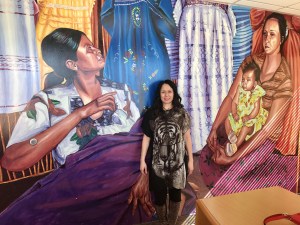
Ruby Chacón posing next to one of her murals. Photo courtesy of Ruby Chacón.

It wasn’t until Chacón had her own son and had to think about what kind of educational experience she wanted for him that she understood she was in a position of great power. “I realized I need[ed] to go back and change from the ground up what needs to be changed in schools,” Chacón said. “I wanted to be the teacher that some kids might not have.” 

More than that, she wanted to execute in her teaching and art what she didn’t receive as a child: representation and a listening ear. “My whole experience of living in Utah and going through the school system and not seeing myself in books we read, images we saw — they did not represent me,” Chacón said. “For the longest time, I thought we were immigrants because that’s what everyone told us.”

Chacón wants to take control of her cultural narrative and show young kids they are allowed to dream and create art. When the dominant narrative is one that doesn’t include someone who looks like you, it has a lasting impact. Paying it forward is the next step to addressing this issue. 

Chacón’s TRAX Mural. Located at the Jackson\Euclid TRAX station, 850 W. North Temple. Photo courtesy of Ruby Chacón.

“It’s really important that they can see themselves reflected in a positive, dignified way to counter those narratives that are very poisoning to their identities,” Chacón said. She now teaches middle and high school art in a different state. As the co-founder of MICA, she still speaks fondly of the mission and organization: “It brings an insider’s perspective to share their voice through their art. It purposefully resides on the west side.” 

Education Empowers Artists 

Miguel Galaz, another west-side artist, didn’t realize he could pursue art as a career until he reached higher education and took an oil painting class at Salt Lake Community College. Eventually, he discovered the power of art and activism during a backpacking trip through Mexico and Central America, which helped his art career take off. 

“I was exposed to a lot of different cultures that were just fascinating,” Galaz said in a phone interview. “We went to a lot of Mayan ruins, we were just drenched with different colors, textures, food and music throughout the whole trip.”

This cultural deep dive is what led Galaz to understand what he wanted to present with his art. “I was born in Mexico, but raised over here (Utah). I sort of felt like an identity struggle of not belonging. So going on this trip made me feel connected with my identity and the richness of my culture,” he said.

In 2015, when a friend asked him to do a piece for a restaurant located in West Jordan, Utah, he wasn’t expecting controversy to occur. The experience shook Galaz to the core, but it was another pivotal moment.

Miguel Galaz’s mural in West Jordan. Photo courtesy of Miguel Galaz.

“It made me realize the power of art,” Galaz said. “How applying paint to a wall in a certain way to really impact people can move them.” This idea led to the creation of Roots Art Kollective. “We wanted to do something for our communities,” he said. “To inspire people to want to learn more.” 

Chacón and Galaz are just two of many examples of artists who believe in the power of  art education for students. On the west side, this education can lead to community, creation and connectivity. As Jennifer Mayer-Glenn, the director of University Neighborhood Partners put it, “Art is a way to express repression and oppression.” 


Liam Elkington

MY STORIES:

MY BLOG:

I had no real notion of what professional journalism looked like in practice before taking this course. All my ideas about research, sources and writing had come from classes that took a general approach. The most challenging (and the most helpful) aspect of the course was the fact that you are expected to perform the tasks of producing great reporting largely outside of class. I learned through experience that responsibility and initiative are requirements for accomplishing any form of meaningful storytelling.

Before taking this course, I had no experience working on a beat. While I was familiar with the concept, I learned to appreciate why having publications that cover specific areas and topics are vital. As I started researching the beat for this course, I started to realize just how little I knew about it. Entire communities and cultures exist within a few blocks of Salt Lake City. There are people and ideas that I would have never been exposed to if I hadn’t been looking. Now, I appreciate the purpose of a beat. There is great value in learning about people and things that are not familiar, and this is accomplished by having a group of reporters that are dedicated to telling the stories that might not otherwise get heard.

A side effect of reporting the stories of a specific community is that you learn about many of the issues that are faced by that community. Learning about immigration, homelessness and education is much different when hearing it from the perspectives of those who are actively involved in those issues. The most moving stories are the human ones, the ones that help us empathize and desire for change. In order for change to come about, these stories must exist. Reporting is vital not only for democracy, but also for our ability to care for our communities.

ABOUT ME:

Liam Elkington graduated with a BS in Communication in 2020. He has experience creating stories in multiple media formats such as audio, video and writing. Liam has shot and edited short documentaries, reported local stories and reviewed products and produced radio programs for student publications and projects. He enjoys focusing his stories on people and their perspectives, and is passionate about music journalism.

Salt Lake City organizations promote community dialogue 

Story and photo by LIAM ELKINGTON

Salt Lake City has never particularly been known to be a diverse town. Due partly to its settlement by primarily white pioneers, Salt Lake City has gained a reputation for being fairly homogeneous. However, throughout the Salt Lake Valley one can find enclaves of unique cultures, cultivating their communities.

Salt Lake City’s west side serves as a home for diverse residents. Cultures can vary between neighborhoods, with each having different modes of expressing their heritage and integration into Salt Lake City as a whole. Several organizations within Salt Lake City are dedicated to not only recognizing and celebrating these differences, but also cultivating a community where differences between residents’ cultural and political backgrounds can be discussed, examined, and learned from.

One such group, Utah Humanities, offers Community Conversation Toolkits designed to provide support for local not-for-profit organizations that wish to host community dialogue events. Utah Humanites’ website features a quote from Lynn Curtis, a participant in the program, who said, “I savor the discussions which have always been engaging, but sometimes difficult.” 

rsz_20200225_142648

The Utah Humanities Council is located at 202 W. 300 North.

The toolkits currently offered by Utah Humanities focus on discussion that surround race and diversity, as well as bridging differences between religious beliefs. While Utah Humanities enables other organizations to host these dialogue events, there are different other events within Salt Lake City that are designed to focus not only on dialogue between community members, but also various forms of cultural and civic education.

The Village Square is a Florida-based organization that is “dedicated to maintaining factual accuracy in civic and political debate by growing civil dialog on diverse issues, and recalling the history and principles at the foundation of our democracy.” The Village Square has an active branch in Utah, which hosts events that encourage participants to engage with issues facing the community, as well as expand attendees’ understanding of Utah’s cultural diversity. 

One of the events featured Andrea Smardon of the KUER podcast “Next Door Strangers.” The podcast focused on the national commentary that our nation has become increasingly divided, and discusses methods that allow individuals to reconnect with their communities in a meaningful way. 

The Village Square events tend to lean political, with events of the past granting participants the opportunity to “speed date” local leaders. One event especially found success in gathering Clinton and Trump supporters during 2016 in an effort to promote civil discourse. 

One could argue that the motivation behind having dialogue between different parties is to achieve understanding, and hopefully to connect in a meaningful way. Utah organization The Golden Rule Project believes that sharing, kindness and compassion are primary facilitators for gaining understanding across any number of social boundaries. 

The website for the Golden Rule Project states that “The Golden Rule Project is not religious, not political, and not associated with any agenda. We promote the Golden Rule as a basic human value.” 

The Golden Rule Project goes about its mission by being involved with numerous organizations, nonprofits and events ranging from farmers markets to Pride parades. Additionally, it hosts community conversation events, again designed to bridge the gap that an individual may feel exists between them and their community.

Communal dialogue can have a real effect on the lives of those involved. Jennifer Mayer-Glenn, director of University Neighborhood Partners, stated the importance of these types of resources. She recalled her work with the Human Rights Commission. Mayer-Glenn collaborated with the Commission as well as west-side communities to host a series of dialogue events designed to determine the needs of Salt Lake residents. These events encouraged discussion regarding the specific cultural, educational and economic challenges faced by the west-side community. The data gathered from these events was used to inform Utah state legislation, and may continue to influence how the west side is perceived by decision-makers in Utah. 

While there are several organizations that provide the space and means for dialogue events, an obstacle facing the communities that could benefit from them is lack of information. “I don’t want to represent community voice,” Mayer-Glenn said. Instead, she said she prefers that communities and organizations are given the resources to speak with each other, that way the needs of the community are being actively expressed.

These organizations are hardly alone in their efforts of community outreach. Many of them place emphasis on collaboration with nonprofits and government bodies like the Human Rights Commission. Ultimately, the goals of these organizations are similar, and require that the community be actively engaged in the discussions being created. The cooperation between these organizations is met with cooperation with the community, so that it may, as Mayer-Glenn suggested, represent its own voice.

Cheyenne Peterson

MY STORIES:

MY BLOG:

This past year, I moved to Salt Lake City’s west side and I don’t believe I would appreciate it as much as I do now. This beat has given me the opportunity to learn about my new community and the curiosity to explore it. There is so much more to the west side than what is portrayed by others.   

I originally thought that this beat was going to be easier. It was difficult to find people to cooperate with interviews. I had people hang up on me or flat out tell me they didn’t have the time. I had to change the direction of my topics to people who were more agreeable. It was intimidating at times, but it pushed me. It pushed me to try again and again, until there was someone who was willing to give their time to a learning journalist. It was so rewarding in the end. The people who were open to talking to me were so kind and made the push worth it. The experience made me appreciate the amazing people in the west-side community. 

I have learned that I do enjoy talking and interviewing people who are passionate about something dear to them. I have the chance to feature them in my own writing and the ability to have it published. It gives a voice to the community. I have found that it is important to not only write an entertaining article, but also to write something meaningful and impactful. 

I found that being a professional communicator can be difficult at times, but also rewarding. I want to write the story as best as I can, for the sake of the community I am writing it for. It is challenging to get a piece the exact way that you would like. In the end, the time makes up for how a story might impact or change a community.

ABOUT ME:

IMG_3636 2

My parents gave me a dune buggy when I was 6-years-old. I lived in this buggy and wanted to be just like my dad. He is a retired driver for Mickey Thompson Off-Road Racing and today watches his old off-road racing friends in NASCAR. We attended hundreds of races growing up. I learned quickly that the sport was expensive and my family didn’t have the time to keep up with my own competitive racing. During this time I became fascinated with the NASCAR pit reporters like Jamie Little and Kim Coon. I wanted to know how they became reporters and was informed that they were journalists. This is what sparked my writing career. 

I am an outdoors woman. Almost everyone in the racing world is involved in the outdoors and I wanted to follow the footsteps of the racing community. I found myself working for an outdoor television show in Nashville. I learned how to produce, film, edit, and be in front of the camera. I had the awesome experience to film legendary outdoor television stars like Jimmy Houston, Hank Parker, and Jimmy Sites. I also had my own episodes.

I am currently a student at the University of Utah studying Journalism. I hope to one day become a broadcaster/reporter in the racing industry or have the opportunity to start my own outdoor television show. I am looking forward to using my degree and entertaining many viewers.