Hispanic immigrants are creative and family-inspired

Screenshot 2019-03-06 15.26.51Story and photos by KRISTEN LAW

Alex Guzman, president and CEO of the Utah Hispanic Chamber of Commerce, said Hispanics are creating jobs and working hard. “They became business owners, with no intention to become business owners. They just had intentions to provide [for their family],” he said.

Moving to a new country and not knowing the language can be difficult. This calls for some creativity when it comes to employment. “What is the solution if I don’t have a job? Create my own job opportunity,” Guzman said. UHCC helps train Hispanic entrepreneurs and business owners and educates them on how to run a successful company. 

According to UHCC, “Success is most often achieved by knowing where your resources lie and not depending entirely on you[r] own talent and strengths.” Guzman said the UHCC helps teach basics like how to file taxes, how to hire and fire personnel, how to do invoicing, and many other skills that are necessary to know before starting a successful business. 

Local businesses are often creative and diverse. Five main industries are reflected in UHHC’s membership directory: restaurants; construction; landscape and snow removal; professional services including photographers, videographers, and accountants; and commercial or residential cleaners. Guzman said they make up about 85 percent of the members.

One local restaurant, although not a UHCC member, illustrates the family-inspired creativity that Guzman emphasized.

Screenshot 2019-03-06 15.26.25

Taqueria Los Lee is located at 2646 S. 700 East in Salt Lake City.

Taquería Los Lee began in the heat of the summer in 2018 in South Salt Lake with a passion and inspiration for flavorful, authentic Mexican food.

The moment you enter the restaurant you are quickly greeted by the Lee family’s welcoming presence. The large windows and open, sun-filled room displays colorful and traditional decorations, which also add to the intimate and wholesome feel of the restaurant.

IMG_1715

The menu of gorditas, tacos, and daily specials is handwritten on the chalkboard.

The family behind Taqueria Los Lee cherishes what they do. Each member has drive, purpose, and a solid work ethic and they inspire each other to be creative.

Rosi and Oscar Lee are the cooks, and their daughters Anileb Anderson and Flor Lee help run the business in various ways. Rosi said she loves to cook and has catered in the past, but she wanted to do something more with her passion for food and make it into a business.

She used to bring her dishes to community or neighborhood events. “People would try her food and would love it,” Anileb said.

IMG_1702

A combination plate with tacos and a gordita, a pocket made of masa and stuffed with filling.

Jim Light, a retired chef from the Salt Lake area, has become a regular at Taqueria Los Lee. He said he doesn’t remember exactly why he initially visited, but his first impressions left him coming back at least once a week since October 2018. “Everything I have had has been really excellent. Their mole sauce, in particular, is very very good,” Light said. “Part of the fun for me has just been getting to know this really cute family that owns this place.” The Lee family even taught Light how to make one of his favorite meals, a bean dish he had really come to enjoy. “They can’t afford to hire anybody, so it’s just a three-generations, family effort.”

Anileb works at the restaurant every day from open to close and helps cook when things get busy. Her sister works another job while helping run the business. Rosi and Oscar are the cooks. It really is a family endeavor. “We’re just a family that works here, so we like to be here with each other,” Anileb said.

This work ethic is bred into Hispanic culture. Guzman said it is not uncommon for some immigrants to work several jobs. However, family-run companies include the whole family, so working from a young age is typical. Working is a part of life. However, Guzman said it is not just about working hard, but about working smart. 

The Latinx community is contributing to Utah’s local economy and well-being not simply benefiting from it. Javier Palomarez, the United States Hispanic Chamber of Commerce president, said in a 2014 speech, “In the state of Utah, Hispanics are paying taxes, creating jobs, and greatly contributing to the local economy.” 

Growing up, Guzman said his father told him, “Work hard. Be the best in your class. Don’t be ambitious. Be content with what you have.” Guzman emphasizes the effect that family has in the Hispanic community in their drive for a successful business. The main goal is family and good living.

Salt Lake County’s inland port: Helpful or harmful for the Latinx community?

Story and photos by KATHERINE ROGERS

Elitzer stood in the doorway of Franklin Elementary School’s gym on Feb. 28.
That evening, the gym hosted a panel about the proposed inland port that is to be built in Salt Lake County. She was watching the proceedings, but not participating in the questioning.

“I wish they would do something in Spanish,” says Elitzer, who asked that her last name not be used. She speaks English well, but it’s not her first language. Spanish is much more comfortable for her.

She is just one of many Latinx people who live near where the inland port is proposed to be built but know very little about it — even though this port could affect them the most, for better or for worse.

The proposed site heavily overlaps with Utah House District 23. This district belongs to Rep. Sandra Hollins, D-Salt Lake City. It also has the highest Latinx population in the state, with 47 percent of the district identifying as Hispanic or Latino, according to the demographic profile of the district.

An inland port is essentially a dry port. It is a place for trucks, planes and trains to meet to exchange and deliver cargo. In the age of online shopping and one-day shipping, a junction like this is helpful.

In the 2018 legislative session, the state passed a bill that would provide funding for an inland port to be built in northern Utah. This inland port is to be built in the northwest quadrant of Salt Lake County, west of Interstate 215 and on both sides of Interstate 80. The area is just north of 2700 South and creeps toward the Great Salt Lake. This would put the port near Salt Lake International Airport and the Union Pacific Rail line, according to the boundary map.

IP 1

Trucks driving down 5600 West, just south of Interstate 80, where the Inland Port is proposed to go.

In the most recent development in this story, Salt Lake City Mayor Jackie Biskupski just filed a lawsuit against the Inland Port Authority (IPA).

Hollins has concerns about the port. She worries that increased truck, plane and train traffic could mean worse air quality.

Questions about how transparent the IPA has been in this process have come up. It has held many meetings that are closed to the public. Hollins says she doesn’t feel like the IPA has been listening to the public like it should.

The state representative does recognize there is good that could come from the port.

A provision has been provided in the Inland Port Bill that requires part of the funding for the project to go toward affordable housing.

The inland port also, of course, could provide potential job growth for the nearby communities, including House District 23.

According to the demographic profile, Hollins’ district has many people who work in construction and the service industry. This port could create more jobs in those areas.

Thomas Wadsworth, director of corporate growth and business development for the governor’s office, reported at the meeting on Feb. 28, that there are incentives in place that would encourage businesses to provide wages at least 110 percent of the average wage in that industry in Salt Lake County.


IP 2.JPG

R.C. Willey and Dematic warehouses along 5300 West, near the proposed location.


However, Hollins expresses that she is concerned about how good those jobs will be. An incentive is not a guarantee. And even if these jobs provide livable wages, there is no promise that there will be room for the employees to grow and move up in the company.

The question that Hollins asks for the good of her constituents is, “Do the economic benefits outweigh the ecological problems?”

The IPA is aware that not everyone supports the port. Envision Utah, a group dedicated to helping Utah grow in a healthy way, has been hired to run public meetings and report back how people are feeling.

These meetings have been well attended. But most of the attendees at the Feb. 28 meeting were white. Even though the neighborhoods closest to the port are heavily Latinx, few of those residents are seen at this meeting.

Elitzer, the Latina woman who was there that night, said this was the first meeting about the inland port that she had attended.

She had heard about it through Hollins when Elitzer had taken a trip to the capitol with her West Side Leadership Institute class. Before that, she didn’t know about the port. Hearing about it now alarmed her.

She has a daughter who is asthmatic. She said she wants her daughter to be able to play outside and run around with the other kids. Utah already struggles with poor air quality. Increased air pollution could keep Elitzer’s little girl from being able to do that.

The potential for worse air quality near their home makes Elitzer worry, not just for her daughter, but for other children as well.

She had recently been to Primary Children’s Hospital and seeing all those children who have similar afflictions as her daughter broke her heart. “They shouldn’t have to live like that,” she said.

It was pointed out during the meeting that the inland port could provide job growth for the community. Elizter just shook her head. “We can get other jobs, in a healthy way,” she said.

Elitzer wants to make a difference in her community. Learning about this port is part of that. She plans to share this information with her friends, family and neighbors. She thinks that they need to know.

She believes that this inland port project is just focused on money. She said she also feels that the IPA does not care about what the people nearest the project think. If it did, Elitzer points out, wouldn’t it have provided some information in Spanish?

Latinx populations help the US economy to thrive

Story and photo by ZANE LAW

In recent years, with the presidency change and promises of a wall between bordering lands, southern immigrants have been the hot point of numerous conversations. While some argue that immigrants hurt the United States economy by stealing jobs and not paying taxes, other credible folks think just the opposite of the situation.

In regard to stealing jobs from American-born individuals, Alex Guzman says the community members create their own jobs and support each other as a collective Latinx whole. Being the CEO of the Utah Hispanic Chamber of Commerce, Guzman knows the working-class population and estimates that as many as 35,000 Hispanic individuals own businesses in Utah.

Whether documented or not, Guzman says they open businesses “not to be entrepreneurs, but to survive.” Those who cannot find jobs due to the lack of a social security number, discrimination, little education, and other reasons are able to open businesses and provide for their expanding families. These business owners are then able to pay it back to fellow immigrants by offering new jobs and opportunities to thousands of other people in similar situations.

While the community creates jobs for themselves and others by having a high number of business owners, another overlooked aspect of immigrant workers is the fact that they are willing to do whatever it takes to provide.

According to a talk at the Center for Latin American Studies at UC Berkeley, immigrants are more willing to move for work than native folk. Giovanni Peri explains that “immigrants’ willingness to move helps slow wage decline in stagnant regions and contributes to economic growth in booming ones.” They move away from regions that do not have enough jobs, allowing the locals to take the few available spots. Immigrants then move to bustling areas, with high demands for work, and are able to fill the positions that owners want to be filled, Peri says.

Alejandro Gutierrez, a Mexican-born man of 45, did just that. He originally moved to a town in California, but as the job market began to fill up, he found his way to Salt Lake City. Gutierrez now works as a dishwasher at the University of Utah’s Peterson Heritage Center, pays his taxes, and adds money to the economy.

While Guzman, Gutierrez, and others within the Latinx community create jobs and work hard for their money, Guzman says that the community also contributes plenty of money to the churning economic machine.

“We live la vida loca and we put our money in the market right away,” explains the enthusiastic business owner, marketing professional, and former Guatemalan senator. “La vida loca” translates to “the crazy life” and Guzman says this is the case for many Latinx individuals. They buy the foods they want, upgrade their cars, party and vacation frequently, and live carefree lives.

Guzman says the community finds it difficult to save, but he sees this as a learning experience for youth. He further backs up his lifestyle choices by saying the “spending helps to inspire a sense of generating income.” The philosophy is that when their kids see what money can bring and how much it costs to live well, they are more driven to earn for themselves.

These spending habits stretch further than the immigrants who Guzman has come to know in Utah, however. Anna Chavarria, a student in Colombia, explains that she and her family have difficulties with saving as well. The family of six lives in a three-bedroom home in Medellin, Colombia, but they enjoy things like motorcycles, fine dining, and huge block parties.

fullsizeoutput_1a9d

Anna Chavarria enjoys “la vida loca” in the sand dunes of Huacachina, Peru.

Chavarria says in a phone interview they would not cut the extravagance out for a more spacious house, explaining that they “live a fast-paced and fun life, and a squished home simply adds to the closeness of our family.” Both her mom and brother work seven days a week to provide such a life and she says she and her family would work just as hard if they lived in America. Chavarria has been in the Visa application process for approximately two years and says she has much to offer to the U.S.

Because Latinx community members often spend as fast as they earn, Guzman says the Latinx community is a major target for marketing as well. With his 25 years of experience in the field, he has found that the return on investment for this group is large.

Spanish-speaking outlets like Telemundo are greatly cheaper to advertise on than English-speaking sources. Then once the advertisements have done their job, Guzman also says Latinx people are very loyal to the brands they buy from. Companies are able to advertise their brands for less money, keep their customers for longer periods of time, and have peace of mind knowing the community will spend for as long as a paycheck is coming in.

The state of Utah and the country as a whole are filled with people similar to the likes of Alex Guzman, Alejandro Gutierrez, and the Chavarria family. According to a June 2018 article in the Salt Lake Tribune, the Latinx population even makes up at least 14 percent of the state’s residents. They are not an anomaly and are a community that will, no matter what, contribute to and affect the economy.

Finding success marketing in the Hispanic segment: Google Translate is not enough

Story and photo by JUSTIN TROMBETTI

What if I told you that the majority of marketers are missing out on close to 20 percent of their viable market?

They spend countless hours on strategy, execution, and data analysis, tirelessly working to drive results for their company. In the planning stages, this usually means determining different avenues for reaching their ideal customers. Why, then, is so much still missed when it comes to targeting the market segment with an estimated purchasing power in the trillions?

The short answer is that, even if businesses realize leaving out the Hispanic segment is a big miss, throwing ad copy into Google Translate and calling it a win is about as effective as windshield flyers at a local mall.

Understanding the Hispanic segment means going beyond language barriers. It also means figuring out how Latinx audiences are different from their non-ethnic counterparts (and perhaps more importantly, how they’re not).

Human beings don’t fit into a nicely labeled box, but stereotypes are not the same as purchase behaviors.

Alex Guzman, a former Guatemalan senator and the voice of Latin America’s version of Tony the Tiger, seems to agree. Guzman currently serves as the president and CEO of the Utah Hispanic Chamber of Commerce, and the financial power of the Latinx segment is far from lost on him.

In an interview with the Voices of Utah press pool, he stressed that this power goes beyond population compositions. Hispanics as a cohort spend hard. A product of the cultural happy-go-lucky mentality, savings accounts are an oft fleeting concept when the latest product hits the market.

Guzman went as far as to say that some of the best market tests can be run on this segment, which has no fear of price points when they think the return on investment is there.

The struggle becomes finding the best ways to go about reaching this vibrant segment. Guzman agrees with the data sets; they show that millennials — who make up over half of the Hispanic population — are on social media, but TV is crucial. It accounts for almost half of all marketing spend in the Hispanic segment, and it’s the channel Guzman believes integral to reaching the older demographics.

Perhaps the most important point Guzman mentioned was that Hispanic segments are extremely brand loyal. Earning that loyalty means resonating on a cultural level, not just a lingual one.

But if reaching the Hispanic population is as much about culture as it is language — let’s not conflate a simple translation being insufficient with it being unimportant — how do we marketers tap into that?

Eric Nielsen is a Hispanic Utahn who works at Soundwell, a popular local club that hosts Latin nights on Fridays in downtown Salt Lake City. He gave some insight as both a Hispanic and someone with experience promoting the events.

He was straightforward about the community focus around these events, and how it makes them effective. “You get a lot of older people mixed in with the younger ones, more than you see at other kinds of events,” Nielsen said in a recent phone interview.

He continues that there is consistency with the people there, the DJs, and the atmosphere in general. The diversity comes from the variety of weekly themes for the events. Nielsen believes that when so few major venues have a Latin focus, the community element is crucial to the club’s success; the events tap in to the norms and idiosyncrasies of the average Hispanic family in order to deliver an experience that feels authentic.

It should be unsurprising by now that social media is integral in promoting these events, given the Hispanic millennial demographics mentioned above. Word of mouth, though, is also integral. While most older populations of Hispanics are watching TV, you’ll be hard-pressed to see any clubs promoting on those channels.

In this way, the success of events that focus on the community also rely on it to stay relevant.

Madelynn Conrad, a seasoned marketer with familial connections to Hispanic culture, knows firsthand how challenging overcoming this “marketing gap” can be. In a recent interview, she detailed her experience working with a Hispanic-owned bakery that saw an almost 10 percent increase in sales after two weeks working with her.

00100dPORTRAIT_00100_BURST20190226210611356_COVER-min

Conrad speaks to Voices of Utah from her home office.

From a business to business standpoint, she sees vast room for improvement in the marketing sector.

Conrad had to earn the bakery’s business with old-school persistence; she was the first marketer to reach out, pitch, and successfully close the bakery on a contract for marketing services.

“A lot of people in [the owner’s] family owned their own businesses, or sold things in their own way, and none of them actually used any real form of marketing other than flyers,” Conrad stated.

“[The owner] didn’t actually realize that there were people out there that specifically do just marketing, and she didn’t think that it could be effective,” Conrad continued. “She generally assumed that marketing was a big corporation idea.

“All I really had to do was show her that I could make a difference. She was actually really determined to maintain the idea that marketing wouldn’t work for her business.”

There’s something to be said for the fact that not all service sector professionals are well-rounded marketers or businesspeople, but Conrad believes there were cultural barriers at play with this client.

She told me “there weren’t a lot of resources available to help [the bakery owner] in the first place, like a business association for a meet-up that educated small business owners in her community specifically.”

While resources like the Utah Hispanic Chamber of Commerce seek to provide businesses with these tools, they’re still just one entity in a state where the Latinx population is booming. In closing, Conrad suggests that there are issues of capacity and awareness with these resources that lead businesses like her bakery client to feel like they’re on their own.

Next time you think of phoning in a Google Translate ad for your Facebook campaign, consider what you might be missing out on, and consider whether or not your message will permeate across cultural barriers.

Economic growth: Now is the time and Utah is the place

Story and photo by SARAH SAIDYKHAN

Utah is home to thriving companies, up-and-coming businesses, an eclectic array of restaurants, nightlife, recreations and so much more. For an eager entrepreneur, Utah is the home of opportunity. Since 1991, the Utah Hispanic Chamber of Commerce (UHCC) has worked in assisting people on their quest for economic development and stronger ties to their communities.

UHCC

The sign and coat of arms on the Salt Lake City building.

For almost 30 years, what began as a small handful of people looking for a change in Utah’s economy has grown into a large network now led by Alex Guzman, president and CEO, according to the Better Business Bureau of Utah. Now the chamber assists Utahns with networking opportunities to showcase their businesses, provides access to educational workshops, offers scholarship opportunities and more. In the four years that Guzman has been president of UHCC, he has revolutionized the chamber. He said he had a vision of what leaders in the Hispanic community must be doing and he set out to make it happen. Under Guzman’s direction, the chamber has moved away from the corporate office scene and ventured out into the community where he meets with the people of Utah.

The Kem C. Gardner Policy Institute reported in 2016 that Utah had a Hispanic community with over 400,000 residents. These numbers are growing each day. Utah’s Latino residents work hard, play hard and give back to their communities to help the state flourish. As Guzman said, “We take care of each other.”

One of the goals of a chamber of commerce is to help citizens understand what it takes to start a business. Guzman said he has taken this theory and put it into action. If you’ve thought about opening your own business, there are steps you must follow. For members of Utah’s Hispanic community, one of those first steps should be joining the UHCC. The possibilities to expand the business are then at one’s fingertips.

Esmeralda Avalos works for the chamber and is one of the first points of contact at UHCC. She said the opportunities offered through the chamber are beneficial to keeping a business running smoothly and she loves seeing business owners looking for new ways to explore the vision and mission of their companies.

One opportunity is the Business Academy, a 10-week course that specializes in essential business topics through education and training. It is only offered at UHCC.

“The Business Academy opens your mind to become more business wise; look at it as a business,” Avalos said. Participants must realize there is more to entrepreneurship than simply stating, “I want to open a business.” Avalos said the course entails in-depth education and hands-on learning. “Marketing, objectives, workshops, communications, customer service, goals, how to get funding” — these are just a few of the topics that are covered during the Business Academy courses, she said.

To obtain financing, loan institutions need to know that entrepreneurs have taken classes on accounting, marketing, distribution, licenses, fees, permits, employees and even taxes.

Juan Pascua is the membership director at UHCC. He said the chamber offers the skills to “help Hispanic businesses understand what they need.” Learning about owning and operating a successful company is all part of the membership, which includes media marketing on Alpha Media Radio, representation on the UHCC website and direct links to other members’ businesses.

Helping to support the Hispanic community in Salt Lake City is important. Pascua said. “If we don’t have the information, we can get the people to another member who has it.” For example, he explained that if someone has a question about business taxes that an employee can’t answer, an expert will be called in. “It’s all part of networking,” Pascua said.

The Utah Hispanic Chamber of Commerce is growing. Right now, it has offices in Salt Lake, Ogden and St. George. These locations serve as information centers, places to hold seminars, workshops and the Business Academy courses.

With help from local sponsors like Zions Bank, Utah’s Hogle Zoo, Utah Cultural Celebration Center, Utah’s economy will continue to grow and provide for the residents for years to come.

For more information about UHCC or to become a sponsor, call Esmeralda Avalos at 801-532-3308.


Latinxs at work: stereotyping results from a lack of sympathy

Story and photo by SAYAKA KOCHI

The population of Latinx is increasing in the Western United States. The Census Bureau’s data says one in four Americans are supposed to be Latinx by 2045. Many people originating from Latin America have crossed the borders to seek high paying jobs for their own dreams to come true or for their families’ sake. On the way to get a better life, many Latinx immigrants encounter stereotypes in their workplaces.

Monica Carpentieri was born and raised in Brazil. After getting married there, she moved with her husband to the United States to pursue her master’s degree. Later on, she started working as a licensed acupuncturist. Monica and her husband have become residents in Scottsdale, Arizona.

“Stereotyping was never overt,” Monica said in an email interview. “I personally had instances though that due to having a Latin accent, people immediately did not give me the credit of being highly educated. Unlike a friend of mine who had a British accent and no formal education.”

Monica’s husband, David, also faced the issue that the employers were ignorant. While he was in the medical residency training in the U.S., one hospital refused him to be a trainee for the following reason: they did not accept medical graduates from Europe. David is from Brazil, located in South America. The hiring manager at the hospital did not know where the country is.

“I was a bit shocked,” David said in an email interview. This case might be rare. But certainly, employers’ ignorance becomes an obstacle to get a job for Latinxs.

Stereotypes that are far from the truth are caused by ignoring true facts and cultural intolerance. The absence of true facts is highly contributed to by media productions. According to research done by an Eastern Washington University student, English-language television programs have often portrayed Hispanics and Latinxs as criminals or gangsters in the past few decades.

In fact, the data provided by the FBI in 2016 proves that more than 80 percent in total arrests were non-Hispanics. True facts are not on TV in many cases.

The same thing can be said about education. The Pew Research Center published a significant report in 2016. The report showed that even though the college enrollment rate of Hispanic U.S. citizens was still low compared to other ethnic groups, the rate of increase was outstandingly high.

Believe it or not, Whites and Hispanics have only 7 percent difference in the college enrollment rate. Recalling Monica’s experience, she has been stereotyped that she was not educated well because of her accent. Like Monica, Hispanics are sometimes unreasonably labeled to be uneducated no matter what kind of higher education degrees they have.

According to a 2017 poll by the Robert Wood Johnson Foundation and the Harvard T.H. Chan School of Public Health, about one in three Latinx poll participants have ever felt discriminated against when applying for jobs because of their ethnicity. The same amount of Latinx participants have experienced that they couldn’t get promoted or a pay raise. What is the main cause of employment discrimination? One of the answers is a false portrayal that Latinx workers are lazy, violent, and uneducated.

Alex Guzman, president and CEO of the Utah Hispanic Chamber of Commerce, said, “Traditionally speaking, the Hispanic community members are very hard workers. They have one, two, or even actually three jobs. Mama works. Papa works. Grandma or grandpa works.”

Story1

The Utah Hispanic Chamber of Commerce is located at 1635 S. Redwood Road in Salt Lake City.

Guzman was born in Guatemala. He was a professional in the strategic marketing field there and also helped foreign companies reach out to the Hispanic community. While continuing his marketing career, he started a political career. However, his children were almost kidnapped twice. To escape from the threats throwing shadows over his family, he got out of his home country and moved to America in 2008. He became an advocate to support Latinx and Hispanic immigrants to become business owners, providing sources and connections.

“They become or became business owners without intent to be business owners. They are intent on surviving. For the business owners, they have to learn how to own a business. They need to know how to pay taxes,” Guzman said.

Utah is one of the states in which the Hispanic population is rapidly growing. According to the data by the Utah Hispanic Chamber of Commerce, the population in Utah now exceeds  450,000. The data also show that Hispanic Utah residents are yearly contributing $9.5 billion to the local economy. Utah’s economy is highly supported by Hispanic hard workers.

Hispanic immigrants are citizens who have civil rights, including equal employment opportunity. Guzman considered equality as “one size does not fit all.” People have different backgrounds, ages, languages, and beliefs. Everyone cannot be treated in the same way.

“There are more than 13,700 Hispanic business owners registered at Hispanic Chamber of Commerce. But actually, the number is more than that. Only 13,700 business owners had the courage to self-identify themselves as Hispanics or minority when they registered their own businesses,” Guzman said.

People tend to estimate who the person is by only looking at the group where he/she belongs in spite of their backgrounds. Stereotyping results from ignorance of who the person is. Hispanic workers and business owners can feel more comfortable with their ethnic identity in a society where they can live fully as citizens.


Effort equals reward for Latinx organizations in Salt Lake City

Story and photos by BRITT BROOKS

IMG_3388 (1)

“DREAMers Life III” by Ana M., 2009.

Twice a year monarch butterflies make a 2,500-mile trek between the U.S. and Mexico. The migration is what keeps them alive. When cold temperatures in the states are unlivable, the warmth of a Mexican winter is the saving grace for this entire species.

Monarchs are more than pretty to look at, though. They’re a symbol for the Latinx community of migrants traveling to the U.S. and elsewhere. Though the journey is long and difficult, the destination promises opportunity, safety and a better life for Latinx individuals and their families.

The immigration process from Central and South America to the U.S. is grueling for even the toughest and most determined, but what happens when immigrants finally cross the border? How are Latinx people — with or without papers — supposed to integrate into American cities? If a language barrier exists, where can immigrants find jobs, housing and education? These kinds of questions are being asked and answered in Salt Lake City by professionals at organizations like the Dream Center, the Utah Coalition of La Raza, and the Utah Hispanic Chamber of Commerce.

The Dream Center at the University of Utah can be found on the south side of campus in the Annex building in the middle of a long hallway dedicated to diversity. Flags and banners hang in bold color, workshops and offices are bustling, and one can’t help feeling better about the world when students of all different cultures and ethnicities are seen thriving.

But the opportunity for higher education isn’t accessible to everyone. Some states bar undocumented citizens from attending universities, even though no federal laws support these actions. Thankfully, Utah isn’t one of them.

Luis Trejo and Brenda Santoyo greet those walking into the Dream Center with smiles and a friendly “what can we do?” attitude. Complete with memorized statistics and an impromptu presentation, Trejo and Santoyo shared some serious knowledge about the college experience of Latinx students in Utah.

Trejo, 19, is a student at the U and peer mentor with Santoyo, 24, a graduate assistant. They help Latinx students with their legal status, career goals, scholarships and strategies for picking the best college. Sometimes, they even recommend that students start at Salt Lake Community College, which is more affordable than the U. The Dream Center is also a resource for community gatherings and conversations and offers a space for local Latinx artists to display their work.

IMG_3392

The Annex building at the University of Utah.

Invigorating orange walls complete with posters and artwork create an environment that is both comforting and energizing. Monarch butterflies are featured in many of the decorations, including two graduation caps made by Santoyo. One of the caps says “Todo lo que hago, lo hago por ustedes.” Everything I do, I do for you. The stories here don’t just educate — they inspire as well.

The faculty are friendly, considerate of sensitive topics and well read on current laws that affect undocumented people here and nationwide. They know about options most students aren’t aware of, such as in-state tuition for anyone during summer semesters. And though the center is located at the U, is offers services to students from any college in the state. “It’s also really important to note we’re the only Dream Center in Utah,” Santoyo said.

Diversity and higher education create a new generation of young adults to tackle inequality, stereotypes and ignorance in an otherwise white-dominated professional world. For years the Latinx community has been marginalized, and Trejo mentioned how dehumanizing it is to call another person illegal.

Civil rights are crucial for Latinxs in America, and an active resistance against prejudice and discrimination has grown considerably in the last few decades. The rapidly growing Utah Latinx populace is at nearly half a million people, as reported by the Salt Lake Tribune in 2018. They strengthen and inspire each other, as well as continue the work of past civil rights leaders, most notably CĂŠsar ChĂĄvez.

The Utah Coalition of La Raza was founded in 1992 as a way to ensure the community had an organization to back up Latinx people in multiple situations. UCLR honors the legacy of César Chávez — Mexican American civil rights activist — with a fundraising banquet each year.

Chris Segura, 78, was president of the organization from 1997-99 and spoke about the action and assistance UCLR provides the Latinx community. “They’re an organization that promotes advocacy through education, immigration, civil rights and justice,” he said.

Segura knows plenty about the Latinx experience in education, as he was the first ever Hispanic administrator in Granite School District. As a U alumnus himself, his eyes lit up when talking about the partnership he started with the University of Utah. His plan involved the education and engineering departments at the U with the goal of making more college-credit classes available. This got Latinx students to take university classes in high school and created a higher chance of graduating and earning scholarships for low-income or undocumented students.

One of the biggest facets of the organization as a whole is education. UCLR runs three programs for K-12. The programs include the Utah Latinx Youth Symposium, CommUNITY Club, and Latinos in Action. As written on the website, Latinx are the least likely group to enroll in early childhood education, something UCLR is trying to change with community outreach. Equity in education for all students is important to give the same opportunities no matter their background.

IMG_3391

Hashtags help connect different communities on social media.

Organizations like the Dream Center and UCLR are resources for the Latinx community to have, especially for education. But what happens after graduation? One of the best pathways to success is to become an entrepreneur. Entrepreneurship is especially popular among undocumented people who might not speak English fluently or at all. Barriers against Latinxs aren’t just legal and political but can be seen in our local communities as well, where non-English speakers are all but ignored.

Someone else advocating for Latinxs is Alex Guzman, CEO of the Utah Hispanic Chamber of Commerce and a former politician from Guatemala. He’s versed in all things business and runs the chamber to give counsel about the different strategies for Latinx people when starting their own company in Utah.

When asked about his personal journey he said, “I’m a door maker more than a door opener.” According to Guzman, this is the kind of attitude one should have in order to be part of UHCC. An annual membership fee covers free classes, community gatherings, and networking events and activities. Once members join they have the opportunity to work with other Latinx-owned businesses and be supported and educated on how to succeed in Utah’s culture.

For the historically marginalized Latinx people of America, Utah is making strides. UHCC wants people to thrive and has helped over 13,700 business owners not just with seminars and networking but also political representation in connection with the national Hispanic Chamber of Commerce in Washington, D.C.

Growing diversity is good news for Salt Lake and surrounding Utah cities. And there’s an abundance of hardworking, inspiring Latinx members in communities across the state. Different cultures and experiences not only enrich our communities, but also help with international perspectives as well.

These organizations truly have what’s best for Latinx people in mind, whether they’ve made a journey like the monarch butterfly or were born in the U.S. In a world where the odds are against you, resources, networks and services can be invaluable.


Immigration, business and community: Organizations in Utah assist Hispanic entrepreneurs overcome challenges and find success

Story and photo by MEGAN CHRISTINE

Gladys Gonzalez was forced to leave her home in Colombia due to the unrest in the region in 1991. She was also forced to start her career over when she arrived in the United States.

Many immigrants who come to the U.S. are unable to pursue their previous vocation because barriers exist between foreign academic and professional worlds. They often are obligated to start at the bottom. This is a phenomenon known as brain waste.

Gonzalez, a former bank executive, knew she did not want to start over cleaning banks. She decided to start her own business.

Gonzalez noticed that there was a need for Spanish speakers in Utah to have a sense of community. She decided to create one of the first Spanish newspapers in Utah, Mundo Hispano. Through this process, Gonzalez was required to write a business plan. But, she had no idea where to start.

Pete Suazo, the first Hispanic Utah state senator, assisted Gonzalez with writing that business plan and finding funding. Gonzalez was inspired by his help and thought that everyone should have their own Pete Suazo to help them launch their business.

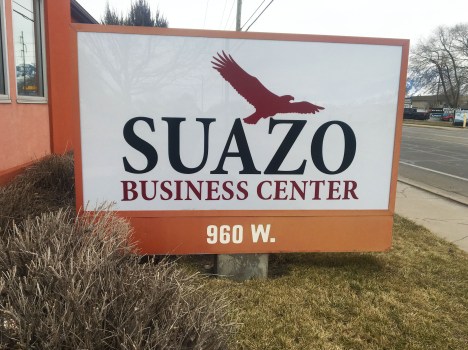
Suazo died in 2001, but Gonzalez never forgot the kindness he offered her. She wanted to honor his memory by creating similar opportunities for her community. This is where the idea for the Suazo Business Center was born.

The Suazo Business Center launched operations in 2003. It is a nonprofit organization that assists entrepreneurs from underserved, low- to moderate-income communities start and sustain their businesses. These communities include Hispanic, female, and refugee populations.

Story1Asset

Silvia Castro, executive director of the center, noted the uniqueness of the center. “We’re focused on economic development, which isn’t a typical role for a nonprofit,” she said. The reason the organization is a nonprofit is because its clients can’t typically afford a consulting business.

The center offers tools to communities who don’t usually get them, which can in turn end cycles of poverty. “We don’t do it for them, but we teach them how to do it,” Castro said. “To me, that’s our community impact. It goes beyond economics, job creation, sales dollars. I think that when you have a stable family, you have a stable community, and then you look to give back to that community.”

Castro added, “As a nonprofit, we serve the client. We’re looking for the best way to impact the community to grow. It also gives us more credibility within the Hispanic community, that we’re actually out there to help them instead of taking advantage of them.”

There are a variety of reasons these populations may require the center’s help when conducting their business. It is difficult for them to access capital. Regulations are troublesome to understand and almost always changing.

Compliance is one of the main challenges these entrepreneurs face because there are regulations that the Utah Department of Commerce asks business owners to follow that may not be in other states, and that definitely aren’t in other countries.

Business regulations in Utah can change without notification, and it is necessary to keep up with them in order to be compliant and to stay in business. Antonella Packard, the lead business advisor and teacher at the center, said business regulations can be complex. “It’s always going to feel like a stink bomb being dropped in the middle of a room because it’s like ‘Oh, really? I didn’t know that I wasn’t complying, what do I do now?’ Don’t worry, we can help.”

The Suazo Business Center offers a variety of services. It offers six-month-long trainings with either a startup or growth track and one-time workshops that focus on specific topics. The center’s business financing will assist those looking for loans or grants.

The center also does one-on-one business advising where clients are able to have their specific concerns reviewed. These sessions help immigrants and refugees understand how entrepreneurship works in this country. Castro said, “Navigating this government regulation can already be rough. Imagine English is your second language.”

The Suazo Business Center is not the only organization in Utah that is dedicated to helping Hispanic entrepreneurs. The Utah Hispanic Chamber of Commerce is a network of entrepreneurs who seek to increase their business opportunities by providing trainings, scholarships, and market research.

UHCC provides networking avenues, while the center works more on business development. “Our focus is different,” Castro said. “We want to make sure that they (entrepreneurs) have an up and running business first, so our priorities are a little different.”

Alex Guzman, president and CEO of the chamber, said about the center, “We have a very nice and good relationship. We should collaborate and make it a bit better, but in reality, we kind of compete. So rather than help my colleague grow, I’m a little bit selfish. But in business, it helps to be selfish. I’d rather keep that customer for the chamber.”

No matter what organization provides these entrepreneurs with resources to help their businesses grow, it is crucial that it is happening at all. Castro said, “When we talk about the Latino community, it’s always in a negative light. Yet what we see here day in and day out, it’s the things that really should be more out in the public.”

Tribal tattoos are more than just a fad

Fred

Fred Frost, owner of Frost City Tattoo. Photo by Diego Romo

Story and photos by DIEGO ROMO

The first thing you notice when walking into Frost City Tattoo is an overwhelming sense of community and inclusiveness. It’s as if the shop were a working and living metaphor for the values that most, if not all, Pacific Islanders stand for: community and tradition.

A warm “hello” greets you as you push open the door, quickly followed by a “make yourself at home” and inviting conversation.

But as you walk around and begin to explore the shop, the work of the artists grabs your attention. The walls are filled with pictures of the beautiful motifs that have ornamented the bodies of generations and generations of Pacific Islanders, which entices your focus and sustains it. The tradition is deep and diverse. The art is unique and beautiful.

Anthropologists agree that the tradition of tattooing has existed in Pacific Islander society for over two millennia. Almost all of the island societies scattered across the Pacific have some form of tattoo culture that permeates their community and helps indicate their place in it.

Although experts disagree on the geographical origin of tattooing — there is evidence of tattoos on the preserved skin of Egyptian mummies and countless other ancient cultures — historians can agree that the linguistic history of the word derives from the Samoan word tatau, which means “to strike.”

Called “kakau” in Hawaiian culture and “moko,” the traditional name for the face tattoos of the Maori in New Zealand, the art has always played an integral role in Pacific Islander society.

“Tattooing is as fundamental to Pacific Islander culture as anything else,” said Fred Frost, owner of Frost City Tattoo, which is located at 7045 State St. in Midvale.

Frost, who has been tattooing for 20 years, never saw the craft as a potential career choice. He got into the art by giving tattoos to friends as party favors when he was a young man living in California.

By the time he was 16, Frost gained an apprenticeship with a shop in California and had begun to discover his passion, which in turn helped him to learn more about himself.

“I actually learned how to speak Samoan through tattooing,” Frost said.

Frost jumped into research and began practicing the ancient motifs that are prevalent in Pacific Island tattooing, becoming a master in the process.

The traditional style of tribal tattoo varies from island to island, but the most common themes seen in the tattoos are strength and the representation of the environment in which they lived.

Many agree that the repeated use of triangles, which are representative of shark teeth, generally symbolizes strength and protection. Another very common pattern seen is the spiral-esque design meant to represent waves.

Because the early societies of the Pacific Islands had no written language, they used tattoos as a means of communication between members of the society.

According to Kealalokahi Losch, an expert in Pacific Islander culture, agrees that tattoos were a way of preserving history and culture, as well as a means of broadcasting one’s individuality.

“For Polynesian people it’s kind of our identity. It’s our thing,” said Lala Ellsworth, a tattoo artist working at Frost City Tattoo.

LaLa

Lala Ellsworth, a tattoo artist at Frost City Tattoo. Photo by Diego Romo

Historically, tattoos contained symbolism that related to the matriarchal and patriarchal lines of the family. They displayed successful hunts and the spoils of war. They also denoted what standing in the society one had, be it king or warrior, and even the origins of their ancestor.

Frost credits these characteristics for his passion and interest in the style. He really liked the fact that he was “able to tell a story using our language.”

Tattoos also played a very personal role in the sense that they shared the story of the bearer to the world. But they were never about the individual, as is the case with most Pacific Islander culture and practices.

“There’s no individual. That doesn’t exist in our style,” Frost said. “You’re all about the family, the clan, and community in a way that makes you whole.”

Historians state that as European cultures began to make contact with the Pacific Island communities, the practices and techniques of Polynesian tattooing began to spread and influence styles all over the world.

“All islanders have always gifted tattoos to foreigners,” Frost added.

And despite many efforts by zealous religious missionaries to curb the practice, it’s still thriving two thousand years later

Frost said that there is a large and growing market of Pacific Islanders who wish to continue the tradition of receiving the tattoos as part of their cultural identity — those who truly understand the deep meaning of the symbolism and the history of the art.

But you do not have to be of Pacific Island descent to appreciate and understand their style of tattooing.

“There’s a lot of non-Polynesians getting Polynesian stuff,” Frost said.

He added that this is a factor in what’s keeping the art alive. The symbols and their meanings are universal. They tell the story of all humans, just through the lens of the Pacific Islander experience.

“The meaning behind it is relatable to anyone in the world,” Frost added. “It’s just done in our style.”

Zay Dela Pena, who has tattooed at Frost City Tatau for three years, was born in Hawaii and grew up in a very religious family. The traditional, Polynesian style tattoos that were inspired by his culture and his spirituality by interweaving symbolism and meaning between the two identities.

tattoo2

Zay Dela Pena tattooing a client at Frost City Tattoo. Photo by Diego Romo

“I had to figure out a way to connect the cultural symbols to spiritual symbols,” he said.

Dela Pena, like many others, was able to see the universal qualities in the symbols and add his own experience and identity to the tattoo, deepening its meaning.

Although the art-form has remained highly unchanged over its two thousand year existence, artists are now beginning to blend styles and create pastiches that contain the influence of many different works and cultures.

“What’s happening now is you’re seeing an evolution,” Fred Frost said. “Because artists are becoming diverse.”

Younger artists like Jroo Winquist are influenced by the tattoos of their older relatives and peers, but are continuing the Pacific Islander tattooing legacy through exploring different and newer styles.

“I love the look of tribal,” Winquist said. “It’s aesthetically so pleasing.”

But Winquist stated his favorite style of tattoo to work on is contemporary, modern and even surrealistic. Still the art is influenced in some way by the traditional Pacific Islander style.

Fred Frost said the traditional style of Polynesian tattooing will not be going away any time soon.

“It has stood the test of time until now, so I’m sure it will last,” he said.

As the buzz of the tattoo guns begins to fade, the conversation builds at Frost City Tatau in Midvale. Those who have just finished receiving their new ink don’t just pay and leave — they stay and talk for a while. Because before anything else, community and family come first in the Pacific Islander tradition.

LoL Hawaiian Grill: Lots of love and laughs in this Sandy restaurant

Story and photos by ALEXANDRA OGILVIE

The restaurant Lol Hawaiian Grill is kind of hard to find, hiding in a strip mall at 9460 S. Union Square in Sandy. The inside is very clean, with bright colors and welcoming music. The smell of slow-cooked pork is enticing as soon as the door is open. There isn’t room for many people with less than a dozen tables, and the kitchen is visible right behind the register.

Seven years ago Lana and Lopi Toleafoa opened their restaurant in American Fork, and about a year ago moved it to Sandy. “When we started out, some of our friends said, ‘Well, you have to find a spot where there are lots of Polynesians,’ but unbelievably, and amazing for us, our clientele, our customer base, is about 70 percent locals from Utah,” she said. “But they love our food.”

And love their food they do: their average on Yelp is four and a half stars out of five. Lana Toleafoa said that’s because “it’s very unique in that all our recipes are made by our family; they’re family recipes and yes there’s a lot of teriyaki barbeque chicken out there, we’ve been known to have the best.”

Of course, Toleafoa said, the most important ingredient used in any mom and pop restaurant is love. “I think it makes a difference that we love what we make.”

Ana, whose family is from Hawaii, loves the authenticity of the food. “A few things they ‘got right’ first of all is flavor. I can tell sauces are scratch made. The overall flavor profile is right on. Second is, the cuts of meat from the short ribs having some fat on them, chicken thigh as opposed to breast and even turkey tails. All cuts you would see used on the island.”

In addition to raving about the food, almost everyone on the first page of Yelp reviews talked about how nice everyone who works at the restaurant is. “You’re treated like family when you come here!” BJ Minson, a regular, said.

Sarah, another regular, wrote, “I love LoL Hawaiian Grill! Friendly staff every time just like being back on the North Shore!” Toleafoa loves learning the story of everyone who comes in, called “talking story” in Hawaii. “We love meeting new customers and getting to know you people every day.”

LoL Hawaiian Grill always offers the basic dishes: barbecue chicken; kalua pork, which is slow cooked until tender; kalbi ribs, a Korean-style dish that is very popular in Hawaii; and garlic shrimp. But if diners want loco moco — rice, a hamburger patty and an egg — they have to come in on a Wednesday. “We find that people look forward to those specials on those days,” Toleafoa said.

“We also make Polynesian dishes, you know, we don’t just focus on Hawaiian,” she said. “What we do have are very popular and people love what we make.” An example of a Polynesian dish they serve is Samoan oka, which comes with traditional Hawaiian poke. Both are made of raw fish, cured with some form of acid, much like Peruvian ceviche.

Lana and Lopi were both born in Tonga and lived in New Zealand before moving to Hawaii and ultimately to Utah when their daughter Juanina was accepted to Brigham Young University-Idaho.

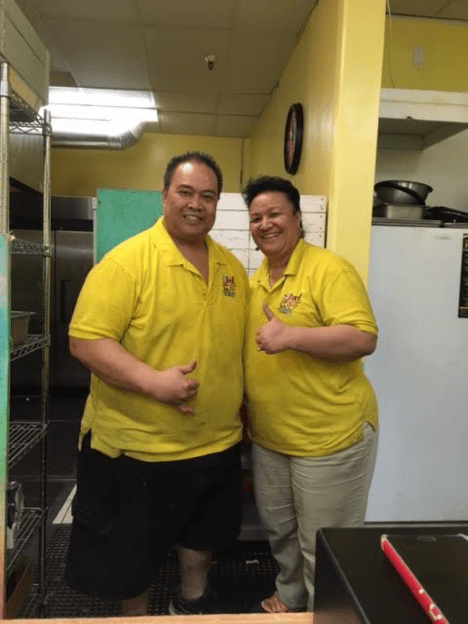
Lana and Lopi Toleafoa, owners of LoL Hawaiian Grill.

“We love our little island, we love the beach, we love the sand, and the ocean, so it’s been a huge, huge adjustment,” Toleafoa said. “But our kids wanted to get off the Rock.”

The LoL in LoL Hawaiian Grill stands for “Lana or Lopi,” but it could also stand for “laughing out loud,” “labor of love,” “love our life,” or “lots of love.” Toleafoa said, “We like to laugh out loud too! It’s catchy; it’s easy for people to remember.”

Despite being in the restaurant almost all day every day, Toleafoa and her husband love being restaurateurs. “It’s a lot of hard work, it gets pretty tiring, but we love what we do, so we hope to grow,” she said. “We work for ourselves, even though it’s really hard work, we’re the first in and the last out kind of thing, so it’s not easy. But just having that option where you don’t have to clock in, clock out, not having anybody to tell you what to do or jump here and jump there.”

They do it to feed their community: “We love that everyone loves to share the spirit of Aloha.”