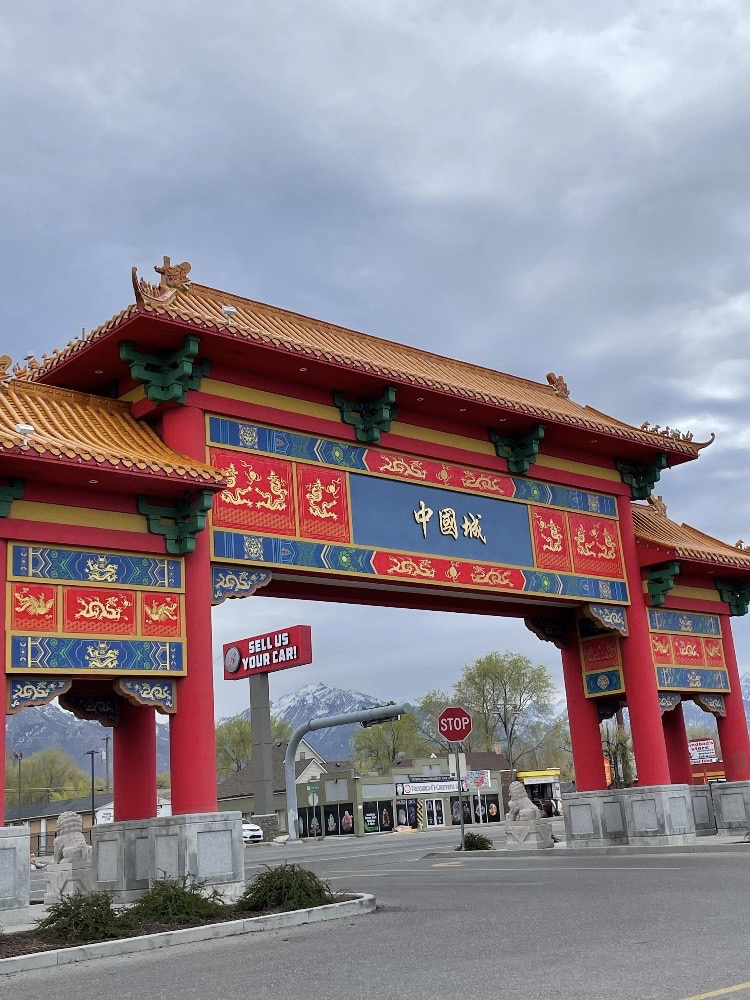
On the south side of Salt Lake City, the mountains are accompanied by a grander view. The crimson paifang arch structure marks the entrance to the Chinatown Supermarket.
The Paifang, a traditional Chinese arch, is the first structure seen before getting into the Chinatown Shopping Center.
The aroma of traditional Vietnamese beef pho fills the air before even getting to the shops. Sweet sounds of sizzling fresh meats on the grill and the pure enjoyment of cooking your own hot pot meal.
Chinatown is home to all these sensations.
In the 5.7-acre shopping community, the largest cultural Asian shopping center in Utah takes on an even bigger role within the daily lives of Asian American communities in and around the Salt Lake area — a safe haven.
On 3370 State St., the marketplace and surrounding businesses made their debut opening on July 30, 2014. Before that, Salt Lake City wasn’t known for Asian markets or substantial in size for that matter.
The development of the shopping center went through many phases and with the initial proposal for Chinatown starting in 2005. Lots of trial and error occurred, but with the importance of the project and having a hub for Asian people in Salt Lake City, a $15-million investment was headed by Hong Kong developers Yue So and Wai Chan, according to Voices of Utah.
The population of different Asian American communities residing in Utah, and Salt Lake City in particular, is increasing. According to the Census Bureau, the population was 5.4% in April 2020.
Salt Lake City’s Asian American population is among the faster-growing populations of diverse groups. Having a larger population of Asian Americans, especially those that continue to grow, signifies the need for the Chinatown Center. With South Salt Lake being one of the most Asian populated areas in the county, the location of the marketplace is pivotal to communities nearby.
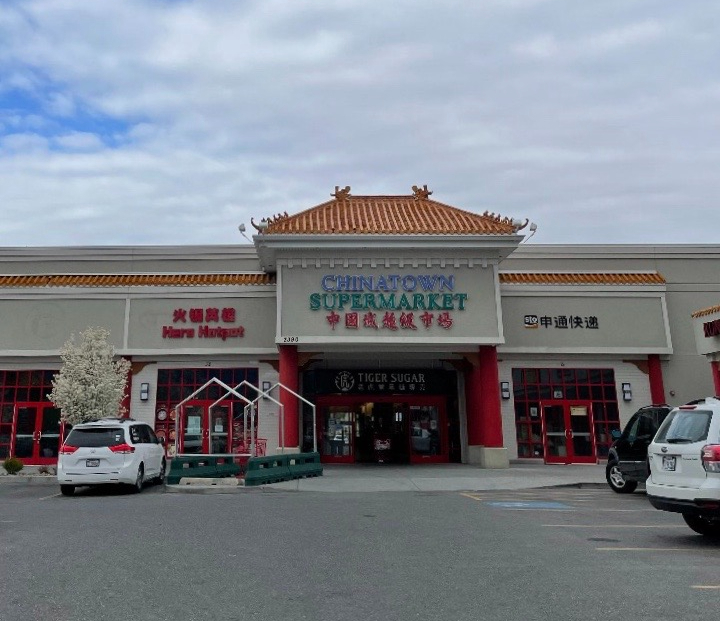
The outside of the Chinatown Shopping Center with access to the market and other shops inside.
Amongst the karaoke bar, boba shops, and hot soup restaurants, the marketplace and its products are the main attraction. Aisles of all kinds of authentic cuisine, from Chinese to Korean, Thai, and Vietnamese, to Indian, Filipino, and Japanese, the supermarket accommodates the Asian American residents of Salt Lake City.
Justine Nguyen, a University of Utah student and a Chinese-Vietnamese American, came to Utah for school from the East Coast, hoping to find a place that could provide a multicultural food experience. Then she found Chinatown.
She likes to order a Bánh mì sandwich at the supermarket, a French baguette filled with pickled carrots and radish, meat, or tofu, along with other fresh veggies and jalapeños. With just the perfect balance of spicy and sweet, she thought no other sandwich could compete with those she previously tried in Utah.
“I love the feeling of familiarity, the people, the ambient lighting, the chaos of the market, it creates a sense of home for me that I’m missing here in Utah,” said Nguyen over direct messaging.
Nguyen, from Maryland, said there are more Asian markets there. The state also has a higher Asian American population of 6.7%, according to the Census Bureau.
The inside entryway, guarded by a panda bear statue, leads into Chinatown Supermarket.
This wasn’t too much of a cultural shock for Nguyen but with the overall lack of diversity in Utah, the 19-year-old college student wanted a place to call home. “The Chinatown Market is a place where I can go to get a sense of home and feel safe,” Nguyen said. “With recent events (Covid-19 and the growth of Asian hate), it’s scary going around Utah myself. I don’t have to worry about that here (Chinatown) and I can fully embrace my culture.”
Having previously worked at the Tiger Sugar Boba Shop in Chinatown, Nguyen emphasizes the way the experience allowed her to “immerse herself in the Asian culture of Utah.”
The cultures that are highlighted are available to those from different groups as well, giving people from different nationalities and backgrounds the same opportunity to discover all that Chinatown has to offer. Part of Nguyen’s experience includes helping people from other cultures on their food journeys.
Born and raised in Salt Lake City, Cynthia Wang, a Chinese-Vietnamese American, gives insight into the tie to her identity that the shops and restaurants have.
“It feels like home. It smells like the spices and flavors my parents used in their cooking. I see people who look like me,” Wang said over direct messaging.
The third-year student describes what it was like living in Utah growing up, and how markets that were around before the Chinatown market had some traditional Asian products, but in smaller selections and markets. “It makes me feel seen,” Wang said. “Growing up here, there were very few restaurants that served food from my culture, but most of them catered to white consumers.”
The South Salt Lake Chinatown allows the majority of residents in Utah to gain a new perspective through the cultural diversity the market has to offer in customer and employee interaction. Engaging with people from all walks of life is a valuable experience, especially when minority populations continue to rise.
The majority of Utah’s population is white, the Chinatown is a community for the underrepresented. For those who haven’t had a place to belong or relate to. A community to be able to “blend in” as Wang describes it.
With the occasional homesickness, Aurora Xu, 36, a Chinese immigrant, had a relatively easy time adapting to Salt Lake City and its culture.
Asian snacks and drinks are two types of purchases Xu said make her visits to the Chinatown Market. Whether the snacks are shrimp chips, choco-pies, or mochi, Xu enjoys the foods that feel more familiar.
About the living adjustments and the transition of living in Utah, Xu said the Chinatown has foods from her hometown, making connecting to tradition “easy for shopping and with the Supermarket having a lot of restaurants.”
Even though her journey to finding her community wasn’t as difficult as others moving from out of state, Chinatown is a meeting ground for social interaction and for cultivating more relationships. Restaurants around the market like Hero Hotpot are hot spots for Xu and her friends to get together.
The impact that Chinatown has on different Asian American communities in Salt Lake City has brought various groups together in celebration of Asian cultures.
A marketplace, one unlike the American grocery store chains, is more than just the produce and products that reside there. It’s a home, a safe haven, a market for all Asian Americans.
When I heard our beat this semester was “the” Asian American community, I was very excited.
Given the amount of Asian hate spurred by the coronavirus, and the number of microaggressions and discrimination Asian Americans experience on a daily basis, I knew this topic was important to cover. It is beneficial to report on beats such as this because they bring light to issues different groups face.
But I was also anxious. I felt unqualified.
I had only published one story, and I was worried people wouldn’t want to speak with me and that my writing wouldn’t depict these communities accurately.
This is why on the drive to the Wat Dhammagunaram temple in Layton, I did not stop when planned.
I was almost on autopilot. The drive to my hometown is one I have experienced many times. Even the path to the temple is very familiar — I admired it every day on my way to junior high.
But as I saw the temple come into view at 10:30 a.m., I passed it. I didn’t pull into the parking lot as I was supposed to.
I drove all the way to my childhood home and then back to the temple, 10 minutes round trip.
After finally pulling into the parking lot of the temple, I felt the familiar pang of nerves. I had been here the week before, but that was to talk to just one monk, Phitthayaphon. Now I needed to talk to people attending the Sunday service, I needed to face a group.
Would they refuse to talk to me? Would they be annoyed I was there?
I checked my bag for seemingly the tenth time that day. All the important things were accounted for: a small notebook with easily turnable pages, a fully charged phone and five pens.
The five pens might have been overkill, but I wanted to be prepared.
I walked to the front door of the temple and slipped off my dress shoes, placing them on the rack by other pairs. It had recently rained, and I was careful not to get my socks wet as I stepped toward the door and walked inside.
I only had a second to take everything in before Arunne Chwab, who I later learned is a committee member at the temple, greeted me.
“Are you new?” she asked.
I breathed a sigh of relief. Right when she addressed me, I knew I would be OK. Everyone was so friendly, introducing me to others I might like to speak with, like Poonie, the oldest Buddhist in the temple, or Warunee, the temple treasurer.
This moment reminded me why I love meeting new people. Although I’m not sure if I will ever feel less anxious going into situations like this, I am always delighted to find that people are so kind. It is a pleasure to meet and talk with such welcoming people.
Discovering I really enjoy talking to varied people is part of why I decided to start studying journalism.
In the fall of 2021, I was just learning the basics of journalism. Only half a year later, I am completely sure I want to be a journalist.
While working on my story on the Wat Dhammagunaram temple, I didn’t just write because I needed to meet a deadline — I wrote because I like writing. I enjoyed every step of the process and continued editing until I felt I had a product that was my best.
Anxiety has been a constant companion when I think of my future career. However, now that I know I can do something I am passionate about, enjoy, and is important, my anxiety has eased.
I am so glad the stories for this beat allowed me to learn so much about myself and about Asian American people and communities. Plus, I feel a little more qualified to be a journalist.
ABOUT ME:
Kristine Weller recently went through a major change. Previously studying business economics and on the path to becoming a consultant, she is now an aspiring journalist. Weller realized that she would rather pursue her passion and affinity for writing. Looking through different career paths, she discovered journalism and decided to try it out.
Although it was something new and challenging, writing and reporting were very exciting. Weller published her first story and knew very quickly that journalism was the right path for her. She is now studying communication with an emphasis in journalism and international studies with a focus on human rights. Weller plans to graduate from the University of Utah in 2023. After graduation, she wishes to combine both of her studies by reporting on human rights-related issues.
The Wat Dhammagunaram Layton temple. Photo by Kristine Weller.
The aromas of homemade Thai food wafted through the hall. A box of sesame balls, a tin pan of pad thai, a plate of fried vegetables, and lots of hot white rice were placed by the entrance to the temple.
More dishes were added as people arrived. Beef jerky, spicy papaya salad, fish and doughnuts.
Members conversed with each other in Thai while arranging the food neatly on a counter. Some grabbed water bottles or poured freshly brewed tea into paper cups.
Every Sunday at 10:30 a.m., Buddhists begin gathering at the Wat Dhammagunaram Layton temple. There they have created a place for community, peace, and Theravada Buddhism.
Most Sundays a woman called Poonie is in attendance. Poonie, 93, is the oldest Buddhist at the temple. She helped set up the first Wat Dhammagunaram temple and has been supporting it ever since.
Poonie is from Thailand and came to Utah because her husband worked at Hill Air Force Base (HAFB). In fact, according to a welcome pamphlet the temple provides, most of the founders of the Wat Dhammagunaram temple are wives of American airmen from HAFB.
The pamphlet explains that these Thai immigrants wanted a place for traditional religious services. So, they founded the Wat Dhammagunaram temple in 1975, but it didn’t look like it does today.
It began in a small residential home in Ogden and was then later moved to a second house in Layton. Finally, the temple found its current location at 644 E. 1000 North in Layton and was consecrated in 1995.
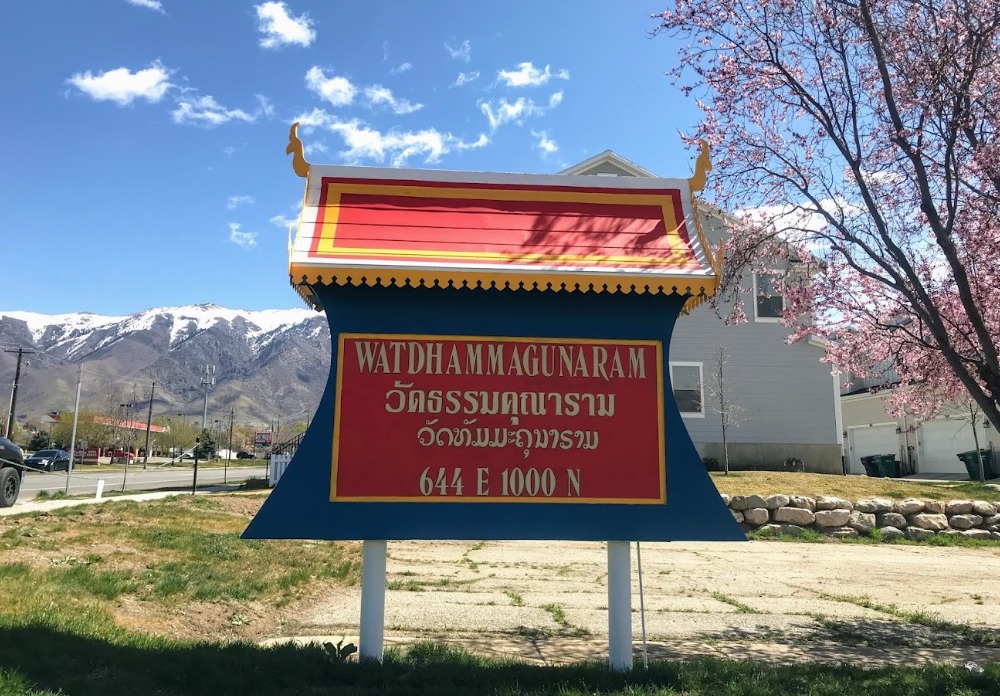
The Wat Dhammagunaram sign identifying the temple. The committee members for the temple wish to add a fence here too so that the temple is more recognizable. Photo by Kristine Weller.
Many immigrants who go to this temple are Thai, although there have been members from Laos and Cambodia as well. Thailand, Laos and Cambodia are all predominantly Theravada Buddhist countries, which is why the Wat Dhammagunaram temple practices Theravada Buddhism.
Phitthayaphon, one of the monks at this temple, said the basics of Theravada Buddhism follow five precepts: refrain from killing, refrain from stealing, refrain from sexual misconduct, refrain from telling lies and refrain from intoxication.
A booklet Phitthayaphon provided, “The Main Ideas of Theravada Buddhism” by Du Wayne Engelhart, explains two important things related to the five precepts.
The first is they are not rules, they are guides.
Engelhart writes, “We should want to follow the precepts, not because we fear being punished by God if we do not but because we understand that good effects will come from observing them.”
Second, the precepts also have a positive meaning.
Engelhart explains that instead of just refraining from each item in the five precepts, aim to spread kindness to all living things, be honest in your words and actions and respect the rights of others, show moderation in sexual activities, be sincere in speech, and keep a clear state of mind.
Another big part of Theravada Buddhism is the four noble truths.
The book describes each of these truths. First is the noble truth of suffering (dukkha). According to Engelhart, this means “suffering in many forms occurs in human life because of the unsatisfactory and changing character of existence.”
Second is the noble truth of the origin (samudaya) of suffering. Engelhart explains this means craving is the origin of suffering.
Third is the noble truth of the end (nirodha, extinction) of suffering. Engelhart writes “getting rid of craving is getting rid of suffering.”
Fourth is the noble truth of the way (magga), which leads to the end of suffering. Engelhart explains that “the Noble Eightfold Path is the Middle Way that leads to the end of suffering.”
Buddhism also emphasizes being welcoming to everyone.
Arunne Chwab, a committee member at the temple, said everyone is invited to come to the temple. In fact, all the members are very friendly to newcomers and make sure to include them in the service.
“Even if you not believe in our religion, you can come,” Chwab said.
Five Red Apples
After members and newcomers take their seats, the monks begin melodic chanting.
Each has a microphone, as does one other member who leads chants the attendees repeat back. Two large speakers project the monks’ rhythmic voices.
These are the five bowls that are offered during the service. Food and larger items are placed inside the bowls and money is placed in the trays. One bowl is offered to the Buddha and two bowls are offered to each monk. Photo by Kristine Weller.
During the service, members walk to five bowls lined up next to the counter with food. It is my first time at the temple, so I stay seated, unsure what I should do.
One congregant then urges me to go with her. She has a whole bag full of offerings to put inside the bowls and wants to include me.
We walk over to the bowls and she picks up a zip-close bag of fresh rice, raises it to her forehead, and places it into the first bowl. She then hands me a small red apple to offer. The last thing for the first offering is a dollar bill, which she raises to her forehead, and places on a tray in front of the bowl. She hands me a dollar bill as well, and I do the same.
We repeat the same offering for each of the five bowls — five bags of rice, five small red apples, five dollars each.
Bright Orange Robes
Today, only two monks look after the temple and conduct Sunday services, Phitthayaphon and Prapatphan.
The two monks who take care of the Wat Dhammagunaram temple: Prapatphan, left, and Phitthayaphon. Photo by Kristine Weller.
Phitthayaphon was born in Chiang Mai, Thailand, and started his monk training after primary school. He was 12 years old. He originally started his training because he wished to follow one of his friends.
However, after going to the temple, studying the Buddha’s teachings, and practicing meditation, he said he felt peaceful and happy. That’s why he continued his training and is still a monk today.
“This is my own decision,” Phitthayaphon said. “In Buddhism, we don’t force people to be ordained as a monk.”
He also said if he wanted to disrobe and not be a monk anymore, he would be free to do so.
Phitthayaphon came to this temple after another monk he knew here invited him. He said the process to come to America is quite lengthy, which is partly why there are only two monks at the temple. He first got a tourist visa and after a few months, he applied for a religious visa.
This is now Phitthayaphon’s fifth year at the temple.
The other monk, Prapatphan, has only been at this temple for about nine months. He can’t speak English, but that doesn’t matter much.
Monks have a fairly structured day, and a lot of the time they are around Thai-speaking people.
Phitthayaphon said he rises at 6 a.m. every day but Sunday and chants until 7:30 a.m. Breakfast is at 8 a.m. and once he has eaten he cleans.
Three buildings are connected to the temple grounds. The temple where services are held, a smaller building to the northeast side of the temple where food is sometimes offered, and a house behind the temple where the monks live. Phitthayaphon cleans and helps take care of all of these buildings.
After cleaning, Phitthayaphon said the monks will usually study until 11 a.m. Then they must eat lunch because monks cannot eat after noon. They can still have drinks, though. Phitthayaphon said his favorite drink is tea, especially Thai orange tea and green tea.
During the week, Phitthayaphon said they will typically cook food for themselves, sometimes with ingredients the Buddhists have offered. He said his favorite is northern Thai dishes because they remind him of home.
Buddhists will also offer lunch to the monks, so they do not have to cook, but that is usually on Friday or Saturday.
When Buddhists do offer lunch, the monks are occasionally taken to restaurants. Phitthayaphon said he and the other monk once drove three hours to bless a new restaurant and have food offered to them.
This is actually unusual for monks, Phitthayaphon said, because in Thailand monks don’t drive.
This is one of a few differences between Buddhism in Thailand compared to Buddhism in the U.S. Another is when the holy day is celebrated.
Buddhism follows the lunar calendar, so its holy days will fall on different days of the week. However, because the U.S. is dominated by Christianity and the workweek is structured accordingly, Buddhists must practice on Sundays instead.
This doesn’t seem to bother the members of the Wat Dhammagunaram temple. Chwab, the committee member, says she goes to the temple because she finds peace and can meditate there. The focus is less on the mechanics of what is traditionally done and more about finding peace and honoring the teachings of the Buddha.
“We come together because we love this peace and happiness,” Chwab said.
Buddhist holidays also correspond to the lunar calendar. The two biggest holidays in Thai Buddhism are the Thai New Year and the Kathina (robe) Ceremony.
Monks attending the Thai New Year festival at the Wat Dhammagunaram. Phitthayaphon said monks from other Theravada Buddhist temples are invited to visit during festivals. Monks from temples in Sandy and West Valley City, Utah, and Las Vegas have visited. Photo courtesy of Phitthayaphon.This is a money tree where people can donate. Warunee said they display it during most celebrations. Photo by Kristine Weller.
Although the new year is celebrated in Thailand on April 13, 14 and 15, it is not always possible to celebrate on those days in Utah. The celebration must be on the weekend since people need to work, so this year the temple held the Thai New Year festival on April 16 and 17.
This is Chwab’s favorite Buddhist holiday. During the new year, people ask for apologies from monks and elders, but there is also a big celebration.
The Wat Dhammagunaram temple, she said, has a food fair every Thai New Year. A small stage outside on the temple grounds hosts traditional Vietnamese, Laos and Thai performances as well.
Chwab said there will also be kickboxing and a Miss New Year contest.
The winner of the Miss New Year contest from the 2019 festival. Photo courtesy of Phitthayaphon.Women in the Miss New Year contest from a previous festival. They are standing on the stage outside the temple, where other performances are also held during the Thai New Year. Photo courtesy of Phitthayaphon.
The other big holiday is the Kathina (robe) ceremony, which is essentially a ceremonial presentation of new robes to the monks.
Phitthayaphon, the younger monk at the temple, said monks typically stay in one place for three months and it is no different for the monks at this temple.
According to the BBC, the historical reason for this is that during the Vassa, or monsoon, period, monks were journeying together, intending to spend Vassa with the Lord Buddha. However, Vassa began before they reached the Lord Buddha, and they could no longer continue their journey.
The Buddha then awarded cloth and told the monks to sew a robe and give it to another because “there was nothing as uplifting as generosity and sharing.”
The BBC also explained that a Kathina is the frame used to make the robes.
So, after the rainy season, monks are offered new robes. They are a striking orange and Phitthayaphon said the robes have three pieces.
According to “The Buddha’s Robe” by Barbara O’Brien, the main piece is a large rectangle, about 6-by-9-feet. It is usually wrapped to cover the left shoulder and leave the right shoulder and arm exposed.
The second piece is worn under the first. O’Brien explains it is wrapped around the waist, covering the body from the knees to the waist.
The third piece, O’Brien writes, is an extra robe. It can be “wrapped around the upper body for warmth” or is “sometimes folded and draped over a shoulder.”
Phitthayaphon occasionally wears an orange sweater under his robes, but this is only because it is cold in Utah. In Thailand, he said he would not wear a shirt underneath.
Phitthayaphon in the main temple area. He wears a sweater under his robe because it is cold in Utah, but in Thailand he would leave the right shoulder and arm bare. Photo by Kristine Weller.
He also said monks used to take robes from dead bodies. According to O’Brien, this is because the Buddha taught monks to get their robes from pure cloth, meaning cloth no one wants.
O’Brien describes a cloth no one wants as the shroud the dead were wrapped in and soiled cloth.
Today, monks no longer get their robes this way. Phitthayaphon said his now comes from a factory. However, the robes have always been the same bright orange.
Wednesday Night Buddha
After making offerings to the first five bowls, I walk with the woman over to a table with eight more. These bowls each have a statue above it with the Buddha in different positions. Each corresponds to a day of the week, with two for Wednesday.
She said Wednesday night is her favorite bowl to make an offering to. The Wednesday night statue is the Buddha standing with an elephant and monkey at its feet.
Below the bowl is a short explanation of the Wednesday Night Buddha.
It says: “Buddha spent the rain retreat on his own in the Palilayaka (palelai) forest because he was tired of the monks of Kosambi who had split into two groups and were not in harmony. While in the forest, the elephant Palilayaka attended to him, and monkey offered him a beehive.”
I place a dollar she hands me in a different vessel and we stand in contemplative silence for a moment.
We take our seats again as the previous five bowls are presented before the monks. Two bowls for each monk and one for the Buddha.
The monks then begin their lyrical chant once more.
Some members will make another offering to one of these bowls, which correspond to the days of the week. Starting with the Sunday bowl from left are “Seven Days Looking,” “Pacifying the Relatives,” “Realizing Nirvana,” “Pang Umbat or Holding Alms Bowl,” “Retreat in the Forest,” “The Meditating Buddha,” “Contemplating Buddha” and “Protected by the Naga King.” Photo by Kristine Weller. This is the statue of the Wednesday Night Buddha. Photo by Kristine Weller.Monks Prapatphan (left) and Phitthayaphon conduct a Sunday service using microphones to project their voices. The four bowls laid out before them are offerings from the congregants. Photo by Kristine Weller.Pictured toward the bottom are a tray and a bowl filled with offerings from members attending the Sunday service. There is also a donation box to the right which was locked for two years because the key was lost. Once the box was finally opened, Warunee, the treasurer, collected over $2,000 from it. Photo by Kristine Weller.
A Changing Landscape
The Wat Dhammagunaram temple has been at its current location since 1995. Although it has stood stable and strong in the ensuing years, the surrounding environment has been changing drastically since its consecration.
An open field once surrounded the temple. However, residential buildings have sprung up in the last few decades.
Previously a noticeable landmark, the temple is now easy to miss.
The committee for the temple, made up of volunteers like Poonie and Chwab, is concerned about this. Warunee, another member, said the group wants to build a fence in front of the temple.
“We want to make something in front to show people this is a Buddhist temple,” Warunee said.
The committee meets monthly to discuss temple activities and finances. Warunee is the treasurer, so she keeps track of money and bills. Every two weeks she counts the money that has been donated to the temple.
At the end of the service I attended, she counted $968.
Warunee counts the money collected from the service. Photo by Kristine Weller.
All the members cheered when Warunee announced this number; they are happy to support their temple.
Warunee said the donations are divided into three parts. One part goes to the temple, which pays for utilities or gas. The other two parts are for the monks. She said they work for free, and they need some income for themselves as well.
You Like Spicy?
A woman rings a gong.
The chanting has stopped, and the gong reverberates into silence.
Now, about 30 minutes before noon, it is time for the monks to have their last meal of the day.
The monks sit at a table toward the back of the temple. Steam drifts from the homemade Thai food that has already been set out before them.
As they eat, the rest of the members converse enthusiastically.
At noon the monks are finished eating, and the service comes to an end. The congregants then gather to have their fill.
The same woman I made offerings with urges me to get food, as does Warunee, the treasurer. They point out different foods displayed.
A box of sesame balls, a tin pan of pad thai, a plate of fried vegetables, and hot white rice.
We begin to fill our plates. Beef jerky, spicy papaya salad, fish and doughnuts.
Poonie, the 93-year-old member, points out the spicy papaya salad on my plate.
“You like spicy?” she asks. I say I do, and she nods and smiles in approval.
She remembers the incident because it was so out of the ordinary.
It happened at the start of the coronavirus pandemic. She was going about her day as usual at the pharmacy. She loves working there because she can empower patients with their health and form connections with people.
Then one day, a white man walked in and told her he didn’t want her to help him.
She couldn’t breathe.
Lehua Kono said she has faced discrimination and microaggressions her whole life, but never like this. The man was forceful in refusing her help. She had never experienced such overt racism.
“Just knowing that I can be as helpful or as empathetic as I can and still be told ‘I don’t want you to help me’ hurt a lot,” Kono said.
Although this was the most extreme experience of racism Kono had ever encountered, she has been impacted by many other instances of discrimination.
Examples of bigotry similar to this are why organizations like the Asian American Student Association at the University of Utah are important. AASA provides a community for minority students to gain support and talk about their experiences in a safe space.
Lehuo Kono was the president of AASA during the 2021-22 school year. The previous year she was the external vice president of AASA. Before she was the external vice president, Kono was the director of social justice. Kono said this is no longer a position in AASA because they believe everyone should be social justice-centered. Photo courtesy of Lehua Kono.
Kono is currently the president of AASA and a senior at the U, planning to graduate in May 2022. She joined AASA her first year because she wanted to find community on campus — something she wasn’t able to do earlier in life.
Growing up in Farmington, Utah, Kono said she was one of the few people of color at her school. As early as first grade, she started to notice that she was treated differently from her white friends. Kids would make fun of her eye shape and would call her “that Chinese girl,” although she is Japanese and Filipino.
Many members of AASA have endured the same thing, Kono said. Together, members can share their frustrations.
One place where productive conversations are held is member meetings. Each Friday at 2 p.m., usually on Zoom because of the coronavirus pandemic, AASA members gather.
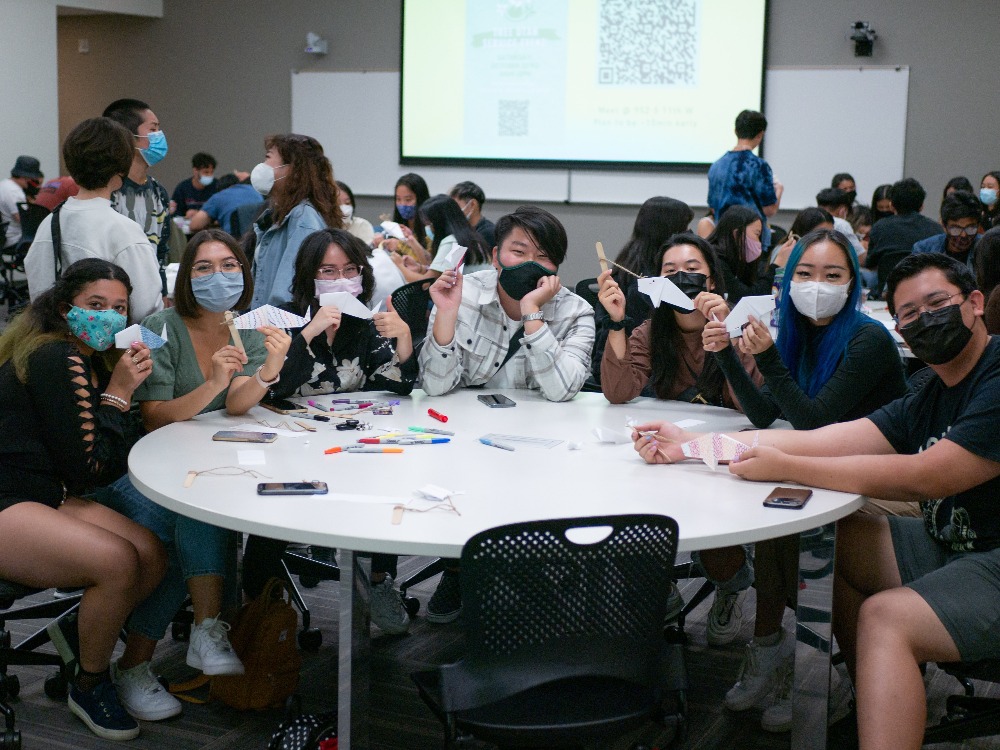
Students make origami fish during a weekly member meeting. Photo courtesy of Lehua Kono.
They go through announcements, which could include service or fundraising opportunities, and also discuss different topics each week. The topic may correspond to an Asian holiday, so members will learn its history and traditions, or it could be something like learning how to do origami. However, other times the topic is heavier, such as discussing the model minority myth and microaggressions.
The model minority myth is based on stereotypes. Kono said Asian Americans are the “standard” for minorities. She said Asians assimilate very well into white American culture, and that many believe every incoming culture should too.
Part of the reason Asian Americans are labeled a model minority is that they were taught not to speak up, Kono said. However, she explained that her generation is trying to disrupt that practice.
Compared to the model minority myth, microaggressions might not seem as big of a problem, but the fact that they happen all the time is cause for concern. Christine Yun, the graphic designer for AASA, said she didn’t even realize she was experiencing microaggressions when she was young. It was AASA that helped her understand why.
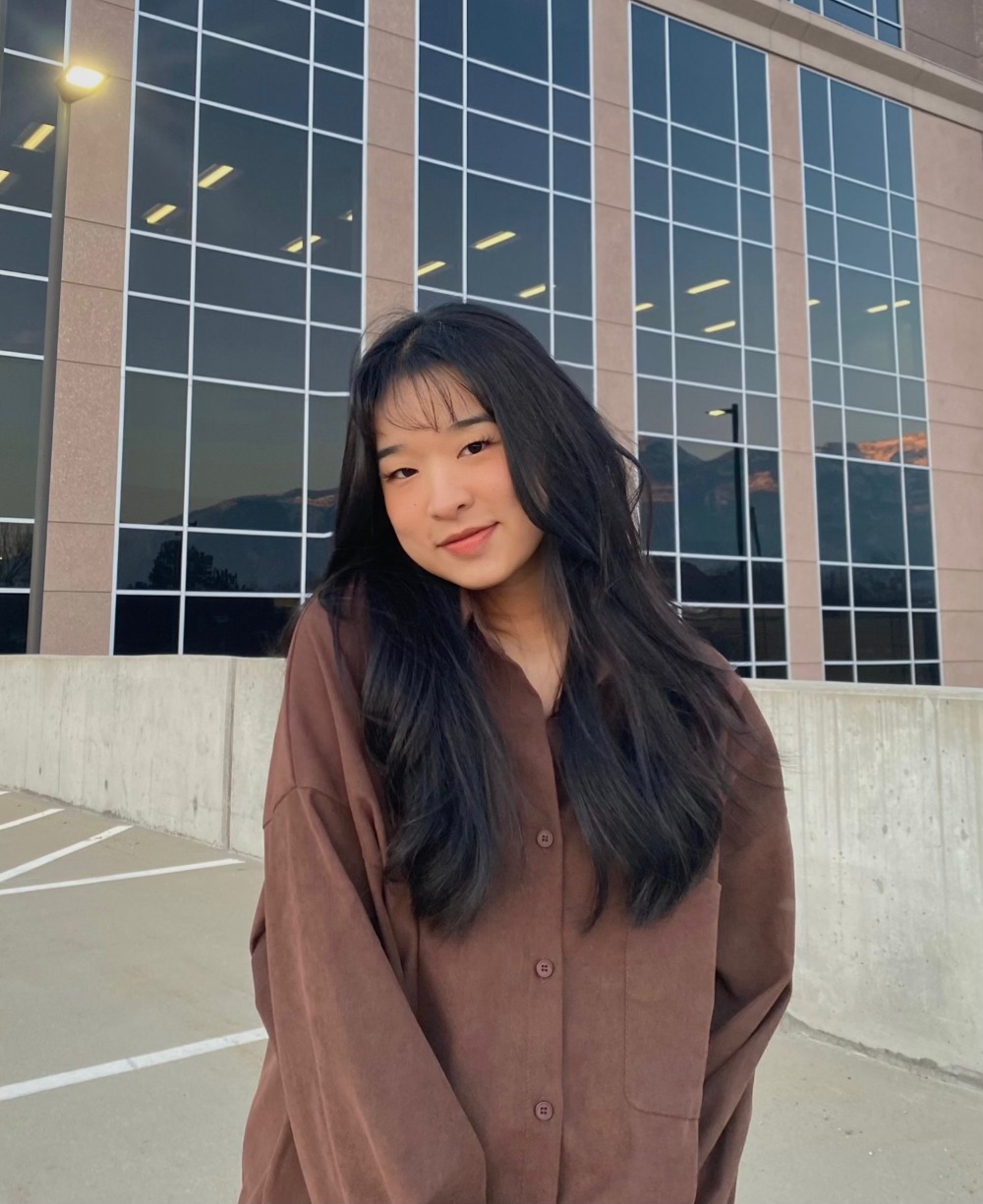
Christine Yun is the graphic designer for AASA. As such, she creates graphics to promote AASA events. Photo courtesy of Christine Yun.
“I didn’t realize being eight years old that I was facing microaggressions,” Yun said, “and that’s why I felt uncomfortable if I wasn’t with Asian people.”
The discomfort caused by microaggressions is what makes communities like AASA so critical. The organization brings light to what Asian Americans are feeling and experiencing, Yun said.
Further, Yun explained that because Utah is a more conservative, majority-white state, it doesn’t leave much room for productive conversations.
Discussions about microaggressions and discrimination Asian Americans face are important for widespread understanding. Predominantly white areas make those discussions difficult to be heard.
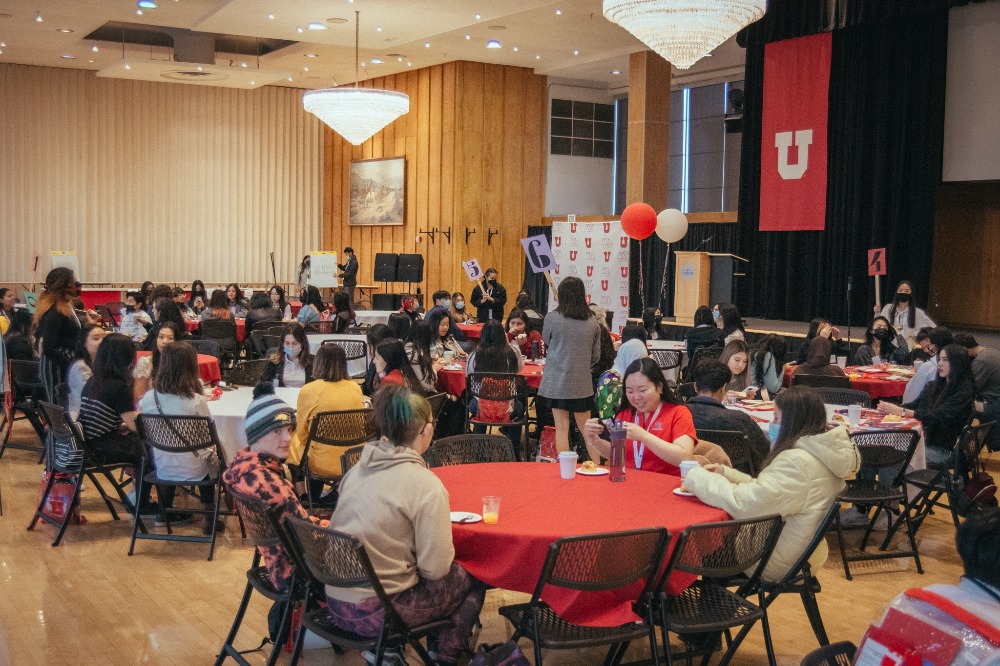
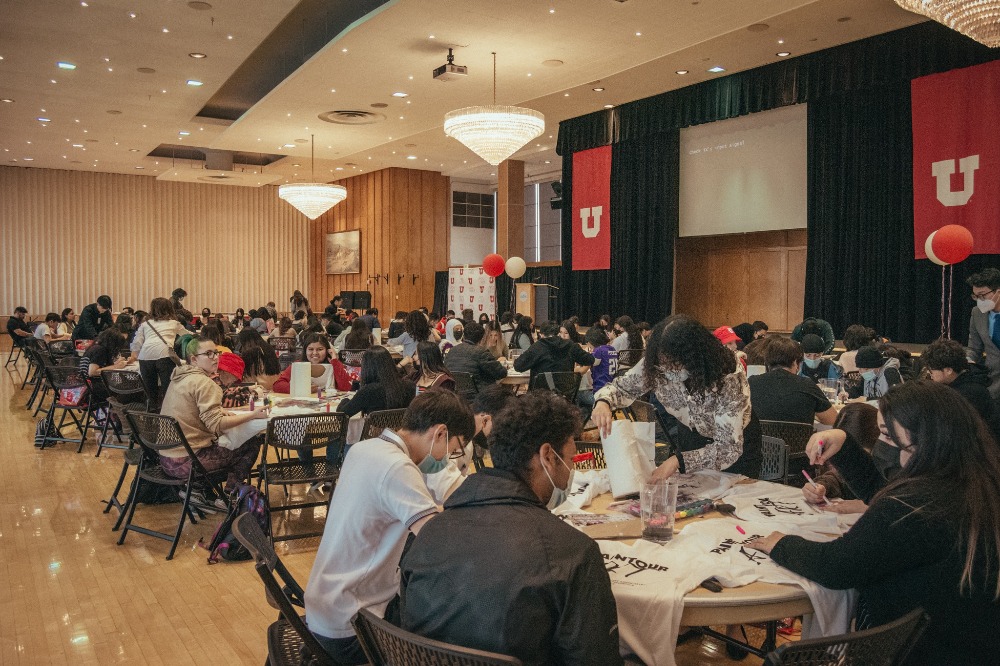
To let Asian American students know they have a place to have meaningful conversations, a place where people listen, AASA hosts a high school conference. At this annual conference, Asian students all around Utah are invited to the University of Utah. The conference showcases unity and lets Asian students know that there is a supportive community for them at the U.
The attendees of the high school conference gather for a group photo. In front you can see Thien Nguyen who was the director of high school conference for AASA. Photo courtesy of Lehua Kono.
The conference usually has a keynote speaker, workshops on social justice, a student panel, traditional singing and dancing performances and more.
Yun said the conference lets incoming students know that AASA is a safe, friendly environment.
“You’re experiencing these things and so are these other people in your community, and you feel a lot less alone,” Yun said.
Similar to Yun, Saya Zeleznik said she didn’t know microaggressions were bad. Zeleznik is the director of service for AASA. She said microaggressions seemed normal because she experienced them all the time.
Zeleznik said if she got a bad grade, other students would say she was a “bad Asian” or call her “fasian” (fake Asian). She would also get negative comments on the food she ate.
Microaggressions against Zeleznik did not originate only from other students, though.
Saya Zeleznik is the director of service for AASA. Her duties include setting up community events for AASA members to gain service hours, volunteer hours, or experience. There are usually events every month. Photo courtesy of Saya Zeleznik.
Zeleznik said teachers loved to “play the ethnicity game.” They would see her and then start naming countries, trying to guess where she is “really” from. As soon as she was sitting at a desk with the roll being called, Zeleznik said she experienced discrimination.
She has even faced discrimination from a teacher at the U.
Zeleznik said her Japanese professor is very passive-aggressive and demeaning toward her and another woman in the class who is also half Japanese. Some students in the class think Zeleznik has an easier time because of her Japanese background, but she said that’s not the case.
“It’s hard to explain to people, especially the white kids in the class,” Zeleznik said. “You have an advantage even here.”
Zeleznik explained that it’s frustrating when people don’t take what she says seriously. Those experiences already are tough to deal with and when people don’t understand or believe her, it makes it even harder.
“It’s hard to be kind of angry all the time,” Zeleznik said. “I would just like to be around people who understand.”
AASA helped her realize that what she experienced was not only not OK, but that others like her had gone through the same thing. AASA is where Zeleznik found people who understand and support her.
One example showcasing the support and community AASA provides was the Tree Utah event Zeleznik organized.
The event was in October 2021, by the International Peace Gardens, where a Japanese sculpture had recently been vandalized with spray paint.
At 8 a.m., 20 AASA members carpooled to West Jordan to plant trees for three hours. Tree Utah provided the plants and equipment, which Zeleznik said included willows, oaks, and shrubs and a “pile of shovels, a bunch of crowbars and gloves.”
The team was ready to start planting after some instruction on how to use the tools and how far to space out the plants — three feet. Everything was going great, although the piercing cold and the pouring rain were not part of the plan.
“Everyone got really, really muddy,” Zeleznik said. “It was really nice because the holes were easy to dig.”
Despite the rainy weather, Zeleznik said it was great to see everyone together. Even Jada Kali, the external vice president of AASA, wanted to help out. Zeleznik said Kali was sick, so she couldn’t help with the planting. However, Kali still drove out to the site, bundled up in three parkas, and brought the team Banbury Cross Donuts.
The spirit of collaboration evident at this AASA event is part of its core beliefs.
AASA fosters collaboration not only within the association but between associations. AASA wishes to support and work with more than just Asian Americans. Zeleznik said the organization cooperates with other groups, including the Pacific Islander Student Association.
“It’s for all minorities,” she said. AASA is “creating a community where minorities support each other.”
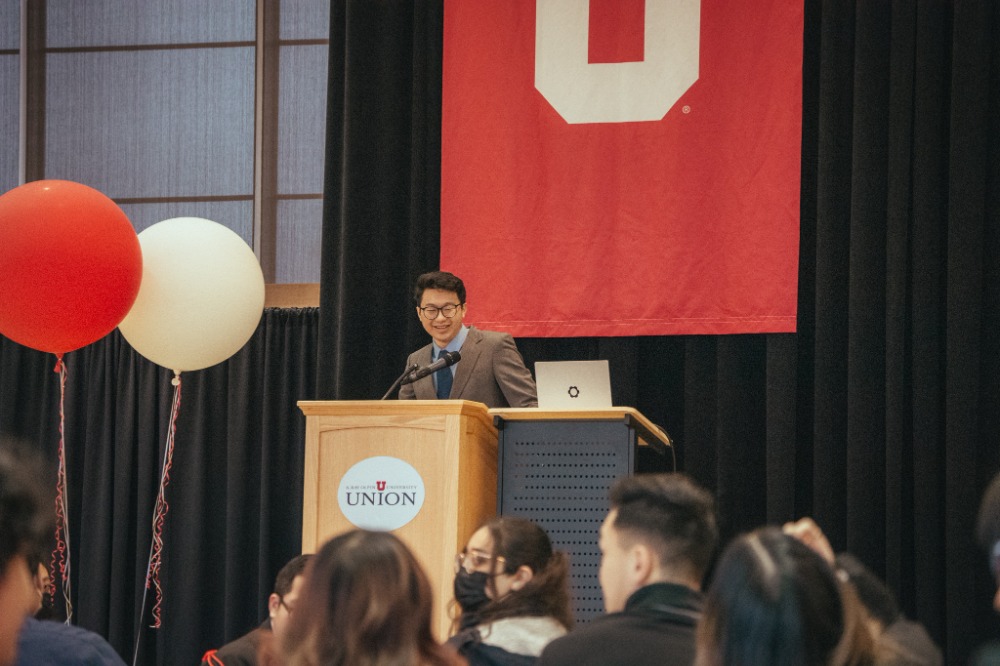
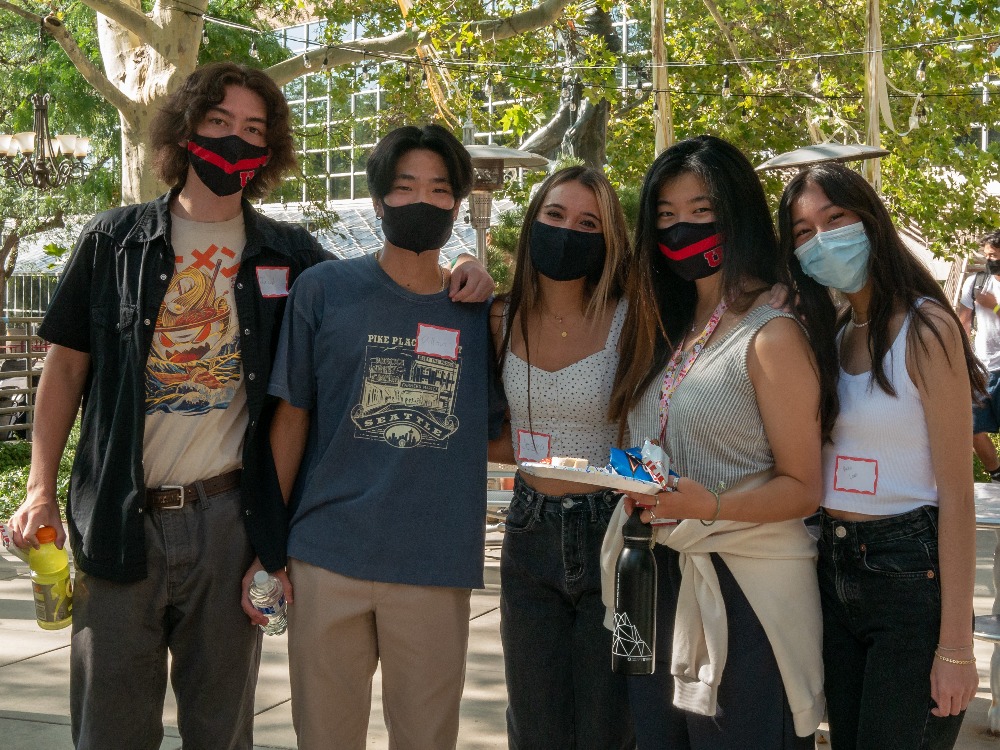
Students check-in at the high school conference. Photo courtesy of Lehua Kono.Students eat breakfast at the high school conference in the Union. Photo courtesy of Lehua Kono.Thien Nguyen gives an opening speech at the high school conference. Photo courtesy of Lehua Kono.Attendees decorate T-shirts at the high school conference. Photo courtesy of Lehua Kono.AASA members meet each other and chat during AASA’s opening social. Photo courtesy of Lehua Kono.
Asian American chef Naomi Larsen opens up about her custard business in Salt Lake City. In step with the times, she brought a popular Japanese dessert here, to the place she fits in and calls it home.
A long way has already been done, but a long way still needs to be done. Women in business have often had to struggle to reach important positions.
Today, many companies can boast gender diversity within them, but the pink power is still not enough, especially within minorities. This is a demonstration of how much the business world has to work to achieve true equality.
There is still a lot to do to enhance females in business even if in the past years it has grown, from 77,800 in 2015 to 80,092 in 2019, according to The Salt Lake Tribune article published in 2021.
And what about double-minority? Female and Asian Americans, for example.
Asian American female chef, Naomi Larsen, tells her story and her business.
She was born and raised in Japan and came to the U.S. when she was only 21 to study. Her dream was to go back and open an import retro business. “I love American retro style, especially the 1950s and 1960s,” she said, and laughing she added, “but this dream disappeared.”
With time, perspectives changed, and Larsen is happy to call Salt Lake City and Utah her home. She identifies herself as an American since she got her citizenship about 25 years ago, and an immigrant.
The transition wasn’t too bad for her. “There were some minor cultural shocks, but I am fitting here much better than in Japan,” she said in a Zoom interview. “I never felt Japan was my home. Is it terrible to say? I never fit in that country,” she added in an email.
Larsen said she suffered the fact that Japanese people say one thing and you have to know nine other meanings for that thing, and she couldn’t do that. It’s easier for her here, even if at the beginning her biggest struggle in the U.S. was the language.
“I remember one time, after three months I was in the U.S., I had a breakdown and just cried. I was at a friend’s house and I just locked myself in the bathroom and started crying for hours because I didn’t understand what they were saying,” she said.
Besides the new language, different culture, and different food, Larsen made her way and her impact in Salt Lake City.
About eight years ago, Larsen and her Japanese friend, Ai Levy, started a Bento business.
“Both of us had been working in the restaurant industry for a long time but that was the first time we started our own,” she said in the interview over Zoom. And she added, “We were getting sick of working for others.”
But when her friend moved out of state, she couldn’t keep Bento by herself. So, she thought, “What is the one thing I can keep doing by myself?” The answer is the Japanese-style custard and her business, Prin-Ya Custard.
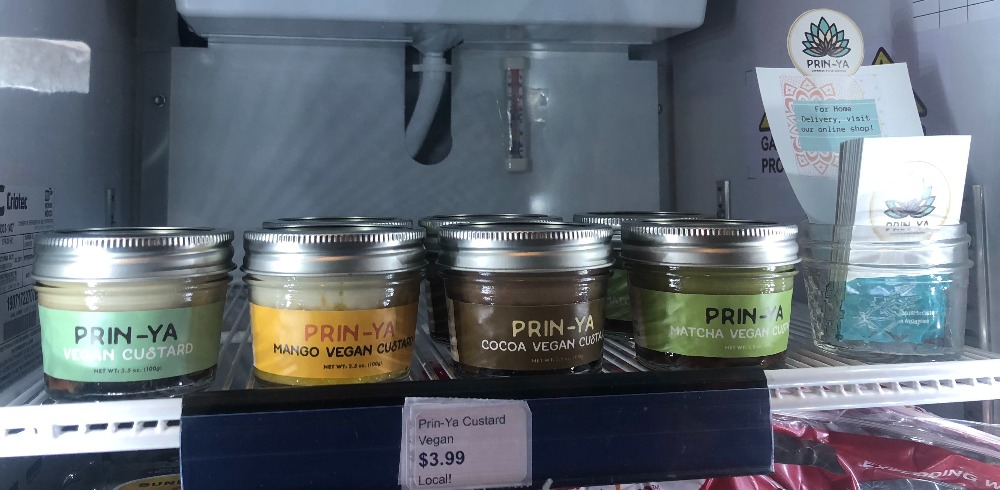
Vegan Custard, Mango Vegan Custard, Cocoa Vegan Custard, Matcha Vegan Custard at Jade’s market. Larsen’s products are very appreciated by customers, who can’t believe they are vegan.
But what is the Japanese custard? Do you know about it?
Japanese custard is an intriguing dessert, simple to prepare but really effective. It is characterized by the classic flavor of the combination of simple ingredients such as eggs, milk, sugar. Ideal for an original snack or as an elegant end to a meal, Larsen’s Japanese-style custard offers a dense and creamy consistency that is truly irresistible.
“I decided to offer the Japanese-style custard because we have flan here and it is different. I couldn’t find the same thing here, so I thought I would make it and introduce it here to Salt Lake City,” she said.
It is one of the most popular desserts in Japan and, there, they could combine it in fancy ways too.
Larsen remembered the custard as a treat to herself when she was young. “In Japan, when I was going to cafés or restaurants, I was just getting the custard arranged in a fancy glass or with fruits.”
As simple as it might seem, the traditional baked custard has a silky soft texture. That caramelized sugar at the bottom is a must, but in a lot of places they don’t have that, Larsen said. It has a mild sweetness and her favorite flavor is cappuccino because she loves coffee. “My husband eats it almost every day,” she said.
The difference between the Japanese custard and the one she makes here is the texture, but ingredients are really just milk and eggs and they are not really “Japanese ingredients,” she said.
She selects local eggs and fruits from the market and other vendors and she tries to use as many local ingredients as she can.
Cocoa Vegan Custard at Jade’s market. Customers are never tired of this flavor.
“It all started with one traditional custard and vegan version because the veganism was growing fast here and with that, it became easier to have different flavors, so I kept making them,” she said.
She also said she packages the dessert in jar containers, so the customer can flip it and put it on a plate and garnish it as they please. “Customers get surprised when they tried the vegan one, because of the creaminess. They can’t believe it’s vegan.”
Larsen humbly doesn’t recognize herself as a real chef, but as a person who was confident enough to make this dessert and decided to just do it.
She is a hope for a lot of Asian Americans and females who want to live in the US or open their own business, or startup company.
“I never thought it was difficult to start a business, as a minority. Although I never applied for any real jobs, I learned that there are many business loans, grants, and aids available for minority people who want to start a business. I am especially grateful for Spice Kitchen and IRC (International Rescue Committee) for providing us the help we need,” Larsen said.
Spice Kitchen Incubator, a project of the IRC that provides help, guidance and support for those who want to start a business in Utah, talks about Prin-Ya Custard: “She strives toward less waste and an ecologically friendly business model. Custards come in a reusable glass jar that can be returned for credit at Hello Bulk Market.”
The onset of the pandemic surely affected her business negatively. Before the pandemic, she had seven retail stores and restaurants carrying her products, but after that, most of them had to shut down their business.
In 2020, food sampling was prohibited in farmers markets where she had a booth. “Due to the pandemic, it was difficult to sell products without having customers to taste them,” she said.
The pandemic also caused a lot of problems regarding major supply chains. All small businesses suffered. “Even now it’s still hard to find certain ingredients and containers,” she said.
On an ordinary day, without us expecting it, life has changed. The simplest habits, like having a coffee with your friend, going out with your partner, hugging someone you love, have become forbidden. And so, we found ourselves living in the present and in a bubble, uncertain about the future but sure of only one thing: moving forward.
And chef Naomi Larsen, even if she doesn’t refer to herself in that way, kept going.
One way of doing that was taking advantage of technology to connect with customers and spread the love for her custard.
“I learned several tricks to post as effectively, like what time to post, what hashtags to use, which photos, etc., but being an older generation, it takes a lot of effort for me,” she said.
Simple to say, difficult to do. It is difficult to create yourself as a female Asian American entrepreneur, especially during the pandemic. If it is true that change is the only certainty in life, it is just as hard to get used to it.
Rethinking in a new perspective, however, is the only possible way. At least now, at least until this war against coronavirus is won. And this is what Naomi Larsen did with her custard business, Prin-Ya.
I have realized through the beat this semester that there are so many things to learn about within my community that can help me to grow. I learned very quickly that it doesn’t take much to learn ways to be involved or to learn about someone’s business. All of the people I interviewed were very eager to talk to me about their work. They all seemed very passionate about it and were excited that someone was interested in them. This in and of itself was very inspiring to me. It was heartwarming to feel their love for their work through many conversations with them.
My community involvement was the most eye opening when I got to hear people’s personal stories. I had a specific moment when interviewing one of the directors of The Asian Link Project. I felt like her desire to help other people was so selfless. It was very humbling to hear about the hardships she has helped with over the last two years. The volunteers do all their work for free and spend a lot of hours on their projects and that was incredible to learn about.
I feel like I am more aware of social injustices due to this semester’s beat. I know more about what has been happening in our community and the struggles that people have had. I really didn’t know that people were being attacked as much as they are for being Asian. I was able to talk firsthand with people who had gone through these attacks, and it gave me an entirely new perspective on how hard that must be. I didn’t realize how close to home these issues are. I learned that finding this awareness about what is going on is the first step to being able to advocate and to get involved to help. I have been able to connect with some incredible people throughout this journey and I also learned a lot about their perspectives. I have a greater empathy for them, their culture, and their community.
ABOUT ME:
Kristan Ehorn has been studying for two degrees at the University of Utah. Her first degree is Family and Consumer Studies and Human Development with a minor in Spanish. Her second degree is Communication. After she graduates, she plans to continue her career serving people in corporate wellness. She also plans to continue her career path with hospitality and design. She plans to implement her new skills with both of her degrees. Kristan’s primary interests consist of helping her community through volunteerism and assisting with personal wellness to corporate employees through offering onsite classes. Kristan is also able to offer support to others via her knowledge of digital design systems.
Kristan has experience in many different fields. The first being corporate wellness. She has taught over 3,000 yoga and meditation classes to date and is ERYT-500 hour certified in her field. She has been teaching onsite for employees across the Salt Lake Valley for over a decade. Kristan plans to continue her journey along with expanding herself in other directions as well. She loves to use her high regard for other people’s feelings and wellness in other aspects of her professional journey.
Kristan has overcome many trials in her life starting from an early age. She spent a year living in Mexico and has been able to use her fluency in Spanish to help communicate with others even further. Kristan found herself in very difficult situations and didn’t have much support, so she learned very quickly how important it was to empathize with others. Kristan has spent many hours volunteering in her community. She was voted as volunteer of the month at the YWCA in Salt Lake City, April 2022.
When Asian hate crimes began to rise around the country during the 2020 pandemic, Carrie Shin knew she had to do something about it.
Shin took a trip from Utah and ended up volunteering in Oakland, California, at a place called Compassion in Oakland. This group helps empower and support the Asian American community. Compassion in Oakland does community service projects, provides companionship, and supports those who are being affected by hate crimes.
It was at this place that Shin felt especially inspired and motivated to do more when she returned home to Utah and within her own community.
“Utah is greatly in need of an organization like this,” Shin said in a phone interview.
So, she started the Asian Link Project in Salt Lake City in late 2021.
The Asian Link Project is a 501(c)(3) nonprofit organization. The group links the Asian community and volunteers for group assignments to help those in need. Its mission is to promote real connections and unity through partnership, sponsors, events and news.
The group Compassion in Oakland inspired Carrie Shin to start The Asian Link Project in Salt Lake City. Photo courtesy of Carrie Shin.
The team consists of five directors, a digital marketing manager, a Vietnamese community coordinator, an event manager, and two Chinese community coordinators. The nonprofit also has a long list of volunteers as well as a youth leadership team.
The organization was inspired to help with a response plan for all of the surge of Asian-American hate crimes during the pandemic. As Asian Americans themselves, they knew just how important this type of work was at that time and will forever be.
Shin, the directors, and the rest of the staff are proud of their recent project called The Chaperone Project. It was created to ease the burden of senior and younger Asian Americans who do not feel safe being alone in the community. Free chaperone services are provided to residents in the Salt Lake Valley so they can feel safer.
The Asian Link Project provides chaperone services to Asian American residents in the Salt Lake Valley to prevent hate crimes. Photo courtesy of Shin.
Another initiative the group was able to be a part of was The Window Project. A local Asian restaurant had its window vandalized. The profanity was etched into the glass, so it wasn’t even able to be cleaned. It had to be physically replaced so the team joined up with some local glass companies to have it paid for and fixed.
The restaurant owners told Shin the business was barely making ends meet and because the vandalism happened during the pandemic they couldn’t afford to pay for the new window. The news wanted to air the story, but this type of hate crime is so shameful for the Asian community, and for them personally and their business, the owners declined to air the story at the time that it occurred.
“We are able to hear these stories that have brought pain, anger, and sadness, and try to give our community something positive to do with that,” Shin said.
The Asian Festival is the current venture that the staff works on tirelessly. This festival is being held July 9, 2022. It is being held to showcase speakers, performers, and food culture across the board for the Asian American community. This is a daylong event that takes at least six to nine months of planning, but Shin said in a phone interview, “It is all worth it in the end.”
Utah’s 45th annual Asian Festival will be held July 22, 2022. It will host hundreds of local businesses. Photo courtesy of Shin.
The festival is filled with beautiful displays and vibrant colors. The warmth and smells are all-encompassing, and it isn’t a day anyone would want to miss.
“So many volunteers have come forward to make this event possible,” Shin said with gratitude. It is because of the efforts from the people in The Asian Link Project that help those being affected by hate crimes, feel seen. Their efforts show that someone is available to be there to support them and that they aren’t alone. They also ensure that the needs are met for those in the community not able or willing to speak out.
Shin received a bachelor of science degree from Southern Utah University in 2002. She is currently a paralegal in criminal law. Her domestic partner and co-founder of The Asian Link Project has an MBA from Westminster College and is the director of finance in his current career. Her partner is also a martial arts teacher in Salt Lake City.
The board of directors at The Asian Link Project all have personal experiences with being harassed due to their ethnicity and came together to find ways to end the toxic behaviors.
Carrie Shin is the director and founder of The Asian Link Project. Photo courtesy of Shin.
Kate Forth is among some of the volunteers for The Asian Link Project. She got involved with the group to help contribute to safety in her community. Forth has spent time helping and donating her time when at all possible. She was able to be a part of The Window Project as well as The Chaperone Project. “I am grateful to be a part of such a wonderful organization,” Forth said in a phone interview.
Shin added, “To help chaperone our Asian senior Americans in need, to help fix damaged property to innocent Asian-owned businesses, to help empower our Asian community to join and be a part of something better than the sad stories on the news. We take a proactive approach to try and get positive results.”
In the heart of downtown Salt Lake City sits a quaint one-of-a-kind bakery. Customers who enter see Japanese-style floor seating, electronic futuristic ordering and plenty of artistic treats to choose from. The hustle and bustle of workers will instantly fill your ears as employees shuffle around making authentic Japanese desserts. Laughter and conversation permeate the walls as many locals enjoy something you cannot get anywhere else in the entire state of Utah.
Doki Doki is the only Japanese bakery of its kind in Salt Lake City. It is owned by Irie Cao, who is a young entrepreneur and self-taught baker.
Doki Doki is a Japanese bakery and is owned and operated by Irie Cao. She is a 30-year-old self-taught baker and entrepreneur.
Cao was born and raised in Vietnam and moved to San Gabriel, California, when she turned 15 in 2006. She said she would often visit local bakeries with her friends and family growing up to enjoy Japanese specialties around the city. California has a higher population of Asians and Asian Americans, so with that comes more options for authentic foods.
Cao started baking on her own at an early age at home and continued to do so as she grew older. Her passion for baking only got stronger once she moved to Utah. She wasn’t as satisfied with the options that Salt Lake City had to offer regarding Japanese desserts. She enjoyed all the options she once had at her fingertips in California and wanted to bring that availability to Utah.
Cao remembered thinking, “I wish I could just open my own Japanese bakery.”
After little convincing, Cao made her dreams become a reality by opening her very own bakery, Doki Doki. In Japanese this means, to feel your heartbeat. She chose this name because she feels this type of connection to her work. She always thought to herself, with the amount of time it takes to bake Japanese desserts at home, it made more sense for her to mass produce her goodies instead. Also, this way she was also able to share her passions with others.
Japanese treats are well known for their decadent and distinct tastes. The Japanese culture prides itself on using no refined sugars or artificial flavors. Japanese desserts do contain less sugar than most American desserts. However, they are still perfectly sweet.
Taiyaki is a traditional dessert that is sold at Doki Doki, 249 E. 400 South. It is a wafer-like batter that is shaped into a fish shape or a cone. Taiyaki is then accompanied with ice cream that comes in many flavors and fresh layered toppings.
Strawberry is a popular flavor at the bakery. It is strawberry ice cream with Oreos, raspberry rosé sauce, fresh strawberry bites, Taiyaki with custard filling, topped with wafer sticks and strawberries.
Fluffy pancakes are also quite common while exploring treats across Japan. They happen to be Cao’s most popular and time consuming menu item. Fluffy pancakes get their special texture by using a soufflé technique. The egg whites are whipped up with a sugary gloss, then they are mixed with the batter that is made with the yolks. It leaves the pancakes light, jiggly, soft and so delicious.
“They are so delicate and are like eating a cloud,” said Joseph Cox, a regular Doki Doki customer. “Her fluffy pancakes are like air.”
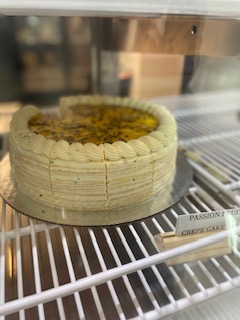
Crepe cakes are another menu item. They are made of 20 layers of thin crepes placed together like an architectural masterpiece with flavors that melt in one’s mouth. Other popular handcrafted desserts that Cao offers are butter cookies, and mille-feuille.
These delicate and detailed desserts do not come without a cost, which is many hours of practice and skill to get them just right.
Cao said the hardest part of opening her own bakery was the extensive training she implemented to get it so her employees knew how to bake properly. They shadowed her for many hours as she trained them in all aspects of baking. It was hard to teach her employees something she had been practicing for over a decade.
The business side came easier to her than the training she did for her employees. She also said that it was much easier to open a business in Salt Lake City than to do so in California because it costs a lot more money.
One of Doki Doki’s most popular desserts is the Japanese crepe cake. It is made from 20-plus light golden brown crepes layered with homemade creams. The passion fruit flavor is shown here.
You might think that with all the recent Asian hate crimes we have seen, a young Asian woman opening her own business may have many trials. But for her, it flowed naturally. Like fate.
Cao said, “I am very lucky.”
In 2020 the pandemic struck the world. The coronavirus devastated local business owners as hundreds of owners were forced to shut down. Many businesses have still yet to recover, and some were forced to close permanently.
For Cao, it had the opposite effect. The community was forced to do takeout only so it gave Cao free marketing across all of the food delivery sites.
As a new business owner, marketing can be one of the most expensive aspects of opening.
Customers became more aware of her bakery after it was listed on food ordering platforms such as Grubhub, Uber Eats, Postmates and DoorDash. All of a sudden everyone knew who she was, and that Doki Doki existed.
“It’s like I blew up overnight,” Cao said in a phone interview.
Cao said she is also forever grateful for the many influencers and foodies in Salt Lake City who blogged, posted and continued to share her work. They helped and continue to help spread her passions of baking and all of the hard work that goes into it, all across every social media platform.
Imagine showing up to a sports competition and not having anyone look like you. Or being told that your athletic ability is only because of your race. Or competing in a sport that holds the nickname “rich white person’s sport” when you aren’t white. Unfortunately, this is the crippling reality for many Black ski racers.
Ski racing is an expensive sport whose participants are predominantly white. Additionally most participants are in the upper-middle-class to upper-class income bracket. There needs to be change made to make it more inclusive and welcoming for all.
In a study of the 2019-2020 season, the Snowsports Industries America found that in winter sports (skiing, snowboarding, cross-country skiing, etc.) participation rates were 67.5% among whites and only 9.2% for Blacks.
The history of skiing can be traced back to 8000-7000 B.C. in Russia, Finland, Sweden and Norway. Skiing was used as a way of transportation and eventually transitioned into a leisure activity.
The first ski competitions weren’t held until the 1840s in Norway. Ultimately, a few decades later, the sport made its way to the U.S. In 1936 alpine skiing made its Olympic debut at the Winter Games in Garmisch-Partenkirchen.
This Indo-European background of winter recreation established it as an activity predominantly enjoyed by white people.
Another aspect that makes ski racing inaccessible is the sheer cost. After equipment, club, camp and travel fees, athletes can expect to spend upward of $30,000-$100,000 (depending on the level of competition). For the U.S. Ski Team (USST) to pay for travel costs across all disciplines each year it needs approximately $1.6 million, according to Ski Racing Magazine.
So, the question is, what can we do as a ski racing community to make the sport more inclusive and welcoming?
“I began ski racing when I was 6 and it wasn’t until I was racing internationally when I competed against someone Black,” said Luke Mathers, University of Utah Alpine Ski Club coach. “I think it’s surprising that there isn’t more diversity within the sport and I wish there was. I mean, who doesn’t love skiing?”
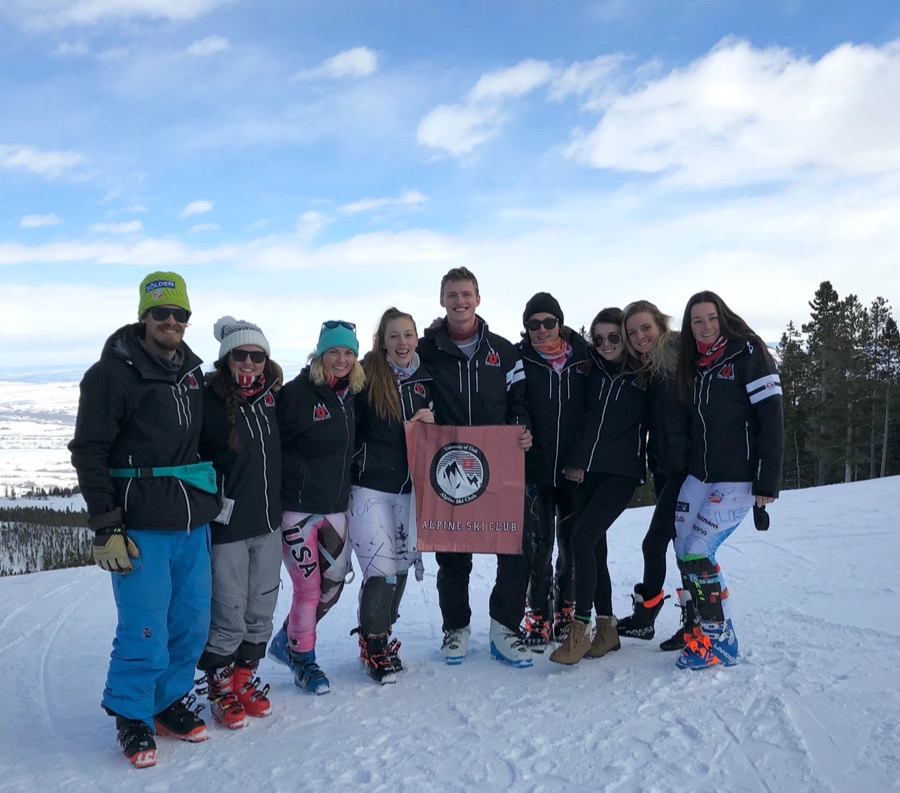
University of Utah Alpine Ski Club at regionals in Red Lodge, Montana, in 2018.
In Mathers’ four years with the club, only one Black ski racer has been a member of the team and he was only involved for just one season.
To increase diversity in the sport, Mathers stressed the importance of “getting rid of the stigma that skiing is only for rich white people.”
This has been an issue that the USST has been trying to change for four years. In 2017, the USST created the Diversity, Equity and Inclusion committee to increase racial, ethnic, gender and socioeconomic diversity at all levels of ski racing.
All committee members serve voluntarily and are comprised of USST staff, leadership and board members, as well as select members of the community. One of these community members is Lauren Samuels, U.S. Ski Team, Rowmark Ski Academy and University of Utah alumna.
Samuels grew up racing for Team Gilboa in Minneapolis, Minnesota, and at 15 was invited to join the U.S. Ski Development Team in Park City, Utah.
During her time with the team, she quickly learned it wasn’t quite what she was expecting.
At her pre-summer testing, known as baseline testing, she broke the record for her vertical jump test. “They said, ‘Well, it’s just because you’re Black, so obviously you can jump,’” Samuels recalled during a Zoom interview.
She also experienced criticism for not braiding her hair, but her hair didn’t braid. “The coaches didn’t talk to me about my technical skills, but instead they asked about my hair,” Samuels said. “Well we did wind tunnel testing and braids were fastest by hundredths of a second,” her coaches told her.
Once Samuels finished with the national team she was eventually invited to join the University of Utah Ski Team. After her time racing, she took her talents back to the slopes of Minnesota coaching and focused on making the sport better.
“I don’t have the end-all solution. But does anyone?” Samuels said. “The main thing is outreach and partnering with organizations. There needs to be a strong partnership between the clubs and the U.S. Ski Team to generate diversity.”
University of Utah NCAA race in 2017 at Beaver Creek, Colorado. Lauren Samuels, left, and teammate Abby Ghent. Photo courtesy of Lauren Samuels
To make change it is important that everyone does their part. If everyone just sits around and points fingers at each other nothing is going to change. We as a community have to go out and create change.
That is the philosophy of former ski racer Shay Glas, who is looking to make ski racing more accessible and affordable.
“Skiing is expensive, we all know that. Skis get old and skiers want new ones. But what happens to the old ones? Normally they just sit in your basement or garage and I want to change that,” Glas said in a FaceTime interview.
Glas is currently working on creating an organization that will provide used ski equipment to people of low income so they can try skiing. The program would provide people of all ages the ability to try out skiing for the day without all the costs and fees that are typically associated with it. For reference, a day of skiing can cost anywhere up to $350 after lift tickets and rentals.
Along with the U.S. Ski Team, there are many organizations that have been working toward the diversification of skiing.
Snowsports Industries America has over 20 inclusion teaching videos on its website stating, “SIA has convened an Inclusion Committee to provide feedback on our plan to incorporate inclusivity into our organization and our industry.”
There is also the National Brotherhood of Skiers founded in 1972 on the basis of creating a national Black Summit for skiers, a place for Black skiers to come together. Today it has over 50 clubs in 43 cities with a membership of 3,500 skiers.
As a community, we need to work together to continue to listen, learn and make change. “If we all work together,” Glas said, “we can create diversity and switch the stigma around skiing.”
After the events that took place in the Spring of 2020 most people in the U.S. had their eyes open to the issues in our society concerning race and the foundation of many institutions. One of these institutions was fraternity and sorority Greek life.
Nationally, several social media posts went viral in the spring pointing out the racial issues with how fraternity and sororities were established. Members shared their own experiences and brought light to changes that needed to be made.
Many called for the abolishment of Greek life. However, there is room for growth and change instead. The University of Utah Greek life chose a path of growth and has since implemented many new policies.
The current social issues that have been highlighted are not to be taken lightly by academic institutions, and Greek life is no exception. Therefore, members who are a part of marginalized communities have had their voices amplified in order to learn what change can be implemented.
Conversations about implicit bias, microaggressions, and mechanisms through which marginalized voices can be uplifted have been prioritized. These conversations are crucial toward spreading awareness and making initial steps to achieve real, measurable change.
This statement was posted on May 31, 2020, by Utah Panhellenic on its Instagram.
The Panhellenic Council oversees the six National Panhellenic Conference chapters and two affiliate chapters at the U. “The Panhellenic community consists of over 850 empowering women who value the excellence of scholarship, leadership, and service,” reads the Panhellenic website.
At the U, diversity and inclusion are highly valued, and Panhellenic activities should reflect these values. So to do this the council began by adding a diversity and inclusion chair to the Panhellenic executive board.
It is a stronghold goal that marginalized members of this university feel comfortable to join Greek life, and that current members feel heard and valued in their Panhellenic activities.
Along with other chapters at the U, including Alpha Chi Omega, Kappa Kappa Gamma and Delta Gamma, Pi Beta Phi followed Panhellenic’s decision. In the Fall of 2020, added a director of diversity and inclusion position to its executive council.
Katia Vu is Pi Phi’s current diversity director. She said believes that within Greek life it is incredibly important to promote diversity and inclusion. “We need to make sure that everyone, no matter their race or if they have a disability, has an equal opportunity to participate within Greek life,” Vu said during a Zoom call.
Through Vu’s position, she gets to help her peers grow and learn every week during Pi Phi’s chapter meetings. She also holds virtual workshops throughout the semester to promote learning and an open conversation about current topics in society.
“I’ve held information sessions during chapter in which I will usually talk about current events, holidays, or topics like accountability and implicit bias. I think I can do so much with this position and we have much more planned for the future starting with this fall’s recruitment,” Vu explained.
Pi Beta Phi sorority house at the University of Utah. Photo by Madison Kuledge.
Greek life has always placed importance on teaching its members how to be better members of society and the community at the U. The homepage of the Fraternity and Sorority Life website for the U reads, “to provide educational programming in the areas of program development, risk management, and the promotion of leadership development.”
“When I was a DG (Delta Gamma) I remember going to many educational presentations and teachings concerning the issues that happened in Greek life such as sex, drugs and alcohol, but I never once attended anything on racism which was also an issue within Greek life,” said Chloe Greep, a former member of Delta Gamma.
“I’m really happy to see that the U has added additional educational efforts on this topic (racism) because I know during my time these talks and presentations were so helpful and informative, so hopefully this can create change,” Greep said.
Not only is Greek life as an institution stepping up, but members within chapters are as well.
Taylor Madsen, who attended the discussion, said in an email interview, “It was nice to be able to talk to my peers about our feelings and frustrations with what was happening and it was also nice to know that you aren’t alone and to know that we all cared about the events that were taking place.”
The Interfraternity Council (IFC) is the governing body for the 12 inter/national fraternities at the U. It has implemented it own teachings and policies to promote the diversity and inclusion within fraternities on campus.
In February, IFC teamed up with the U to celebrate Black History Month and held extra educational events for members on top of the programming that the university held for all students.
Several chapters at the U have or are working toward adding a position focusing on diversity and inclusion to their respective executive council.
“We may not have a designated diversity chair but Sigma Nu has held a handful of educational Zoom calls and meetings focused around diversity and eliminating stereotypes and microaggressions,” said Johnny Foster, a Sigma Nu member.
So how do we continue to build on what has already been done? Katia Vu, Pi Phi’s diversity and inclusion director, said, “We can always do more research and educate ourselves. No matter how much we think we know, or how many workshops we attend we can always learn and improve. We can always be more welcoming by checking our implicit biases and making sure to engage with everyone so that they feel included within the community.”














 voices-of-utah.com