Navigating bilingual education for Utah students

IMG_8714

Story and photos by KAELI WILTBANK

The last decade has seen a large influx of Utah residents who speak a language other than English in the home. As of 2016, that number was over 400,000 people, ranking Utah as the third-fasting growing state for residents who speak a foreign language in the home. Much of that growth can be attributed to native-born children of immigrants

Paige Wightman teaches eighth- and ninth-grade English at West Jordan Middle School. Because of the demographics of the area, she was required to get an English as a Second Language (ESL) endorsement, which has given her the opportunity to teach a language development class. The curriculum is designed for students who don’t speak English as their primary language at home. While the languages spoken in the class range from Portuguese to Arabic, the main language spoken by her students is Spanish.

IMG_8716

Pictured here and at top, three books from a small Spanish selection of books at Sprague Branch Library in Salt Lake City.

When speaking of the challenges of teaching a class of bilingual children she explains, “I ran into some problems when I encouraged my students to read a book in English and a book in their native language one quarter and the kids didn’t have access to what they needed. It surprised me and it was very disheartening when I learned that we didn’t have any Spanish books in the library.”

According to a study by the American Psychological Association, native Spanish-speaking students who had an increased vocabulary in Spanish saw significant positive effects on their English fluency and reading speed. Their research helped prove a positive correlation of literacy skills being transferred between the first and second languages. 

Rebecca Chavez-Houck, former Utah State House Representative, is a third-generation American. She recounts her grandfather moving to the United States from Mexico in the early 1900s and making education in both Spanish and English a priority for his children. “My grandfather, my mom’s dad, knew how to read and write in Spanish. So what did he do? He taught his kids how to read and write Spanish before they were in kindergarten. This set the stage for my mom’s success as well as for subsequent generations,” she said.

The Gomez family has been living in Utah for over 15 years and has been navigating their own bilingual experience a bit differently in 2019. Both Monica and her husband Rafael grew up speaking Spanish as their native language. Monica was born in Mexico and picked up English from watching movies and television. When she moved to San Diego and married Rafael, who was born in the U.S. to immigrant parents, they had to decide how they wanted their three children to learn both languages.

Gomez explained the education her oldest daughter received in San Diego. “It was a Spanish immersion program in San Diego where they had half of their classes in English and half of their classes in Spanish. By sixth grade, they would come out reading and writing in both languages. But she was only there for a couple of months because we moved.”

After coming to Utah the girl was put in the English courses. Monica’s daughter, now 18, said she can speak both Spanish and English like she’s a native to both, but has a difficult time writing in Spanish.

Monica’s youngest son, Nick, is 10 years old and can understand Spanish, but doesn’t feel confident speaking the language. “Nicholas is different [than my older children] because, church, school, and friends are in English. We speak Spanish at home but if it’s homework time it has to be in English.”

Monica described a system that she saw in Mexico growing up. Many of the schools have English classes offered to children from the time they are in preschool, similar to what is offered to high school students here in the United States. She said she would have liked the opportunity to have her son take Spanish classes in elementary school, believing that this could be an alternative route to the ESL program.

Wightman, the teacher at West Jordan Middle School, is eager to offer better resources to her bilingual students. She has asked her school librarian to be on the lookout for Spanish books. Like many teachers, she has spent much of her personal money filling her bookshelf with Spanish options but has found that most books are low level and not what her middle school students need. Wightman explained, “I think that sends the message to that community that they are children or like it’s some sort of disadvantage if you don’t speak English and the only other resource we offer them is something with very simple Spanish. We should be encouraging culture and language through a variety of different ways.”

While the resources for bilingual students in Utah may be limited, Wightman said she has deep respect for her diligent students. “I’m especially fond of the Latinx community because they are some of the hardest working students I have, keeping in mind they have to work double time. They have to translate what they hear into Spanish, then they have to translate their answer from Spanish to English. They have to have the courage to speak up, which is hard for any teenager, but especially hard if you’re afraid you’re going to sound dumb.”

Wightman concluded, “We need this generation to stay in school and we need them to have post-secondary education. They are going to be the change makers and if we want any change we need to invest in them, in the Latinx community.”

Hispanic immigrants are creative and family-inspired

Screenshot 2019-03-06 15.26.51Story and photos by KRISTEN LAW

Alex Guzman, president and CEO of the Utah Hispanic Chamber of Commerce, said Hispanics are creating jobs and working hard. “They became business owners, with no intention to become business owners. They just had intentions to provide [for their family],” he said.

Moving to a new country and not knowing the language can be difficult. This calls for some creativity when it comes to employment. “What is the solution if I don’t have a job? Create my own job opportunity,” Guzman said. UHCC helps train Hispanic entrepreneurs and business owners and educates them on how to run a successful company. 

According to UHCC, “Success is most often achieved by knowing where your resources lie and not depending entirely on you[r] own talent and strengths.” Guzman said the UHCC helps teach basics like how to file taxes, how to hire and fire personnel, how to do invoicing, and many other skills that are necessary to know before starting a successful business. 

Local businesses are often creative and diverse. Five main industries are reflected in UHHC’s membership directory: restaurants; construction; landscape and snow removal; professional services including photographers, videographers, and accountants; and commercial or residential cleaners. Guzman said they make up about 85 percent of the members.

One local restaurant, although not a UHCC member, illustrates the family-inspired creativity that Guzman emphasized.

Screenshot 2019-03-06 15.26.25

Taqueria Los Lee is located at 2646 S. 700 East in Salt Lake City.

Taquería Los Lee began in the heat of the summer in 2018 in South Salt Lake with a passion and inspiration for flavorful, authentic Mexican food.

The moment you enter the restaurant you are quickly greeted by the Lee family’s welcoming presence. The large windows and open, sun-filled room displays colorful and traditional decorations, which also add to the intimate and wholesome feel of the restaurant.

IMG_1715

The menu of gorditas, tacos, and daily specials is handwritten on the chalkboard.

The family behind Taqueria Los Lee cherishes what they do. Each member has drive, purpose, and a solid work ethic and they inspire each other to be creative.

Rosi and Oscar Lee are the cooks, and their daughters Anileb Anderson and Flor Lee help run the business in various ways. Rosi said she loves to cook and has catered in the past, but she wanted to do something more with her passion for food and make it into a business.

She used to bring her dishes to community or neighborhood events. “People would try her food and would love it,” Anileb said.

IMG_1702

A combination plate with tacos and a gordita, a pocket made of masa and stuffed with filling.

Jim Light, a retired chef from the Salt Lake area, has become a regular at Taqueria Los Lee. He said he doesn’t remember exactly why he initially visited, but his first impressions left him coming back at least once a week since October 2018. “Everything I have had has been really excellent. Their mole sauce, in particular, is very very good,” Light said. “Part of the fun for me has just been getting to know this really cute family that owns this place.” The Lee family even taught Light how to make one of his favorite meals, a bean dish he had really come to enjoy. “They can’t afford to hire anybody, so it’s just a three-generations, family effort.”

Anileb works at the restaurant every day from open to close and helps cook when things get busy. Her sister works another job while helping run the business. Rosi and Oscar are the cooks. It really is a family endeavor. “We’re just a family that works here, so we like to be here with each other,” Anileb said.

This work ethic is bred into Hispanic culture. Guzman said it is not uncommon for some immigrants to work several jobs. However, family-run companies include the whole family, so working from a young age is typical. Working is a part of life. However, Guzman said it is not just about working hard, but about working smart. 

The Latinx community is contributing to Utah’s local economy and well-being not simply benefiting from it. Javier Palomarez, the United States Hispanic Chamber of Commerce president, said in a 2014 speech, “In the state of Utah, Hispanics are paying taxes, creating jobs, and greatly contributing to the local economy.” 

Growing up, Guzman said his father told him, “Work hard. Be the best in your class. Don’t be ambitious. Be content with what you have.” Guzman emphasizes the effect that family has in the Hispanic community in their drive for a successful business. The main goal is family and good living.

Is this the place for me? Being Latinx at a predominantly white institution

Story and photos by IASIA BEH

With the latest photos to come out regarding placement of racist banners and posters on the “Block U,” it raises a lot of questions: Who are they? Why are they doing this? Why do they feel so emboldened that they show their faces when spreading clearly racist rhetoric?

One reason behavior like this is possible is because the University of Utah campus itself is isolated from communities of color. Tucked away on the foothills of the Wasatch Mountains in neighborhoods only few can afford, many white students are never introduced or interact with people of color on a meaningful basis.

IMG_2230

Wendy Vazquez pictured at the annual MEChA High School Conference on Feb. 27, 2019.

Wendy Vazquez is taking a criminal justice class this semester as part of her sociology and criminology degree. While the class material has proven to be interesting to her, Vazquez believes her fellow classmates have not.

Sitting on the couches with her sister in the Center for Ethnic Student Affairs in the A. Ray Olpin University Union, Vazquez talked about a white male student she has class with. Even though they have had some classes together previously, he still won’t sit next to her. This confused her until he mentioned in class that he was fearful of people of color.

“At that point, I understood why he didn’t talk to me,” Vazquez said.

She said he works in the library, which also confuses her.

“It kinda doesn’t make sense because he has to give directions to all students,” she said. “Do brown students come up and he just turns around?”

He isn’t the only classmate who has made her feel excluded. A white female student in an in-class group discussion spoke about how building the wall would stop crime.

“She basically implied that as long as the country stayed white, crime would stop because minorities are the ones who commit crimes,” Vazquez said. “She also said we need to ‘have to put these people in their place.’”

Students of color have experiences like this every day on predominantly white universities across the country. William Smith, who is the department chair of the Education, Culture and Society program at the U, describes racial battle fatigue as “the physical and psychological toll taken due to constant and unceasing discrimination, microaggressions, and stereotype threat.”

Smith’s presentation on the subject through the MUSE luncheon lecture series at the Sill Center on Feb. 7, 2019, brought the discussion to the CESA office that afternoon about times students themselves had felt drained.

n72uCtoQSBOHgIb%ZWtSjQ

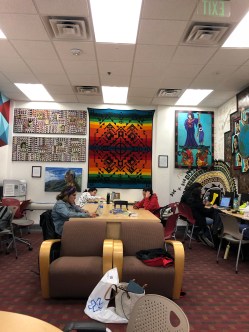
The Center for Ethnic Student Affairs is a space on campus where many students of color meet to study, socialize and meet with advisers.

One Latinx student talked about how it was hard for him to study with his study group because they were Trump supporters. He said he stopped even talking about it with them because it just “wasn’t worth it.” Multiple students mentioned how white people, mostly women in the examples they gave, would cry when confronted about  “problematic” comments. The Latinx students looked both frustrated and relieved when telling these stories, showing that they had been holding those feelings in for some time.

How are professors reacting to situations like these?

Vazquez said her professor only calls out overtly racist comments while letting ones that “aren’t as bad” slide through the cracks.

“It seems to [the students] like he’s validating their opinions when he shouldn’t be,” she said.

Karen, her sister, then spoke about her experience working at the news station at the school. She said she has been prevented from getting into events even when she had the correct credentials.

“My white male coworker even came out and said ‘she’s with me’ but they still wouldn’t let me in,” she said.

What do these stories have to do with anything? Well, everything.

If a student doesn’t feel comfortable and safe on campus, how will they ever be able to reach their full academic potential? The answer is they can’t. That is why the university has created spaces such as CESA for students of color to be able to meet and talk about their experiences in an area where they do feel safe. But is that enough? How will students be exposed to each other if they are only staying in certain places on campus? That then brings the question of whether it’s the job of students’ of color to teach white people how to be culturally sensitive.

Is it enough for the university to call out certain acts of racism but not what is happening in the classroom on a daily basis? How will it implement that? The university has begun to realize that something needs to be done, as it has added many new programs in recent years, but is it working?


Salt Lake County’s inland port: Helpful or harmful for the Latinx community?

Story and photos by KATHERINE ROGERS

Elitzer stood in the doorway of Franklin Elementary School’s gym on Feb. 28.
That evening, the gym hosted a panel about the proposed inland port that is to be built in Salt Lake County. She was watching the proceedings, but not participating in the questioning.

“I wish they would do something in Spanish,” says Elitzer, who asked that her last name not be used. She speaks English well, but it’s not her first language. Spanish is much more comfortable for her.

She is just one of many Latinx people who live near where the inland port is proposed to be built but know very little about it — even though this port could affect them the most, for better or for worse.

The proposed site heavily overlaps with Utah House District 23. This district belongs to Rep. Sandra Hollins, D-Salt Lake City. It also has the highest Latinx population in the state, with 47 percent of the district identifying as Hispanic or Latino, according to the demographic profile of the district.

An inland port is essentially a dry port. It is a place for trucks, planes and trains to meet to exchange and deliver cargo. In the age of online shopping and one-day shipping, a junction like this is helpful.

In the 2018 legislative session, the state passed a bill that would provide funding for an inland port to be built in northern Utah. This inland port is to be built in the northwest quadrant of Salt Lake County, west of Interstate 215 and on both sides of Interstate 80. The area is just north of 2700 South and creeps toward the Great Salt Lake. This would put the port near Salt Lake International Airport and the Union Pacific Rail line, according to the boundary map.

IP 1

Trucks driving down 5600 West, just south of Interstate 80, where the Inland Port is proposed to go.

In the most recent development in this story, Salt Lake City Mayor Jackie Biskupski just filed a lawsuit against the Inland Port Authority (IPA).

Hollins has concerns about the port. She worries that increased truck, plane and train traffic could mean worse air quality.

Questions about how transparent the IPA has been in this process have come up. It has held many meetings that are closed to the public. Hollins says she doesn’t feel like the IPA has been listening to the public like it should.

The state representative does recognize there is good that could come from the port.

A provision has been provided in the Inland Port Bill that requires part of the funding for the project to go toward affordable housing.

The inland port also, of course, could provide potential job growth for the nearby communities, including House District 23.

According to the demographic profile, Hollins’ district has many people who work in construction and the service industry. This port could create more jobs in those areas.

Thomas Wadsworth, director of corporate growth and business development for the governor’s office, reported at the meeting on Feb. 28, that there are incentives in place that would encourage businesses to provide wages at least 110 percent of the average wage in that industry in Salt Lake County.


IP 2.JPG

R.C. Willey and Dematic warehouses along 5300 West, near the proposed location.


However, Hollins expresses that she is concerned about how good those jobs will be. An incentive is not a guarantee. And even if these jobs provide livable wages, there is no promise that there will be room for the employees to grow and move up in the company.

The question that Hollins asks for the good of her constituents is, “Do the economic benefits outweigh the ecological problems?”

The IPA is aware that not everyone supports the port. Envision Utah, a group dedicated to helping Utah grow in a healthy way, has been hired to run public meetings and report back how people are feeling.

These meetings have been well attended. But most of the attendees at the Feb. 28 meeting were white. Even though the neighborhoods closest to the port are heavily Latinx, few of those residents are seen at this meeting.

Elitzer, the Latina woman who was there that night, said this was the first meeting about the inland port that she had attended.

She had heard about it through Hollins when Elitzer had taken a trip to the capitol with her West Side Leadership Institute class. Before that, she didn’t know about the port. Hearing about it now alarmed her.

She has a daughter who is asthmatic. She said she wants her daughter to be able to play outside and run around with the other kids. Utah already struggles with poor air quality. Increased air pollution could keep Elitzer’s little girl from being able to do that.

The potential for worse air quality near their home makes Elitzer worry, not just for her daughter, but for other children as well.

She had recently been to Primary Children’s Hospital and seeing all those children who have similar afflictions as her daughter broke her heart. “They shouldn’t have to live like that,” she said.

It was pointed out during the meeting that the inland port could provide job growth for the community. Elizter just shook her head. “We can get other jobs, in a healthy way,” she said.

Elitzer wants to make a difference in her community. Learning about this port is part of that. She plans to share this information with her friends, family and neighbors. She thinks that they need to know.

She believes that this inland port project is just focused on money. She said she also feels that the IPA does not care about what the people nearest the project think. If it did, Elitzer points out, wouldn’t it have provided some information in Spanish?

Centro de la Familia de Utah, promoting healthy and engaged Latino(x) communities

Story by BRIANNA WINN

“We pursue what we see,” said Rebecca Chavez-Houck, former member of the Utah State House of Representatives. “If children do not see people that look like them representing their communities in positions of higher power, then they don’t see that as an opportunity for them.”

Chavez-Houck is also a longtime advocate of the Latinx community.

“I was in my early 30s, I’m looking at the legislature and I’m thinking about my neighborhood and amazing people I know with accomplishments. I’m wondering why we’re considered a representative democracy when none of the legislature looks like our state or our community,” she said while reminiscing.

This, she said, is what motivated her to run for office.

Chavez-Houck previously worked at Centro de la Familia de Utah.

IMG_2509

Words on the wall walking out of one of the classrooms at Centro. 

Centro de la Familia de Utah means “Utah Family Center” in English. It is a nonprofit organization dedicated to advocating for children’s educational success and fostering healthy and engaged communities.

According to the website, Centro works with Utah families, most in rural and difficult situations, to help them with resources to improve the outcomes of their children.

“Sometimes the families were Latinos, sometimes they were from other communities, sometimes they were white, but most of them were from the Latino community,” Chavez-Houck said.

Centro impacts underserved communities through services founded on parent engagement, providing standardized year-long programs in rural communities, and engaging staff in meaningful professional development, as stated on the website.

According to the website, the program originally was incorporated in April 1975 as the Institute of Human Resource Development during the Chicano movement in Utah. The agency has now taken an interest in serving youth.

During the 1980s and 1990s, programs were incorporated into the agency’s mental health services to prevent substance abuse and its associated problems. Centro initiated its Hispanic Youth Leadership Institute (HYLI) program as well as several other programs.

The HYLI program provided prevention services to more than 300 high-risk Latino youth.

In 1994, the board and staff decided the name Institute of Human Resource Development no longer exemplified the mission of the agency, and changed its name to Centro de la Familia de Utah, according to the website.

Centro operates Head Start, Early Head Start, and Migrant and Seasonal Head Start programs.

Kari Moore, program design and community impact manager, facilitates the execution of grant communications, the community assessment, self-assessment, annual reports, ongoing monitoring of the Head Start program services, and data driven-demonstration of community impact.

“Hispanic families are mostly the families we see throughout the program, but it really depends on what program and what location,” Moore said in a phone interview. “Up north and south of Provo we tend to get a higher number of Hispanic families.”

In 1991, the federal government implemented the Migrant Head Start Program for the state.

Head Start is a program dedicated to promoting school readiness among economically disadvantaged and underserved children through the provision of educational, health, nutrition, and other services,” according to the website.

“We tried to help the families learn to advocate for themselves,” Chavez-Houck said. “We wanted to give them tools to work within the Head Start program for their children.”

IMG_2510

Young students in class, image courtesy of Kari Moore

For instance, the Head Start program includes parent policy committees. The idea behind this is that there is no hierarchy of teachers and administrators. “Parents come and decide for that center what their priorities are going to be,” Chavez-Houck said.

According to the Utah State Board of Education, Hispanic/Latino students have increased significantly with their graduation rate over the past five years with increases of 9 percentage points since 2013.

Will Gonzalez, a member of the program and father of three, said through an interpreter, “This organization has had a huge impact on my family. We have learned to get along better — we have learned many things.”

He added, “The primary changes I’ve seen is in the behavior of my children. It has helped the children get along better.”

Centro has provided over 41 years of community service focused on increased individual and family self-reliance in Utah.

“I started off as a family service specialist basically going out and recruiting families to join the program,” Moore said. “I really fell in love with the work and I’m just so blessed in my own life for the different opportunities I have to help educate families and give resources to help encourage parents in their children’s education.”

Today, Centro operates five rural Head Start centers and nine Head Start childcare partnerships, according to the website, as well as a portfolio of outcome-based programs for elementary, middle and high school students.

It also offers programs for adults that provide necessary tools and skills for self-sufficiency. Centro continues to fulfill its mission by helping the neediest populations in Utah.

IMG_2511

Students and teachers at Centro. Image courtesy of Kari Moore

According to the website, Centro annually serves more than 700 Early Head Start and Head Start children throughout the state of Utah in both rural and urban areas.

Centro de la Familia is just one program that is helping Latino families all around the state of Utah. If you want to get involved, you can donate online to help provide stronger programs and broaden the impact in the community. Volunteering is another option. You can also contact Kari Moore at (801) 521-4473 or info@cdlf.org.

Centro’s corporate office is located at 525 S. 300 West in Salt Lake City. Other locations are in Providence, Honeyville, Genola, Mount Pleasant and Centerfield.

Latinx populations help the US economy to thrive

Story and photo by ZANE LAW

In recent years, with the presidency change and promises of a wall between bordering lands, southern immigrants have been the hot point of numerous conversations. While some argue that immigrants hurt the United States economy by stealing jobs and not paying taxes, other credible folks think just the opposite of the situation.

In regard to stealing jobs from American-born individuals, Alex Guzman says the community members create their own jobs and support each other as a collective Latinx whole. Being the CEO of the Utah Hispanic Chamber of Commerce, Guzman knows the working-class population and estimates that as many as 35,000 Hispanic individuals own businesses in Utah.

Whether documented or not, Guzman says they open businesses “not to be entrepreneurs, but to survive.” Those who cannot find jobs due to the lack of a social security number, discrimination, little education, and other reasons are able to open businesses and provide for their expanding families. These business owners are then able to pay it back to fellow immigrants by offering new jobs and opportunities to thousands of other people in similar situations.

While the community creates jobs for themselves and others by having a high number of business owners, another overlooked aspect of immigrant workers is the fact that they are willing to do whatever it takes to provide.

According to a talk at the Center for Latin American Studies at UC Berkeley, immigrants are more willing to move for work than native folk. Giovanni Peri explains that “immigrants’ willingness to move helps slow wage decline in stagnant regions and contributes to economic growth in booming ones.” They move away from regions that do not have enough jobs, allowing the locals to take the few available spots. Immigrants then move to bustling areas, with high demands for work, and are able to fill the positions that owners want to be filled, Peri says.

Alejandro Gutierrez, a Mexican-born man of 45, did just that. He originally moved to a town in California, but as the job market began to fill up, he found his way to Salt Lake City. Gutierrez now works as a dishwasher at the University of Utah’s Peterson Heritage Center, pays his taxes, and adds money to the economy.

While Guzman, Gutierrez, and others within the Latinx community create jobs and work hard for their money, Guzman says that the community also contributes plenty of money to the churning economic machine.

“We live la vida loca and we put our money in the market right away,” explains the enthusiastic business owner, marketing professional, and former Guatemalan senator. “La vida loca” translates to “the crazy life” and Guzman says this is the case for many Latinx individuals. They buy the foods they want, upgrade their cars, party and vacation frequently, and live carefree lives.

Guzman says the community finds it difficult to save, but he sees this as a learning experience for youth. He further backs up his lifestyle choices by saying the “spending helps to inspire a sense of generating income.” The philosophy is that when their kids see what money can bring and how much it costs to live well, they are more driven to earn for themselves.

These spending habits stretch further than the immigrants who Guzman has come to know in Utah, however. Anna Chavarria, a student in Colombia, explains that she and her family have difficulties with saving as well. The family of six lives in a three-bedroom home in Medellin, Colombia, but they enjoy things like motorcycles, fine dining, and huge block parties.

fullsizeoutput_1a9d

Anna Chavarria enjoys “la vida loca” in the sand dunes of Huacachina, Peru.

Chavarria says in a phone interview they would not cut the extravagance out for a more spacious house, explaining that they “live a fast-paced and fun life, and a squished home simply adds to the closeness of our family.” Both her mom and brother work seven days a week to provide such a life and she says she and her family would work just as hard if they lived in America. Chavarria has been in the Visa application process for approximately two years and says she has much to offer to the U.S.

Because Latinx community members often spend as fast as they earn, Guzman says the Latinx community is a major target for marketing as well. With his 25 years of experience in the field, he has found that the return on investment for this group is large.

Spanish-speaking outlets like Telemundo are greatly cheaper to advertise on than English-speaking sources. Then once the advertisements have done their job, Guzman also says Latinx people are very loyal to the brands they buy from. Companies are able to advertise their brands for less money, keep their customers for longer periods of time, and have peace of mind knowing the community will spend for as long as a paycheck is coming in.

The state of Utah and the country as a whole are filled with people similar to the likes of Alex Guzman, Alejandro Gutierrez, and the Chavarria family. According to a June 2018 article in the Salt Lake Tribune, the Latinx population even makes up at least 14 percent of the state’s residents. They are not an anomaly and are a community that will, no matter what, contribute to and affect the economy.

Losing the Latinx identity

Story and photo by KARA D. RHODES

Culture has always been an idea that people hold close to their heart as it brings families, friends, and generally speaking, people together. What happens when people decide that their culture is no longer important to them? Killing their culture little by little by not accepting or not keeping their culture as prominent as they once had before.

Alex Guzman, president and CEO of the Utah Hispanic Chamber of Commerce, is mainly a hard-hitting businessman committed to the growth of the Latinx business community. Guzman is a family man who fears his children are losing their culture that he is fond of. In an interview, he tells a story of his son getting ridiculed at the local elementary school for not speaking English well enough for his teacher to understand him.

Now, immersion schools assist with teaching those who have a first language that is not English. Guzman says he wishes his son hadn’t had to go through something so traumatic. This taught the young boy that his language was not correct and forced him out of his culture. Guzman likes to speak Spanish while he is home; his son now speaks Spanish with an accent that is not from his culture.

Christian Oregon, a 23-year-old student with family origins in Acapulco, Guerrero, Mexico, says, “Culture is very important to me. It sets us apart; we value a lot of different things. My culture has helped define and shape me into the person I am today. I always remember my roots. I take huge pride in my culture so it’s definitely important to me.”

Oregon says he believes that his culture is stronger than ever despite all the push-back from the political climate. “We’re staying strong together because we have people thinking we’re all drug dealers and criminals. The racists are believing everything Trump says. We have people yelling at us with their MAGA (Make America Great Again) hats saying, build the wall, but we are fighting back and we’re not letting them take away or make us feel bad because of our culture.”

As strong as Oregon says the culture is, he believes that there are still people losing the culture. He says the times are to blame because people want to “fit in” nowadays. “Latinx people believe they should forget their culture to advance in today’s society,” Oregon says.

Oregon says there are ways to preserve their culture. “People can conserve their culture by sticking to their roots and teaching everything they’ve learned from their family onto their children. Doing this preserves our culture and keeps it alive. I think it’s just about passing it down from generation to generation.”

Asset_Story 1

Combining cultures: Amanda Ruelas, left, is Navajo while her husband is Latinx. She is pictured with her daughter, Gabby Ruelas. 

Amanda Ruelas, a mother of three, is immersed in multiple cultures including the Latinx community. Ruelas had a difficult time explaining what culture means to her but that it is very important. “I do feel that the younger generation is losing culture. They definitely see it different than I do. Especially my eldest daughter, Gabby. She is so interested in fitting in that she doesn’t want to understand our culture as much,” she says.

Ruelas’ husband, Vic, speaks Spanish but didn’t take the time while the children were young to teach them. She explains that they should have started teaching their kids both Navajo and Spanish when they were younger because her daughters are no longer interested in it. Ruelas is Navajo while her husband is Latinx.

Culture is clearly a big part in the Latinx community. Some believe it is thriving while others can see it slowly fading away. According to a summary of a 2014 forum at Mimar Sinan Fine Arts University, “Cultural heritage affirms our identity as a people because it creates a comprehensive framework for the preservation of cultural heritage including cultural sites, old buildings, monuments, shrines, and landmarks that have cultural significance and historical value.”

Mass incarceration, health disparities, the achievement gap: Is the Utah governor’s Multicultural Commission helping?

Story and photos by MEGAN CHRISTINE

“What is the concern, what is being done about it, and what can we do?”

Jacqueline Thompson, a member of the governor’s Multicultural Commission, said this was the commission’s approach to issues facing minorities in Utah.

The commission’s goals are to promote inclusiveness, cultivate trust between state government and ethnic communities, and improve educational resources regarding equity for the state.

The Utah Office of Multicultural Affairs and the commission was created in 2012 when Gov. Gary R. Herbert signed an executive order.

Rebecca Chavez-Houck, a former member of the Utah State House of Representatives and current commissioner, said the commission “continues in some ways to be a little bit of a controversial existence because the development of it is grounded in some controversy.”

Before 2012, there was the Department of Community and Culture, which employed a director of ethnic affairs. This department had oversight of the African American, Hispanic, Asian, and Pacific Islander affair offices. Each office had employees who were responsible for listening and responding to the needs of its respective community.

When the commission was created, this department and its individual offices were disbanded. The Department of Heritage and Arts now oversees the Utah Office of Multicultural Affairs and the Multicultural Commission.

Rio Grande

The Rio Grande building in Salt Lake City, home of the Utah Department of Heritage & Arts.

Chavez-Houck noted that the commission was developed in the middle of an economic recession when the executive branch was looking for places to cut. Some members of the community were against the elimination of the department and individual offices.

The commission is expected to listen to the needs of the community while also fulfilling the expectations of the governor. Chavez-Houck said that “sometimes it feels overwhelming that we’re trying to bring the voice of communities upward to the executive branch at the same time we’re trying to carry forward the executive branch’s priorities to the communities we represent.”

Thompson said the individual offices were able to work directly with communities one-on-one and could therefore have a more widespread impact.

Thompson also noted that though the staff at the office is small and consists of only three employees, they are “phenomenal.” She said that “if they (Utah Office of Multicultural Affairs) didn’t have the personnel they had, things wouldn’t get done because the staff is so outstanding and efficient.”

Jacqueline Thompson

Jacqueline Thompson, a current member of the governor’s Multicultural Commission.

Lt. Gov. Spencer Cox serves as co-chair of the commission as appointed in the executive order by the governor. Thompson said Cox is “always thinking outside of the box” and is conscious of being inclusive of all voices.

The 25 commissioners represent a wide variety of voices, and the large majority of them are community leaders in their respective industries, whether that be government, nonprofit, or business. Chavez-Houck is a former Utah legislator. Maria Garciaz is the CEO of Neighborworks, a nonprofit organization. Thompson is a state employee with years of experience in educational equity.

Chavez-Houck said, “I still sincerely believe that there is value in consolidating issues because communities of color share a lot of common concerns.” These are things like health disparities, mass incarceration and the school-to-prison pipeline, economic opportunity and development, and education and the achievement gap. “These things hit communities of color the same,” she said.

Garciaz said the commission structure is beneficial because “there’s good reciprocity. There are people on the commission who are community representatives and then you have the state department heads. There’s this exchange of information.”

Though the commission is able to have a wide impact because of the community leaders who serve on it, Garciaz noted that she would like to spread the work they do geographically. “When people hear commission, they assume they’re up on the hill (the Utah Capitol) and inaccessible,” she said. “I think we need to be able to visit other counties so that they’re aware that we’re here.”

The commission meets every two months, and the meetings are open the public. The agendas for previous meetings are available online. Recent topics of discussion include the hiring of an executive director for the Utah Office of Multicultural Affairs, the role of the commission in partnership with Intermountain Healthcare regarding work on the social determinants of health, and the Multicultural Youth Leadership Day.

Commissioners listen to the issues that are presented and then respond with feedback. They work collaboratively to come up with solutions to complex issues that face our community.

Those who want to join the commission must apply and be appointed by the governor. A term can be one, two, or three years long but commissioners serve at the pleasure of the governor and are subject to be removed at any time.

The commissioners assisted in the development of the Senior Leader Toolkit and Participant Course Journal, programs that are currently in their pilot phase among state agencies and community organizations. The goal of these trainings is to improve cross-cultural communication and to “sensitize people more than anything,” Garciaz said.

The Utah Office of Multicultural Affairs oversees the Multicultural Youth Leadership Day at the Capitol and the Multicultural Youth Leadership Summit. The commissioners offer input, consultation, guidance, and are invited to attend. About 1,000 kids of color come to listen to role models of color, but also to present on what they think is or is not working in their schools.

“When these students come to the conferences, they are already born leaders. They are acting in leadership capacities. We call them future leaders, but they really are present leaders, too,” Thompson said.

The commission is attempting to tackle problems communities of color face with help from community leaders and government officials. Its purpose is to ensure that these voices are heard and that minorities are being represented at a state level, because some believe that is not always done effectively through the Utah legislature.

Chavez-Houck said, “I’m looking at the legislature, and I’m looking at who’s up there, and I’m looking at my neighborhood, and I’m looking at the amazing people I know who are very diverse and I’m thinking, ‘If we’re truly a representative democracy, that does not look like our state. That body, the institution, they don’t look like the community.’”

Tomsik helping West Valley community one taco at a time

Story and photo by KOTRYNA LIEPINYTE

Patricia Tomsik starts her Monday mornings by boiling some water on the stove. The smell of coffee engulfs the cozy kitchen as she sits down and scribbles notes in her notebook, the news playing on a TV in the background. Tomsik lives in West Valley City, the largest Hispanic city in Utah with 37.7 percent of the Hispanic population residing here. The news continues to flash on her TV, showing updates on President Trump’s plan of building a wall. Tomsik watches intently.

“There’s more problems we have to deal with than this wall,” Tomsik says scoffingly, going back to writing in her notebook. She’s referring to the 13.8 percent poverty rate and the 5.4 percent unemployment rate West Valley City is notable for, as well as the high rate of suicide the state of Utah is facing.

Tomsik originally came from Ciudad Juárez, Chihuahua, and is used to the massive number of homicides that country faces, but “nothing like this” she says, referring to the suicide rates Utah is infamous for.

Tomsik’s son has struggled with depression and suicidal tendencies since he was a boy. She says that this is normal in a Hispanic community, especially with bullying in schools. “It’s just one of those things that you unfortunately have to deal with, and that’s just the reality,” Tomsik says, shaking her head. “I know other mothers are dealing with it too. It’s just sad.”

Miguel Alonso, a friend of Tomsik’s son, agrees. “We’ve been friends since junior high,” Alonso says, “and it’s kind of just an unspoken agreement that we all have to be there for each other.” Alonso is originally from Mexico City, and was forced to cross the border with his family to live a better life in the United States.

Alonso often spends his dinners at the Tomsik household. Tomsik hosts regular weekly meals at her home, inviting Alonso and his high school and college friends for a classic Mexican meal, complete with music and dancing. “It’s nice to get together,” she says. “We’re all just trying our best.”

While the community feels uneasy with news regarding President Trump’s wall, Tomsik tries to focus on the bigger issues at hand that the Hispanic community in Utah must face. Tomsik pays particular attention to the overall well-being of her community. While she hopes to help the community with depression, she knows it’s not an overnight project.

IMG_6033

Gabriel Moreno, a University of Utah student currently holding an internship in Washington, D.C., grew up with the Tomsik family.

Gabriel Moreno, a University of Utah student, is also attempting to find ways to cope with the issues the Hispanic community is facing. “I’m seeing everything first-hand here,” Moreno discusses over the phone while working out in Washington, D.C. “It’s just scary.”

Moreno originally emigrated from Columbia and grew up in Sandy, Utah. His passion lies in “Project Be Yourself,” a nonprofit organization focusing on mental illness in the state of Utah. “One of the most sickening things about this all,” he says, “is how easy it is to prevent these things. We just need to show the kids that there’s no bad culture, there’s no bad race. We’re all the same.”

By providing her neighborhood with fresh food and a listening ear, Tomsik hopes someone will begin to pay it forward so the good acts can spread. Alonso and Moreno assist as much as they can while also focusing on the online problem of cyber-bullying.

The trio works together in an attempt to help the Hispanic community thrive, but rarely see results. “It’s tough,” Moreno says. “I mean, we can’t just make jobs or say ‘stop bullying’ and expect it to stop. It’s a work-in-progress, but I don’t think any of us are planning on quitting any time soon.”

As Utah sits as the fifth highest in teen and young adult suicide rates, the trio is scrambling to find something to help counter this. Often times, the food and advice are not enough. Tomsik believes that communication and openness about mental health will be a step forward in the right direction. “We’re not talking enough about it,” she says, “and it needs to be talked about.”

As President Trump’s plan to build the wall continues to occupy the screen on the TV, Tomsik simply hums to herself as she resumes scribbling in her notebook, making a grocery list of ingredients for this week’s dinner. She sips her coffee while planning what meal she will prepare next.

Tomsik lives by a “we’ll cross that bridge when we get there” attitude, tackling a single problem at a time in the West Valley City community. “It’s hard to measure progress with something so intangible,” she says. “But we’re just going to assume it’s working and go from there.”


DREAMers at the U: One step to graduation

Story and photo by SHAUN AJAY

What does it feel like when you walk into a classroom? Do you fear integration? Assimilation? Deportation? Do you worry about your immigration status?

More undocumented immigrants, predominantly Latinx, enter the country and face daily challenges with their legal status, work, livelihood and education. Misconceptions have quickly spread that undocumented folks cannot pursue higher education and consequently secure a better job. Rivarola’s story tells us otherwise.

Alonso Rafael Reyna Rivarola was an undocumented immigrant himself. He moved to the United States from Peru at the age of 11 and has lived in Utah ever since. He attended the University of Utah in 2008 — a time when the Deferred Action for Children Arrivals policy, or DACA, did not exist. The DACA policy began in June 2012, right before Rivarola was finishing his final year at school. During his undergraduate years studying sociology, he worked with a group of scholars called The Mestizo Arts and Activism Collective. The group created a website that continues to serve as a center of information on the undocumented community and experience. It offers a list of scholarship resources for first-generation POC (people of color) college students and DREAMers (Development, Relief and Education for Alien Minors).

IMG_3577

Rivarola poses in front of a collage of DREAMers.

Fast forward to his master’s program in educational leadership and policy. Rivarola wrote a piece on the importance of undocumented student centers. A DREAMer himself, he became the first director of the Dream Center in the state of Utah in 2017. His personal experience allows him to provide support and services to students much like himself. “We work with everyone who enters our doors; those who are historically forgotten in higher education,” he said. Rivarola also became the first advisor at the Center for Ethnic Student Affairs (CESA). In that role, he focuses on working with other undocumented students on campus.

The Dream Center consists of a four-person team that works with undocumented students and their families to facilitate their academic success and graduation. The center helps students with their academic pathway, from individual mentorship to scholarship support. 

The Salt Lake Tribune reported in 2018 that Hispanics are now Utah’s largest minority. They comprise 14 percent of the state’s population, or 434,288 people. 

In Utah, some laws were made to help undocumented students access more affordable education, provided they have graduated from a local high school. For example, HB 144 allows these students to pay in-state tuition. But inversely, a law passed in 2009, SB 81, prevents them from receiving private funding. And now, under SB 253, passed in 2015, students can access federal benefits for their education. 

It’s a complex system that the Dream Center has to work with. And for those who are affected, the question, “Will I be able to afford college?” always lingers silently under the bills that pass in the country or state.

For the Latinx community, whether undocumented or not, higher education is a steep climb that many cannot risk to take. Jasmin Valdivia is a 21-year-old Latina, born and raised in Provo, a city just along the Wasatch Mountain Front. Her parents had both migrated from Mexico. In 2016, she graduated from high school in a majority white neighborhood in Springville. During her high school years, Valdivia involved herself with ballet, orchestra, and cheer — activities that weren’t typical for Latinas, she said.

“I knew what was expected of me as a minority,” she said. Valdivia compared her outsider-insider position of living in Utah to holding a snow globe and looking inside. In her last year of high school, her school counselor only recommended Utah Valley University — a school, she said, that most Latinx students attended. Valdivia considers herself to be an adamant person. She believed in her own abilities and didn’t subject herself to the stereotypes that people imposed on her. She applied and was accepted to the University of Utah Asia Campus, located in South Korea.

Valdivia is the first in her family to attend college. She said her mother graduated from high school and her dad from elementary school. Her grandfather can barely read or write in Spanish. Her first cousin attended a semester in college before getting pregnant and dropping out. A majority of her Latinx friends do fall into the stereotype of settling with just a high school degree. “It’s usually the cultural issue of, ‘Well, my parents didn’t go to college and they’re doing fine,’ and when you think like that, you start to limit yourself,” she said

Valdivia said a friend of hers was brought illegally to the U.S from Mexico. She was a straight-A student in school and a talented musician in her orchestra. Valdivia also said her friend, due to her legal status, was unable to get financial aid to pursue a good music program in college. Now, three years since high school, Valdivia’s friend is still unable to attend university.

What Valdivia hopes to see is a system that is more supportive of giving the Latinx population equal opportunities to pursue their ambitions. She is currently working on her bachelor’s degree in communication and aspires to work in the news field to represent her culture and ethnicity.

With representation on one hand and education on the other, Dream Center Director Rivarola said he believes these elements should work together. He wants more Latinxs pursuing education and eventually become future professors, teachers and paraprofessionals. He said a lot of Latinx students learn typically in their second language, as opposed to their native Spanish. Seeing teachers like themselves serves as an important indicator to strive for success and ultimately leads them to different fields of studies. The Dream Center at the University of Utah remains an active system for any student to reach out to and ask for help.